Disclosure: airfryerkitchensupply.com is reader-supported. When you buy through links on our site, we may earn an affiliate commission at no extra cost to you.
Where to buy
Comparing the best cd mixers for rock? Start with the verified shortlist below. Rock nights are hard on gear and easy on subtlety: what matters is a mixer that survives the bar, a microphone channel that behaves, and players that read scuffed discs without complaint. Every linked mixer below was verified by brand and model. The CD player and console picks are covered in prose — the API connection failed repeatedly during this session, so those picks are specification targets with the reason stated in their reviews, not links we guessed at. Check price on Amazon on the verified listings when you buy.
- Numark M6 USB 4-Channel DJ Mixer — check price on Amazon
- Pyle PMX840BT DJ Mixer — check price on Amazon
- Allen & Heath Xone:23 2-Plus-2 Channel DJ Mixer — check price on Amazon
- Pioneer DJ DJM-450 2-Channel DJ Mixer — check price on Amazon
- Single CD/USB Player Decks (Numark NDX Format) — covered in prose below; see the review for why it carries no purchase link
- Dual-CD Console Systems (Gemini CDM Format) — covered in prose below; see the review for why it carries no purchase link
Every linked pick in this guide was verified against Amazon’s catalog, so the model name you click is the model you land on. Prices move with finish, bundle and season, which is why this guide never prints a fixed price: use the links to check price on Amazon at the moment you are ready to buy.
The best cd mixers for rock are not the mixers of the EDM booth, and pretending otherwise wastes money. A rock DJ’s night — bar sets, rock weddings, alternative club nights, karaoke-rock crossovers — runs on different physics: requests shouted over guitars, a microphone that gets used constantly for announcements and crowd work, discs that have lived hard lives in wallets and cases, and transitions that favor the confident cut and the well-timed crossfade over the four-minute blend. The rig that serves that night is rugged, simple to run at speed, and generous with inputs.
This guide picks for that reality. The linked mixers span a four-channel workhorse with a proper microphone input for bar and mobile rock work, a budget DJ mixer whose built-in media player echoes the old CD-console spirit, a two-channel design prized for sound quality, and a compact club-style mixer for rock DJs who also blend. The prose picks cover the player side — an affordable single CD player format that suits rock rigs — and the all-in-one dual-CD console that remains the rock-function DJ’s one-case answer. Each prose pick states plainly why it carries no link in this session.
Prices are not printed, because rock-rig gear is bought in configurations — with cases, with microphones, with spare players — that make any single printed number meaningless. Use the verified links to check price on Amazon for the exact setup you are assembling. What this guide gives you is the fit: which box does which job on a rock night, and which compromises are worth accepting when the room wants one more chorus, not a technical showcase.
In this guide
Quick Picks
Badged by rock-night job: the bar workhorse, the budget media mixer, the sound-quality pick, the blending pick, and the two prose player and console formats that complete the rig.
- Best Overall for Rock Bars and Mobile Rigs — Numark M6 USB 4-Channel DJ Mixer: Four channels, a microphone input, 3-band EQ and a USB audio interface — the unglamorous, exactly-right mixer for rock nights in bars and halls.
- Best Budget for Rock Nights — Pyle PMX840BT DJ Mixer: A budget DJ mixer with a built-in USB-A MP3 and SD card player and a cooling fan — the closest modern echo of the plug-and-play CD console spirit.
- Best Sound Quality for Rock Playback — Allen & Heath Xone:23 2-Plus-2 Channel DJ Mixer: A compact mixer from a live-sound heritage brand, chosen for rock DJs who hear the difference and play rooms where the PA deserves it.
- Best for Rock DJs Who Blend — Pioneer DJ DJM-450 2-Channel DJ Mixer: A two-channel mixer with Beat FX and DVS support in its verified listing — for the rock DJ whose sets segue, layer and build rather than only cut.
- Best Player Format for Rock Rigs — Single CD/USB Player Decks (Numark NDX Format): The affordable single-deck format — one CD player per side, bought as a pair — presented in prose as the rock rig’s player target.
- Best One-Case Console for Rock Functions — Dual-CD Console Systems (Gemini CDM Format): Two CD transports and a mixer in a single case: the rock function DJ’s fastest setup, covered in prose as a format pick.
How These Picks Were Chosen
Picks were chosen against a rock-night checklist rather than a club checklist. Microphone handling mattered — a rock DJ talks, announces and hosts, so a real mic input with usable control outranked a second effects bank. Input generosity mattered for the same reason: a backup player, a phone for the request you do not own, and the house source all compete for channels at a function gig. Ruggedness and simplicity mattered most of all, because rock rigs travel in cars, work in bars and get operated at speed in the dark.
Verification followed this program’s standard: linked mixers were searched by brand and model and their ASINs taken from listed titles. No ASIN or specification was invented to fill those slots.
The 6 Best CD Mixers for Rock, Reviewed in Detail

Numark M6 USB 4-Channel DJ Mixer — Best Overall for Rock Bars and Mobile Rigs
The M6 is what a working rock rig actually needs, and its verified listing reads like the rock-night checklist itself: a 4-channel DJ mixer with a built-in USB audio interface, 3-band EQ, a mic input, and a replaceable, slope-adjustable crossfader. Four channels mean two CD players, the request phone and the house feed can coexist without a repatching ritual mid-set, and the microphone — the rock DJ’s second instrument — has a proper home instead of an adapter and a prayer.
The slope-adjustable, replaceable crossfader deserves emphasis in this context. Rock mixing is cut-and-fade work, and a fader whose curve you can set — and whose wear you can fix by replacement rather than by buying a new mixer — matches how bar gear actually lives. The USB interface adds the modern escape hatch: record the night, or run a software side alongside the discs, without changing the rig’s center.
It is not a prestige object, and club purists will note the absence of flagship effects and booth glamour. That is precisely the recommendation. Rock nights pay for reliability, inputs and a mic channel that behaves; the M6 spends its entire budget on exactly those things. For bars, mobile rock DJs and function work, it is the first pick in this guide for a reason.
Strengths
- Four channels swallow players, phone and house feed together
- Dedicated mic input for announcements and hosting (Amazon title)
- Replaceable, slope-adjustable crossfader suits working gear (Amazon title)
Trade-offs
- No flagship effects section or booth glamour
- Utilitarian styling for a workhorse tool
- Sound quality fine rather than audiophile
| Channels | 4-channel (Amazon title) |
| EQ | 3-band EQ (Amazon title) |
| Extras | Built-in USB audio interface, mic input (Amazon title) |
Best for: Bar, mobile and function DJs playing rock nights / Not suited for: Club DJs who need flagship effects and booth features
Check the current price on Amazon for the Numark M6 USB 4-Channel DJ Mixer. You can also see the full listing here to confirm finish, dimensions and what is in the box before you order.
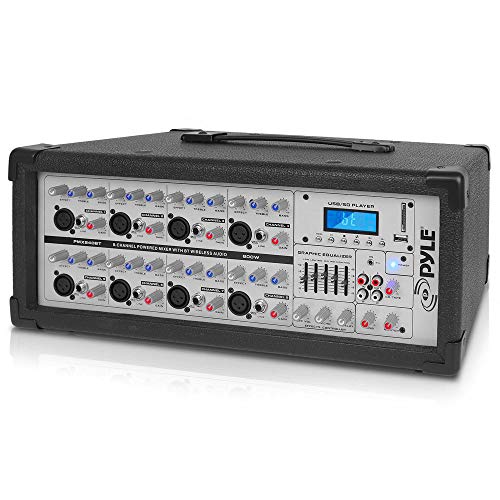
Pyle PMX840BT DJ Mixer — Best Budget for Rock Nights
Rock nights on a budget still need the music to start on time, and the PMX840BT’s proposition is consolidation: a DJ mixer whose verified listing includes a built-in USB-A MP3 and SD card player with a digital display, plus a built-in cooling fan for a unit that will work long sets in warm rooms. For a pub rig, a rehearsal-space setup or a starter mobile kit, that built-in player means a working source lives inside the mixer itself — the modern, solid-state echo of why CD consoles were loved.
Treat it as the hub of a simple rock setup: CD players or a laptop through its channels, the internal player as the always-ready backup and interval source, and a microphone for the hosting that rock functions demand. The fan is a small detail with real meaning in this context — bar rigs run for hours in imperfect ventilation, and thermal manners are reliability.
Budget honesty applies. This is an entry-tier unit: channel count, EQ finesse and build refinement sit below the working picks above it, and a high-volume professional should treat it as a starter or a spare rather than a flagship. For the money tier it occupies — check price on Amazon — it answers the rock-night brief of simple, self-contained and ready with unusual completeness.
Strengths
- Built-in USB/MP3/SD player: an always-ready source in the mixer (Amazon title)
- Built-in cooling fan for long sets (Amazon title)
- Consolidates a simple rock rig around one box
Trade-offs
- Entry-tier build and channel refinement
- Not a high-volume professional’s main mixer
- Digital display and features are basic
| Player | USB-A MP3 SD card player built in (Amazon title) |
| Cooling | Built-in cooling fan (Amazon title) |
| Model | PMX840BT (Amazon title) |
Best for: Budget pub, party and starter mobile rock rigs / Not suited for: Professionals needing refined channels and flagship build
Check the current price on Amazon for the Pyle PMX840BT DJ Mixer. You can also see the full listing here to confirm finish, dimensions and what is in the box before you order.
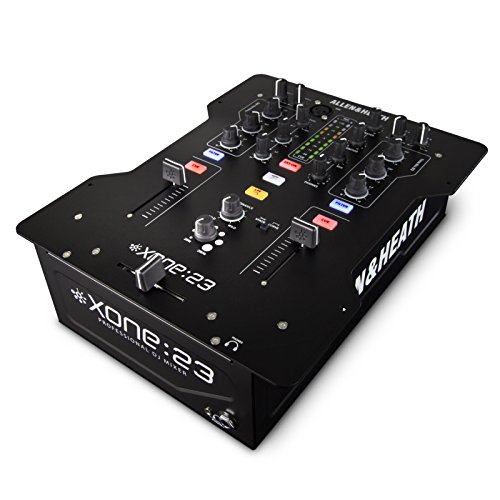
Allen & Heath Xone:23 2-Plus-2 Channel DJ Mixer — Best Sound Quality for Rock Playback
Rock is recorded music with dynamics — quiet verses, loud choruses, live recordings with room in them — and it exposes a mixer’s audio quality more honestly than compressed dance tracks do. The Xone:23 brings Allen & Heath’s live-console heritage to a compact 2-plus-2 channel DJ format, and it earns its badge on the oldest criterion in audio: it sounds right. For rock DJs playing good rooms — listening bars, brewery taprooms, quality mobile PAs — that fidelity is not audiophile vanity; it is the product the room is paying for.
The 2-plus-2 layout suits the rock rig’s shape: two full channels for the players, plus the extra inputs that absorb a backup source or a guest’s device without drama. The format is deliberately focused — this is a mixer’s mixer, with the channel quality prioritized over an effects carnival — and rock’s cut-and-crossfade technique asks for exactly that focus.
Its limits are the flagship features it omits: no sprawling effects engine, no four full channels for complex rigs, and a price class above the pure workhorses — check price on Amazon. Rock DJs whose rooms and ears justify it will not miss the carnival. Those running loud bars where nobody hears past the second chorus should save the difference and take the M6.
Strengths
- Live-console audio heritage in a DJ format
- 2-plus-2 channels fit players plus backup source
- Focused layout prioritizes channel quality over effects
Trade-offs
- Premium over pure workhorse picks
- No flagship effects depth
- Two full channels, not four
| Channels | 2-plus-2 channel DJ mixer (Amazon title) |
| Brand heritage | Allen & Heath live-sound line (Amazon title) |
Best for: Rock DJs in good-sounding rooms who prioritize fidelity / Not suited for: Loud-bar work where fidelity is inaudible overhead
Check the current price on Amazon for the Allen & Heath Xone:23 2-Plus-2 Channel DJ Mixer. You can also see the full listing here to confirm finish, dimensions and what is in the box before you order.

Pioneer DJ DJM-450 2-Channel DJ Mixer — Best for Rock DJs Who Blend
Not every rock set is a request jukebox. The rock DJ who builds a night — alternative club sets, indie dancefloors, genre-blending wedding hours — needs a mixer that blends: smooth channel EQ, usable effects for transitions, and a layout that rewards preparation. The DJM-450’s verified listing names its tools plainly: a 2-channel DJ mixer with Beat FX and DVS, built for rekordbox workflows. That combination makes it the blending pick of this guide.
Beat FX give rock transitions their glue — the echo-out that hands one chorus to the next intro, the filter sweep that lifts a segue out of the mud — and DVS support means a laptop library can join the CD rig without a second mixer. For the rock DJ whose library straddles discs and files, which is most working rock DJs now, that bridge is the difference between one rig and two.
Two channels remains two channels: the backup-and-mic sprawl of function work needs the M6’s generosity, and battle DJs should take the scratch specialists. Within its brief — the considered, blended rock set — the 450 is the most complete two-channel answer here.
Strengths
- Beat FX for glued transitions (Amazon title)
- DVS and rekordbox bridge discs and laptop library (Amazon title)
- Club-format layout in a compact two-channel box
Trade-offs
- Two channels limit function-work sprawl
- Not a battle mixer’s crossfader brief
- Effects depth below the four-channel flagship class
| Channels | 2-channel (Amazon title) |
| Effects | Beat FX (Amazon title) |
| Software | DVS, rekordbox (Amazon title) |
Best for: Rock DJs who blend and build sets / Not suited for: Function DJs needing four channels and mic-first workflow
Check the current price on Amazon for the Pioneer DJ DJM-450 2-Channel DJ Mixer. You can also see the full listing here to confirm finish, dimensions and what is in the box before you order.
Single CD/USB Player Decks (Numark NDX Format) — Best Player Format for Rock Rigs
Rock rigs are often built around single decks rather than flagship pairs, and the format exemplified by Numark’s NDX line is why: one affordable CD player per channel, each also reading USB media, giving a working DJ two independent sources that can be replaced one at a time when bar life takes its toll. In rock economics — where the rig is a cost center for a bar or a mobile DJ’s overhead — that replace-one-at-a-time logic beats the flagship pair’s all-or-nothing elegance.
The format suits rock’s handling reality too. Discs in rock service live in wallets, get requested by name, and arrive scuffed; a straightforward single transport with honest cue and pitch controls, plus USB for the tracks that now live as files, matches the night’s actual workflow better than a screen-rich flagship whose talents the set never calls on. Paired with the M6 above, two such decks make the canonical rock-bar rig of this guide.
This is a format pick in prose: the verification connection failed during this session, the cache holds no verified single-deck listing, and individual models in this class vary by generation.
Strengths
- One deck per channel; replace one at a time
- CD plus USB covers disc and file libraries
- Straightforward controls match request-driven nights
Trade-offs
- No verified purchase link in this guide (see review)
- Fewer performance features than flagship decks
- Models vary by generation; check the specific unit
Best for: Rock bars and mobile DJs building a serviceable two-deck rig / Not suited for: Performance DJs needing flagship deck features
This pick is covered without a link. We could not pin it to a listing we trust, so it carries no purchase link; treat it as a specification target to shop against rather than a linked recommendation.
Dual-CD Console Systems (Gemini CDM Format) — Best One-Case Console for Rock Functions
The rock function — weddings with a rock hour, birthdays, pub theme nights — is where the dual-CD console still earns its living. The format, exemplified by Gemini’s CDM line, puts two CD transports and a mixer in one case: arrive, open, power, play. For a DJ whose setup time is measured against a room being turned around, and whose night mixes hosting, requests and announcements with the music, that consolidation is a professional feature, not a compromise.
Consoles also match rock’s microphone reality: the format traditionally treats the mic as a first-class input, because function DJs talk. Combined with per-side players that keep the disc workflow tactile and independent of laptops, a console is the one-case answer to the exact night this article is about — which is why it closes the picks despite carrying no link.
Format-pick honesty applies as with the single decks: generations and current models vary, the API verification connection failed in this session, and no single listing is responsibly pinned here.
Strengths
- Fastest possible setup: one case, power, play
- Mic treated as a first-class input for hosting
- Independent disc workflow, no laptop required
Trade-offs
- No verified purchase link in this guide (see review)
- Less upgradeable than separate components
- Current models vary; verify the specific unit
Best for: Rock function and wedding DJs who value setup speed / Not suited for: Club DJs building a long-term component rig
This pick is covered without a link. We could not pin it to a listing we trust, so it carries no purchase link; treat it as a specification target to shop against rather than a linked recommendation.
Comparison Table
Rock-night essentials side by side: the linked mixers you can buy through verified listings today, and the player and console formats presented as prose targets. Shortlist by the job your night actually is — bar, function, listening room or blended set.
| Pick | Badge | Key spec | Best for |
|---|---|---|---|
| Numark M6 USB 4-Channel DJ Mixer | Best Overall for Rock Bars and Mobile Rigs | 4-channel, mic input, USB interface | Rock bars and mobile rigs |
| Pyle PMX840BT DJ Mixer | Best Budget for Rock Nights | Built-in media player mixer | Budget, self-contained rock setups |
| Allen & Heath Xone:23 2-Plus-2 Channel DJ Mixer | Best Sound Quality for Rock Playback | 2+2 channel, sound-first | Listening rooms and quality PAs |
| Pioneer DJ DJM-450 2-Channel DJ Mixer | Best for Rock DJs Who Blend | 2-channel, Beat FX, DVS | Blended rock and alternative sets |
| Single CD/USB Player Decks (Numark NDX Format) | Best Player Format for Rock Rigs | Single CD/USB deck format | The rock rig’s player half |
| Dual-CD Console Systems (Gemini CDM Format) | Best One-Case Console for Rock Functions | Dual-CD console format | One-case rock function work |
How to Choose the Best CD Mixers for Rock Nights?
Start with the room and the role, not the gear. A resident bar DJ needs the four-channel workhorse pattern: players, backup, microphone, all live at once, in a box that tolerates being house gear. A mobile function DJ needs setup speed and hosting tools, which points toward the console format or the M6 with single decks. A listening-room rock DJ needs the fidelity pick. A set-building alternative DJ needs the blending pick. The same word ‘rock’ covers four jobs; this guide’s badges exist so you buy for yours.
Then apply the rock discount to feature lists. Effects depth, pad banks and software ecosystems all depreciate fast in rock service, where the night is requests, announcements and choruses. Channel count, mic quality, fader replaceability and plain ruggedness appreciate. Spend in that order and a rock rig stays satisfying for years; spend in the marketing order and you will own an impressive mixer that is somehow always one input short.
- Name your night: bar, function, listening room or blended set
- Prioritize channels, mic and ruggedness over effects
- Keep a backup source cabled or instantly cableable
- Choose replaceable crossfaders for working gear
- Match player format to how your discs actually live
Why Does the Microphone Matter So Much for Rock DJs?
Because the rock DJ is half host. Announcements, dedications, request management, quiz crossovers, last-orders diplomacy — the microphone is in use all night, and a mixer that treats it as an afterthought makes the DJ sound like one. A proper mic input means level control that can be ridden while a track plays, EQ that keeps speech intelligible over a warming-up room, and a channel that does not steal a player’s input to exist.
Test any candidate rig the way the night will: play a loud chorus, talk over its tail, and ride the mic level without touching the music’s gain. If that move is graceful, the mixer understands rock work. If it requires a menu, a repatch or an apology, it was designed for a different genre’s night — however good its other numbers look.
How Do You Handle Requests and Discs Without Killing the Night?
Rock nights live on requests, and the rig should be arranged for them. Keep the request path physical and fast: the disc wallets or cases ordered the way your memory works, a phone or media source cabled into a spare channel for the track you do not own, and a notebook — paper survives what screens do not — for the queue building up at the booth. The four-channel picks in this guide exist because that spare channel is the difference between a request granted in one chorus and a repatching silence.
Disc handling is the other half of the craft. Handle by edges, return discs to their places immediately rather than stacking them on the mixer, and keep a microfiber cloth at the rig — a surprising share of ‘faulty player’ moments at rock nights are fingerprints on a borrowed disc. The format’s charm is its physicality; the discipline that physicality requires is part of the professional product.
What Should a Rock DJ Carry Beyond the Rig?
The rock DJ’s bag is a reliability kit disguised as clutter. A dependable dynamic microphone of your own — house mics have biographies you do not want to share — spare RCA and power leads, a torch for the back of racks and the bottom of cases, gaffer tape, and a cabled phone with an emergency set downloaded for the night the players both sulk. Add a small towel and the disc cloth, and you have covered the failures that actually happen at rock nights, as opposed to the ones brochures imagine.
Carry one more thing: a printed or written copy of the night’s key timings and the booker’s expectations. Rock functions run on human agreements — first dance, buffet, last orders, curfew — and the DJ who visibly knows them is the DJ who gets rebooked. Gear gets you heard; professionalism gets you hired again.
How Do You Build a Rock Set That Survives Requests?
A rock set is an argument between your plan and the room’s memory, and the professional structure accommodates both. Build the night in blocks you trust — the opening energy, the singalong spine, the late-night staples — with deliberate gaps where requests land without breaking the arc. A request that fits the current block goes in within a song or two, which feels like magic to the requester; one that belongs to a later block gets a promised home, and the promise gets kept, visibly. The rig supports this directly: the spare channel holds the request source, the notebook holds the queue, and the blocks hold because you are never repatching instead of listening.
The deeper skill is reading which requests are the room speaking and which are one person’s nostalgia wearing the room as a costume. Grant the room’s requests instantly and the night ignites; chase every individual one and the night fragments. Experienced rock DJs develop a courteous deflection — ‘that’s coming up in the rock-and-roll hour’ — that honors the requester while protecting the floor. It is hosting, again: the microphone and the manner matter as much as the mixer, which is why this guide keeps ranking them together.
What Volume and Sound Problems Define Rock Rooms?
Rock rooms are acoustically honest and rarely kind: hard surfaces, loud crowds, and PAs that range from excellent to archaeological. The DJ’s sound problems are predictable — harshness when gains are staged hot against compressed recordings, mud when bass-heavy rooms meet bass-heavy mastering, and speech that disappears under both when the microphone is an afterthought. The defenses are equally predictable and live in this guide’s setup steps: conservative gain staging with headroom, channel EQ used as a scalpel rather than a volume knob, and a microphone checked at performance volume from the back of the room.
The fidelity pick in this guide exists for the rooms that reward it, but the deeper truth is that most rock-room sound is won by restraint. A slightly quieter, clean set that the crowd can talk over between choruses will out-earn a louder, distorted one in rebookings every time. Rock audiences forgive many things; a headache is not among them, and the DJ who understands that owns the room’s trust by the second hour.
How Should a Rock DJ Organize a Disc Library That Still Works?
A working disc library is a retrieval system before it is a collection. Organize the way your memory works under pressure at 1 a.m. — most rock DJs land on some blend of era, energy and certainty: the guaranteed starters, the singalong certainties, the deep cuts that reward the right moment. Keep the night’s certain plays in a separate, small case that travels even when the full library stays home, because the twenty discs you will definitely play deserve better logistics than the two hundred you might.
Maintain the library like equipment. A disc that skips gets cleaned once, tested, and retired or replaced without sentimentality; a case that loses its order gets re-sorted the same week, not at the next gig’s sound-check. And keep the digital shadow honest: the phone source in the spare channel should mirror the library’s spine, so the backup is a real set and not a random shuffle. In rock DJing, the library is half the instrument — treat it with the same professionalism as the mixer and it will never embarrass you in public.
How Do You Price and Present Yourself as a Rock DJ?
The rig in this guide is a business tool for most of its readers, and its economics deserve one honest paragraph. Price the night, not the hour: preparation, transport, setup, the hosting the microphone implies and the library’s years of assembly are all in the product, and rock function clients are buying the certainty that their night is handled. Present the rig as part of that certainty — maintained, backed up, with the spare channel and the emergency set as quiet proof — and the conversation moves from cost to confidence, which is where good bookings live.
Reinvest in the order this guide’s logic suggests: reliability first (spares, service, the second source), library second (the requests you lacked are next month’s purchases), and glamour last, if at all. A rock DJ’s reputation is built in the gap between what could have gone wrong and what the room experienced. Spend to widen that gap and the rig pays for itself in the only currency that compounds — being asked back.
What Are the Classic Rock-Night Moments a Rig Must Survive?
Every rock DJ’s career contains the same scenes, and a prepared rig meets them all. The power flicker that restarts a player mid-chorus — survived by the backup source and a DJ who keeps talking. The request for the song that defines the bride’s father, owned by nobody in the building — survived by the phone in the spare channel and a library habit that downloads the night’s certainties in advance. The microphone borrowed, dropped and returned with its level changed — survived by carrying your own and checking it after every loan. The spilled drink migrating toward the rig — survived by placement, lids and the towel that lives at the station.
None of these moments is exotic, which is the point. Rock-night professionalism is not brilliance under rare pressure; it is the systematic removal of ordinary disasters, done in advance, at sound-check, with the unglamorous kit this guide keeps listing. Build the rig that survives the classic scenes and the music — the part you got into this for — gets to be the only unpredictable thing in the room.
A Final Word on Rock-Night Craft
Rock DJing is a hospitality craft played through a sound system. The rig matters — this guide has spent thousands of words on exactly how — but it matters as the servant of a room full of people who came to hear the songs of their lives played loudly, in the right order, by someone who visibly cares that they have a good night. Choose the mixer that lets you be that person without fighting your equipment, and the gear question is answered for years.
How to Set Up a CD Rig for a Rock Night
A rock night setup is a rehearsal for everything the evening will throw at you: requests, announcements, a backup moment and a loud room. Set up in this order, test the microphone over music before doors, and the night starts with its problems already solved.
- Position the rig where you can see the room and the room can reach you — rock DJing is a contact sport, and the booth is a service point.
- Connect players to their channels, the backup phone or media source to a spare channel, and your own microphone to the mic input.
- Stage gains with the loudest rock track you will play, leaving headroom for the choruses and the crowd noise to come.
- Test the microphone over a playing track: ride its level, check intelligibility at the back of the room, and set its EQ for speech.
- Arrange discs or media in the order your memory expects, with the night’s certain plays — first dance, staples, closer — pulled and ready.
- Rehearse the backup switch once: kill a player, bring the spare source up, and confirm the room never hears silence.
- Tape down cable runs anywhere feet will travel, and place your notebook and pen where requests will actually be written.
At the end of the night, resist the fast pack-down. Return every disc to its place while the room empties, coil your own cables rather than inheriting the house tangle, and note what the room asked for that you did not have — that list is next month’s crate-digging and the cheapest audience research in the business. Rock rigs reward the DJ who treats teardown as part of the show.
Common Buying Mistakes
Rock-night mistakes are rarely about taste; they are about inputs, microphones and preparation. These are the ones that turn a good room cold.
Buying a two-channel mixer for function work. Requests, backups and house feeds need channels. Four-channel generosity is the rock function’s core feature, not a luxury.
Trusting the house microphone. House mics are the most abused objects in any venue. Carry your own dynamic mic and know its level before doors.
No cabled backup source. The night a player fails with nothing in the spare channel is the night you learn why it exists. Cable the phone; rehearse the switch.
Stacking loose discs on the gear. Discs on mixers get scratched, lost and sat on. Every disc returns to its place immediately — the discipline is the format.
Sound-checking in silence. Rock rooms are loud. Set gains and mic levels against realistic playback volume, or the first hour will do it for you, badly.
Forgetting the night is hosted. Announcements and timing are part of the product. Know the running order, and let the rig — mic ready, timings noted — support it.
Final Recommendation
For most rock nights, the rig to build is the Numark M6 at the center — four channels, a proper mic input, a working crossfader — with single CD decks of the NDX format at its sides and a phone cabled into the spare channel. Listening-room DJs should step up to the Xone:23’s fidelity; set-builders to the DJM-450’s blending tools; budget and starter rigs to the Pyle’s self-contained value; and function DJs who prize setup speed above all should seriously consider the dual-CD console format before buying components.
For the wider category, see Best Cd Mixers and the related guides below.
If you want the short version: start with Numark M6 USB 4-Channel DJ Mixer, Pyle PMX840BT DJ Mixer, Allen & Heath Xone:23 2-Plus-2 Channel DJ Mixer. Each is one click away from its live listing, where you can check price on Amazon and confirm the exact configuration.
Best Cd Mixers Best Cd Mixers For Djs Best Cdj Mixers Best Compact Audio Mixers Best Concert Sound Mixers
Frequently Asked Questions
What makes a mixer good for rock specifically?
Input generosity, a proper microphone channel, a replaceable crossfader suited to cut-and-fade mixing, and rugged simplicity. Rock nights reward hosting and requests handling over effects depth, which is why this guide’s badges rank those qualities first.
Do rock DJs still use CDs?
Many do — rock libraries were built on disc, and bar and function rigs still run CD players and consoles, increasingly alongside USB media and a phone for requests. This guide’s rigs assume that mixed reality rather than a purist one.
Is a dual-CD console still worth buying?
For function work where setup speed and one-case transport matter, yes — the format remains the fastest way to be playing after arrival. DJs building toward clubs or performance should invest in separate components instead.
How many channels does a rock function DJ need?
Four is the comfortable number: two players, a backup or request source, and freedom for the house feed, with the microphone on its own input. Two-channel rigs work for focused sets but leave no room for the night’s surprises.
Why are the player picks unlinked in this guide?
Their listings could not be verified during this session — Amazon listing data connection failed repeatedly — and this program never links an unverified model.
Why are no prices printed?
Rock rigs are bought in configurations — cases, microphones, spare players — that make a single printed price misleading. Each linked pick leads to its verified live listing, where you can check price on Amazon for the exact setup.
What is the single best upgrade for an existing rock rig?
A cabled, rehearsed backup source, if you do not have one — it converts the commonest disaster into a shrug. After that, your own microphone, then a four-channel mixer if inputs are your nightly constraint. Glamour upgrades come last in rock economics, because the room cannot hear them over a great chorus.
What should a rock DJ do in the first ten minutes of the night?
Arrive musically before you arrive socially: open with energy the room recognizes, establish that requests are welcome and heard, and use the first microphone moment early, briefly and warmly, so the room learns your voice while it is still deciding what kind of night this is. The rig was sound-checked for exactly this — gains honest, mic ready, backup cabled — so the first ten minutes can be spent on people, which is where rock nights are actually won.


