Disclosure: airfryerkitchensupply.com is reader-supported. When you buy through links on our site, we may earn an affiliate commission at no extra cost to you.
Where to buy
The fastest way to compare the best concert sound mixers in this guide is on Amazon, where most of the models below are sold by the brands themselves or by authorized kitchen and audio retailers. Prices and stock move around, especially on seasonal colors and bundle configurations, so every pick here is listed with a live price check rather than a fixed number.
Confirm the exact channel configuration on the listing: mixer model names count total inputs, not microphone preamps, and several families below span four sizes that look identical in photos.
- Yamaha MG16XU (Best Overall) — check price on Amazon
- Mackie ProFX16v3 (Best for Recording the Show) — check price on Amazon
- Allen & Heath ZED-16FX (Best Sound Quality) — check price on Amazon
- Soundcraft EFX12 (Best Effects and Simplicity) — check price on Amazon
- Allen & Heath ZED-24 (Best for Larger Bands) — check price on Amazon
- Behringer XENYX QX1204USB (Best Budget for Small Venues) — check price on Amazon
The best concert sound mixers are the ones that survive the life: loaded in and out of venues, run by tired hands in the dark, and expected to make a loud band sound clear in rooms that were never designed for music. A concert mixer is not a studio desk and not a DJ controller — it is a working tool judged on microphone preamps that stay clean at high gain, EQ that fixes problems fast, enough monitor sends for the stage, and faders that still feel right after five hundred shows.
This guide focuses on the mixers that cover the real concert circuit most readers play: clubs, churches with serious music programs, regional touring bands, wedding and event bands, and small festivals. That means analog and hybrid boards in the 12-to-24-input class — big enough for a full band with drums, small enough for one person to carry and run. Stadium consoles exist in another price universe and are honestly another profession.
Channel counts need translating before anything else, because marketing counts every hole in the surface. A “16-channel” concert mixer typically offers eight or ten microphone preamps, with the remaining channels arriving as stereo line inputs for keyboards and playback. For a band, microphone preamps are the currency that matters — drums alone can spend six to eight of them — and every review below states the mic-preamp reality alongside the headline number.
A note on who runs these boards: in this class, the engineer is often a band member, a venue staffer, or a volunteer, not a touring professional. That reality shaped every choice below. Surfaces are judged on whether a competent non-specialist can learn them in an afternoon and operate them under pressure, because a mixer that only reveals its quality to experts is the wrong mixer for most of the rooms where concerts actually happen.
Effects, USB recording, and wireless control all appear in this list, but they rank below the fundamentals. A concert mixer earns its place by sounding clean when pushed, being fixable mid-show by feel, and never, ever being the reason the show stops.
In this guide
Quick Picks
If you are short on time, these are the six best concert sound mixers worth your attention first. Each one carries a badge for the job it does best, and the same badge follows it into the detailed review further down the page.
- Yamaha MG16XU — Best Overall. Ten D-PRE mic preamps, one-knob compressors on key channels, SPX effects, and USB — the club-and-church workhorse that simply never embarrasses anyone. Check price on Amazon.
- Mackie ProFX16v3 — Best for Recording the Show. Onyx preamps, GigFX effects, and USB recording that captures the stereo mix — the concert board for bands who tape every gig. Check price on Amazon.
- Allen & Heath ZED-16FX — Best Sound Quality. DuoPre preamps, the famously musical ZED EQ, and quality onboard effects — the analog board engineers pick when tone is the argument. Check price on Amazon.
- Soundcraft EFX12 — Best Effects and Simplicity. Lexicon reverbs onboard, GB30 preamps, and a surface a volunteer can learn in an afternoon — the friendly face of concert mixing. Check price on Amazon.
- Allen & Heath ZED-24 — Best for Larger Bands. Sixteen DuoPre mic preamps and 24 inputs of ZED quality — the analog step-up when the band, the choir, or the festival stage outgrows 16 channels. Check price on Amazon.
- Behringer XENYX QX1204USB — Best Budget for Small Venues. Four XENYX preamps, one-knob compressors, KLARK TEKNIK effects, and USB at a budget tier — the honest starter board for small-room shows. Check price on Amazon.
How These Picks Were Chosen
Every pick was verified against live Amazon catalog data, so model names and configurations match current listings. We required at least eight true microphone preamps (or a clear small-venue exception), per-channel EQ with a swept midrange or better, at least two pre-fader monitor sends, and a build intended for transport rather than a studio shelf.
We weighted preamp headroom and noise first — concert gain staging is unforgiving — then monitor-send count, because stage mixes are where amateur boards run out of road, then the speed of the surface: can you grab the right fader, mute, or EQ band in the dark, mid-song, without looking? USB recording and onboard effects scored as bonuses, valuable for rehearsals and live captures but never a substitute for the core job.
Excluded: DJ mixers, powered box mixers for rehearsal rooms (covered by the powered-mixer coverage in this cluster’s research), and large-format digital consoles whose price and learning curve belong to professional touring. What remains are the boards working sound engineers actually recommend to bands.
The 6 Best Concert Sound Mixers

Yamaha MG16XU — Best Overall
The MG16XU is the default recommendation in this class because it gets the fundamentals right in the order engineers care about. Yamaha’s D-PRE preamps are clean and quiet with enough headroom for loud stages, the one-knob compressors tame vocalists and bass with a single intuitive control, and the SPX effects bank provides reverbs and delays that sit naturally in a live mix. Ten microphone preamps cover a full band with drums; two aux sends handle stage monitors, with more routing available for effects and groups.
Strengths
- Clean, high-headroom D-PRE preamps
- One-knob compressors and quality SPX effects
- Rugged metal chassis with a logical, fast surface
Trade-offs
- Analog — no scene recall or saving mixes
- Two aux sends limit separate monitor mixes
- No multitrack USB recording
| Mic preamps | 10 (D-PRE) |
| Total inputs | 16 |
| Extras | SPX effects, one-knob compressors, USB audio |
The surface is built for the dark: clear channel layout, positive-feeling faders, and metal chassis construction that tolerates life in a gig bag or rack. USB audio makes rehearsal recording and between-set playback trivial. Nothing about the MG16XU is exotic, and that is precisely its virtue at a show — every control is where a working engineer expects it to be.
Its limits are the analog format itself: no scene recall, no per-channel everything, and monitor mixes limited by its aux count for bands wanting four or more separate stage mixes. Within the analog club class it remains the board to beat, at a mid tier — check the current price on Amazon.
Best for: Clubs, churches, and gigging bands wanting a dependable analog board / Not suited for: Bands needing four-plus monitor mixes or scene recall
Check the current price on Amazon
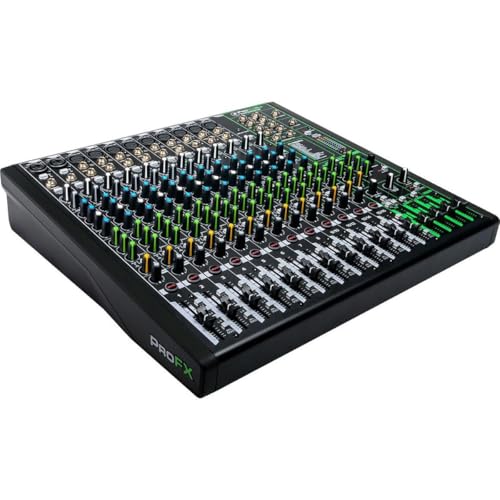
Mackie ProFX16v3 — Best for Recording the Show
Mackie built the ProFXv3 series for the band that records itself, and the 16-channel model is the concert-sized version: Onyx microphone preamps with generous headroom, a GigFX engine with reverbs, delays, and chorus that are genuinely gig-usable, and USB connectivity that records the main mix to a laptop while feeding playback back between sets. For bands building a live archive or reviewing performances, that capture workflow is the reason to buy this board over rivals.
Strengths
- Onyx preamps with strong headroom
- USB recording of the live mix plus playback return
- GigFX effects and subgroup routing
Trade-offs
- Stereo USB only — no multitrack
- No scene memory
- Monitor mixes limited for large bands
| Mic preamps | 10 (Onyx) |
| Total inputs | 16 |
| Extras | GigFX engine, USB record/playback, subgroups |
The analog core is honest Mackie: clear EQ, subgroup routing for organizing drums or backing vocals, and a steel chassis with the company’s built-like-a-tank reputation earned over decades of exactly this use. Ten microphone inputs handle a full band, and the aux structure covers typical two-mix stage monitoring with an effects send to spare.
Like the Yamaha, it is an analog board: no recall, no digital stage box, monitor mixes counted in twos rather than fours. Its effects and USB are stereo-mix tools, not multitrack production. Judge it as a rugged concert mixer that also tapes the show, at a mid tier, and it is excellent — check price on Amazon.
Best for: Gigging bands who record every show for review and content / Not suited for: Multitrack recording or complex monitor worlds
Check the current price on Amazon

Allen & Heath ZED-16FX — Best Sound Quality
Allen & Heath’s ZED series has a reputation among live engineers that borders on folklore, and the ZED-16FX shows why. The DuoPre preamps are clean with a character engineers describe as forgiving — loud sources stay composed — and the EQ section is the best in this guide: the swept midrange finds and fixes problem frequencies in a live room faster and more musically than rivals’ fixed bands. On vocals and acoustic instruments especially, the ZED simply sounds like more money.
Strengths
- Best-in-guide EQ with swept mids
- DuoPre preamps with composed, musical character
- Four aux sends for better monitor flexibility
Trade-offs
- Upper price tier for an analog board
- No multitrack recording
- No scene recall
| Mic preamps | 10 (DuoPre) |
| Total inputs | 16 |
| Extras | Onboard FX with tap tempo, 4 aux, USB |
The onboard effects are a curated set of reverbs, delays, and modulation drawn from the company’s larger consoles, with tap tempo and sensible defaults. USB carries audio to and from a computer for recording and playback. Ten microphone inputs, four auxes (giving it a monitor-mix edge over the Yamaha and Mackie here), and a solid, repairable build complete the picture.
The trade-offs are price tier and modernity: it sits above the mid-tier boards, offers no multitrack and no recall, and its USB is a stereo utility rather than a recording system. Buy it when the sound itself is the priority — many engineers do, happily. Check the current price on Amazon.
Best for: Engineers and bands who prioritize tone above features / Not suited for: Feature-maximalists or multitrack recordists
Check the current price on Amazon

Soundcraft EFX12 — Best Effects and Simplicity
The EFX12 earns its place on one feature done properly: a Lexicon effects engine. Lexicon reverbs are the sound of decades of live and recorded music, and having a well-implemented set — with storable user settings and tap-controlled delays — inside a straightforward analog board is a genuine differentiator for vocal-forward acts. The rest of the board follows Soundcraft’s GB30 preamp design: clean, quiet, and unfussy.
Strengths
- Genuine Lexicon effects engine
- Clean GB30 preamps
- Approachable surface for volunteer engineers
Trade-offs
- Eight mic preamps cap band size
- Limited monitor routing
- No USB recording
| Mic preamps | 8 (GB30) |
| Total inputs | 12 |
| Extras | Lexicon FX engine, tap delay |
Eight microphone preamps size it for smaller concert work: acoustic acts, jazz and folk ensembles, worship bands, club rock with economical drum miking, and speaking-plus-music events. The surface is famously approachable, which matters in the venues this board serves, where the engineer may also be the drummer’s cousin. A configurable aux and monitor routing cover the typical one-or-two-mix stage.
Bands with big drum kits or four separate monitor mixes will outgrow it; that is what the bigger boards above are for. As a 12-input concert mixer with best-in-class reverbs at a mid tier, it remains a deeply sensible buy — check price on Amazon.
Best for: Smaller ensembles and venues wanting superb reverbs and simplicity / Not suited for: Big drum kits or monitor-heavy stages
Check the current price on Amazon

Allen & Heath ZED-24 — Best for Larger Bands
The ZED-24 is the answer when the input list stops fitting on the boards above: sixteen true microphone preamps take a fully miked drum kit, a full backline, multiple vocalists, and guests without borrowing channels from the stereo inputs. It keeps the family virtues — DuoPre preamps, musical EQ with swept mids, four aux sends, USB for stereo recording and playback — and scales them to small-festival and large-church duty.
Strengths
- 16 real mic preamps for full bands
- Four aux sends and ZED EQ quality
- Walk-up-and-mix analog simplicity at scale
Trade-offs
- No onboard effects engine
- Large and heavy for one-person load-ins
- Upper price tier
| Mic preamps | 16 (DuoPre) |
| Total inputs | 24 |
| Extras | 4 aux, USB stereo audio |
For event bands and production companies, the value is headroom in every sense: spare channels for the walk-on guest, the extra keyboard, the choir mics at Christmas. Analog simplicity remains — any competent engineer can walk up to it cold and mix a show — and the build is the same serviceable, roadworthy standard as its smaller sibling.
It is a bigger, heavier, upper-tier board with no effects engine (external or computer effects join via USB and inserts) and no digital recall. Buy it when channel count is your binding constraint and analog workflow is your preference. Check the current price on Amazon.
Best for: Large bands, festivals, and big worship teams / Not suited for: Small acts or engineers wanting built-in FX
Check the current price on Amazon

Behringer XENYX QX1204USB — Best Budget for Small Venues
Not every concert is a band with a drum kit. Acoustic duos, singer-songwriters, comedy-and-music nights, school and community events, and café residencies need a small board that sounds respectable, sets up in minutes, and costs what a working musician can actually pay. The QX1204USB is that board: four XENYX microphone preamps with one-knob compressors on the mic channels, a KLARK TEKNIK effects engine, and USB for recording the night or playing backing tracks.
Strengths
- Very affordable with compressors and effects included
- USB recording and playback
- Compact enough for a shoulder-bag rig
Trade-offs
- Only 4 mic preamps
- Not built for full-band drum miking
- Light-duty construction versus pro boards
| Mic preamps | 4 (XENYX) |
| Total inputs | 12 |
| Extras | KLARK TEKNIK FX, one-knob compressors, USB |
Expectations should be set by its size: four mic preamps means a duo with two vocal mics and instruments, or a small ensemble with disciplined miking. Within that brief it performs honorably — the compressors genuinely help amateur vocalists, the effects are usable, and the whole rig fits in a shoulder bag.
It is included here as the budget, small-venue exception to this guide’s eight-preamp rule, and it should be bought as exactly that. Bands will outgrow it; solo and duo acts may never need more. At its budget tier — check price on Amazon — it is the rational first concert mixer for small rooms.
Best for: Solo and duo acts, cafés, schools, and community events / Not suited for: Full bands or multi-mix monitor setups
Check the current price on Amazon
Comparison Table
| Pick | Badge | Key spec | Best for |
|---|---|---|---|
| Yamaha MG16XU | Best Overall | 10 mic preamps, SPX FX, USB | Clubs, churches, and gigging bands wanting a dependable analog board |
| Mackie ProFX16v3 | Best for Recording the Show | 10 Onyx preamps, USB recording | Gigging bands who record every show for review and content |
| Allen & Heath ZED-16FX | Best Sound Quality | 10 DuoPre preamps, swept-mid EQ | Engineers and bands who prioritize tone above features |
| Soundcraft EFX12 | Best Effects and Simplicity | 8 preamps, Lexicon reverbs | Smaller ensembles and venues wanting superb reverbs and simplicity |
| Allen & Heath ZED-24 | Best for Larger Bands | 16 mic preamps, 24 inputs | Large bands, festivals, and big worship teams |
| Behringer XENYX QX1204USB | Best Budget for Small Venues | 4 preamps, FX, USB, budget tier | Solo and duo acts, cafés, schools, and community events |
Preamp count is the column to read first. The jump from 8 to 10 preamps is the jump from “acoustic and small bands” to “full band with drums”; the jump to 16 is festival and large-team territory. Effects and USB differ, but no feature compensates for running out of microphone inputs at soundcheck.
How to Choose a Concert Mixer: Count Preamps, Not Channels
Write your band’s input list before you shop, in the order the stage demands it: kick, snare, toms, overheads, bass, guitars, keys, playback, and every vocal. A five-piece rock band with a fully miked kit typically lands between 12 and 16 inputs, of which 10 to 12 are microphones. That arithmetic is why the 16-input boards with 10 preamps anchor this guide, why the 8-preamp EFX12 suits smaller ensembles, and why the 4-preamp Behringer is honestly labeled a small-venue board.
Then count monitor mixes, the second budget beginners forget. Each distinct “I need more of me” on stage is a mix, and each mix spends an aux send. A singer with wedges, a drummer on in-ears, and a band mix is three. The four-aux Allen & Heath boards cover that world; two-aux boards cover a shared stage mix and an effects send. In-ear systems do not reduce the count — they increase the expectation of personal mixes — so bands moving to in-ears should count auxes before they count channels.
Finally, decide analog versus digital with clear eyes. Every pick here is analog or analog-with-USB because this guide optimizes for walk-up usability, repairability, and price. Digital consoles add scene recall, per-channel processing, wireless control, and multitrack — genuinely valuable, at higher cost and with a learning curve and a boot-up time. If your show is the same every night and you are the only engineer, analog speed is a feature. If different engineers run the same venue weekly, recall becomes one. Both answers are professional; the mistake is buying either by fashion.
What Do the Effects in a Concert Mixer Actually Need to Do?
Live effects have one job: put space around voices and instruments so the audience hears a performance rather than a rehearsal. In practice that means two reverbs (a short, bright plate or room for presence and a longer hall for ballads), a tempo-matched delay for vocals, and the discipline to use less of all of them than instinct suggests. The boards here implement this well — Yamaha’s SPX and Soundcraft’s Lexicon engines are industry dialects, and Mackie’s GigFX and Behringer’s KLARK TEKNIK sets cover the same ground at their tiers.
Judge an onboard effects section by three things: whether the reverbs sound smooth rather than metallic at gig volumes, whether delay time can be tapped to the song’s tempo, and whether effects can be muted between songs from the surface — the footswitch or mute that stops your stage banter from echoing like a cave announcement. Parameter depth matters far less live than in a studio; a great preset you can reach in two seconds beats a perfect algorithm buried in a menu.
One structural note: a mixer with a dedicated effects send per channel lets each source take a different amount of reverb — dry drums, wetter lead vocal — which is how professional mixes are built. Boards that only offer effects as a master insert force one wetness on everything. All the mid-and-up picks in this guide route effects properly per channel; it is one of the quiet lines between concert boards and rehearsal-room boxes.
How Loud Is Too Loud for Your Mixer? Headroom Explained Simply
Headroom is the distance between your normal operating level and the point where the mixer starts distorting, and concert sound lives or dies by it. A board run near its ceiling sounds harsh and fatiguing even before it audibly clips, because transients — kick drum hits, vocal peaks, snare cracks — keep slamming into the limit. The preamps in this guide were chosen partly for their composure when pushed: the D-PRE, Onyx, DuoPre, and GB30 designs all tolerate hot sources gracefully, which is a large part of why professional ears prefer them.
You manage headroom with gain staging: set each channel’s input gain so its loudest moment peaks healthily below the red, keep the channel faders near their unity region rather than at the bottom with gains cranked, and let the master fader do the final level. The one-knob compressors on the Yamaha, Mackie, and Behringer boards exist precisely to buy headroom back from unpredictable sources — a vocalist who finds another ten decibels when the chorus lands.
A practical soundcheck ritual protects all of this: have the band play its loudest chorus, not its quietest verse, while you set gains. Soundchecks done at polite volumes produce shows that clip from the first chorus onward. Two minutes of full-volume honesty at 4 p.m. is worth more than any feature on any mixer in this guide.
Running Monitors from a Small Concert Board
Monitor mixing is where small-venue shows are won and lost, because musicians play to what they hear. The governing rule is pre-fader sends: monitor feeds must not change when you adjust the house mix, which is why this guide required pre-fader-capable auxes. Set monitor levels during soundcheck with the house off or low, walk the stage if you can, and make one change at a time — “more guitar in wedge two” is a sentence; three simultaneous requests is chaos.
Feedback control is gain discipline plus geography. Keep vocal microphones behind the main speakers, point wedges at ears rather than at microphone capsules, and ring out the system — raise each monitor mix slowly until it just feeds back, note the frequency region, cut it slightly on the EQ, and repeat once. The swept-mid EQ on the Allen & Heath boards is a genuine weapon here; on simpler boards, the channel EQ and modest levels do the job.
If the band is transitioning to in-ears, a small board’s aux count becomes the hard limit on personal mixes. Shared mixes (rhythm section together, vocalists together) are the standard compromise, and they work better than proud engineers expect — especially when the alternative is a shared wedge world nobody liked either.
How to Set Up a Concert Mixer from Load-In to First Song
This sequence assumes a band, a small venue, and one of the boards in this guide. It is ordered so that any interruption still leaves you closer to a working show.
- Position and power. Place the mixer where the engineer can hear what the audience hears — out front if the snake allows, side-stage if it must be. Power the mixer before the amplifiers and speakers; power speakers down first at the end of the night. This order prevents the pops that damage drivers.
- Run the snake and connect the stage. Stage box at the drum riser or center stage; microphones and DIs into their planned channels, returns to monitor wedges and main speakers. Keep power cables and audio cables from running parallel in long bundles to avoid hum.
- Zero the board. Gains down, faders down, EQ flat, effects returns down, phantom power off except on condenser channels. Every show starts from a known state, not from wherever the last engineer left things.
- Line-check and set gains channel by channel. Drums first, then bass, guitars, keys, playback, vocals last so they are freshest in your ears. Each source plays its loudest part; set gain for healthy peaks below clipping.
- Build the house mix. Bring up drums to a solid foundation, add bass, then instruments, then vocals clearly on top. Pan sparingly — most small rooms are effectively mono for most of the audience.
- Add effects. A short reverb on vocals and snare, delay tapped to tempo if the song wants it, effects muted between songs. Less than your instinct says.
- Set monitors pre-fader, one mix at a time, ringing out feedback as described in the monitor section, and mark positions when the band is happy.
- Play the full band at full volume for one chorus, walk the room, make final adjustments, start the USB recording, and only then open the doors.
Tape a setlist-ordered note of any per-song changes — a muted channel, a delay for one ballad — to the mixer. Mid-show, memory is the first casualty; the note is the show’s insurance policy.
Analog Boards in a Digital Decade: What You Give Up and What You Keep
Choosing analog in this decade is a deliberate trade, and this guide makes it openly. You give up: scene recall between bands or services, per-channel gates and fully parametric EQ, wireless mixing from the back of the room, integrated multitrack recording, and digital stage boxes that replace the heavy copper snake. For festivals with four changeovers, or venues with rotating engineers, those are not luxuries — they are the job, and a digital console is the right purchase even at several times the price.
What you keep is equally real: zero boot time, a control for every function visible at a glance, graceful behavior when something goes wrong (an analog board fails one channel, not one operating system), repairability by any competent technician, and a price that leaves budget for microphones, which improve a show more than console features do. Analog boards also teach mixing faster — every beginner who learns gain, EQ, and sends on a surface like these can walk up to any console on earth and orient themselves.
The picks here hedge the trade sensibly: USB for stereo capture and playback, quality onboard effects, and monitor structures that cover the majority of real club and church work. If your show outgrows them, it will be because your production genuinely grew — the happiest reason to upgrade in all of audio.
The Snake, the Stage Box, and Other Unglamorous Essentials
A concert mixer is only as usable as its cabling. For most bands in this class, the mixer lives at front-of-house or side-stage and connects to the stage through a snake — a multicore cable with a stage box. Budget for it as part of the mixer purchase, with at least as many returns (lines back to the stage for monitors and mains) as your monitor plan needs. A board with four auxes and a snake with two returns is a board with two usable monitor mixes, whatever the spec sheet says.
Label everything. Channel lists taped to the mixer, cables numbered at both ends, and a one-page stage plot turn a stressful changeover into a routine. The boards in this guide reward this discipline because their surfaces are consistent — the same input list lands on the same channels every night, and muscle memory builds fast.
Finally, protect the investment physically: a padded case or rack for transport, strain relief on every cable, and a spare for the one cable whose failure ends shows (the main output pair). Concert gear dies from transport and connectors far more often than from electronics; the unglamorous budget lines are what keep a good mixer good.
Soundcheck Routine for a Band Running Its Own Mixer
Most readers of this guide will run their own sound at least some of the time, so here is the routine that makes a self-mixed show work. Line-check every input first — signal present, no buzzes, phantom power only where condensers need it. Set gains with the loudest material. Build the house mix drums-first at moderate volume, then vocals on top, because the vocal is the product the audience came for. Set monitors last, one mix at a time, with the house muted, and mark every fader and knob position with tape or a photo when it sounds right.
During the show, the self-mixing musician’s rule is restraint: fix problems (feedback, a buried vocal, a runaway keyboard) and leave preferences alone. One trusted pair of ears in the audience with a pre-agreed set of hand signals is worth more than any mid-show knob expedition. Record the stereo mix from the USB output — the Mackie and Yamaha picks make this trivial — and review it during the week; self-mixed bands improve fastest by listening to what the room actually heard.
Wireless Control and Digital Stage Boxes: When to Step Beyond This Guide
Two technologies tempt every analog buyer, and both deserve a fair hearing. Wireless tablet control — mixing monitors from the stage, adjusting the house from the back row — is transformative for the solo engineer-musician, and it is the native language of rack digital mixers like the stage-box units covered in the conference guide in this cluster. If you routinely mix your own band from onstage, that workflow may be worth more than any surface feature in this guide.
Digital stage boxes similarly replace the heavy copper snake with a single network cable and put the preamps on stage where they belong. The cost is the console ecosystem itself: apps, firmware, boot times, and a different failure profile. Neither technology makes the analog boards here obsolete — club engineers still choose surfaces like the ZED and MG for their immediacy — but a buyer whose show depends on remote control or instant recall should buy the digital tool deliberately rather than bolting hope onto an analog purchase.
The honest summary: this guide’s boards are the right answer for the majority of club, church, and event work being done today. The moment your production meetings start using the words “scenes,” “changeover,” and “personal mixes for nine,” you have outgrown the category, and you should be pleased — that is growth, not a buying mistake.
Common Buying Mistakes
Counting channels instead of preamps. A “16-channel” board with 8 mic preamps cannot mic a 10-microphone band. Count XLR inputs against your input list before anything else.
Forgetting monitor mixes in the budget. Aux sends, returns on the snake, and wedges or in-ear systems are part of the mixer purchase. A great board with one monitor mix is a one-mix show.
Soundchecking quietly. Gains set on polite playing clip on the first loud chorus. Always set levels with the band’s loudest material.
Drowning the mix in reverb. Live rooms already add space. Onboard effects should be felt more than heard; if the audience can name the effect, there is probably too much of it.
Running the master at maximum and channels at minimum. That inverts healthy gain structure and buries the mix in noise. Keep channel faders near unity and let the master sit in its normal range.
Leaving the mixer where the last band left it. Inherited knob positions are someone else’s show. Zero the board at every load-in — gains down, EQ flat, effects returns down — so the first sound of the night is a state you chose, not a surprise you inherited. Two minutes of discipline prevents the loudest category of soundcheck accident.
No recording of the show. The USB-equipped boards here capture the stereo mix for free. Bands that review their shows improve; bands that guess, repeat. Skipping the recording is skipping the cheapest coaching available.
Final Recommendation
The Yamaha MG16XU is the concert mixer we recommend first for most bands and venues: clean preamps, forgiving compressors, proper effects, and a surface that never gets in the way of the show. Engineers who mix with their ears first should look at the Allen & Heath ZED-16FX for its EQ and preamp character, and bands that outgrow 16 inputs should step straight to the ZED-24 rather than compromising.
The Mackie ProFX16v3 is the pick for bands who record every night, the Soundcraft EFX12 brings Lexicon reverbs and simplicity to smaller ensembles, and the Behringer QX1204USB covers solo and duo work at a budget tier with its limits clearly understood. Count your preamps and your monitor mixes honestly, measure your room and your stage with the same honesty, and the right board from this list will serve you faithfully for years of shows in rooms of every size and shape, season after season, show after show, without ever once being the reason the music ever stopped early on any night.
Ready to buy? Start with Yamaha MG16XU, Mackie ProFX16v3, Allen & Heath ZED-16FX — check the current price on Amazon for each and confirm the exact color and configuration on the listing before you order.
Keep exploring the rest of this cluster: Best 16 Channel Mixers Best 12 Channel Mixers Best Conference Room Sound Mixers Best Powered Mixers Best Mixers For Live Sound
Frequently Asked Questions
How many channels do I need for a live band?
List every source, then add two spares. A typical five-piece with fully miked drums lands at 12–16 inputs with 10–12 microphone preamps. Acoustic and folk acts can live happily on 8 preamps; festival and large worship rigs should start at 16 preamps. Spare channels are not waste — they are where the guest vocalist and the extra keyboard go.
Is an analog mixer still a good buy for concerts?
Yes, for clubs, churches, and self-run bands: instant-on, walk-up usability, repairability, and price that leaves budget for microphones. Digital consoles win when you need scene recall, many monitor mixes, wireless control, or multitrack recording. The format question is about your show’s structure, not about which decade it is.
What is the difference between aux sends and monitor mixes?
An aux send is a separate blend of channels sent somewhere else — a stage wedge, an in-ear system, or an effects unit. Each monitor mix a musician hears consumes one aux. Pre-fader auxes are essential for monitors so house adjustments do not change what the band hears.
Can I record concerts with these mixers?
The Yamaha, Mackie, and Allen & Heath boards record the stereo main mix over USB — perfect for review, content, and live albums with modest ambitions. True multitrack recording, where every channel is captured separately for later mixing, requires a digital console or interface system beyond this guide’s analog scope.
Do I need a separate effects unit?
For most club and church work, no: the onboard SPX, Lexicon, GigFX, and KLARK TEKNIK engines cover reverbs and delays properly, routed per channel. External effects still have a place in larger rigs, but at this scale the money almost always improves the show more when spent on microphones.
Should the mixer live at front-of-house or on stage?
Front-of-house, whenever the snake and venue allow: the engineer must hear what the audience hears, and no monitor position on stage provides that. Side-stage mixing is the workable compromise for self-run bands, especially with one trusted listener out front giving simple signals. Mixing from behind the speakers by guesswork is how vocals disappear.
How long should a concert mixer last?
The professional analog boards in this guide are built for many years of weekly gigging; faders and connectors wear first and are serviceable. Budget boards trade that longevity for price. Transport is the biggest lifespan variable: a padded case and strain-relieved cables will add years to any mixer on this page.
How do I stop feedback in monitors?
Keep microphones behind the main speakers, aim wedges at ears not capsules, set monitor levels with pre-fader sends, and ring out each mix: raise it slowly, find the first ringing frequency, cut it slightly, repeat once. Most feedback is a gain and geography problem, not an equipment problem. Work through those three steps in order before blaming or replacing any gear, because in the overwhelming majority of small-venue cases the ringing stops at the geography step — a microphone moved two feet, a wedge angled toward ears instead of toward the singer’s microphone, and a level set with the band playing at full show volume rather than soundcheck politeness.


