Disclosure: airfryerkitchensupply.com is reader-supported. When you buy through links on our site, we may earn an affiliate commission at no extra cost to you.
Where to buy
Shopping for the best cd mixers? CD-based DJing starts with the mixer the decks plug into: the Pioneer DJ DJM-A9 Professional 4-Channel DJ Mixer for a flagship four-deck rig, or the Numark M6 USB 4-Channel DJ Mixer for a straightforward CD-player setup with USB recording. Every pick below was verified.
- Pioneer DJ DJM-A9 Professional 4-Channel DJ Mixer — check price on Amazon
- Pioneer DJ DJM-450 2-Channel DJ Mixer — check price on Amazon
- Pioneer DJ DJM-250MK2 2-Channel DJ Mixer — check price on Amazon
- Allen & Heath XONE:23 2-Plus-2 Channel DJ Mixer — check price on Amazon
- RANE DJ SEVENTY Two Channel DJ Mixer — check price on Amazon
- Numark M6 USB 4-Channel DJ Mixer — check price on Amazon
Every linked pick in this guide was verified against Amazon’s catalog, so the model name you click is the model you land on. Prices move with finish, bundle and season, which is why this guide never prints a fixed price: use the links to check price on Amazon at the moment you are ready to buy.
The best cd mixers are the mixers a CD-based DJ rig is built around, and the phrase needs one honest clarification before the picks: the standalone CD-mixer combo units of the 1990s and 2000s — dual CD transports with a mixer wedged between them — have largely left the new market. What replaced them is better in every way that matters: professional DJ mixers with line inputs for CDJs and media players, phono stages for turntables, digital audio interfaces for recording and software control, and crossfaders built for a decade of nightly use. A modern CD DJ buys CDJs or media players for playback and one of the mixers below for everything else — cueing, EQ, effects, and the mix itself. This guide ranks those mixers for CD-first rigs.
That framing decides the criteria. A CD mixer’s first job is input honesty: enough line-level channels for two to four CD players, clean gain staging so digital sources — which arrive hot and unforgiving — stay out of distortion, and EQ that can actually carve two mastered tracks apart. Its second job is cueing: a headphone section with proper cue mixing, because CD DJing is cue-point DJing. Its third job is durability of the moving parts — crossfader above all — because a mixer is the one component every set touches constantly. Effects, DVS compatibility and USB audio matter in proportion to how the individual DJ works, and the badges below sort exactly that.
The six verified picks span the real market: Pioneer’s flagship and its two-channel club and entry models, Allen & Heath’s analog purist entry, RANE’s battle flagship for the scratch-minded CD DJ, and Numark’s four-channel value workhorse with a USB interface. Every model was matched before it earned a link. Whether your rig is two CDJs in a bedroom or four decks in a booth, the mixer that belongs at its center is below.
In this guide
Quick Picks
Six DJ mixers ranked for CD-player rigs: channels and cueing first, crossfader quality second, effects and software third. Badges match the full reviews below.
- Best Overall — Pioneer DJ DJM-A9 Professional 4-Channel DJ Mixer: The current booth flagship: four channels for a full CDJ rig, a built-in audio interface for recording and performance, and Pioneer’s club-standard layout.
- Best Club-Style Two-Channel — Pioneer DJ DJM-450 2-Channel DJ Mixer: The flagship’s little sibling: two channels with Beat FX and DVS support for rekordbox, in the club layout at home-rig scale.
- Best Entry Pioneer — Pioneer DJ DJM-250MK2 2-Channel DJ Mixer: Club-style workflow and a Sound Color FX filter in the entry Pioneer, with a free rekordbox DVS unlock for growing into software control.
- Best Analog Sound — Allen & Heath XONE:23 2-Plus-2 Channel DJ Mixer: The analog purist’s entry: a 2-plus-2 channel Allen & Heath mixer prized for sound quality and filter character over digital features.
- Best for Scratch DJs — RANE DJ SEVENTY Two Channel DJ Mixer: The battle flagship: three contactless MAG FOUR faders, Akai MPC performance pads and internal FX, built for Serato DJ scratch work.
- Best Value Four-Channel — Numark M6 USB 4-Channel DJ Mixer: Four channels, 3-band EQ, a mic input and a built-in USB audio interface, with a replaceable slope-adjustable crossfader — the working value mixer.
How These Picks Were Chosen
CD-rig criteria were set first. A pick needed at least two line-capable channels with sensible gain range for digital sources, a proper headphone cue section, and a crossfader appropriate to its style — smooth and curve-adjustable for mixing, contactless or Innofader-class for scratching. Four-channel models were credited for the four-deck and two-DJ handovers that real booths demand. Mixers aimed purely at podcasting or live-sound consoles were excluded; this is a DJ shortlist.
Verification followed the program standard: brand-plus-model searches, with channel counts, headline features and included software taken from the returned listing titles.
The spread covers the CD DJ’s real ladder: an entry two-channel Pioneer for the first rig, a club-standard two-channel with effects, an analog two-plus-two alternative, a battle flagship, a four-channel value mixer for CD players plus recording, and the four-channel flagship that defines the current booth standard. Price tiers are described in words, per program rules — check price on Amazon for the live figure on any pick.
The 6 Best CD Mixers, Reviewed in Detail

Pioneer DJ DJM-A9 Professional 4-Channel DJ Mixer — Best Overall
The DJM-A9 is the mixer a CD rig grows up into. Four channels accept the full professional layout — four CDJs, or two CDJs plus turntables, or a two-DJ handover rig with room to breathe — in the control layout that club booths worldwide have standardized on, which matters more than any single feature: a DJ who learns the A9’s dialect can walk into almost any professional booth and play. For CD sources specifically, the gain staging and channel architecture are built for hot digital inputs, keeping mastered tracks clean at the top of the fader where CD DJing lives.
The built-in audio interface, named in its listing as serving recording and performance, closes the modern CD rig’s loop: sets record digitally without an external box, and software sources join the hardware ones on equal footing. That dual role is the contemporary flagship formula — the mixer as the rig’s router, recorder and effects engine as well as its faders — and the A9 executes it as the reference implementation its rivals are compared against. Effects, EQ and the headphone cue system all operate at the same flagship standard, because at this tier a weakness anywhere is the story.
The considerations are commitment and scale. This is a flagship-tier purchase aimed at working DJs, venues and serious home rigs; a bedroom two-CDJ setup will use a fraction of it, and the two-channel picks below serve that room better and leave budget for the players themselves. Buy the A9 when the rig, the bookings or the ambition justify the booth standard — and expect it to remain the center of the setup through several generations of players around it.
Strengths
- Four channels run a full CDJ rig or two-DJ handovers
- Built-in audio interface records sets without extra hardware
- The club-standard layout transfers to professional booths worldwide
Trade-offs
- Flagship tier aimed at working DJs and venues
- Two-deck bedroom rigs will use a fraction of its capacity
- Large footprint demands a proper booth or desk setup
| Channels | 4 (per Amazon listing title) |
| Interface | Built-in audio interface for recording and performance (per Amazon listing title) |
| Type | Professional DJ mixer |
Best for: working DJs, venues and four-deck CDJ rigs that need the booth standard / Not suited for: bedroom beginners who should fund CD players before a flagship mixer
Check the current price on Amazon for the Pioneer DJ DJM-A9 Professional 4-Channel DJ Mixer. You can also see the full listing here to confirm finish, dimensions and what is in the box before you order.

Pioneer DJ DJM-450 2-Channel DJ Mixer — Best Club-Style Two-Channel
The DJM-450 exists for the CD DJ who plays two decks and wants the club experience without the club’s invoice. Its layout mirrors Pioneer’s flagship dialect — channel strips, EQ and the effects section arranged where a booth-trained hand expects them — so skills built on this mixer transfer upward intact. Beat FX, the performance effects engine named in its listing, is the feature that defines the model: tempo-aware effects, applied per channel or to the master, that let a two-deck CD set sound produced rather than merely mixed, which is the modern audience’s baseline expectation.
DVS support with rekordbox is the second half of the proposition. A CD rig built around this mixer can grow sideways into digital vinyl control — timecode from the players driving software libraries — without replacing the mixer, because the interface and licensing path are part of the product. For the DJ whose collection lives half on disc and half on drive, that bridge is worth more than a third channel. The two-channel format keeps the footprint and the focus honest: two CDJs, one mixer, everything reachable.
The ceiling is the channel count, stated plainly: no third deck for samples or a backup player, no four-deck layering, and handovers with a second DJ get cozy. DJs who already know they play that way should start at the four-channel picks. For the two-deck CD DJ — still the majority of the world’s rigs — the 450 is the sweet spot where club layout, effects and software growth meet a home-rig tier.
Strengths
- Club-standard Pioneer layout in a two-channel format
- Beat FX delivers tempo-aware performance effects
- DVS and rekordbox support let a CD rig grow into software
Trade-offs
- Two channels only — no third deck or easy handovers
- Effects depth tempts overuse in inexperienced hands
- Mid tier above the true entry models
| Channels | 2 (per Amazon listing title) |
| Effects | Beat FX (per Amazon listing title) |
| Software | DVS, rekordbox (per Amazon listing title) |
Best for: two-deck CD DJs who want club layout, effects and a software growth path / Not suited for: four-deck players or DJs who need handover channels
Check the current price on Amazon for the Pioneer DJ DJM-450 2-Channel DJ Mixer. You can also see the full listing here to confirm finish, dimensions and what is in the box before you order.

Pioneer DJ DJM-250MK2 2-Channel DJ Mixer — Best Entry Pioneer
The DJM-250MK2 is the correct first mixer for a CD DJ building a Pioneer-style rig, because it teaches the right habits at the entry tier. The listing’s phrase is club-style workflow, and it is accurate: the channel layout, EQ arrangement and fader feel follow the flagship dialect in miniature, so the beginner’s muscle memory is an investment rather than a loan. Two channels suit the two CDJs every starting rig runs, and the black cabinet matches the players it will live between.
Its signature feature is the Sound Color FX filter — one big, musical filter knob per channel that sweeps a track in or out of a mix with a single gesture. For a learning DJ, it is the perfect first effect: immediately useful, hard to misuse catastrophically, and the foundation under every fancier transition. The free rekordbox DVS unlock in the listing completes the growth story: when the CD collection wants a software sibling, the mixer already speaks DVS, and the first step into digital control costs nothing but setup time.
Entry-tier honesty applies to the moving parts and the ceiling: this is a two-channel mixer with an entry crossfader, built for mixing first and scratching second — the RANE below is the scratch answer — and DJs who discover a four-deck style will outgrow the channel count. Neither fact diminishes the pick for its brief. As the first mixer in a CD rig that intends to grow up Pioneer, nothing else at the tier is as well aimed.
Strengths
- Club-style workflow teaches transferable flagship habits
- Sound Color FX filter is the ideal first performance effect
- Free rekordbox DVS unlock included for software growth
Trade-offs
- Entry crossfader is mixing-first, not a battle fader
- Two channels cap the rig’s growth at the mixer
- Feature set is deliberately trimmed versus the 450
| Channels | 2 (per Amazon listing title) |
| Effects | Sound Color FX filter (per Amazon listing title) |
| Software | Free rekordbox DVS unlock (per Amazon listing title) |
| Finish | Black |
Best for: beginners building a first CDJ rig in the Pioneer ecosystem / Not suited for: scratch DJs or anyone planning four decks soon
Check the current price on Amazon for the Pioneer DJ DJM-250MK2 2-Channel DJ Mixer. You can also see the full listing here to confirm finish, dimensions and what is in the box before you order.
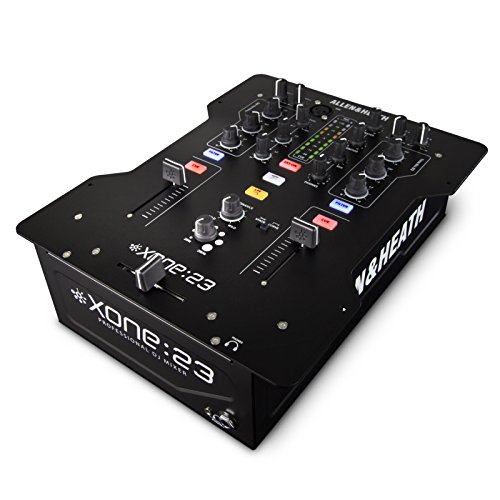
Allen & Heath XONE:23 2-Plus-2 Channel DJ Mixer — Best Analog Sound
The Xone:23 serves the CD DJ who believes a mixer should sound like something. Allen & Heath’s Xone line built its reputation on analog circuitry and a filter sound that DJs describe the way guitarists describe amplifiers, and the 23 is that philosophy at its most accessible: a 2-plus-2 channel layout — two full channels with additional inputs alongside — that covers a two-CDJ rig with room for an extra source, in a compact, booth-tough box. For CD sources, which arrive as finished, mastered digital audio, the mixer’s job is to combine them without thinning, harshness or gain-stage grit, and analog headroom is precisely the virtue this pick trades on.
The working experience is deliberately un-digital. There is no effects computer narrating the set and no software bridge in the listing; the performance tools are the EQ, the gains, the faders and the Xone filter, played by hand. A generation of house and techno DJs considers that a feature set rather than a gap, because the filter’s sweep becomes a signature rather than a preset. Cueing and monitoring follow the same purist logic — the headphone section exists to serve the mix, and it does.
Choose it with eyes open about the modern checklist: no built-in recording interface, no DVS bridge, no Beat FX — the recording and software jobs move to external hardware or are simply not this rig’s jobs. The DJ whose CD sets are about selection, blending and sound will find the 23 the most satisfying two-channel mixer in this guide. The DJ whose sets are about effects choreography should take a Pioneer and not look back. Both verdicts are compliments to the clarity of the category.
Strengths
- Analog Xone sound and filter character prized by purists
- 2-plus-2 channels cover two CDJs plus an extra source
- Compact, booth-tough build with a focused control set
Trade-offs
- No built-in interface, DVS or digital effects in the listing
- Recording a set requires external hardware
- Purist feature set will frustrate effects-driven DJs
| Channels | 2-plus-2 (per Amazon listing title) |
| Type | Analog DJ mixer |
| Brand line | Allen & Heath XONE |
Best for: sound-first CD DJs who mix with EQ and filter rather than effects / Not suited for: DJs who need recording, DVS or Beat FX from the mixer itself
Check the current price on Amazon for the Allen & Heath XONE:23 2-Plus-2 Channel DJ Mixer. You can also see the full listing here to confirm finish, dimensions and what is in the box before you order.

RANE DJ SEVENTY Two Channel DJ Mixer — Best for Scratch DJs
Some CD DJs mix; others cut. The RANE SEVENTY is built for the second tribe, and its listing reads like their manifesto: three contactless MAG FOUR faders — crossfader and both upfaders magnetic and contact-free, so the wear mechanism that kills ordinary faders simply does not exist — plus Akai Professional MPC performance pads, the pad hardware of production legend, mapped to the cues, rolls and samples a scratch set is built from. Internal DJ FX complete a two-channel battle mixer that treats the CDJ or media player as a scratch instrument’s source, which in the DVS era is exactly what it is.
Serato DJ is the stated ecosystem, and the integration is the point: pads, faders and effects speak to the software as one instrument, so a CD-and-timecode or media-player rig performs like a dedicated controller while keeping real players under the hands. For the DJ whose CD collection became a Serato library with discs as control surfaces, no mixer in this guide is more native. Build quality follows the battle brief — this is hardware designed to be struck, cut on and transported, nightly.
The specialisation is the trade. Two channels, a battle layout with the crossfader as the center of gravity, and an ecosystem commitment to Serato: a four-deck house DJ or a rekordbox loyalist will each find a better-fitting pick above. The SEVENTY does not pretend otherwise. For the scratch-first CD DJ, it is not a pick on a list — it is the category’s reference, and the faders alone justify the pilgrimage.
Strengths
- Three contactless MAG FOUR faders eliminate fader wear
- Akai MPC performance pads for cues, rolls and samples
- Deep Serato DJ integration with internal FX
Trade-offs
- Two-channel battle layout only
- Serato ecosystem commitment; rekordbox DJs should look above
- Flagship battle tier for a specialised brief
| Channels | 2 (per Amazon listing title) |
| Faders | Three contactless MAG FOUR faders (per Amazon listing title) |
| Pads | Akai Professional MPC performance pads (per Amazon listing title) |
| Software | Serato DJ (per Amazon listing title) |
Best for: scratch and battle DJs running CD or media players with Serato / Not suited for: four-deck mixers or rekordbox-ecosystem DJs
Check the current price on Amazon for the RANE DJ SEVENTY Two Channel DJ Mixer. You can also see the full listing here to confirm finish, dimensions and what is in the box before you order.

Numark M6 USB 4-Channel DJ Mixer — Best Value Four-Channel
The M6 USB is the mixer that has quietly run more real-world CD rigs — mobile discos, bars, community halls, starter booths — than any flagship in this guide, because it answers the working DJ’s actual checklist at a value tier. Four channels take two CD players with two channels to spare for a media player, a laptop or a second DJ. Three-band EQ on the channels carves mastered tracks apart properly. A mic input covers the announcements, dedications and hosting that mobile and bar work runs on. And the built-in USB audio interface records the set or streams a source without another box in the bag.
The ownership detail that defines the model is in its listing: a replaceable, slope-adjustable crossfader. Crossfaders are wear parts, and on most value mixers a worn fader is a death sentence or a soldering project. On the M6 it is a spare part and a few screws — while the slope adjustment lets the same fader serve a smooth-blend DJ and a cut-happy DJ at different gigs. That is design intelligence aimed at working life rather than showroom light, and it is why these mixers accumulate decades in service.
The tier’s honesty: the M6 offers no effects engine, no DVS ecosystem and no flagship fader feel, and its four channels are straightforward rather than booth-standard. A DJ building toward club residencies should start Pioneer and climb. A DJ equipping a CD rig for real gigs on a real budget — or a venue that needs a dependable house mixer — will find the M6 the most service per purchase in this guide, which is the definition of its badge.
Strengths
- Four channels plus mic input cover working CD rigs completely
- Built-in USB interface records sets without extra hardware
- Replaceable, slope-adjustable crossfader extends service life
Trade-offs
- No effects engine or DVS ecosystem
- Straightforward channel architecture, not booth-standard
- Value-tier fit and finish beside the flagships
| Channels | 4 (per Amazon listing title) |
| EQ | 3-band (per Amazon listing title) |
| Interface | Built-in USB audio interface (per Amazon listing title) |
| Crossfader | Replaceable, slope-adjustable (per Amazon listing title) |
Best for: mobile, bar and budget CD rigs that need four channels and a mic / Not suited for: effects-driven club DJs or DVS-first setups
Check the current price on Amazon for the Numark M6 USB 4-Channel DJ Mixer. You can also see the full listing here to confirm finish, dimensions and what is in the box before you order.
Comparison Table
Channels decide the rig’s ceiling, the crossfader decides its feel, and the ecosystem — rekordbox, Serato or none — decides its future. Read the table in that order.
| Pick | Badge | Key spec | Best for |
|---|---|---|---|
| Pioneer DJ DJM-A9 Professional 4-Channel DJ Mixer | Best Overall | 4-channel, built-in audio interface | Professional CDJ rigs |
| Pioneer DJ DJM-450 2-Channel DJ Mixer | Best Club-Style Two-Channel | 2-channel, Beat FX, DVS | Club-style home CD rigs |
| Pioneer DJ DJM-250MK2 2-Channel DJ Mixer | Best Entry Pioneer | 2-channel, Color FX, DVS unlock | First CD rigs |
| Allen & Heath XONE:23 2-Plus-2 Channel DJ Mixer | Best Analog Sound | 2+2 channel analog | Analog purist CD rigs |
| RANE DJ SEVENTY Two Channel DJ Mixer | Best for Scratch DJs | 2-channel, MAG FOUR faders, MPC pads | Scratch CD rigs |
| Numark M6 USB 4-Channel DJ Mixer | Best Value Four-Channel | 4-channel, USB interface, mic in | Working value CD rigs |
How to Choose a Mixer for a CD DJ Rig
Start with the players you own or intend to own, because the mixer serves them. Two CDJs need two honest line channels with clean gain range — digital sources arrive hot, and a mixer that distorts at the top of its gain is unusable with mastered tracks no matter how good its brochure looks. Four-deck ambitions, a backup player or regular two-DJ handovers need four channels, full stop; buying two channels for a four-deck style is the category’s classic false economy. Then choose the ecosystem deliberately: Pioneer’s mixers grow into rekordbox and the club booth’s layout, RANE grows into Serato battle culture, Allen & Heath stays proudly analog, and value four-channels like the Numark stay universal and uncommitted. The ecosystem decision outlives the mixer decision, so make it on the rooms you want to play.
Then audition the moving parts as the instrument they are. The crossfader’s curve decides whether blends melt or lurch — look for curve adjustment, and for scratch intentions, contactless or Innofader-class hardware that will not bleed after a season of cuts. The headphone section decides your cueing life: you need to hear the cued track alone, the mix alone, and a blend, at booth volume, without menu-diving. EQ decides your transitions: three bands with real cut are the working standard. Everything after that — effects, pads, interfaces — is style and workflow, valuable exactly in proportion to how your sets actually use them.
- Match channel count to your real deck count, including handovers and backups
- Choose the software ecosystem — rekordbox, Serato or analog — before the model
- Demand crossfader curve control; demand contactless hardware for scratching
- Test the headphone cue section for solo, mix and blend monitoring
CD Players, Media Players and DVS — How Modern CD Rigs Actually Work
The contemporary CD rig has three source architectures, and a good mixer serves all of them. Pure CD playback is the original: discs in CDJs, line outputs to the mixer, no computer anywhere — still the most failure-proof architecture in DJing, and the reason CD rigs persist in bars, mobile work and purist booths. Media players generalize the disc: USB drives and SD cards in CDJ-style hardware, same line outputs, same mixer — the disc becomes a library you carry in a pocket. DVS closes the triangle: timecode from discs or files makes the players into control surfaces for software libraries, and the mixer — or its built-in interface — becomes the bridge. The picks in this guide were chosen to cover that triangle honestly: the Numark and Xone for the pure-playback end, the Pioneers for the rekordbox bridge, the RANE for the Serato end.
The practical consequence for buyers is liberating: the mixer is the rig’s longest-lived decision. Players change as media evolve; a well-chosen mixer serves CDs this year, media players next year and DVS the year after, which is why this guide weights build, faders and channel architecture above this season’s feature list. Buy the center of the rig once, properly, and let the sources orbit it.
How Do I Maintain Crossfaders, Faders and Connections on a CD Rig?
A DJ mixer’s working life is decided by three maintenance habits, none of which cost money. The first is fader hygiene: dust and drink residue are the enemies, so keep the mixer covered when the rig is idle — a fitted cover or even a clean cloth — and work the faders gently through their travel weekly if the rig sits unused, which keeps contact surfaces honest. Contactless faders like the RANE SEVENTY’s MAG FOUR set remove most of this concern by design, which is part of their flagship case; conventional faders reward the covered, gentle regime with years of clean travel, and punish the smoky, uncovered one with crackle that no cleaning fully reverses.
The second habit is connection discipline. RCA connectors on CD players and mixers loosen and oxidize in transport; a rig that travels should have its cables inspected monthly, its connectors seated firmly, and its spares — one full set of RCAs and a power lead — living permanently in the gig bag. The third habit is thermal and liquid common sense: mixers vent heat through their top plates, so nothing sits on the mixer in the booth, and drinks live on a different surface than the rig, at a different height, by house rule. Every veteran DJ has a mixer that survived a decade on these three habits and a story about one that did not survive a single spilled drink. Maintenance, in this category, is the cheapest flagship feature there is.
- Cover the mixer whenever the rig is idle; dust is the fader’s enemy
- Inspect and reseat RCA connections monthly on a travelling rig
- Carry a full spare cable set in the gig bag permanently
- Keep drinks on a different surface and height from the rig, always
What Else Does a CD Rig Need Besides the Mixer and Players?
New CD DJs budget for two boxes and discover the rig is a system, so here is the rest of the list in the order it will demand attention. Headphones come first — a closed-back DJ pair that isolates in a loud room and folds or swivels for one-ear cueing — because cueing is impossible without them and every pick in this guide assumes them. Monitoring comes second: at home, a pair of nearfield speakers at ear height teaches you what your mixes actually sound like; in a booth, the venue’s monitor is part of the instrument, and learning to ask for its level is a professional skill. A microphone joins the list the moment the work involves hosting, announcements or mobile gigs — the Numark M6’s mic input exists because that moment arrives for most working DJs.
The supporting cast finishes the system: a stand or booth surface at a height that keeps faders at a comfortable working level for a full set, because posture is a mixing skill over two hours; lighting you control, since booths are dark and labels matter mid-handover; a recording path, whether the mixer’s own USB interface or an external recorder, because listening back is how DJs improve fastest; and the unglamorous consumables — spare cables, spare styli if turntables share the rig, gaffer tape, and a small torch. Budget the system, not the centerpiece, and the rig that results will sound like it cost twice what it did.
How to Set Up a CD DJ Rig and Gain-Stage It Correctly
A CD rig’s sound quality is decided in the first ten minutes of setup, at the gain knobs. This sequence prevents the distortion that ruins more CD sets than any other cause.
- Connect the players to line inputs — never phono inputs, which apply turntable equalization and will make CD sources sound harsh and overloaded. Confirm each channel’s input selector matches the socket you used.
- Set the mixer’s master output to a conservative level and the amplifier or speakers to their working volume first, so every later adjustment happens in the safe direction.
- Play the loudest mastered track in your collection — the one that always runs hot — and raise the channel gain until the channel meter peaks just below the red, then back off slightly. Repeat per channel and per player; CD sources vary more than DJs expect.
- Set channel EQ to flat (center) as your home position. EQ is for transitions and problem rooms, not a permanent boost; a rig that needs constant EQ to sound right has a gain or placement problem upstream.
- Balance the headphone cue: practice hearing the cued track alone, the program alone, and a blend of both, at the volume the booth will demand. Set your preferred blend before the room fills, not during your first transition.
- If your mixer has a USB interface, record a five-minute test mix and listen back on headphones. Recording exposes gain errors, hum from grounding and cable faults that booth monitoring forgives — better discovered in setup than in the set you meant to keep.
- Label your cables and channels — player left, player right, spare source, mic — with tape at both ends. In a dark booth mid-handover, labels are the difference between a swap and an incident.
Re-check gains whenever the room changes: a fuller room absorbs sound, monitors get louder, and the headroom you set in an empty room is the headroom that saves the full one. Gain staging is not a setup step; it is a habit that runs all night.
Common Buying Mistakes
CD-rig regret concentrates on the mixer more than any other component, because the mixer is touched constantly and replaced reluctantly. These are the mistakes that produce it.
Plugging CD players into phono inputs. Phono inputs apply RIAA equalization and extra gain meant for turntable cartridges. A CD source through them distorts and sounds harsh no matter how you EQ it. Line sources go to line inputs — the single most common CD-rig fault, and the easiest to prevent.
Buying two channels for a four-deck future. If your style is growing toward a third deck, a sampler or partner handovers, a two-channel mixer becomes the rig’s ceiling within a year. Channel count is the one spec that cannot be upgraded around; buy for the rig you are becoming.
Running gains into the red for loudness. Digital sources and digital recording punish clipping absolutely — there is no warm saturation, only damage. Loudness belongs to the amplifier. Keep channel peaks below the red and let the system do its job.
Choosing a mixer by its effects list. Effects are the most demo-friendly and least load-bearing part of a mixer. Faders, gains, EQ and cueing carry every set; effects decorate some of them. Buy the instrument first and the decorations second — the picks in this guide are ordered by exactly that logic.
Ignoring the crossfader’s replaceability. On a working rig the crossfader is a consumable. A mixer whose fader can be replaced — or whose contactless faders barely wear at all — stays in service for years longer. Ask the fader question before purchase, not at the first bleed.
Final Recommendation
The Pioneer DJ DJM-A9 is the CD rig’s flagship answer: four channels, a recording interface and the booth standard in one centerpiece. Two-deck DJs should choose by style — the DJM-450 for club layout and Beat FX, the DJM-250MK2 as the entry that teaches the right habits, the Xone:23 for analog sound, and the RANE SEVENTY if scratching is the point of the exercise. Working and budget rigs belong to the Numark M6 USB, whose four channels, mic input and replaceable fader have outlasted trend cycles for a reason. Every pick treats the mixer as what it is in a CD rig: the longest-lived, most-touched component you own.
Building the rest of the rig or comparing across the mixer category? The companion guides below cover the baking end of the same program and the wider mixer field.
If you want the short version: start with Pioneer DJ DJM-A9 Professional 4-Channel DJ Mixer, Pioneer DJ DJM-450 2-Channel DJ Mixer, Pioneer DJ DJM-250MK2 2-Channel DJ Mixer. Each is one click away from its live listing, where you can check price on Amazon and confirm the exact configuration.
Best Cakes Mixers Best Dj Mixers Best Audio Mixers Best Mixers For Dj Best Mixers
Frequently Asked Questions
What is a CD mixer, exactly?
Historically, a CD mixer was a combo unit with dual CD transports and a mixer in one box. Those units have largely left the new market. Today the term describes the DJ mixer at the center of a CD-based rig: a multi-channel mixer with line inputs for CDJs or media players, DJ EQ, a performance crossfader and a headphone cue section. All six picks in this guide are that modern kind of CD mixer, chosen because they serve CD sources properly.
How many channels do I need for two CD players?
Two channels play two players — but think one step ahead. A third or fourth channel covers a backup player, a media source, a guest DJ’s rig or two-DJ handovers without re-patching mid-night. DJs certain their world is two decks can buy two channels happily, as the Pioneer and RANE picks here show. Everyone else should read the four-channel picks — the DJM-A9 and the Numark M6 USB — before deciding the ceiling is worth saving on.
Can I record my sets from a CD mixer?
If the mixer has a built-in USB audio interface — the DJM-A9 and Numark M6 USB in this guide do — recording is a cable and a laptop away, straight from the mixer’s digital output. Analog mixers without an interface, like the Xone:23, record through an external interface or recorder fed from a booth or record output. Either path works; the built-in path is simply one less box to carry, power and troubleshoot.
What is DVS and do CD DJs need it?
DVS — digital vinyl system — lets timecode signals from your players control music files in software such as rekordbox or Serato, combining a software library’s size with real-player control. CD DJs with large disc collections may never need it; DJs whose collections live on drives increasingly do. The Pioneer picks in this guide support the rekordbox path and the RANE is built for Serato, so the mixer need not be replaced when a rig crosses over.
Are expensive crossfaders actually worth it?
For mixing DJs, a smooth fader with curve adjustment matters more than exotic hardware. For scratch DJs, yes — contactless faders like the RANE SEVENTY’s MAG FOUR set eliminate the wear and bleed that end ordinary faders’ lives, and the cut precision is the instrument itself. The middle path is replaceability, as on the Numark M6: a fader you can swap in minutes turns a fatal wear item into routine maintenance.
Should a beginner buy a flagship mixer first?
Almost never. A beginner’s budget serves the rig best split across competent players and an entry mixer that teaches correct habits — the DJM-250MK2 in this guide exists for exactly that — because early skill grows on any honest mixer, while early money sunk in a flagship starves the rest of the setup. Upgrade the mixer when your channel count, bookings or technique genuinely demand it; the flagship will still be there, and you will know precisely why you need it.


