Disclosure: airfryerkitchensupply.com is reader-supported. When you buy through links on our site, we may earn an affiliate commission at no extra cost to you.
Where to buy
If you are shopping for the best blenders mixers, start with the shortlist below. This guide covers the combo machines the keyword really points at: one motor base that blends in a pitcher and mixes, chops and processes in a work bowl — the kitchen systems and blender-processor duets that replace two appliances with one. Every pick is a current model sold through Amazon, where the listing states the exact pitcher size, bowl size and included cups, all of which vary between near-identical model names.
- Ninja Kitchen System Pro BL770 — check the current price on Amazon and confirm the exact variant on the listing before you order.
- Ninja Compact Kitchen System AMZ493BRN — check the current price on Amazon and confirm the exact variant on the listing before you order.
- Cuisinart Smart Power Duet BFP-703BCP1 — check the current price on Amazon and confirm the exact variant on the listing before you order.
- Cuisinart Velocity Ultra BFP-650P1 — check the current price on Amazon and confirm the exact variant on the listing before you order.
- Hamilton Beach Blender and Food Processor Combo 58163 — check the current price on Amazon and confirm the exact variant on the listing before you order.
- Breville 3X Bluicer Pro BJB815BSS — check the current price on Amazon and confirm the exact variant on the listing before you order.
Decide which second job matters in your kitchen — food processing, dough, juicing or travel cups — and buy the system built around it. The base motors in this class are all strong; the attachments are where the machines genuinely differ.
The best blenders mixers answer a counter-space question. A blender alone cannot chop an onion evenly or knead a pizza dough; a food processor alone makes a poor smoothie. Combo systems solve both by putting one powerful motor under two tools: a tall pitcher with blades tuned for liquids, and a wide work bowl with blades and discs tuned for mixing, chopping, slicing and light dough work. For most home kitchens, that pairing covers the realistic weekly jobs — smoothies, soups, salsas, sauces, chopped vegetables, grated cheese, hummus, batters and pizza dough — with one appliance to store, wash and learn.
Honesty about the category’s edge matters, though. A combo system’s processor bowl mixes and kneads light-to-medium doughs well, but it is not a stand mixer: heavy bread doughs in quantity, whipped egg whites by the dozen and all-day baking belong to the bowl-mixer class covered elsewhere in this programme. Buyers who mostly bake should start there. Buyers whose cooking is smoothie-first, sauce-heavy and weeknight-practical will find a good combo system is the hardest-working appliance they own.
All six picks were verified as current Amazon listings before writing, and specifications below come from those listings. The spread is deliberate: two Ninja kitchen systems at different sizes, two Cuisinart blender-processor duets with glass jars, the budget Hamilton Beach combo, and Breville’s premium bluicer for households whose second job is juicing rather than processing. Wattage figures in this class are peak marketing numbers across the industry, so the reviews judge the machines by pitcher, bowl, programs and real tasks instead.
In this guide
Quick Picks
Six combo systems, six kitchen priorities. Badges match the full reviews below.
Best Overall — Ninja Kitchen System Pro BL770
The BL770 is the archetypal kitchen system: its listing confirms a 1500W base that blends smoothies and processes salsa and dough, with a 72-oz pitcher, an 8-cup processor bowl and two 16-oz travel cups. That 8-cup bowl is the largest processor here, and it is why this system, above the others, can honestly call itself the one-appliance answer for a family kitchen.
Best Compact System — Ninja Compact Kitchen System AMZ493BRN
The Compact Kitchen System keeps the Ninja formula and trims the bowl: its listing confirms 1200W with Auto-iQ, three functions for smoothies, dough and frozen drinks, a 72-oz pitcher, a 40-oz processor bowl and an 18-oz cup. Couples and smaller households get the same full-size pitcher and preset convenience with a processor sized to their actual cooking.
Best Glass Jar Combo — Cuisinart Smart Power Duet BFP-703BCP1
The Smart Power Duet is the traditionalist’s combo: a 500-watt blender and food processor with a 48-oz glass jar, a 3-cup processor, seven speeds with ice crush and stainless blades, per its listing. Glass matters to households that blend hot soups and dislike plastic on principle, and Cuisinart’s dial-and-button control is the simplest here to teach a whole household.
Best for Smoothies and Travel Cups — Cuisinart Velocity Ultra BFP-650P1
The Velocity Ultra steps the Cuisinart duet up: its listing confirms a 1 HP blender and food processor combo for smoothies, protein shakes, ice crushing and chopping, with two 16-oz travel cups. It is the Cuisinart for the smoothie-first household — stronger than the Smart Power Duet, with blend-and-go cups for the gym-and-commute routine, plus a processor for the evening meal.
Best Budget Combo — Hamilton Beach Blender and Food Processor Combo 58163
Hamilton Beach’s combo is the value door into this category: its listing confirms a blender and food processor combo for shakes and smoothies with a 3-cup electric food chopper attachment, a 40-oz glass jar, a blender travel cup and 700 watts of peak power. A glass jar at the budget end is a genuine distinction, and the chopper covers the daily prep that justifies a combo in the first place.
Best Premium Blender and Juicer — Breville 3X Bluicer Pro BJB815BSS
The Bluicer Pro is the alternative reading of this search: a premium Breville that pairs a full blender with a juicer in one footprint, for households whose second job is fresh juice rather than chopping. If your mornings alternate between smoothies and green juices and your processing needs are light, this brushed stainless machine replaces a different pair of appliances than the other five — judge it on that basis.
If you cannot decide, the Ninja BL770 is the default answer for most households: the largest processor bowl in this guide, a full-size pitcher, and travel cups in one box.
How These Picks Were Chosen
Selection started from the combo definition itself: a pick had to genuinely blend and genuinely mix or process from one base — a blender with a token mini-chopper did not qualify. Every model then had to verify as a current Amazon listing with an exact title match, so pitcher volumes, bowl sizes and included accessories below are listing facts, not brochure memory.
We then weighted the tasks these machines are bought for. Smoothie and frozen-drink performance is table stakes; the separators are processor bowl capacity, dough capability, the usefulness of the included cups and discs, and whether the control scheme — Auto-iQ programs on the Ninjas, dial speeds on the Cuisinarts — suits a busy home cook. Glass versus plastic pitchers were treated as a real fork in the road rather than a detail, because households split strongly on weight, durability and hot-liquid habits.
Finally, we spread the six across budget and intent instead of crowning variations of one system: full-size and compact Ninja systems, two glass-jar Cuisinart duets at different strengths, the value Hamilton Beach, and the Breville bluicer as the premium alternative for juice households. Prices in this category swing with promotions, so the guide uses check-price links rather than figures that would date quickly.
- True combo design: full blending pitcher plus a real mixing/processing bowl or second function
- Verified current Amazon listing, exact model match
- Pitcher and bowl capacities stated from the listing, in usable household terms
- A control scheme a busy cook will actually use, from presets to simple dials
- Included accessories that match the badge: cups, discs, dough tools as listed
- No fixed prices or ratings printed — check price on Amazon for the current figure
The 6 Best Blenders Mixers
Each review states who the system suits, its strengths, its honest trade-offs, and the listing-verified specifications. Badges match the Quick Picks.

Ninja Kitchen System Pro BL770 — Best Overall
The Ninja Kitchen System Pro BL770 has defined this category for years, and the verified listing shows why: a 1500W all-in-one system that blends smoothies and processes salsa and dough, built around a 72-oz pitcher, an 8-cup food processor bowl and two 16-oz to-go cups. The design insight is proportion. Many combos bolt a token chopper onto a blender; the BL770’s processor is a full-size bowl that can work through a family quantity of vegetables, a batch of dough or a bowl of hummus without a second load, which is what makes owners actually use both halves of the machine.
Strengths
- Full 8-cup processor bowl handles family quantities in one batch
- 1500W system crushes ice and frozen fruit without hesitation
- Pitcher, processor and two travel cups cover the whole weekly routine
Trade-offs
- Large footprint — pitcher, bowl and cups need real cupboard space
- Plastic pitcher rather than glass, which some households avoid for hot liquids
- Powerful and correspondingly loud at full speed
Key specs (from the manufacturer’s Amazon listing title):
- Power: 1500W, per listing title
- Pitcher: 72-oz, per listing title
- Processor bowl: 8-cup, per listing title
- Included: Two 16-oz cups, per listing title
- Tasks: Blends smoothies, processes salsa and dough, per listing title
In a real week, the BL770’s value is sequencing. Morning smoothies in the pitcher or a travel cup. Evening salsa, chopped onions and peppers, and a pizza dough in the bowl. Weekend soup blended in the pitcher after the vegetables were chopped in the bowl. Each job uses the right geometry — tall and narrow for liquids, wide and shallow for processing — instead of forcing one vessel to fake the other. The limits are the class limits, stated plainly: plastic vessels, family-counter footprint, and dough capacity suited to home batches rather than bakery ambitions. Households wanting a stand mixer’s kneading stamina should buy one as well or instead. Households wanting one strong system for everything else will find this the most complete box in the guide, and the benchmark the other five are priced and sized against.
Best for: families wanting one system for smoothies, processing and home dough batches / Not suited for: serious bread bakers or kitchens with very limited storage
Check the BL770 on Amazon — check price on Amazon and read the full listing details for the current configuration.

Ninja Compact Kitchen System AMZ493BRN — Best Compact System
The Ninja Compact Kitchen System answers the BL770’s one weakness — sheer volume of stuff — for households that cook smaller. The verified listing describes a 1200W Auto-iQ system with three functions covering smoothies, dough and frozen drinks, a full 72-oz pitcher, a 40-oz processor bowl and an 18-oz to-go cup. Note the design choice: the pitcher stays family-size for drinks and soups, while the processor shrinks to the quantity a couple or small family actually chops. That is the right place to save the space.
Strengths
- Auto-iQ presets make smoothies, dough and frozen drinks one-touch jobs
- Full-size 72-oz pitcher despite the compact system name
- 40-oz processor is honestly sized for smaller households
Trade-offs
- Processor bowl is less than half the BL770’s — batch cooking means two loads
- 1200W is ample for drinks but a step below the Pro for heavy processing
- Still a multi-piece system that needs organised storage
Key specs (from the manufacturer’s Amazon listing title):
- Power: 1200W, per listing title
- Programs: Auto-iQ, 3 functions for smoothies, dough and frozen drinks, per listing title
- Pitcher: 72-oz, per listing title
- Processor bowl: 40-oz, per listing title
- Included: 18-oz cup, per listing title
Auto-iQ is this system’s real argument. The preset programs pulse, pause and ramp in patterns tuned to each job, so a frozen drink gets the ice-breaking rhythm it needs and a dough gets worked rather than shredded — outcomes a new owner reaches on day one instead of after a month of speed experiments. For a household of one to three, the 40-oz bowl is not a downgrade but a fit: salsa, chopped vegetables for two meals, a small dough. The honest boundary is batch ambition. If you meal-prep for a crowd or process kilos of vegetables at harvest time, the BL770’s bowl earns its cupboard space. If your cooking is daily and modest, this compact system delivers the same Ninja experience with less to store, wash and lift.
Best for: couples and small households wanting preset convenience and a right-sized processor / Not suited for: batch cooks and large families who will fill an 8-cup bowl regularly
Check the Compact Kitchen System on Amazon — check price on Amazon and read the full listing details for the current configuration.

Cuisinart Smart Power Duet BFP-703BCP1 — Best Glass Jar Combo
Cuisinart’s Smart Power Duet BFP-703BCP1 is the classic blender-processor duet, and its verified listing states the formula plainly: a 500-watt motor, a 48-oz glass blending jar, a 3-cup food processor, seven speeds including ice crush, and stainless steel blades. In a category drifting toward ever-larger plastic systems, the Duet’s argument is material and manner. A glass jar suits hot liquids and long ownership, the controls are physical and obvious, and the processor is sized for the daily chop rather than the weekly marathon.
Strengths
- 48-oz glass jar suits hot soups and plastic-averse households
- Simple seven-speed control anyone in the house can run
- 3-cup processor is the right size for daily chopping and sauces
Trade-offs
- 500 watts is the gentlest motor here — frozen drinks take more patience
- 3-cup processor is small for family batch cooking
- No travel cups or preset programs of the Ninja systems
Key specs (from the manufacturer’s Amazon listing title):
- Power: 500-watt motor, per listing title
- Jar: 48-oz glass jar, per listing title
- Processor: 3-cup food processor, per listing title
- Speeds: 7-speed with ice crush, per listing title
- Blades: Stainless steel, per listing title
Judge the Duet by the cooking it was designed around: soups, sauces, dressings, smoothies of fresh rather than rock-frozen fruit, and the nightly onion-garlic-carrot chop. At those jobs its glass jar and honest controls are a pleasure, and the machine’s modest footprint suits smaller counters better than either Ninja. Where it must not be oversold is brute force. A pitcher of frozen margaritas or a week of meal-prep processing asks more of a 500-watt, 3-cup system than it was built to give, and owners who push it there end up disappointed with a machine that is well made for a different brief. Traditional kitchens with traditional jobs will keep this Cuisinart happily for years; smoothie-bar households should look up the list.
Best for: traditional cooks wanting a glass jar, simple controls and a daily-size processor / Not suited for: frozen-drink enthusiasts or large-batch processors
Check the Smart Power Duet on Amazon — check price on Amazon and read the full listing details for the current configuration.

Cuisinart Velocity Ultra BFP-650P1 — Best for Smoothies and Travel Cups
The Cuisinart Velocity Ultra BFP-650P1 is the stronger sibling in the Duet family, and its verified listing positions it precisely: a 1 HP blender and food processor combo built for smoothies, protein shakes, ice crushing and chopping, supplied with two 16-oz travel cups. That combination maps onto a real household pattern — a blended breakfast that leaves with you in its own cup, and a processor that handles dinner prep on the same base in the evening. Where the Smart Power Duet is the traditionalist’s pick, the Velocity Ultra is the routine-driven one.
Strengths
- 1 HP motor handles smoothies and ice crushing with more authority
- Two 16-oz travel cups fit the blend-and-go morning routine
- Processor side covers chopping for everyday cooking
Trade-offs
- Travel-cup blending suits single servings, not family smoothie batches
- Less sheer system capacity than the Ninja BL770 at the top of this guide
- Preset-free controls require a little more user judgement than Auto-iQ
Key specs (from the manufacturer’s Amazon listing title):
- Power: 1 HP, per listing title
- Role: Blender and food processor combo, per listing title
- Tasks: Smoothies, protein shakes, ice crushing and chopping, per listing title
- Included: Two 16-oz travel cups, per listing title
The Velocity Ultra’s strength is how completely it serves one person’s day while remaining useful to a household. The travel cups eliminate the decant-and-wash step that quietly kills smoothie habits, and the motor has the authority for frozen fruit and ice that the smaller Duet lacks. The processor then earns the base its evening counter space. Its boundaries sit at scale: a family of five blending breakfast at once will want the BL770’s pitcher-and-bowl volume, and a dedicated baker will still want a stand mixer for dough. For the large middle — smoothie-led mornings, ordinary family cooking, one base on the counter — this is the most balanced Cuisinart in the guide and a genuine alternative philosophy to the Ninja systems: fewer presets, more straightforward mechanical strength.
Best for: smoothie-first households wanting travel cups plus an everyday processor / Not suited for: large families blending and processing in bulk
Check the Velocity Ultra on Amazon — check price on Amazon and read the full listing details for the current configuration.
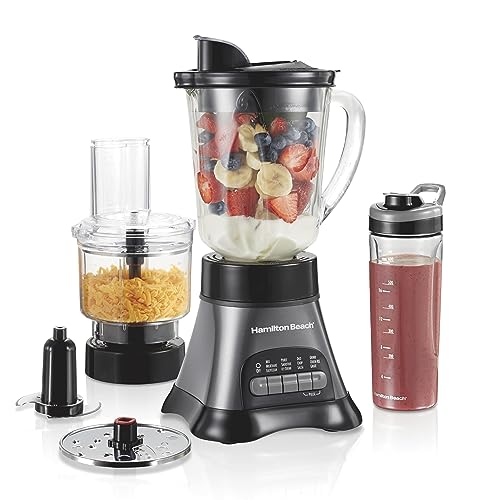
Hamilton Beach Blender and Food Processor Combo 58163 — Best Budget Combo
The Hamilton Beach 58163 proves a combo system does not need a premium commitment to be useful. Its verified listing describes a blender and food processor combo for shakes and smoothies, with a 3-cup electric food chopper attachment, a 40-oz glass jar, a blender travel cup and 700 watts of peak power. Hamilton Beach’s long speciality is honest appliances for ordinary kitchens, and this is that philosophy in combo form: the two vessels real households use, in sensible sizes, with a glass jar many pricier systems skip.
Strengths
- Glass jar at the budget end of the category
- 3-cup chopper covers the daily chop, salsa and sauce routine
- Travel cup included for single-serve blending
Trade-offs
- 700W peak is a smoothie-and-shakes motor, not a heavy processing one
- 40-oz jar and 3-cup chopper are modest sizes for families
- Fewer programs and refinements than the Ninja and Cuisinart systems
Key specs (from the manufacturer’s Amazon listing title):
- Power: 700 watts peak power, per listing title
- Jar: 40-oz glass jar, per listing title
- Chopper: 3-cup electric food chopper attachment, per listing title
- Included: Blender travel cup, per listing title
The right way to buy the 58163 is as a first combo for a small household, a second home, a student kitchen or a cook whose processing is measured in cups rather than kilos. Shakes and smoothies are its home ground, the chopper genuinely replaces the knife-and-board routine for onions, herbs, nuts and salsa, and the glass jar will outlast trends. The wrong way is to expect Ninja-class frozen crushing or family-scale processing from a budget motor and vessels; pushed there, it will feel strained, because it is. Within its brief it is complete and likeable, and its existence usefully disciplines the whole category: every dollar above it in this guide should buy you visible capacity, power or convenience, and on the picks above, it does.
Best for: small households, first combos and budget buyers wanting a glass jar / Not suited for: heavy frozen blending or family-scale food processing
Check the 58163 Combo on Amazon — check price on Amazon and read the full listing details for the current configuration.

Breville 3X Bluicer Pro BJB815BSS — Best Premium Blender and Juicer
Breville’s 3X Bluicer Pro BJB815BSS takes the combo idea in the other direction: instead of blender plus processor, it is blender plus juicer, in a brushed stainless steel design, as its verified listing states. That makes it the premium outlier of this guide and, for a specific household, the smartest pick in it. Juice people and smoothie people are often the same people on different mornings, and a machine that does both from one base — blending whole fruit for smoothies, extracting juice for clear drinks — removes an entire appliance from the counter.
Strengths
- Blends and juices from one premium base — a different, rarer pairing
- Breville build and brushed stainless finish suit a permanent counter spot
- Ideal for produce-heavy households that alternate smoothies and juices
Trade-offs
- No food processor bowl — chopping and dough are not its jobs
- Premium positioning: the most considered purchase in this guide
- Juicing brings its own pulp handling and cleaning routine
Key specs (from the manufacturer’s Amazon listing title):
- Design: Blender and juicer (Bluicer), per listing title
- Model: BJB815BSS, per listing title
- Finish: Brushed stainless steel, per listing title
The Bluicer Pro demands the most honest self-assessment in this guide. If your kitchen’s second appliance was always going to be a juicer — because clear juices, not chopped vegetables, are your daily habit — then this machine is not an outlier at all but the only correct answer here, and Breville’s engineering makes it a satisfying one. If, like most buyers of this search, your second job is processing — onions, dough, salsa, grating — the Bluicer leaves that job undone no matter how beautifully it juices, and a Ninja or Cuisinart system will serve you better for less commitment. We include it because the keyword genuinely contains both households, and because a guide that ignored the juicing half of the blender-combo world would be steering juice households into processors they will not use.
Best for: produce-focused households that blend smoothies and press juices daily / Not suited for: cooks whose second job is chopping, slicing or dough
Check the 3X Bluicer Pro on Amazon — check price on Amazon and read the full listing details for the current configuration.
Comparison Table
Capacity and second-job are the columns that matter: every motor here blends, but the bowls, jars and pairings decide what the machine does all week.
| Pick | Badge | Key spec | Best for |
|---|---|---|---|
| Ninja Kitchen System Pro BL770 | Best Overall | 1500W, 72-oz pitcher, 8-cup processor, 2 travel cups | families wanting one system for smoothies, processing and home dough batches |
| Ninja Compact Kitchen System AMZ493BRN | Best Compact System | 1200W Auto-iQ, 72-oz pitcher, 40-oz processor bowl | couples and small households wanting preset convenience and a right-sized processor |
| Cuisinart Smart Power Duet BFP-703BCP1 | Best Glass Jar Combo | 500W, 48-oz glass jar, 3-cup processor, 7 speeds | traditional cooks wanting a glass jar, simple controls and a daily-size processor |
| Cuisinart Velocity Ultra BFP-650P1 | Best for Smoothies and Travel Cups | 1 HP combo with two 16-oz travel cups | smoothie-first households wanting travel cups plus an everyday processor |
| Hamilton Beach Blender and Food Processor Combo 58163 | Best Budget Combo | 700W peak, 40-oz glass jar, 3-cup chopper, travel cup | small households, first combos and budget buyers wanting a glass jar |
| Breville 3X Bluicer Pro BJB815BSS | Best Premium Blender and Juicer | Blender plus juicer in one, brushed stainless | produce-focused households that blend smoothies and press juices daily |
How to Choose a Blender Mixer Combo
Name your second job first. The first job is always blending; the second job defines the machine. If it is chopping, slicing, grating and light dough, you want a kitchen system or duet with a real processor bowl, sized to your household — 8 cups for family batch cooking, 40 ounces or 3 cups for daily small-scale prep. If the second job is juicing, only the Breville Bluicer in this guide does it, and no processor feature compensates a juice household for its absence. Let that one decision order the shortlist before you compare watts.
Treat wattage as the least reliable number on the box. Figures in this class are peak ratings measured differently by every maker, and they predict frozen-drink authority only loosely. Vessel design, blade geometry and programs matter as much: Ninja’s Auto-iQ systems achieve consistent frozen results through programmed pulsing rather than raw power alone. Judge by the tasks in the listing and the reviews — ice crushing, dough, salsa — rather than by the biggest wattage headline.
Finally, count the pieces against your cupboard, honestly. A full kitchen system is a base, a pitcher, a bowl, blades, discs and cups; it replaces two or three appliances but only saves space if those appliances actually leave. Households short on storage often do better with the compact system or the Hamilton Beach combo and a clear-out, than with the largest system and a cupboard that fights back every morning.
- Second job first: processing, dough, travel servings or juicing
- Size the processor bowl to your real batch, not your biggest-ever batch
- Prefer task evidence and programs over headline wattage
- Glass jars for hot liquids and plastic-averse homes; plastic for lightness and family pitchers
- Count total pieces against real cupboard space before ordering
Combo System vs Separate Blender and Stand Mixer
A combo system and a stand mixer overlap less than their shared vocabulary suggests. The combo’s processor mixes, chops and kneads with blades in a bowl: brilliant for pastry, pizza dough in home quantities, batters and everything chopped. A stand mixer’s planetary tool works dough with sustained torque and whisks and creams in ways a processor cannot match: heavy bread doughs, big meringues, and long creaming jobs belong to it. Households that cook broadly and bake occasionally are usually best served by a combo alone. Households that bake seriously should own the stand mixer first and add blending separately — the programme’s bowl mixer guide covers that class in depth.
Separate full-size appliances still win one argument: simultaneous and specialised work at scale. A caterer-scale cook will outgrow any combo’s bowl and any home pitcher’s patience. But for the ordinary family week, the combo’s one-base logic — fewer appliances, fewer wash-ups, one learning curve — is why this category exists and why it keeps growing. Buy for your actual week, not your most ambitious imagined weekend.
Getting the Most from a Combo System
Combos reward three habits. First, liquid discipline in the pitcher: liquids first, powders next, frozen ingredients last, and never fill past the marked line, because blending needs room to form a vortex. Second, pulse discipline in the processor: short pulses and a scrape-down beat holding the button, which is how salsa becomes mush and onions become soup. Third, dry-before-store discipline: blades and discs washed, dried and stored in the bowl or a designated box, because a system whose sharp parts live in a drawer tangle is a system that stops being used.
Frozen performance improves with ingredient prep more than with power: partially thaw rock-hard fruit for a few minutes, add enough liquid to start the vortex, and use the tamper or program rather than shaking the base. None of this is advanced technique — it is the difference between a combo that feels magical and the same combo feeling underpowered.
- Pitcher order: liquids, powders, then frozen ingredients on top
- Processor: pulse and scrape rather than running continuously
- Keep blades and discs washed, dry and stored together
- Give frozen blends liquid and a few minutes of thaw before blaming the motor
- Use presets as written for the first month before improvising speeds
Cleaning and Storing a Combo System So It Lasts
Combo systems die by neglect in drawers, not by motor failure. The vessels and blades meet acidic fruit, dairy and raw vegetables daily, and residues left overnight stain plastic, dull seals and perfume the next smoothie with the last salsa. The habit that saves the machine is a rinse within minutes of use — warm water, a drop of washing-up liquid, a ten-second blend for the pitcher, a brush (never fingers) along the processor blades — followed by proper drying before the pieces are put away. Seals and gaskets deserve a weekly removal and wash where the manual allows it, because the groove under a seal is where old flavours live.
Storage is the second half of longevity. Keep the system assembled on the counter if you blend daily, because a combo that must be excavated from a cupboard gets used weekly at best. If it must be stored, keep blades and discs in the bowl or a single designated container — never loose in a cutlery drawer, where edges dull and fingers find them — and keep the cups and lids with the base so the travel routine never stalls on a missing part. Once a season, inspect the drive coupling and the bowl’s locking tabs for wear, run a pitcher of warm water with a little bicarbonate for a deep freshen, and check the manual’s care pages again. None of this takes an afternoon; all of it together is the difference between a system that serves a decade and one that is replaced, faintly smelling of old onion, in year three.
- Rinse within minutes; deep-wash seals weekly
- Brush blades, never fingers, and dry fully before storing
- Store discs and blades in the bowl or one container, never loose
- Keep the system assembled where it will actually be used
- Inspect couplings and locking tabs once a season
How to Use a Blender Mixer Combo for a Full Week of Cooking
A combo system earns its counter space across the week rather than in a single recipe. This walkthrough shows the rhythm owners settle into, using the pitcher and the bowl as the two tools they are.
- Monday smoothies: blend in the full pitcher for the household, or in a travel cup for one — liquids first, frozen fruit last, preset or high speed until the vortex runs smooth.
- Tuesday prep: fit the processor’s chopping blade and pulse onions, peppers and herbs for the week’s sauces and stir-fries; store chopped, cook faster all week.
- Wednesday soup: cook vegetables in the pot, then blend in batches in the pitcher — with a glass jar, hot blending is straightforward; with plastic, let the soup cool slightly and vent the lid as the manual directs.
- Thursday dough: use the processor’s dough tool or blade for a pizza or flatbread dough in the bowl, keeping to the bowl’s stated capacity so the motor works the dough rather than straining against it.
- Friday drinks: frozen drinks in the pitcher with ice added to liquid, using the ice-crush or frozen-drink program where fitted.
- Weekend baking support: use the processor for pastry, crumb toppings and nut butters in small batches, and the pitcher for batters and dressings.
- After each job: rinse vessels immediately, wash blades with a brush away from the edge, dry fully, and store the system assembled so it is ready rather than buried.
Once a month, check blade sharpness and seal condition, and descale or deep-clean per the manual if your water is hard. A combo that is clean, assembled and visible gets used daily; that visibility, more than any specification, is what turns the purchase into a habit.
Common Buying Mistakes
Combo systems disappoint when they are bought against the wrong job or run against their geometry. These are the mistakes behind most of the disappointment.
- Expecting stand-mixer performance from a processor bowl for heavy bread dough in quantity
- Choosing by headline wattage instead of bowl size, jar material and included tools
- Overfilling the pitcher past its line, then blaming the motor for a blend that had no room to move
- Processing in one long run instead of pulses, turning salsa and chopped vegetables into puree
- Buying the largest system without the cupboard to store it, so it migrates out of daily reach
- Ignoring the second-job question and buying a juicer combo for chopping, or a processor combo for juicing
Final Recommendation
For most households the answer is the Ninja Kitchen System Pro BL770: the fullest pitcher-and-bowl combination in the guide, with travel cups included. Smaller households should take the same idea in the Ninja Compact Kitchen System and enjoy the Auto-iQ presets with a right-sized bowl. Glass-jar traditionalists have two good Cuisinarts — the Smart Power Duet for gentle daily work, the Velocity Ultra for smoothie-led routines — and budget buyers a genuinely capable door into the category in the Hamilton Beach 58163. Juice households, and only juice households, should step sideways to the Breville Bluicer Pro.
The neighbouring decisions are covered across this programme: the baking-first alternative lives in Best Bowl Mixers and Best Bargain Stand Mixers, the wider stand-mixer field in Best Blenders Mixers companion coverage of single blenders, and the audio namesakes of this category in Best Beginner Passive Mixers and Best Behringer Mixers. Choose the second job honestly and any of the six systems above will work as hard as your kitchen does.
Before you decide, re-check the shortlist leaders at their current listings: Ninja Kitchen System Pro BL770, Ninja Compact Kitchen System AMZ493BRN, Cuisinart Smart Power Duet BFP-703BCP1 — check price on Amazon for each and confirm the exact variant.
Frequently Asked Questions
What is the difference between a blender mixer combo and a food processor?
A combo system is one motor base driving both a blending pitcher and a processing bowl, so it covers liquids and chopping in a single appliance. A standalone food processor has no blending pitcher and usually offers a wider range of discs and a larger, more specialised bowl. For most households the combo’s coverage is the point: smoothies, soups and sauces from the pitcher, chopping, slicing and light dough from the bowl. Cooks who process at large scale or need specialist discs should still consider a dedicated processor.
Can a combo system replace a stand mixer?
For many kitchens, mostly — with one honest exception. A processor bowl mixes batters, pastry and pizza dough in home quantities and handles all chopping, which covers the majority of stand-mixer jobs in a non-baking household. It does not match a stand mixer for heavy bread dough in quantity, large meringues or long creaming, where sustained planetary torque matters. Serious bakers should buy the stand mixer class first; everyone else usually finds the combo the more-used appliance.
Is a glass or plastic pitcher better?
It depends on your cooking. Glass suits hot soups, resists staining and scratching, and pleases plastic-averse households, at the cost of weight and breakability — the Cuisinart duets and the Hamilton Beach in this guide offer it. Plastic pitchers, as on the Ninja systems, are lighter, larger and tougher for family and frozen use, but makers advise care with very hot liquids. Neither is universally better; match the jar to whether your blending is soup-led or smoothie-led.
Why does my combo struggle with frozen fruit when the wattage sounds high?
Wattage in this class is a peak figure and only part of frozen performance. Blends stall when the pitcher is overfilled, when there is too little liquid to start a vortex, or when rock-hard frozen fruit goes in straight from a deep freeze. Add liquid first, frozen ingredients last, let the hardest fruit thaw a few minutes, and use the frozen or Auto-iQ program, which pulses to pull ingredients down. Technique fixes most ‘underpowered’ complaints on systems in this guide’s class.
How big a processor bowl do I need?
Match the bowl to your typical batch, not your largest. A 3-cup or 40-oz bowl handles daily chopping, salsas and small doughs for one to three people without washing a cavern between jobs. An 8-cup bowl, as on the Ninja BL770, earns its space when you batch-cook for a family, process garden produce or make dough for several pizzas at once. Oversized bowls chop small quantities poorly, because ingredients hide under the blade’s path — another reason the honest middle sizes exist.
Are the travel cups worth having?
For smoothie households, yes — they change the habit, not just the vessel. Blending directly in a sealed cup removes decanting and extra washing, which is why cups feature on both Ninja systems, the Velocity Ultra and the Hamilton Beach combo. They suit single servings of smoothies and shakes; they do not replace the pitcher for family batches, soups or frozen drinks in quantity. Treat them as a routine feature, valuable exactly in proportion to how many weekday mornings start with a blended drink.


