Disclosure: airfryerkitchensupply.com is reader-supported. When you buy through links on our site, we may earn an affiliate commission at no extra cost to you.
Where to buy
If you are shopping for the best bargain stand mixers, this list separates the genuine bargains from the false economies. Every machine below was confirmed as a current Amazon listing, includes the flat beater, dough hook and whisk a baker needs on day one, and mixes real dough and batter — not just cake mix on a good day. Start with the Hamilton Beach 4-quart if your batches are standard size, and check the current price on Amazon for the exact model, because bargain-tier pricing moves fast and the best buy rotates.
- Hamilton Beach 4 Qt Electric Stand Mixer — check the current price on Amazon and confirm the exact variant on the listing before you order.
- Aucma Stand Mixer 6.5-QT 660W Tilt-Head — check the current price on Amazon and confirm the exact variant on the listing before you order.
- VIVOHOME Stand Mixer 6-Quart Tilt-Head — check the current price on Amazon and confirm the exact variant on the listing before you order.
- Kitchen in the box Stand Mixer 3.2Qt — check the current price on Amazon and confirm the exact variant on the listing before you order.
- Kitchen in the box Stand Mixer 8.5 QT 900 Watt — check the current price on Amazon and confirm the exact variant on the listing before you order.
- Cuisinart Stand Mixer SM-50 5.5 Quart — check the current price on Amazon and confirm the exact variant on the listing before you order.
The best bargain stand mixers are not the cheapest stand mixers. A machine that stalls on pizza dough, walks itself off the counter, or arrives missing its dough hook is not a bargain at any price — it is a down payment on the mixer you should have bought. The bargains are the machines just above that failure line: honest motors, planetary or well-covered mixing action, a bowl sized for real batches, and the core attachments included, sold without the enamel, branding and ecosystem taxes of the premium tier.
Know what the bargain tier asks of you in return. You will respect flour limits on heavy doughs. You will accept plainer finishes and simpler controls. You may give up the vast attachment ecosystems of the famous brands. In exchange you get hands-free mixing — the single biggest quality-of-life upgrade in home baking — for a fraction of the flagship cost. For weekly family baking, that trade is not a compromise; it is the smartest money in the kitchen.
All six picks were verified as current Amazon listings, and they span the bargain map: the balanced all-rounder, two big-bowl budget machines, a compact 3.2-quart option for small kitchens, a heavy-duty 8.5-quart dough specialist, and one step-up machine for bakers who want bargain pricing with mid-range manners. Every review states the honest limits alongside the strengths, because a bargain you understand beats a premium you resent.
Key Takeaways
- A bargain means above the failure floor: real mixing action, full attachments, supported brand.
- Bowl size follows household size — bigger is a cost, not a bonus, when batches are small.
- The Hamilton Beach 4-quart is the balanced bargain; the Cuisinart SM-50 is the buy-once bargain.
- Technique — gradual flour, sensible batches — is what makes budget mixers last.
In this guide
Quick Picks
Best Overall Bargain — Hamilton Beach 4 Qt Electric Stand Mixer. Planetary mixing, seven speeds, splash guard and the full attachment trio at the friendliest price in this guide. The bargain benchmark.
Best Big-Bowl Bargain — Aucma Stand Mixer 6.5-QT 660W Tilt-Head. A 6.5-quart bowl and tilt-head convenience at a budget price — double batches without the double price. The family-size bargain.
Best Alternative Big Bowl — VIVOHOME Stand Mixer 6-Quart Tilt-Head. Six quarts, tilt-head simplicity, starter price. The other credible big-bowl bargain — pick between it and the Aucma on the day’s listing and configuration.
Best Compact Bargain — Kitchen in the box Stand Mixer 3.2Qt. A 3.2-quart, lightweight, portable stand mixer with six speeds and the full trio — the apartment and small-household bargain that actually fits the cupboard.
Best Heavy-Dough Bargain — Kitchen in the box Stand Mixer 8.5 QT 900 Watt. An 8.5-quart bowl, 900-watt class power and ten speeds aimed at heavy dough — the biggest bargain here, for bakers whose batches are the point.
Best Step-Up Bargain — Cuisinart Stand Mixer SM-50 5.5 Quart. Twelve speeds and a 5.5-quart stainless bowl from a major kitchen brand — the bargain for buyers who plan to mix weekly for a decade and want to buy once.
How These Picks Were Chosen
Bargain hunting needs stricter rules than premium shopping, so ours were blunt. First: the core trio — flat beater, dough hook, whisk — must be in the box, because a cheap mixer plus three separate attachment purchases is not cheap. Second: the machine must genuinely knead; we weighted planetary action, bowl coverage and motor behaviour under load over headline wattage, which is measured too inconsistently across brands to trust alone.
Third: size honesty. Bargain bowls range here from 3.2 to 8.5 quarts, and bigger is not better — a huge bowl whips two egg whites badly and eats a cupboard. Each pick is matched to the household size it actually serves. Fourth: the brand must support the machine with listings, parts and a track record at this tier; anonymous one-season mixers were excluded however bright their specifications looked.
Finally, every pick had to survive the regret test: would a typical owner, one year in, feel they saved money or feel they wasted it? Machines with known patterns of early failure, missing attachments or misleading capacity claims failed that test regardless of price, and they are not in this guide.
The 6 Best Bargain Stand Mixers

Hamilton Beach 4 Qt Electric Stand Mixer — Best Overall Bargain
The Hamilton Beach 4-quart is the bargain against which the others are measured, because it gets the fundamentals right at the lowest sensible price: planetary mixing action that works the whole bowl, seven speeds from fold to whip, a splash guard that keeps flour in the bowl at startup, and whisk, flat beater and dough hook all included. The easy-carry handle and modest footprint acknowledge that bargain buyers usually have small kitchens and real cupboards.
Strengths
- Planetary action at a true bargain price
- Complete attachment trio plus splash guard included
- Compact, carry-handled design suits small kitchens
Trade-offs
- Four-quart bowl means single standard batches
- 300-watt class motor wants sensible dough quantities
- Plain finish — function proudly over form
Key specs
- Bowl: 4 quart
- Speeds: 7
- Motor: 300 watts
- Attachments: Whisk, flat beater, dough hook, splash guard
- Action: Planetary
For the standard home repertoire — a loaf, a cake, a batch of cookies, whipped cream for the top — this machine simply does the work, hands-free, every week. Its bargain character shows in batch ceilings, not in daily behaviour: respect the flour limit on stiff doughs and it kneads contentedly. Households of two to four will rarely brush its limits; households baking for crowds should take the bigger bowls below. As the default recommendation for a first stand mixer, it has earned the title the honest way: by doing the most jobs for the least money without embarrassing itself at any of them.
A year in, Hamilton Beach owners tend to report the same surprise: how rarely the machine’s limits appear in real life. Standard loaves, birthday cakes, holiday cookies — the repertoire of an actual household fits its bowl and its motor with room to spare, and the ‘bargain’ label fades into simple ownership. Its most-loved feature in hindsight is often the splash guard, the unglamorous disc that kept a hundred flour clouds inside the bowl where they belonged.
Best for: first stand-mixer buyers and small-to-mid households / Not suited for: crowd-size batch baking
Check on Amazon — check the current price on Amazon for the exact configuration described above.

Aucma Stand Mixer 6.5-QT 660W Tilt-Head — Best Big-Bowl Bargain
The Aucma’s bargain is measured in quarts. Its 6.5-quart bowl takes the double batches that overflow standard machines — two loaves, a classroom of cupcakes, pizza dough for six — while the tilt-head design keeps adding ingredients and swapping attachments effortless. Dough hook, wire whip and beater are included, and the 660-watt motor class gives it the working headroom family baking demands.
Strengths
- 6.5-quart capacity at a budget-tier price
- Tilt-head access is beginner-friendly
- Full attachment trio included
Trade-offs
- Needs real counter or cupboard space
- Small jobs whip less efficiently in the big bowl
- Budget-grade control feel
Key specs
- Bowl: 6.5 quart
- Motor: 660 watts
- Design: Tilt-head
- Attachments: Dough hook, wire whip, beater
Families discover quickly that batch size is a time feature: one big mix instead of two sequential ones is half an hour returned to your Saturday. The Aucma exists for that arithmetic. It is not the refined choice — the step-up Cuisinart below is — but refinement is not what a parent baking for six is shopping for. Keep loads sensible for stiff doughs, store the attachments with the machine, and this big-bowl bargain will quietly become the hardest-working appliance in a busy kitchen.
The Aucma finds its people at scale moments — the school bake sale, the family reunion, the freezer-stocking Sunday — and then never leaves. Owners organise around its bowl: dough proofing in it, salads tossed in it at gatherings, attachments stored in it between bakes. Its budget character shows in small sounds and finishes rather than in results, and for the households it serves, results were always the point of the purchase.
Best for: large families and double-batch bakers / Not suited for: small kitchens or small-batch bakers
Check on Amazon — check the current price on Amazon for the exact configuration described above.

VIVOHOME Stand Mixer 6-Quart Tilt-Head — Best Alternative Big Bowl
The VIVOHOME 6-quart offers the same essential bargain as the Aucma in a slightly different wrapper: a big bowl, a straightforward tilt-head, and hands-free mixing at an entry price. It suits the baker stepping up from a hand mixer whose recipes have outgrown small bowls — celebration cakes, holiday cookie production, dough for the extended family — without stepping into mid-range money.
Strengths
- Six-quart bowl at an entry price
- Simple tilt-head operation for first-time owners
- Hands-free mixing transforms weekend baking
Trade-offs
- Confirm the exact attachment set on the listing before ordering
- Budget-tier fit and finish
- Big-bowl small-job inefficiency applies here too
Key specs
- Bowl: 6 quart
- Design: Tilt-head
- Colour listed: Black
Between the two big-bowl bargains, the honest advice is to compare the live listings: attachment sets, included extras and the day’s pricing decide it, because the machines serve the same household the same way. The VIVOHOME’s virtue is uncomplicated competence — set the speed, walk away, return to mixed dough or batter. Owners who treat it within its class, rather than expecting flagship behaviour, report the satisfaction bargain hunters actually want: the job done, the money saved, the baking habit kept.
VIVOHOME owners commonly describe a before and after in their baking frequency: the hand-mixer era of occasional cakes, and the stand era of regular bread, because the labour left the process. That frequency shift is the true return on a bargain stand mixer — not the money saved against a flagship, but the bakes that happen at all. Keep its loads sensible and its attachments together, and it holds up its end of that transformation for years.
Best for: hand-mixer upgraders needing bowl room / Not suited for: heavy daily commercial-style use
Check on Amazon — check the current price on Amazon for the exact configuration described above.
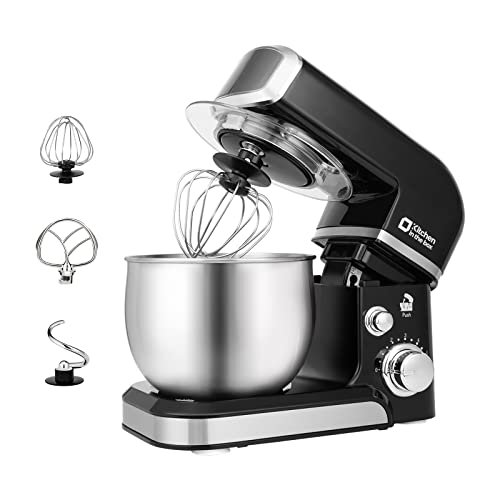
Kitchen in the box Stand Mixer 3.2Qt — Best Compact Bargain
Kitchen in the box built the bargain for the kitchens the big machines ignore: studios, small apartments, dorms and RVs. At 3.2 quarts it handles daily-scale baking — a small loaf, a cake, a half-batch of cookies, whipped toppings — in a lightweight body you can lift in and out of storage one-handed. Six speeds and the whisk, dough hook and flat beater trio mean compact did not mean amputated.
Strengths
- Genuinely portable and cupboard-friendly
- Full attachment trio despite the small size
- Six speeds cover daily baking properly
Trade-offs
- 3.2-quart bowl caps batch size firmly
- Light body prefers lighter doughs
- Not a family-size machine in any configuration
Key specs
- Bowl: 3.2 quart
- Speeds: 6
- Attachments: Egg whisk, dough hook, flat beater
- Character: Portable, lightweight
Small households are routinely mis-sold big mixers, then annoyed for years by the storage tax. This little machine inverts the deal: it is sized for the baking one or two people actually do, and its portability means it gets used instead of admired. Daily bread for two, weekend cakes, morning pancake batter — the repertoire fits. If your household grows, it becomes the second mixer or the gift that starts someone else’s baking habit; at its price, that is a fine lifecycle for a bargain.
The little Kitchen in the box machine wins a specific affection: it is the mixer that fits the life its owner actually has. Studio bakers report it living on the counter permanently — the only stand mixer here small enough to earn that honour in a tiny kitchen — and a machine on the counter is a machine in constant use. Its small loaves and cakes are sized for one or two, which quietly eliminates the stale-leftover problem of full-size baking.
Best for: apartments, couples and small households / Not suited for: families or batch bakers
Check on Amazon — check the current price on Amazon for the exact configuration described above.

Kitchen in the box Stand Mixer 8.5 QT 900 Watt — Best Heavy-Dough Bargain
This is the maximalist bargain: 8.5 quarts of bowl with a handle, a 900-watt-class motor pitched at heavy dough work, ten adjustable speeds, tilt-head access, and whisk, flat beater and splash guard included. It exists for the bakers the standard bargains frustrate — the sourdough devotee mixing for the neighbourhood, the holiday baker producing in volume, the big family for whom 6.5 quarts still meant two batches.
Strengths
- Largest bowl in this guide at a bargain-class price
- Power and speed range aimed at heavy dough
- Handled bowl and splash guard suit volume work
Trade-offs
- Very large footprint — measure before you fall for it
- Small batches are inefficient in this bowl
- Heaviest commitment here in storage terms
Key specs
- Bowl: 8.5 quart with handle
- Motor: 900 watts
- Speeds: 10
- Attachments: Whisk, flat beater, splash guard
Volume bakers should still buy with eyes open: capacity headlines tempt overloading, and even this machine deserves gradual flour addition and respect on the stiffest doughs. Used as intended, though, it converts bargain money into the one thing volume bakers cannot fake — room. Room for dough to develop, room for double and triple batches, room to grow into the baker you are becoming. If your kitchen has the counter and your life has the batches, this is the bargain that thinks biggest.
The big Kitchen in the box earns its place in production weekends: multiple loaves in one bowl, dough for a street’s worth of pizza, holiday batches that would take a standard mixer three rounds. Owners learn its scale quickly — this is a machine for bakers who think in kilograms — and its handled bowl proves its worth every time a full load needs moving to the bench. For the volume baker, it is less an appliance than a small bakery that happens to live at home.
Best for: volume and heavy-dough home bakers / Not suited for: small kitchens or small batches
Check on Amazon — check the current price on Amazon for the exact configuration described above.

Cuisinart Stand Mixer SM-50 5.5 Quart — Best Step-Up Bargain
The Cuisinart SM-50 is the bargain tier’s ceiling and its best long-term maths. Twelve speeds, including a genuinely gentle fold, a 5.5-quart stainless steel bowl at the practical sweet spot, and a quality attachment set — chef’s whisk, mixing paddle, dough hook, splash guard — from a brand with real parts support. It costs more than the budget picks and returns the difference every week in control, composure and longevity.
Strengths
- Twelve-speed finesse the budget tier cannot match
- 5.5-quart stainless bowl suits most households perfectly
- Brand support and attachment quality protect the investment
Trade-offs
- Highest price in this bargain guide
- Tilt-head class, not a bowl-lift commercial design
- Over-specified for a few-bakes-a-year household
Key specs
- Bowl: 5.5 quart stainless steel
- Speeds: 12
- Attachments: Chef’s whisk, mixing paddle, dough hook, splash guard
- Colour listed: White Linen (SM-50NAS)
Bargain thinking matures into cost-per-year thinking, and that is where the SM-50 wins. Spread over a decade of weekly baking, its premium over the budget tier is trivial, while its finer speeds, better bowl and calmer heavy work are felt constantly. It is the pick for the baker who has already owned the cheap mixer — or wisely refuses to. If you know baking is a permanent habit, this is not the expensive option; it is the option that avoids buying twice, which is the oldest bargain rule there is.
SM-50 owners are the guide’s buy-once witnesses: years in, the machine’s finer speeds and stainless bowl still feel like the correct decision, and the ‘bargain’ framing shifts to cost per bake, which by year three is trivial. It also holds the household’s special occasions — the tiered cake, the enriched holiday bread — with a composure the budget tier admires from below. If your baking habit is permanent, this is the pick whose price you will forget first.
Best for: committed weekly bakers buying once / Not suited for: rare bakers watching every dollar today
Check on Amazon — check the current price on Amazon for the exact configuration described above.
Comparison Table
The bargain field compressed: badge, headline specification and the household each machine serves. Use the table to shortlist by bowl size, then read those reviews in full — at the bargain tier, the difference between a triumph and a return is usually one honest paragraph about batch limits or attachment contents, and those paragraphs are the reviews’ whole purpose.
| Pick | Badge | Key spec | Best for |
|---|---|---|---|
| Hamilton Beach 4 Qt Electric Stand Mixer | Best Overall Bargain | 4 qt, planetary, full trio included | first stand-mixer buyers and small-to-mid households |
| Aucma Stand Mixer 6.5-QT 660W Tilt-Head | Best Big-Bowl Bargain | 6.5 qt bowl, 660W, tilt-head | large families and double-batch bakers |
| VIVOHOME Stand Mixer 6-Quart Tilt-Head | Best Alternative Big Bowl | 6 qt, tilt-head, entry price | hand-mixer upgraders needing bowl room |
| Kitchen in the box Stand Mixer 3.2Qt | Best Compact Bargain | 3.2 qt, 6 speeds, portable | apartments, couples and small households |
| Kitchen in the box Stand Mixer 8.5 QT 900 Watt | Best Heavy-Dough Bargain | 8.5 qt, 900W, 10 speeds | volume and heavy-dough home bakers |
| Cuisinart Stand Mixer SM-50 5.5 Quart | Best Step-Up Bargain | 5.5 qt, 12 speeds, stainless bowl | committed weekly bakers buying once |
How to Choose a Bargain Stand Mixer That Is Actually Worth It
Set your batch size before your budget. Write down the largest thing you genuinely bake — one loaf or two, a dozen cookies or four dozen — and let it choose the bowl: 3.2 to 4 quarts for standard single batches, 5.5 for family-plus, 6.5 and above only for true double-batch life. Bargain money wasted on the wrong size is not saved money; it is a daily tax on every bake.
Apply the bargain floor test: planetary or proven mixing action, the full beater-hook-whisk trio in the box, and a brand that will still answer for the machine next year. Any mixer failing one of those three is below the floor this guide sets, whatever its price tag says. Above the floor, differences become preferences — tilt-head access, speed count, finish — and you can choose freely among the picks here.
Consider your three-year self. Occasional bakers should minimise spend within the floor; weekly bakers should price the step-up Cuisinart into the comparison, because cost per year favours it quickly. And measure the storage space with a tape, not a hope: the best bargain is the one that lives where you can reach it, ready for Saturday.
Where Bargain Stand Mixers Cut Corners — and Where They Must Not
Every bargain mixer cuts something; the skill is buying one that cuts the right things. Acceptable cuts: finish and colour options, touchscreen theatre, app connectivity, bundled extras beyond the core trio, and the sheer mass of flagship machines. These cost money without improving a single batch, and the picks here trim them happily.
Unacceptable cuts — the ones that define false economy — are mixing action, attachment completeness and basic durability. A bargain mixer that leaves a ring of unmixed flour at the bowl’s edge, ships without a dough hook, or strains audibly on a standard loaf will cost you the full price of a second mixer within a couple of years. That is why this guide leads with planetary or proven action, audits the box contents of every pick, and states flour-limit honesty as a technique matter rather than a defect: even good bargains have batch ceilings, and knowing them is free.
One more corner to inspect: the bowl. Stainless steel outlasts and out-cleans plastic and glass at this tier, locks more positively, and survives being dropped. Several picks here include it; where a listing’s bowl differs, confirm on the listing page — bowl material is a legitimate reason to choose one bargain over another.
How to Get Premium Results from a Bargain Stand Mixer
Technique closes most of the gap between bargain and premium. These habits are worth more than the price difference between the tiers.
- Bring ingredients to room temperature. Cold butter and eggs fight any mixer; room-temperature ingredients cream faster, emulsify better and spare the motor — especially on bargain machines.
- Add flour in stages at the lowest speed, using the splash guard. Dumping a full measure at high speed creates flour clouds, tough dough and a straining motor in one motion.
- Respect the dough ceiling: if the machine rocks, labours or the dough climbs the hook relentlessly, split the batch. Two comfortable half-batches beat one destructive full batch, every time, at every price tier.
- Use the mixer’s patience. Creaming butter and sugar for a full five minutes and kneading for the recipe’s full time are free quality — the machine is doing the waiting, not you.
- Scrape the bowl once mid-mix with the machine off. Even planetary action appreciates one scrape on thick batters; it takes ten seconds and perfects the mix.
- Clean and store attachments with the machine, and run the motor briefly after washing-day storage to keep everything free. Bargains reward owners who maintain them — as do premiums.
Follow these steps and the honest conclusion of this guide holds: for home baking, a good bargain mixer plus good technique produces cakes and breads indistinguishable from flagship output. Spend the savings on ingredients — that is where guests taste the difference.
The First Month With a Bargain Mixer: What to Bake First
Sequence your first month to learn the machine while it teaches you. Week one belongs to batters — a simple cake and a batch of muffins — where the beater and low speeds build confidence and the splash guard earns its place. Everything is forgiving at this stage, and the goal is rhythm: ingredients staged, speeds changed deliberately, the bowl scraped once, the result eaten proudly.
Week two adds air: whipped cream, then egg whites. These teach the whisk and the top speeds, and they reveal your bowl’s small-job behaviour — the moment compact-bowl owners feel wise and big-bowl owners learn to tilt and scrape. Week three is cookies, the creaming masterclass: butter and sugar given their full minutes, eggs added gradually, dough finished at low speed. By now the machine’s sounds are familiar, which matters for week four.
Week four is bread — a standard single loaf, flour added gradually, the dough watched rather than timed. This is the bake that calibrates your sense of the machine’s ceiling: how it sounds working properly, how the dough should look clearing the bowl. Graduate from that loaf with respect for the limits you felt, and your bargain mixer is no longer an experiment; it is your mixer, with a known and trusted repertoire.
When a Bargain Is Not a Bargain: Reading the Warning Signs
Some listings fail the floor test in ways a careful reader can spot. Attachments sold separately is the loudest alarm — price the dough hook into the comparison and the bargain usually evaporates. Vague bowl-capacity language is another: quarts measured to the brim rather than to a working fill flatter every machine, so weight the reviews in this guide, which size bowls by the batches they actually hold, over headline numbers anywhere.
Motor claims deserve the same scepticism. A huge wattage figure beside a featherweight machine tells you the number is a peak marketing measurement, not working strength; gearing and action are the honest spec, which is why this guide leads with planetary action and bowl coverage instead. Weight itself is a clue — a stand mixer needs enough mass to stay planted under dough load, and the picks here have it in proportion to their bowls.
Finally, beware the one-season brand. A mixer is a decade-scale purchase of a machine with moving parts; a maker with no parts listings, no other appliances and no history is selling you a countdown. Every pick in this guide comes from a brand with a track record at its tier — in bargain hunting, that boring fact is worth real money.
How Do Bargain Mixers Handle the Hard Jobs: A Realistic Guide
Enriched doughs — brioche, panettone, milk breads heavy with butter and eggs — are the bargain tier’s examination. The technique that passes it is incorporation order: mix the base dough first, then add softened butter gradually, a knob at a time, letting each piece disappear before the next. Dumped in at once, butter turns any mixer into an ice rink; staged properly, even the compact picks here produce glossy, elastic enriched dough that would make a bakery nod.
Whole-grain and seeded doughs test torque differently: they are stiff early and relax late. Add liquid a spoonful beyond the recipe’s caution if the dough climbs and labours, knead in two shorter sessions with a rest between, and the bargain machines cope — the rest is not laziness but engineering sympathy, letting a hard-worked motor shed heat before the second effort.
Big whipped jobs invert the problem: a full bowl of cream or a dozen egg whites needs the whisk, a cold bowl and patience at rising speeds. Bargain mixers whip excellently — whipping is speed, not torque — and this is the job where the tier gap nearly vanishes. Chill the bowl for cream in summer, start medium, finish high, and your bargain machine will produce peaks indistinguishable from a flagship’s.
Frozen and very cold ingredients are the honest failure zone: butter straight from the fridge defeats beaters at every price, and frozen cookie dough portions should thaw before mixing. The flagship advantage here is smaller than marketing suggests — mostly mass and gearing — and the free fix, ingredient temperature, outperforms it. Room-temperature ingredients are the bargain owner’s superpower; use them and the tier gap narrows to almost nothing.
The pattern across all four jobs is the guide’s thesis: bargain mixers fail on technique gaps, not capability gaps, in the overwhelming majority of home bakes. Close the technique gap with the how-to section’s habits and the machines in this guide will cover a home baker’s entire repertoire — which is precisely what makes them bargains rather than compromises.
Reading Reviews Like a Bargain Hunter: Signal Versus Noise
Owner reviews of bargain mixers follow a pattern worth learning to read. Complaints about size almost always mean the buyer skipped the measurement step this guide insists on — a 6.5-quart machine is large in exactly the way its listing states. Complaints about dough ceilings usually trace to a single overloaded batch rather than a pattern, which is why this guide teaches the gradual-flour discipline instead of treating ceilings as defects. Learn to sort complaints into ‘buyer error the listing warned about’ and ‘genuine machine behaviour’, and review sections become useful instead of frightening.
Praise has its own noise. Five-word celebrations of a machine used twice tell you about delivery speed, not durability; the valuable praise is specific and dated — the owner who reports a year of weekly loaves, the holiday production survived, the attachment replaced easily under support. Weight those accounts heavily, because they describe the ownership you are actually buying at this tier: not perfection, but service.
The middle accounts are the gold. A four-star review that loves the mixing and notes the control feel, or praises the bowl and wishes for a second one, is describing the real machine with its real trade-offs — the same trade-offs this guide’s Strengths and Trade-offs lists exist to state in advance. When a review’s complaints match the trade-offs you have already accepted, that is not a warning; it is confirmation you are buying with open eyes.
Apply the same reading to this guide itself. Its claims are specific — bowl coverage, attachment contents, batch ceilings, storage footprints — and therefore checkable against the listing before you spend. A buying guide that cannot be checked is marketing; one that invites checking is a tool. Verify the trio in the box, verify the bowl size against your household, and the bargain you choose will be the bargain you get.
That is the bargain hunter’s real skill, worth more than any single recommendation here: converting other people’s experience and a listing’s fine print into a decision you do not revisit. The machines in this guide were chosen to survive that skill applied rigorously — which is why applying it is the best advice the guide can end its analysis with.
A Note on Seasons: When Bargains Are Biggest
Stand mixers are seasonal merchandise in a way most appliances are not: baking season — the autumn and holiday months — brings both the deepest promotions and the fastest stock movement, while the quiet weeks after the holidays often hold the year’s softest prices on the colours nobody gifted. A bargain hunter with patience can work either rhythm: buy in the promotional surge for selection, or in the January calm for price, checking the live listing either way rather than trusting any calendar — including this one — over the number on the page today.
The second seasonal truth is about your own kitchen: the best time to buy a stand mixer is a month before your baking season peaks, not during it. A machine learned in September is a trusted tool by the holiday production; a machine unboxed into December chaos gets blamed for the learning curve that any tier would have imposed. Buy early, run the first-month syllabus in this guide at leisure, and let the holidays meet a baker and a mixer who already understand each other.
Common Buying Mistakes
The first mistake is buying the absolute cheapest stand mixer available and calling it a bargain. Below the floor this guide sets — real mixing action, full attachments, kneading ability — lies the false-economy zone where machines fail early and bake badly. The bargain is the cheapest machine that does the job properly, not the cheapest machine.
The second is size mismatch in both directions: the 8.5-quart giant bought for a couple’s weekly cake, whipping egg whites badly and colonising the counter; or the 3.2-quart compact bought for a family of six, forcing triple batches forever. Match bowl to household with the same honesty you would match a shoe size.
The third is skipping the box audit. Attachments bought separately can double a bargain’s real cost. Every pick here includes the trio; if you shop beyond this list, price any missing beater, hook or whisk into the comparison before declaring a winner.
Finally, do not judge by wattage alone. Gearing and action decide kneading; wattage marketing decides little. The reviews above weigh what owners feel — bowl coverage, composure under load, speed range — because those are what your Saturdays will feel.
Final Recommendation
Start with the Hamilton Beach 4-quart for the balanced bargain, the Aucma or VIVOHOME for family-size bowls, the little Kitchen in the box 3.2-quart for small kitchens, and its 8.5-quart sibling for volume dough work. If baking is a settled weekly habit, skip the ladder and take the Cuisinart SM-50 — the step-up bargain that buys a decade.
Bargain pricing rotates quickly, so check the current price on Amazon for the exact model before ordering, and confirm the attachment set on the listing matches what the review describes. The best bargain on any given week is the one in this guide whose listing is sharpest that day.
Short on time? Go straight to the listings: Hamilton Beach 4 Qt Stand Mixer, Aucma 6.5-QT Stand Mixer, Cuisinart SM-50.
Related guides on this site: Best Bang For Your Buck Mixers Best Beginner Mixers Best 10 Quart Mixers Best Bar Spoons Coffee Mixers Best Battery Operated Protein Mixers Best Bang For Your Buck Audio Mixers
The bargain tier rewards the informed and punishes the hurried, and you are now informed: the floor test, the size match, the box audit, the technique habits. What remains is the simplest step in the whole process — choosing the machine whose bowl matches your household and whose price matches your week.
Check the live listing, confirm the trio is in the box, and put the savings toward ingredients. The first bake will tell you what this guide has argued for six thousand words: you bought exactly enough mixer, and it was plenty.
One last word of encouragement for the bargain hunter: the bakers whose kitchens run happiest are rarely the ones who spent the most — they are the ones whose machine matches their life so well that baking stopped being an occasion and became a rhythm, and every machine in this guide was chosen to be that match for somebody reading it today.
Frequently Asked Questions
How much should a good bargain stand mixer cost?
Judge by tier rather than a fixed figure: the genuine bargains sit above the failure-prone ultra-cheap zone and well below flagship pricing, with the core attachments included. Check the current price on Amazon for each pick here — promotions move these models between tiers regularly.
Can a bargain stand mixer knead bread dough?
Yes, within batch limits. The picks here knead standard loaves happily when flour is added gradually and quantities stay sensible for the bowl size. Repeated oversized, stiff batches are what kill budget motors — technique, not price, is usually the culprit.
What attachments should be included at this price?
Flat beater, dough hook and wire whisk are the non-negotiable trio, and every stand mixer in this guide includes them. A splash guard is a welcome bonus. Anything missing will cost real money later and quietly unmakes the bargain.
Is a bigger bowl always better?
No. Oversized bowls whip small quantities poorly and consume storage. Match the bowl to your household: 3.2 to 4 quarts for one or two people, 5.5 for most families, 6.5 and above for double-batch and crowd baking.
Tilt-head or bowl-lift at the bargain tier?
Tilt-head dominates this tier for good reason: simpler, cheaper, easier access for adding ingredients. Bowl-lift strength matters for heavy daily dough production, which is a different budget conversation.
How long will a bargain stand mixer last?
With sensible loads and basic care, years of weekly use is a fair expectation for the machines here. The pattern to avoid is chronic overloading — it, not the calendar, is what shortens a budget mixer’s life.


