Disclosure: airfryerkitchensupply.com is reader-supported. When you buy through links on our site, we may earn an affiliate commission at no extra cost to you.
Where to buy
Shopping for the best bbq grills under 200 dollars starts with verified listings, not with the loudest discount banner. Every pick in this guide was verified against a live Amazon listing. Prices in this tier move constantly with seasons and sales, so this page prints none: use the links to check the current price on Amazon, and treat the under-$200 figure as the budget frame these models are positioned in, not a promise about today’s tag.
- Weber Original Kettle Charcoal Grill, 22-Inch (Best Overall) — Check the current price on Amazon
- Weber Original Kettle Charcoal Grill, 18-Inch (Best Budget) — Check the current price on Amazon
- Char-Griller AKORN Jr. Portable Kamado Charcoal Grill and Smoker (Best Kamado Value) — Check the current price on Amazon
- George Foreman Indoor/Outdoor Electric Grill with Stand (Best for Balconies and Indoors) — Check the current price on Amazon
- Coleman RoadTrip 285 Portable Propane Grill (Best Portable) — Check the current price on Amazon
- Cuisinart CEG-115 2-in-1 Portable Outdoor Electric Grill (Best Tabletop Electric) — Check the current price on Amazon
What the Best BBQ Grills Under 200 Dollars Can Honestly Do
Shopping for the best bbq grills under 200 dollars means accepting one honest trade from the start: at this budget you are buying cooking ability, not heirloom construction. The good news is that cooking ability is genuinely available here. A simple charcoal kettle in this tier can sear a steak as hard as a grill costing five times more, because charcoal heat is charcoal heat. What the budget removes is thickness of steel, size of cooking area, and the long parts support you get from premium lines — not the ability to put a proper crust on dinner.
This tier splits into three honest families. Charcoal kettles and small kamados deliver the most real grilling per dollar and dominate our picks. Portable propane models earn a place for tailgates, camping and small patios, though full-size cart gas grills at this price are usually built so thin that we would rather steer you to charcoal. Electric grills fill the last niche: buildings that ban open flame. If your lease or HOA forbids charcoal and gas, an electric pick below is not a compromise pick — it is the only legal way to grill, and the better ones cook far better than their reputation suggests.
One warning before the picks: this is the tier where no-name listings multiply fastest, with inflated burner counts and cooking areas measured in ways no tape measure would agree with. Every model below is from a brand with a real parts catalog, verified on Amazon, and chosen because its design is simple enough that a low price does not automatically mean a short life.
In this guide
Quick Picks
Six picks, six different jobs. Every model below was verified on Amazon, and each badge is used consistently through the reviews that follow, so you can scan this list now and read the reasoning after.
Weber Original Kettle Charcoal Grill, 22-Inch — Best Overall. The 22-inch Weber kettle is the default answer at this price for a reason: a real two-zone fire, parts available everywhere, and a design that has been refined for decades. If you buy one grill in this tier, buy this one. Check on Amazon
Weber Original Kettle Charcoal Grill, 18-Inch — Best Budget. The 18-inch kettle is the same proven design shrunk for smaller households and smaller budgets — the cheapest route to genuine charcoal grilling from a brand that will still sell you a grate in ten years. Check on Amazon
Char-Griller AKORN Jr. Portable Kamado Charcoal Grill and Smoker — Best Kamado Value. A real insulated kamado at a tabletop size: the AKORN Jr. holds low smoking temperatures and ripping-hot searing heat in the same small body, and sips charcoal while doing it. Check on Amazon
George Foreman Indoor/Outdoor Electric Grill with Stand — Best for Balconies and Indoors. A 15-serving electric grill on a removable stand: no flame, no fuel runs, and a cooking surface big enough for a family — the pick where charcoal and gas are banned outright. Check on Amazon
Coleman RoadTrip 285 Portable Propane Grill — Best Portable. A folding, wheeled portable with three burners and push-button ignition: the RoadTrip 285 sets up at a tailgate or campsite in minutes and cooks like a small patio grill, not a toy. Check on Amazon
Cuisinart CEG-115 2-in-1 Portable Outdoor Electric Grill — Best Tabletop Electric. An electric grill that genuinely gets hot — 550°F from a wall outlet — and works on its stand or as a tabletop unit, for cooks who want real searing without any flame at all. Check on Amazon
How These Picks Were Chosen
We started with every grill Amazon lists in this budget frame across charcoal, gas, pellet and electric, then cut the list by rules that matter at this price. First, the brand must sell replacement parts — grates, igniters, ash pans — because a cheap grill you cannot repair is the most expensive kind. Second, the design had to be simple: at this tier, every extra feature is a future failure point, so basic kettles and straightforward portables scored ahead of feature-stuffed carts. Third, the grill had to cook honestly — enough grate space for a family meal and a lid that seals well enough to hold temperature.
We verified each surviving model against Amazon listing data, recorded its ASIN and listing title, and used only the specifications the listing itself states. Where a fuel type is thin at this price — full-size gas carts and pellet grills, for example — we say so in the review rather than padding the list with a model we would not buy. Six picks survived, one for each job this budget is actually asked to do.
The 6 Best BBQ Grills Under $200

Weber Original Kettle Charcoal Grill, 22-Inch — Best Overall
This is the pick for anyone whose priority is the food itself. The 22-inch kettle gives you room to run a hot searing zone and a cooler indirect zone side by side, which is the single technique that separates grilling from merely cooking outdoors. It suits first-time buyers who want to learn real fire management and experienced cooks who know a kettle’s ceiling is set by the cook, not the equipment.
Strengths
- Two-zone cooking is easy with the wide 22-inch grate
- One-Touch cleaning sweeps ash into the catcher in seconds
- Replacement grates, dampers and lids are sold everywhere
Trade-offs
- No built-in thermometer on this base model
- Charcoal takes longer to light than gas
- Thin legs feel basic next to premium carts
| Specification | Detail (from the Amazon listing) |
|---|---|
| Fuel | Charcoal |
| Grill size | 22-inch kettle |
| Cleaning | One-Touch cleaning system |
What keeps the kettle on top of this tier is thermal honesty. The bowl shape concentrates heat for searing, the dampers give you real control over airflow, and the porcelain-enameled steel shrugs off weather that would rust a bargain gas cart’s firebox in two seasons. Burgers, steaks, whole chickens under a banked fire, ribs run indirect for a couple of hours — the kettle does all of it without a single part that can electronically fail. Assembly is a short job, and the learning curve is the good kind: every cook teaches you something about fire.
Best for: Most buyers in this tier who want real charcoal flavor and room to learn two-zone cooking / Not suited for: Anyone who needs push-button gas convenience or a built-in temperature gauge
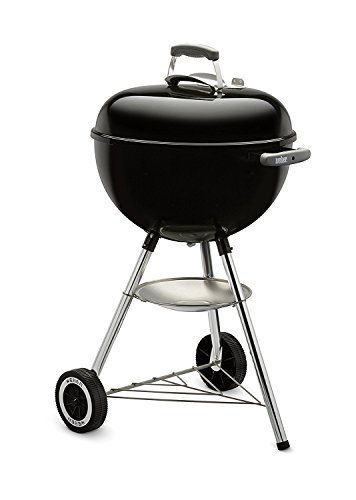
Weber Original Kettle Charcoal Grill, 18-Inch — Best Budget
Choose the 18-inch kettle if you usually cook for one to three people and your patio, balcony or storage space is tight. It lights faster than its bigger sibling because the charcoal bed is smaller, it sips fuel, and it stores in a corner that a cart grill could never occupy. Couples, small families and apartment dwellers with permission for charcoal get nearly all of the kettle experience here.
Strengths
- Smallest footprint of any pick here
- Uses less charcoal per cook than the 22-inch
- Same One-Touch ash cleaning as the bigger kettle
Trade-offs
- Grate space gets crowded beyond three servings
- Two-zone fires are tighter to manage
- Too small for a whole packer brisket or big parties
| Specification | Detail (from the Amazon listing) |
|---|---|
| Fuel | Charcoal |
| Grill size | 18-inch kettle |
| Cleaning | One-Touch cleaning system |
The honest question with the 18-inch is capacity, and the honest answer is that most weeknight grilling is smaller than people imagine: four burgers, a pair of steaks, six chicken thighs, a skewer lineup — all fit with room to spare. Where it struggles is the holiday cookout, when a second batch has to wait on the first. If your grill’s busiest day of the year is the deciding factor, step up to the 22-inch. If its typical Tuesday is, this smaller kettle saves money, charcoal and space on every single cook.
Best for: Singles, couples and small-space cooks who grill modest portions often / Not suited for: Hosts who regularly cook for six or more people at once

Char-Griller AKORN Jr. Portable Kamado Charcoal Grill and Smoker — Best Kamado Value
The AKORN Jr. is for the cook who wants kamado behavior — steady low-and-slow heat and serious searing — without kamado size or kamado money. Its triple-wall insulated steel body holds temperature with remarkably little charcoal, which makes it a quiet budget win over a season of cooks. It works as a tailgate and camping grill too, though ‘portable’ here means luggable by one strong person, not featherweight.
Strengths
- Insulated body holds smoking temperatures steadily
- Cast iron grates leave proper sear marks
- Extremely fuel-efficient compared with open kettles
Trade-offs
- Cooking area suits small batches only
- Heavier than its size suggests
- Kamado airflow takes a few cooks to learn
| Specification | Detail (from the Amazon listing) |
|---|---|
| Fuel | Charcoal (kamado) |
| Format | Portable kamado |
| Body | Triple-wall insulated steel |
| Grates | Cast iron |
Kamado cooking is about stored heat: the insulated walls absorb energy and radiate it back evenly, so the fire does not swing every time you lift the lid. In this Jr. format that translates to a grill that can smoke a small pork shoulder on a modest pile of lump charcoal and then, vents opened, sear steaks over a genuinely fierce fire. The trade is space — plan on cooking in waves for a crowd. For one or two households, or as a second grill beside a big gas cart, it is the most capable small charcoal cooker in this guide.
Best for: Small households that want kamado temperature control and fuel efficiency / Not suited for: Anyone cooking for crowds or wanting a featherweight camping grill
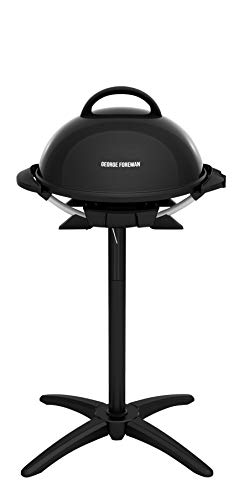
George Foreman Indoor/Outdoor Electric Grill with Stand — Best for Balconies and Indoors
If your building bans open flame, this is your grill, and it is a better one than the ban suggests. The large domed cooking surface handles a full family batch of burgers or chicken, the stand puts it at comfortable grilling height on a balcony, and the whole top lifts off the stand for tabletop or indoor use. It suits renters, condo owners and anyone whose grilling has to happen under a roof or a strict lease.
Strengths
- Legal where charcoal and propane are prohibited
- Big 15-serving surface cooks for a family at once
- Removable stand converts it to a tabletop grill
Trade-offs
- No charcoal or smoke flavor
- Heat recovery is slower than gas after loading cold food
- Needs an outdoor-rated outlet within cord reach
| Specification | Detail (from the Amazon listing) |
|---|---|
| Fuel | Electric |
| Capacity | 15-serving cooking surface |
| Format | Removable stand, indoor/outdoor |
Electric grilling lives or dies on surface temperature and recovery, and the Foreman’s large plate does steady, even work once it is fully preheated — the key habit is giving it time and not crowding the surface, so food sears instead of steaming. The sloped plate and drip tray also make it one of the easiest grills here to clean, a real consideration for balcony cooking where a greasy cleanup in a kitchen sink beats scrubbing a firebox outside. It will not perfume the neighborhood, but it grills dinner any night of the week, in any weather, steps from the kitchen.
Best for: Renters and condo owners under flame bans who still want to cook for a family / Not suited for: Flavor-first cooks who want charcoal smoke in the food
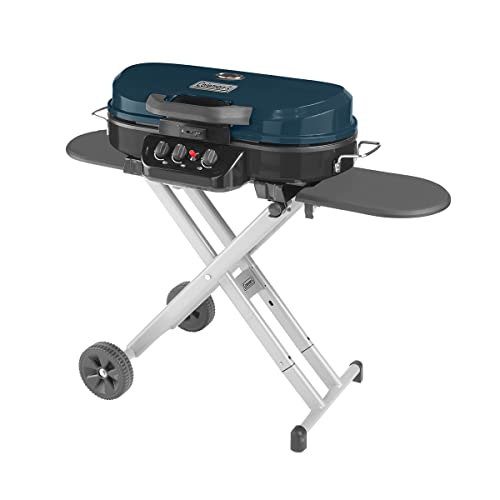
Coleman RoadTrip 285 Portable Propane Grill — Best Portable
Buy the RoadTrip 285 if your grilling happens away from home — tailgates, campsites, picnics, the beach parking lot — or if your patio is so small that the grill must fold away after dinner. The collapsible wheeled stand is the point: it rolls like luggage, stands at full height, and the three-burner layout gives you a hot zone and a gentle zone on the same grate, which most portables cannot do.
Strengths
- Folding wheeled stand sets up and packs fast
- Three burners allow real zone cooking for a portable
- Instastart ignition lights without matches
Trade-offs
- Sits at the very top of this budget frame
- Heavier than tabletop portables
- Uses small propane canisters unless you add an adapter hose
| Specification | Detail (from the Amazon listing) |
|---|---|
| Fuel | Propane gas (portable) |
| Burners | 3 |
| Output | 20,000 BTU |
| Ignition | Instastart |
Most portable grills are one-burner compromises; the RoadTrip’s three burners across a wide grate let you sear brats on one side while onions soften on the other, and that changes what a campsite menu can be. The trade-offs are honest ones: it lives at the top of this tier’s budget frame, and at this size ‘portable’ means car camping, not backpacking. Owners who grill at home more than away should put the money into the kettle instead. Owners whose grill rides in the trunk all summer will not find a better fit in this guide.
Best for: Tailgaters, campers and small-patio cooks who need a grill that folds and rolls / Not suited for: Backpackers or buyers who grill almost exclusively at home

Cuisinart CEG-115 2-in-1 Portable Outdoor Electric Grill — Best Tabletop Electric
The CEG-115 suits the buyer who looked at the balcony ban, accepted it, and still wants grill marks. Its headline trait is heat: many electrics top out at temperatures that steam meat, while this one is built to reach a true searing temperature from an ordinary outlet. The 2-in-1 format means it stands on its own for patio use and drops to a tabletop for a counter or picnic table, which suits small households that grill in more than one place.
Strengths
- Reaches a true searing temperature on household power
- Stand or tabletop formats in one unit
- Compact footprint for small patios and storage
Trade-offs
- Cooking area is sized for small households
- Cord length dictates where it can live
- No smoke flavor without adding it yourself
| Specification | Detail (from the Amazon listing) |
|---|---|
| Fuel | Electric |
| Max heat | 550°F from a wall outlet |
| Format | Stand or tabletop use |
Judged as an electric, the CEG-115 does the two things that matter: it gets hot enough to brown, and its thermostat recovers reasonably when food lands. Judged as a grill, its limits are space and flavor — plan on batches for more than three or four servings, and accept that smoke has to come from a smoker box alternative or marinades rather than the fuel. For a small household under a flame ban that found the big Foreman more grill than it needs, this is the tidier answer, and it stores in a closet when the season ends.
Best for: Small households under flame bans that want genuine electric searing in a compact unit / Not suited for: Families cooking large batches or cooks chasing charcoal flavor
Comparison Table
| Pick | Badge | Key spec | Best for |
|---|---|---|---|
| Weber Original Kettle Charcoal Grill, 22-Inch | Best Overall | Fuel: Charcoal; Grill size: 22-inch kettle | Most buyers in this tier who want real charcoal flavor and room to learn two-zone cooking |
| Weber Original Kettle Charcoal Grill, 18-Inch | Best Budget | Fuel: Charcoal; Grill size: 18-inch kettle | Singles, couples and small-space cooks who grill modest portions often |
| Char-Griller AKORN Jr. Portable Kamado Charcoal Grill and Smoker | Best Kamado Value | Fuel: Charcoal (kamado); Format: Portable kamado | Small households that want kamado temperature control and fuel efficiency |
| George Foreman Indoor/Outdoor Electric Grill with Stand | Best for Balconies and Indoors | Fuel: Electric; Capacity: 15-serving cooking surface | Renters and condo owners under flame bans who still want to cook for a family |
| Coleman RoadTrip 285 Portable Propane Grill | Best Portable | Fuel: Propane gas (portable); Burners: 3 | Tailgaters, campers and small-patio cooks who need a grill that folds and rolls |
| Cuisinart CEG-115 2-in-1 Portable Outdoor Electric Grill | Best Tabletop Electric | Fuel: Electric; Max heat: 550°F from a wall outlet | Small households under flame bans that want genuine electric searing in a compact unit |
How to Choose a BBQ Grill in This Budget Frame
Start with fuel, because at this price fuel decides everything else. Charcoal gives the most heat, the most flavor and the simplest, longest-lasting hardware per dollar — and asks for lighting time and ash cleanup in return. Propane gives speed and control, but a full-size gas cart built to this budget usually cuts the firebox and burners so thin that charcoal is the smarter buy; gas makes sense here mainly in portable form. Electric gives permission: it is the only option where flame is banned, and it trades smoke flavor for the ability to grill on a balcony at all. Pellet grills, honestly, do not exist at this tier from brands we would recommend — if pellet cooking is your goal, the budget frame has to rise, and our higher-tier guides cover the entry models.
Next, size the grate to your real life, not your biggest party. A 22-inch kettle or a 15-serving electric covers a family of four with room to spare; an 18-inch kettle or a compact kamado covers one to three people and uses less fuel doing it. Count burners only on gas models, and treat the number as a zoning tool — two heat zones matter more than raw totals. Finally, check the unglamorous details: a lid that seals, dampers or controls that move smoothly, and a brand that lists replacement grates and parts. In this tier, repairability is the difference between a five-year grill and a two-season one.
Charcoal vs. Gas vs. Electric When Money Is Tight
The strongest argument for charcoal at this budget is physics: a modest pile of briquettes produces heat no budget gas burner can match, and the hardware is a steel bowl, a grate and dampers — almost nothing to break. The strongest argument against it is time: twenty minutes to light, ash to empty, and a learning curve for temperature control. Gas answers with a knob and instant flame, which is why busy weeknight cooks love it, but the budget versions concentrate cost in the cart and cosmetics, leaving thin burners that flare and rust. That is exactly why our gas pick in this tier is a portable built by a camping brand rather than a shiny full-size cart.
Electric is the specialist. It cannot smoke, and it will never match charcoal’s peak heat across a whole grate, but the better models sear credibly and — decisive for many buyers — they are allowed where the other two fuels are not. If you are choosing between fuels under a flame ban, the choice is already made; spend your decision energy on surface size instead. If you have no ban, the kettle-versus-portable-gas question comes down to where you grill: at home, charcoal wins on food; away from home, the folding gas portable wins on logistics.
Getting the Most From a Budget Grill: Setup and Care
Whatever you buy in this tier, three habits multiply its life and its cooking quality. First, season and protect the grates: a light coat of high-heat oil after cleaning keeps porcelain and cast iron from rusting, and a cover — even an inexpensive one — keeps rain out of the ash pan and firebox, which is where budget grills die. Second, manage ash like it matters, because it does: ash left in a kettle absorbs moisture, turns corrosive, and chokes airflow on the next cook. Empty it once cool, every time. Third, cook with the lid and zones rather than against them: bank charcoal to one side for a safe zone, preheat longer than you think you need, and let the grill’s stored heat do the searing.
For gas portables, the equivalent habits are checking the regulator connection with soapy water at the season’s start, clearing the burner ports with a soft brush when flames turn lazy and yellow, and storing canisters disconnected and upright. For electrics, it is simpler still: preheat fully with the lid down, keep the drip tray emptied, and never use an indoor extension cord that is not rated for the load. None of this costs money. All of it is the difference between a cheap grill and an inexpensive one — the first is a purchase you repeat, the second is a tool you keep.
How to Set Up Two-Zone Charcoal Cooking (and Use It on Any Grill Here)
Two-zone cooking is the one technique that makes a budget grill perform like an expensive one, because it gives you both a searing zone and a safe zone on the same grate. On a kettle or kamado, light a full chimney of charcoal, let it ash over completely, then pour it onto one half of the charcoal grate and spread it into an even bank. The other half stays empty. Put the cooking grate on, lid down, vents open, and give the grill a full ten minutes to preheat. Food starts over the coals for color and crust, then moves to the empty side to finish gently with the lid on — thick steaks, chicken pieces and sausages all cook through without burning.
On the portable gas grill in this guide, the same idea is built in: light the burners on one side to high and leave the other side low or off, close the lid, and preheat. Sear over the lit side, finish over the gentle side. On the electrics, you cannot create two zones, so imitate one: preheat fully, sear in uncrowded batches, and rest cooked food on a warm plate tented with foil while the next batch goes on. In every case the discipline is the same — do not crowd the hot zone, do not skip the preheat, and use the lid as an oven once the crust is set. Master that rhythm and the price of the grill stops being the limiting factor at dinner.
A Week of Real Cooking on a Budget Grill: What to Expect
Monday-night burgers on the 22-inch kettle take twenty minutes from match to plate once the routine is yours: chimney lit while you season, coals banked to one side, burgers over the fire, buns on the cool side at the end. The grill’s small appetite for ceremony is its weeknight virtue — there is no control panel to fail, no tank to gauge, just a fire you made. Wednesday chicken pieces run indirect, skin crisping in the banked heat while you make a salad indoors. Nothing about these cooks feels like a compromise, which is the discovery most budget-kettle owners make in their first month: the food was never the cheap part.
The weekend is where the tier’s differences show. The kettle and the kamado Jr. can both run a few hours of low cooking — ribs, a small shoulder — but they ask for opposite temperaments: the kettle wants an occasional vent nudge and a coal check, the kamado wants to be left alone. The RoadTrip, meanwhile, leaves the patio entirely and cooks at the lake, which no amount of home-grill quality can imitate. And the electrics simply wait, patient and legal, for the balcony cook who gets home at seven and eats at seven-thirty. Choosing in this tier is really choosing which of those weeks is yours.
Storage and weather write the last paragraph of budget ownership. Kettles live happily under an inexpensive cover for years; their enemies are only standing water in the ash and neglect of the one moving system they have. The portables live indoors, which flatters their longevity. The electrics live wherever the cord reaches and ask for a wiped plate. None of the six requires a garage, a technician or a parts prayer — and that simplicity, more than any specification, is what this budget frame is actually selling.
Charcoal, Briquettes and the Budget Cook’s Fuel Drawer
Fuel choice quietly decides how a budget charcoal grill cooks. Standard briquettes are the kettle’s natural partner: uniform, long-burning and predictable, they make two-zone fires and snake arrangements behave the same way every time, which is how beginners build skill. Lump charcoal burns hotter and cleaner with less ash, and it is the kamado’s preference — its irregular pieces suit the insulated firebox, and its fast response rewards the vent discipline the AKORN Jr. teaches. Neither is ‘better’; they are matched to different cookers and different cooks, and most households settle on one within a season.
What to avoid is the false economy drawer: accelerant-soaked briquettes that perfume the food, half-bags of damp charcoal that will not light cleanly, and the giant bargain sack whose dust and fragments choke airflow in a kamado. Store fuel dry, off the floor, and buy the size you will use within a season or two. A chimney starter — the cheapest accessory in grilling — makes all of it moot to light: no fluid, no fumes, fifteen minutes to a working fire. At this tier, where the grill itself costs little, fuel discipline is the highest-return skill you can own, and it costs nothing but attention.
Assembly Day and Your First Three Cooks
Assembly at this tier is mercifully short, and it is worth doing slowly anyway. The kettles go together in well under an hour: legs, ash catcher, dampers, grate — and the one instruction that matters is to leave the fasteners finger-tight until the whole frame stands square, then snug them in sequence. The kamado Jr. asks you to check its bands and gasket alignment before the first fire, because its efficiency lives in its seal. The RoadTrip’s stand rewards a practice fold and unfold on the patio before it ever meets a campsite. The electrics need nothing but a wiped plate and a full preheat — but give them that preheat empty, once, to burn off factory residues before food ever touches the surface. Every grill in this guide deserves one empty burn-in cook; it seasons, it tests, and it teaches you the controls with nothing at stake.
First cook: something forgiving. On charcoal, burgers over a two-zone fire — you will learn more about your new grill’s heat map from twelve burgers than from any manual, and the cool zone forgives every mistake in real time. On the RoadTrip, the same burgers teach you its burner layout and its lid behavior. On the electrics, cook chicken thighs: they are tolerant, they brown visibly when the surface is right, and they will tell you honestly whether your preheat was long enough. Resist the urge to debut with a dinner party. The first cook is a rehearsal, and treating it as one is the difference between a confident second cook and a superstitious owner.
Second cook: something indirect. A whole chicken on the kettle, a small rack of ribs on the kamado, a tray of vegetables under the RoadTrip’s lid — the cook that teaches you your grill’s low-temperature personality, which is where its character lives. Take notes, literally: vent positions, times, what you would change. Third cook: repeat the first cook and notice how much better it goes. That delta — three cooks wide — is the entire learning curve of this tier’s honest designs, and it is why we recommend simple grills to beginners: the equipment stops being the variable almost immediately, and the cooking becomes the hobby.
A word on the first month’s shopping list, because this tier attracts gadget enthusiasm it has not earned: a chimney if you bought charcoal, a cover that fits, a brush suited to your grate material, and tongs you like. That is the whole list. Everything else — and the internet will suggest plenty — should wait until a specific cook asks for it by name. Budget grilling’s charm is its ratio of dinner to equipment, and the owners who protect that ratio in month one are the ones still grilling happily, on the same simple tools, in year five.
Placement, Clearances and Safe Habits at This Tier
Small grills tempt casual placement, and small grills are exactly where placement discipline matters most, because they get used on balconies, tailgate tables and crowded patios. Keep every charcoal and gas pick here on a stable, level, non-combustible surface, well clear of siding, railings, overhangs and anything that can blow into the fire — a kettle’s chimney plume and a portable’s flare both reach farther than new owners expect. Never use charcoal or gas indoors or in a garage, including ‘just to finish’ in the rain: carbon monoxide is the invisible line in this hobby, and it does not negotiate. The electrics are the indoor-adjacent exception, and even they want clearance from curtains and a circuit that is not already loaded.
Build the three reflexes of safe budget grilling in your first season. First, the ash reflex: charcoal is fully cold — a full day, not an hour — before it goes anywhere near a bin, and a metal ash can with a lid is the budget tier’s best safety purchase. Second, the gas reflex: connections checked with soapy water at the season’s start and whenever a canister or tank changes, and canisters stored disconnected, upright and outdoors. Third, the supervision reflex: a lit grill is an attended grill, and children and pets learn the hot zone’s boundary the way they learn the stove’s. None of this requires money, and all of it is what separates the households that grill for decades from the ones with a story. The grills in this guide are simple; let your habits be as reliable as they are.
Common Buying Mistakes
Buying the biggest gas cart the budget allows
A full-size gas cart squeezed into this frame pays for its size with a thin firebox, thin burners and fasteners that loosen. A smaller charcoal kettle at the same money cooks better and lasts longer. Size is only a feature when the structure underneath it is sound.
Judging a grill by its advertised cooking area
Listings often count warming racks and every square inch of grate geometry. Compare primary grate space, and remember that a 22-inch kettle’s usable two-zone layout beats a larger but single-zone surface for real cooking.
Skipping the preheat to save time
Cold grates and a cold lid are why budget grills get blamed for steaming meat. Ten minutes of preheating stores the heat that sears. It is the cheapest performance upgrade in this entire guide.
Leaving ash and grease to ‘burn off later’
Ash plus moisture corrodes kettles from the inside, and old grease is what turns a flare-up into a fire. Five minutes of cleanup after the grill cools is what separates a five-year grill from a two-season one.
Ignoring your building’s rules until after delivery
Charcoal and propane bans in apartments and condos are common and enforced. Check the lease and local rules first; if flame is banned, the electric picks in this guide are the right answer, not a loophole.
Final Recommendation
If you buy one grill from this guide, make it the Weber Original Kettle 22-Inch: it is the most complete cooker here and the one we would hand to any beginner or budget-minded cook. Households of one to three should save money and space with the 18-inch kettle, and small households chasing kamado control should look at the AKORN Jr. Renters under a flame ban are well served by the George Foreman for family-size batches or the compact Cuisinart CEG-115 for smaller ones, and anyone whose grill travels should take the folding Coleman RoadTrip 285.
If your budget can stretch even one frame higher, the next tier changes the conversation — better charcoal models with thermometers and hinged grates, and the first gas grills built sturdily enough to recommend. Read our guides to the Best Bbq Grills Under $250 and Best Bbq Grills Under $300 before you decide, compare the gas-only view in Best Bbq Gas Grills Under $200, and if portability is the theme, see Best Bbq Camp Grills and the simple, honest starters in Best Basic Grills.
If you are ready to buy, start with the top of the list: Weber Original Kettle Charcoal Grill, 22-Inch, Weber Original Kettle Charcoal Grill, 18-Inch, Char-Griller AKORN Jr. Portable Kamado Charcoal Grill and Smoker — and check the current price on Amazon for the configuration you choose.
Frequently Asked Questions
Can you actually get a good grill at this price?
Yes — if you spend the money on cooking hardware instead of cart cosmetics. A simple charcoal kettle in this tier sears as well as grills costing far more, because the heat source is the same. What you give up is size, steel thickness and premium parts support, not the ability to cook well.
Is a cheap gas grill better than a cheap charcoal grill?
For most buyers, no. Full-size gas carts built to this budget usually have thin fireboxes and burners that age fast, while a charcoal kettle at the same money is nearly indestructible. Gas earns its place in this tier in portable form, where the design brief is different and the better camping brands build honestly.
How long will a budget grill last?
A kettle that is emptied of ash and kept covered can serve for many years, and its grates and dampers are replaceable. Thin gas carts typically age out in a few seasons as burners and igniters fail. Care habits — ash removal, covers, dry storage — matter more at this price than at any other.
What size grill does a family of four need?
A 22-inch kettle or an electric with a family-size surface handles four servings with working room. An 18-inch kettle works if you are comfortable cooking in two quick batches. Count your typical cook, not your largest gathering — renting or borrowing for the one big party is cheaper than heating an oversized grill all year.
Are electric grills worth it if I am allowed charcoal?
If charcoal is legal where you live and you enjoy it, charcoal gives more flavor and heat for the money. Electric earns its keep where flame is banned, where storage is indoor, or where you want to grill on a weeknight with zero setup. It is a permission and convenience choice, not a performance one.
Why are there no pellet grills in this guide?
Because at this budget frame there is no pellet grill from an established brand that we could verify and honestly recommend; the mechanics — auger, fan, controller, hopper — cannot be built soundly at this price. Pellet picks start appearing in our higher-tier guides, where the entry models are real products with parts support.
What is the cheapest accessory that improves every cook here?
A chimney starter for the charcoal picks — it lights fuel evenly without fluid and pays for itself in a few cooks — and, across all fuels, an instant-read thermometer. Together they cost very little and remove the two biggest beginner variables: uneven fires and guessed doneness.
Can I leave these grills outside all year?
The kettles and kamado can live outdoors under covers indefinitely, with ash removed and grates oiled. The portables and electrics live longer stored indoors or under deep shelter. In every case the cover goes on cold, and gas tanks are stored disconnected, upright and outside.


