Disclosure: airfryerkitchensupply.com is reader-supported. When you buy through links on our site, we may earn an affiliate commission at no extra cost to you.
Where to buy
Shopping for the best bbq grills under 300 dollars starts with verified listings, not with the loudest discount banner. Every model below was verified against a live Amazon listing, with specifications taken only from those listings. No prices are printed in this guide — they change too often to be trustworthy in print — so check the current price on Amazon for each pick, and read the under-$300 figure as the budget frame these grills are positioned in.
- Char-Griller AKORN 20-Inch Kamado Charcoal Grill and Smoker (Best Overall) — Check the current price on Amazon
- Weber Master-Touch Charcoal Grill, 22-Inch (Best Premium Kettle) — Check the current price on Amazon
- Weber Original Kettle Premium Charcoal Grill, 22-Inch (Best Kettle for Indirect Cooking) — Check the current price on Amazon
- Char-Broil Classic 3-Burner Propane Gas Grill (Best Budget Gas) — Check the current price on Amazon
- Blackstone 1883 Original 28-Inch Omnivore Griddle with Hood (Best Griddle) — Check the current price on Amazon
- Char-Broil Patio Bistro TRU-Infrared Electric Grill (Best Electric) — Check the current price on Amazon
The Best BBQ Grills Under 300 Dollars: Where Kamados and Premium Kettles Meet
The best bbq grills under 300 dollars are where grilling stops being a compromise category. At this frame the kamado — insulated, efficient, capable of both pizza-hot searing and all-day smoking — becomes available in full size from a real brand. The premium kettle gains its full working kit. The gas and electric picks stop apologizing. If the tiers below this one are about cooking well despite the budget, the best bbq grills under 300 are about cooking well, period, with the budget simply deciding which excellent tool you take home.
The headline here is versatility per dollar. The AKORN kamado in this guide grills, smokes, roasts and bakes in one insulated steel body at a fraction of ceramic kamado money, and it does it while using less charcoal than an open kettle. Around it, this guide keeps the strongest representatives of the other fuels: the fully-equipped kettle for classic two-zone cooking, a compact infrared electric for balconies, the griddle for flat-top menus, and the value gas cart for weeknight speed.
What this frame still asks of you is a fuel decision, because no pick here does everything. The kamado is the closest thing to a universal cooker, but it is charcoal-slow to start and modest in grate size. Read the reviews with your menu in mind — that, more than any specification, is what separates the right pick from the merely good one.
In this guide
Quick Picks
Six picks, six different jobs. Every model below was verified on Amazon, and each badge is used consistently through the reviews that follow, so you can scan this list now and read the reasoning after.
Char-Griller AKORN 20-Inch Kamado Charcoal Grill and Smoker — Best Overall. A full-size insulated kamado that grills, smokes, roasts and sears on a fraction of the charcoal — the most versatile cooker in this frame and the easiest recommendation here. Check on Amazon
Weber Master-Touch Charcoal Grill, 22-Inch — Best Premium Kettle. The kettle in its most complete form in this frame: lid holder, One-Touch cleaning and the classic 22-inch two-zone layout, for cooks who want the kettle experience with nothing left to wish for. Check on Amazon
Weber Original Kettle Premium Charcoal Grill, 22-Inch — Best Kettle for Indirect Cooking. The Premium kettle’s lid thermometer and hinged grate make it the indirect-cooking specialist of the kettle family — whole birds and roasts with the data to repeat them. Check on Amazon
Char-Broil Classic 3-Burner Propane Gas Grill — Best Budget Gas. Three burners and 360 square inches of honest gas grilling — the value gas answer carried into this tier for households whose priority is dinner speed, not smoke. Check on Amazon
Blackstone 1883 Original 28-Inch Omnivore Griddle with Hood — Best Griddle. The 28-inch hooded flat-top: the full griddle menu — smash burgers, breakfasts, fried rice, cheesesteaks — with a hood that melts and steams like a pro station. Check on Amazon
Char-Broil Patio Bistro TRU-Infrared Electric Grill — Best Electric. TRU-Infrared electric grilling on a patio-friendly stand: even, juicy results with no flame at all — the pick for balconies and buildings where gas and charcoal are banned. Check on Amazon
How These Picks Were Chosen
Selection at this tier used three filters. First, the grill had to be the strongest representative of its fuel or format at this money — no second-best versions carried along for variety. Second, it had to show build decisions that predict longevity: insulation, grate material, lid fit, and a brand that sells the wear parts. Third, it had to be verifiable — listed on Amazon, confirmed, with specifications we could quote from the listing itself rather than from marketing summaries.
That process produced a deliberately diverse six: a full-size steel kamado, the premium kettle, a budget gas cart carried over as the value gas answer, a hooded griddle, the Master-Touch as the kettle line’s flagship in this frame, and an infrared electric for flame-free patios. Two of the six are kettles, which is not favoritism — it reflects that at this money the kettle family genuinely offers two distinct, defensible choices, one centered on kamado-style versatility being the other pole. Each review names the buyer who should walk past it, because at this tier fit matters more than rank.
The 6 Best BBQ Grills Under $300

Char-Griller AKORN 20-Inch Kamado Charcoal Grill and Smoker — Best Overall
The AKORN is for the cook who wants one charcoal grill that does every job: weeknight steaks seared over a hot fire, Saturday ribs held low for hours, whole chickens roasted with convection-like evenness, even pizzas and bread on a stone. Its triple-wall insulated steel body is the enabler — it stores heat like a ceramic kamado, so temperatures hold steady and fuel use drops, but the steel construction keeps it lighter and far less fragile than ceramic.
Strengths
- Triple-wall insulation holds low smoking temps and searing heat alike
- Cast iron grates for real sear marks
- Uses notably less charcoal than an open kettle
Trade-offs
- 20-inch grate is generous for families, tight for parties
- Steel kamado still needs cover care to stay rust-free
- Airflow control has a learning curve for beginners
| Specification | Detail (from the Amazon listing) |
|---|---|
| Fuel | Charcoal (kamado) |
| Grill size | 20-inch kamado |
| Body | Triple-wall insulated steel |
| Grates | Cast iron |
What separates the AKORN from every kettle is temperature stability. Set the vents for a low cook and the insulated walls smooth out the fire’s moods for hours; open them and the same body concentrates heat for a steakhouse sear. That range — genuine smoking and genuine searing in one cooker — normally costs ceramic money. The steel body is the intelligent compromise: it gives up a little of ceramic’s thermal mass and gains freedom from crack anxiety and a lot of weight. For a household that grills and smokes weekly, this is the highest-ceiling cooker in the guide and the one most likely to still be your only grill in five years.
Best for: Charcoal cooks who want one grill that smokes, roasts and sears with kamado efficiency / Not suited for: Party hosts needing maximum grate acreage or gas-speed starters

Weber Master-Touch Charcoal Grill, 22-Inch — Best Premium Kettle
Choose the Master-Touch if you love how a kettle cooks and want the working details finished. The Tuck-Away lid holder solves the kettle’s oldest annoyance — the hot lid with nowhere to go — by parking it on the bowl’s side, where it doubles as a windbreak. Combined with the One-Touch cleaning system and the 22-inch grate, it is the kettle set up exactly as experienced kettle cooks would spec it.
Strengths
- Tuck-Away lid holder parks the hot lid safely
- 22-inch grate runs true two-zone fires
- One-Touch cleaning keeps ash management quick
Trade-offs
- No insulated body — uses more charcoal than the kamado
- Open design loses more heat in wind and winter
- Still no gas-style instant start
| Specification | Detail (from the Amazon listing) |
|---|---|
| Fuel | Charcoal |
| Grill size | 22-inch kettle |
| Extras | Tuck-Away lid holder, One-Touch cleaning |
The kettle versus kamado question defines this tier, and the Master-Touch is the kettle’s best case. Its argument is openness and capacity: a wide, accessible grate, a fire you can see and rearrange, and a cooking style that rewards active cooks who like to move food between zones. The kamado wins on efficiency and stability; the kettle wins on workspace, simplicity and the sheer decades-deep ecosystem of accessories and knowledge around it. If your cooking is mostly direct grilling with some indirect roasting — rather than long unattended smoking — the Master-Touch is the more natural tool, and a deeply satisfying one.
Best for: Active charcoal cooks who want the complete kettle setup and maximum working room / Not suited for: Low-and-slow specialists who prioritize fuel efficiency and set-and-forget stability

Weber Original Kettle Premium Charcoal Grill, 22-Inch — Best Kettle for Indirect Cooking
This pick serves the cook whose kettle menu leans indirect: beer-can-style chickens, roasts, ribs run for a few hours, vegetables in the cool zone while meat sears. The built-in thermometer tells you the dome temperature you are managing, and the hinged grate means the fire can be fed at hour two without dismantling dinner. It is the thinking cook’s kettle at a friendlier step than the flagship.
Strengths
- Lid thermometer makes indirect cooks repeatable
- Hinged grate for mid-cook fuel additions
- Full 22-inch two-zone capacity
Trade-offs
- Lid gauge reads dome air, not grate level
- No lid holder like the Master-Touch
- Kamado in this guide smokes more efficiently
| Specification | Detail (from the Amazon listing) |
|---|---|
| Fuel | Charcoal |
| Grill size | 22-inch kettle |
| Extras | Built-in lid thermometer |
Repeatability is the unglamorous skill that separates good grillers from lucky ones, and the Premium is built around it. Knowing that your dome held a steady band through a whole chicken — and being able to reproduce that band next Sunday — is worth more than any cosmetic upgrade. Positioned between the standard kettle and the Master-Touch, it is the right buy for the cook who values information over accessories: the gauge and hinge change outcomes, while the lid holder changes convenience. Both are legitimate; this one changes dinner.
Best for: Indirect-cooking fans who want temperature data and fuel access on a 22-inch kettle / Not suited for: Cooks who mostly sear directly or want the lid-holder flagship

Char-Broil Classic 3-Burner Propane Gas Grill — Best Budget Gas
Not every buyer in this frame wants charcoal, and for the household that grills on weeknights under time pressure, the Classic 3-Burner remains the sensible gas spend: three burners for real zoning, a compact cart for small decks, and push-button starts that get chicken on the grate while a kettle is still lighting. It is the pick for the cook who measures a grill in dinners per week.
Strengths
- Three burners give true two-zone gas cooking
- Compact cart suits small patios and decks
- Fast starts suit weeknight cooking rhythms
Trade-offs
- Porcelain-coated grates need gentle handling
- No side burner or cabinet storage
- Charcoal picks here out-cook it on flavor
| Specification | Detail (from the Amazon listing) |
|---|---|
| Fuel | Propane gas |
| Burners | 3 |
| Output | 30,000 BTU |
| Cooking area | 360 sq. in. |
| Grates | Porcelain-coated |
Judged against gas grills at its own money it is a sound, honest cart; judged against this tier’s charcoal stars it trades flavor ceiling for convenience floor — and for many households that trade is correct. The care notes matter: preheat the porcelain grates before cooking, oil the food, and clean with a brush suited to coated grates, and the cooking surface will hold up. If your household’s alternative to gas is not grilling at all on busy nights, this is the most valuable grill in the guide, whatever the charcoal picks can do on weekends.
Best for: Busy households wanting fast gas dinners with genuine zone control / Not suited for: Flavor-first cooks or anyone wanting a side burner at this money

Blackstone 1883 Original 28-Inch Omnivore Griddle with Hood — Best Griddle
The Blackstone earns its repeat appearance in this tier because no other pick cooks its menu at all. If your outdoor cooking dreams run to diner food — burgers with lacy edges, bacon by the pound, pancakes for a crowd, peppers and onions piled high — this is the tool, and the hood expands it further by trapping heat for cheese-melting and vegetable-steaming. It is a family and entertainer’s appliance that happens to live outside.
Strengths
- Enormous flat surface for batch and diner-style cooking
- Hood adds melting and steaming ability
- Counter-height shelves make a real work station
Trade-offs
- No smoke, no char lines — a different instrument
- Surface needs seasoning and oiling discipline
- Footprint equals a full-size grill
| Specification | Detail (from the Amazon listing) |
|---|---|
| Fuel | Propane gas (flat-top griddle) |
| Griddle size | 28-inch Omnivore plate |
| Extras | Hood, counter-height side shelves |
The griddle’s secret is workflow: everything cooks in the open, at once, with spatulas, and cleanup is a scrape and an oil wipe while the surface is warm. Entertaining changes character — you cook facing your guests instead of turning your back to a lid. The compromises are the familiar ones: no barbecue smoke, no open-flame char, and a steel surface that rewards regular use and punishes wet storage. In this tier it is the pick most likely to change what a household cooks outdoors, rather than how well it cooks the same old menu.
Best for: Families and entertainers whose menu is burgers, breakfasts and flat-top food / Not suited for: Barbecue purists wanting smoke and open-flame cooking
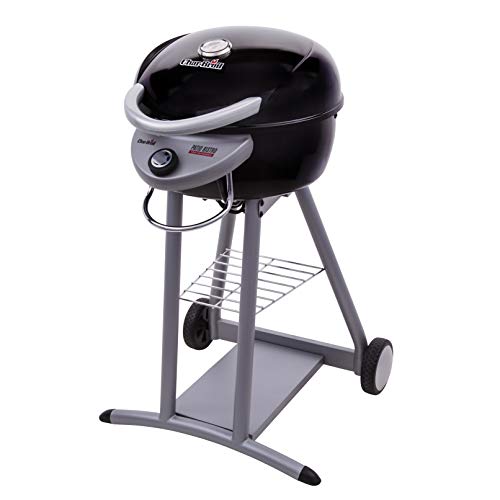
Char-Broil Patio Bistro TRU-Infrared Electric Grill — Best Electric
The Patio Bistro serves the buyer the flame bans would otherwise exclude from this tier entirely. Its infrared system puts a barrier between the element and the food that evens out heat and reduces flare-ups, which is why electric skeptics are often surprised by its results on chicken and burgers. The stand format keeps it a real patio appliance rather than a countertop appliance taken outdoors.
Strengths
- Legal where open flame is prohibited
- Infrared design evens heat and limits flare-ups
- Stand format with a proper grilling stance
Trade-offs
- No smoke flavor from the fuel
- Output trails gas and charcoal for hard searing
- Depends on a nearby outdoor outlet
| Specification | Detail (from the Amazon listing) |
|---|---|
| Fuel | Electric |
| Heating | TRU-Infrared system |
| Format | Patio bistro style on stand |
Infrared is the right technology for electric grilling because it attacks the format’s weakness — uneven, gentle heat — directly. The emitter plate radiates evenly across the grate, so chicken cooks without the raw-and-burned patchwork of cheap electrics, and juices stay in the food rather than flaring away. It will not sear a thick steak like charcoal, and no electric will. But as the only legal option on many balconies, and a genuinely tidy one — no tanks, no ash, no fuel runs — it earns its place in this tier on merit, not just permission.
Best for: Balcony and condo cooks under flame bans who want even, tidy electric grilling / Not suited for: Sear-and-smoke purists or patios without outdoor power
Comparison Table
| Pick | Badge | Key spec | Best for |
|---|---|---|---|
| Char-Griller AKORN 20-Inch Kamado Charcoal Grill and Smoker | Best Overall | Fuel: Charcoal (kamado); Grill size: 20-inch kamado | Charcoal cooks who want one grill that smokes, roasts and sears with kamado efficiency |
| Weber Master-Touch Charcoal Grill, 22-Inch | Best Premium Kettle | Fuel: Charcoal; Grill size: 22-inch kettle | Active charcoal cooks who want the complete kettle setup and maximum working room |
| Weber Original Kettle Premium Charcoal Grill, 22-Inch | Best Kettle for Indirect Cooking | Fuel: Charcoal; Grill size: 22-inch kettle | Indirect-cooking fans who want temperature data and fuel access on a 22-inch kettle |
| Char-Broil Classic 3-Burner Propane Gas Grill | Best Budget Gas | Fuel: Propane gas; Burners: 3 | Busy households wanting fast gas dinners with genuine zone control |
| Blackstone 1883 Original 28-Inch Omnivore Griddle with Hood | Best Griddle | Fuel: Propane gas (flat-top griddle); Griddle size: 28-inch Omnivore plate | Families and entertainers whose menu is burgers, breakfasts and flat-top food |
| Char-Broil Patio Bistro TRU-Infrared Electric Grill | Best Electric | Fuel: Electric; Heating: TRU-Infrared system | Balcony and condo cooks under flame bans who want even, tidy electric grilling |
How to Choose Among the Best BBQ Grills Under 300
Begin with the tier’s central question: kamado or kettle? The kamado (here, the AKORN) wins on range and efficiency — it smokes steadily, sears fiercely and sips charcoal — while the kettles win on workspace, simplicity and accessory ecosystems. If your menu includes long low cooks, choose the kamado. If your cooking is mostly active grilling with some roasting, choose the kettle that matches your information needs: thermometer and hinge if you cook indirectly, lid holder and flagship finish if you want the complete setup. Neither answer is wrong; they are different cooking styles with different pleasures.
Then check the secondary decisions. Gas in this frame is a convenience purchase — buy it if weeknight speed decides whether you grill at all, and accept the flavor trade with open eyes. The griddle is a menu purchase: it is the best pick in the guide for the food it cooks and useless for the food it does not. The electric is a permission purchase that happens to cook well. Finally, measure your space honestly: the kamado and kettles store compactly, the griddle anchors a corner, and all of them need a cover and a few feet of clearance from siding and railings to be used safely and kept in good condition.
Steel Kamado vs. Ceramic Kamado vs. Kettle: An Honest Comparison
Buyers researching this tier often ask why the AKORN costs so much less than the famous ceramic kamados, and whether they are missing something. Ceramic holds heat superbly and lasts generations, but it is heavy, fragile in transport, and priced far above this frame. Insulated steel delivers most of the cooking behavior — steady low temperatures, fierce searing, low fuel use — at a weight and price that fit normal life, with rust prevention as its main care demand instead of crack prevention. For the overwhelming majority of cooks, the steel kamado is the rational version of the idea.
Against the kettle, the kamado’s case is control and efficiency; the kettle’s case is openness and tradition. A kettle fire is visible, rearrangeable and forgiving of improvisation; a kamado fire is set-and-trusted. Kettles also win on raw grate diameter per dollar and on the sheer volume of accessories — rotisseries, pizza rings, plancha plates — built around the 22-inch standard. If you already know you love tending a fire, the kettle will never bore you. If you want the fire to tend itself while you host, the kamado is your grill. This tier, happily, funds either preference properly.
Fuel Economics and Running Costs Nobody Mentions
The purchase price is the loud number; fuel is the quiet one that adds up. An open kettle burns the most charcoal per cook, a kamado the least — over a heavy grilling season the difference is real money and real trips to the store. Gas burns propane at a moderate, predictable rate, with the tank refill cycle as its rhythm. The griddle’s two burners are similarly moderate. Electrics cost pennies per cook in electricity but demand an outlet where you want to stand. None of these should decide the purchase alone, but the kamado’s efficiency is a genuine part of its value case in this tier, and the kettle’s appetite is a genuine part of its running cost.
Consumables beyond fuel are small but real: replacement grates every few years on coated surfaces, igniters on gas, gaskets eventually on kamados. This is where the brands in this guide justify themselves — every pick has a parts channel, so a worn grate is an order, not a funeral. When you compare a pick here against a cheaper no-name listing with a longer feature list, price in the second purchase you will not have to make. That arithmetic is the whole philosophy of this tier.
How to Set Up a Kamado for Low-and-Slow Smoking (and for Searing)
Kamado control is vent control, and the setup differs by mission. For low-and-slow: fill the firebox with lump charcoal mixed with two or three wood chunks, light a single point in the center with a starter cube, and let the fire establish with the lid open for a few minutes. Close the lid with vents mostly open until the temperature approaches your target band, then close the vents down to narrow slits — well before the target, because an insulated cooker overshoots slowly and comes back even more slowly. Once stable, the AKORN will hold that band for hours with no attention beyond an occasional glance, which is the entire point of the design.
For searing, reverse everything: a full bed of lump, vents wide open, lid closed until the cooker is thoroughly heat-soaked, then steaks onto the cast iron grates for short, hot contact. The discipline that serves both missions is patience at the start — change one vent at a time, wait ten minutes, and let the insulated walls show you the result. New kamado owners who chase the thermometer with constant adjustments cook worse food than owners who set the vents and trust the steel. Your first three cooks are tuition; by the fourth, the cooker feels telepathic.
One last kamado habit separates calm owners from busy ones: cook with the dome thermometer as a trend, not a verdict. Insulated cookers move slowly in both directions, so a reading is a sentence about where the fire is going, not where it is. Glance, infer, adjust a vent by a small increment if the trend demands it, and then return to your guests. The cooker rewards this restraint with the steadiest cooks in this guide — and the cook who learns it on the AKORN will find, years later, that the same patience improves every grill they ever touch, including the kettles and gas grills sharing this tier.
Kettle vs. Kamado: A Month of Sundays With Each
Spend a month of Sundays alternating the Master-Touch kettle and the AKORN kamado and the difference stops being specifications and becomes temperament. Kettle Sundays are active: you build the fire, watch the first sear, slide food between zones, feed a few coals at the hour. The cooking feels like driving a manual car — engagement is the pleasure, and the wide grate makes every maneuver easy. Kamado Sundays are architectural: you design the fire once, set the vents, and the cooker executes for hours while you do other things, returning to food that has been quietly becoming excellent. Neither Sunday is better. They are different relationships with fire, and most cooks know within one cook which one is theirs.
The fuel ledger tells the same story in numbers you can feel: the kettle month burns visibly more charcoal, cook for cook, because its open bowl radiates heat to the sky; the kamado month sips, because its walls return the heat to the food. Over a heavy season that difference is bags of charcoal and trips to the store — real money, though rarely decisive money. More decisive is weather: wind worries the kettle’s fire and barely touches the kamado’s, and a January cook is a pleasure in the insulated cooker and an exercise in character over the open bowl.
Party math cuts the other way. The kettle’s 22-inch grate swallows a crowd’s burgers in one wave where the kamado’s 20 inches, minus its zone discipline, asks for two. Households that host big and cook long face a genuine fork — which is why so many patios in this tier’s future hold both shapes eventually. Forced to one, choose by your majority Sundays: active and social, take the kettle; long and low, take the kamado. The minority Sundays will still be good on either — that is the luxury this frame buys.
Winter, Wind and Rain: Cooking Year-Round on This Tier’s Grills
A grill bought in spring gets judged in January, and this tier’s picks have distinct winter personalities worth knowing before you buy. The kamado is the winter champion of the group: its insulated walls treat a freezing day as a minor variable, holding smoking temperatures with only slightly more fuel, and its small, hot fire is a pleasure to tend in cold air. The kettles are willing but honest — wind steals their heat through every vent and seam, preheats stretch, and charcoal consumption climbs; a sheltered corner and a windbreak transform their winter behavior more than any accessory.
Gas in winter is a story of patience and pressure: the Classic 3-Burner lights as willingly as ever, but the grate takes longer to reach searing heat, and cooks who rush it steam their food and blame the grill. Give it the full preheat, keep the lid down, and it performs. The griddle, interestingly, is a winter natural — its mass of hot steel is indifferent to air temperature once hot, and a January breakfast cooked outdoors is one of its party tricks. The Patio Bistro electric simply moves the question indoors-adjacent: on a covered balcony it cooks in any weather the cook can stand.
Storage writes the epilogue: every pick here survives winter outdoors under a sound cover, with ash removed, grates oiled, and — for gas — the tank valve closed and the burners checked in spring. The steel kamado and the mid-tier carts ask one extra kindness, a dry-ish spot out of the prevailing rain. Treat them so and the tier’s promise holds: these are four-season tools, bought once, that make February smell faintly of smoke — one of home cooking’s underrated pleasures.
Assembly Day and Your First Three Cooks
Assembly in this tier divides by philosophy. The kettles remain the relaxed builds — frame, dampers, grate, done — with the Master-Touch’s lid holder as the one mechanism to fit carefully, since it will handle a hot lid for a decade. The AKORN is the tier’s considered build: bands checked, gasket seated, the paper-drag test around the rim to confirm the seal, because an insulated cooker with a leaking gasket is just a heavy kettle. Give it one slow, empty burn-in at moderate temperature to cure and season, and resist cooking on it the same hour — kamado ownership begins with patience, appropriately. The gas cart wants the full session and the leak test; the griddle wants its seasoning ceremony; the electric wants a wiped plate and one empty preheat. None of this is difficult. All of it is the difference between a grill that performs as designed and one that spends its life slightly off.
First cooks, matched to signatures: the AKORN should debut low — ribs or a small shoulder, vents set early, the cooker’s calm demonstrated over hours rather than minutes, because an owner whose first kamado cook is a sear learns the wrong lesson about what they bought. The Master-Touch should debut mixed: sausages and chicken pieces across its two zones, lid parked in its holder a dozen times, until the choreography is muscle memory. The gas pick debuts as a timed weeknight dinner. The griddle debuts as breakfast. The Bistro debuts as balcony chicken, preheated longer than impatience suggests. Each debut is a thesis statement about its grill, and cooking it first sets the ownership on the right rails.
The third cook is for range: whatever your grill does second-best. The kamado sears steaks at full vent; the kettle runs a snake for ribs; the gas grill roasts a chicken indirect with the lid down; the griddle attempts the delicate — fish, with respect and a well-oiled plate. Owners who deliberately cook the second-best thing early become versatile; owners who only repeat the debut become specialists by accident. This tier’s grills were chosen for range within their formats, and the first three cooks are where that range stops being a review’s claim and becomes your own repertoire.
Finally, the paperwork hour nobody schedules: register the warranties, photograph the model plates, and file the manuals where the household files such things. At this frame the brands’ support is a real asset — but only to owners who can name their model and its year. Five minutes with a phone camera on assembly day is the cheapest insurance in this entire guide, and the one most often skipped by the owners who need it in year six.
Placement, Clearances and Safe Habits at This Tier
The kamado changes the placement conversation in one specific way: an insulated cooker stays hot far longer than an open one, and its exterior during a high-heat cook is not a surface for a child’s hand or a leaning stack of firewood. Give it its own clear corner, on a non-combustible base, with the same overhead clearance you would give any charcoal fire — and treat ‘the cook is over’ as the beginning, not the end, of its hot hours. The kettles cool faster but share the ash rule: a full day to cold, into metal, never into anything combustible on the strength of feeling cool to a quick touch. Ash insulates embers the way the kamado insulates fires; respect the symmetry.
Gas and electric picks follow their format rules: the cart’s leak test at season start and tank changes, the valve reachable without crossing the firebox; the Bistro on a stable stand, its cord routed where feet and water are not, on a circuit with capacity to spare. The griddle’s grease cup is emptied before it becomes a reservoir. Across all five formats, the supervision rule is absolute — a lit grill is an attended grill — and the wind rule is practical: position any charcoal cooker so the prevailing breeze feeds it gently rather than gusting through it, both for the cook’s quality and for the neighborhood’s air. This tier cooks like a serious hobby; its safety habits should read the same way.
Common Buying Mistakes
Buying a ceramic kamado’s reputation on a steel-kamado budget — or vice versa
Insulated steel delivers most of the kamado experience at this frame’s price. Stretching for ceramic means blowing the budget; dismissing steel means missing the tier’s best value. Judge the cooking behavior, not the material romance.
Overshooting kamado temperatures and fighting the cooker
Insulated grills gain heat slowly and shed it slower. Owners who light a huge fire and then chase the gauge spend the cook battling. Light small, approach the target from below, and let the vents do fine work.
Judging grills by grate size alone
A 20-inch kamado with two-zone control and steady heat out-cooks a sprawling cheap grate for most families. Usable, controllable space beats advertised area every time.
Neglecting rust prevention on steel bodies
Steel kamados and mid-tier carts live long lives when covered and kept dry, and short ones when left wet. A cover and a wipedown are the cheapest longevity insurance in this guide.
Expecting one grill to be best at everything
The griddle cannot smoke; the electric cannot char like charcoal; the kamado starts slower than gas. This tier funds excellence at a chosen job. Pick the job first and the grill chooses itself.
Final Recommendation
The AKORN kamado is this tier’s headline and our default recommendation: no other pick here covers as much cooking — smoking, roasting, searing — in one body. Kettle loyalists should choose between the Master-Touch’s complete setup and the Premium’s indirect-cooking instruments, gas households keep the honest Char-Broil Classic 3-Burner, flat-top menus belong to the Blackstone, and flame-banned balconies to the Patio Bistro.
If your budget is still flexible, the frames around this one are worth a look: Best Bbq Grills Under $250 keeps most of the kettle story for less, while Best Bbq Grills Under $350 and Best Bbq Grills Under $500 bring in the first premium gas lines and pellet grills. Combination hunters who want gas and charcoal in one unit should detour to Best Bbq Combo Grills before deciding.
If you are ready to buy, start with the top of the list: Char-Griller AKORN 20-Inch Kamado Charcoal Grill and Smoker, Weber Master-Touch Charcoal Grill, 22-Inch, Weber Original Kettle Premium Charcoal Grill, 22-Inch — and check the current price on Amazon for the configuration you choose.
Frequently Asked Questions
Is a steel kamado as good as a ceramic one?
For cooking, nearly: insulated steel holds low temperatures steadily, sears at high heat and uses little fuel, just like ceramic. Ceramic wins on ultimate thermal mass and heirloom lifespan; steel wins on weight, toughness and price. At this budget the steel kamado is not a compromise — it is the sensible form of the idea.
AKORN or kettle — which should I buy?
Buy the kamado if you smoke often or want set-and-forget temperature stability and low fuel use. Buy the kettle if you mostly grill actively, want the widest grate and accessory ecosystem, and enjoy tending a fire. Both sear beautifully; they differ in temperament more than capability.
Can the AKORN really smoke all day on one load?
Yes — that is the design’s party trick. A full firebox of lump charcoal, vents set low, will hold a smoking band for many hours because the insulated walls waste so little heat. It is the cheapest route in this guide to genuine long cooks without refueling.
Why is there only one gas grill in this tier?
Because at this money, one honest gas cart is what the market offers from brands with parts support; the rest of the gas field here is either the same class dressed differently or thinner hardware with longer feature lists. Buyers wanting a stronger gas field should look at the next tiers up, where the premium lines begin.
Does the Patio Bistro actually brown food?
Better than most electrics, because its infrared emitter evens the heat and gets the grate properly hot across its surface. It will not match charcoal’s crust on a thick steak — no electric does — but chicken, burgers and vegetables brown convincingly, and it is legal where the others are not.
What accessories are worth buying first at this tier?
A cover, a chimney starter for charcoal models, and a reliable instant-read thermometer, in that order. Those three protect the grill, speed every cook and remove the guesswork from doneness. Fancy tool sets and extra racks can wait until your cooking tells you what you actually need.
Can the AKORN bake bread and pizza?
Yes — kamados are effectively wood-fired ovens, and with a pizza stone or steel and a fully heat-soaked body, the AKORN bakes at temperatures home ovens cannot reach. Let the stone heat with the cooker, manage the vents for a steady high band, and expect your first attempt to teach you the timing; the second will be excellent.
Which pick handles a whole turkey?
The kettles, with their 22-inch diameter and indirect setup, are the practical turkey tools here — a modest bird fits under the lid with room for the drip pan. The kamado handles smaller birds superbly. Whichever you choose, a probe thermometer is non-negotiable equipment for a cook that size.
How loud is the difference between the kettle and kamado on flavor?
Subtler than the forums claim, and worth describing precisely. Food from both is charcoal food — real fire, real smoke — and in a blind tasting of simple grilled items, most eaters would struggle to separate them. The differences appear at the edges: the kamado’s steadier low heat gives long cooks a more even smoke ring and gentler bark, while the kettle’s more active fire gives direct-grilled food a slightly wilder char. Where the gap truly widens is not flavor but process — fuel use, stability, weather tolerance, tending. Buyers choosing between them on taste alone are splitting a hair; buyers choosing on how they want to spend the cooking hours are making the real decision, and both picks here reward it.


