Disclosure: airfryerkitchensupply.com is reader-supported. When you buy through links on our site, we may earn an affiliate commission at no extra cost to you.
Where to buy
Shopping for the best bbq grills under 250 dollars starts with verified listings, not with the loudest discount banner. All six picks were verified against live Amazon listings, and only listing-stated specifications are printed here. This guide publishes no prices — grill pricing swings with season and retailer promotions — so check the current price on Amazon for each pick and treat the under-$250 figure as the budget frame these models are positioned within.
- Weber Original Kettle Premium Charcoal Grill, 22-Inch (Best Overall) — Check the current price on Amazon
- Char-Broil Classic 3-Burner Propane Gas Grill (Best Gas Grill) — Check the current price on Amazon
- Weber Original Kettle Charcoal Grill, 22-Inch (Best Value Charcoal) — Check the current price on Amazon
- Char-Griller AKORN Jr. Portable Kamado Charcoal Grill and Smoker (Best Small Kamado) — Check the current price on Amazon
- Coleman RoadTrip 285 Portable Propane Grill (Best Portable) — Check the current price on Amazon
- Blackstone 1883 Original 28-Inch Omnivore Griddle with Hood (Best Griddle) — Check the current price on Amazon
What Changes When the Budget Reaches the Best BBQ Grills Under 250
The best bbq grills under 250 dollars occupy the most interesting frame in grilling, because this is where the first genuinely well-built models appear. Step up from the entry tier and the money stops going to survival and starts going to features that change how you cook: a kettle with a built-in thermometer and a hinged grate, a three-burner gas grill with real zone control, a flat-top griddle that opens an entirely different menu. The best bbq grills under 250 are not cheap grills with better marketing; they are the first rung where each fuel type has a representative worth owning for years.
Charcoal still leads on value. The premium kettle in this guide adds the two things kettle owners actually wish for — temperature information and easy charcoal access — without changing the simple design that makes kettles last. Gas becomes defensible here too: the three-burner pick below has the burner count to run real zones and a footprint sized for smaller patios. And this is the tier where a griddle earns a place, because smash burgers, breakfasts and teppanyaki-style cooking are things a grate simply cannot do.
What this frame still does not buy is thick premium construction or pellet cooking from a brand we would recommend. It buys honest mid-weight hardware from real brands, with parts catalogs behind them. Every pick below was verified on Amazon, and each one is the model we would buy for its specific job at this money.
In this guide
Quick Picks
Six picks, six different jobs. Every model below was verified on Amazon, and each badge is used consistently through the reviews that follow, so you can scan this list now and read the reasoning after.
Weber Original Kettle Premium Charcoal Grill, 22-Inch — Best Overall. The Premium kettle fixes the two real complaints about the basic kettle — no thermometer, awkward charcoal access — with a lid gauge and a hinged grate, and stays the best all-round cooker in this frame. Check on Amazon
Char-Broil Classic 3-Burner Propane Gas Grill — Best Gas Grill. Three burners, 30,000 BTU and 360 square inches in a compact cart: the first gas grill in this guide series we can recommend without a warning label, for weeknight cooks who value the knob over the chimney. Check on Amazon
Weber Original Kettle Charcoal Grill, 22-Inch — Best Value Charcoal. The standard 22-inch kettle remains the value anchor of this tier: everything the Premium does on the fire, minus the thermometer and hinge, for buyers who would rather put the savings into charcoal and meat. Check on Amazon
Char-Griller AKORN Jr. Portable Kamado Charcoal Grill and Smoker — Best Small Kamado. Insulated kamado cooking in a portable body: the AKORN Jr. holds a low smoking temperature for hours on a handful of charcoal and still sears hard when the vents open. Check on Amazon
Coleman RoadTrip 285 Portable Propane Grill — Best Portable. Three burners, a folding wheeled stand and push-button ignition: the RoadTrip 285 remains the portable to beat, cooking like a small patio grill wherever the car stops. Check on Amazon
Blackstone 1883 Original 28-Inch Omnivore Griddle with Hood — Best Griddle. A 28-inch flat-top with a hood: smash burgers, full breakfasts, fried rice and cheesesteaks — the Blackstone cooks the whole menu a grate cannot touch. Check on Amazon
How These Picks Were Chosen
Our method at this tier starts with the entry-tier rules — real brand, available parts, honest design — and adds a harder test: the step-up has to be worth it. Each pick had to offer something the cheaper tier cannot, whether that is a thermometer and hinged grate, a third burner, kamado insulation or a flat-top surface. Models that merely added chrome trim, bottle openers or side shelves to entry hardware were cut, because at this money decoration is a tax on the firebox.
We then verified every surviving candidate against Amazon listing data, matched the listing title to the exact model, and used only specifications the listing states. Six picks remained: the strongest charcoal kettle in the frame, the first gas grill we recommend in this series of guides, a budget kamado, a portable for travel, a griddle for flat-top cooking, and the entry kettle for buyers who would rather save the difference. Each review below says plainly who should skip it, because at this tier the wrong fuel choice costs more than the wrong model.
The 6 Best BBQ Grills Under $250

Weber Original Kettle Premium Charcoal Grill, 22-Inch — Best Overall
This is the grill for the buyer who wants charcoal to be their long-term setup rather than a starter experiment. The built-in lid thermometer turns guessing into information: you learn what your fire is actually doing, and your indirect cooking — chicken, ribs, roasts — becomes repeatable instead of lucky. The hinged grate lets you add charcoal or wood mid-cook without lifting the food off, which matters most on the long cooks this grill encourages.
Strengths
- Built-in lid thermometer makes indirect cooking repeatable
- Hinged grate allows adding fuel without moving food
- Same durable kettle design and parts support as the base model
Trade-offs
- Costs a real step more than the standard kettle
- Thermometer reads lid air, not grate temperature
- Still charcoal: lighting time and ash are part of the deal
| Specification | Detail (from the Amazon listing) |
|---|---|
| Fuel | Charcoal |
| Grill size | 22-inch kettle |
| Extras | Built-in lid thermometer |
Everything that makes the standard kettle great is here — the two-zone fire, the One-Touch ash system, the weatherproof porcelain enamel — with the friction removed at exactly the points where owners feel it. A lid thermometer sounds minor until your first whole chicken comes out evenly cooked because you held the dome temperature steady instead of peeking every ten minutes and dumping heat. If you know you like charcoal, this is the version to buy once. If you are unsure whether charcoal is for you, the standard kettle below is the cheaper way to find out.
Best for: Committed charcoal cooks who want temperature feedback and mid-cook fuel access / Not suited for: Buyers still deciding whether they like charcoal at all

Char-Broil Classic 3-Burner Propane Gas Grill — Best Gas Grill
Choose the Classic 3-Burner if your grilling is mostly weeknight dinners for two to five people and speed matters more than smoke. Three burners across 360 square inches is the smallest gas layout that still gives you a true two-zone setup — sear on one side, hold on the other — and the compact cart with side shelves fits the small patios and decks where a big four-burner would crowd out the chairs.
Strengths
- Three burners allow genuine two-zone gas cooking
- 360 sq. in. grate suits family weeknight meals
- Compact cart fits small patios and decks
Trade-offs
- Porcelain-coated grates need gentler care than cast iron
- No side burner at this price
- Firebox steel is mid-weight, not premium
| Specification | Detail (from the Amazon listing) |
|---|---|
| Fuel | Propane gas |
| Burners | 3 |
| Output | 30,000 BTU |
| Cooking area | 360 sq. in. |
| Grates | Porcelain-coated |
The honest way to judge a gas grill in this frame is burner layout and grate, and both are right here: three burners in a row so zones run left-to-right, and enough total output that the grate actually sears when it is loaded. The porcelain-coated grates are the compromise to manage — preheat them, oil food rather than scrubbing the coating, and they will serve well; treat them with a wire brush like cast iron and they will not. For the household that grills chicken, burgers and vegetables three nights a week and wants dinner in twenty minutes, this is the gas answer in this tier.
Best for: Weeknight cooks cooking for two to five who want gas speed with real zone control / Not suited for: Smoke seekers or anyone who wants a side burner included

Weber Original Kettle Charcoal Grill, 22-Inch — Best Value Charcoal
Pick the standard kettle if you are new to charcoal or simply economical by nature. Its cooking performance — searing heat, two-zone control, indirect roasting under the lid — matches the Premium model cook for cook. What you manage manually is information: you will judge temperature by hand tests, vent position and experience, which generations of kettle cooks have done perfectly well.
Strengths
- Full 22-inch two-zone cooking at the lowest kettle price
- One-Touch cleaning and weatherproof enamel
- Every part replaceable and sold everywhere
Trade-offs
- No thermometer for indirect cooks
- Adding charcoal means lifting the grate
- Base three-leg design is plainer than the Premium’s presentation
| Specification | Detail (from the Amazon listing) |
|---|---|
| Fuel | Charcoal |
| Grill size | 22-inch kettle |
| Cleaning | One-Touch cleaning system |
There is a reason this grill anchors two tiers of our guides: it is the most cooking per dollar in outdoor food, full stop. In this frame it plays the role of the smart saving — the buyer who chooses it over the Premium is not getting a worse dinner, just a less instrumented process. Add an inexpensive probe thermometer later if indirect cooking becomes your habit and you have closed most of the gap for very little money. As a first grill, a second grill for charcoal beside a gas cart, or a gift that will actually be used for a decade, it has no equal here.
Best for: New charcoal cooks and value hunters who want full kettle performance for less / Not suited for: Cooks who want built-in temperature readings from day one

Char-Griller AKORN Jr. Portable Kamado Charcoal Grill and Smoker — Best Small Kamado
The AKORN Jr. fits the cook whose batches are small but whose ambitions are not: smoked ribs for two, a small pork shoulder, reverse-seared steaks finished over a fierce little fire. Its triple-wall steel insulation is the story — heat stays in the cooker instead of leaking into the yard, so fuel use drops and temperature steadies. It also travels, in the car-camping sense, better than any full-size kamado.
Strengths
- Triple-wall insulation holds temperatures with little fuel
- Cast iron grates sear properly
- Small footprint suits patios and car camping
Trade-offs
- Cooking area limits batch size
- Learning kamado vents takes a few cooks
- Heavier than its compact size implies
| Specification | Detail (from the Amazon listing) |
|---|---|
| Fuel | Charcoal (kamado) |
| Format | Portable kamado |
| Body | Triple-wall insulated steel |
| Grates | Cast iron |
Kamados teach a different skill than kettles: you set the vents and trust the insulation. In the Jr., that skill pays off quickly because the small fire responds fast and the walls smooth out your mistakes. Low-and-slow cooks that would eat a bag of charcoal in an open cooker sip fuel here, which quietly makes this one of the cheapest grills to run in the guide. Its ceiling is company — four hungry guests means cooking in waves. For a household of one to three that prizes control and efficiency over acreage, it is the most interesting grill in this frame.
Best for: Small households wanting kamado control, efficiency and occasional travel use / Not suited for: Hosts cooking for groups or anyone needing a big grate
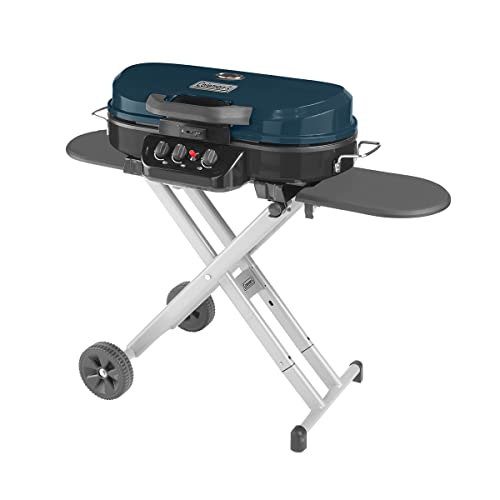
Coleman RoadTrip 285 Portable Propane Grill — Best Portable
Buy the RoadTrip if your grill’s natural habitat is a tailgate lot, a campsite or a rented cabin deck — or if your home patio demands a grill that folds flat against the wall after dinner. The stand is the engineering that matters: it rolls, it locks at full grilling height, and it collapses without tools. Three burners on a portable is still rare, and it is what lets this grill run a hot side and a gentle side simultaneously.
Strengths
- Folding wheeled stand is genuinely easy to move and store
- Three burners give zone control most portables lack
- Instastart ignition for matchless lighting
Trade-offs
- Lives at the top of this budget frame
- Too heavy for anything but car-based travel
- Small canisters add up without an adapter hose for a full tank
| Specification | Detail (from the Amazon listing) |
|---|---|
| Fuel | Propane gas (portable) |
| Burners | 3 |
| Output | 20,000 BTU |
| Ignition | Instastart |
Portables usually force a choice between cooking power and packability; the RoadTrip refuses by being a real small grill on a clever cart. Brats sear on the hot side while peppers char gently on the other, breakfast cooks on the optional griddle surface, and the whole thing is in the trunk before the game starts. The honest costs are weight and fuel format — plan on an adapter hose if you camp often, both for economy and to run a full-size tank at home. For the traveling cook, nothing else in this frame does its job as completely.
Best for: Tailgaters, campers and small-space households needing a folding full-height grill / Not suited for: Ultralight travelers or buyers who never grill away from home

Blackstone 1883 Original 28-Inch Omnivore Griddle with Hood — Best Griddle
The Blackstone is for the cook who realized their favorite grill food is actually griddle food. Burgers smashed thin with lacy edges, bacon and eggs for a crowd, onions and peppers by the pile, fried rice that needs a big hot surface — a flat-top does all of it better than any grate, and the 28-inch size with a hood is the sweet spot for a family without taking over the patio. The hood matters: it traps heat for melting cheese and steaming vegetables, the two jobs open griddles do slowly.
Strengths
- Huge flat surface for burgers, breakfasts and batch cooking
- Hood speeds melting and steaming
- Side shelves at counter height for real prep space
Trade-offs
- No grate marks and no smoke — it is a different tool
- Flat-top needs seasoning and surface care
- Takes patio space like a full-size grill
| Specification | Detail (from the Amazon listing) |
|---|---|
| Fuel | Propane gas (flat-top griddle) |
| Griddle size | 28-inch Omnivore plate |
| Extras | Hood, counter-height side shelves |
A griddle changes your outdoor menu more than any other purchase in this guide. The Omnivore plate heats evenly enough that pancakes and smash burgers can share the surface, and the workflow — cook, scrape, oil, done — is faster to clean than any grate-and-firebox combination. The discipline it asks for is seasoning: keep the surface oiled, cook on it often, and never let it sit wet. Buyers who want one appliance for everything should know it will not smoke a brisket or char a steak over open flame; buyers who know their menu is griddle-shaped have found their grill.
Best for: Families whose menu is burgers, breakfasts and flat-top cooking / Not suited for: Anyone wanting open-flame char or smoked barbecue from the same unit
Comparison Table
| Pick | Badge | Key spec | Best for |
|---|---|---|---|
| Weber Original Kettle Premium Charcoal Grill, 22-Inch | Best Overall | Fuel: Charcoal; Grill size: 22-inch kettle | Committed charcoal cooks who want temperature feedback and mid-cook fuel access |
| Char-Broil Classic 3-Burner Propane Gas Grill | Best Gas Grill | Fuel: Propane gas; Burners: 3 | Weeknight cooks cooking for two to five who want gas speed with real zone control |
| Weber Original Kettle Charcoal Grill, 22-Inch | Best Value Charcoal | Fuel: Charcoal; Grill size: 22-inch kettle | New charcoal cooks and value hunters who want full kettle performance for less |
| Char-Griller AKORN Jr. Portable Kamado Charcoal Grill and Smoker | Best Small Kamado | Fuel: Charcoal (kamado); Format: Portable kamado | Small households wanting kamado control, efficiency and occasional travel use |
| Coleman RoadTrip 285 Portable Propane Grill | Best Portable | Fuel: Propane gas (portable); Burners: 3 | Tailgaters, campers and small-space households needing a folding full-height grill |
| Blackstone 1883 Original 28-Inch Omnivore Griddle with Hood | Best Griddle | Fuel: Propane gas (flat-top griddle); Griddle size: 28-inch Omnivore plate | Families whose menu is burgers, breakfasts and flat-top cooking |
How to Choose Among the Best BBQ Grills Under 250
The decision in this frame is really three decisions. First, fuel: charcoal for flavor and longevity, gas for speed, flat-top for a different menu entirely. Second, format: a kettle you wheel into a corner, a compact cart, a portable that folds, or a griddle that anchors a patio corner like an appliance. Third, the honest size question — how many servings on your busiest normal day, not your biggest holiday. A 360-square-inch gas grate or a 22-inch kettle covers a family of five; the small kamado covers three with better control; the 28-inch griddle covers a crowd if the food is griddle food.
Within a fuel, spend on the firebox and grate before anything else. A hinged grate and thermometer on a kettle, a third burner on a gas grill, insulation on a kamado — these change cooks. Side shelves, chrome and tool hooks do not. Also check what the brand sells separately: replacement grates, covers and igniters listed on the same storefront are the clearest signal that a grill is a product line, not a one-season listing. That signal matters more in this frame than in any other, because this is where real product lines and dressed-up disposables sit side by side at similar money.
Kettle Upgrades That Matter — and the Ones That Do Not
This tier is where kettle buyers meet the upgrade question directly, so it is worth being precise. A built-in thermometer matters if you cook indirectly — whole birds, ribs, roasts — because dome temperature is the variable you are managing for hours. A hinged grate matters on those same long cooks, when the fire needs feeding at hour two. A lid holder matters every single cook, because a hot lid needs somewhere to go that is not the ground. Those three are functional, and the Premium kettle in this guide bundles the first two, which is why it leads the tier.
What does not change dinner: taller legs, prettier colors, a side table you will use as a shelf for the chimney anyway. If you already own the standard kettle, none of the upgrades justify replacing it — add a probe thermometer and cook on. If you are buying fresh and indirect cooking is your plan, the Premium’s bundle is the rational spend. This same logic applies across the guide: on the gas side, a third burner is a functional upgrade and a side burner at this price usually is not; on the griddle side, a hood is functional and a paper-towel holder is not. Spend on the fire and the surface, always.
Seasoning, Preheating and Other Habits That Close the Gap
Mid-tier hardware rewards good habits more than cheap hardware does, because its ceiling is higher. Season cast iron and keep porcelain grates oiled and un-scraped by steel brushes; preheat gas grills a full ten to fifteen minutes so the grates — not just the air — are at searing temperature; and learn your grill’s thermometer offset, since a lid gauge reads dome air that runs hotter than the grate on a kettle and cooler on some gas lids. A single session with an oven thermometer on the grate teaches you your grill’s dialect permanently.
For the griddle, the ritual is seasoning layers: thin coats of high-heat oil burned on until the surface darkens, then maintenance coats after cooks. For the kamado, it is patience — small vent changes, made early, because insulated cookers overshoot slowly and forgive slowly. None of these habits cost money, and together they are most of the difference between the food this tier can produce and the food it usually produces in careless hands. The hardware in this guide was chosen to be worth the habits.
How to Smoke on a Kettle: The Snake Method, Step by Step
The kettle picks in this guide can smoke genuinely well using the snake method, and learning it unlocks ribs, pork shoulder and brisket-style cooks without buying a dedicated smoker. Arrange unlit briquettes two wide and two high in a ring around most of the kettle’s charcoal grate, leaving a gap at one end. Scatter a few wood chunks along the top of the ring. Light eight to ten briquettes in a chimney until they are ashed over, pour them at one end of the ring, and the fire will creep slowly along the snake for hours, holding a low, steady temperature as it goes.
Set a drip pan with water in the center of the ring, place the food over the pan on the cooking grate, lid on with the vent over the food, and manage temperature with the bottom vents — small adjustments, made early. The Premium kettle’s lid thermometer earns its price here: you are steering dome temperature for four to eight hours, and the gauge turns the snake from folklore into a repeatable process. The same patience applies on the AKORN Jr. with a small banked fire. Resist lifting the lid to admire the work; every peek costs heat and time. When the snake has burned through, the food has had exactly the long, gentle cook you planned.
Three Cooks That Show What This Tier Can Do
Cook one: a whole chicken on the Premium kettle, indirect, with the lid thermometer holding its band for a little over an hour. This is the cook the tier below guesses at and this tier repeats on demand — the gauge turns ‘probably done’ into a process, and the hinged grate means the mid-cook handful of briquettes goes in without moving the bird. Cook two: burgers and dogs for six on the Char-Broil’s three burners, zones running hot-left and warm-right, dinner in twenty minutes on a Tuesday. Cook three: a full breakfast on the Blackstone — bacon, eggs, hash browns and pancakes sharing one hot plate — the cook that converts skeptics at first bite.
Notice what unites the three: none is a stunt. They are the ordinary ambitions of a household that grills weekly, executed with information, zoning and surface — the three currencies this tier adds. The kamado Jr. contributes a fourth cook, the low ribs that sip charcoal all afternoon; the RoadTrip a fifth, the away-game cookout. A buyer in this frame is not purchasing a grill so much as purchasing which of these cooks becomes routine. Read the list again and notice which one made you hungry; that reaction is better buying data than any specification in this guide.
The cooks also expose the tier’s honest ceiling. None of the six will smoke a full packer brisket with room to spare, none preheats like a premium gas flagship, and the electrics of the tier below are absent here because at this money the flame fuels simply out-cook them for open patios. This frame’s promise is narrower and better: the everyday repertoire, done properly, with the tools matched to it. Households whose repertoire is exactly that will never feel the ceiling at all.
Accessories That Earn Their Money at This Tier (and Two That Do Not)
The first accessory dollar at this tier belongs to a chimney starter if you cook on charcoal — it deletes lighter fluid from your life, lights evenly, and costs less than a bag of premium briquettes. The second belongs to an instant-read thermometer, which is not an accessory so much as the missing half of every grill in this guide: the kettle’s lid gauge tells you the fire’s weather, the probe tells you the food’s truth. The third belongs to a fitted cover, sized to your actual grill, because every pick here lives outdoors and water is the only opponent none of them can out-cook.
For the griddle, the kit is spatulas, a scraper and squeeze bottles — the flat-top’s native tools, inexpensive and transformative. For the gas pick, a spare tank is the accessory that saves a dinner party exactly once a year and is worth it for that once. What does not earn its money here: elaborate tool sets with fourteen pieces where three would do, and novelty gadgets — burger presses shaped like states, branding irons, LED everything — that spend the budget the fire and the food deserved. This tier rewards the same discipline in accessories as in grills: fund the function, skip the theatre.
Assembly Day and Your First Three Cooks
This tier’s assembly spans the range from the kettles’ relaxed half-hour to the gas cart’s genuine project, and the approach should match. Kettle buyers: square the frame before tightening, confirm the dampers sweep freely, and run one empty burn to season the grate and burn off factory film. Kamado Jr. buyers: check the band tension and gasket seal with a strip of paper around the rim — it should drag evenly — because the cooker’s whole talent is stored in that seal. Blackstone owners have the tier’s most important assembly task disguised as a chore: the initial seasoning, several thin coats of oil burned onto the plate until it darkens, which is not preparation for the griddle’s life but the foundation of it. Gas buyers: budget the full session, lay the parts out, and finish with the soapy-water leak test on every connection before the first ignition — the test takes four minutes and is the entire safety culture of gas grilling in one habit.
First cooks should be chosen to teach each grill’s signature. The Premium kettle’s debut is a whole chicken, indirect, thermometer watched — the cook it was built to make repeatable. The Char-Broil’s debut is a weeknight spread across its three zones, timed, because its signature is the twenty-minute dinner. The griddle’s debut is breakfast for the household, all at once, because its signature is simultaneity. The RoadTrip’s debut should happen in the driveway, folded and unfolded once, before it ever performs at a distance. In every case the principle is identical: the first cook is tuition, priced in forgiving food.
By the third cook, start the notebook habit this tier rewards: vent positions and gauge readings on the kettle, zone settings on the gas, seasoning notes on the griddle. These grills are instruments now, not just fires, and instruments reward records. The owners who keep the notebook for one season become the cooks their friends call for advice; the notebook is also, years later, the most nostalgic document a grilling household owns. This tier is where that identity — a person who grills, deliberately — becomes available, and the first three cooks are its initiation.
One caution specific to this frame: the step-up features tempt owners to skip fundamentals. A thermometer does not replace the probe check on the chicken; a third burner does not replace the zone discipline; a seasoned griddle does not replace the scrape-and-oil after every cook. The features in this tier amplify habits — they do not substitute for them. Build the habits in the first three cooks, while the food is forgiving and the stakes are a Tuesday, and the tier’s full value unlocks itself over the following seasons.
Placement, Clearances and Safe Habits at This Tier
This tier’s mix — charcoal, gas, kamado and a big steel griddle plate — shares one placement rule and then divides. The shared rule: a level, stable, non-combustible footing with generous clearance above and behind, because every pick here radiates serious heat and the griddle adds a wide field of hot steel at counter height. The divisions matter. Charcoal and the kamado want distance from anything that can blow or fall in, and their ash is cold for a full day before disposal in metal. The gas cart wants its leak test honored and its tank valve accessible — you should be able to reach the shutoff without reaching across the grill. The griddle wants respect for its grease path: the cup emptied, the area beneath it kept clear, because a season of drippings under a hot plate is a fire applying for permission.
Two habits specific to this frame deserve emphasis. The first is the thermometer habit’s safety twin: a probe thermometer does not just improve cooking, it ends the practice of cutting into food to check it and of serving chicken on hope — food safety at the table is part of grill safety, and this tier’s instruments make it easy. The second is the cover habit’s shadow side: never cover a grill that is still warm from cooking, and never store a gas grill with its tank in an enclosed space. Wait for cold, then cover; store the tank outside, upright, disconnected. These are small disciplines, but at the tier where grilling becomes a weekly identity, small disciplines are the whole safety program.
Common Buying Mistakes
Paying for side burners and chrome instead of firebox quality
In this frame every dollar is contested. A side burner you use twice a year is a firebox wall that could have been thicker. Read past the feature list to burners, grates and insulation — that is where this money should live.
Assuming more burners always means a better gas grill
Burner count is about zoning, not bragging. Three well-spaced burners beat four cramped ones, and total output must match the grate size or the grill runs hot spots and cold corners. Judge the layout, not the number.
Treating a griddle like a grill
A flat-top will not give you smoke or char lines, and a grate will not fry rice. Buyers who expect one tool to do both end up disappointed in a good product. Decide which menu is yours before you decide which pick is.
Skipping the cover and the seasoning
Mid-tier grates and griddle surfaces are investments worth protecting. A cover keeps water out of the firebox, and oiled, seasoned surfaces resist the rust that ends more grills than any mechanical failure.
Buying for the annual party instead of the weekly dinner
An oversized grill heats slowly, eats fuel and crowds a small patio 51 weeks a year to shine on one. Size for your normal cook; borrow or batch-cook for the exceptional one.
Final Recommendation
For most buyers in this frame, the Weber Original Kettle Premium is the purchase: it keeps everything that makes the kettle the value king and removes its two real frictions. Gas-first households should take the Char-Broil Classic 3-Burner and its genuine zone control, flat-top cooks the Blackstone 28, and small households wanting efficiency and control the AKORN Jr. The standard kettle remains the value play, and the RoadTrip 285 the traveler’s answer.
Still deciding where your budget should land? Compare this tier with the entry frame in Best Bbq Grills Under $200 and the step above in Best Bbq Grills Under $300 and Best Bbq Grills Under $350. Gas shoppers can also scan the wider gas picture in Best Bbq Gas Grills Under $400, and combination hunters should see Best Bbq Combo Grills before settling on a single fuel.
If you are ready to buy, start with the top of the list: Weber Original Kettle Premium Charcoal Grill, 22-Inch, Char-Broil Classic 3-Burner Propane Gas Grill, Weber Original Kettle Charcoal Grill, 22-Inch — and check the current price on Amazon for the configuration you choose.
Frequently Asked Questions
What does this tier buy that the cheaper one does not?
Function. A thermometer and hinged grate on the kettle, a third burner and real zoning on gas, a hood on the griddle, insulation on the kamado. The entry tier buys cooking ability; this tier buys control and convenience layered on top of it — the upgrades you feel on every cook rather than features you use twice.
Is the Premium kettle worth it over the standard kettle?
If you cook indirectly — whole chickens, ribs, roasts — yes: the thermometer and hinged grate pay for themselves in repeatable results. If you mostly sear burgers and steaks over direct heat, the standard kettle cooks identically and the savings are real. Match the model to your menu, not to the spec sheet.
How many people can a 360-square-inch gas grill feed?
Comfortably four to five servings at once — roughly a dozen burgers or equivalent mixed load — with the three-burner zoning letting you hold finished food warm on the low side. For regular six-plus crowds, look at the four-burner models in our higher-tier guides.
Can a griddle replace a grill entirely?
For menus built on burgers, breakfasts, stir-fries, cheesesteaks and vegetables, yes — and it will do them better. It cannot smoke, char over open flame or give you grate marks. Many households end up happiest with a griddle plus an inexpensive kettle, which together cost less than one premium grill and cover both menus.
Do kamados really use less charcoal?
Yes, measurably in practice: insulated walls keep heat in the cooker, so a small fire holds temperature for hours. The AKORN Jr. in this guide can run a long low cook on a modest load of lump. The saving compounds over a season, and the steadier temperatures are the bigger prize.
Should I wait for a sale or buy at this tier now?
Grill pricing is seasonal, with the deepest discounts usually at the end of summer rather than the start. This guide prints no prices precisely because they move; check the current price on Amazon for the pick you want, and weigh a possible future discount against a season of cooking. The models here are current product lines, not clearance bait.
Should I buy the kettle or save toward the next tier?
If the Premium kettle’s thermometer and hinge match how you cook, buy it now and cook for years — the next tier adds size and systems, not a better kettle dinner. Save toward higher tiers only if your ambition is specifically premium gas or pellet cooking; for charcoal households, this tier’s top is a destination, not a waypoint.
How do I keep porcelain-coated grates from chipping?
Preheat before cooking, oil the food rather than the cold grate, and clean with a brush made for coated surfaces once the grate is warm — never scrape a cold coated grate with steel. Treated so, the coating lasts for seasons; treated like cast iron, it chips within one.
What separates a good buy in this tier from a regret?
Almost always, it is whether the step-up feature matches the buyer’s actual menu. The Premium kettle delights the indirect cook and merely costs the direct griller more; the third burner transforms weeknight zoning and means nothing to a household that grills twice a month; the griddle is a revelation to the breakfast family and a puzzling slab to the brisket household. Before buying, write down the five cooks you repeat most. The pick whose headline feature serves at least three of them is the good buy — the others, however excellent, are someone else’s. This tier is generous enough to contain a right answer for nearly every menu, and specific enough that the wrong one is easy to choose by accident. The five-cook list is the whole method; everything else in this guide is commentary on it.


