Disclosure: airfryerkitchensupply.com is reader-supported. When you buy through links on our site, we may earn an affiliate commission at no extra cost to you.
Where to buy
Every linked pick in this guide to the best bar style kitchen faucets was verified against Amazon’s catalog on 2026-11-20, so the model numbers below are the exact bar and prep faucets you will land on. Start with the Kraus Oletto Bar Faucet (KPF-2822SFS) for the best all-round bar sink performance, the Grohe Concetto Bar Faucet (31479001) for European engineering in miniature, and the Delta Foundations Two-Handle Bar/Prep for the classic two-handle wet-bar setup. Check the current price on Amazon for each pick; we never print static prices.
A bar faucet is not a small kitchen faucet by accident; it is a faucet scaled to a different job. Bar and prep sinks are shallower, narrower, and used in bursts — rinsing a shaker, filling an ice bucket, washing garnish, quick glassware — often by someone standing at a home bar, a butler’s pantry, a coffee station, or an island prep zone rather than at the main sink. A full-size kitchen faucet over a bar sink is a daily splash machine: too much arc, too much reach, too much flow for the bowl. The six faucets below are the ones actually designed or sized for the format — compact arcs, controlled reach, single-hole or small-spread decks — verified model by model, with the fit math your bar sink demands.
In this guide
Quick Picks
- Best Overall: Kraus Oletto Bar Faucet (KPF-2822SFS) — the Oletto platform scaled to bar height, spot-free stainless, single handle.
- Best Engineering: Grohe Concetto Pull-Down Bar Faucet (31479001) — SilkMove ceramic valve, dual spray, 1.75 GPM, true bar proportions.
- Best Mainstream Pick: Delta Modern Bar Faucet (14882LF-SP) — single-hole prep faucet in SpotShield Stainless from Delta’s parts-rich line.
- Best Pull-Down Bar Faucet: Delta Essa Bar Faucet (9913-BL-DST) — the Essa in bar scale and matte black, with a pull-down sprayer.
- Best Two-Handle Classic: Delta Foundations Two-Handle Bar/Prep — separate hot and cold handles for the traditional wet bar.
- Best Budget: GIMILI Bar Sink Faucet — single-hole pull-down bar faucet in brushed nickel at a value tier.
How These Picks Were Chosen
Bar faucets are where vague shopping goes to die, because half the listings that surface for this search are full-size kitchen faucets wearing a bar costume. We filtered ruthlessly. Every candidate was verified by brand and model, with the returned title required to identify the model as a bar or prep faucet — or, in the Kraus case, to be the bar-height variant of a known line — before we took an ASIN. Full-size models that appeared in the same searches were excluded even when excellent; they live in our other guides.
Within the true bar class, we weighted proportion first: spout height and reach matched to the shallow, narrow bowls these faucets serve. Next, control: single-handle models dominate wet-bar use because one hand is usually holding a glass, but we kept a two-handle classic for traditional bars where the ritual is part of the point. Then the ownership basics that apply everywhere in this cluster — ceramic cartridges, real manufacturers, parts by model number. The value pick, GIMILI, is held to the same honesty standard as elsewhere in this batch: a coherent brand line in the value class, recommended for what it is, with its support caveats stated in the review rather than discovered by the buyer.
The 6 Best Bar Style Kitchen Faucets
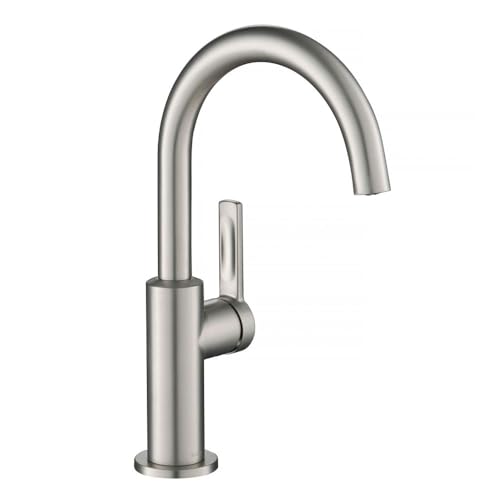
Kraus Oletto Bar Faucet (KPF-2822SFS) — Best Overall
Kraus sells the Oletto in two heights, and this is the bar one — the same spot-free stainless, single-handle design as the full-size KPF-2820 in our best-and-worst guide, scaled down so its arc and reach sit correctly over a bar bowl. That scaling is the entire ballgame in this category: the water lands in the bowl instead of on the far rim, the spray (where the bar format offers it) stays contained, and the faucet’s visual weight matches a secondary sink instead of shouting over it. Kraus’s build habits carry down intact — metal construction, ceramic cartridge, a finish that shrugs off the water spots a bar sink generates in bursts. It suits home bars, butler’s pantries, coffee stations, and island prep sinks in kitchens whose main faucet is already chosen. If your “bar sink” is actually a deep farmhouse second bowl, buy the full-size Oletto instead; this one is honest about its proportions.
Strengths
- True bar proportions from a quality platform — not a kitchen faucet with a marketing adjective.
- Spot-free stainless finish suits the splash-and-go rhythm of bar use.
- Single-handle control for one-handed operation while holding glassware.
Trade-offs
- Bar scale means bar reach: it will not serve a deep or wide bowl.
- Kraus’s parts network is real but smaller than Delta’s; confirm cartridge availability if you are remote.
- Contemporary styling only — traditional wet bars should look at the Foundations pick.
The Oletto bar earns Best Overall by being the faucet with no apologies in its class: right size, right materials, right control scheme, from a manufacturer that publishes specifications and sells parts. In a home bar that sees weekend duty, it will feel like the fixture the bar was designed around — which, if you are reading this guide before the bar is built, is exactly the order of decisions we recommend.
Best for: home bars, pantries, and prep sinks of true bar size / Not suited for: deep second bowls or traditional styling. Check the current price on Amazon.
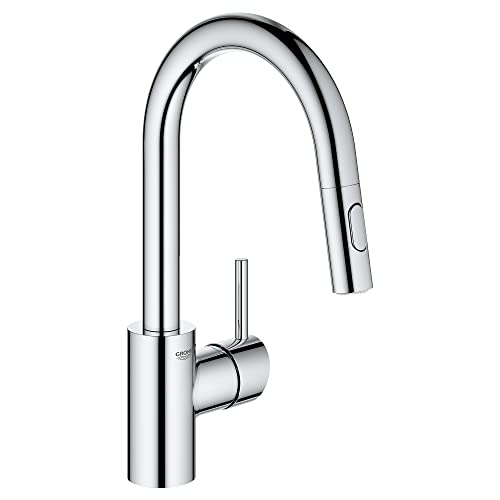
Grohe Concetto Pull-Down Bar Faucet (31479001) — Best Engineering
Grohe’s Concetto bar faucet is the engineer’s entry: a single-hole, deck-mount bar prep faucet with a pull-down sprayer, a 360-degree swivel spout, dual spray modes, a 1.75 GPM flow, and the company’s SilkMove ceramic valve — a cartridge whose action feels, even in miniature, like it was machined rather than assembled. The Starlight Chrome finish is Grohe’s hard, bright plating. It suits design-conscious bars, European-style kitchens extending their fixture language to the second sink, and users who notice handle feel. The pull-down at bar scale is a genuine functional bonus — rinsing a blender jar or a cocktail shaker at angles a fixed spout cannot reach — provided your bar bowl is deep enough to contain it; on the shallowest bowls, keep the wand docked and use the stream. Grohe’s US parts support is professional but less ubiquitous than Delta’s, the one ownership caveat.
Strengths
- SilkMove cartridge: the smoothest handle action in this guide, at bar scale.
- Pull-down sprayer with dual modes — rare, real utility in the bar format.
- 360-degree swivel covers corner-mounted bar sinks and L-shaped prep zones.
Trade-offs
- Pull-down spray can overwhelm the shallowest bar bowls; technique required.
- Chrome-only in this verified listing; warm or matte suites look elsewhere.
- Parts support is thinner on the ground in the US than Delta’s.
| Spec | Detail |
|---|---|
| Model | 31479001 (verified via API) |
| Flow rate | 1.75 GPM (verified via API) |
| Mounting | Single hole, deck mount, 360° swivel |
| Valve | SilkMove ceramic, dual spray modes |
There is a particular pleasure in a small object made without compromise, and the Concetto is that object in this category: nothing about it feels like the junior line. If your bar is a place you perform a craft — coffee, cocktails, both — this is the faucet whose daily tactility will keep pleasing you after the novelty of the bar itself has settled into routine.
Best for: craft-focused bars and European-style kitchens / Not suited for: the shallowest bowls or matte/warm finish schemes. Check the current price on Amazon.

Delta Modern Bar Faucet (14882LF-SP) — Best Mainstream Pick
Delta’s Modern bar faucet is the sensible center of this category: a single-hole, single-handle prep faucet in SpotShield Stainless, sized for bar decks, backed by the deepest parts and support network in American plumbing. No pull-down, no theatrics — a well-proportioned spout, a clean modern body, and Delta’s cartridge ecosystem underneath. It suits the majority of real installations: the island prep sink in a Delta kitchen, the pantry sink in a new build, the home bar whose owner wants the faucet decision to be as durable as the bar itself. SpotShield’s spot resistance is a thoughtful match for bar duty, where the faucet is wiped rarely and splashed constantly. Buyers wanting a sprayer should step to the Essa bar below; buyers wanting warmth of finish should note this listing is stainless-toned.
Strengths
- Delta’s parts, warranty administration, and support — the lowest-risk ownership in the bar class.
- SpotShield finish minimizes the water-spot evidence of bar use.
- Single-hole simplicity: the easiest deck story in this guide.
Trade-offs
- Fixed spout: rinsing reach is the swing radius and nothing more.
- Modern styling is neutral to a fault for character bars.
- Bar proportions only — not a substitute for a main-sink faucet.
The mainstream pick is rarely the exciting one, and here that is the point: most bar sinks need a faucet that is correctly sized, quietly handsome, and serviceable forever, and Delta’s distribution makes “forever” a logistical fact rather than a hope. If the bar is part of a larger Delta kitchen, the suite logic seals it.
Best for: island prep sinks, pantries, and Delta-suite kitchens / Not suited for: sprayer seekers or character-driven traditional bars. Check the current price on Amazon.
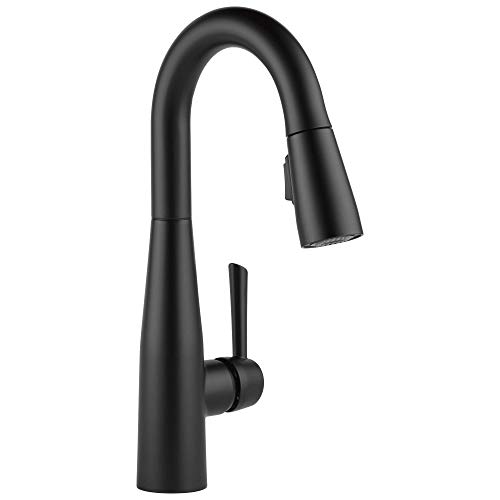
Delta Essa Bar Faucet (9913-BL-DST) — Best Pull-Down Bar Faucet
The Essa bar takes Delta’s most-loved modern platform — the same Essa whose full-size version anchors our American made guide — and scales it to a prep sink, in matte black, with the pull-down sprayer intact. That combination is rarer than it should be: a bar faucet with a genuine spray wand, magnetic-era docking manners, and a finish that anchors a black-fixture bar or coffee station. It suits design-led second sinks, matte black suites, and prep zones that do real work — produce rinsing, carafe filling, blender-jar duty — where the sprayer’s reach earns its keep daily. The matte black cautions from elsewhere in this batch apply: hard water will write on it unless wiped, and the pull-down’s hose needs its under-sink loop respected even in a small cabinet.
Strengths
- A true pull-down sprayer at bar scale, from the Essa platform’s proven design.
- Matte black finish with Delta’s warranty and parts depth behind it.
- Single-hole format suits the stone and solid-surface bars where prep sinks live.
Trade-offs
- Sprayer plus shallow bowl demands a light touch; expect a learning curve on splash.
- Matte black maintenance in hard-water districts is a weekly wipe.
- Premium positioning within the bar class.
Choose the Essa bar when the second sink is a real workstation and the room’s design language is modern black. It is the bar faucet least likely to feel like the B-team fixture — because mechanically and aesthetically, it is not.
Best for: working prep sinks and matte black bars / Not suited for: shallow bowls used carelessly or traditional rooms. Check the current price on Amazon.

Delta Foundations Two-Handle Bar/Prep — Best Two-Handle Classic
Some bars are rituals, and rituals have two handles. The Foundations bar/prep faucet gives the traditional wet bar its classic control scheme — separate hot and cold handles, a modest spout sized for bar decks — on Delta’s budget-friendly Foundations platform, which means the cartridges and parts are Delta-standard even at this tier. It suits traditional home bars, basement rec-room sinks, and any installation where the person mixing drinks wants unambiguous, glanceable temperature control and a faucet that looks like it has always been there. It is not the pick for one-handed modern prep work, and the Foundations line’s finishes are workmanlike rather than luxurious — appropriate for the rec room, less so for the showpiece bar, where the Kraus or Grohe above wear better.
Strengths
- Two-handle clarity: instant, unambiguous temperature at a glance and by feel.
- Delta platform parts at a budget tier — the value here is serviceable, not disposable.
- Period-correct presence for traditional bar design.
Trade-offs
- Two hands for temperature changes; slower in active prep.
- Foundations styling is plain; showpiece bars will want more.
- Requires its two-handle deck pattern — confirm your bar sink’s holes.
The Foundations bar faucet is the pick that respects how many American bars actually live: in basements and rec rooms, used hard on weekends, expected to work for decades without a thought. Delta’s ubiquity means the eventual cartridge is a hardware-store errand. There are prettier faucets in this guide; there is none more honestly matched to that room.
Best for: traditional wet bars and rec-room sinks / Not suited for: one-handed prep workflows or luxury bars. Check the current price on Amazon.

GIMILI Bar Sink Faucet — Best Budget
The value slot, held to this batch’s honesty standard: GIMILI’s single-hole bar faucet in brushed nickel adds a pull-down sprayer to the bar format at a budget positioning — check price on Amazon — from a brand with a coherent faucet line (its manual and touchless models verified elsewhere in this cluster’s research). It suits first bars, budget remodels, laundry-adjacent prep sinks, and buyers who want sprayer utility without Delta money. The caveats are the value class’s own: finish refinement and long-term parts depth trail the majors, and the sprayer in a shallow bar bowl requires the same splash discipline as the Essa’s. What it is not is anonymous — and that distinction, a brand with a line and a storefront identity over a letter-salad listing, is precisely the line our best-and-worst guide draws.
Strengths
- Pull-down sprayer at bar scale for budget money.
- Single-hole install and brushed nickel neutrality fit most bar decks and palettes.
- A coherent brand line behind it, unlike the anonymous bar listings in this category.
Trade-offs
- Parts depth and finish refinement are a tier below Delta and Kraus.
- Sprayer exuberance versus shallow bowls — technique required.
- Long-term support depends on a value brand’s continuity.
For the bar that is being built on a real budget — which is most first bars — this is the responsible way to save: keep the format right (true bar proportions, single hole, sprayer where the bowl can take it) and accept the support trade-off knowingly, rather than saving the same money on a mis-sized or anonymous faucet. If the bar becomes a permanent institution, the upgrade path to the Delta or Kraus picks uses the same single hole.
Best for: first bars and budget prep sinks / Not suited for: buyers who need flagship parts depth. Check the current price on Amazon.
Comparison Table
| Pick | Badge | Key spec | Best for |
|---|---|---|---|
| Kraus Oletto Bar KPF-2822SFS | Best Overall | Bar-height Oletto, spot-free stainless | Most bar and prep sinks |
| Grohe Concetto Bar 31479001 | Best Engineering | Pull-down, 1.75 GPM, SilkMove, 360° swivel | Craft bars, Euro kitchens |
| Delta Modern Bar 14882LF-SP | Best Mainstream | Single hole, SpotShield Stainless | Prep sinks, Delta suites |
| Delta Essa Bar 9913-BL-DST | Best Pull-Down Bar | Pull-down sprayer, matte black | Working prep sinks |
| Delta Foundations Bar/Prep | Best Two-Handle Classic | Separate hot/cold handles | Traditional wet bars |
| GIMILI Bar Faucet | Best Budget | Single hole, pull-down, brushed nickel | First bars, budgets |
How to Choose a Bar Style Kitchen Faucet
Start with the bowl, because bar sinks punish guessing. Measure the bowl’s depth and width, and the distance from the faucet hole to the bowl’s center. Bar bowls are commonly shallower than kitchen bowls — sometimes dramatically — and the faucet’s arc height and reach must be chosen so the stream lands mid-bowl with energy the depth can absorb. A full-size kitchen faucet fails this test in both directions, which is why this category exists. If your bar sink is actually a deep, generous second sink, be honest about it and buy from the main faucet guides instead; the bar picks here will feel undersized, and undersized is its own daily annoyance.
Next, the deck. Most bar sinks are single-hole, and four of our six picks live there. Two-handle classics need their spread; measure it rather than assuming. Stone and solid-surface bar tops are often drilled at build time, so the faucet decision and the drilling decision are the same decision — have the faucet, or at least its spec sheet, before the fabricator drills. Then the workflow question: is this sink a rinser (fixed spout suffices), a worker (pull-down earns its place), or a ritual (two handles, deliberately)? Bar sinks also live near ice makers, beverage fridges, and glass storage, so check the spout swing against shelves and upstands behind the sink — a 360-degree swivel like the Grohe’s is a blessing in a corner and a knuckle-rapping curse against a low shelf.
Finally, flow and fill. Bar duty includes filling ice buckets, coffee reservoirs, and occasionally a stockpot borrowed from the kitchen; a modest flow rate is fine for rinsing but slow for bucket duty, so if your bar sink doubles as the utility fill point, weight the Grohe’s 1.75 GPM and the pull-down models’ reach more heavily. And as everywhere in this cluster: buy the platform, not the photograph — the cartridge and parts story decides whether the bar’s faucet is a fixture or a consumable.
How to Install a Bar Faucet (and Plumb a New Bar Sink)
On an existing bar sink, installation mirrors a kitchen swap at smaller scale: shut off supplies (bar sinks in finished basements sometimes lack local stops — if yours does, add them during this job and thank yourself forever), remove the old unit, clean the deck, set the new faucet, and connect. The bar-specific checks are swing clearance against the backsplash and any rear shelf, and the pull-down hose loop in what is often a shallower cabinet with a beverage fridge’s plumbing competing for space. For a new bar installation, sequence matters: choose the faucet before the counter is drilled, rough the supplies with stops at a height that leaves the hose loop clear, and if the bar includes an ice maker or a glass washer, give each its own shutoff so the faucet’s service never requires draining the whole bar.
One practical upgrade while the cabinet is open: a leak alarm under the bar sink. Bars live in finished spaces — rec rooms, dens, guest suites — where a slow leak’s first announcement is a ruined floor rather than a noticed drip, and bar sinks are used in bursts that make small leaks easy to miss. The alarm costs less than the faucet’s cartridge and protects the room the bar was built to show off.
Designing the Bar Sink Station Around the Faucet
A bar sink is a workstation in miniature, and the faucet is its center of gravity; the stations that work are designed outward from it. Start with the landing zones: a bar faucet’s swing defines an arc of wet work, and the ice well, the garnish board, and the glass drainer should sit inside or beside that arc so rinsed things travel inches, not feet. If the bar includes a coffee station, put the faucet within a carafe’s carry of the brewer — the Essa Bar’s pull-down exists precisely for the reservoir fill that otherwise becomes a jug-and-spill ritual. Height planning matters too: the arc must clear the tallest regular vessel — a cocktail shaker, a French press, a wine decanter — with the vessel sitting in the bowl, not tilted under the spout. Decanters are the classic gotcha: tall, fragile, and filled at the bar sink more often than anywhere else in the house.
Water quality is the bar’s private concern in a way the kitchen’s is not. Ice and dilution water are ingredients, and a bar sink that feeds an ice maker or fills a water pitcher for the table benefits from a filtered supply — the fourth deck hole on many bar sinks, or an under-counter filter on the cold line. If you plan filtration, plan it with the faucet purchase, because the filter’s own tap needs a hole and its lines need cabinet room beside the faucet’s. Drainage, finally, is the unglamorous decider: bar sinks see sugary, acidic liquids that sit in traps, and a bar used on weekends and ignored on weekdays should be run with clean water at the end of every session — a habit the faucet’s ease of use directly encourages or discourages. The best bar faucet is the one that makes the station’s closing routine effortless, because that routine is what the next session inherits.
Bar Faucet Care: Living with Glass, Ice, and Garnish Duty
Bar faucets age differently from kitchen faucets, and their care calendar reflects it. The enemies are sugar and acid rather than grease: cocktail syrups, citrus, and wine dry into films that glue aerators and stiffen spray faces, and they do it in a sink that may sit unused for five days between sessions. The countermeasure is a closing flush — thirty seconds of clean hot water through the spout and sprayer at session’s end — plus a monthly aerator rinse, which on every pick here is a hand-tool-free job. Finishes at the bar suffer a specific insult: the rims of glasses and the bases of shakers strike the spout, so chip-prone decorative coatings suffer; the metal finishes on this list — Kraus’s spot-free stainless, Grohe’s Starlight chrome, Delta’s SpotShield — are chosen partly for their indifference to that contact.
Ice duty adds one more behavior: thermal shock and condensation. A faucet that fills ice buckets and rinses frosted glassware sweats in humid rooms, and the deck seal is where that water wants to go. Check the deck gasket’s integrity at the same monthly aerator rinse, and keep a bar towel’s home within reach of the sink rather than across the room — the stations that stay dry are the ones where drying is convenient. None of this is burdensome; it is simply the bar’s version of the kitchen’s rules, translated to a smaller, sweeter, more intermittent workload.
Budget Tiers in the Bar Class, in Plain Terms
We do not print static prices, so the ladder in words. The budget tier is the GIMILI’s and, in spirit, the Foundations’: correct format and a real brand, with finish and parts depth as the accepted trades. The middle tier — the Delta Modern and the Kraus Oletto Bar — is where most home bars should land: full platform quality, finishes that survive bar duty, and parts pipelines that treat the faucet as a fixture. The premium tier, the Grohe Concetto and the Essa Bar, buys tactility and capability — the SilkMove action, the pull-down at scale — for bars that are genuine craft stations. Because a bar faucet’s total cost includes the room it can damage, we counsel against saving below the budget tier’s floor: an anonymous faucet over a rec-room floor is the most expensive faucet in this guide, on the installment plan. Check price on Amazon for the current numbers at each rung.
Common Buying Mistakes
- Putting a full-size kitchen faucet on a bar sink. The splash math never works; buy the bar format for the bar bowl.
- Conversely, putting a bar faucet on a deep second sink. Undersized reach and flow will annoy daily. Match the faucet to the bowl’s real dimensions.
- Drilling the bar top before choosing the faucet. Hole count and spread are the faucet’s decision; sequence the build correctly.
- Forgetting swing clearance. Shelves, upstands, and window frames behind bar sinks collide with tall arcs and wide swivels. Measure the arc’s whole path.
- No local shutoff valves. Bars plumbed as an afterthought often lack stops; add them at install, not at the first leak.
- Buying anonymous at the bar. A bar faucet in a finished room has the highest leak-consequence in the house; the brand and parts story matter more here, not less.
Bar Faucets for Coffee Stations, Pantries, and Outdoor Kitchens
The bar format’s second career is everywhere a small sink serves a single purpose. At a coffee station, the faucet’s jobs are carafe rinsing, reservoir filling, and portafilter duty; a pull-down (Grohe, Essa Bar) transforms the reservoir fill from a jug relay into a direct operation, and the arc must clear the tallest carafe the household owns — measure it, because coffee gear is taller than bar glassware. In a butler’s pantry, the sink is a staging area: flower vases, serving-piece rinsing, and overflow dish duty during events. There the mainstream Delta or the Oletto Bar fit best, and the faucet should be chosen to survive event-scale bursts rather than daily rhythm — which is to say, buy the platform, because the pantry faucet that fails fails on Thanksgiving.
Outdoor kitchens are the bar format’s hardest posting and deserve a sober paragraph. A bar faucet outdoors must be drained or the installation winterized in any freeze climate — no model in this guide survives trapped water in a hard freeze — and finishes age faster under UV and weather. Stainless constructions fare best; matte and dark finishes show outdoor spotting fastest. If the outdoor bar is a three-season room, treat the faucet as a seasonal appliance with a shutoff and drain in the basement, and choose the pick whose replacement cost you can shrug at — which, in this guide, argues for the Delta Modern or the GIMILI rather than the Grohe. The format is right for outdoor sinks; the expectations must be set by the climate, not the catalog.
Final Recommendation
For most bar and prep sinks, buy the Kraus Oletto Bar: correct proportions, quality build, no drama. Craft bars take the Grohe Concetto, Delta kitchens take the Delta Modern, working prep sinks take the Essa Bar, traditional wet bars take the Foundations two-handle, and first bars on a budget take the GIMILI. Continue in the cluster: Best Basic Kitchen Faucets, Best Automatic Kitchen Faucets, Best American Made Kitchen Faucets, Best Antique Kitchen Faucets, Best And Worst Kitchen Faucets.
A Note on Water Pressure and Flow at the Bar Sink
Bar sinks often sit at the end of long plumbing runs — the basement bar at the far corner from the main, the pantry off a branch line — and their pressure can be the house’s most honest report card. The picks here are regulated-flow faucets that behave predictably across normal residential pressure, but two bar-specific notes apply. First, a long run means a long wait for hot water, and bar duty is impatient: if your bar sink’s hot line travels the house, consider that most bar tasks are actually cold-water tasks (rinsing, ice, dilution) and set your expectations — or your plumber’s recirculation plans — accordingly. Second, aerator condition matters more at marginal pressure than anywhere else: a half-scaled aerator on a weak line turns a faucet anemic, and the monthly rinse in the care section is the difference between blaming the faucet and fixing the house. If a new bar faucet disappoints on day one, measure before you return: static pressure at the bar’s stops, with the aerator off, tells you whether you bought the wrong faucet or inherited the house’s plumbing personality.
The Bar Faucet in an Open-Plan Kitchen: Sightlines and Sound
In open-plan homes the bar or prep sink is visible from the living space, and the faucet — the tallest object on that counter — becomes part of the room’s furniture whether it was chosen that way or not. This changes the choosing in two practical ways. First, finish discipline matters more at the island than at the main sink: the bar faucet is seen against the living room’s metals, not the kitchen’s, and a finish that matches the cabinet hardware and lighting in the shared space reads as design, while a fourth unrelated metal reads as an accident. This is one reason the single-finish discipline of the picks here — stainless, chrome, or matte black, each carried cleanly — outperforms variety at the bar. Second, sound: bar faucets run in the evening, in rooms where people are talking, and a faucet’s noise is set by its aerator and flow path. Aerated streams are quieter than laminar or spray modes at the same flow; if your prep sink hosts conversations, favor the fixed-spout picks for daily use and save the sprayers for work sessions. Neither consideration appears on a spec sheet, and both decide whether the bar feels finished six months after the remodel’s photographs fade.
There is also a choreography point unique to visible bars: guests will use this faucet. They will rinse a glass, fill a water pitcher, wash hands before dinner. A bar faucet that requires instruction — an unfamiliar sensor, a quirky control — makes the host a narrator; the picks here were chosen partly for guest-legibility, the quality of being understood by a person meeting them for the first time with a glass in hand. The two-handle Foundations is the extreme case of legibility; the single-handle models are close behind. Judge your bar’s faucet partly through a guest’s eyes, because in an open plan, the bar is a stage and the faucet is on it nightly.
Frequently Asked Questions
Should a home bar’s faucet match the kitchen faucet?
Match the family, not necessarily the model. Carrying one brand’s finish and cartridge platform from the kitchen to the bar — Delta to Delta, Kraus to Kraus — simplifies parts, pleases the eye in open-plan rooms, and usually reads as intentional design. Where the bar is a separate world (a basement rec room, a themed den), a deliberate contrast is fine and often better: the Foundations two-handle under a modern kitchen’s single-lever faucet is a room telling its own story. What to avoid is the accidental mismatch — five metals in one sightline with no two alike — which reads as indecision rather than eclecticism.
How do I stop a bar faucet from splashing a shallow bowl?
Technique and aeration. First, run the faucet at partial flow for rinsing — bar duty rarely needs full stream, and the valve’s first half of travel is the splash-free half. Second, keep the aerator clean; a scaled aerator breaks the stream into spray, which is splash in uniform. Third, angle vessels rather than holding them flat under the stream, and keep the pull-down wand (where fitted) docked for shallow work, using its spray only in the bowl’s deepest moments. If splashing persists at gentle flow with a clean aerator, the faucet is oversized for the bowl — the category error this guide exists to prevent.
What is the difference between a bar faucet and a kitchen faucet?
Scale and intent. A bar faucet is proportioned for a smaller, shallower prep or bar sink: lower arc, shorter reach, often a single-hole deck, and flow suited to rinsing and small fills. A kitchen faucet is sized for deep bowls, big pots, and heavy daily volume. Each looks wrong and works badly in the other’s sink — the bar faucet cannot fill a stockpot sensibly, and the kitchen faucet splashes a bar bowl relentlessly.
Can I use a bar faucet as my main kitchen faucet?
Only in genuinely small kitchens — a compact apartment or galley where the main sink is itself bar-sized — and even then, a compact pull-out (see our American Standard guide’s Colony Pro Pull-Out) usually serves better. For a standard kitchen sink, a bar faucet’s reach and height will frustrate every pot fill and pan rinse. Buy the format for the bowl you have.
Do bar faucets need a sprayer?
Most do not: bar duty is rinsing glasses, shakers, and produce within a small bowl, which a swivel spout covers. A pull-down earns its place when the prep sink does real kitchen work — produce washing, carafe and blender rinsing — and when the bowl is deep enough to contain the spray. Two picks here (Grohe, Essa Bar) and the budget GIMILI offer it; the fixed-spout picks are the calmer choice for shallow bowls.
What hole pattern do bar sinks usually have?
Single-hole is the modern default, which is why most picks here are single-hole designs. Traditional bars and older rec-room sinks may have two-handle spreads — the Foundations pick serves those — and some bar sinks are drilled for a small centerset. Measure before ordering; bar tops in stone are expensive to re-drill, and the faucet should be chosen before a new top is fabricated.
Is a bar faucet a good choice for a laundry or utility sink?
Sometimes. A bar faucet’s compact arc suits a shallow utility sink better than a tall kitchen faucet does, and single-handle control is handy with messy hands. But utility duty is hard duty — paint, garden chemicals, workshop grime — and a faucet there should be chosen for serviceability above styling. The Delta picks’ parts depth makes them the safer utility choice; save the Grohe’s finish for the bar it was designed to grace.
Do bar faucets come in finishes that match my kitchen?
The main families are represented: stainless tones (Kraus spot-free, Delta SpotShield), polished chrome (Grohe), and matte black (Delta Essa Bar) all appear in this guide, and the two-handle Foundations covers the traditional chrome wet-bar look. Warm bronzes and brass are the bar category’s gap — antique and farmhouse bars wanting those finishes should look at the compact models in our antique guide and verify their proportions against the bar bowl, since the antique lines run larger. Within the finishes here, cross-brand matching is approximate at best; if the bar sits in the kitchen’s sightline, carrying the main faucet’s brand family to the bar is the reliable way to land the tone exactly.
What size sink works best with a bar faucet?
The classic bar sink is a compact single bowl — roughly the footprint of a large dishpan, and shallower than a kitchen bowl — and the picks here are proportioned for it. If your second sink is substantially larger or deeper, it has outgrown the bar category and deserves a compact kitchen faucet instead. The tell is the fill test: if you regularly fill vessels that dwarf the bowl, or rinse items wider than the bowl, the sink is a small kitchen sink, not a bar sink, whatever the room is called.
How long should a bar faucet last?
On the same schedule as its kitchen counterpart, and often longer in calendar terms, because bar duty is intermittent: the cartridge cycles that a family kitchen accumulates in a year may take a weekend bar five. The Delta and Kraus platforms here should be thought of as decade-scale fixtures with a cartridge refresh somewhere along the way; the Grohe’s SilkMove valve is built to the same horizon. What shortens a bar faucet’s life is rarely use — it is neglect chemistry (sugar and acid films left to harden), freeze damage in unheated spaces, and leaks ignored in rooms nobody enters on weekdays. The care section’s closing flush and monthly aerator rinse are the whole insurance policy, and they cost about a minute a session.
Can a bar faucet handle a garbage disposal?
Yes — the faucet and the disposal never meet mechanically; the disposal lives on the drain, the faucet on the deck. The practical considerations are under-sink space (a disposal plus a pull-down hose loop in a small bar cabinet needs the routing care described in the install section) and habit: bar waste is sugary and acidic, so run water while the disposal works and flush briefly afterward, as you would in the kitchen. Many bar sinks skip the disposal entirely and use a strainer, which is also fine — the faucet choice is unaffected.
How much clearance does a bar faucet need behind it?
Enough for the handle’s full travel and the spout’s swing, measured against whatever lives behind your sink — backsplash, shelf, window, or bar back. Single-handle bar faucets typically park their lever to the side or front, which helps in tight bars, but the only reliable method is the tape measure against the model’s dimensions before purchase. Corner installations benefit from a full 360-degree swivel; straight runs against a shelf benefit from a restrained arc.


