Disclosure: airfryerkitchensupply.com is reader-supported. When you buy through links on our site, we may earn an affiliate commission at no extra cost to you.
Where to buy
This guide to the best and worst kitchen faucets does two jobs at once. On the buy side, every linked pick was verified against Amazon’s catalog on 2026-11-20: start with the Moen Essie 87014SRS for the safest mainstream pull-down, the Delta Lenta 19802Z-SP-DST for the best docking and spray technology, and the Kraus Oletto KPF-2820SFS for the heaviest build quality at its tier. On the avoid side, the three “worst” entries below are deliberately not linked for purchase — they are named, listing-verified listings used as documented examples of the failure patterns that burn buyers: the parts black hole, the misleading listing, and the feature-stacked budget trap. Read both halves before you spend anything; the worst list will save you more money than the best list makes us.
A kitchen faucet is the most-used plumbing fixture in the house, cycled dozens of times a day by every member of the household, and the one whose failure is most disruptive — a dead faucet means no cooking water, no dishwashing, and an emergency purchase made in a hurry at whatever price the nearest store demands. That is why the gap between the best and worst kitchen faucets is wider than in almost any other category: the best are 15-year appliances with replaceable wear parts, and the worst are effectively disposable, failing at a cartridge or hose that cannot be replaced at any price. This guide names names on both ends, with the receipts — model numbers, verified listings, and the specific mechanism of failure — rather than vague warnings about “cheap faucets.”
In this guide
Quick Picks
- Best Overall: Moen Essie 87014SRS — the mainstream pull-down with the fewest ownership surprises.
- Best Docking and Spray: Delta Lenta 19802Z-SP-DST — MagnaTite docking, ShieldSpray power, and a tall modern arc.
- Best Build Quality per Dollar: Kraus Oletto KPF-2820SFS — brass body, ceramic cartridge, and commercial heft in a residential faucet.
- Worst for Parts Support: unbranded import faucets (example verified listing: GBBNE bar sink faucet) — no brand, no parts catalog, no recourse when a cartridge fails.
- Worst Listing Confusion: Moen M-Dura 8289 marketplace listings — listing data for this model describes replacement-part attributes on a listing presented as a complete faucet.
- Worst Feature Trap: feature-stacked budget touchless faucets (example verified listing: Jlerli Touchless) — sensor, LED, and three spray modes from a brand with no service network.
How These Picks Were Chosen
For the best side, we applied the same discipline as our other faucet guides: every candidate was searched by brand and model, the returned Amazon title was matched to the intended model, and only then did we take the ASIN. The winners had to clear four bars — a standardized, replaceable cartridge; a spray head that docks positively; metal where water pressure lives; and a manufacturer with a real parts and support operation. Dozens of popular faucets failed one of those bars, most often the parts test.
For the worst side, we did something more unusual: we verified the bad examples through the same API, because an accusation needs the same evidence as a recommendation. Each worst entry below is a real, current, purchasable listing whose problem is structural rather than anecdotal. The unbranded faucet’s problem is that there is no company behind it to sell you a cartridge in year three. The M-Dura listing’s problem is visible in the listing data itself, which describes attributes inconsistent with a complete faucet — a data trail suggesting buyers may receive, or be serviced as, a part rather than the fixture pictured. The budget touchless trap’s problem is arithmetic: a sensor system, an LED, a pull-down mechanism, and a stainless body cannot all be built well at a rock-bottom price, so something inside is built to a price that guarantees early failure — and the brand behind it has no network to make it right. We are not claiming every individual unit of these models fails; we are claiming the risk structure is bad, which is the claim that matters before purchase.
One more methodological note: we excluded simple “cheapness” as a worst criterion, and we also excluded styling. A faucet can be ugly and excellent, or gorgeous and disposable; this guide’s best and worst are engineering and ownership judgments, and the photographs were not allowed to vote. Where a pick’s looks genuinely matter to its use case — the Lenta in a modern kitchen, for instance — we say so as a fit note, never as the ranking reason. Readers who weight design above all should use our style-specific guides in this cluster, where the same parts-and-support floor still applies beneath the aesthetics. An honest budget faucet from a real brand — metal spout, standard cartridge, published parts — is a legitimate product, and several appear elsewhere in this cluster’s guides. The worst list is reserved for products whose failure mode is designed-in or whose listing misleads, not for products that are merely inexpensive.
The Best and Worst Kitchen Faucets, Reviewed
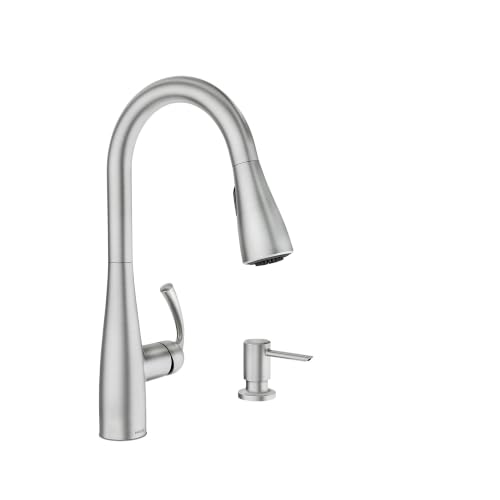
Moen Essie 87014SRS — Best Overall
The Essie is the faucet that defines the safe center of the market: a high-arc pull-down in Spot Resist Stainless with Moen’s Power Clean spray and Reflex docking, a bundled soap dispenser, and the deepest parts ecosystem in residential plumbing behind it. It suits the mainstream family kitchen completely — 1- to 4-hole decks with its included deck plate, everyday cooking, and owners who want the faucet decision to stay made. It is not the most beautiful faucet here, nor the heaviest; it is the one least likely to generate a regret, which is what “best overall” should mean in a category where the downside of a bad pick is a flooded cabinet or a week without a sink.
Strengths
- Power Clean spray delivers a concentrated, high-force rinse that genuinely speeds up pan washing.
- Reflex hose system retracts smoothly and keeps the wand seated in the spout over years of use.
- Moen’s cartridge and parts availability is the benchmark: replacements are stocked nationally and priced as consumables.
Trade-offs
- The styling is pleasant rather than striking; design-led kitchens may prefer the Delta below.
- The included soap dispenser occupies the fourth hole some owners would rather use for a filtered-water tap.
- Spot Resist finish is excellent against fingerprints but the underlying design shows water spots in very hard water without a wipe-down habit.
| Spec | Detail |
|---|---|
| Overall height | 15.75 in (verified via API) |
| Mounting | 1, 2, 3, or 4-hole with included deck plate (verified via API) |
| Spray | Power Clean, Reflex docking, Duralock connections |
| Included | Soap/lotion dispenser (per API features) |
What keeps the Essie at the top of a best-and-worst list is the absence of a failure story. Its cartridge is a standard Moen unit; its hose is a listed replacement part; its finish warranty is administered by a company with US support lines. Compare that profile with any entry on the worst half of this page and the pattern is clear: the best faucets are not the ones with the longest feature lists, they are the ones whose every wear part has a name, a number, and a warehouse. Buy the Essie when you want to stop researching faucets, which for most households is the correct ambition.
Best for: mainstream family kitchens and low-drama ownership / Not suited for: design-showpiece kitchens. Check the current price on Amazon.

Delta Lenta 19802Z-SP-DST — Best Docking and Spray
If the Essie is the safe center, the Lenta is the technology leader of the honest tier: a tall, modern pull-down in SpotShield Stainless whose wand docks with Delta’s MagnaTite magnet and whose spray head carries ShieldSpray, a concentrated jet inside a protective shield of water that scrubs stuck-on food while containing splatter. It suits cooks who rinse aggressively — sheet pans, blender jars, roasting racks — and modern kitchens that want the faucet to look like it belongs with the appliances. The height, at 16.25 inches verified, needs the standard cabinet check, and the modern look will not flatter a farmhouse kitchen.
Strengths
- MagnaTite docking is the strongest, most positive wand dock in the industry — the head clicks home and stays.
- ShieldSpray genuinely reduces the splash-back that makes high-pressure rinsing a countertop-flooding exercise.
- DIAMOND Seal valving attacks drip formation at the disc surface itself.
Trade-offs
- Premium tier pricing over the Essie for technology some households will rarely use.
- Tall arc plus pull-down hose demands clear under-sink space for the weight’s travel.
- SpotShield stainless is a Delta-specific tone; cross-brand suite matching is imperfect.
| Spec | Detail |
|---|---|
| Overall height | 16.25 in (verified via API) |
| Dimensions | 9.13 x 1.5 x 16.25 in (verified via API) |
| Docking | MagnaTite magnetic |
| Mounting | Single hole (verified via API) |
The Lenta earns its place on the best side by solving the two complaints that dominate pull-down ownership: the wandering wand and the wimpy spray. Both are engineering problems with engineering answers, and Delta’s answers are patented, proven, and — critically for this guide’s theme — supported by a parts network that will sell you a replacement wand, hose, or cartridge by model number for years. This is what the good end of the market looks like: innovation you can also repair.
Best for: serious home cooks and modern kitchens / Not suited for: farmhouse styling or tight under-sink cabinets. Check the current price on Amazon.

Kraus Oletto KPF-2820SFS — Best Build Quality per Dollar
Kraus built its reputation by putting commercial material choices into residential faucets at mid-range prices, and the Oletto is the purest example: a solid brass body, a ceramic cartridge, a spot-free stainless finish, and the company’s Reach technology for smooth spout movement, standing 16.625 inches tall with a 1.8 GPM flow. It suits buyers who pick up a faucet in a showroom and judge it by weight and action — the Oletto passes that test against faucets a tier above it — and kitchens that want a single-hole contemporary look without paying designer-brand premiums. Kraus’s parts network, while real, is smaller than Moen’s or Delta’s, so a rural buyer should confirm cartridge availability before committing.
Strengths
- Brass body construction at a tier where plastic-bodied rivals are common.
- Ceramic cartridge and metal hardware throughout the water path.
- Spot-free finish keeps the tall arc looking clean with minimal wiping.
Trade-offs
- Smaller brand: parts are available but not on every hardware store shelf.
- The contemporary design language is one-note — modern or nothing.
- At 16.625 in tall, it needs the same clearance diligence as the Lenta.
| Spec | Detail |
|---|---|
| Overall height | 16.625 in (verified via API) |
| Spout height / reach | 8.75 in / 8.875 in (verified via API) |
| Flow rate | 1.8 GPM (verified via API) |
| Construction | Brass body, ceramic cartridge, single hole |
The Oletto is our standing rebuttal to the idea that the best list is just the biggest brands. It clears every structural bar — material, cartridge, docking behavior, a manufacturer that publishes specifications and sells parts — and does it at a mid-range tier. If the worst half of this guide teaches skepticism, the Oletto teaches the complementary lesson: judge the construction and the support, not the logo’s fame.
Best for: build-quality hunters at a mid-range budget / Not suited for: traditional kitchens or buyers who need parts on a rural shelf today. Check the current price on Amazon.
Unbranded Import Faucets (Example: GBBNE Bar Sink Faucet) — Worst for Parts Support
Now the other end of the market. The verified listing we use as the documented example is a bar sink faucet sold under the GBBNE name — a string of letters that is not a plumbing company, has no parts catalog, no published cartridge standard, and no support channel beyond the marketplace message button. The listing itself is a word salad of applications — commercial utility, laundry, RV, outdoor, slop sinks, kitchen and bath — which is what a listing looks like when it is written to catch searches rather than to specify a product. On day one, such a faucet usually works; water comes out, and the buyer feels clever. The failure arrives on schedule at the cartridge, the diverter, or a fitting, somewhere in years one to three, and at that moment the product’s true specification reveals itself: there is no replacement part, because there is no parts system, because there is no manufacturer in any sense that matters to an owner. The faucet is replaced whole, the “savings” invert, and the landfill gains a metal-plastic assembly that a branded faucet would have outlived three times over.
Weaknesses
- No identifiable manufacturer: no parts catalog, no cartridge standard, no warranty administrator.
- Listing copy optimized for search coverage rather than specification — a reliable tell of a disposable product.
- Certification claims, where present, are unverifiable because there is no listing holder to check.
The narrow case for it
- As a temporary faucet for a renovation in progress or a utility sink that sees monthly use, a cheap unit can be a rational consumable — if bought with that expectation, at a consumable price, and never plumbed anywhere a leak would be catastrophic.
How to spot this category in the wild: the brand name is unpronounceable or generic, the title is a comma-separated pile of room names, there is no model number you could type into a parts search, and the seller’s storefront sells unrelated categories. Any two of those four signs should move a faucet from “bargain” to “disposable” in your mental accounting — and disposables should be priced and placed accordingly.
Worst for: any primary kitchen sink / Tolerable only for: temporary or rarely used utility installations bought as consumables. (Unlinked entry — deliberately not linked.)
Moen M-Dura 8289 Marketplace Listings — Worst Listing Confusion
This entry is a different species of worst: not a bad faucet, but a bad buying experience created by bad data. The Moen M-Dura line is legitimate commercial hardware, and the 8287 and 8244 models verified cleanly through the API with full feature sets — flow rate, certifications, weights consistent with complete faucets. The 8289 listing is where the data falls apart: when we verified this model, the returned feature data described replacement-part attributes and a weight of a fraction of a pound — the signature of a parts listing wearing a faucet’s identity, or of catalog data so corrupted that neither buyer nor seller can be sure what ships. A homeowner who orders “the 8289” on the strength of the M-Dura name may receive the wrong thing, or the right thing with the wrong expectations, and will burn their weekend discovering which.
Weaknesses
- Catalog data for this model is internally inconsistent (part-level weight and features on a faucet listing).
- Commercial model numbers are opaque to homeowners; a single digit separates faucets, parts, and variants.
- Returns and corrections for commercial plumbing listings are slower than for consumer lines.
The narrow case for it
- The M-Dura family itself is durable commercial equipment; the verified 8287 and 8244 listings are legitimate ways to buy into it — the failure here is this model’s listing data, not the product line.
The generalizable lesson is worth more than the specific model: when a listing’s specifications contradict themselves — weight, dimensions, or features that describe a different object — believe the contradiction, not the photograph. Verify the model number against the manufacturer’s own catalog, and if the marketplace data and the manufacturer data disagree, buy through whichever channel shows you consistent data, or pick the sibling model whose data is clean.
Worst for: first-time commercial-faucet buyers ordering by model number alone / Workable for: buyers who verify against the manufacturer’s catalog and order the cleanly listed siblings. (Unlinked entry — deliberately not linked.)
Feature-Stacked Budget Touchless Faucets (Example: Jlerli Touchless) — Worst Feature Trap
The third failure pattern is the most seductive: a touchless sensor, a pull-down sprayer with three modes, a temperature LED, high-arc styling, and stainless construction, all at a budget price, from a brand — our verified example is sold as Jlerli — with no service network, no parts catalog, and no track record. Each individual feature is real enough to photograph. What cannot be real at that price is the durability of all of them together: the sensor module, the solenoid valve, the battery or power system, the hose, and the cartridge each had to be built to a number, and the number was small. Electronics near water, built cheaply, fail in the specific way that leaves a kitchen without water until the whole unit is swapped — there is no manual override culture in this product class and no technician who stocks its parts.
Weaknesses
- Maximum component count at minimum component budget — the arithmetic of early failure.
- Sensor and solenoid failures typically disable the faucet entirely rather than degrading it.
- No parts ecosystem: a failed control box is a full replacement, at full price, on your schedule of emergency.
The narrow case for it
- If you specifically want to trial touchless living before committing to a Moen MotionSense or Kohler Response model, a budget unit is a cheap experiment — in a secondary sink, with the old faucet kept in the garage.
Contrast the structure with the legitimate touchless tier in our automatic faucets guide: there, the sensor system comes from a company that sells the solenoid, the control box, and the battery pack as numbered parts, and the faucet still works as a manual faucet when the electronics are off. Features are not the sin; unrepairable features are. When a listing leads with how many technologies it stacks and cannot name its cartridge, it is telling you exactly where the money did not go.
Worst for: primary sinks and anyone without a backup faucet / Tolerable only for: low-stakes touchless experiments in secondary sinks. (Unlinked entry — deliberately not linked.)
Comparison Table
| Pick | Badge | Key spec | Best for |
|---|---|---|---|
| Moen Essie 87014SRS | Best Overall | 15.75 in, Power Clean, Reflex, dispenser included | Family kitchens |
| Delta Lenta 19802Z-SP-DST | Best Docking and Spray | 16.25 in, MagnaTite, ShieldSpray | Serious cooks, modern kitchens |
| Kraus Oletto KPF-2820SFS | Best Build Quality per Dollar | 16.625 in, brass body, 1.8 GPM | Mid-range quality hunters |
| Unbranded imports (GBBNE example) | Worst for Parts Support | No manufacturer, no parts catalog | Avoid for primary sinks |
| Moen M-Dura 8289 listings | Worst Listing Confusion | Listing data describes part-level attributes | Verify or buy clean siblings |
| Budget touchless stacks (Jlerli example) | Worst Feature Trap | Sensor + LED + 3 modes, no service network | Avoid for primary sinks |
How to Choose: The Five Tests That Separate Best from Worst
Everything in this guide compresses into five tests you can run on any faucet listing in about three minutes. Test one, the cartridge test: can you find the replacement cartridge for this exact model, for sale, by number, from more than one seller? If not, the faucet’s lifespan is the cartridge’s lifespan. Test two, the company test: does the brand have its own website with a parts section, a support line, and a physical business identity? A storefront is not a company. Test three, the contradiction test: do the listing’s weight, dimensions, flow rate, and features describe the same object? Data that contradicts itself predicts a shipment that surprises you. Test four, the material test: is the body and spout metal where pressure lives, and does the manufacturer say so in specifications rather than adjectives? Test five, the arithmetic test: does the feature list make sense at the price — or would each feature, bought separately from a real brand, cost more than the whole faucet? The best picks in this guide pass all five; each worst entry fails at least two, and the failures are visible before purchase to anyone who runs the tests.
Apply the tests in order of your kitchen’s reality. A primary family sink weights tests one and two most heavily, because downtime is the true cost. A design-led remodel adds the finish-warranty question to test two. A utility or bar sink can relax — but should relax knowingly, pricing the faucet as a consumable rather than discovering its status during a leak. And whatever the sink, test three is free and instant: read the specifications like an auditor, not like a fan.
How to Rescue a Bad Faucet Situation
If you already own a worst-list faucet, the playbook differs by failure. For an unbranded unit with a dripping cartridge, do not hunt for the part that does not exist; photograph the installation, measure the deck, and order a branded replacement from the best list while the old faucet still mostly works — planned replacement on your schedule beats emergency replacement on the leak’s. For a commercial-listing mix-up like the M-Dura case, keep all packaging and listing screenshots, verify what arrived against the manufacturer’s catalog before installing, and resolve mismatches through the marketplace’s return channel before the faucet is plumbed in; an uninstalled return is a errand, an installed one is a project. For a dead budget touchless unit, check the simple things first — batteries, the sensor window’s cleanliness, the control box connections — because a meaningful share of “failures” are power and fouling; if the solenoid itself is gone, accept the lesson, keep the manual fallback in mind for the replacement, and buy the replacement from a brand that sells the control box as a part.
The Anatomy of a Faucet Failure: How Best and Worst Diverge Over Time
To see why the two halves of this guide diverge, follow a faucet’s life. In year one, best and worst are nearly indistinguishable: seals are new, hoses are supple, finishes are unmarked, and water flows. The first divergence is mineral. Hard water deposits scale in aerators and begins scoring lesser cartridge surfaces; the best-list faucets answer with cleanable aerators, Touch-Clean-style wipeable spray holes, and ceramic or diamond-disc valving that tolerates the environment, while the worst list’s soft-seal cartridges start to weep at the handle — the first drip, arriving somewhere in years one to three.
Years three to five bring the mechanical reckoning. Pull-down hoses have now flexed tens of thousands of times. On the best list, the hose is a braided, guided component with a listed replacement; on the worst list, it is an unlisted tube whose fitting matches nothing else on earth. Spray heads clog and docks loosen; magnetic and Reflex docks hold their alignment, friction docks on disposable faucets begin the slow dangle. This is also when finishes separate: PVD-class and commercial finishes shrug off the cleaning chemicals of real kitchens, while thin decorative platings on budget imports start to pit at the spout tip where water and scrub pads meet.
By years five to ten, the question is no longer quality but identity: is there a company that knows your faucet’s name? The best-list owner orders a cartridge by model number and is done in an afternoon. The worst-list owner discovers that their faucet, as a serviceable object, no longer exists — the brand storefront has moved on to other categories, the listing is delisted, and the only fix is full replacement, usually urgent, usually at retail, always at the worst possible moment. Total cost of ownership, the only honest metric, inverts the sticker prices completely: the “expensive” faucet was the cheap one. That inversion is the entire argument of this guide, and it is why we weight parts systems over features in every ranking we publish.
Best and Worst by Kitchen Type
The right answer also shifts with the room. In a rental property, the best faucet is the one a tenant cannot easily break and a handyman can service with a standard cartridge — the Essie’s profile exactly — while the worst is anything electronic or anonymous, because the service call will cost more than the faucet. In a short-term renovation or a flip, a branded basic faucet (see our basic faucets guide) is the rational best; the worst is over-investing in premium features the sale price will not return. In a forever home, the best list’s repairable flagships justify themselves fully, and the worst mistake is the opposite of the flipper’s: saving a small amount on the faucet you will touch ten thousand times.
Specialty rooms sharpen the point. A bar or prep sink used weekly can honestly host a simpler faucet — our bar style guide covers the format — but “simpler” should still mean branded and serviceable; the unbranded worst-list example in this guide was, pointedly, a bar faucet. A utility or laundry sink is the one place a true consumable faucet is defensible, and even there, the leak location matters: above a finished floor, buy the brand. An outdoor kitchen adds freeze risk, which no faucet on either list survives un-drained; the best practice there is a drainable installation, not a particular model. Match the faucet’s service class to the room’s consequence class, and both halves of this guide will have done their job.
Common Buying Mistakes
- Judging by day-one performance. Almost every faucet works on day one. The best/worst divide appears at the first wear part, years later.
- Counting features instead of parts. A long feature list with no parts catalog is a countdown timer, not a bargain.
- Trusting listing data that contradicts itself. Weight and dimensions that describe a part, on a faucet listing, mean stop and verify.
- Assuming a famous name sanitizes a listing. Even major brands have corrupted marketplace listings; the model-level data check is always yours to run.
- Installing before verifying. Check the delivered unit against the manufacturer catalog while returns are still free and the old faucet still works.
- Paying appliance money for a consumable. If you knowingly buy a disposable faucet, pay a disposable price and install it somewhere a failure is an inconvenience, not a flood.
How to Read Faucet Marketing Without Getting Played
Because the worst list is partly a literacy problem, here is a short field guide to listing language. “Stainless steel” on a faucet may describe the finish, the body, or merely the color; the specification that matters is the body material in the manufacturer’s own spec sheet. “Lead-free” is a regulated claim in the US market — compliant products meet the federal reduction-of-lead standard — but on an anonymous listing there is no listing holder whose certification you can check, which converts a legal term into decoration. “Commercial grade” has no legal definition at all in this category; genuine commercial faucets, like the Moen M-Dura and Chicago Faucets lines elsewhere in this cluster, are identified by model systems, published certifications such as ASME A112.18.1/CSA B125.1, and parts catalogs, not by the adjective. “Lifetime warranty” is only as good as the company standing behind it and the parts pipeline that fulfills it; a lifetime promise from a storefront that will not exist in three years is worth the pixels it is printed with.
The positive signals are equally learnable. A published model number that resolves in a parts search. A specification table with consistent dimensions, weight, and flow rate that match the manufacturer’s catalog. Certifications attributed to a named listing body. Installation instructions available as a document before purchase — disposable brands rarely write them. A support page that lists cartridges, hoses, and handles by number. None of these signals is glamorous, which is precisely why they work: they are expensive to fake and cheap for a real manufacturer to provide. Run the five tests from the buying guide, read the language with this field guide open, and the best and worst halves of the faucet market will sort themselves before your money moves.
The Middle of the Market: Neither Best nor Worst, and Often the Right Buy
Most faucets sold are neither list-worthy stars nor structural failures, and intellectual honesty requires a paragraph for them. The broad middle — branded value lines from Moen, Delta, American Standard, Pfister, and Kraus, plus the house brands of the big home centers — typically offers a real cartridge standard, a real (if thinner) parts pipeline, and construction that economizes on finish and features rather than on the water path. These faucets drip later than the worst list and earlier than the best; their hoses and wands are replaceable but sometimes priced steeply enough to make you think. For secondary sinks, rental kitchens you own and maintain yourself, and remodels on a genuine budget, the middle is not a compromise to apologize for — it is the market working as intended.
The discipline is knowing which list a given faucet is actually on before you pay. The failure of shopping, repeated daily, is paying best-list money for a middle product (paying for a designer label whose internals are ordinary) or paying middle money for a worst-list product (the feature-stacked anonymous faucet priced just below the real brands to look like a deal). Both errors are visible in advance: the first by comparing cartridge and construction against the flagship picks here, the second by running the five tests. If you take one habit from this guide, take that: classify before you compare prices, because a price is only a bargain relative to its class.
There is also a timing truth worth stating. Faucet models churn, finishes rotate, and last year’s flagship becomes this year’s clearance — often with its parts pipeline fully intact, because the platform underneath continues. A discontinued design on a living platform is one of the best buys in the category; a current design on a dead-end platform from a vanishing brand is one of the worst, whatever its launch reviews said. Platforms outlive products, and parts outlive platforms’ marketing. Buy the platform.
Final Recommendation
Buy from the best half with confidence: the Moen Essie for the all-round family kitchen, the Delta Lenta for spray power and docking, the Kraus Oletto for build quality per dollar. Avoid the worst half structurally, not just by name: any faucet with no parts catalog, any listing whose data contradicts itself, and any budget product stacking electronics it cannot support. The names will change next season; the patterns will not. Keep reading in this cluster: Best American Made Kitchen Faucets, Best American Standard Kitchen Faucets, Best Basic Kitchen Faucets, Best Automatic Kitchen Faucets, Best Antique Kitchen Faucets.
A Quick Word on Warranties, Read Properly
Both halves of this guide come with warranties, and the documents are not comparable even when the durations sound identical. A warranty is a promise plus a pipeline: the promise says what is covered, the pipeline — parts stock, support staff, a claims process that answers — decides whether the promise is worth anything at year six. Read for the exclusions that matter in kitchens: finishes are often covered for the original owner at the original address, cartridges are wear items in some brands’ fine print and covered parts in others’, and electronic components in touchless models frequently carry a shorter term than the faucet body. When a listing advertises a lifetime warranty but the brand has no website on which to file the claim, you have learned everything the five tests would have told you. The best-list brands publish their warranty terms as documents and staff the phones behind them; that administrative boringness is, in the end, the product.
Frequently Asked Questions
What actually makes a kitchen faucet “the worst”?
Not price and not day-one performance. A faucet earns “worst” when its failure is structural: wear parts that cannot be replaced because no parts system exists, listing data so corrupted that buyers cannot know what they are getting, or electronic complexity at a price that guarantees early, total failure with no service path. Each worst entry in this guide documents one of those mechanisms with a verified, purchasable example.
Are all cheap kitchen faucets bad?
No. An inexpensive faucet from a real brand — metal spout, standardized cartridge, published parts — is a legitimate product that will serve for years; our basic faucets guide recommends several. The danger zone is cheap plus anonymous: no manufacturer identity, no cartridge standard, no support. Judge the company and the parts, not the price tag in isolation.
How can I check a faucet’s parts availability before buying?
Take the exact model number and search for its replacement cartridge and hose as separate products. If multiple sellers stock them by number, the parts system is real. If the only results are the faucet itself and generic “universal” parts, you are looking at a disposable product regardless of its marketing. This three-minute check is the single highest-value step in faucet buying.
My faucet’s listing specs contradict each other. What should I do?
Believe the contradiction. Cross-check the model number on the manufacturer’s own website or catalog, where weights, dimensions, and features are controlled. If the marketplace listing still disagrees, either buy through a channel with consistent data or choose the sibling model whose listing is clean — as with the M-Dura family here, where other models verified cleanly through the API.
Is a touchless faucet a risky buy?
From an established brand, no: Moen and Kohler sell the electronic components as replaceable parts, and their faucets retain manual operation. The risk concentrates in budget touchless models from brands without service networks, where a failed sensor or solenoid bricks the whole faucet. The technology is sound; the support structure is what you are actually buying.
How long do the best kitchen faucets actually last compared with the worst?
A best-list faucet — metal body, standard cartridge, real parts network — should deliver 10 to 15 years of service with one cartridge replacement and routine aerator cleaning. A worst-list faucet’s practical life is the life of its first wear part, commonly the cartridge or hose, because neither can be replaced; in hard-water or heavy-use homes that can arrive within the first few years. The purchase prices differ by less than the lifespans do, which is why cost per year, not cost at checkout, is the comparison that matters.
Should I replace a working worst-list faucet before it fails?
If it is your only kitchen faucet and the failure would strand you, planned replacement is worth considering — especially if the unit is already past its first drip, stiffening hose, or flickering sensor, which are the audible warnings of the end. Replace on a calm weekend, keep the deck measurements, and choose the successor from a platform with a parts pipeline. If the faucet is in a low-consequence spot — a utility sink over a floor drain — running it to failure is a perfectly rational economy. The mistake is not owning a cheap faucet; it is being surprised by one.
Can a bad faucet damage my home?
Yes, and this is the under-discussed stake in the best/worst divide. A faucet’s failure modes include slow under-sink leaks from hoses and fittings, which can rot a cabinet floor and subfloor for months before anyone notices, and supply-line failures that release water at full line pressure. Branded faucets mitigate this with tested fittings, braided or PEX supplies, and certifications that include burst and cycle testing. Whatever you buy, fit a simple leak alarm under the sink — it is the cheapest insurance in the kitchen — and inspect the under-sink area every few months.
What should I do if my current faucet is a no-name model that still works?
Use it, but plan around it — and resist the temptation to spend money accessorizing or repairing around a faucet whose core parts cannot be replaced, because every dollar attached to a disposable platform is a dollar with the same lifespan. Photograph the deck configuration and keep the measurements, so a replacement can be chosen in minutes rather than during a leak. Consider pre-buying nothing — parts do not exist — but do know which branded model you would replace it with, and avoid investing in accessories matched to a faucet with a short expected life.


