Disclosure: airfryerkitchensupply.com is reader-supported. When you buy through links on our site, we may earn an affiliate commission at no extra cost to you.
Where to buy
Every linked pick in this guide to the best american standard kitchen faucets was verified against Amazon’s catalog on 2026-11-20, so the model numbers below — Colony Pro, Southport, Aspirations — are the exact models you will land on when you click. Start with the American Standard Southport Pull-Down in Stainless Steel if you want the brand’s most complete modern kitchen faucet, the Colony Pro Single-Handle if you want the honest budget workhorse, and the Colony Pro Pull-Out if your sink is small and a full pull-down arc would crowd it. As always here, check the current price on Amazon rather than trusting any number printed elsewhere, because we do not publish static prices.
Why do people search for this brand specifically? Partly habit, partly hard experience: American Standard fixtures are already installed in an enormous share of American homes, so a replacement buyer often wants the cartridge logic, handle feel, and finish language they already know. There is also a plumber effect — this is a brand tradespeople have stocked parts for across generations, so “get an American Standard” is advice handed down with the house. This guide takes that loyalty seriously and spends its effort where loyalty can still go wrong: picking the wrong configuration for your deck. American Standard has been plumbing American homes since the nineteenth century, and its kitchen line occupies a particular niche: less design-forward than Delta, less premium-priced than Moen’s top shelf, but built around metal bodies, ceramic disc cartridges, and a parts network that reaches back decades. The brand’s modern kitchen range is narrower than its rivals’ — which is actually good news for buyers, because the six models below cover essentially the whole realistic shortlist: two pull-downs, a pull-out, and three Colony Pro deck configurations. If you have already decided on the brand, this guide is about choosing the right configuration, not about being upsold out of it.
In this guide
Quick Picks
- Best Overall: American Standard Southport Pull-Down, Stainless Steel (7441300.075) — high-arc metal body, 2-function spray head, memory-position valving, deck plate included.
- Best Modern Design: American Standard Aspirations Pull-Down, Polished Chrome — the newest design language in the brand’s kitchen line, in a clean pull-down format.
- Best for Small Sinks: American Standard Colony Pro Pull-Out (7074100.002) — the spray lives in a compact spout, so you get rinsing reach without a tall arc.
- Best Budget: American Standard Colony Pro Single-Handle (7074000.002) — brass swivel spout, drip-free ceramic disc, deck plate in the box.
- Best Traditional with Side Spray: American Standard Colony Pro with Side Spray (7074040.002) — single handle plus a separate deck sprayer for the classic four-hole layout.
- Best Two-Handle: American Standard Colony Pro Two-Handle High-Arc with Spray (7074551.002) — high-arc clearance with separate hot and cold handles and an included spray.
How These Picks Were Chosen
Brand-specific guides live or die on whether they respect the brand’s actual lineup instead of padding with near-duplicates. We mapped American Standard’s current kitchen faucet range — searching by brand and collection, then matching each returned Amazon title to the exact model number before taking any ASIN — and the range resolved into two families. The Colony Pro family is the value backbone: metal construction, ceramic disc cartridges, and a spread of configurations (single-handle, pull-out, side-spray, two-handle) that share parts logic. The Southport and Aspirations models are the brand’s step-up pull-downs, with higher arcs, better spray heads, and the finishes most remodels want.
Within that map we picked for coverage, not repetition. Each of the six picks answers a different kitchen: the small sink, the traditional four-hole deck, the two-handle household, the budget remodel, the modern remodel, and the mainstream family kitchen. We weighted cartridge quality heavily — American Standard’s ceramic disc valving, including the memory-position feature on the Southport that returns the handle to your last temperature setting, is the brand’s quiet engineering strength — and we weighted configuration fit over raw feature count, because the best faucet in the wrong hole pattern is a return label waiting to happen. Every pick below was listing-verified on 2026-11-20; finishes and model numbers in this article match the verified Amazon listings exactly.
One scoping note: American Standard sells through many channels, and some legacy models circulate under superseded numbers. We limited this guide to models the listed as current listings under the brand’s own name, which is why you will not find discontinued archive models here even where they still have loyal followings. If you are replacing an older American Standard faucet and want to keep your existing deck holes, the Colony Pro configurations below are your most likely like-for-like successors.
The 6 Best American Standard Kitchen Faucets
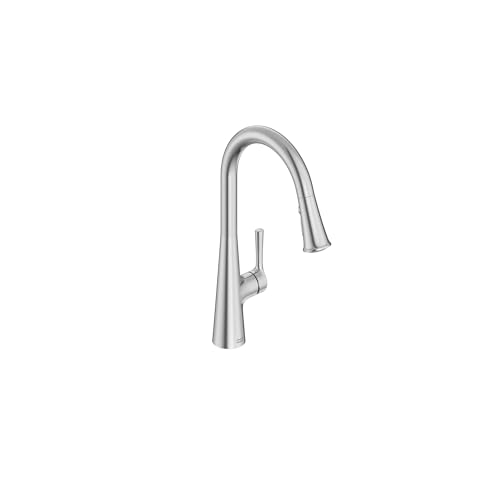
American Standard Southport Pull-Down, Stainless Steel (7441300.075) — Best Overall
The Southport is what American Standard does when it builds the faucet it actually wants you to buy: a high-arc, single-handle pull-down with a metal body, a two-function spray head, and memory-position valving that returns the lever to the temperature you last used — a small feature that, in a household that makes coffee before dawn, becomes the feature. The stainless steel finish suits the appliance suites most kitchens already have, and the included deck plate means it drops onto a standard 3-hole sink as happily as a single-hole one. It suits family kitchens, frequent cooks, and anyone replacing a builder-grade faucet with the intention of not thinking about it again for a decade. It is not the cheapest way into the brand — that is the Colony Pro below — and its high arc needs the usual cabinet-clearance check.
Strengths
- Memory-position valving: the handle returns to your last temperature, so morning water is right without the hunt.
- Metal body and metal spray head construction, where many rivals quietly substitute plastic at this tier.
- Two-function head covers both aerated filling and a rinsing spray, with a pause-friendly flow for watering or rinsing outside the bowl.
Trade-offs
- It is the premium of this list; the Colony Pro delivers the same cartridge philosophy for less.
- High-arc pull-downs need vertical room for the hose weight under the sink; crowded cabinets can shorten the pull.
- Stainless shows water spots more than the brand’s chrome in hard-water homes unless wiped down.
| Spec | Detail |
|---|---|
| Model | 7441300.075 (verified via API) |
| Spray head | 2-function pull-down |
| Valving | Memory position, drip-free ceramic disc |
| Body | Metal, deck plate included |
Daily life with the Southport is defined by the valving. Ceramic disc cartridges are the industry’s answer to the washer-drip era, and American Standard’s implementation is conservative in the best way: smooth lever travel, a definite shut-off, and no mid-travel grit. The pull-down hose retracts with a weight, the head seats into the spout with a positive fit, and the spray pattern stays coherent rather than misting at household pressures. For the mainstream buyer who typed this search because a plumber, a parent, or a previous good experience pointed them at the brand, this is the model that justifies the loyalty.
Best for: family kitchens and brand-loyal upgraders / Not suited for: tight budgets or very low cabinets over the sink. Check the current price on Amazon.

American Standard Aspirations Pull-Down, Polished Chrome — Best Modern Design
The Aspirations collection is American Standard’s design-forward line, and its pull-down kitchen faucet is the one to pick when the Colony Pro’s traditional curves would look dated against new cabinetry. The polished chrome finish is the classic choice — bright, easy to match with the brand’s bathroom fixtures from the same collection, and the most forgiving finish of all for hiding the mineral film that hard water leaves behind. It suits remodels that are coordinating a whole suite, contemporary kitchens that still want a conventional pull-down rather than a spring-sprayer statement, and buyers who prefer chrome’s lifetime durability story. If your appliances are stainless and your eye is sensitive to the slight warmth mismatch between chrome and stainless, the Southport’s stainless finish will blend better.
Strengths
- Part of a coordinated collection, so the kitchen faucet can match Aspirations bathroom fixtures across the home.
- Polished chrome is the most durable and most repairable-looking finish over long service.
- Pull-down format with the brand’s ceramic disc valving underneath the new styling.
Trade-offs
- Chrome-only in this verified listing; warm-metal kitchens should look at the Southport or elsewhere in the brand.
- Newer collection means a shorter long-term parts track record than the decades-old Colony Pro line.
- Design-led pricing over the functionally similar Colony Pro pull-out.
What you are buying here beyond the silhouette is suite logic. American Standard’s strength as a whole-home brand is that a remodeler can carry one design language and one parts philosophy through kitchen and baths, and the Aspirations pull-down is the kitchen anchor of that plan. The faucet itself behaves like the brand’s other modern pull-downs — single-lever control, a spray head that toggles between stream and spray, and installation hardware aimed at standard decks — so the decision really is aesthetic and coordinative, and that is a perfectly good basis for choosing a faucet you will look at every day.
Best for: coordinated whole-home remodels and chrome suites / Not suited for: stainless-matching perfectionists or warm bronze palettes. Check the current price on Amazon.

American Standard Colony Pro Pull-Out (7074100.002) — Best for Small Sinks
Pull-out faucets are the unfashionable correct answer for small kitchens, and the Colony Pro pull-out is the brand’s execution of the idea: the spray head is the spout, pulling toward you on its hose instead of docking in a tall arc. In a compact sink — a galley kitchen, a small apartment, a bar-adjacent prep sink that moonlights as the main sink — this format rinses corners a fixed spout cannot reach, fills a pot sitting on the counter beside the sink, and never asks for the vertical clearance a high arc demands. It suits small households, older homes with low cabinets or a window with a low sill in front of the sink, and anyone whose “kitchen faucet” also serves the laundry-adjacent utility role. Cooks with a deep double-bowl farmhouse sink will find the hose length and low profile limiting compared with a true pull-down.
Strengths
- Low profile fits under low cabinets and window sills that rule out high-arc pull-downs.
- Pull-out reach covers sink corners and countertop pots without moving them to the bowl.
- Colony Pro parts commonality keeps the cartridge story simple and inexpensive.
Trade-offs
- Lower spout height means filling tall stockpots in the bowl is a tilt-and-maneuver job.
- Pull-out heads generally offer less spray pressure drama than pull-down wands with boost modes.
- The traditional styling will not anchor a modern design scheme.
The ownership experience is pure Colony Pro: a ceramic disc cartridge that shuts off with certainty, a hose that slides through its guide without the grinding feel of the cheapest pull-outs, and a deck footprint that fits the standard patterns found in the older housing stock where this faucet will mostly live. American Standard’s distribution means the replacement cartridge is a hardware-store item, not a special order. For the small kitchen that cannot accept the Southport’s arc, this is not a compromise pick — it is the correct format, executed by the brand you came for.
Best for: small sinks, low clearances, apartments and galleys / Not suited for: deep farmhouse bowls or stockpot-heavy cooking. Check the current price on Amazon.

American Standard Colony Pro Single-Handle (7074000.002) — Best Budget
Every brand guide needs its honest floor, and this is American Standard’s: a single-handle, deck-mounted faucet with a brass swivel spout, a drip-free ceramic disc cartridge, water-saving flow, and the deck plate included in the box. No pull-down, no spray head — a side-spray sibling exists below if you need rinsing reach — just the core job of delivering hot and cold water, mixed by one lever, for years. It suits rental properties, budget remodels, first homes, and utility-minded buyers who would rather spend the difference on a better sink. It will not rinse a sheet pan’s far corner or fill a pot on the counter, and households that cook seriously every night will outgrow its fixed spout within a year.
Strengths
- Brass swivel spout — the moving part is metal, where the cheapest faucets in any brand go plastic.
- Ceramic disc, drip-free valving is the same technology family as the brand’s pricier models.
- Deck plate included, so it covers standard 3-hole decks without a second purchase.
Trade-offs
- Fixed spout: all rinsing happens within the spout’s swing radius.
- No spray function at all on this configuration.
- Chrome finish only in this verified listing.
| Spec | Detail |
|---|---|
| Model | 7074000.002 (verified via API) |
| Spout | Brass, swivel |
| Valving | Drip-free ceramic disc |
| Included | Deck plate |
The case for this faucet is total cost of ownership at the low end. Budget faucets fail in two ways: the cartridge starts dripping and cannot be replaced, or the plastic spout and fittings fatigue. The Colony Pro’s metal spout and standard cartridge attack both failure modes while staying in the brand’s budget tier — check price on Amazon for the current number, but the positioning is firmly entry-level. Landlords in particular should note the parts story: a tenant-proof faucet whose wear part is a common cartridge is worth more than a marginally cheaper faucet that must be replaced whole at the first drip.
Best for: rentals, budget remodels, simple kitchens / Not suited for: serious daily cooking or anyone who needs spray reach. Check the current price on Amazon.

American Standard Colony Pro with Side Spray (7074040.002) — Best Traditional with Side Spray
Before pull-downs conquered the market, the side sprayer was how a kitchen faucet reached around a sink, and a substantial slice of American housing stock is still drilled for it: three faucet holes plus a fourth for the sprayer. This Colony Pro configuration serves that deck exactly — a single-handle faucet with a brass swivel spout and a separate side spray on its own hose. It suits owners of older sinks who want a like-for-like replacement without plugging holes or buying covers, cooks who prefer a trigger sprayer that lives beside the faucet, and traditional kitchens where the four-piece deck set looks correct. If your sink has no fourth hole, this configuration is simply not yours; choose the pull-down or pull-out above.
Strengths
- True like-for-like replacement for the classic 4-hole deck, sprayer hole included.
- Side sprayer on a flexible hose reaches every corner and rinses produce without moving the spout.
- Single-handle mixing keeps one-handed temperature control, unlike two-handle traditional sets.
Trade-offs
- The sprayer’s diverter and hose are extra wear parts compared with a fixed-spout model.
- Side sprayers deliver a simpler spray pattern than modern pull-down wands.
- Requires the fourth deck hole; not adaptable to 3-hole sinks.
In use, the side sprayer has one advantage its critics forget: it works while the spout is swung aside or filling something else, and its trigger gives a hard, directed rinse that is genuinely good at clearing a colander or blasting a roasting pan at close range. The Colony Pro underneath it is the same metal-and-ceramic-disc formula as the rest of the family, and the deck plate in the box tidies the standard installation. For the large population of kitchens drilled 3+1, this is the path of least resistance into the brand.
Best for: 4-hole traditional decks and like-for-like replacements / Not suited for: 1- or 3-hole sinks. Check the current price on Amazon.

American Standard Colony Pro Two-Handle High-Arc with Spray (7074551.002) — Best Two-Handle
Some households simply prefer two handles: separate, unambiguous hot and cold controls that a grandparent, a child, or a guest can read at a glance, with no lever-position learning curve. This Colony Pro answers with a high-arc spout — the clearance stockpots and canning jars need — plus an included spray, in the widespread two-handle format traditional kitchens are drilled for. It suits multi-generational homes, traditional and farmhouse styling, and buyers who find single-lever mixing fiddly. It gives up the one-handed, elbow-friendly operation that makes single-handle faucets better when your hands are covered in chicken or dough, and temperature blending is inherently a two-step adjustment.
Strengths
- High-arc clearance with the included spray covers both filling and rinsing jobs.
- Separate handles are intuitive for every user and age, with no mixed-position guessing.
- Two-handle Colony Pro cartridges are individually replaceable — a hot-side drip does not touch the cold side.
Trade-offs
- Two-handed temperature setting is slower and awkward with messy hands.
- More deck penetrations mean more joints to check at install and more cleaning edges.
- Traditional styling only; it will not modernize a kitchen.
The high arc is the detail that elevates this above basic two-handle sets: budget two-handle faucets are usually low-arc, which is why their owners fill pots by tilting. Here the arc clears tall vessels properly, the spray handles the rinsing the fixed spout cannot, and the whole assembly rides on the Colony Pro cartridge ecosystem. If your household’s muscle memory is two-handle — and millions of American kitchens say it is — this is the brand’s most complete expression of that format.
Best for: two-handle households, traditional kitchens, canning and stockpots / Not suited for: one-handed cooks or modern styling. Check the current price on Amazon.
Comparison Table
| Pick | Badge | Key spec | Best for |
|---|---|---|---|
| Southport Pull-Down 7441300.075 | Best Overall | 2-function head, memory valving, metal body | Family kitchens |
| Aspirations Pull-Down | Best Modern Design | Coordinated collection, polished chrome | Whole-suite remodels |
| Colony Pro Pull-Out 7074100.002 | Best for Small Sinks | Low-profile pull-out spout | Small sinks, low clearance |
| Colony Pro Single-Handle 7074000.002 | Best Budget | Brass swivel spout, deck plate included | Rentals, budget remodels |
| Colony Pro Side Spray 7074040.002 | Best Traditional with Side Spray | 4-hole deck, separate sprayer | Older 3+1 decks |
| Colony Pro Two-Handle 7074551.002 | Best Two-Handle | High arc, included spray | Two-handle households |
How to Choose an American Standard Kitchen Faucet
Because the brand’s range is compact, choosing is mostly about configuration, and configuration starts at the sink deck. Count the holes and measure the spread before falling for any model: single-hole and 3-hole decks take the Southport, Aspirations, pull-out, and (with its plate) the budget single-handle; the side-spray model needs the fourth hole; the two-handle model needs its widespread pattern. A surprising share of faucet returns across all brands trace to this one skipped measurement, and American Standard’s tidy lineup makes it easy to map your deck to exactly one or two candidates.
Next, choose your reach technology honestly. A pull-down gives the longest, most powerful rinsing and the tallest filling clearance, at the price of under-sink hose management. A pull-out trades height for compactness and is the right answer under low cabinets. A side spray keeps the spout simple and is the only no-modification option for 4-hole decks. A fixed spout — the budget pick — is fine for households whose sink work is washing and filling at the bowl, and frustrating for everyone else. Be honest about how often you rinse big, awkward items; that frequency, more than any feature list, should pick your format.
Then think in cartridges and decades. All six picks use the brand’s ceramic disc approach, which is the right default for hard-water America: discs resist the mineral scoring that makes washer faucets drip, and replacements are standardized. Where the models differ is valving refinement — the Southport’s memory-position feature genuinely changes daily feel — and in how much metal you are buying. If the faucet will serve a rental or a flip, the Colony Pro single-handle’s metal spout at a budget tier is the rational spend. If it will serve your own kitchen for fifteen years, the Southport’s construction justifies its tier. Finish, finally, is a coordination decision: stainless for appliance matching, chrome for suite matching and maximum forgiveness.
American Standard vs. the Other American Brands
Readers cross-shopping this brand against Moen and Delta deserve a straight comparison. Moen’s range is broader and more design-led, with stronger spray technology at the top and a larger touchless selection; Delta counters with magnetic docking and its own deep US assembly story. American Standard’s counter-argument is focus and value density: fewer models, metal where rivals economize, cartridges with a long service record, and pricing that typically undercuts the equivalent Moen or Delta configuration — check price on Amazon to see the current gap on the exact models you are comparing, because promotions move it around. The brand also leans commercial: its institutional engineering culture shows in the Colony Pro’s no-nonsense construction. Choose American Standard when you want the plumbing-first faucet; choose the rivals when design range or a specific feature — touchless, magnetic docking — tops your list.
How to Install an American Standard Kitchen Faucet
The Colony Pro and Southport installs follow the standard modern pattern and are realistic weekend jobs. Kill the water at the angle stops, drain the old faucet, and remove it — budget most of your patience for the old mounting nuts, which in pre-2000 kitchens may need penetrating oil and a basin wrench. Dry-fit the new faucet on the deck to confirm the plate covers your holes and the handle swings clear of the backsplash; handle-to-backsplash clearance is the fit issue specific to rear-lever designs, so check it before final tightening. Connect the supply lines to the stops hand-tight plus a quarter turn, route the pull-down hose (where fitted) so its weight hangs in a clear loop away from the disposal and stored chemicals, and clip the weight at the factory-marked position.
Before the first full-pressure test, pull the aerator and flush the lines for thirty seconds into the bowl — installation debris is the leading cause of “weak new faucet” complaints, and American Standard’s aerators are designed to be removed and rinsed by hand for exactly this reason. Then run hot and cold, work the spray functions, and inspect every joint with a dry fingertip or paper towel. Recheck after the first evening’s hot-water use. If your home’s water is hard, make aerator rinsing a monthly habit for the first season; the faucet will feel new far longer, and the ceramic discs will thank you by not grinding on trapped grit.
Ceramic Disc Cartridges and Memory Valving, Explained
Nearly every claim in this guide rests on one component, so it deserves a plain explanation. A ceramic disc cartridge controls water with two polished ceramic discs: one fixed, one moved by the handle, their ports aligning to admit and mix water. Because the sealing surfaces are ceramic rather than rubber washers, there is nothing soft to compress, tear, or take a set — which is why this technology ended the era of the annually dripping faucet. American Standard built its modern reputation on this valving, and the Colony Pro and Southport models here all use versions of it. The practical consequences for an owner are three: shut-off stays positive for years, handle feel stays smooth instead of developing gritty spots, and when the cartridge finally does wear — usually from grit in the water rather than the discs themselves — it is a single standardized part, swapped in minutes.
Memory-position valving, fitted to the Southport, adds a small mechanical courtesy on top of that foundation: the handle’s temperature position is retained between uses, so the first water of the morning arrives at yesterday’s setting instead of at whatever the cleaning routine left. It sounds trivial until you live with the alternative — the daily cold-blast or scald-gamble while filling a kettle half-asleep. It is also a safety-adjacent feature in homes with children, because the faucet’s resting state is a known, moderate temperature rather than full hot. No electronics are involved; it is valving geometry, which means it will work for exactly as long as the cartridge does.
What kills these cartridges early is not use but contamination: construction debris after a remodel, sediment from an aging water heater, or scale in hard-water districts. The defenses are boring and effective — flush lines at install, keep the aerator clean so back-pressure does not stress seals, and if your home sheds visible sediment, fit a simple inline filter or accept a shorter cartridge interval as a maintenance cost. Budget-wise, treat the cartridge as this faucet’s brake pads: a planned, inexpensive consumable that keeps the expensive assembly — body, finish, spout — in service for a decade or more.
Replacing an Older American Standard Faucet: Getting the Successor Right
A large share of this brand’s kitchen sales are replacements, and replacements have their own logic. Start by identifying what you have: the model number is often on a tag on the supply lines under the sink, on the original paperwork, or inferable from the deck pattern and handle style. Photograph the deck from above and below before ordering anything; the hole count and spread in the photo are the specification that matters. Colony Pro’s spread of configurations exists precisely because the installed base is so varied — there is a deliberate successor for the 4-hole side-spray deck, the widespread two-handle deck, and the standard 3-hole deck alike.
Expect the under-sink reality to be the project. Angle stops that have not moved in fifteen years may not close fully; test them before the new faucet arrives, and if a stop weeps or refuses, replace it while the water is off — it is the cheapest plumbing insurance there is. Supply line standards have also changed across the decades spanned by this brand’s installed base, so confirm your stop sizes (typically 3/8-inch compression on modern integrated lines) and have adapters on hand rather than discovering the mismatch with the old faucet already in the trash. Finally, keep the old faucet’s cartridge if it still works: in multi-bathroom homes with sibling fixtures of the same era, yesterday’s take-out is tomorrow’s free spare part.
One more replacement-specific trap deserves naming: deck thickness and sink material. Cast-iron and thick fireclay sinks, and stone counters with undermount sinks, present a thicker mounting sandwich than the stamped-steel decks many faucets are pictured on. The mounting hardware on the models here accommodates typical residential decks, but if your counter is unusually thick, check the maximum deck thickness in the model’s specification before ordering — it is a two-minute check that prevents the one return reason no amount of brand loyalty can fix.
Common Buying Mistakes
- Buying the side-spray model for a 3-hole sink. The fourth hole is not optional decoration; without it, the sprayer has nowhere to live.
- Choosing by collection name alone. Colony Pro spans four configurations with different decks and reaches — buy the configuration, not the label.
- Skipping the backsplash clearance check. Rear-facing levers need room to swing to full hot; measure before you mount.
- Assuming stainless and chrome match. They sit side by side in many kitchens, but stainless is brushed and slightly warm-grey while chrome is mirror-bright; mixing them at the sink is visible every day.
- Ignoring the hose path on pull-downs. A weight that snags on the disposal turns a premium faucet into a daily annoyance; survey the cabinet first.
- Paying pull-down money for a fixed-spout household. If you never rinse big items, the Colony Pro single-handle does the whole job for a budget-tier spend.
Finish Care and Hard-Water Survival for This Brand
American Standard’s two finishes in this guide — stainless steel on the Southport and polished chrome across the Colony Pro and Aspirations listings — age differently, and choosing between them is partly a water decision. Chrome is a hard, non-porous plating that tolerates hard water best: mineral spots wipe off, and the finish itself does not stain. Its enemies are abrasive pads and acidic cleaners, which micro-scratch the mirror surface over years. Stainless finishes hide fingerprints and blend with appliances, but in hard-water homes they show a chalky film sooner than chrome unless the owner wipes the spout down as part of the evening routine — a ten-second habit that decides whether a stainless faucet looks new at year five.
For both finishes the rules are the same and worth printing on the inside of the sink cabinet: clean with a soft cloth and mild soap, never with scouring powder or vinegar left to sit on the surface; rinse and dry after cleaning; and attack the aerator, not the finish, when flow weakens — nine times out of ten the “failing faucet” is a scaled aerator screen, removed by hand, rinsed under the tap, and reinstalled in two minutes. In genuinely hard districts, a point-of-use softener or even a simple sediment-and-scale filter on the cold line pays for itself in cartridge life across every faucet and appliance in the kitchen, this brand’s included. The metal bodies under these finishes are the long game: treated this way, there is no cosmetic reason any pick in this guide should look tired before its second cartridge.
Budget Tiers Within the Brand, in Plain Terms
We never print static prices, so here is the brand’s internal ladder in words. The Colony Pro single-handle is the budget tier: full metal-spout, ceramic-disc substance with the fewest moving extras, aimed at replacements and rentals. The Colony Pro pull-out, side-spray, and two-handle models form the lower-middle tier — you are paying for configuration and reach, not for fancier valving. The Aspirations pull-down is the design tier, where the premium buys the coordinated collection look. The Southport tops the range as the feature tier, with the two-function head and memory valving. The useful insight is that the cartridge philosophy does not change as you climb: money in this brand buys format, finish, and refinement rather than a different durability class. That is unusual — many brands reserve their best valving for the top — and it is why the budget Colony Pro is a legitimate recommendation rather than a warning. Decide your format first, then let the tier fall out of it, and check price on Amazon for the current numbers before ordering.
One allocation tip for whole-kitchen budgets: because the brand’s mid-tier is so serviceable, the smarter remodel often pairs a Colony Pro or Southport faucet with a better sink, rather than stretching to a designer faucet over a tired sink. The faucet is the part you touch; the sink is the part you look into. Both matter, but if the budget forces a choice, this brand is precisely the one that lets you economize on the faucet without buying a disposable product.
Final Recommendation
Most buyers who came for this brand should buy the Southport Pull-Down in Stainless Steel: it is the most complete faucet American Standard currently makes for a mainstream kitchen, and its memory-position valving is a daily pleasure. Coordinated remodels take the Aspirations, small sinks take the Colony Pro Pull-Out, tight budgets and rentals take the Colony Pro Single-Handle, 4-hole traditional decks take the side-spray Colony Pro, and two-handle households take the high-arc two-handle. Related reading in this cluster: Best American Made Kitchen Faucets, Best Basic Kitchen Faucets, Best And Worst Kitchen Faucets, Best Automatic Kitchen Faucets, Best Bar Style Kitchen Faucets.
A Note on Water Savings Across This Range
Several listings in this range call out water-saving design, and it is worth understanding what that means at the sink. Modern kitchen faucets are built to the prevailing flow standards — 1.8 gallons per minute at the top end nationally, with stricter limits in states like California — and the verified Southport chrome listing confirms a 1.8 GPM rating for that model. In practice, the aerated stream on a well-designed faucet feels fuller than its flow number suggests, because the aerator mixes air into the stream. Where you will notice savings is not in a weaker-feeling faucet but in the aggregate: a household that runs the kitchen tap for filling, rinsing, and washing accumulates real volume over a year, and a faucet that delivers a coherent, non-splashing stream wastes less of it down the drain unused. The practical advice is simple: do not defeat the aerator to chase pressure. If flow feels weak, clean the aerator screen first; if it is still weak, measure your home’s static pressure, because the house — not the faucet — is the usual constraint.
Frequently Asked Questions
Where is the model number on my existing American Standard faucet?
Look first under the sink: many models carry a tag on one of the supply lines with the model number printed on it. Failing that, check any paperwork left from the install, or photograph the faucet and match the handle and spout profile against the brand’s current and archived catalog images. The deck pattern narrows it further — a 4-hole side-spray deck and a widespread two-handle deck point to different Colony Pro generations. Knowing the old number matters mainly for cartridge matching; for a full replacement, the deck photo is the document that counts.
Is American Standard a good kitchen faucet brand?
Yes — it is one of the long-established American plumbing brands, with a kitchen range built around metal bodies and ceramic disc cartridges rather than fashion features. Its strengths are value density, parts availability, and conservative engineering; its range is narrower and less design-led than Moen’s or Delta’s. For buyers who prioritize plumbing substance over styling breadth, it is a sound default.
What is the difference between Colony Pro and Southport?
Colony Pro is the brand’s value family: several deck configurations (single-handle, pull-out, side spray, two-handle) sharing ceramic disc valving and metal spouts, aimed at replacements and budget remodels. Southport is the step-up pull-down line with a metal body, a two-function spray head, and memory-position valving that returns the handle to your last temperature. Same brand philosophy, different tier and format.
Are American Standard faucet cartridges easy to replace?
Yes. The brand’s ceramic disc cartridges are standardized across wide model ranges and sold through normal plumbing channels, and the replacement procedure — shut off water, remove handle, swap cartridge — is a standard DIY job. This parts accessibility is a core reason to buy the brand over an obscure import whose cartridge may be unobtainable in a few years.
Does American Standard make touchless kitchen faucets?
The brand has offered sensor models in some markets and periods, but its current verified Amazon kitchen range centers on manual models like the ones in this guide. If touchless operation is your top requirement, the sensor specialists from Moen and Kohler in our automatic faucet guide are the stronger shortlist; if you want American Standard specifically, the Southport is its most modern-feeling manual faucet.
Which American Standard faucet fits a 4-hole sink?
The Colony Pro with Side Spray (7074040.002) is the native 4-hole configuration: three holes for the faucet and a fourth for the sprayer. Alternatively, any of the single-hole models with an included deck plate can cover the three main holes, leaving the fourth to be capped with a matching hole cover or used for a soap dispenser — a common and tidy solution.
Can I install one of these myself, or do I need a plumber?
Most homeowners with a basin wrench and an hour can install any pick in this guide: the connections are standard, the deck hardware is conventional, and the brand’s instructions assume a competent DIYer. Call a plumber instead if your angle stops do not close fully, if the old faucet’s nuts are corroded solid, or if the job expands into moving supply lines — those are the three situations where a one-hour swap turns into a weekend. The faucet itself is rarely the hard part; the house is.
How long should an American Standard kitchen faucet last?
With municipal water and normal use, the metal-bodied models here are 10-to-15-year appliances, typically needing one cartridge refresh and aerator maintenance along the way rather than replacement. Hard water shortens cartridge life unless the aerator and inlet screens are kept clean. The brand’s limited lifetime warranty on many residential models backs the finish and cartridge for the original owner — check the specific model’s warranty terms before purchase.


