Disclosure: airfryerkitchensupply.com is reader-supported. When you buy through links on our site, we may earn an affiliate commission at no extra cost to you.
Where to buy
Every linked pick in this guide to the best antique kitchen faucets was verified against Amazon’s catalog on 2026-11-20, so the Kingston Brass model numbers below — Heritage bridges, French Country widespreads, a wall-mount bridge — are the exact models you will land on. Start with the Kingston Brass Heritage Bridge in Brushed Nickel (KS1278ALBS) for the most versatile antique look, the Heritage Bridge in Antique Brass (KS1273ALBS) for the warmest period finish, and the Wall Mount Bridge in Oil Rubbed Bronze (KS3225AX) if your farmhouse sink has no deck holes at all. Check the current price on Amazon for any pick; we never print static prices, and antique-finish faucets are promoted unevenly through the year.
Set expectations honestly before the list: “antique” in modern faucet catalogs means antique styling, not antique plumbing — and that distinction is a feature, because it lets a period kitchen keep modern water quality, modern shut-off reliability, and a warranty, none of which a salvaged original can offer a working household. Nobody should install a genuine century-old faucet as a daily driver — the washers, seats, and lead content of true antiques belong in museums and in carefully replumbed showpieces. What the best modern antique-style faucets offer is the visual language of 1900–1930 plumbing — bridge bodies, cross or lever handles with porcelain-style accents, gooseneck and shepherd’s-crook spouts, living finishes like oil rubbed bronze and antique brass — wrapped around modern ceramic disc cartridges, modern low-lead brass, and modern seals. Kingston Brass dominates this niche so thoroughly that a credible best list is mostly a guided tour of its Heritage and related lines, which is what follows; we chose across its finishes and formats rather than pretending five brands compete here equally.
In this guide
Quick Picks
- Best Overall: Kingston Brass Heritage Bridge, Brushed Nickel (KS1278ALBS) — the classic 8-inch bridge with brass side sprayer, in the finish that fits the most kitchens.
- Best Antique Brass: Kingston Brass Heritage Bridge, Antique Brass (KS1273ALBS) — warm, aged brass over the same bridge body, with brass sprayer.
- Best Oil Rubbed Bronze: Kingston Brass Bridge, Oil Rubbed Bronze (KS1275AXBS) — the dark, hand-rubbed look with cross-handle period detailing.
- Best Value Heritage: Kingston Brass Heritage Bridge, Oil Rubbed Bronze (KS1175AX) — the bridge silhouette at the friendliest tier of the line, without the side sprayer.
- Best Widespread: Kingston Brass French Country Widespread, Oil Rubbed Bronze (KB1795TXBS) — separate handles and spout on an 8-1/4 inch reach for drilled stone and wide decks.
- Best Wall-Mount: Kingston Brass Wall Mount Bridge, Oil Rubbed Bronze (KS3225AX) — for apron-front and freestanding farmhouse sinks with wall supplies.
How These Picks Were Chosen
We verified candidates by brand, collection, and model number, matching each returned Amazon title before taking an ASIN — particularly important in this niche, because Kingston Brass model numbers encode finish and sprayer configuration in their suffixes, and a single letter separates a faucet with a brass sprayer from one without. Within the verified set, we chose for coverage of the four decisions an antique-style buyer actually faces: finish (brushed nickel, antique brass, oil rubbed bronze), format (deck bridge, widespread, wall-mount), sprayer or no sprayer, and handle style. Every pick uses modern ceramic-disc or compression-replacement cartridge technology under the period styling, solid brass construction in the body and — on the BS-suffix models — a brass side sprayer rather than a plastic one.
We also applied a historical-accuracy filter, loosely but sincerely. The bridge faucet — two valves joined by an exposed horizontal bridge carrying the spout — is a genuinely period form, standard in quality plumbing of the early twentieth century, and it dominates this list because it is what an antique kitchen faucet actually looked like. Finishes were judged on how they age: oil rubbed bronze and antique brass are “living” finishes that develop highlights on touch points, which suits the antique brief far better than a static electroplate that will look factory-new (and therefore wrong) in a decade. What we excluded: modern pull-downs with a bronze tint marketed as “antique,” and any faucet whose period costume hid a plastic body.
The 6 Best Antique Kitchen Faucets
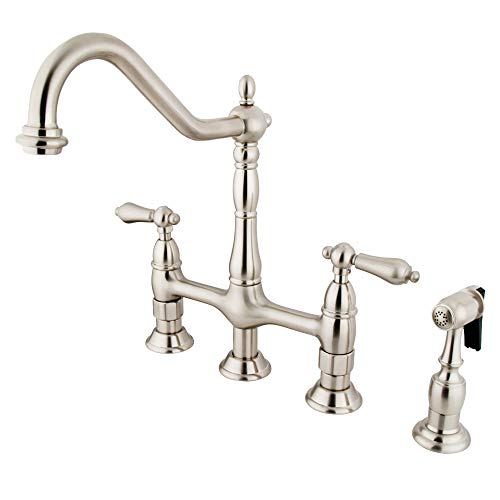
Kingston Brass Heritage Bridge, Brushed Nickel (KS1278ALBS) — Best Overall
The Heritage bridge in brushed nickel is the antique faucet for people who want the period silhouette without committing the whole kitchen to a dark, moody palette. The form is the real thing: two lever-handle valves on 8-inch centers joined by an exposed bridge, a high gooseneck spout with an 8-3/4 inch reach, and a solid brass side sprayer (the BS in the model suffix) for rinsing. Brushed nickel reads as the soft, warm-grey metal that historic nickel plating aged into, so it sits comfortably beside stainless appliances in a way bronze cannot — this is the antique faucet for a working modern kitchen that wants heritage character, not a stage set. It suits farmhouse, cottage, and transitional kitchens, owners of 8-inch-center decks, and anyone restoring a period home who still cooks like it’s now. Buyers wanting the darkest, most dramatic period look should go straight to the oil rubbed bronze models below.
Strengths
- Authentic bridge construction in solid brass, with a brass — not plastic — side sprayer.
- Brushed nickel bridges the antique silhouette and a stainless appliance suite better than any other period finish.
- Modern cartridge internals under period styling: the look is 1915, the shut-off is contemporary.
Trade-offs
- Requires an 8-inch-center deck or a sink drilled for it; it will not adapt to single-hole or 4-inch patterns.
- Two-handle operation and a fixed (non-pull-down) spout: period-correct, but slower than a modern single-lever pull-down.
- The exposed bridge adds cleaning edges that a one-piece modern faucet does not have.
| Spec | Detail |
|---|---|
| Model | KS1278ALBS (verified via API) |
| Spout reach | 8-3/4 in (per Amazon title) |
| Format | 8 in bridge, deck mount, brass side sprayer |
| Finish | Brushed nickel |
Living with the Heritage means re-learning two pleasant period habits: blending temperature with two hands (which regulars come to prefer for its precision at the extremes — full cold for filling a glass, full hot for soaking a pan, without hunting a lever’s mixed zone) and using the side sprayer as the reach tool. The sprayer, being brass, has the heft and trigger feel of the originals, and its hose gives the bridge the one modern convenience it lacks. In a white-subway-tile, wood-counter kitchen, this faucet is the piece visitors ask about; in ownership terms it is also a conventional, serviceable Kingston Brass valve set with cartridges available through the brand’s normal channels.
Best for: farmhouse and transitional kitchens wanting heritage form with modern internals / Not suited for: single-hole decks or pull-down devotees. Check the current price on Amazon.
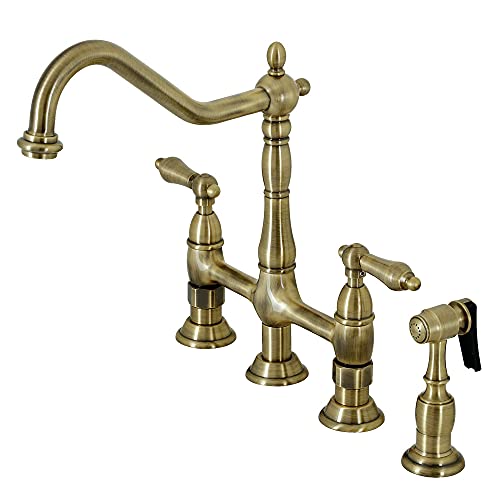
Kingston Brass Heritage Bridge, Antique Brass (KS1273ALBS) — Best Antique Brass
Same honest bridge body, completely different room effect: antique brass is the warm, browned-gold finish that unlacquered brass develops over years of handling, reproduced here as a stable finish over the Heritage’s 8-inch bridge with its brass sprayer. This is the pick for kitchens built around warm wood, copper accents, cream cabinetry, and the English-country or French-provincial mood — the faucet looks inherited rather than installed. It suits period restorations aiming for a pre-chrome era (brass was the standard before nickel and chrome plating took over), and homes where the hardware palette is brass throughout. It will fight a cool stainless-and-grey kitchen every day of its life; finish discipline matters more with this pick than any other on the list.
Strengths
- The most historically evocative finish in the line — pre-chrome-era brass, aged rather than shiny.
- Full bridge format with brass side sprayer, identical mechanical platform to the Best Overall pick.
- Warm finish hides water spots and fingerprints better than polished metals.
Trade-offs
- Antique brass is hard to match across brands; cabinet hardware and lighting should be chosen to it, not vice versa.
- The warm palette narrows future appliance choices — stainless reads cool against it.
- Same 8-inch-center and two-handle constraints as the whole bridge family.
The ownership note specific to this finish: treat it as a living surface. Clean with a soft cloth and mild soap, never with brass polish or acidic cleaners, which strip the antiquing and leave bright, patchy gold — the single most common way owners ruin this finish in year one. Left alone, the high-touch areas will lighten gently and the recesses stay deep, which is exactly the gradient a genuine antique shows. Mechanically you are on the same Heritage platform as the nickel model, so everything said there about cartridges and the sprayer applies unchanged.
Best for: warm, period-true kitchens and brass hardware suites / Not suited for: cool modern palettes or polish-happy cleaners. Check the current price on Amazon.

Kingston Brass Bridge, Oil Rubbed Bronze (KS1275AXBS) — Best Oil Rubbed Bronze
Oil rubbed bronze is the finish most buyers picture when they type “antique,” and this Heritage-family bridge — AX-suffix cross-handle styling with a brass sprayer — is its fullest expression in the line: deep brown-black metal with coppery highlights at the edges, cross handles that belong on a 1920s scullery sink, and the same exposed bridge architecture. It suits dark-wood farmhouse kitchens, butler’s pantries, and any room where the faucet should read as furniture-grade ironwork. Cross handles are the most period-authentic control and also the slowest to operate with wet or messy hands — a genuine trade-off the lever-handle models soften — and the dark finish shows light-colored mineral deposits prominently in hard-water homes, so a wipe-down habit is part of the deal.
Strengths
- Cross handles and oil rubbed bronze deliver the strongest period authenticity on this list.
- Brass side sprayer included (BS suffix) — the reach tool the fixed bridge spout needs.
- Living finish develops touch-point highlights that deepen the antique effect with age.
Trade-offs
- Cross handles are slower and less grip-friendly than levers, especially for arthritic hands.
- Dark finish shows hard-water spotting clearly; maintenance is a weekly wipe, not a monthly one.
- 8-inch bridge format only — no deck flexibility.
Under the costume, the same serviceable Kingston Brass valving does the work, and the sprayer’s brass construction matters more in this finish than most: a plastic sprayer in a bronze-look coating would betray the whole illusion the first time you picked it up, and its coating would wear at a different rate than the faucet’s. Here the set ages as one object. Choose this model when the room’s story is the point and the household’s hands are able — it is the connoisseur’s pick of the six.
Best for: period-drama farmhouse kitchens and cross-handle traditionalists / Not suited for: limited-grip users or hard-water homes unwilling to wipe down. Check the current price on Amazon.

Kingston Brass Heritage Bridge, Oil Rubbed Bronze (KS1175AX) — Best Value Heritage
Not every antique kitchen needs the side sprayer, and this is the Heritage bridge with that line item removed: the same 8-inch bridge body and cross-handle styling in oil rubbed bronze, at the friendliest tier of the family — check price on Amazon for the current positioning. It suits smaller period kitchens where the sink is compact enough that a fixed spout genuinely covers it, secondary sinks in a pantry, and buyers whose deck has no fourth hole for a sprayer anyway. The honest limitation is reach: without the sprayer, rinsing a wide roasting pan means maneuvering the pan under a fixed stream, and filling anything that does not fit in the bowl is a jug-and-carry exercise. If your sink is a big single farmhouse bowl, step up to a BS-suffix model; if it is a modest double bowl, this simpler bridge is all the antique you need.
Strengths
- The full bridge silhouette and living bronze finish without paying for the sprayer hardware.
- Fewer components: no diverter, no sprayer hose — the simplest possible antique installation and upkeep.
- Works on decks without a sprayer hole, where the BS models cannot go unmodified.
Trade-offs
- No sprayer of any kind; rinsing reach is the spout’s swing and nothing more.
- Cross handles carry the same grip and speed caveats as the model above.
- Bronze finish still demands the gentle-cleaning discipline of the whole family.
There is a quiet design argument for this model too: many genuine antique installations had no sprayer, because the side sprayer is a mid-century convenience. A bridge without one is, paradoxically, the most historically complete object on this page. Pair it with a basin that suits it and a household that washes up in the traditional way, and nothing about the experience feels like a compromise — it feels like 1925, with better cartridges.
Best for: compact period kitchens, pantry sinks, sprayer-free decks / Not suited for: large single bowls or sprayer-dependent cooks. Check the current price on Amazon.

Kingston Brass French Country Widespread, Oil Rubbed Bronze (KB1795TXBS) — Best Widespread
The French Country widespread breaks the bridge into its components — separate hot and cold valves and a separate spout, spread across the deck on flexible centers — which makes it the antique answer for drilled stone counters, wide custom decks, and sinks whose hole spacing no bridge can match. The verified model carries an 8-1/4 inch spout reach and a brass sprayer, in oil rubbed bronze with the collection’s French-country handle styling. It suits high-end period remodels where the countertop was drilled for a widespread set, and kitchens that want the antique look with a more open, furniture-like deck presence than the connected bridge gives. Installation is the most involved on this list — three separate deck pieces to align and seal, plus the sprayer — so budget either patience or a plumber.
Strengths
- Flexible widespread layout fits custom and stone decks that fixed-center bridges cannot.
- 8-1/4 in spout reach (verified via API) suits deep farmhouse bowls.
- Brass sprayer included, so the format keeps its rinsing reach.
Trade-offs
- Most complex install of the six: multiple deck penetrations, more joints to seal and check.
- More exposed components means more cleaning edges and more finish to maintain.
- Premium positioning within the antique niche.
The widespread format has one ownership advantage worth naming: each valve is independently serviceable and replaceable without disturbing the spout, and the under-deck connections are conventional. In a stone-counter kitchen — where the counter itself is the most expensive object in the room — a faucet format that adapts to the stone rather than demanding new holes is worth its premium. This is the antique pick for the remodel that started with the countertop.
Best for: drilled stone counters and wide custom decks / Not suited for: standard 8-inch-center sinks (a bridge is simpler) or rushed installs. Check the current price on Amazon.

Kingston Brass Wall Mount Bridge, Oil Rubbed Bronze (KS3225AX) — Best Wall-Mount
Some of the most beautiful antique sinks — apron-front farmhouse basins, freestanding scullery sinks, trough sinks in garden kitchens — have no faucet deck at all; their supplies come out of the wall, as they did in 1910. This wall-mount bridge is built for exactly that architecture: the bridge body mounts to wall supplies, the spout swings over the basin, and the whole assembly in oil rubbed bronze completes the period picture. It suits farmhouse-sink installations with wall plumbing, historic homes whose original configuration was wall-mount, and anyone who wants the countertop completely clear. The constraints are real: your supply stubs must be at the right height and spread (or a plumber must make them so), the spout’s projection must be matched to your basin’s depth so water lands in the bowl rather than on its rim, and there is no sprayer in this format.
Strengths
- The only format here for deckless farmhouse and freestanding sinks.
- Frees the entire countertop and makes the sink surround trivially easy to clean.
- Wall-mount is the most historically original configuration of all — pre-deck plumbing, faithfully reproduced.
Trade-offs
- Requires wall supplies at the correct spread and height; retrofitting them is plumbing work, not a faucet swap.
- Spout projection must be matched to basin depth before ordering — measure twice.
- No sprayer option in this configuration.
Done right, with the measurements verified twice and the stub-outs exactly where the bridge expects them, the wall-mount is the most striking installation in this guide and the one that draws the “is that original to the house?” question — the highest compliment an antique-style fixture can earn. Done carelessly, it drips on the rim and splashes the wall, so treat the measurements in the buying guide below as mandatory homework. For the right sink, nothing else on this page is even a candidate.
Best for: apron-front and freestanding sinks with wall supplies / Not suited for: deck-mount sinks or buyers unwilling to verify stub-out dimensions. Check the current price on Amazon.
Comparison Table
| Pick | Badge | Key spec | Best for |
|---|---|---|---|
| Heritage Bridge KS1278ALBS | Best Overall | 8 in bridge, 8-3/4 in reach, brass sprayer, brushed nickel | Most farmhouse kitchens |
| Heritage Bridge KS1273ALBS | Best Antique Brass | Bridge + brass sprayer, antique brass | Warm period kitchens |
| Bridge KS1275AXBS | Best Oil Rubbed Bronze | Cross handles, brass sprayer, ORB | Period drama |
| Heritage Bridge KS1175AX | Best Value Heritage | Bridge, ORB, no sprayer | Compact period kitchens |
| French Country KB1795TXBS | Best Widespread | Widespread, 8-1/4 in reach, brass sprayer | Stone and custom decks |
| Wall Mount Bridge KS3225AX | Best Wall-Mount | Wall supplies, ORB bridge | Deckless farmhouse sinks |
How to Choose an Antique Kitchen Faucet
Format first, because format is dictated by your sink, not your taste. Deck-mounted bridges need 8-inch centers (measure between the hot and cold hole centers, not the outer edges). Widespread sets need three deck holes on flexible centers plus a fourth if you want the sprayer. Wall-mounts need supply stubs in the wall at the bridge’s spread, at a height that puts the spout above the basin rim with the arc clearing it. If your sink matches none of these — a modern single-hole deck, say — the honest antique answer is a deck plate conversion or a different sink, not a forced fit; antique faucets punish improvisation.
Finish second, and finish is a whole-room decision. Brushed nickel is the diplomat: period-correct for the nickel era, compatible with stainless appliances, and the easiest to live with. Antique brass is the romantic: warm, pre-chrome, and demanding that the room’s other metals fall in line. Oil rubbed bronze is the dramatist: darkest, most forgiving of fingerprints, least forgiving of hard-water spots, and committed to a farmhouse or traditional scheme. All three are living or soft finishes that reward gentle care; if your household cleans with whatever spray is under the sink and a scouring pad, choose brushed nickel and accept the compromise, because bronze and brass will record the abuse.
Third, the sprayer decision. The BS-suffix models include a brass side sprayer, and in a bridge-faucet kitchen the sprayer is not a garnish — it is your only rinsing reach, since the spout does not pull out. Big single bowls and sheet-pan bakers should treat the sprayer as mandatory. Compact double bowls can honestly skip it, gaining the simpler KS1175AX and one less hose under the sink. Fourth, handles: levers for accessibility and speed, crosses for authenticity. Households with children or arthritis should weight this higher than the photographs suggest — you will operate these handles thousands of times, with wet hands, often mid-recipe.
Living Finishes: How Antique Bronze and Brass Actually Age
Buyers new to living finishes sometimes mistake their behavior for defects, so here is the deal in plain terms. Oil rubbed bronze is a dark finish applied over copper-toned metal; at the points your hands touch daily — handle edges, spout tip, sprayer trigger — it will gradually lighten toward a warm copper-brown highlight, while untouched recesses stay deep. That gradient is the antique effect, and it is why these faucets look more authentic at year five than at installation. Antique brass behaves similarly in the golden register. Brushed nickel is not a living finish in the same sense; it is stable, and its aging is limited to the soft dulling that suits it.
Care rules follow from the chemistry. Never use vinegar, citrus cleaners, or brass polish on antiqued finishes — acids and polishes strip the dark layer unevenly and leave bright blotches that cannot be un-stripped. Warm water, a soft cloth, and the mildest soap are the whole regimen; dry after washing up if your water is hard, because mineral crust on a dark finish reads as damage even though it wipes off. If a highlight develops where you do not want it, that is the finish being a finish — the remedy culture of these products is acceptance, and it is precisely what separates a convincing antique installation from a themed one.
How to Install a Bridge Faucet (and When to Call a Plumber)
A deck bridge installs like two faucets joined at birth: set each valve body through its deck hole, connect the bridge and spout assembly per the manual’s sequence, then make the supply connections and the sprayer hose and diverter if fitted. The antique-specific cautions are three. First, sealing: multiple deck penetrations mean multiple gaskets — seat them evenly and resist the urge to bed everything in silicone, which makes future service miserable. Second, alignment: a bridge shows misalignment mercilessly, so dry-fit and sight down the bridge before final tightening; a spout a degree off-vertical is visible across the room. Third, the sprayer diverter: test it before closing up — run the spout, trigger the sprayer, confirm full diversion and no hammer.
Call a plumber without embarrassment for the wall-mount pick if your stub-outs need moving, for any installation where the angle stops fail to close fully, and for stone decks where a slipped wrench costs more than the faucet. For a standard 8-inch deck bridge swap on healthy plumbing, a careful DIYer with a basin wrench and a free afternoon is genuinely sufficient — the technology under the costume is modern and forgiving.
Matching the Faucet to the Era of the House
“Antique” covers a century of plumbing, and a few signposts help you land in the right decade. Houses and styles before roughly 1920 — Victorian, Edwardian, early Craftsman — wore brass and nickel, often mixed, with cross handles and exposed construction: the bridge faucets in this guide, especially in antique brass and brushed nickel, are their descendants. The 1920s and 1930s brought chrome to dominance and a sleeker, more geometric hand; a brushed nickel bridge still reads correctly there, while oil rubbed bronze is more of a modern farmhouse interpretation than a period documentary choice. Mid-century kitchens largely abandoned the antique language altogether, which is why a bronze bridge in a 1955 ranch reads as a deliberate farmhouse remodel rather than a restoration — a fine thing to do, as long as it is done on purpose.
Handle choice carries era information too. Cross handles with porcelain-style inserts are the oldest language; simple metal crosses are interwar; lever handles in the traditional shapes Kingston Brass uses are the most forgiving reading of “period” and the easiest to live with. Spout shape speaks as well: the high gooseneck is the scullery classic, made for filling buckets and tall pots in an era before sprayers, and it remains the most functional antique silhouette for a deep farmhouse bowl. None of this requires museum rigor — kitchens are palimpsests, and a well-chosen bridge over a modern sink is a legitimate design sentence. But choosing the finish and handle with an era in mind is what separates a kitchen that looks collected from one that looks themed.
One more authenticity note, because buyers ask: the side sprayer is not period. It arrived with mid-century American kitchens, and its presence on these bridges is a modern graft — a welcome one, in brass, that keeps the format usable. Purists building a true scullery can choose the sprayer-free KS1175AX and lose nothing but convenience. Everyone else should take the sprayer and not apologize: the goal is a kitchen that cooks like the present and looks like the past, and every pick here is engineered to exactly that compromise.
Parts, Cartridges, and Service for the Heritage Lines
An antique-style faucet is a long-term aesthetic commitment, so its service story matters as much as its silhouette. Kingston Brass supports its lines with replacement cartridges, handles, aerators, and sprayer assemblies sold by model number through normal retail and plumbing channels — the model-number discipline in this guide (finish and sprayer encoded in the suffix) is what makes that parts system usable, because the number on your box identifies the exact valve set inside. Keep the number: photograph the box end and the underside tag at installation, and store them with the house documents. The day a cartridge needs replacing, that photograph is the difference between a ten-minute order and an afternoon of forensic plumbing.
The wear schedule on these faucets is conventional. Cartridges are the brake pads — plan on a refresh somewhere in the five-to-ten-year window depending on water quality, sooner in hard districts unless the aerator and inlet screens are kept clean. Sprayer hoses flex and age like any hose; the brass sprayer head itself is effectively permanent, and its hose is a replaceable assembly. Finishes, treated per the living-finish rules in this guide, do not wear out at all — they mature. Compare that profile with a themed faucet from an anonymous brand, where the costume is similar but the parts system does not exist: the antique look is a twenty-year decision, and it should be bought from a catalog that intends to exist for twenty years. On that test, the Heritage platform’s long production run is its own argument.
Common Buying Mistakes
- Buying a bridge for the wrong centers. Eight-inch means eight inches between valve centers; 4-inch and single-hole decks cannot take a bridge without a new sink or deck work.
- Polishing a living finish. Brass polish and vinegar strip oil rubbed bronze and antique brass antiquing permanently. Soft cloth, mild soap, nothing else.
- Skipping the sprayer on a big single bowl. A fixed bridge spout cannot rinse a farmhouse bowl’s corners; the BS models exist for this reason.
- Choosing cross handles for arthritic hands. Authenticity loses to usability at the thousandth operation, every single time. Levers are period-plausible too — early twentieth-century quality plumbing used both — so choosing them is not even a historical compromise.
- Guessing wall-mount geometry. Stub height, spread, and spout projection versus basin depth must be measured, or the faucet will splash the rim forever.
- Mixing antique finishes across brands. One brand’s oil rubbed bronze is not another’s; consolidate the visible metals under one maker where you can.
Budget Tiers in the Antique Niche, in Plain Terms
We do not print static prices, so here is the niche’s ladder in words. The sprayer-free Heritage bridge anchors the value tier — the authentic form and living finish with the fewest components. The BS bridge models occupy the middle: you are paying for the brass sprayer, its diverter, and the finish of your choice, on the same valve platform. The French Country widespread sits at the top of this list’s range, where the premium buys layout flexibility for custom decks rather than better water. Notably absent is a true budget tier: credible antique faucets are brass-bodied niche products, and the very cheap “antique style” listings elsewhere are usually zinc or plastic under a bronze-look coating — a costume that chips, pits, and cannot be serviced. In this category more than most, the entry price of the real thing is the honest floor, and the value pick above is where we would start rather than below it. Check price on Amazon for the current numbers on each model before deciding where your kitchen lands.
Final Recommendation
For most antique-style kitchens, buy the Heritage Bridge in Brushed Nickel — the authentic form in the finish that coexists with a modern appliance suite. Warm period rooms take the Antique Brass Heritage, drama-first farmhouse kitchens take the cross-handle Oil Rubbed Bronze bridge, compact kitchens take the sprayer-free Heritage, stone decks take the French Country widespread, and deckless farmhouse sinks take the wall-mount bridge. Continue in this cluster: Best American Made Kitchen Faucets, Best Basic Kitchen Faucets, Best And Worst Kitchen Faucets, Best Bar Style Kitchen Faucets, Best Automatic Kitchen Faucets.
Pairing an Antique Faucet with a Modern Sink and Appliances
The most common design anxiety with this category is the mix: a 1920s bridge over a stainless undermount sink, beside a French-door refrigerator. The mix works when one element is allowed to be the bridge between eras — usually the faucet’s finish. Brushed nickel is the mediator: it is period-correct and appliance-compatible at once, which is why it anchors this list. With bronze or brass, mediate with the hardware instead: cabinet pulls, pendant lights, and a pot rail in the same warm family will make the faucet look like the head of a family rather than a visitor. The sink itself can stay modern without apology; farmhouse apron sinks are the natural partner, but a plain undermount in stainless or fireclay reads as the neutral basin every era shares.
Function pairings matter too. A bridge faucet over a very deep, wide single bowl wants the sprayer models; over a double bowl of modest size, the sprayer-free bridge is proportionate. A wall-mount over an apron sink wants a backsplash or tile that can take splashes at the stub-outs, and a counter-depth check so the swinging spout clears stand mixers and tall bottles stored behind the sink. None of these are rules of taste — they are the geometry and housekeeping of a format designed before dishwashers, and thirty minutes of measuring at the planning stage is what makes an antique installation feel inevitable rather than improvised.
Frequently Asked Questions
What deck thickness and hole size do bridge faucets need?
Standard residential decks — stamped steel, cast iron with enamel, and typical stone with an undermount sink — are within the mounting range of the Heritage hardware, but antique installations disproportionately involve thick, old, or custom decks, so verify two numbers before ordering: the deck thickness at the holes against the model’s maximum, and the hole diameter against the valve bodies. Both are published in the model’s specification. If the deck is too thick, extension kits exist for some configurations, but discovering the mismatch after the old faucet is out is the classic way an afternoon project becomes a week without a sink.
Are antique kitchen faucets practical for everyday use?
The modern antique-style ones in this guide are: beneath the period styling they use contemporary cartridges, seals, and low-lead brass, so shut-off, flow, and service are modern. What you give up versus a contemporary pull-down is convenience — two-handle blending and a fixed spout (mitigated by the side sprayer) — not reliability. A genuine antique faucet, by contrast, is a restoration project, not an appliance.
What is a bridge faucet, and why do antique faucets use it?
A bridge faucet joins its hot and cold valves with an exposed horizontal pipe — the bridge — that carries the spout, with the mixing happening in that exposed body. It was standard quality construction in the early twentieth century, before deck plates and single castings hid the plumbing. Antique-style faucets use it because it is the authentic form; it also happens to be honest, serviceable engineering.
Will oil rubbed bronze wear off?
It will evolve, which is different. Oil rubbed bronze is a living finish: high-touch areas lighten toward warm copper-brown highlights while recesses stay dark, producing the aged gradient the style wants. It does not peel or expose raw metal under normal care. What damages it is chemistry — acidic cleaners and polishes strip the dark layer unevenly — so keep the care regimen to a soft cloth and mild soap.
Do bridge faucets work with a pull-out sprayer added later?
Not as a retrofit to the spout — the bridge spout is a fixed gooseneck, and its reach solution is the deck-mounted side sprayer, which is why the sprayer decision belongs at purchase time. If your bridge has no sprayer and the deck has a spare hole (many sinks carry an unused fourth hole under a cover), a matching side sprayer can sometimes be added through the faucet’s diverter port where the model provides one; where it does not, the honest options are living with the fixed spout or exchanging the faucet for a BS model. Decide with the bowl size in front of you: measure the pan you rinse most, not the one you rinse least.
Can I put a bridge faucet on a modern sink?
Only if the deck matches: bridges need 8-inch centers. Many farmhouse and traditional sinks are drilled for it; most modern single-hole and 4-inch decks are not. Options are a sink drilled for 8-inch centers at replacement time, a widespread set like the French Country pick for flexible centers, or accepting a different faucet format. Do not plan to drill a finished stone counter casually.
Are replacement handles and trim available if I change my mind about the style?
Within the Kingston Brass ecosystem, handles and trim are sold as components, and the bridge platform’s long production run means cross and lever styles in the line’s finishes remain obtainable — one of the practical advantages of buying the niche’s dominant brand rather than a one-season themed import. Swapping handle style on an installed bridge is a set-screw job, not a re-plumb, so a household that starts with crosses and later needs levers for accessibility can change its mind cheaply. Confirm the exact model’s trim compatibility by its model number before ordering parts, as with any faucet.
Do antique faucets come with sprayers?
Some do — in this guide, model numbers ending in BS include a brass side sprayer, which is the period-plausible way to add rinsing reach to a fixed bridge spout. There is no pull-down antique faucet in any credible sense; the pull-down is a modern format. If rinsing reach matters and your bowl is large, choose a BS model.
Can I use a bridge faucet with a dishwasher and a garbage disposal?
Yes — the faucet format does not interact with either appliance, beyond the under-sink housekeeping every faucet shares. The dishwasher connects to the hot supply and the disposal to the drain; neither cares whether the faucet above is a bridge or a pull-down. The one antique-specific consideration is the sprayer hose and diverter plumbing sharing under-sink space with the disposal body: route the hose so it cannot chafe on the disposal or the dishwasher’s supply line, and confirm the sprayer still diverts cleanly after everything is connected. A bridge installation in a modern working kitchen is entirely conventional under the deck.
What water pressure do bridge faucets need?
The same as any modern faucet: they are built for standard US residential pressure and regulated flow, and their gooseneck spouts deliver a conventional aerated stream. Very low-pressure homes will notice a gentler stream from the tall arc — gravity is not helping a spout that rises above the supply — and very hard water will ask for the usual aerator maintenance. Neither is a reason to avoid the format; both are reasons to keep the aerator clean, which the FAQ above covers.
How do I clean an antique-finish faucet without ruining it?
Warm water, a soft cloth, and a drop of mild dish soap for grease; rinse and dry. Never vinegar, lemon, ammonia-based sprays left to sit, scouring pads, or metal polish. Descale the aerator separately by unscrewing it and soaking it in a cup off the faucet, so the acid never touches the finish. That single habit — aerator in the cup, never cleaner on the body — preserves living finishes indefinitely.
How can you choose modern faucets and fixtures that look period-correct?
Start with a genuinely period form rather than a modern shape in an old finish: the bridge faucet is the authentic early-twentieth-century pattern, which is why it dominates this guide. Choose a period finish — antique brass or oil rubbed bronze, ideally a living finish that ages — and keep handle shapes consistent across the faucet and any matching fixtures. Underneath, insist on modern internals: contemporary cartridges, seals and low-lead brass give you current reliability and service. Finally, match the era of the house rather than a generic old look, and keep proportions in scale with the sink.


