Disclosure: airfryerkitchensupply.com is reader-supported. When you buy through links on our site, we may earn an affiliate commission at no extra cost to you.
Where to buy
If you are shopping for the best audio mixers for recording voice, start with the shortlist below. Every mixer in this guide is a current model sold through Amazon, which is where we recommend buying voice-recording gear: the listing states the exact variant — bare unit or bundle, color, channel configuration — and returns are painless if a unit arrives noisy. Start with the Rode Rodecaster Duo if voice is your profession, and check the current price on Amazon under the full model name, because several of these units are sold in bundles with microphones that change what you are actually buying.
- Rode Rodecaster Duo — check the current price on Amazon and confirm the exact configuration on the listing before you order.
- Yamaha AG06MK2 — check the current price on Amazon and confirm the exact configuration on the listing before you order.
- Soundcraft Notepad-12FX — check the current price on Amazon and confirm the exact configuration on the listing before you order.
- Mackie ProFX10v3+ — check the current price on Amazon and confirm the exact configuration on the listing before you order.
- CAD Audio MXU2 — check the current price on Amazon and confirm the exact configuration on the listing before you order.
- Zoom PodTrak P4 — check the current price on Amazon and confirm the exact configuration on the listing before you order.
The best audio mixers for recording voice solve a narrower, deeper problem than their music and live cousins. Voice recording — narration, audiobooks, voice-over, podcasting, streaming, video essays — lives and dies on a single channel: one microphone, one preamp, and the silence around them. There is no band to hide behind. Every flaw is exposed: the preamp’s hiss in the pause before a sentence, the room’s echo on a plosive, the level that wandered because the narrator leaned back. The mixers in this guide were therefore chosen by a different standard than channel counts. What matters here is clean gain for the low-output dynamic microphones the voice world loves, processing that keeps a voice present and consistent for hours of listening, and a workflow quiet and simple enough that the performer can forget the equipment entirely — because a voice artist thinking about gain staging is a voice artist not thinking about the sentence.
Two truths frame the category and this guide honors both. First, the room and the microphone matter more than the mixer: a treated corner and a close microphone will outperform a flagship console in an echoing kitchen every time, and our buying guidance below spends real attention there. Second, within a sane room, the mixer’s preamp and processing are exactly the difference between amateur and professional voice work — between a voice that sounds recorded and a voice that sounds broadcast. The six picks span that difference at every budget: a flagship voice console from Rode, Yamaha’s streaming desk with hardware DSP, an analog Soundcraft with Lexicon polish, Mackie’s versatile streamer console, a pocket-budget CAD unit that gets the basics right, and Zoom’s portable interview recorder for voices captured where they live.
A third truth deserves stating, because it decides budgets: voice listeners are the least forgiving audience in audio. A music listener forgives a rough edge inside an arrangement; a voice listener, alone with one voice in their headphones for hours, notices everything and forgives slowly. That is why this category’s money concentrates where it does — on the silence between words and the sameness between sessions — rather than on the channel counts and feature lists that headline other mixer categories. Judge every pick below by those two measures and the rankings will explain themselves.
All six picks were verified as current Amazon listings on 2026-11-20, three of them — the Rodecaster Duo, the AG06MK2, and the PodTrak P4 — in this writer’s own API session for this batch. Spec boxes are limited to what those verified listings and the manufacturers’ published formats support.
In this guide
Quick Picks
- Best Overall — Rode Rodecaster Duo: the quietest preamps and the best voice processing in the guide, in a two-channel console built for spoken word.
- Best for Solo Creators — Yamaha AG06MK2: two mic inputs, loopback, and hardware DSP in a compact streaming desk. The narrator-streamer’s sweet spot.
- Best Analog — Soundcraft Notepad-12FX: a traditional console with Lexicon effects and USB, for voices recorded the classic way.
- Best Versatile — Mackie ProFX10v3+: Bluetooth guests, GigFX+ vocal effects, and ten channels for voices that share a desk with music.
- Best Budget — CAD Audio MXU2: two channels, XLR combo inputs, USB — the honest minimum for a real voice setup, at a minimum price.
- Best Portable — Zoom PodTrak P4: battery-powered interview recording with four mic inputs and four headphone outputs, anywhere.
How These Picks Were Chosen
Voice recording imposed the most specialized screen in this batch of guides. First, preamp noise and gain: the voice world’s favorite microphones are low-output dynamics spoken into at close range for hours, so a preamp must deliver substantial gain without audible hiss in the silences — the test that eliminates most general-purpose mixers from serious voice work. Second, voice processing: compression to hold a narrator’s level steady across a chapter, EQ to add presence without harshness, and ideally a de-esser and a gate, whether in hardware DSP or a well-designed analog chain. Third, monitoring honesty: zero-latency headphone monitoring, because narrators and streamers perform to what they hear. Fourth, workflow silence: no fans, no fiddly menus mid-session, controls that can be operated by the performer without breaking the spell. Fifth, recording integrity: clean conversion to the computer or standalone media, at the quality long-form listening demands.
We deliberately excluded large live consoles — their preamps are fine but their size, fans, and stage priorities fight the voice booth — and pure interfaces without any mixer layer, which belong to a different guide. The result spans purpose-built voice consoles, streaming desks, one analog classic, and honest budget and portable options. Every product was cross-checked against Amazon listing data on 2026-11-20 before linking.
One screening decision deserves a footnote, because readers ask: several excellent general mixers from our other guides were auditioned for this list and set aside — not for quality, but for fit. A voice booth is a specialist environment with a specialist’s priorities, and a guide that recommends the same six boxes for every purpose has stopped guiding. The picks below earned their places on voice criteria alone, and where a familiar name appears, it appears because its voice credentials — not its versatility — carried it here.
The 6 Best Audio Mixers for Recording Voice
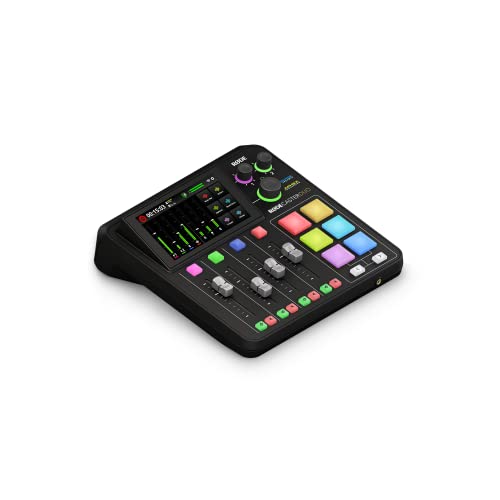
Rode Rodecaster Duo — Best Overall
The Rodecaster Duo is the voice professional’s console: two studio-grade Revolution preamps, APHEX processing per channel, smart pads, and multitrack recording, in a compact unit designed around spoken word. It suits narrators, voice-over artists, podcasters, and streamers whose voice is the product and whose second channel serves a guest, a producer, or a spare. It does not suit buyers needing many simultaneous microphones, or anyone whose room is still untreated — treat the room first, then let this console show you why.
Strengths
- The quietest, highest-gain preamps in this guide: low-output broadcast dynamics reach working level with the noise floor still inaudible in the pauses.
- APHEX voice processing delivers the finished broadcast sound — compression, presence, polish — in hardware, identically on every session.
- Records multitrack standalone or to computer, with pads for production elements, so a solo voice artist runs an entire show from one surface.
Trade-offs
- Premium pricing, justified by the preamps and processing rather than channel count.
- Two channels is the format; panels belong to larger consoles in our podcasting guide.
- The touchscreen workflow asks for one proper setup session before it becomes invisible.
Key specs: 2 studio preamps · APHEX processing · smart pads · multitrack recording to PC/microSD/USB · dual USB + Bluetooth
Voice work exposes equipment in a way music never does, and the Duo was plainly designed by people who record voices daily. The detail that matters most is what happens between sentences: nothing. No hiss swelling as the compressor breathes, no room tone pumping, just silence and then the next line, at the same level and the same distance as the last. For an audiobook narrator recording six hours a day, that consistency is the difference between an edit that assembles chapters and an edit that repairs them. Add processing that survives being left alone — set it once, record for a year — and the Duo is less a mixer than a promise that the technical layer of voice work is handled, permanently and quietly, by someone who understands it far better than you should ever have to, in session after session, week after week, year after year, that you will never have to think about again.
Best for: narrators, voice-over artists, professional podcasters and streamers / Not suited for: multi-guest panels or untreated rooms on a budget
Check the current price on Amazon

Yamaha AG06MK2 — Best for Solo Creators
The AG06MK2 is Yamaha’s 6-channel streaming mixer with two microphone inputs, loopback routing, and hardware DSP — the desk for the creator who narrates, streams, and takes calls from the same chair. It suits solo voice artists who also live on camera or on calls, podcasters with an occasional in-room guest, and remote professionals who want a produced voice everywhere. It does not suit multitrack producers or panels beyond two voices.
Strengths
- Hardware DSP — compressor, EQ, reverb — gives every platform the same polished voice, including calls where no plugins exist.
- Two proper mic inputs cover the host-plus-guest format that the solo AG03 cannot.
- Loopback and a dedicated streaming output make the streaming workflow a knob, not a configuration project.
Trade-offs
- Preamp gain is capable rather than flagship-class; the quietest dynamics at distance will ask more of placement than of the dial.
- Stereo streaming architecture rather than a multitrack production desk.
- Some DSP depth lives in the companion app rather than on the panel.
Key specs: 6-channel loopback mixer/USB interface · 2 mic inputs · hardware DSP · USB-C · 48V phantom power
The AG06MK2 understands the modern voice worker’s actual day: a morning of narration recording, an afternoon of client calls, an evening stream. In each, the voice arrives processed and consistent because the processing lives in the desk, not in whichever app happens to be open. The second microphone input is the upgrade that matters over its smaller sibling — the guest chair, the co-narrator, the producer’s talkback — and the fader-per-source layout keeps live control physical. For the solo creator whose voice works in several rooms at once, this is the desk that keeps it sounding like one voice. It is also the gentlest possible introduction to Yamaha’s wider mixer world — the same preamps and design manners, scaled to a desk and a day that most voice workers will recognize as their own.
Best for: narrator-streamers, solo podcasters with guests, remote professionals / Not suited for: multitrack production or large panels
Check the current price on Amazon

Soundcraft Notepad-12FX — Best Analog
The Notepad-12FX is a small analog console with USB I/O and Lexicon effects — the traditional recording path, executed warmly. It suits voice artists who record one voice at a time but want a real console’s EQ and headroom, home studios where the voice shares the desk with instruments, and engineers who prefer decisions made by ear and hand. It does not suit users wanting app-driven voice chains or multitrack capture; its USB is the stereo mix, printed with intent.
Strengths
- Lexicon reverbs let a narrator monitor with a flattering space while the recording stays as dry or as printed as you choose.
- Proper analog channel EQ shapes a voice at capture — presence, warmth, and de-harshing by ear.
- Soundcraft preamps and build quality bring studio manners to a small desk and a small budget.
Trade-offs
- No hardware voice chain of the Rode/Yamaha DSP kind; processing is EQ, effects, and your discipline.
- Stereo USB only — the performance is the master.
- More channels than a pure voice booth needs; you are buying a small studio desk, not a voice appliance.
Key specs: small-format analog console · USB I/O · Lexicon effects · analog channel EQ · Soundcraft mic preamps
There is a reason the classic voice chain ran through a console: EQ at capture, set by ear against the actual voice in the actual room, is faster and more musical than a screen of plugins after the fact. The Notepad-12FX keeps that craft available at a home-studio scale. Its Lexicon effects serve the narrator’s oldest trick — a whisper of space in the headphones makes long sessions feel less clinical and performances more relaxed — while the analog path keeps the recording honest. For the voice artist who is also a musician, or who simply thinks in faders, it is the warmest route in this guide. Its twelve channels look like excess for a booth until the day a guitar, a second voice, and a playback source all join the session — and then they look like foresight.
Best for: voice-plus-music home studios, analog-minded narrators / Not suited for: set-and-forget DSP workflows
Check the current price on Amazon

Mackie ProFX10v3+ — Best Versatile
The ProFX10v3+ brings Mackie’s small console to the voice desk: Onyx preamps, GigFX+ vocal effects, Bluetooth for phone guests, and USB recording across ten channels. It suits streamers and video creators whose voice work shares space with guests, instruments, and production audio, and podcasters who take remote guests by phone as a matter of format. It does not suit the pure narrator seeking the quietest possible single channel — the Rode and Yamaha DSP desks are quieter company — or multitrack editors.
Strengths
- GigFX+ effects include voice-friendly reverbs and delays that flatter spoken and sung performances live.
- Bluetooth channel makes the phone guest a fader instead of a wiring project — with the level control voice work demands.
- Multiple Onyx preamps mean the guest’s microphone gets the same respect as the host’s.
Trade-offs
- Stereo USB capture; no per-channel tracks for post.
- A real console’s footprint and channel count for what may be a two-voice show.
- No dedicated voice-processing chain of the APHEX kind; polish is manual.
Key specs: 10 channels · Onyx mic preamps · Bluetooth input · GigFX+ effects · USB recording (stereo)
Versatility is this desk’s voice credential: the modern voice worker rarely only narrates. They interview by phone, host a guest in the room, sing a theme, and stream the whole enterprise, and the ProFX10v3+ is the pick that treats all of those as one desk’s ordinary Tuesday. Its preamps are clean enough for serious voice capture, its effects give live vocal production without a plugin chain, and its Bluetooth path removes the most common friction in guest-based shows. If your voice work is a variety show, this is the variety desk. It is also the safest recommendation in this guide to give a creator whose format is still evolving, because nearly every direction a voice show can grow — guests, music, streaming, panels of two or three — is already sitting on its surface, waiting.
Best for: streamers, interview shows, voice-plus-music creators / Not suited for: pure narration booths
Check the current price on Amazon

CAD Audio MXU2 — Best Budget
The MXU2 is a 2-channel USB audio mixer with XLR combo inputs from CAD Audio, a microphone company that has served broadcasters for generations. It suits first voice setups, students, remote workers graduating to a real microphone, and anyone whose budget must cover the microphone and the room before the console. It does not suit low-output dynamics pushed to their limits or users who will outgrow two channels by spring — it is a beginning, and an honest one.
Strengths
- Two XLR combo inputs with USB connection cover the host-plus-guest or voice-plus-instrument basics properly.
- Simple, quiet operation: the controls a voice setup needs and none of the menu depth a beginner fears.
- The price leaves budget for the microphone, the boom arm, and the room treatment that matter more.
Trade-offs
- Entry-tier preamp gain and noise; pair it with a reasonably sensitive microphone and close placement.
- No onboard processing — your voice chain lives in software or in your technique.
- Two channels, compact build: a starter’s desk by design.
Key specs: 2-channel USB audio mixer · XLR combo inputs · headphone monitoring · compact desktop format
The MXU2’s virtue is proportion. Voice beginners routinely overspend on the console and underspend on everything the console cannot fix; this little CAD unit reverses the error, delivering a clean, simple path from a real XLR microphone to the computer while leaving the budget where it belongs. Its broadcast heritage shows in the basics being right — proper combo inputs, sensible monitoring, no gimmicks. A first audiobook recorded on an MXU2 in a treated closet will sound more professional than a flagship recording in a bare room, and the artist who learns that lesson on this desk will never unlearn it. There are worse foundations for a career in voice than a small, honest box and a correct set of priorities; many working narrators began with less and remember the setup fondly.
Best for: first voice setups, students, remote workers / Not suited for: demanding microphones or growing panels
Check the current price on Amazon

Zoom PodTrak P4 — Best Portable
The PodTrak P4 records voice where voices actually are: four XLR inputs, four headphone outputs, sound pads, phone interviews, and battery power in a field unit that captures to SD. It suits interviewers, journalists, oral historians, and podcasters whose material is gathered rather than summoned. It does not suit the fixed narration booth, where its portability is wasted and the Rode/Yamaha processing depth matters more.
Strengths
- Battery operation and SD recording make any quiet room — or parked car, the field recordist’s classic booth — a voice studio.
- Four headphone outputs with individual levels keep every interviewee monitored and comfortable.
- Gain staging aids and limiters forgive the unpredictable levels of real-world speech.
Trade-offs
- Processing is protective rather than beautifying; polish happens in post.
- Preamp gain suits typical interview dynamics; the quietest broadcast mics want closeness.
- Small controls and screen favor recording over live production.
Key specs: 4 XLR mic inputs · 4 headphone outputs · sound pads · phone input · battery powered · SD recording · USB interface
Interview voice work has a different quality bar than booth narration: the standard is not perfection but presence — a real person, in a real place, captured cleanly enough that the listener leans in. The P4 is built to that standard with unusual completeness. Its four headphone outputs alone justify it for anyone recording pairs or panels outside a studio, and its forgiving gain structure respects the fact that interviewees do not perform test tones. For documentary, journalism, and any voice work gathered in the wild, it is the professional’s pocket choice. It also moonlights honorably as the second recorder — the backup unit running in the main studio, quietly insuring the sessions that matter most.
Best for: interviews, journalism, field recording, oral history / Not suited for: fixed narration booths
Check the current price on Amazon
Comparison Table
| Pick | Badge | Key spec | Best for |
|---|---|---|---|
| Rode Rodecaster Duo | Best Overall | APHEX processing, ultra-quiet preamps, multitrack | Professional voice work |
| Yamaha AG06MK2 | Best for Solo Creators | Loopback, hardware DSP, 2 mic inputs | Narrator-streamers |
| Soundcraft Notepad-12FX | Best Analog | Lexicon effects, analog EQ, USB | Voice-plus-music studios |
| Mackie ProFX10v3+ | Best Versatile | Bluetooth guests, GigFX+, 10 channels | Streamers and interview shows |
| CAD Audio MXU2 | Best Budget | 2 channels, XLR combo inputs, USB | First voice setups |
| Zoom PodTrak P4 | Best Portable | Battery power, 4 mics, 4 headphone outs | Field interviews |
How to Choose the Best Audio Mixer for Recording Voice
Start with your microphone, because the pairing decides the preamp you need. Voice microphones divide into the sensitive — condensers and hot dynamics that reach working level on modest gain — and the hungry, the low-output broadcast dynamics that the voice world adores for their flattering, room-rejecting sound. Hungry microphones demand the deep, quiet gain of the Rodecaster Duo first, the Yamaha DSP desks second, and they will expose the budget tier’s ceiling; sensitive microphones make every pick in this guide viable. If you have not yet bought the microphone, buy the pair as a pair: the console’s clean gain and the microphone’s appetite are one specification wearing two price tags.
Second, decide where your processing lives. Hardware processing — the Duo’s APHEX chain, the AG06MK2’s DSP — gives you the same finished voice on every recording, every call, and every stream, with zero setup per session; it is the professional narrator’s and the working streamer’s choice. Software processing offers deeper tools and endless revision, at the price of configuring every application and accepting that a bare call gets your bare voice. Analog processing — the Soundcraft’s EQ and Lexicon space — is the musician’s middle path: printed, musical, and immediate. None is wrong; the error is owning none deliberately and wondering why sessions sound inconsistent.
Third, be honest about format growth. A narration booth is one channel forever, and a Duo or AG06 is a lifetime desk for it. An interview show adds chairs; a streaming desk adds sources. The Mackie and the PodTrak exist in this guide for the formats that sprawl. Buy the desk your next fifty sessions need — not the one your first session survives, and not the one your fantasy format would fill.
Finally, the room. Budget for it in the same purchase: the quietest corner, soft material behind and beside you, a door that closes. Every mixer here will faithfully record the room you give it, and the difference between a treated closet and a bare office is larger than the difference between any two picks in this guide. Voice professionals are not being precious when they record in wardrobes; they are allocating budget correctly.
How to Set Up for a Voice Recording Session
Position before power. Place the microphone a hand’s breadth from your mouth, slightly off to the side so breath and plosives pass beside the capsule rather than into it, and keep that geometry identical every session — consistency of distance is consistency of tone, and long-form listeners hear drift before they can name it. Set the gain on your loudest real material: the dramatic peak, the laugh, the shouted line in chapter nine — not on a mumbled test — and leave headroom above it, because a voice recording can always be raised in level and can never be un-clipped.
Engage the chain in order: high-pass filter to remove rumble, gentle compression to hold the level, a touch of presence EQ if the voice needs help cutting through, and nothing else until you have listened to a full minute of playback on ordinary headphones. Monitor yourself in closed-back headphones at a modest level — loud monitoring makes performers unconsciously quieter and thinner. Record thirty seconds, play it back, and listen specifically to the silences: that is where preamp hiss, computer fans, and the refrigerator’s opinion of your novel all live, and the silences are what your listeners will judge the recording by.
Then protect the session like a professional. Record a backup if your desk allows it, slate the take aloud with the date and chapter, and keep water — in a closed bottle, on a different surface — within reach, because the best voice technique in the world loses to a dry throat in hour three. Note your settings when you find them; the narrator who can recreate Tuesday’s sound on Friday is the narrator whose audiobook sounds like one performance instead of a patchwork.
Between sessions, maintain the chain’s memory. Leave the microphone mounted and the desk set; a voice booth that must be rebuilt is a voice booth that will be rebuilt slightly differently, and “slightly differently” is the enemy this entire guide is organized against. If the space is shared, your settings note and a phone photograph of the microphone’s position are the next best thing. Dust the capsule’s windscreen, check the cable’s connectors monthly, and treat the setup as an instrument that stays in tune only if nobody keeps restringing it.
Common Buying Mistakes
- Pairing a hungry microphone with a weak preamp. The hiss in your pauses was purchased in advance. Match the microphone’s output to the mixer’s clean gain — the Rode exists in this guide for exactly this pairing.
- Buying channels instead of quiet. Voice work uses one or two channels and judges the silence between words. A quiet two-channel desk beats a noisy sixteen-channel one for this job, every session.
- Skipping the room to afford the console. The mixer records the room faithfully. Treatment first, flagship second — the order is not negotiable and the savings are audible.
- Over-processing at capture. Heavy gates chop word endings; heavy compression pumps the room tone. Set the chain gently, listen to the silences, and let the performance carry the drama.
- Monitoring on speakers or open headphones. Bleed prints onto voice recordings invisibly and edits terribly. Closed-back headphones, always, at a level that keeps your performance natural.
- Changing one variable per session. New mic position Monday, new gain Wednesday, new plugin Friday — and no idea which one helped. Lock the setup, note it, and let consistency compound.
Long-Form Consistency: The Problem Music Never Has
An audiobook chapter recorded on Tuesday must match the chapter recorded on Friday, and a podcast’s hundredth episode should sound like its fiftieth. That demand — consistency across days, moods, and mild colds — is voice recording’s defining technical challenge, and it shapes equipment choices more than any specification. Hardware processing earns its keep here precisely because it is hardware: the Duo’s APHEX settings and the AG06MK2’s DSP do not get rearranged by a software update, a new plugin preset, or a tired engineer at midnight. Your chain is a photograph that never fades. Analog desks answer the same need with ritual — settings noted, knobs returned to their marks — which works beautifully for the disciplined and is why the Soundcraft’s owners develop a liturgy of setup steps.
The performer’s half of consistency is physical: the same chair height, the same microphone distance, the same time of day where possible, because a voice at 9 a.m. and a voice at 11 p.m. are cousins rather than twins. The mixer’s contribution is to make the technical half boring — same gain, same processing, same monitoring level — so the human half is the only variable left to manage. When you evaluate the picks in this guide, weigh them partly as consistency machines: the best voice mixer is the one whose sound you can reproduce on your worst day, not merely achieve on your best.
The Voice Chain, Explained Without Mysticism
Every “professional voice” you admire passes through the same short chain, and understanding it turns mixer shopping from superstition into shopping. The high-pass filter removes everything below the voice — rumble, thumps, air handling — buying clarity for free. The gate or expander quiets the channel between phrases so the room vanishes when you pause; used gently it is the sound of a studio, used hard it is the sound of a walkie-talkie. The compressor evens the performance, turning down shouts and lifting whispers toward a steady, intimate level — the single biggest contributor to the “broadcast” feel. EQ then does the cosmetic work: warmth in the low mids, presence where intelligibility lives, restraint at the harsh top. A de-esser, where fitted, files the spikes off sibilant sounds.
The consoles here package that chain at three levels of automation. Rode’s APHEX implementation pre-judges nearly all of it, tuned by people who process voices for a living. Yamaha’s DSP offers the same tools with more of the judging left to you. The analog Soundcraft gives you the EQ and the space, and trusts your ears for the dynamics. None of these is a lesser philosophy; they are the same chain wearing different amounts of autopilot. Choose the autopilot level that matches how you actually work at 11 p.m. before a deadline, not how you aspire to work in a brochure.
Budget Tiers and the Sensible Upgrade Path
Voice recording rewards a particular spending order, and this guide’s tiers map onto it. The first money goes to the microphone and the room, because they bound everything downstream; the CAD MXU2 exists so that a beginner can honor that order, pairing a modest console with a proper microphone in a treated corner and sounding startlingly professional for the total spent. The middle tier — the Yamaha AG06MK2 and the Soundcraft Notepad-12FX — buys the working creator’s two luxuries: hardware consistency and analog craft respectively. A voice that earns money, or soon will, belongs here at minimum, because session time is the real budget and these desks stop consuming it.
The flagship tier, the Rodecaster Duo, buys silence and certainty: the quietest gain for the most demanding microphones, processing that never needs re-deciding, and a workflow a solo professional can run half-asleep at a deadline. Its price looks different once you price the alternative honestly — an interface, a channel strip or plugin suite, a backup recorder, and the hours spent making them agree. The Mackie and the Zoom, meanwhile, remind us that “tier” is about format as much as money: a field interviewer with a flagship budget still belongs on the PodTrak, and a variety streamer still belongs on the ProFX. Spend by job, then by tier, and the upgrade path mostly disappears — replaced by buying the right desk once.
When an upgrade does come, it usually announces itself precisely: hiss you can no longer un-hear means preamp; a second regular voice means channels; sessions lost to software means hardware recording. Upgrade the announced problem, keep the rest of the chain — microphone, room, habits — untouched, and your sound will improve in the one dimension that was actually limiting it. Voice artists who upgrade by announcement rather than by appetite build, within a few years, a chain where every piece is there for a reason they can name.
Final Recommendation
If voice is your profession, buy the Rode Rodecaster Duo: its preamps and processing remove the technical layer from voice work entirely, and its second channel covers the guest, the producer, or the future. Solo creators who live across recording, calls, and streams should take the Yamaha AG06MK2 and its everywhere-DSP; analog-minded studios will be happiest with the Soundcraft Notepad-12FX; variety-format creators, the Mackie ProFX10v3+; field interviewers, the Zoom PodTrak P4; and beginners should start — proudly, not apologetically — with the CAD MXU2 and spend the savings on the room. In voice recording, the order of operations is microphone, room, mixer; this guide’s job is to make the third step the right one. Get the pairing right, lock the chain, treat the corner you record in, and the mixer will disappear — leaving only the voice, which is where this entire category has been trying to put your attention from the first paragraph.
Keep exploring the cluster: Best Audio Mixers For Podcasting · Best Audio Mixers For Pc · Best 2 Mic Mixers For Podcasting · Best Audio Mixers For Recording Music · Best Audio Mixers For Podcasting & Music
Frequently Asked Questions
Why does my voice recording hiss in the quiet parts?
Almost always, gain staging: a low-output microphone turned up through a preamp that gets noisy at the top of its range, or a voice recorded too quietly and raised later in software, which raises the noise floor with it. The fixes in order are proximity — record closer, which is free level; then correct gain at the mixer, set on your loudest material; then, if the pairing still struggles, a quieter, higher-gain preamp. The Rodecaster Duo in this guide is the benchmark for exactly this problem.
Dynamic or condenser microphone for voice recording?
Dynamics are the forgiving default: they reject room sound, tolerate close working, and flatter spoken voices, at the price of needing more preamp gain. Condensers capture more detail and more room, and reward treated spaces with a polished, open sound. Choose by your room first and your preamp second: an untreated room argues dynamic on any desk here; a treated booth lets a condenser shine on all of them.
Do I need processing, or can I record dry and fix it later?
Both workflows are legitimate. Recording dry preserves every option and suits producers who edit carefully; hardware processing — the Duo’s APHEX chain, the Yamaha’s DSP — suits performers who publish fast, stream live, or record long-form work where consistency across sessions is the product. The hybrid most professionals use: gentle hardware compression and filtering at capture for consistency, detailed work later in software. What you cannot do later is remove hiss, echo, or clipping, so capture discipline outranks processing philosophy.
How loud should I record my voice?
Set gain so your loudest genuine moments — the laugh, the dramatic peak — peak with clear headroom to spare, and your normal speech sits comfortably below that. Exact meter numbers vary by system, but the principle does not: digital recording has no benefit to recording hot, and clipping is unrecoverable, while a conservatively gained take can be raised in level cleanly. When in doubt, err quieter and closer: proximity gives you level without risk.
Can one mixer serve narration, podcasting, and streaming?
Yes — that convergence is exactly what the Yamaha AG06MK2 and Rode Rodecaster Duo were designed for. The narration session wants quiet gain and consistency; the podcast wants a second channel and guest routing; the stream wants loopback and live processing. A desk with those three traits, both of these have them in different proportions, serves all three jobs from one chair, which is why they anchor this guide.
What is the cheapest meaningful upgrade to my voice sound?
Distance and room, in that order, and neither is a purchase: move the microphone to a hand’s breadth from your mouth, and record in the most furnished, softest space you have — the wardrobe full of clothes is a cliché because it works. After those free upgrades, the first purchase that matters is a real XLR microphone into a clean input, which is the entire premise of the budget CAD pick here. Consoles refine a voice; position and room create it.
What do audiobook and voice-over clients actually require from my recordings?
Consistency and cleanliness, above all: a stable noise floor with no hiss swelling in the pauses, no clipping anywhere, consistent level and tone from session to session, and files delivered in the format the client specifies. The equipment translation of those requirements is exactly this guide’s criteria — quiet gain, a locked processing chain, disciplined gain staging, and settings you can reproduce on demand. Clients rarely ask what mixer you own; they hear whether your chain meets the standard in the first ten seconds, including the silence before your first sentence.
Should my mixer have a built-in backup recording?
For paid or irreplaceable sessions, it is close to essential, and it is a quiet reason the Rode consoles and the PodTrak P4 rank as they do here: they record to removable media independently of the computer, so a crashed laptop costs you a restart, not a performance. If your desk records only through the computer, adopt the compensating habits — short test recordings before long sessions, autosave discipline, and a second device capturing the room as insurance on the sessions that cannot be repeated.


