Disclosure: airfryerkitchensupply.com is reader-supported. When you buy through links on our site, we may earn an affiliate commission at no extra cost to you.
Where to buy
Every product in this guide to the best audio mixers for electronic music was verified against Amazon’s own catalog data before it earned a place here, and Amazon is where we recommend buying in this category: the listing states the exact variant, the returns window protects you if a unit arrives with a fault, and marketplace pricing in this category moves often enough that a printed figure would mislead you. Use the links below to check the current price on Amazon for each pick.
- Pioneer DJ DJM-A9 — Best Overall for Electronic Music: check price on Amazon
- Allen & Heath Xone:23 — Best Analog DJ Sound: check price on Amazon
- Pioneer DJ DJM-S11 — Best for Scratch and Performance DJs: check price on Amazon
- Numark Scratch — Best Value Performance Mixer: check price on Amazon
- Allen & Heath ZED-14 — Best for Synth and Hardware Rigs: check price on Amazon
- Zoom LiveTrak L-12 — Best for Recording Electronic Performances: check price on Amazon
Electronic music uses mixers in three fundamentally different ways, and the best audio mixers for electronic music divide along those lines. Club DJs perform on four-channel mixers where EQ, filters and effects are instruments. Turntablists play two-channel battle mixers where the crossfader is percussion. And hardware producers mix synth rigs on studio-style boards, increasingly while recording every channel. A guide that pretended one product served all three would serve none of them, so this one names the champion of each discipline and the value pick where budgets bind.
Every pick is a current model verified against the retailer’s catalog data — the club standard, the analog purist’s filter mixer, the performance flagship, the value battle board, the synth-rig mixer and the multitrack recorder-mixer. What unites them is that each is played, not merely operated: in electronic music the mixer sits inside the performance, and its feel under the hands matters as much as its specifications.
No prices are printed; flagship DJ equipment pricing moves with bundles and software offers. Tiers are described honestly in words — check the current price on Amazon through the links before committing.
In this guide
Quick Picks
- Pioneer DJ DJM-A9 — Best Overall for Electronic Music. The club-standard performance mixer for serious electronic music DJs — Check on Amazon
- Allen & Heath Xone:23 — Best Analog DJ Sound. Purists who mix with filters and want analog warmth over digital features — Check on Amazon
- Pioneer DJ DJM-S11 — Best for Scratch and Performance DJs. Turntablists and performance DJs whose mixer is a percussion instrument — Check on Amazon
- Numark Scratch — Best Value Performance Mixer. Scratch capability with pro fader hardware at an entry commitment — Check on Amazon
- Allen & Heath ZED-14 — Best for Synth and Hardware Rigs. Electronic producers running hardware synths, drum machines and effects without a computer — Check on Amazon
- Zoom LiveTrak L-12 — Best for Recording Electronic Performances. Electronic acts that must capture every channel of the performance, not just the mix — Check on Amazon
How These Picks Were Chosen
Candidates were verified against catalog data for exact model and format, and sorted by discipline before judging — a battle mixer was never marked down for lacking four channels, nor a studio board for lacking a crossfader. Within each discipline we weighted feel and response (faders, filters, EQ behaviour), audio path quality, software or recording integration where relevant, and build for the life the discipline imposes.
Reputation was treated as evidence only where it reflects the working reality — club standardisation, fader hardware specified by practitioners, platforms venues install. No prices or scored ratings are printed; positioning is given in words and live prices are one click away through the links.
The 6 Best Audio Mixers for Electronic Music

Pioneer DJ DJM-A9 — Best Overall for Electronic Music
The DJM-A9 is what the world’s booths standardised on: a four-channel professional DJ mixer with the layout every touring DJ’s hands already know, high-resolution audio path, performance effects and an interface for recording and performance. For electronic music — where the mixer is an instrument, not a utility — this is the reference pick. It suits working DJs and serious performers building a home booth that mirrors the club. It is unapologetically professional in scope and commitment; bedroom beginners should start on the value picks and arrive here when their bookings do.
Strengths
- Club-standard layout — skills transfer to any booth
- Performance effects designed for electronic music in real time
- Audio interface records sets and routes performance audio
- Build and support at a touring standard
Trade-offs
- Professional scope is wasted on casual home use
- Four channels assume a DJ workflow, not a band’s
- Demands quality sources and speakers to justify itself
| Specification | Detail |
|---|---|
| Channels | 4 |
| Format | Club-standard DJ mixer |
| Interface | Audio interface for recording and performance |
| Heritage | Pioneer DJ club line |
Playing the A9 explains its dominance in one transition: the EQ, filters and effects respond like parts of one instrument, voiced for the frequencies electronic music actually occupies. The magvel-feel crossfader work, the per-channel colour effects and the headroom to run a system hard without hardness are not specifications — they are the difference between mixing tracks and performing them. Home booths built around it stop being practice rigs and become the place the set is actually composed.
Best for: Working and aspiring professional DJs in electronic music / Not suited for: Beginners buying their very first mixer
Check on Amazon — check the current price on Amazon before you decide, because bundles and variants change.
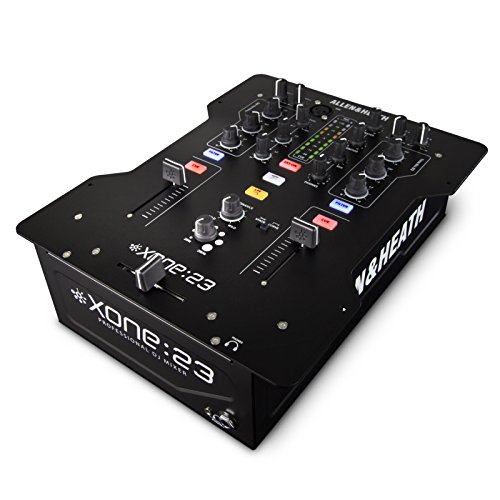
Allen & Heath Xone:23 — Best Analog DJ Sound
The Xone:23 is the analog counter-argument: a 2-plus-2 channel DJ mixer built around Allen & Heath’s famous VCF filter, with a sound electronic music purists describe in vocabulary usually reserved for instruments. It suits DJs who mix long blends with filters and EQ rather than effects tricks — house and techno players especially. There is no USB performance ecosystem and no effects bank; the filter is the effect, and in skilled hands it is enough. Buyers wanting digital connectivity should take the Pioneer picks; buyers wanting the blend itself to be beautiful should start here.
Strengths
- Xone VCF filter is a genuine musical instrument
- Analog signal path with revered blend character
- Compact, tough, booth-proven layout
- Simple — nothing between the DJ and the music
Trade-offs
- No performance effects bank or USB ecosystem
- 2+2 channels suit DJ sources only
- Filter-led mixing is a skill to learn, not a preset
| Specification | Detail |
|---|---|
| Channels | 2+2 |
| Filters | Xone VCF filter system |
| Heritage | Xone analog line |
| Format | Compact battle-ready layout |
Long blends are where the Xone earns its following: two tracks held together for a minute or more stay musical because the filter lets you carve space continuously rather than switching it. House DJs who learned on Xone mixers speak about them the way guitarists speak about a first good amp — as the tool that taught them touch. If your electronic music lives in transitions rather than drops, this modest box will teach you more than any flagship.
Best for: House and techno DJs who mix with filters and long blends / Not suited for: Effects-led performers and digital-workflow DJs
Check on Amazon — check the current price on Amazon before you decide, because bundles and variants change.

Pioneer DJ DJM-S11 — Best for Scratch and Performance DJs
The DJM-S11 is built for the other electronic tradition: scratching, cutting and live remixing, where the crossfader is struck like a drum and the pads trigger the performance. It suits turntablists and open-format performance DJs working with Serato DJ Pro or rekordbox. Its two channels and battle layout are a deliberate specialisation — long-blend house DJs should take the Xone or the A9. In its arena, nothing here is decorative: the fader feel, the pad response and the effects levers exist because a performance technique demands each one.
Strengths
- Battle layout refined for scratch technique
- Deep integration with the major DJ software platforms
- Performance pads and effects built for live remixing
- Fader feel engineered for percussive cutting
Trade-offs
- Two channels — a specialist’s format
- Software-centred workflow assumes a laptop rig
- Long-blend DJs will prefer the four-channel picks
| Specification | Detail |
|---|---|
| Channels | 2 |
| Format | Battle/performance |
| Compatibility | Serato DJ Pro and rekordbox |
| Heritage | Pioneer DJ performance line |
Scratch DJs judge mixers in milliseconds and millimetres, and the S11 was designed by people who understood both: cuts land where the hand expects, the deck controls fall under the fingers without looking, and the whole unit survives the physical playing style it invites. For electronic musicians whose performance is manipulation — juggling, cutting, rebuilding tracks live — it is not an accessory to the turntables. It is the third instrument.
Best for: Turntablists and performance DJs / Not suited for: Four-channel club mixers and long-blend players
Check on Amazon — check the current price on Amazon before you decide, because bundles and variants change.

Numark Scratch — Best Value Performance Mixer
The Numark Scratch democratised the battle mixer: an InnoFader crossfader — the hardware scratch DJs actually specify — Serato DJ Pro included with DVS licensing, performance pads and FX paddles, at a commitment a working beginner can reach. It suits aspiring scratch DJs and open-format players equipping a first serious rig. It concedes the flagship Pioneer’s depth and ecosystem, and its two channels keep it in the performance lane. Judged as a cost-per-technique proposition, it is the strongest value in this guide: the fader alone justifies the audition.
Strengths
- InnoFader crossfader is genuine professional hardware
- Serato DJ Pro and DVS included — no hidden software costs
- FX paddles encourage performance playing
- Accessible commitment for a first serious rig
Trade-offs
- Two-channel specialist format
- Shallower ecosystem than the Pioneer flagship
- Build is working-grade rather than tour-luxury
| Specification | Detail |
|---|---|
| Channels | 2 |
| Crossfader | InnoFader |
| Software | Serato DJ Pro included, DVS licensed |
| FX | Paddle triggers |
Value in a scratch mixer is decided at the crossfader, because that is the component the technique consumes — and Numark’s decision to fit an InnoFader rather than a lookalike is why this board appears in serious rigs despite its badge price. The included software licensing removes the second hidden cost that catches beginners. Learn your cuts here and the skills transfer upward unchanged when the flagship eventually calls.
Best for: Aspiring scratch and open-format DJs on a real budget / Not suited for: Four-channel club-style mixers
Check on Amazon — check the current price on Amazon before you decide, because bundles and variants change.

Allen & Heath ZED-14 — Best for Synth and Hardware Rigs
Not all electronic music comes from decks. The DAW-less producer — synthesisers, drum machines, samplers and effects, performed live — needs a studio-style mixer with many line inputs, musical EQ and subgroups, and the ZED-14 is that tool: fourteen channels of Allen & Heath analog mixing with USB to capture the performance. It suits hardware live acts and hybrid studios. It has no crossfader and no DJ pretensions; deck players should take the Pioneer and Xone picks. For the synth rig, its channel count, EQ and build are exactly the product.
Strengths
- Channel count fits full hardware rigs
- Musical EQ shapes synths without harshness
- USB captures the live performance in stereo
- Touring-quality build for live electronic acts
Trade-offs
- No DJ features whatsoever — a different instrument
- Stereo recording only, like its class
- Size assumes a studio desk or a serious live case
| Specification | Detail |
|---|---|
| Channels | 14 |
| Preamps | DuoPre lineage |
| USB | I/O |
| Format | Touring-quality frame |
Hardware electronic music is mixed like a band, not a DJ set: levels ride continuously, the drum machine’s EQ fights the bass synth’s, and effects returns become instruments in themselves. The ZED-14’s forgiving EQ and generous headroom suit that continuous style, and its subgroups let a performer gather the rhythm section under one hand while the other plays. Producers moving a studio rig onto a stage will find this learning curve the shortest of any pick here.
Best for: DAW-less and hybrid electronic producers with hardware rigs / Not suited for: DJs of any style
Check on Amazon — check the current price on Amazon before you decide, because bundles and variants change.

Zoom LiveTrak L-12 — Best for Recording Electronic Performances
The LiveTrak L-12 answers the hardware performer’s recording problem: it mixes the rig and records every channel separately to SD, so the live set can be mixed properly afterwards — the kick rebalanced, the synth take chosen, the performance preserved in full. It suits electronic acts who release live recordings and producers who compose by performing. Its mixer ergonomics serve recording sessions more than DJ-style performance, and deck players are in the wrong guide section entirely. As a capture device for electronic performance, it has no rival among these picks.
Strengths
- Multitrack recording of the whole performance
- Mixer and recorder in one unit — no computer on stage
- Scene and workflow designed around sessions
- Ideal for live electronic releases and archives
Trade-offs
- Not a DJ mixer in any respect
- Session workflow is slower than a performance board
- Recording media management becomes part of the rig
| Specification | Detail |
|---|---|
| Channels | 12 |
| Recording | Multitrack to SD |
| Format | Mixer and recorder |
| Heritage | Zoom LiveTrak line |
Most live electronic recordings fail as documents because a stereo board tape freezes the balance of a room that no longer exists. Multitrack capture changes the afterlife of a performance entirely: the set becomes raw material, editable with the same care as a studio session while keeping the energy only a live take has. Acts building a catalogue from live work should treat this capability as the headline feature it is — the mixer is, in effect, buying back every performance you will ever give on it.
Best for: Electronic acts recording live releases and archives / Not suited for: DJs and performers who never record
Check on Amazon — check the current price on Amazon before you decide, because bundles and variants change.
Comparison Table
| Pick | Badge | Key spec | Best for |
|---|---|---|---|
| Pioneer DJ DJM-A9 | Best Overall for Electronic Music | Professional 4-channel DJ mixer | The club-standard performance mixer for serious electronic music DJs |
| Allen & Heath Xone:23 | Best Analog DJ Sound | 2+2 channel analog DJ mixer | Purists who mix with filters and want analog warmth over digital features |
| Pioneer DJ DJM-S11 | Best for Scratch and Performance DJs | Professional 2-channel scratch mixer | Turntablists and performance DJs whose mixer is a percussion instrument |
| Numark Scratch | Best Value Performance Mixer | 2-channel DJ scratch mixer | Scratch capability with pro fader hardware at an entry commitment |
| Allen & Heath ZED-14 | Best for Synth and Hardware Rigs | Analog studio/live mixer with USB | Electronic producers running hardware synths, drum machines and effects without a computer |
| Zoom LiveTrak L-12 | Best for Recording Electronic Performances | Mixer/recorder for musicians | Electronic acts that must capture every channel of the performance, not just the mix |
How to Choose a Mixer for Electronic Music
Name your discipline first
The buying mistake in this category is cross-discipline envy: the house DJ who buys a battle mixer for its energy, the turntablist seduced by a four-channel flagship, the synth producer trying to mix a rig on a DJ board. Each discipline’s mixer is a different instrument optimised for different hands. Decide how you actually perform — long blends, cuts and performance, or hardware composition — and the shortlist in this guide collapses to two or three honest candidates.
Hybrid performers exist and should buy for their dominant discipline, borrowing the other’s tools as outboard or software. The centre of your set is what the mixer must serve at 1 a.m. with the room full.
Feel is a specification
Fader travel and resistance, filter sweep behaviour, EQ pot spacing — in performance disciplines these are not ergonomics, they are the instrument’s action, and they cannot be read off a specification sheet. The picks here were chosen partly on documented feel: the InnoFader’s reputation among scratch DJs, the Xone filter’s musicality, the A9’s booth-standard response. Wherever possible, put hands on a candidate before buying; ten minutes of mixing tells a DJ more than ten reviews.
Software integration is the other feel: how the mixer and the laptop behave as one system — latency, mapping, stability. The Pioneer performance picks and the Numark were judged on their platforms’ working records, because a crashed driver is a stopped room.
Recording the set is no longer optional
Electronic careers are built on recorded sets and live releases, so the capture path deserves a line in every buying decision. DJ picks here record through their interfaces; the Zoom exists solely to capture hardware performances in multitrack. Even a simple stereo recording of every set builds the archive a career runs on — and the habit costs nothing once the workflow exists. Decide your capture format before the mixer, not after the first great set goes unrecorded.
How to Set Up an Electronic Music Mixer Rig
[‘Whether the rig is decks, a battle setup or a wall of synths, this sequence builds it reliably.’]
- Power and ground first. Run the whole rig from one power distribution point where possible; most hum in electronic rigs is two circuits arguing. Connect audio only after power is stable.
- Gain each source to the same neighbourhood. Tracks, synths and samplers vary wildly in output. Normalise them at the mixer so faders live in their useful middle range, where fine moves are possible.
- Set the master chain conservatively. Leave headroom at the main output for the loudest moment of the set; a limiter-minded approach at home prevents the red-line habits clubs punish.
- Rehearse transitions, not tracks. The mixer earns its money between songs. Practise the blend, the cut or the rig changeover until it is muscle memory, at performance volume, on the performance system.
- Record the rehearsal. Listen back for level jumps between sources and transitions that felt better than they sound. Adjust gains, not hopes.
- Pack the rig as a system. Cables labelled, power supplies captive, settings photographed or saved. A rig that rebuilds identically is a professional rig.
Common Buying Mistakes
Buying a flagship to learn on
Professional mixers assume technique. A beginner learns faster on the value picks, whose limitations are honest, and upgrades with bookings rather than hope as the trigger.
Ignoring the crossfader in a scratch purchase
For turntablism the fader is the instrument; its quality decides the ceiling of every technique. It is the one component never to compromise, which is why the value pick here specifies its fader by name.
Mixing a synth rig on a DJ mixer
DJ boards lack the channel count, EQ depth and routing hardware music needs. The disciplines have different mixers because they have different problems.
Forgetting the recording until the great set
Careers run on archives. Set the capture workflow up with the rig, record everything, and delete generously later — the opposite order is not available.
Chasing features over feel
In performance disciplines, the mixer you play best beats the mixer with the longest feature list. Hands first, specifications second.
Final Recommendation
Perform on the Pioneer DJM-A9 if the club is your destination; blend on the Xone:23 if the filter is your language; cut on the DJM-S11 if the turntables are your percussion; start on the Numark Scratch if the budget is real and the ambition is too. Producers: mix the rig on the ZED-14, and record it all on the LiveTrak L-12. Electronic music is performed on its mixers — choose the one your hands would choose.
Related guides in this series: Best Audio Mixers · Best Audio Mixers Digital For Live · Best 2 Channel Dj Mixers · Best Audio Mixers For Home Studios
Cueing and Monitoring: The DJ’s Private Mix
Every DJ mixer maintains two mixes: the one the room hears and the one in the headphones, and the craft lives in the second. Cueing — previewing the incoming track, matching its tempo and choosing the entry point while the current track plays out — is the skill the audience never sees and always hears. The picks here support it in their disciplines’ dialects: split cue and cue/master blending on the club boards, so the DJ hears the mix as the room will; tight, immediate cue response on the battle boards, where the headphone check happens mid-routine at speed.
Booth monitoring completes the picture. A DJ who cannot hear the room mix accurately will misjudge every transition, which is why booth speakers at ear level, fed from the mixer’s booth output where fitted, are part of the professional rig rather than a luxury. At home, the same principle scales down: practise on the speakers you will perform on, at honest volume, because headphone-only practice builds transitions that collapse in a room. The mixer is where the two worlds — private preparation and public performance — meet, and the great ones make the border invisible.
Recording the Set: Workflows by Discipline
Club and performance DJs on the Pioneer and Numark picks record through the software ecosystem — the set captured as played, ready for the upload that builds the audience between gigs. Discipline in this workflow is file hygiene: record every set, name by date and venue, and review transitions with the waveform in view, because the blend that felt heroic at 1 a.m. sometimes shows its seams in the cold light of the editor, and that review is where DJs actually improve.
Hardware performers on the Zoom path hold a richer archive: every channel isolated, the performance re-mixable. Their hygiene is session discipline — label takes at the rig, back the cards up the same night, and keep one performance per project folder so the archive stays searchable when a label asks for the live version in six months. Analog purists on the Xone add a recorder to the chain and gain the same archive at one extra cable’s cost. In all three disciplines the principle is identical and non-negotiable: the set you did not record is the set you cannot prove, post or learn from.
Three Rigs, Built From This Guide
The resident house DJ. Xone:23 at the centre for filter-led blending, two media players, a small recorder on the booth output, and monitors at ear height. The rig’s whole philosophy is touch — nothing in it updates, pairs or loads, and its owner can rebuild it in the dark. The performance turntablist. DJM-S11 or the Numark Scratch, two turntables with control vinyl, laptop riding high where the screen never competes with the hands, and a spare crossfader in the bag because the discipline consumes them. Every element exists to keep the routine’s latency — physical and digital — at zero.
The DAW-less live act. ZED-14 mixing two synths, a drum machine, a sampler and two effects returns; LiveTrak L-12 either replacing it as the capture hub or fed from its groups, recording every channel of the show. The rig travels in two cases and sets up in twenty minutes, and its owner leaves every venue with a multitrack of the night. Three disciplines, three philosophies, one shared trait: each rig was bought as a system around a chosen mixer, not assembled by accident around a bargain.
DVS and Controllers, Explained for the Perplexed
Digital Vinyl Systems let turntables control digital files: a special record outputs a timecode tone, the software reads it, and the file follows the record’s every move — scratch, back-cue, pitch — with the feel of vinyl and the library of a laptop. The performance picks here are built for this world, with the Numark’s included licensing removing the usual extra purchase. Controller DJs skip the turntables entirely; their mixers are the performance surface itself, which is the A9’s home territory when paired with media players.
Neither workflow is more authentic; they are different instruments sharing a repertoire. What matters for buyers is that the ecosystem decision — software platform, media format, library — precedes the mixer decision, because the mixer is chosen to serve it. Decide how your music lives first. The hardware shortlist then writes itself, and it will contain two or three names from this guide whichever way you decide.
Protecting the Instrument: Care for Performance Mixers
Performance mixers live harder lives than any other equipment in this series — faders struck, filters swept thousands of times a night, drinks in the same postcode. The care regime is correspondingly specific. Faders and pots want clean, dry operation: compressed air for dust, no lubricants not specified for the purpose, and a cover or case whenever the mixer is not being played, because booth dust is mostly sugar and it is patient. Crossfaders are consumables in the battle disciplines; know your unit’s replacement procedure before the night it matters.
Transport decides lifespan more than use does. A mixer that travels in a fitted case arrives as the same instrument that left; one that travels loose in a cable bag arrives as a lottery. Budget the case with the mixer, keep the power supply captive to it, and photograph your full rig assembled — the picture is the setup manual your future tired self will need at load-in. These mixers are instruments, priced like instruments; treat them with an instrument’s respect and they will hold their feel, their value and their nerve for years.
The Transition Is the Track: Technique Notes by Discipline
Club mixing’s core technique is the long blend governed by EQ and filter discipline: frequencies are exchanged, not stacked, so the incoming track’s bass waits until the outgoing track’s bass leaves. The Xone filter and the A9’s channel tools exist for exactly this negotiation, and the audible signature of a skilled resident is that the room never hears the join. Practise it by recording blends and listening only to the thirty seconds around each one; that narrow audit teaches faster than whole-set reviews.
Battle technique is rhythmic before it is melodic: the cut is timed to the beat’s skeleton, the juggle rebuilds the break in real time, and the mixer’s fader response is the technique’s physical limit — the reason this guide names fader hardware in its picks. Hardware performance technique is orchestration: muting, riding and effecting a rig of machines so the arrangement breathes across twenty minutes rather than four. Three disciplines, three definitions of a good transition, and one shared rule — the audience should feel the change as music, never as mechanics.
Building a Home Booth That Teaches Club Craft
A home setup teaches what it resembles. Booth-height surfaces, monitors at ear level in a nearfield triangle, and the mixer centred where both hands fall naturally will build transferable habits; a mixer on a coffee table builds a bad back and approximate technique. Lighting deserves a sentence DJs learn late: practise in the low, coloured light you will perform in, because reading a mixer by feel is a performance skill and the booth will not provide a desk lamp.
Record from the first week, review transitions narrowly, and invite one honest listener monthly. The home booth’s purpose is not comfort; it is a simulator accurate enough that the club holds no surprises except the audience. The picks in this guide scale into that booth at every tier — the value boards teach the same fundamentals as the flagships, which is precisely what makes them value boards rather than toys.
Vinyl, Digital and the Hybrid Booth
Contemporary electronic performance is hybrid by default: vinyl for the feel and the catalogue that never digitised, files for the unreleased and the unobtainable, hardware for the live elements. The mixers here accommodate that reality — DVS integration for the turntable workflows, interfaces for the file workflows, and honest analog paths for the purists. The strategic advice is to let your music collection, not ideology, draw the map: inventory what you actually play, in what formats, and the booth’s architecture follows.
Budget follows the same logic. Records, files, needles, cartridges and software licences all draw from the same account as the mixer, and a balanced rig — a value performance mixer and a deep, well-organised library — outperforms a flagship starved of music in every room on earth. The mixer is the instrument; the library is the repertoire; careers are built from repertoire played beautifully, in that order.
Reading a Room as a DJ: Levels, Energy and Restraint
The mixer’s final job is translation between the music and the room’s energy, and its master section is where that translation is negotiated. Experienced performers ride overall level against the floor’s density — fuller rooms absorb sound and invite more; emptier rooms punish volume with harshness. Effects follow the same curve: a packed, warm room needs less artificial space than the same set played to forty people and a hard wall. None of this is in any manual, because it is not a property of the mixer; it is the discipline the mixer makes possible when its gains are staged with headroom to spare.
Restraint is the mark of the resident over the guest: the long blend held a chorus longer than instinct suggests, the effect left off because the room is already singing, the level held steady while the track does the work. The instruments in this guide reward that restraint with transparency — they get out of the way of judgement. Choose yours, learn its feel until the hands stop thinking, and then spend your attention where it belongs: on the room, the music and the next transition.
The Archive Mindset: Every Set a Document
Close this guide where the discipline’s professionals live: in the archive. The recorded set is the DJ’s portfolio, the producer’s raw material and the performer’s only honest teacher. Build the capture into the rig’s setup checklist so it happens on tired nights as reliably as on inspired ones, store the files with the same care as the music library itself, and review with a notebook rather than a memory. A year of archived sets is a curriculum no course sells, written in your own transitions.
It is also, not incidentally, how the equipment in this guide justifies itself commercially: the bookings, releases and audiences that follow a documented year of work repay the mixer many times over. Buy the instrument your discipline demands, record everything it helps you play, and let the archive make the argument your future self will need.
Headphones and Hearing: The Performer’s Safety Section
Electronic performance is loud by design, and the mixer sits at the centre of the performer’s exposure: cue levels in headphones, booth monitors at arm’s length, hours at a time. Set cue volumes at the lowest level that stays intelligible, take headphone breaks between sets, and treat any ringing after a performance as data, not bravado. The instruments in this guide will happily produce damaging levels all night; the discipline of the person operating them is the only limiter that matters.
This is not a footnote to the craft — hearing is the instrument behind the instrument, and its damage is cumulative and permanent. Performers who manage levels deliberately in their twenties are the ones still mixing with precision in their fifties, still hearing the filter sweep’s top octave, still catching the blend’s smallest drift. Buy the mixer your discipline demands, and then operate it like you intend to enjoy it for decades.
Genres Within the Genre: What Changes Between House, Techno, Drum and Bass and Open Format
House rewards blend length and filter control, and its DJs gravitate to the Xone and the A9’s EQ discipline. Techno adds hardware — a drum machine or a synth voice folded into the set — which is where a third and fourth channel stop being luxury and the rig thinking from the ZED-14’s world starts to inform DJ setups. Drum and bass lives at transition speed: shorter blends, faster hands, and a premium on cue immediacy and fader response that pulls its players toward the performance boards. Open format spans everything at wedding-and-club tempo, living inside software ecosystems where the S11 and the Numark’s integration earn their keep nightly.
The point of the taxonomy is permission: your genre’s norms are a legitimate buying input, not a fashion to apologise for. The mixer that serves a techno hybrid set is genuinely different from the one that serves a drum and bass routine, and this guide’s discipline-first structure exists so that each reader can find their own row in that table without translating from someone else’s.
One closing observation from the booth: audiences remember transitions and energy, never specifications. They will not know which of these instruments you played, and they will know within two tracks whether you played it well. So choose the mixer your hands believe in, learn it until the thinking stops, record everything, and let the room be the judge it always was. The equipment in this guide has held up the biggest rooms in the world; in yours, it is waiting to be played.
Trust the process the professionals share: discipline first, feel second, memory always. The mixer is where those three meet the music — pick the one built for your meeting place, and play.
One more practical habit deserves its place here: photograph your booth wiring whenever it works perfectly. A rig that has been unplugged for transport rebuilds in minutes from a photograph and in an hour from memory, and the difference, multiplied across a year of load-ins, is the difference between a performer who soundchecks and a performer who troubleshoots. Label both ends of every cable while you are at it. Future you, in a dark booth with the room filling, sends thanks in advance.
And when the rig is rebuilt and the first track loads, take one breath before the room fills. Everything this guide described — the gains, the scenes, the archive, the discipline — exists to buy you that breath: the moment where preparation ends and performance, which is the entire point, begins on time and in tune with itself.
Play the first record like you mean it. The room can tell within eight bars, and so, listening back to the recording tomorrow morning with honest ears and a notebook open, will you — which is exactly how a good set becomes a better one.
Related guides
- Best Audio Mixers For Singing And Pre Recorded Music
- Best Audio Electronic Mixers For Under $500
- Best Audio Mixers For Podcasting & Music
Frequently Asked Questions
What is the difference between a DJ mixer and a studio mixer for electronic music?
Intent. A DJ mixer is a performance instrument for two to four sources — crossfader, filters, effects, cueing. A studio-style mixer like the ZED-14 handles many simultaneous sources with EQ and subgroups for composition and live hardware acts. Electronic musicians choose by how they perform.
Why do house and techno DJs love the Xone filter?
Because long blends need continuous control of the frequency space two tracks share, and the Xone VCF filter provides it musically — carving room for the incoming track without the sterility of simply cutting EQ. It turns transitions into composition.
Do I need Serato or rekordbox compatibility?
If your performance uses digital files with turntables or controllers, yes — DVS or native integration is the workflow, and the performance picks here are built around those platforms. Vinyl-only and hardware-only performers can ignore it entirely.
Can these mixers record my set?
The Pioneer picks record through their audio interfaces, the Numark through its software path, and the Zoom LiveTrak records every channel to SD for hardware rigs. Only the analog Xone asks you to add a recorder — part of its purist bargain.
Is four channels necessary for club DJing?
For the standard club workflow — two decks plus expansion for a third source, sampler or guest — four channels is the professional format the A9 represents. Two-channel mixers serve battle and minimalist styles by design, not by deficiency.
What should a beginner in electronic music buy first?
The discipline’s value pick: the Numark Scratch for performance styles, or a hardware-rig path starting smaller if you produce. Spend the savings on music, cables and the recording habit.


