Disclosure: airfryerkitchensupply.com is reader-supported. When you buy through links on our site, we may earn an affiliate commission at no extra cost to you.
Where to buy
If you are shopping for the best alternative to bbq smokers, buy through Amazon and confirm the exact model on the listing — grill and smoker lines reuse names across sizes and fuel types. Start with the Traeger Pro 22 if what you want is real wood smoke with the fire-tending removed, and read down the list by which part of traditional smoking you actually want to escape: the tending, the space, the weather or the smoke itself.
- Traeger Pro 22 Wood Pellet Grill & Smoker — check the current price on Amazon and confirm the exact configuration on the listing before you order.
- Masterbuilt 30-inch Digital Electric Smoker MB20071117 — check the current price on Amazon and confirm the exact configuration on the listing before you order.
- Z Grills ZPG-7002B Pellet Smoker Grill — check the current price on Amazon and confirm the exact configuration on the listing before you order.
- Pit Boss 850 Navigator Series Pellet Grill & Smoker — check the current price on Amazon and confirm the exact configuration on the listing before you order.
- Char-Griller AKORN Kamado Charcoal Grill and Smoker — check the current price on Amazon and confirm the exact configuration on the listing before you order.
- Ninja Foodi Smart XL 6-in-1 Indoor Grill & Air Fryer DG551 — check the current price on Amazon and confirm the exact configuration on the listing before you order.
Nobody shops for an alternative to a BBQ smoker because they dislike smoked food. They shop because they dislike something around it: the all-night fire management of an offset, the patio space a traditional rig commands, the learning curve measured in ruined briskets, or — in apartments and condos — the smoke itself, which landlords and neighbors experience differently than the cook does. The honest alternatives divide by which of those problems they solve, and this guide labels each pick with the problem it kills and the part of the traditional experience it asks you to surrender.
The closest relatives keep the wood and automate the fire. Pellet grills — Traeger, Z Grills, Pit Boss here — burn real wood pellets, hold temperature by thermostat and auger, and produce genuine smoke flavor while the cook sleeps, works or watches the game; they are the alternative for people whose complaint was tending, not tradition. Electric vertical smokers — the Masterbuilt here — go further: a heating element, a tray of wood chips and a digital dial, in a compact cabinet that fits a small patio and a beginner’s confidence. Kamado cookers — the Char-Griller AKORN — attack a different problem: fuel efficiency, heat range and versatility in a small footprint, at the cost of keeping charcoal craft alive.
And then there is the alternative for people whose real problem is smoke itself: the indoor grill with a smoke-control design, represented by the Ninja Foodi Smart XL, which grills with genuine char character in a kitchen, with minimal smoke, on a weeknight, in February. It does not smoke a brisket and this guide will not pretend otherwise; it replaces the 80 percent of smoker usage that was actually weeknight grilling, and for many households that replacement is the honest answer to the search.
All six picks were verified as current Amazon listings on 2026-11-20 — pellet, electric and kamado models from the verified grills and smokers caches, the indoor grill likewise. This guide prints no prices; check the current price on Amazon under the full model name, and note that pellet and electric models carry ongoing fuel costs of different shapes.
In this guide
Quick Picks
- Best Overall Alternative — Traeger Pro 22 Wood Pellet Grill & Smoker: real wood smoke, thermostat control and 572 sq in of cooking area — the offset smoker’s results with the fire-tending deleted.
- Best for Beginners and Small Patios — Masterbuilt 30-inch Digital Electric Smoker MB20071117: a digital electric cabinet with a side chip loader and 710 sq in across its racks — low-and-slow with a dial, in a footprint a balcony can hold.
- Best Value Pellet — Z Grills ZPG-7002B Pellet Smoker Grill: PID-controlled pellet cooking with 700 sq in of area and a rain cover in the box — the pellet alternative’s value benchmark.
- Best for Searing Versatility — Pit Boss 850 Navigator Series Pellet Grill & Smoker: a pellet grill with a flame-broiler sear zone, Wi-Fi and Bluetooth control — the alternative for cooks who refuse to give up a hard sear.
- Best Charcoal Alternative — Char-Griller AKORN Kamado Charcoal Grill and Smoker: a triple-wall insulated steel kamado that sips charcoal, holds low temperatures for hours and sears at steakhouse heat — tradition, made efficient.
- Best No-Smoke Indoor Alternative — Ninja Foodi Smart XL 6-in-1 Indoor Grill & Air Fryer DG551: an indoor grill with a smart thermometer and smoke-controlled design that grills, air-fries and more — the alternative when the problem is smoke, space or season itself.
How These Picks Were Chosen
We screened alternatives on fidelity and freedom together: how close the food gets to traditional low-and-slow results, and how completely the cook is freed from the specific burden that sent them shopping. Pellet models were judged on temperature stability, smoke production at low settings and controller quality. The electric cabinet was judged on capacity, chip-loading convenience and temperature honesty. The kamado was judged on insulation, temperature range and charcoal economy. The indoor grill was judged on the only terms its category allows: grilling quality, smoke control and weeknight practicality.
Excluded were gas grills wearing a smoker box as a marketing line (the smoke is an garnish, not a method), stovetop smokers too small for the category’s real jobs, and any product whose “alternative” claim rested on liquid smoke. What remains is a ladder from near-traditional to fully reimagined, with the trade-offs printed on each rung.
The 6 Best Alternatives to BBQ Smokers

Traeger Pro 22 Wood Pellet Grill & Smoker — Best Overall Alternative
The Pro 22 is the alternative that converted the most traditionalists, because its bargain is so clean: keep the wood, the smoke ring and the bark; surrender the fire watch. Pellets feed by auger under thermostat control, the cooking area — 572 square inches in its listing — holds a brisket or a pair of pork butts, a meat probe watches the cook, and the 6-in-1 versatility (smoke, grill, bake, roast, braise, barbecue) covers the rest of outdoor cooking in the same footprint the offset used to monopolize.
The surrender is real and should be named: pellet smoke at cooking temperatures is cleaner and milder than offset smoke, and competition palates can tell. For the other 95 percent of backyard cooks, the trade — mild smoke in exchange for sleeping through the night before the party — is not a compromise but the entire point of shopping for an alternative. The Pro 22’s generation of Traeger controller holds its set temperature with the steadiness that makes brisket a plan instead of a vigil.
Strengths
- Genuine wood-fired cooking with set-and-forget temperature control
- 572 sq in handles real barbecue cuts, not token ones
- 6-in-1 range replaces a grill as well as a smoker
Trade-offs
- Smoke intensity is milder than a live-fire offset, especially at higher temperatures
- Pellets are an ongoing fuel purchase and must be kept dry
- Needs mains power for the auger and controller — not an off-grid cooker
| Specification | Detail |
|---|---|
| Fuel | Wood pellets, auger-fed |
| Cooking area | 572 sq in (per Amazon title) |
| Versatility | 6-in-1: smoke, grill, bake, roast, braise, BBQ |
| Extras | Meat probe, 450°F max (per Amazon title) |
Run the Pro 22 low for the first hours of a long cook — pellet smoke production is strongest at lower settings — then finish at your target temperature. That single habit closes most of the smoke-intensity gap with traditional rigs, and it costs the cook nothing, because the machine, not the human, is awake for all of it.
Best for: traditionalists whose complaint was tending the fire, not the tradition / Not suited for: purists who consider managing a live fire the entire point — for them, no alternative exists and this guide is honest about it
Check the current price on Amazon for the Traeger Pro 22 Wood Pellet Grill & Smoker.

Masterbuilt 30-inch Digital Electric Smoker MB20071117 — Best for Beginners and Small Patios
The Masterbuilt electric cabinet is the alternative as on-ramp. A vertical insulated box, chrome racks totaling 710 square inches in its listing, a digital control that holds smoking temperatures without a single fire skill, and — the detail that defines the model — a side wood chip loader that lets you add smoke wood without opening the door and dumping the heat and smoke you have built. Ribs, chicken, salmon, cheese at the low end: the cabinet’s repertoire is the gentle half of barbecue, done reliably by people who started last month.
Its limits are the electric format’s limits: no live fire, no searing, a temperature ceiling suited to smoking rather than grilling, and smoke flavor that comes in chip-sized doses — present and pleasant, milder than pellet or charcoal. As a first smoker, a small-space smoker or a second smoker for delicate jobs alongside a grill, it remains the category’s most forgiving teacher.
Strengths
- Side chip loader adds smoke without opening the door — the beginner-friendly detail that matters
- Digital temperature holding removes the entire fire-management curriculum
- Compact vertical footprint suits small patios and balconies (check local rules)
Trade-offs
- No searing or high-heat grilling capability
- Smoke flavor is the mildest of the wood-burning picks here
- Electric element pace: recovery after door openings is unhurried
| Specification | Detail |
|---|---|
| Fuel | Electric element + wood chips |
| Cooking area | 710 sq in across chrome racks (per Amazon title) |
| Loading | Side wood chip loader |
| Controls | Digital temperature and timer |
The Masterbuilt’s best household role is often as the second cooker: the grill keeps its high-heat job, the cabinet owns ribs, poultry and fish, and neither appliance compromises for the other. Households that buy it as their only cooker should do so knowing their cooking style lives at smoking temperatures — many do, and thrive.
Best for: first-time smokers, small patios and anyone whose barrier was confidence rather than tradition / Not suited for: sear seekers — an electric cabinet smokes and roasts; high-heat grilling lives elsewhere in this guide
Check the current price on Amazon for the Masterbuilt 30-inch Digital Electric Smoker MB20071117.

Z Grills ZPG-7002B Pellet Smoker Grill — Best Value Pellet
Z Grills built its name by offering the pellet alternative at a value tier without gutting the specification, and the ZPG-7002B is the pattern: PID temperature control — the steadier, self-correcting controller class — 700 square inches of cooking area in its listing, and a rain cover included, because pellet grills live outdoors and their electronics and pellets both hate weather. The cooking experience mirrors the category: set the temperature, mind the hopper, eat brisket that tastes like a weekend project and schedules like a weeknight appliance.
Against the Traeger above, the honest differences are ecosystem and finish rather than food: fewer accessories designed for it, a smaller owner community, and appointments a notch plainer. Against the complaint that sent you shopping — fire tending — it is identically liberating, and its area-per-tier is the strongest in this guide.
Strengths
- PID controller steadiness at a value tier
- 700 sq in is the largest cooking area among this guide’s pellet picks
- Rain cover included — a small mercy pellet owners appreciate in month one
Trade-offs
- Accessory and community ecosystem trails Traeger’s
- Finish and fittings are a tier plainer than the flagship brands
- Same pellet realities: fuel cost, dry storage, mains power
| Specification | Detail |
|---|---|
| Fuel | Wood pellets, auger-fed |
| Controller | PID temperature control |
| Cooking area | 700 sq in (per Amazon title) |
| Included | Rain cover |
Value pellet buying advice is simple: spend the savings on the unglamorous companions — a cover discipline (included here), a pellet storage bin with a sealed lid, and a good instant-read thermometer. The grill’s controller manages the fire; those three items manage everything that actually ruins pellet cooks in the real world.
Best for: buyers sold on the pellet idea who want maximum cooking area and controller quality per dollar / Not suited for: brand loyalists who value the Traeger ecosystem and dealer network above specification value
Check the current price on Amazon for the Z Grills ZPG-7002B Pellet Smoker Grill.

Pit Boss 850 Navigator Series Pellet Grill & Smoker — Best for Searing Versatility
The Navigator 850 answers the pellet category’s standing objection — “but it can’t sear” — with a sliding flame-broiler plate that exposes the fire pot for direct-flame grilling, inside an 850-class pellet grill with Wi-Fi and Bluetooth control and an LCD controller. Smoke the ribs at noon, slide the plate and sear the steaks at six: for households replacing both a smoker and a grill with one alternative, that dual personality is the deciding feature.
Pit Boss’s ownership experience leans hearty: generous hopper thinking, robust construction for the tier, and app control that suits the set-and-monitor rhythm pellet cooking promises. Its smoke character at low settings is competitive with the class, and its high end reaches where the Masterbuilt cannot follow and the kamado reaches only with charcoal craft.
Strengths
- Flame-broiler sear zone solves the pellet grill’s classic weakness
- Wi-Fi and Bluetooth control fits the low-and-slow monitoring lifestyle
- One machine honestly replacing smoker plus grill for many households
Trade-offs
- Sear-zone designs need the plate kept clean to slide and seal well
- App ecosystems vary in polish; the grill cooks fine without it
- Pellet fuel and power requirements as with all pellet picks
| Specification | Detail |
|---|---|
| Fuel | Wood pellets, auger-fed |
| Searing | Flame broiler direct-flame zone |
| Control | LCD board, Wi-Fi and Bluetooth |
| Series | Navigator 850 class |
Choose between the Navigator and the Pro 22 by your week, not your weekend: if weeknight grilling with a real sear is half your outdoor cooking, the Pit Boss’s versatility wins. If your outdoor cooking is a barbecue project twice a month and the grill job lives elsewhere, the Traeger’s smoking focus is the tighter match.
Best for: pellet buyers who grill as much as they smoke and want direct-flame searing in the same machine / Not suited for: smoke purists — the sear zone’s versatility trades a measure of low-and-slow specialization
Check the current price on Amazon for the Pit Boss 850 Navigator Series Pellet Grill & Smoker.

Char-Griller AKORN Kamado Charcoal Grill and Smoker — Best Charcoal Alternative
The AKORN is the alternative for the cook whose complaint was never charcoal itself. Its triple-wall insulated steel body holds smoking temperatures for hours on a modest load of lump charcoal — a fraction of an offset’s appetite — then climbs, on the same fire, to genuine searing heat no pellet or electric pick here can match. In one 20-inch footprint it smokes, roasts, bakes and sears, sipping fuel and shrugging at weather that would bully a thin offset.
The craft remains: lighting, vent management and temperature coaxing are skills, gentler than offset skills but real. In exchange, the AKORN delivers the live-fire flavor the pellet picks soften, fuel costs in lump charcoal’s modest range, and independence from mains power. It is the alternative as refinement of tradition rather than replacement of it — and for many cooks scanning this search, that is the truer description of what they wanted.
Strengths
- Charcoal flavor with kamado efficiency: long smokes on little fuel
- The widest temperature range here — low smoking to fierce searing
- No power, no pellets, no proprietary fuel ecosystem
Trade-offs
- Vent craft is a learning curve; the first cooks will overshoot and learn
- Steel body is durable but not ceramic-mass; extreme long cooks need a mid-cook check
- Capacity is family-sized, not party-sized
| Specification | Detail |
|---|---|
| Fuel | Lump charcoal |
| Body | Triple-wall insulated steel, 20-inch |
| Grates | Cast iron |
| Range | Low-and-slow smoking to high-heat searing |
Kamado discipline in one paragraph: light less charcoal than instinct says, catch the temperature on the way up with the vents, and change one vent at a time with patience between moves. The AKORN’s insulation forgives beginners more than most charcoal cookers, but it cannot forgive a fully lit firebox aimed at a low target — physics, like smoke, respects planning.
Best for: cooks who want to keep charcoal craft but escape the offset’s fuel burn, space and babysitting / Not suited for: set-and-forget seekers — a kamado is automated by physics, not electronics, and still asks for a cook
Check the current price on Amazon for the Char-Griller AKORN Kamado Charcoal Grill and Smoker.
Ninja Foodi Smart XL 6-in-1 Indoor Grill & Air Fryer DG551 — Best No-Smoke Indoor Alternative
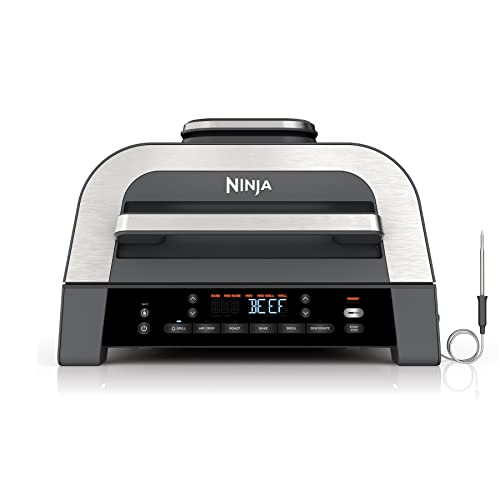
The Foodi Smart XL is included under a strict honesty clause: it is not a smoker and does not smoke food. It is the best alternative to bbq smokers for the large group of owners whose smoker’s real job turned out to be weeknight grilling — burgers, chicken, steaks, vegetables — and whose barriers were smoke rules, patio absence, weather and time. Indoors, on a counter, its cyclonic air and high-heat grill grate produce genuine grill character with smoke controlled to apartment-tolerable levels, guided by a smart thermometer that ends the guesswork on doneness.
Its 6-in-1 range — grill, air crisp, bake, roast, dehydrate and more in Ninja’s pattern — covers the weekly cooking a smoker never touched, and its XL capacity handles family quantities. What it surrenders is the entire low-and-slow universe and wood smoke itself; liquid-smoke marinades and smoked salts gesture at the flavor, honestly labeled as gestures. For the household that recognizes its own habits in this description, the Foodi is not the consolation pick — it is the correct one.
Strengths
- Real indoor grilling with controlled smoke — usable where smokers are banned or impossible
- Smart thermometer cooks proteins to target doneness without guesswork
- 6-in-1 versatility earns its counter space every week, not twice a month
Trade-offs
- No wood smoke, no low-and-slow barbecue — the category boundary is absolute
- Counter footprint is substantial for an indoor appliance
- Capacity suits family meals, not barbecue-party volumes
| Specification | Detail |
|---|---|
| Type | Indoor electric grill and air fryer |
| Functions | 6-in-1 (per Amazon title) |
| Guidance | Smart Cook System with food thermometer |
| Model | DG551, Smart XL |
Judge this pick by your last ten smoker cooks. If eight were grilling-speed meals, the Foodi alternative is not a downgrade but a diagnosis. If eight were ribs, briskets and butts, close this review and buy the Traeger — the guide’s job is matching the alternative to the complaint, and yours would be tending, not grilling.
Best for: apartment and condo cooks, winter grillers and weeknight households whose smoker sat unused / Not suited for: low-and-slow barbecue itself — it does not smoke brisket, ribs or pork butt, and this guide will not claim it does
Check the current price on Amazon for the Ninja Foodi Smart XL 6-in-1 Indoor Grill & Air Fryer DG551.
Comparison Table
| Pick | Badge | Key spec | Best for |
|---|---|---|---|
| Traeger Pro 22 Wood Pellet Grill & Smoker | Best Overall Alternative | Pellet fuel, 572 sq in, 6-in-1 versatility | traditionalists whose complaint was tending the fire, not the tradition |
| Masterbuilt 30-inch Digital Electric Smoker MB20071117 | Best for Beginners and Small Patios | Electric, side chip loader, 710 sq in racks | first-time smokers, small patios and anyone whose barrier was confidence rather than tradition |
| Z Grills ZPG-7002B Pellet Smoker Grill | Best Value Pellet | Pellet, PID control, 700 sq in | buyers sold on the pellet idea who want maximum cooking area and controller quality per dollar |
| Pit Boss 850 Navigator Series Pellet Grill & Smoker | Best for Searing Versatility | Pellet, flame broiler sear, Wi-Fi/Bluetooth | pellet buyers who grill as much as they smoke and want direct-flame searing in the same machine |
| Char-Griller AKORN Kamado Charcoal Grill and Smoker | Best Charcoal Alternative | Kamado, triple-wall steel, charcoal | cooks who want to keep charcoal craft but escape the offset’s fuel burn, space and babysitting |
| Ninja Foodi Smart XL 6-in-1 Indoor Grill & Air Fryer DG551 | Best No-Smoke Indoor Alternative | Indoor electric, smart thermometer, 6-in-1 | apartment and condo cooks, winter grillers and weeknight households whose smoker sat unused |
How to Choose the Best Alternative to BBQ Smokers
Name your complaint precisely, because each alternative in this guide assassinates a different one. Tending: pellet grills (Traeger, Z Grills, Pit Boss) automate the fire and keep the wood. Confidence and space: the Masterbuilt electric cabinet removes fire skill and shrinks the footprint. Fuel, versatility and tradition’s inefficiencies: the AKORN kamado keeps charcoal and fixes its economics. Smoke, rules, season and time themselves: the Ninja Foodi moves the grilling job indoors and abandons smoking honestly. A buyer who cannot state their complaint in one sentence is not ready to choose, and will likely buy a second smoker’s problems in a new shape.
Then audit the surrender with equal precision. Pellet costs you smoke intensity and adds a fuel-and-power dependency. Electric costs you searing and smoke depth. Kamado costs you automation — a cook is still required. Indoor costs you barbecue itself. Every alternative is a trade; the right one is the trade whose cost column lists only things you were already trying to escape.
- Capacity: match cooking area to your real cooks — 572–700 sq in covers most family barbecue; kamado and indoor picks serve smaller, more frequent cooks.
- Fuel economics: pellets, chips, lump charcoal and electricity differ per cook and per year — run your frequency through each.
- Power access: pellet and electric picks need an outdoor outlet; the kamado needs none.
- Rules: apartments and condos may restrict charcoal, pellets or all outdoor smoke — check before the machine, not after.
- Second-cooker logic: an electric cabinet beside an existing grill, or a Foodi beside an occasional smoker, often beats one machine compromising at both jobs.
Budget tiers in plain terms: the electric cabinet is the gentlest entry; value pellet (Z Grills) and the kamado occupy the middle with opposite philosophies; flagship pellet (Traeger, Pit Boss Navigator class) tops the outdoor range; the indoor Foodi prices as a premium countertop appliance and should be compared against countertop budgets, not smoker budgets. Total cost honesty includes fuel for a year of your real cooking frequency.
Getting Maximum Smoke Flavor From Any Alternative
Whatever you choose, smoke flavor obeys the same physics. Smoke is produced most generously at lower temperatures and in a fire’s early, active phase — so pellet cooks should start long cooks low, electric-cabinet cooks should load chips early and reload on schedule rather than all at once, and kamado cooks should add wood chunks at lighting, buried in the charcoal to smolder through the cook. Cold, clean meat takes smoke best; a half-hour of patience while the cooker stabilizes beats rushing food onto a dirty, billowing fire of any fuel.
And keep the exhaust honest: thin, pale smoke is the goal on every platform in this guide. Thick white smoke — from a pellet grill’s startup, a chip tray’s overload or a kamado’s smothered fire — deposits the bitter flavors that give alternatives an undeserved reputation. The machines removed the tending; the cook still owns the judgment, and that judgment is mostly this paragraph.
What Traditional Smokers Still Do Better — Said Plainly
An alternatives guide that hides the original’s virtues is a sales brochure, so here they are. A well-run offset produces the deepest, most complex smoke flavor in barbecue — bark with layers, a smoke ring with theater, a character that pellet and electric platforms approach and, on their best days, approximate. It cooks at a scale no pick here attempts, turning out whole-case quantities for crowds and competitions. And it offers the ritual itself: fire craft as a discipline and a pleasure, which for many cooks is not the cost of the hobby but the hobby. If those three sentences describe your values in order, your search should end with a better traditional smoker, not an alternative, and this guide releases you with respect.
The alternatives win where the offset’s costs are real: the overnight hours, the fuel appetite, the weather exposure, the learning curve priced in meat, the patio footprint, the rules of landlords and homeowner associations. Most households shopping this search live in that second paragraph, not the first — but the minority in the first paragraph deserve the honesty, because an alternative bought by a ritual-lover becomes next year’s resale listing, and the cycle helps no one except the secondhand market.
Accessories That Complete Any Alternative Platform
Every platform in this guide improves more from three unglamorous companions than from any upgrade within its own line. First, an instant-read thermometer you trust, because alternative platforms’ repeatability deserves measurement worthy of it — and the built-in probes on the pellet picks and the Foodi are guides, not gospel, until verified against a reference. Second, a cover and storage discipline matched to the fuel: pellets in a sealed bin, the electric cabinet’s chip supply dry, the kamado’s charcoal bagged off the ground. Third, a cleaning kit kept with the cooker — the ash vacuum or scoop, the grate brush, the degreaser — because the alternative platforms’ reliability advantage evaporates in neglected grease, and every “these machines are unreliable” story that survives scrutiny ends at a fire pot or a drip tray nobody cleaned.
Budget these into the purchase, whichever pick you choose, and resist the accessory carnival beyond them until your cook log — you are keeping one, per the how-to section — identifies a real bottleneck. Barbecue accessories are an industry built on imagined bottlenecks; the alternative platforms were bought to simplify a life, and the shelf of unused gadgets is the old complexity returning through the side door.
Learning Curves Compared: Your First Month on Each Platform
Every alternative promises ease, but the eases differ in kind and the first month tells the truth about each. The electric cabinet’s month is the gentlest: the learning is scheduling — when to load chips, how the cabinet’s pace differs from a grill’s — and the failures are mild, a cook that finishes late rather than ruined. The pellet month is about trust and housekeeping: learning that the controller really will hold the temperature releases the cook by the third session, while the platform’s only sharp lessons involve wet pellets and a neglected fire pot, both taught once and remembered. The kamado’s month is a genuine apprenticeship in miniature — vent discipline, temperature momentum, the humility of overshooting — with the reward that its graduate owns a skill, not just an appliance.
The indoor grill’s month is the strangest, because its learning is mostly unlearning: accepting that weeknight grilling is now a twenty-minute indoor event changes shopping, marinating and even weeknight expectations, and households routinely report using it five times the smoker’s frequency by month two. None of these curves is a reason to avoid its platform; they are reasons to choose with eyes open. The buyer who wants an appliance buys pellet or electric; the buyer who wants a gentler craft buys the kamado; the buyer who wants dinner buys the Foodi — and the first month confirms each of them, provided the purchase matched the person.
Resale, Upgrades and the Alternative You Grow Into Next
Alternative platforms have an afterlife that belongs in the purchase decision. Pellet grills from the established names hold value and find second owners easily, because their parts and pellets remain available; electric cabinets trade cheaply and make generous gifts to the next beginner; kamados, being nearly immortal, circulate for decades. None of this should drive the choice — buy for your complaint, as this guide has insisted throughout — but it softens the risk of the first purchase: a household that discovers its true complaint was a different one can exit a mainstream alternative with most of its stake intact, which is more than can be said for the niche traditional rigs these machines replace.
The commonest upgrade path is also worth naming, because it is a sign of health rather than failure: the alternative becomes the weekday and overflow cooker when a traditional smoker eventually joins it, or the traditional rig retires and the alternative inherits everything. Barbecue households converge, over years, on a small fleet matched to their real cooks — and the alternatives in this guide are the fleet members most likely to still be cooking, weekly, a decade from now.
How to Set Up Your Alternative Smoker for Its First Low-and-Slow Cook
The first cook on any alternative platform should be forgiving: pork butt or chicken, not the brisket you have been dreaming about. The routine below translates across every pick in this guide.
- Season and prepare the cooker as its maker directs — pellet grills need their initial burn-off and hopper priming, electric cabinets a dry seasoning run, kamados a gentle first fire to cure and learn the vents.
- Stabilize the temperature before food goes on: pellet and electric, let the controller settle for twenty minutes; kamado, catch the target on the way up and give the ceramic-steel mass time to heat-soak.
- Load smoke wood with the cook’s arc in mind: pellets in the hopper with a low start, chips staged for scheduled reloads, chunks buried in the kamado’s charcoal.
- Cook to temperature and tenderness, not to the clock: every alternative here rewards a probe or thermometer habit, and the Foodi’s smart thermometer spoils its owners for every other platform.
- Rest the meat properly — the alternative changed the fire, not the meat science — and note everything: settings, times, fuel used, results. Alternative platforms are repeatable in a way offsets are not, and your notes compound that advantage.
- Clean on the maker’s rhythm: ash and grease management are the unglamorous half of every alternative’s reliability, and pellet grills in particular repay a vacuumed fire pot with years of uneventful cooks.
By the third cook, the platform should feel boring in the best way: known settings, known timing, known results. That boredom — barbecue as a plan rather than an adventure — is precisely the product every buyer of this search was shopping for.
Common Buying Mistakes
Alternative-smoker regrets follow a pattern as old as the category; the standard set is below.
- Buying an alternative to escape a complaint it does not solve — a kamado for a set-and-forget seeker, an indoor grill for a brisket lover.
- Expecting pellet or electric smoke to match an offset’s intensity, then scorching food with oversmoking tricks instead of accepting the cleaner profile.
- Storing pellets where humidity reaches them: swollen pellets jam augers and end parties.
- Judging the electric cabinet as a grill and the indoor grill as a smoker — each fails the other’s exam and passes its own.
- Skipping the forgiving first cooks and learning a new platform on an expensive brisket for guests.
- Ignoring local rules for balconies and shared spaces until a neighbor or landlord explains them.
Final Recommendation
For most shoppers, the best alternative to bbq smokers is the Traeger Pro 22: real wood, real barbecue, and a thermostat standing the night watch you used to stand. Value seekers get the same liberation from the Z Grills ZPG-7002B with more area per dollar; sear-demanding households, the Pit Boss Navigator 850. Beginners and small patios belong with the Masterbuilt electric cabinet; charcoal loyalists escaping offset economics, with the AKORN kamado. And households honest enough to admit the job was weeknight grilling should take the Ninja Foodi Smart XL indoors and never apologize for it.
Check the current price on Amazon under the full model name, confirm fuel and capacity against your real cooks, and buy the alternative that kills your actual complaint. The best alternative is not the one most like a smoker — it is the one whose surrenders you will never miss.
Start your shortlist with Traeger Pro 22 Wood Pellet Grill & Smoker, Masterbuilt 30-inch Digital Electric Smoker MB20071117, Z Grills ZPG-7002B Pellet Smoker Grill — check the current price on Amazon for each and compare the exact configurations side by side before you decide.
Related guides in this series: Best Affordable Smokers · Best Affordable Pellet Smokers · Best Electric Smokers With Windows · Best 30 Inch Electric Smokers · Best Accessories For Bbq Smokers
Related guides
Frequently Asked Questions
What is the closest alternative to a traditional BBQ smoker?
A pellet grill — the Traeger Pro 22, Z Grills ZPG-7002B and Pit Boss Navigator in this guide. It burns real wood, cooks low-and-slow for as long as a traditional smoker and produces genuine bark and smoke ring, while a thermostat and auger replace fire tending. The trade is smoke intensity: pellet smoke is cleaner and milder than offset smoke, a difference most backyard eaters never notice and purists always do.
Can an electric smoker really make good barbecue?
Yes, within its lane. The Masterbuilt cabinet produces tender, genuinely smoked ribs, poultry, fish and more with almost no skill barrier, using wood chips for flavor. Its lane excludes high-heat grilling and the deepest smoke profiles. As a first smoker, a small-space smoker or a delicate-jobs second cooker, it is excellent; as a searing grill replacement, it is the wrong tool.
Pellet grill or kamado — which alternative should I choose?
Choose pellet if your complaint was tending: automation is total and the cook can leave. Choose the kamado if your complaint was the offset’s fuel burn, space and weather sensitivity while you still enjoy charcoal craft — the AKORN keeps live-fire flavor and adds searing range no pellet grill matches, at the price of a cook’s attention. The two picks solve different complaints that share a keyword.
Is an indoor grill a real alternative to a smoker?
It is a real alternative to the grilling most smoker owners actually do, and no alternative at all to low-and-slow barbecue. The Ninja Foodi Smart XL in this guide is labeled with that boundary in its review: apartment cooks and weeknight grillers gain enormously; brisket cooks gain nothing. Honest matching beats category pride.
What fuel costs should I expect from each alternative?
Pellet grills consume pellets steadily through long cooks and need them stored dry. Electric cabinets sip electricity and wood chips in small quantities — the cheapest fuel pattern here. Kamados burn lump charcoal with notable efficiency thanks to their insulation. Indoor electric grilling costs household electricity for short cooks. Multiply by your real cooking frequency; for occasional cooks fuel is trivial, for weekly cooks it shapes the true price of each platform.
Can these alternatives handle a full brisket or a big party?
The pellet picks can — 572 to 700 square inches with all-day fuel is brisket territory, and the Navigator class adds hopper capacity for long cooks. The electric cabinet handles brisket flats and family volumes across its racks. The kamado and the indoor grill serve smaller formats honestly; party-scale barbecue is the pellet platform’s home ground among alternatives.
Do pellet grills work in winter and rain?
Yes, with the insulation caveat: pellet consumption rises in cold weather as the controller feeds more fuel to hold temperature, and wind is a greater enemy than cold. A welding-blanket-style insulation cover (where the maker approves one) and a sheltered position recover most of the efficiency. Rain demands the obvious — keep the hopper and electronics dry, which is why the Z Grills’ included cover and every owner’s cover discipline matter — but the cook itself proceeds unbothered.
How long do pellets, chips and charcoal last per cook?
As patterns rather than promises: a long low-and-slow pellet cook consumes pellets steadily by the hour and a full hopper is the standard preparation; an electric cabinet uses a small tray of chips per loading, reloaded a few times across a long cook; a kamado’s single modest charcoal load can outlast the cook entirely. Your first month’s cook log will replace these patterns with your platform’s exact appetite — another reason this guide keeps prescribing the log.


