Disclosure: airfryerkitchensupply.com is reader-supported. When you buy through links on our site, we may earn an affiliate commission at no extra cost to you.
Where to buy
Every model in this guide to the best affordable induction cooktops was confirmed in Amazon’s catalogue data for this site — format, burner count, wattage, and control type matched to a real listing — before it earned a link. This guide splits cleanly in two: four portable induction burners that plug into a normal outlet, and two built-in decks for renovators. Decide which half of the list is your life before comparing models, because they answer different kitchens.
- Duxtop 8100MC Portable Induction Cooktop, 1800W — check price on Amazon
- Duxtop 8500ST Portable Induction Cooktop, 1800W — check price on Amazon
- Duxtop 9620LS LCD Portable Double Induction Cooktop — check price on Amazon
- COOKTRON Portable Double Induction Cooktop with Knob Control — check price on Amazon
- Empava Ease 30-Inch Induction Cooktop, 4 Burner — check price on Amazon
- Noxton 30-Inch Induction Cooktop, 7200W, 4 Burners — check price on Amazon
The best affordable induction cooktops deliver the technology’s core magic — speed, precision, and a surface that stays comparatively cool — without the premium tier that built-in induction is famous for. The affordable end splits into two honest families. Portables, led by Duxtop’s long-running burners, bring 1800W of plug-in induction to renters, dorms, RVs, and holiday overflow cooking. Built-ins, represented here by Empava’s Ease and a Noxton deck, put four induction zones into a standard 30-inch cutout at positions the legacy brands do not attempt. Six verified models cover both families. One gate stands in front of all of them: your pans must be magnetic. Run the two-second magnet test described in this guide before falling for any pick, because induction’s only true incompatibility is not price — it is cookware.
In this guide
Quick Picks
- Duxtop 8100MC Portable Induction Cooktop, 1800W — Best Overall Portable: The reference portable induction burner: 1800W, plug-in simplicity, and a production run that has made it the default recommendation of its class for years. — Check on Amazon
- Duxtop 8500ST Portable Induction Cooktop, 1800W — Best Touch-Control Portable: The 8100MC’s formula with sensor touch controls and a built-in timer — the portable for cooks who set it and walk away. — Check on Amazon
- Duxtop 9620LS LCD Portable Double Induction Cooktop — Best Double Portable: Two independent induction zones with an LCD panel in one portable body — a two-burner stove that plugs in and puts away. — Check on Amazon
- COOKTRON Portable Double Induction Cooktop with Knob Control — Best Knob-Control Portable: A double portable built around physical knobs and continuous low-power heating — the simmer specialist of the portable class. — Check on Amazon
- Empava Ease 30-Inch Induction Cooktop, 4 Burner — Best Affordable Built-In: The built-in breakthrough of the tier: four induction zones, boost, timers, pan sensor, and a safety lock in a standard 30-inch drop-in, ETL certified. — Check on Amazon
- Noxton 30-Inch Induction Cooktop, 7200W, 4 Burners — Best Built-In Alternative: 7200W across four boost-capable zones with timer, child lock, and pause — the Empava’s genuine peer for shoppers deciding on stock and live price. — Check on Amazon
How These Picks Were Chosen
Candidates had to be genuine induction — not radiant decks borrowing the word — with verifiable catalogue presence through Amazon data for this site. Portables were required to run from a standard outlet at the class-standard 1800W; built-ins had to fit the common 30-inch footprint with published power and safety features. Ranking weighed heating speed and low-end control (induction’s twin promises), temperature and power step granularity, pan-size flexibility, safety equipment such as pan detection, child locks, timers, and auto shutoff, and the support model behind each brand. We favored models with long production runs in portables — where a decade of ownership reports is the best spec sheet — and full feature baselines in built-ins. Prices are not printed; check the live figure at each link once format and pans are settled.
The 6 Best Affordable Induction Cooktops, Reviewed
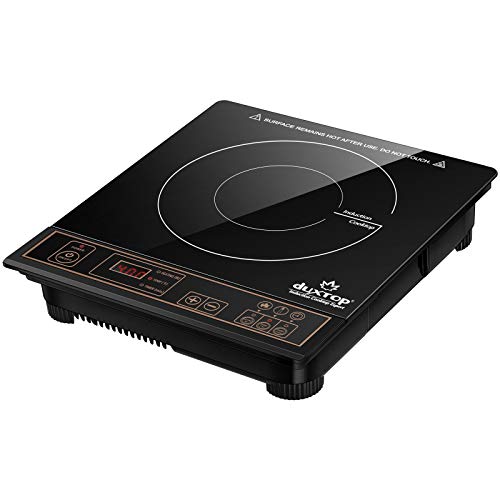
1. Duxtop 8100MC Portable Induction Cooktop, 1800W — Best Overall Portable
The 8100MC suits renters, students, small kitchens, and anyone adding one fast burner to a slow stove. It boils water with a speed that embarrasses full-size radiant ranges, simmers gently, and stores in a drawer when the meal ends. It does not suit non-magnetic pans or two-burner cooking — both limits are honest and visible before purchase.
Strengths
- Genuine 1800W induction speed from a normal outlet
- Compact, storable, and travel-friendly
- Long production history with deep ownership knowledge
Trade-offs
- One burner only
- Cooling fan hum is part of the design
- Glass top wants the same care as any smoothtop
| Format | Portable countertop |
| Power | 1800W |
| Cookware | Magnetic pans required |
Portable induction succeeds when it feels like an appliance rather than a gadget, and the 8100MC’s longevity in Duxtop’s line is the market’s verdict that it does. The control steps cover the real cooking range — a true low for melting and holding, a full-power sprint for boiling — and the unit’s pan detection refuses to heat empty air or a stray spoon, a safety behavior that matters in the crowded counters where portables live.
Ownership is refreshingly dull: wipe the glass, keep the vents clear, store it flat. For the renter whose lease forbids renovation, this burner is not the affordable alternative to a good cooktop — it is a good cooktop, full stop, and it moves out with you when the lease ends.
The 8100MC also teaches its owner induction’s grammar faster than any built-in could, because a single burner makes cause and effect unmistakable: this setting, this pan, this result. A month of portable cooking produces the calibrated instincts — which level boils, which level holds a bare simmer, how a heavy skillet smooths the power steps — that transfer intact to any induction deck the household buys later. It is the cheapest induction education in existence, and it comes with dinner. A storage note that extends the 8100MC’s life: keep it flat, glass up, with nothing heavy stacked on it, and the unit will outlast several of the kitchens it serves. Portables die of cupboard accidents more than of electronics. The burner that is treated like the precision instrument it is — rather than like a cutting board with a cord — is the one still sprinting to a boil a decade from now.
Best for: renters, students, and one-burner households / Not suited for: multi-burner cooking or non-magnetic cookware
Check on Amazon — check the current price on Amazon before you buy, because countertop and built-in appliance pricing moves often.
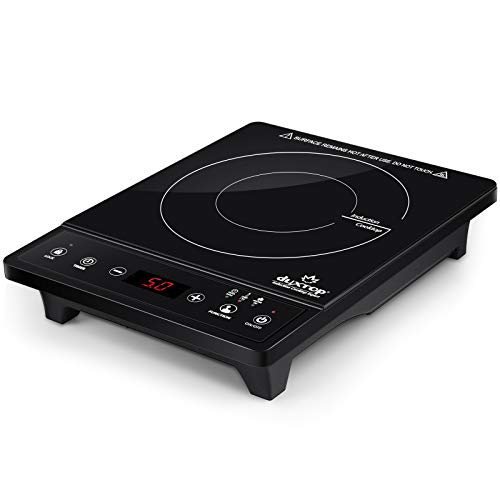
2. Duxtop 8500ST Portable Induction Cooktop, 1800W — Best Touch-Control Portable
The 8500ST suits the same kitchens as its sibling but a different cook: one who uses timers religiously and prefers a flat touch surface that wipes in one pass. Sensor touch and a count-down timer with shutoff make it the better rice, oats, and slow-simmer companion. Buyers who cook with wet hands mid-splash may prefer the 8100MC’s physical feel.
Strengths
- Timer with automatic shutoff for unattended simmering
- Flat touch panel cleans instantly
- Same proven 1800W Duxtop heating core
Trade-offs
- Touch controls can hesitate with wet fingers
- Single burner, like all portables in its class
- Fan noise accompanies full-power work
| Format | Portable countertop |
| Power | 1800W |
| Controls | Sensor touch with timer |
The difference between the two Duxtop siblings is a philosophy of attention. The 8500ST assumes you will start the lentils, set the timer, and leave — and it rewards that trust by shutting itself off on schedule instead of scorching dinner to the pan. Its touch surface also suits the way portables actually live: splashed, wiped mid-cook, and stored against other kitchen gear without knobs to snap.
Everything else is the family inheritance — honest 1800W speed, pan detection, and a glass top sized for real skillets rather than toy pans. Choose between the siblings on control style alone; the cooking underneath is the same proven hardware, and neither choice is the wrong one.
The 8500ST’s timer deserves a second look from one specific household: the one that cooks breakfast oats, rice, and boiled eggs on weekday autopilot. Set the timer, and the burner owns the ending — no boiled-dry pot, no scorched oats, no ‘did I turn that off’ from the train. Appliances that reliably finish small jobs unattended earn a trust that specs cannot describe, and weekday mornings are where that trust is spent. The 8500ST also suits the small-batch precision jobs that big stoves handle clumsily: melting chocolate without a double boiler’s ceremony, holding a hollandaise at the edge of warm, proofing a small bowl of yeast in gentle heat. Induction’s low end is a pastry tool, and the timer makes it a trustworthy one — set it, and the delicate thing stays delicate.
Best for: timer-driven cooks and set-and-forget simmering / Not suited for: wet-hand control preferences
Check on Amazon — check the current price on Amazon before you buy, because countertop and built-in appliance pricing moves often.

3. Duxtop 9620LS LCD Portable Double Induction Cooktop — Best Double Portable
The 9620LS suits small kitchens that cook real two-pot meals — pasta and sauce, rice and stir-fry — without any renovation at all. Two zones in one body answer the single-burner compromise directly. The physical law of portables applies: both zones draw from one outlet’s budget, so two simultaneous full-power sprints share the available watts; staggered cooking never notices.
Strengths
- Two independent zones for genuine two-pot cooking
- LCD panel makes both zones’ settings readable at a glance
- Still portable and storable when the kitchen must reset
Trade-offs
- Shared power budget limits dual full-power use
- Larger footprint than single burners
- Two fans’ worth of hum at full tilt
| Format | Portable countertop, double burner |
| Zones | 2 independent induction zones |
| Controls | Digital sensor touch with LCD |
| Model | 9620LS / BT-350DZ |
A double portable is the closest thing renters get to a stove upgrade, and Duxtop’s execution respects the brief: independent controls per zone, a shared glass surface that cleans like a smoothtop, and enough presence to host a 12-inch skillet beside a saucepan without either feeling exiled. For studio and small-apartment cooking, it converts ‘one burner at a time’ meals into actual dinners with components that finish together.
Manage the shared power budget the way the design intends — bring the pasta water up first, then drop it to a simmer while the sauce gets the watts — and the limitation dissolves into technique. Households that cook in that rhythm will find this the most capable affordable induction product in the guide, portable or otherwise.
Hosts should note what the 9620LS does to a dinner party in a small apartment: the main stove keeps its four burners for the menu while the portable, on a side counter or even a sturdy sideboard, holds the sauce and the vegetables at serving temperature in the room where the guests are. A second cooking station changes the geography of entertaining, and a portable double is the only way most small kitchens will ever have one. Two-zone technique is worth one paragraph: put the forgiving pot — the rice, the steaming vegetables — on the zone you check least, and the demanding one — the sear, the sauce — where your eye already lives. The 9620LS’s independent controls make that division real, and cooks who assign zones by attention rather than by habit find the double portable cooks like a stove twice its price.
Best for: small kitchens cooking two-pot meals without renovating / Not suited for: simultaneous maximum-power cooking on both zones
Check on Amazon — check the current price on Amazon before you buy, because countertop and built-in appliance pricing moves often.

4. COOKTRON Portable Double Induction Cooktop with Knob Control — Best Knob-Control Portable
The COOKTRON suits cooks who distrust touch panels and baby their low temperatures: its knobs adjust by feel, and its continuous low-power heating addresses the portable class’s oldest flaw — cheap induction that pulses on and off at low settings, cycling a delicate sauce between simmer and sulk. It does not suit minimalists; knobs interrupt the flat glass aesthetic on purpose.
Strengths
- Knobs give instant, tactile, wet-hand-friendly control
- Continuous low power holds gentle simmers without pulsing
- Two independent zones for real meals
Trade-offs
- Knob design is bulkier than touch rivals
- Brand history is shorter than Duxtop’s
- Shared outlet power budget, as with all double portables
| Format | Portable countertop, double burner |
| Controls | Physical knobs |
| Levels | 9 power levels, 10 temperature settings |
| Feature | Continuous low-power heating |
Low-end behavior is where induction price tiers confess. Premium units hold a whisper of power continuously; cheap units cheat by pulsing full power in bursts, which scorches milk and splits sauces in the pauses. COOKTRON advertises continuous low-power heating as its headline for a reason — it is the feature that decides whether a portable can do the gentle cooking that half of home recipes actually require, and its presence at this tier is genuinely notable.
Pair that with knobs a cook can turn by feel while watching the pan, and you have the portable for people who cook attentively rather than by timer. The Duxtop double above wins on interface polish and track record; this one wins the simmer and the tactile argument. Kitchens know which cook they house.
The COOKTRON’s knobs have a teaching virtue, too: they are the interface a nervous new cook — a teenager learning the kitchen, a grandparent meeting induction for the first time — understands without instruction. Turn for more, turn for less, click to off. In households where the cooktop must serve every generation without a tutorial, that legibility is a safety feature wearing a design preference’s clothes. COOKTRON’s continuous low heat also rescues the overnight-adjacent jobs: the stock that wants six gentle hours, the beans that must never boil hard, the mulled cider holding at serving warmth through a whole party. Pulsing burners make those jobs a supervision tax; this one makes them a setting. For slow-food households in small kitchens, that is not a feature — it is the product.
Best for: attentive cooks who simmer and prefer knobs / Not suited for: touch-panel minimalists
Check on Amazon — check the current price on Amazon before you buy, because countertop and built-in appliance pricing moves often.

5. Empava Ease 30-Inch Induction Cooktop, 4 Burner — Best Affordable Built-In
The Empava Ease suits renovators who want real built-in induction — flush glass, four zones, boost speed — at a tier the legacy brands leave empty. Its feature baseline is complete: pan sensor, child lock, pause, and a proper timer range. It asks for hardwired installation and magnetic pans, and its support runs through the brand rather than a dealer network.
Strengths
- Four true induction zones in the standard cutout
- Boost function for fast boils; 9 levels for control
- Full safety baseline: pan sensor, lock, pause, ETL certification
Trade-offs
- Hardwired install — an electrician line item
- Value-tier support model
- Four zones, not five, at this size and tier
| Size | 30 inch built-in, hardwired |
| Zones | 4 induction burners |
| Levels | 9 power levels with Power Boost |
| Timer | 1–99 minutes |
| Safety | Pan sensor, safety lock, pause function |
| Certification | ETL |
Built-in induction used to have a cover charge that kept it in premium kitchens. The Ease is evidence the charge has fallen: its specification reads like a checklist written by someone who knew the category — boost for the pasta water, a 99-minute timer for the stock, a pause function for the doorbell moment, pan sensing so a zone never heats a forgotten utensil. In daily use those details compound into the calm, fast cooking that makes induction converts evangelical.
The ownership terms are the value tier’s standard ones, stated plainly: hardwired installation to plan, online-first support, and a pan collection that must pass the magnet test. Renovators who accept those terms get the single largest cooking upgrade available at this guide’s tier — the jump from radiant or gas to induction itself.
The Ease’s pause function deserves its sentence in the sun, because it is the feature owners mention most after a month: the doorbell, the child, the phone — life interrupts cooking constantly, and a deck that holds every zone’s state while you answer, then resumes exactly, removes the small restart friction that radiant and gas impose. Multiply that by a year of evenings and pause becomes the difference between a cooktop that fits a life and one that merely fits a counter. The Ease also changes a kitchen’s summer. Induction’s waste heat is a fraction of gas or radiant’s, so the room stays livable through a full dinner’s cooking in August — a quality-of-life specification that never appears on a spec sheet and that owners in warm climates rank, by July, above every other feature the deck possesses.
Best for: renovators wanting built-in induction on a real budget / Not suited for: renters or non-magnetic cookware collections
Check on Amazon — check the current price on Amazon before you buy, because countertop and built-in appliance pricing moves often.

6. Noxton 30-Inch Induction Cooktop, 7200W, 4 Burners — Best Built-In Alternative
The Noxton gives the built-in half of this guide its second source: same standard footprint, same feature baseline, boost across all four zones, and a headline 7200W total. It suits the same renovator as the Empava Ease, and the honest advice is to let cutout-sheet details, availability, and the day’s pricing arbitrate between them. Its brand record is the shorter of the two.
Strengths
- Boost capability on all four zones, not just one
- 7200W total output is strong for the class
- Complete safety and timer baseline
Trade-offs
- Shorter brand track record than Empava
- Hardwired installation required
- Seller-based support model
| Size | 30 inch built-in |
| Zones | 4 induction burners with Boost |
| Total power | 7200W |
| Settings | 9 power settings |
| Safety | Timer, child safety lock, pause |
Peer competition is the healthiest thing that can happen to a value tier, and the Noxton’s presence keeps the built-in induction shopper honest: two decks, one footprint, near-identical promises. Its distinguishing flourish is boost on every zone rather than reserving it for a flagship burner, which suits households whose cooking distributes urgency evenly — four pans, any of which might need the sprint.
Choose it the value-tier way: verify the cutout sheet against your counter to the millimeter, confirm the circuit capacity for its draw, buy through a channel with real returns, and keep the paperwork. Executed with that discipline, the badge on a modern induction deck matters less than the installation — and the cooking will feel like the future either way.
Noxton’s all-zone boost has a household rhythm argument: breakfast. Four zones that can all sprint means the kettle, the eggs’ water, the bacon pan’s preheat, and the oats can all move at once in the fifteen minutes when a family’s morning is decided. Decks that reserve boost for one hero burner serialize the morning; this one parallelizes it, and school-day households feel that difference five days a week. Noxton’s 7200W total deserves its practical translation: four zones of ordinary cooking, two zones of serious sprinting, one zone of boost heroics while the others hold — the distribution of power matches the distribution of effort in a real meal. Shoppers comparing totals should ask not ‘how much’ but ‘how shareable,’ and on that question this deck’s answer is the flexible one.
Best for: renovators choosing between built-in peers on fit and price / Not suited for: buyers wanting the longest brand record
Check on Amazon — check the current price on Amazon before you buy, because countertop and built-in appliance pricing moves often.
Comparison Table
| Pick | Badge | Key spec | Best for |
|---|---|---|---|
| Duxtop 8100MC Portable Induction Cooktop, 1800W | Best Overall Portable | Portable single burner, 1800W, plug-in | renters, students, and one-burner households |
| Duxtop 8500ST Portable Induction Cooktop, 1800W | Best Touch-Control Portable | Portable single burner, 1800W, sensor touch, timer | timer-driven cooks and set-and-forget simmering |
| Duxtop 9620LS LCD Portable Double Induction Cooktop | Best Double Portable | Portable double burner, 1800W shared class, LCD sensor touch | small kitchens cooking two-pot meals without renovating |
| COOKTRON Portable Double Induction Cooktop with Knob Control | Best Knob-Control Portable | Portable double burner, knob control, continuous low-power heating, 9 power levels | attentive cooks who simmer and prefer knobs |
| Empava Ease 30-Inch Induction Cooktop, 4 Burner | Best Affordable Built-In | 30-inch built-in, 4 induction zones, 9 levels + boost, pan sensor, ETL certified | renovators wanting built-in induction on a real budget |
| Noxton 30-Inch Induction Cooktop, 7200W, 4 Burners | Best Built-In Alternative | 30-inch built-in, 4 zones, 7200W, boost on all zones, child lock | renovators choosing between built-in peers on fit and price |
How to Choose an Affordable Induction Cooktop
Run the magnet test before anything else. If a fridge magnet sticks firmly to your pan’s base, the pan works on induction; if it slides off, it never will, on any induction cooktop at any price. Audit the pans you actually use — most households find their cast iron and much of their stainless passes, and a small minority of aluminum favorites fails. That audit, which takes five minutes, is the entire compatibility question, and it should happen before the shopping, not during the unboxing.
Then choose the family. Portables plug in, store away, travel between kitchens, and cap out at one outlet’s worth of power shared across their zones — perfect for renters, small kitchens, and supplementary burners. Built-ins hardwire into the counter, spread real power across four zones, and belong to owners mid-renovation. Neither family is the budget version of the other; they are different answers to different housing situations, and this guide’s six picks divide evenly between them.
Within a family, judge the low end as hard as the high end. Full-power speed is easy to advertise; continuous low-power control — advertised explicitly by the COOKTRON here — is what separates induction that can hold a sauce from induction that pulses it. Timers with shutoff, pan detection, and child locks complete the modern baseline, and every pick in this guide carries them.
What Induction Does Better — and What It Will Never Do
Induction’s wins are physical. Energy goes into the pan rather than the room, so water boils startlingly fast and the kitchen stays cooler. Response is instant in both directions — lift the pan and heating stops; drop to low and the simmer obeys now, not after a glowing element cools. The glass surface, heated only by contact with the pan, wipes clean without baked-on drama, and the absence of open flame or glowing elements changes the safety character of the whole kitchen.
The limits are equally physical. Non-magnetic pans are invisible to it. Flat bases matter, because contact is the mechanism. Portable units share one outlet’s budget across zones, and all induction hums and clicks faintly as fans and pan materials react — normal sounds that surprise first-time owners. Judge the technology by these honest terms and it tends to win converts permanently; judge it by brochure magic and the first aluminum pan will feel like betrayal.
Induction Power, Translated: What the Watts Buy You
Induction numbers confuse shoppers because the same wattage behaves differently here than on radiant or gas. An 1800W portable induction burner delivers most of its energy into the pan itself, so its boiling performance feels like a much larger radiant element that spends a share of its power heating glass and air. That is why the portables in this guide, capped by a household outlet, still out-boil full-size electric stoves: the limit is real, but so is the efficiency, and the pan only knows about the energy it receives.
Built-in decks speak in totals — the Noxton’s 7200W across four zones — and the translation matters there too. The total is the ceiling for all zones running hard at once; individual zones carry their own ratings, and boost modes temporarily borrow headroom from a paired zone. In practice this means two zones can sprint together while four zones share politely, which matches how cooking actually distributes effort across a meal. Shoppers comparing totals between brands should compare zone layouts alongside, because where the power can go matters as much as how much exists.
The low end has its own translation. Power levels and temperature settings are not interchangeable currencies: power levels govern how hard the burner pushes, temperature settings ask the unit to hold a target and modulate to keep it. Sauces and frying prefer temperature thinking; boiling and searing prefer power thinking. Decks that offer both vocabularies — as the better picks here do — let the cook speak to the food in the language the food understands.
Living With Induction: Noise, Pans, and the First-Week Adjustment
Honesty about induction’s texture prevents the returns that disappointment causes. The sounds first: a low fan hum whenever the electronics work hard, a faint buzz or tick from some pans at high power as their layered bases vibrate microscopically, and silence the rest of the time. None of it is a defect; all of it surprises owners who expected a gas flame’s hush. Heavy, flat, well-made pans are the quietest, which is one more reason the cookware audit in this guide pays for itself.
The first-week adjustment is about response. Food begins cooking sooner, water boils while you are still chopping, and the margin between ‘almost’ and ‘over’ narrows at high power — while at the other end, lifting the pan stops the cooking with a finality that makes delicate work easier than any other fuel. Cooks recalibrate within days, and most report the same conversion story: the old stove feels, afterward, like cooking by letter post.
Care is the last texture, and it is all good news. The glass never hosts a flame or a glowing element, so spills do not carbonize on contact; a wipe after cooking, while the surface is warm from the pan, handles nearly everything. Keep the vents clear, use pans with clean flat bases, and an affordable induction deck will look and behave new for years — the technology has fewer ways to age than any rival in this series.
Portable vs Built-In Induction: The Decision in One Sitting
Sit with the actual fork for a moment, because shoppers blur it constantly. A portable induction burner is an appliance: it arrives by courier, cooks tonight, answers to no contractor, and leaves with you when you move. Its power ceiling is the wall outlet, shared across its zones, and its capacity ceiling is the counter it sits on. A built-in is a renovation: it needs a cutout, a circuit, and a decision you will live inside for a decade, and in exchange it gives four zones of full household power in a surface that becomes part of the room.
The households that choose wrongly are the ones that choose by aspiration — the renter who dreams in built-ins and buys a portable resentfully, the renovator who fears commitment and leaves a portable on a new stone counter for five years. Both appliances in this guide are good; both households in that sentence are unhappy. Match the format to the housing facts — lease or deed, circuit or outlet, this year or this decade — and the model choice afterward is almost clerical.
There is also a legitimate both: the built-in for the kitchen’s daily life and a portable in reserve for holidays, canning days, and the outdoor table. Because portables cost what they cost at this tier, the combination is not extravagance — it is the standard kit of serious small households, and several picks in this guide will happily serve as either half of it.
The Sound of Induction, Revisited: When to Actually Worry
Normal induction sounds are a fan’s hum and, from some pans, a soft buzz or tick at high power. The sounds that deserve attention are different: a fan that grinds or stops while the unit runs hot, clicking that continues after the pan is lifted and the zone is off, or any smell of hot electronics. Those are stop-and-call symptoms, not character. Everything else — the hum, the tick, the faint ring as a big pan settles — is the physics of the technology introducing itself, and owners reliably stop hearing it within the first month.
Why Induction Heats the Pan and Not Your Patience: A Plain-Language Physics
One paragraph of physics, because understanding the trick makes owners better cooks. An induction zone generates a rapidly alternating magnetic field in a coil beneath the glass; when a magnetic pan sits in that field, the field induces swirling currents inside the pan’s own metal, and the metal’s resistance to those currents is what becomes heat. The pan is the heating element. That single fact explains everything owners observe: the instant response (no middleman to heat or cool), the cool glass (it is warmed only by contact with the pan), the pan-dependence (no magnetic metal, no currents, no heat), and the efficiency (the energy’s journey is centimeters, not a room’s worth of hot air).
It also explains the one technique adjustment that matters: because the pan heats itself, its own quality — flatness, thickness, even heating — becomes the cooktop’s quality. A great pan on an affordable induction deck will outcook a poor pan on a flagship, which is the most democratic fact in modern cooking, and a fine place for an affordable guide to end.
A Note on Induction and the Family Cookbook
Every household owns a few recipes written in another fuel’s language — ‘over medium heat until it shimmers,’ ‘at a rolling boil,’ ‘on the lowest flame.’ Induction translates them faithfully once the cook learns the local equivalents: the power level that shimmers, the boost that rolls, the continuous low that whispers. Write the translations into the cookbook’s margins during the first month, in pencil, in your own numbers. That small act converts a new appliance into a familiar instrument faster than any manual, and it is how technologies actually get adopted — one annotated recipe at a time.
One Last Practical Note
And a closing practicality: keep one pan you trust completely — the heavy, flat, magnetic skillet that never buzzes and never rocks — as your reference instrument. Every new setting, every new recipe, every question about a zone’s behavior gets answered against that pan first. Cooks calibrate stoves the way musicians tune to one trusted note, and induction rewards the habit immediately.
Closing Thought
Trust the first boil. The first time a new induction owner watches a quart of water sprint to a rolling boil in a fraction of their old stove’s time, the technology stops being a specification and becomes a fact of their kitchen. Every pick in this guide delivers that moment; the rest of ownership is just learning how many other moments it has been hiding.
How to Check Your Cookware and Outlet Before Buying Induction
Ten minutes of checking prevents the only two disappointments induction ever causes. Work through this list with your actual kitchen, not the imagined one.
- Take a fridge magnet to every pan you use weekly. Firm stick: compatible. Weak or no stick: that pan sits out induction cooking — decide now whether you will replace it or choose a different fuel.
- Check pan bases for flatness with a ruler across the bottom. Warped bases rock, buzz, and heat unevenly on glass induction surfaces.
- For a portable, find its outlet and confirm nothing else hungry shares the circuit — a portable induction burner at full power wants the circuit largely to itself.
- For a built-in, open the electrical panel and note the spare capacity, then compare it with the deck’s requirements. This is the electrician conversation, held before the purchase.
- Measure the cutout for built-ins, or the counter run and storage spot for portables. Induction is compact, but its fans need breathing room the spec sheet specifies.
Common Buying Mistakes
- Skipping the magnet test. It takes five minutes and settles the only compatibility question induction has. Every ‘induction doesn’t work’ story begins with an aluminum pan and no magnet.
- Expecting two portable zones to sprint simultaneously. Portable doubles share one outlet’s power budget. Stagger the boils and the limitation disappears; ignore it and both zones feel slow.
- Buying built-in induction for a rental. Hardwired decks belong to owners. Renters get the same technology, with a handle, in the portable half of this guide.
- Judging induction by its highest setting only. Low-end behavior — continuous simmer versus pulsing — decides half your recipes. Read for it specifically, as this guide does.
- Placing a portable on a metal surface or blocking its vents. Induction units breathe through their undersides and dislike metal counters beneath them. Give the fan its air and the unit its lifespan.
Final Recommendation
For most readers the Duxtop 8100MC is the affordable induction answer — proven, fast, and honest about being one excellent burner. Its 8500ST sibling serves timer-driven cooks, the 9620LS double serves small kitchens cooking real meals, and the COOKTRON serves simmerers and knob loyalists. Renovators should choose between the Empava Ease and the Noxton on cutout details and the day’s pricing, confident that either delivers the genuine induction upgrade. Run the magnet test first, check the live price at the link last, and this tier will change how your kitchen feels every single day. The companion guides below place these picks inside the full affordable-cooktop picture and the five-burner built-in conversation.
Shortlist again, for convenience: Duxtop 8100MC Portable Induction Cooktop, 1800W (Best Overall Portable); Duxtop 8500ST Portable Induction Cooktop, 1800W (Best Touch-Control Portable); Duxtop 9620LS LCD Portable Double Induction Cooktop (Best Double Portable).
Frequently Asked Questions
Do I need special pans for induction?
You need magnetic pans — the magnet test settles it in seconds per pan. Cast iron and enamelled steel always pass; stainless depends on its base construction; aluminum, copper, and glass need a magnetic layer to work. Most households find the majority of their collection already qualifies.
Why is portable induction so much cheaper than built-in?
A portable is one zone, one housing, and a plug — no installation, no cabinetry, no multi-zone power electronics. The heating technology is the same; you are paying for format and scale, not for a lesser kind of induction.
Can a portable induction burner boil water as fast as a stove?
Usually faster than radiant electric and competitive with gas for typical pot sizes, because the energy goes directly into the pan. It is the party trick that stops being a trick and becomes the reason owners rarely go back.
What does ‘continuous low-power heating’ mean?
Some induction units deliver low settings by pulsing full power on and off, which makes delicate foods surge and scorch between pulses. Continuous low-power models — the COOKTRON in this guide advertises it — deliver a steady low output instead, holding a true gentle simmer.
Is induction safe around kids and pacemakers?
The surface stays far cooler than radiant or gas, zones will not heat without a pan, and locks and timers are standard on this guide’s picks. Pacemaker guidance varies by manufacturer and medical advice — the standard counsel is to keep a sensible distance and consult your clinician and the manual.
Can I install an affordable built-in induction cooktop myself?
The swap is a common project where code allows and the circuit already suits, but hardwired electrical work carries real stakes. If the circuit needs changes, or your jurisdiction requires a licensed installer, hire it out — the same advice this series gives for every built-in fuel.
Does induction work during a power flicker or on a generator?
Induction electronics are fussier about power quality than a radiant element’s simple resistance wire. Brief flickers typically just pause a portable, which restarts or waits for your input; sustained dirty power from a small generator can make some units refuse or behave erratically, and manufacturers’ manuals are the authority for your model. Households planning backup-power cooking should test their specific unit on their specific generator before the emergency, not during it — the same delivery-day discipline this series recommends for gas conversions.
Best 5 Burner Electric Smoothtop Cooktops
Best Induction Cooktops


