Disclosure: airfryerkitchensupply.com is reader-supported. When you buy through links on our site, we may earn an affiliate commission at no extra cost to you.
Where to buy
The best affordable cooktops are the ones whose compromises you can live with, and every cooktop below was confirmed in Amazon’s catalogue data for this site before earning a link — burner configuration, fuel, and controls all matched to a live listing. The list deliberately mixes built-in decks and portable burners, because ‘affordable’ means different things to a renovator and a renter; each review says plainly which buyer it serves.
- Empava 30-Inch Radiant Electric Cooktop, 4 Burners — check price on Amazon
- ThermoMate 30-Inch Gas Cooktop, 4 Sabaf Burners, Stainless — check price on Amazon
- Duxtop 8100MC Portable Induction Cooktop, 1800W — check price on Amazon
- Karinear 30-Inch Electric Cooktop, 4 Burners, Knob Control — check price on Amazon
- CUSIMAX Double Burner Hot Plate, 1800W Cast Iron — check price on Amazon
- Empava 30-Inch Gas Cooktop, 5 SABAF Burners, Stainless — check price on Amazon
The best affordable cooktops are not the cheapest cooktops — they are the ones whose compromises you can live with for years. This guide compares six verified options across every fuel and format: a radiant electric built-in from Empava, a four-burner gas deck from ThermoMate, Karinear’s knob-controlled electric 30-inch, a five-burner Empava gas upgrade pick, and two portables — Duxtop’s benchmark induction burner and a CUSIMAX double hot plate — for the renters and dorm cooks whom built-in guides usually forget. The affordable tier has matured remarkably: sealed Italian burners, thermocouple protection, child locks, and timers now appear at positions that once bought bare metal. What still separates a smart affordable purchase from a false economy is honesty about support, materials, and fit, and that is the standard these reviews apply.
In this guide
Quick Picks
- Empava 30-Inch Radiant Electric Cooktop, 4 Burners — Best Overall Affordable Built-In: A four-burner radiant smoothtop with a dual-zone element and ETL certification — the built-in center of the affordable tier. — Check on Amazon
- ThermoMate 30-Inch Gas Cooktop, 4 Sabaf Burners, Stainless — Best Affordable Gas: Four Sabaf burners in heavy 304 stainless with conversion and flame protection — proof that affordable gas can still be built properly. — Check on Amazon
- Duxtop 8100MC Portable Induction Cooktop, 1800W — Best Portable: The portable induction benchmark: 1800W, countertop freedom, and a production run long enough to have earned its reputation one dorm and RV at a time. — Check on Amazon
- Karinear 30-Inch Electric Cooktop, 4 Burners, Knob Control — Best Knob-Control Built-In: 6700W of radiant cooking behind physical knobs, with a hot surface indicator — the tactile traditionalist’s affordable built-in. — Check on Amazon
- CUSIMAX Double Burner Hot Plate, 1800W Cast Iron — Best for Dorms and Backup Cooking: Two cast-iron burners, 1800W shared, works with every pan you own — the universal backup burner and dorm-kitchen starter. — Check on Amazon
- Empava 30-Inch Gas Cooktop, 5 SABAF Burners, Stainless — Best Affordable 5-Burner Upgrade: When four burners are not enough: the affordable tier’s five-burner gas answer, with SABAF hardware, conversion, and flame protection. — Check on Amazon
How These Picks Were Chosen
Candidates had to be cooktops in the genuine value tier of their format with verifiable catalogue presence, checked through Amazon data for this site. We required the safety and usability baseline of their class: thermocouple protection on gas, hot-surface indication and shutoff features on electric, and published dimensions for anything built in. Ranking weighed cooking competence first — burner spread, control range, surface quality — then ownership realism: cleaning burden, parts and support model, and how much kitchen the product demands. Portables were judged against portable standards, not built-in ones, because a renter’s best cooktop and a renovator’s best cooktop are different products answering different lives. Prices are not printed; the live figure at the link is the only honest number in a tier defined by promotions.
The 6 Best Affordable Cooktops, Reviewed

1. Empava 30-Inch Radiant Electric Cooktop, 4 Burners — Best Overall Affordable Built-In
The Empava radiant deck suits renovators who want the smoothtop look and wipe-clean life without induction’s cookware rules or price tier. The dual-zone element lets one burner serve a small saucepan or a large skillet honestly. It does not suit five-burner households or speed obsessives — radiant heats at radiant’s pace, and four burners is four burners.
Strengths
- Dual zone element flexes between small and large pans
- Ceramic glass surface cleans with a single wipe
- ETL certified and compatible with every cookware material
Trade-offs
- Four burners, not five — plan holiday cooking accordingly
- Radiant response is slower than induction or gas
- Value-tier support model through brand and seller
| Size | 30 inch built-in |
| Burners | 4 radiant, including a dual zone element |
| Surface | Ceramic glass, black |
| Certification | ETL certified |
| Cookware | Works with all flat-bottomed cookware types |
Affordable built-ins live or die on whether they feel like a compromise every single day, and this Empava mostly does not. The glass deck looks and cleans like units a tier up, the dual-zone element quietly solves the small-pan-on-big-burner waste that plagues fixed layouts, and radiant’s cookware democracy — aluminum, cast iron, copper, whatever you own — means the cooktop is the only purchase, with no pan replacement tax hiding behind it.
Its limits are the class’s limits: elements that cycle rather than glide at low settings, heat that lingers after shutoff, and a support model that runs online. None of those will surprise anyone who reads this guide before buying, which is rather the point. For a kitchen renovation on a real budget, this is the built-in to beat.
First-time smoothtop owners should know the Empava’s glass will teach them one new habit and reward it forever: lift, do not slide. Radiant glass tolerates enormous heat and weight, but a cast-iron skillet dragged daily will engrave its opinion over the years. Owners who make the lift a reflex — it takes a week — keep a deck that looks showroom-clean for the life of the elements, and resale photographs that make the whole kitchen look newer than it is. The dual-zone element teaches a money-saving habit all by itself: matching burner size to pan size. A small saucepan on a large radiant element wastes the ring of heat that escapes around it, meal after meal, year after year. The Empava’s flexible element makes the efficient choice the easy choice, and across a decade of dinners that quiet matching is worth more than the cooktop’s discount ever was.
Best for: budget renovators wanting a smoothtop that takes any pan / Not suited for: five-burner households or induction-speed seekers
Check on Amazon — check the current price on Amazon before you buy, because countertop and built-in appliance pricing moves often.

2. ThermoMate 30-Inch Gas Cooktop, 4 Sabaf Burners, Stainless — Best Affordable Gas
This ThermoMate suits gas loyalists on a budget whose cooking fits four burners — which, honestly observed, is most households most nights. The 304 stainless deck outclasses the materials usually offered at this tier. It does not suit the five-burner ambitions covered elsewhere in this series, and that focus is its strength: nothing here is stretched thin.
Strengths
- 304 stainless at a tier that usually settles for less
- Proven Sabaf burners with thermocouple protection
- NG/LPG conversion included for propane homes
Trade-offs
- Four burners cap simultaneous cooking
- No headline power burner for wok heroics
- Seller-and-brand support rather than dealer network
| Size | 30 inch built-in |
| Burners | 4 Italy Sabaf power burners |
| Material | 304 stainless steel |
| Fuel | NG/LPG convertible |
| Safety | Thermocouple protection |
There is a discipline to a good four-burner deck: every burner earns its place, spacing stays generous, and the cook never plays pan Tetris. ThermoMate builds that discipline into heavy stainless with the category’s reference burners, producing the rare affordable appliance that feels overbuilt for its tier. Daily cooking — the eggs, the pasta, the weeknight stir-fry — lands exactly where this deck is strongest.
Buyers should simply be honest about headcount and habit. If your cooking regularly runs a main, two sides, and a sauce at once, the five-burner Empava below is your pick and this one is your warning. If it does not, this ThermoMate is arguably the best-made affordable gas cooktop in this entire series of guides.
The four-burner ThermoMate also wins a point for the way it handles the week’s least glamorous cooking: the reheated soup, the single fried egg, the small pot of rice for two. Right-sized burners under right-sized pans waste less gas and less time than a flagship’s artillery brought to bear on a snack, and a deck honest about its scale encourages the small daily cooking that keeps a kitchen alive between the big performances. ThermoMate’s four-burner deck is also the easiest gas install in this guide to live around: standard footprint, standard fuels, standard hardware. Renovations die by a thousand special cases, and a cooktop that introduces none of them — no odd cutout, no proprietary parts, no conversion surprises — returns days to a project schedule that has better uses for them.
Best for: gas cooks whose real life fits four good burners / Not suited for: multi-pot households needing five
Check on Amazon — check the current price on Amazon before you buy, because countertop and built-in appliance pricing moves often.
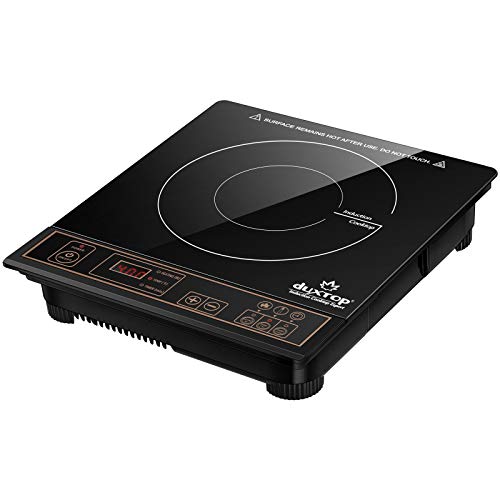
3. Duxtop 8100MC Portable Induction Cooktop, 1800W — Best Portable
The Duxtop 8100MC suits anyone whose kitchen is temporary, tiny, or supplemented: renters, students, RV travelers, and homeowners who need one extra burner on holidays. It boils fast, keeps its surface comparatively cool, and stores in a drawer. It does not suit non-magnetic cookware collections or anyone needing two burners at once — its double-burner relatives handle that brief.
Strengths
- 1800W induction boils faster than any plug-in rival class
- Portable and storable — a burner that appears when needed
- Long production history with a deep base of ownership knowledge
Trade-offs
- Single burner only
- Requires magnetic (induction-compatible) pans
- Fan noise is part of portable induction life
| Format | Portable countertop, plug-in |
| Power | 1800W |
| Fuel | Induction — requires magnetic cookware |
Portable induction is the affordable tier’s best idea, and the 8100MC is its reference model for a reason: it delivers most of built-in induction’s speed and control from a standard outlet, then vanishes into a cabinet when the meal ends. For a renter forbidden from renovating, it is not a compromise at all — it is the best cooktop their lease allows, and it travels with them when they move.
The ownership notes are simple. Test your pans with a magnet before ordering, expect the cooling fan’s hum, and give it counter space with airflow. Do that and this modest box will out-cook the aging coil stove in most rental kitchens while using a fraction of the counter and none of the permanence.
The 8100MC has an afterlife worth planning for: when its owner finally renovates into a built-in kitchen, the portable does not retire — it becomes the holiday burner, the outdoor-kitchen burner, the canning overflow, the college send-off gift. Appliances that cascade down a household’s generations of kitchens spread one purchase across decades of meals, and few products in this entire series cascade as gracefully as a good portable induction burner. One more 8100MC constituency deserves naming: the experienced cook with a good stove who simply wants one great burner. Sauce at a true bare simmer beside a range whose lowest setting is a boil, a sear at full sprint while the oven holds the roast — the portable as specialist tool rather than substitute stove is a legitimate, even luxurious, use of the affordable tier.
Best for: renters, students, RVs, and holiday overflow burners / Not suited for: non-magnetic cookware owners or two-burner cooking
Check on Amazon — check the current price on Amazon before you buy, because countertop and built-in appliance pricing moves often.
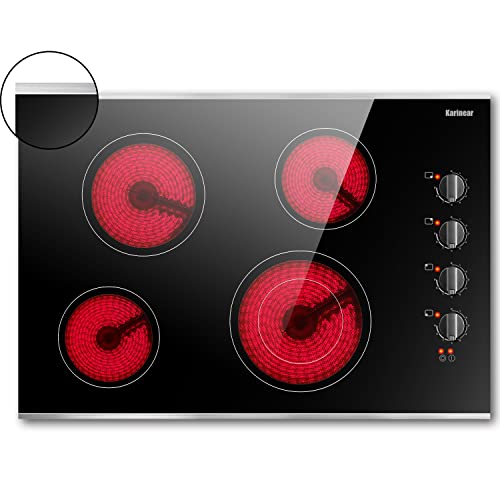
4. Karinear 30-Inch Electric Cooktop, 4 Burners, Knob Control — Best Knob-Control Built-In
The Karinear suits cooks who want a built-in smoothtop but refuse touch panels — a larger group than manufacturers admit, including anyone who cooks with wet hands or simply likes a knob’s certainty. The hot surface indicator covers radiant’s one real safety gap. It does not suit minimalists who want an unbroken glass plane; the knobs are the point, and they interrupt the wipe.
Strengths
- Knobs answer instantly, wet hands or not
- Hot surface indicator warns while elements stay warm
- 6700W is honest output for the four-burner class
Trade-offs
- Knobs trap splashes and slow the cleaning ritual
- Four burners, standard for the tier
- Radiant cycling at low settings, as with all radiant decks
| Size | 30 inch built-in |
| Burners | 4 radiant |
| Total power | 6700W |
| Controls | Physical knobs |
| Safety | Hot surface indicator |
Control philosophy is a legitimate specification. Touch panels look cleaner and offer timers; knobs offer certainty — a quarter-turn you can feel, a setting you can read from across the room, a control that never ignores a damp fingertip at the exact moment the pan boils over. Karinear builds its affordable deck around that certainty and adds the indicator light that radiant cooking genuinely needs, because a black glass element that looks off can still be hot.
Everything else is competent class-standard: four radiant burners with sensible spacing, a glass surface that cleans well around the knob cluster, and output that covers weeknight cooking without drama. If your household includes older cooks, enthusiastic kids learning the kitchen, or anyone who has ever sworn at a touch panel, this is the affordable built-in designed for your actual life.
Karinear’s knob deck quietly serves another master: resale and rental documentation. A cooktop whose state reads at a glance — knobs visibly off, indicator light dark — is the easiest kind to hand over between tenants, guests, and family members without a tutorial. In shared and transitional housing, appliances that explain themselves are worth a premium nobody lists, and this one charges nothing for it. The Karinear’s indicator light also makes it the deck to specify when the household includes anyone whose memory is not what it was. A glowing reminder that the surface is still hot, knobs whose positions can be verified by a hand in the dark — these are dignity features, the kind that let a cook age in their own kitchen safely, and they cost nothing extra here.
Best for: knob loyalists and multi-generation households / Not suited for: touch-panel minimalists
Check on Amazon — check the current price on Amazon before you buy, because countertop and built-in appliance pricing moves often.

5. CUSIMAX Double Burner Hot Plate, 1800W Cast Iron — Best for Dorms and Backup Cooking
The CUSIMAX suits the gaps in other kitchens: dorms, studioettes, office kitchenettes, camper setups, and the week the range dies before the replacement arrives. Cast iron plates heat slowly and evenly and accept every pan material without complaint. It does not suit speed — two burners share one outlet’s worth of power — or anyone calling it a primary family cooktop.
Strengths
- Works with literally every pan, including glass and aluminum
- Two burners in a footprint that stores anywhere
- Simple, repairable, nothing-to-update design
Trade-offs
- 1800W shared across two burners limits simultaneous power
- Cast iron plates are slow to heat and slow to cool
- Not a substitute for a real cooktop at family scale
| Format | Portable countertop, plug-in |
| Burners | 2 cast iron hot plates |
| Power | 1800W |
| Cookware | Compatible with all cookware types |
Every category needs its honest utility player, and in portable cooking this is it. The CUSIMAX makes no speed claims and breaks none: its cast iron plates come up to temperature patiently, hold it steadily, and simmer sauces and soups with a calm that cheap coil burners cannot match. For the dorm cook making real food, the renter bridging a broken stove, or the host keeping gravy warm at a holiday buffet, those are exactly the virtues required.
Judge it as infrastructure rather than appliance theatre and it shines. It will not sear like gas or sprint like induction, and its plates stay hot long after dinner — respect them. But as the most compatible, most storable pair of burners in this guide, it earns its place in more kitchens than its modest appearance suggests.
The CUSIMAX also earns a place in preparedness thinking, the unglamorous kind that pays off once and is remembered forever. When the main range fails on a holiday weekend, when the power flickers back and the gas stays off, when a family member’s temporary housing has a counter and an outlet and nothing else — two cast-iron burners and a kettle are the difference between a household that cooks and a household that waits. It costs little, stores anywhere, and asks nothing until the day it is indispensable. CUSIMAX ownership has one technique worth passing on: preheat the plates empty for several minutes before the pan lands, because cast iron’s thermal mass is the product. Cooks who rush a cold plate conclude the unit is weak; cooks who let the iron charge find a steadiness that thin coil burners never achieve. The hot plate rewards the patient exactly as its namesake material does in pan form.
Best for: dorms, studios, buffets, and emergency backup cooking / Not suited for: primary family cooking or speed-critical meals
Check on Amazon — check the current price on Amazon before you buy, because countertop and built-in appliance pricing moves often.

6. Empava 30-Inch Gas Cooktop, 5 SABAF Burners, Stainless — Best Affordable 5-Burner Upgrade
This Empava closes the guide as the step-up pick: the household that has outgrown four burners but not its budget. Five Sabaf burners, dual-fuel conversion, and flame protection at the affordable tier’s edge make it the natural graduation from the ThermoMate above. Center-burner heroics are not its game; simultaneous competence is.
Strengths
- Five burners without leaving the affordable tier
- Proven SABAF components with full safety baseline
- Propane conversion included for non-mains households
Trade-offs
- 30-inch five-burner spacing is snug for large pans
- Moderate center output versus flagship decks
- Value-tier support model
| Size | 30 inch built-in |
| Burners | 5 Italian SABAF burners |
| Fuel | NG/LPG convertible |
| Safety | Thermocouple flame failure protection |
| Surface | Stainless steel |
The jump from four burners to five is the jump from sequencing dinner to conducting it — the sauce holds its own burner while the main, the side, and the kettle proceed in parallel. Empava delivers that jump at a tier where it used to require a brand premium, because its SABAF burner set is bought-in proven hardware rather than bespoke engineering. The savings went to the badge, not the burners, and burners are what cook.
Its compromises mirror the category: spacing that rewards medium pans, a center burner tuned for boiling rather than wok theatre, and online-first support. Households graduating from four burners will feel the upgrade every single night, which is the most that any affordable pick in this guide can promise.
Graduating households should plan the five-burner Empava’s first month deliberately: the fifth burner changes cooking habits slowly, because cooks trained on four burners keep sequencing out of reflex. Put the kettle on the fifth burner permanently for the first fortnight. The habit of parallel cooking — the sauce holding, the water ready, the main event unhurried — forms around that one standing assignment, and by the time it does, the upgrade has justified itself in the only currency that matters, which is weeknight calm. The five-burner Empava also future-proofs a growing household in a way four-burner decks cannot: the cooking that arrives with teenagers, with in-laws’ visits, with a newfound bread-and-sauce hobby, finds burners waiting. Buying one size up in burner count, at the tier where the step costs least, is the affordable tier’s version of buying the bigger house — cheaper now than moving later.
Best for: households outgrowing four burners on a firm budget / Not suited for: wok specialists or 36-inch remodels
Check on Amazon — check the current price on Amazon before you buy, because countertop and built-in appliance pricing moves often.
Comparison Table
| Pick | Badge | Key spec | Best for |
|---|---|---|---|
| Empava 30-Inch Radiant Electric Cooktop, 4 Burners | Best Overall Affordable Built-In | 30-inch, 4 radiant burners, dual zone element, ceramic glass, ETL certified | budget renovators wanting a smoothtop that takes any pan |
| ThermoMate 30-Inch Gas Cooktop, 4 Sabaf Burners, Stainless | Best Affordable Gas | 30-inch, 4 Sabaf burners, 304 stainless, NG/LPG convertible | gas cooks whose real life fits four good burners |
| Duxtop 8100MC Portable Induction Cooktop, 1800W | Best Portable | Portable single burner, 1800W induction, plug-in | renters, students, RVs, and holiday overflow burners |
| Karinear 30-Inch Electric Cooktop, 4 Burners, Knob Control | Best Knob-Control Built-In | 30-inch, 4 burners, 6700W, knob control, hot surface indicator | knob loyalists and multi-generation households |
| CUSIMAX Double Burner Hot Plate, 1800W Cast Iron | Best for Dorms and Backup Cooking | Portable double burner, 1800W, cast iron plates, all-cookware compatible | dorms, studios, buffets, and emergency backup cooking |
| Empava 30-Inch Gas Cooktop, 5 SABAF Burners, Stainless | Best Affordable 5-Burner Upgrade | 30-inch, 5 SABAF burners, NG/LPG convertible, thermocouple protection | households outgrowing four burners on a firm budget |
How to Choose an Affordable Cooktop Without Buying Twice
Decide the format before the fuel. Built-in decks belong to owners and long leases; portables belong to renters, students, travelers, and anyone whose kitchen situation will change within a couple of years. A portable induction burner bought today and kept as a holiday spare after you renovate is a smarter purchase than a built-in installed in a kitchen you are about to leave. Format honesty saves more money than any promotion.
Then apply the class baselines without exception. Gas must have thermocouple flame-failure protection and, for propane homes, documented conversion. Electric built-ins should carry recognized certification — the ETL marks on picks in this guide — and hot-surface indication on radiant glass. Induction portables need a magnet test on your pans before the order, not after. These are not premium features; at the modern affordable tier they are the definition of a complete product, and any model missing them is cheap in the wrong way.
Finally, price the support, not just the box. Value brands support online and through sellers; legacy brands support through networks. Either can be the right buy — but know which you purchased, keep the documentation, and buy through channels with real return policies for freight-sized items. Affordable and unsupported are synonyms only if you let them be.
Which Fuel Is Cheapest to Live With?
Running costs differ less than purchase tiers, but the patterns are worth knowing. Induction converts the most electricity into pan heat and wastes the least into the kitchen; radiant electric spends more on heat that lingers in glass and air; gas burns a fuel that is inexpensive per unit of heat in many regions but sends a share of it around the pan into the room. Your local utility rates decide the arithmetic, and for most households the difference across a year of dinners is smaller than the difference between two models’ purchase tiers.
The larger living cost is behavioral. A cooktop that heats slowly gets abandoned for takeout; a cooktop that frightens its owner with fiddly controls gathers dust. The cheapest fuel is the one attached to the cooktop you actually enjoy using nightly — which is why these guides rank cooking competence above theoretical efficiency every time.
The Affordable Cooktop Formats, Compared Honestly
Built-in decks, portable burners, and hot plates are not three prices of one product; they are three different relationships with a kitchen. A built-in is a commitment measured in decades and countertop cuts — it becomes part of the house, raises its finish, and demands the house’s infrastructure in return. A portable is a relationship measured in leases and life stages: it arrives in a box, cooks tonight, and leaves with you, and its ceiling is set by a wall outlet rather than by your ambitions. A hot plate is infrastructure of last resort and first convenience — the buffer that keeps a household cooking through renovations, breakdowns, dorm years, and buffet lines.
Shoppers err when they rank these formats against each other instead of against their own timeline. The correct question is never ‘which is best’ but ‘how long will this kitchen be mine, and what may I change in it?’ Owners renovating for a decade belong in the built-in half of this guide. Anyone whose address has an expiry date belongs in the portable half, where the Duxtop’s induction speed will make them forget they compromised at all. Households in transition — and every household is, eventually — keep a hot plate in the cupboard the way they keep a flashlight in the drawer.
Budget interacts with format in one more useful way: portables let you stage a renovation. Cook on a good portable for the months while counters, cabinets, and circuits are being planned, and the built-in decision gets made with real cooking data instead of showroom imagination. Many a five-burner mistake has been prevented by a season spent learning, on an 1800W portable, exactly how many burners a household truly uses.
Cookware: The Hidden Line Item in Every Cooktop Decision
Every fuel change is secretly a cookware decision, and the affordable tier is where that secret costs the most, because the pan budget and the cooktop budget are the same budget. Radiant electric and gas accept the collection you already own — every material, every era, the inherited cast iron and the wedding stainless alike. That compatibility is a genuine financial feature of the Empava radiant and the gas decks in this guide, worth real money to any household whose pans predate its cooktop ambitions.
Induction asks for magnetism and pays for the demand in speed and control. The audit is quick — the magnet test from this guide’s induction companion — and the results are usually kinder than feared: cast iron passes, most modern stainless passes, and the casualties are typically a few aluminum favorites whose replacements are neither many nor expensive. What matters is doing the audit before the purchase, so the pan replacements, if any, are a planned line item rather than a second surprise bill in the same week as the cooktop.
Flatness is the third cookware truth, shared by every smoothtop in this guide, radiant and induction alike. A warped pan rocks, buzzes, and heats in rings on glass; the same pan on gas grates merely works. Households with a beloved but banana-bottomed skillet should hear that plainly now, because no cooktop in this series will love that pan back — and retiring one pan is still cheaper than choosing the wrong fuel for a whole kitchen.
Installation Costs: The Budget Item Nobody Budgets
Affordable cooktops carry a shadow price that varies by format, and honest shopping includes it from the start. Portables have none — the box, the outlet, dinner. That zero is a genuine part of their value, and it is why a portable can be the rational choice even for a household that could afford a built-in: the built-in’s true price is the deck plus the circuit or the gas line, the counter work, and the installer, and that sum routinely doubles the sticker.
Built-in swaps divide into the lucky and the honest. A like-for-like replacement — same size, same fuel, same circuit or line — is the lucky kind: an hour or two of professional time for gas, a straightforward connection for electric, and cooking by dinner. The honest kind involves any change at all: a new circuit run, a gas line moved, a cutout recut in stone. None of these are ruinous, all of them are quotable in advance, and every horror story in this category begins with discovering them after the delivery truck leaves.
The affordable shopper’s rule is therefore simple: get the install quoted against the specific model before the model is ordered, using the measurement photographs from this guide’s audit. A deck that is fifty cheaper and three hundred more expensive to install is not cheaper. The guides in this series repeat the point because the category’s shoppers keep paying tuition to learn it.
The Two-Cooktop Household: A Quietly Sensible System
Many households in this tier’s audience end up, deliberately or by accumulation, with a system rather than a single appliance: a built-in deck for daily duty and a portable for overflow, or a portable pair where a renovation is still a rumor. Judged as a system, the pieces cover each other’s ceilings — the holiday fifth burner, the simmer specialist, the burner that travels to the patio. If your kitchen life has outgrown one format but not justified the next, adding the complementary piece is often the most affordable correct answer in this entire series.
Reading Reviews of Affordable Cooktops Without Being Fooled
A last skill for this tier: reading other owners’ reports with the right filters. Weight the reviews that describe a specific meal cooked, a specific pan used, a specific month of ownership — detail is the signature of experience. Discount the ones that grade the delivery box, the courier, or the color against a photograph. And pay special attention to the quiet middle of the distribution, where owners report that a deck simply works, month after month, because in the affordable tier that unglamorous sentence is the highest praise a cooktop can earn.
Apply the same filter backward to this guide: every pick here was chosen because its verifiable specification and its class baseline survive scrutiny, not because its marketing does. If a model’s listing ever stops confirming the safety and configuration details these reviews rely on, trust the listing’s silence over this guide’s words and choose the pick whose paperwork still speaks clearly.
A Word on Buying During Promotions
The affordable tier runs on a promotional calendar, and a patient shopper can use it without becoming its servant. The models in this guide are the standing residents of their tier — the ones whose normal position is already the value position — so a promotion is a bonus on a sound purchase rather than the purchase’s only justification. The rule that protects you: decide the model on specification, fit, and support first, in the calm of this guide, and let the calendar decide only the week. Shoppers who reverse that order own whatever was discounted, and their kitchens can tell.
One Last Practical Note
One sentence for the gift-givers and the inheritors in this tier’s audience: an affordable cooktop chosen on its verifiable specification travels well between households — the renter’s portable becomes the graduate’s first burner, the renovator’s replaced deck becomes the cabin’s stove — and a product with a documented baseline is the only kind that can be handed on with honest instructions.
Closing Thought
When in doubt between two finalists in this guide, choose the one whose compromises you can describe out loud without wincing — that sentence, spoken honestly, has ended more cooktop deliberations than any comparison table.
How to Test Whether Your Kitchen Fits a Built-In Cooktop
Before any affordable built-in earns your money, it has to earn its hole in your counter. This fifteen-minute audit decides whether you are a built-in buyer or a portable buyer — both honorable answers.
- Measure the existing cutout or the intended cabinet run: width, depth, and the cabinet box below. Compare against the candidate’s published cutout sheet, never its outer dimensions.
- Identify your fuel reality: a gas line with a shutoff, a dedicated electric circuit with capacity to spare, or neither. ‘Neither’ is the portable section’s whole reason to exist.
- Check the panel: note the free breaker capacity for an electric deck, or confirm propane supply and conversion needs for gas.
- Stand at the counter and mime your busiest meal. Count the burners you truly run at once — that number, not aspiration, picks between the four- and five-burner models above.
- Photograph everything: cutout, lines, panel, and the space below. If you consult an installer or a seller, those photos are the conversation.
Common Buying Mistakes
- Buying built-in for a temporary kitchen. Renters and short stays belong in the portable section. A Duxtop that moves with you beats a deck you abandon.
- Skipping certification on cheap electrics. Recognized marks like ETL are the floor for hardwired appliances. Uncertified bargains are not bargains.
- Assuming affordable gas skips safety. It should not: thermocouple protection is standard across this guide’s gas picks. If a cheap gas deck lacks it, walk away.
- Forgetting the pan test for induction. A magnet on the pan base settles compatibility in two seconds — before the portable arrives, not after.
- Counting burners instead of mapping pans. Your largest skillet plus your stockpot is the real specification. If they cannot share the deck, the burner count is fiction.
Final Recommendation
Most renovators should start with the Empava radiant built-in for its any-pan flexibility, or the ThermoMate gas deck if flame is non-negotiable and four burners fit your life. The Karinear serves knob loyalists, the five-burner Empava serves households graduating in size, and the Duxtop and CUSIMAX portables cover every kitchen that cannot or should not be renovated. Check the live price at each link, run the fit audit in this guide before ordering anything built in, and the affordable tier will treat you far better than its reputation suggests. The deeper guides below take the affordable question fuel by fuel — gas and induction each get their own full bench of picks.
Shortlist again, for convenience: Empava 30-Inch Radiant Electric Cooktop, 4 Burners (Best Overall Affordable Built-In); ThermoMate 30-Inch Gas Cooktop, 4 Sabaf Burners, Stainless (Best Affordable Gas); Duxtop 8100MC Portable Induction Cooktop, 1800W (Best Portable).
Frequently Asked Questions
Can an affordable cooktop really last?
Yes, when its class baselines are intact: proven burner components on gas, certified electrics, and a support channel you have actually identified. The affordable tier’s failures are usually unsupported no-name products, not the established value brands in this guide.
Is portable induction a real cooktop or a gadget?
A real one. A quality 1800W portable induction burner boils faster than many full-size radiant stoves and offers precise low control. Its limits are burner count and pan compatibility, not competence.
Do I need new pans for an affordable electric cooktop?
For radiant smoothtops, no — any flat-bottomed pan works, which is a core reason the Empava radiant deck leads this guide. For induction, pans must be magnetic; the magnet test takes seconds and your cast iron and many stainless pieces will likely pass.
What is the cheapest cooktop to run?
It depends on your local gas and electricity prices, but induction wastes the least energy as heat, while gas is often cheapest per unit of heat where mains gas is inexpensive. Across a year, the purchase tier usually matters more than the fuel arithmetic.
Should I buy a 4-burner or 5-burner affordable deck?
Count your busiest real meal. Four burners with generous spacing serve most households nightly; five earn their place when a sauce, a side, and a kettle genuinely compete every evening. Do not buy the fifth burner for a holiday that happens twice a year — borrow a portable instead.
Are knob controls outdated on affordable cooktops?
No — they are a preference with real arguments: instant tactile response, readability from across the room, and no wet-finger failures. Touch panels clean easier and add timers. This guide includes both because households legitimately differ.
Is it cheaper to repair or replace an affordable cooktop?
For portables, replacement is usually the honest answer — their parts and labor economics rarely justify a repair bench. For built-ins, the answer turns on the component: a radiant element, an igniter, or a knob is a modest repair on any deck in this guide, while a cracked glass top approaches the price of a new value-tier unit and should trigger the replacement conversation. The support model you bought decides how available those repairs are, which is why this guide treats it as a specification rather than a footnote.
Best Affordable Induction Cooktops
Best 5 Burner Electric Smoothtop Cooktops
Best Induction Cooktops
Best Gas Cooktops


