Disclosure: airfryerkitchensupply.com is reader-supported. When you buy through links on our site, we may earn an affiliate commission at no extra cost to you.
Where to buy
All six sets below are sold on Amazon, and in the affordable tier the exact bundle matters more than anywhere else — contents drift between colourways and seasonal boxes, so confirm the piece list on the product page before you order. The strongest starting points are the Tramontina PrimaWare 18-piece set for maximum coverage per pound spent, the GreenLife Soft Grip 16-piece ceramic set for PFAS-free cooking, and the Cuisinart Chef’s Classic 10-piece set if you want affordable to still mean durable. Also linked below: the T-fal Initiatives Ceramic 14-piece set, the Farberware EcoAdvantage 13-piece set and the GreenLife Soft Grip 12-piece set.
Introduction
The best affordable cookware sets are not the cheapest sets on the page — they are the sets whose cost per year of real service is lowest, and those are very different things. A bargain set that warps in six months and sheds its coating in a year is expensive twice: once at the till and once at the replacement. A genuinely affordable set is built from honest, documented materials, covers the vessels you actually use, and survives several years of ordinary weeknight cooking without drama or complaint. Every single pick in this guide was chosen on that definition of affordable, and we will show the full working for each one.
It is also worth saying plainly what this guide will not recommend, because the affordable shelf is where cookware marketing is at its most creative. We will not recommend a set for being the cheapest in its search results, a set whose piece count depends on counting each lid twice, or a set whose coating is described only with adjectives. Affordable shoppers are the readers most exposed to those tricks and the least able to absorb a bad purchase — which is exactly why this guide is stricter about documentation than our premium guides need to be.
Here is what the affordable tier really looks like in 2026. The volume end is aluminium nonstick and ceramic — light, forgiving, easy to clean, finite in lifespan. The durability end is one stainless set, the Cuisinart Chef’s Classic, which costs more upfront than the coated sets here and then simply refuses to wear out. In between sit the thoughtful budget designs: Tramontina’s PrimaWare, which covers more cooking per box than anything else at its tier; T-fal’s Initiatives Ceramic, with its recycled bodies and heat indicator; Farberware’s EcoAdvantage, built from recycled aluminium; and GreenLife’s two Soft Grip configurations, the ceramic default for small budgets.
Every set was verified against its current Amazon listing before inclusion, and the contents in each review are the contents that listing states. A note on one pick: the PrimaWare’s listing showed fluctuating availability during our checks — the set is a long-running Tramontina line sold widely, but if the link shows a third-party seller, compare the contents carefully, because this set is frequently re-bundled.
In this guide
Quick Picks
- Best Overall Value — Tramontina PrimaWare 18-Piece Nonstick Set. The most cooking coverage in this guide: three saucepans, a griddle, a Dutch oven, a steamer and utensils in one budget box. Check the current price on Amazon
- Best Ceramic — GreenLife Soft Grip 16-Piece Ceramic Set. PFAS-free ceramic nonstick across a full family configuration, with stay-cool handles and a steamer included. Check the current price on Amazon
- Best for Beginners — T-fal Initiatives Ceramic 14-Piece Set. Recycled aluminium bodies, Thermo-Spot preheat indicator and an egg pan — a forgiving first set. Check the current price on Amazon
- Best Eco Pick — Farberware EcoAdvantage Ceramic 13-Piece Set. Recycled aluminium construction, ceramic nonstick, dishwasher safe, squarely in the budget tier. Check the current price on Amazon
- Best Affordable Stainless — Cuisinart Chef’s Classic 10-Piece Set. 18/10 stainless with an encapsulated base: the affordable pick that lasts like an expensive one. Check the current price on Amazon
- Best for Small Kitchens — GreenLife Soft Grip 12-Piece Ceramic Set. The compact GreenLife configuration for one or two people, with a steamer and tools included. Check the current price on Amazon
How These Picks Were Chosen
Affordable guides fail readers when they rank by sticker alone, so our filter was value over time. Each candidate had to clear three bars: honest contents (at least six real vessels in the larger sets, with utensils counted as utensils, not cookware), construction that matches its price (no clad-level pricing for thin aluminium, no premium claims for basic coatings), and a maker with a real warranty and support operation behind it. Sets from anonymous marketplace brands were excluded regardless of price — in the budget tier, the brand’s accountability is part of the product.
We then verified every finalist against its live Amazon listing and read the contents off those listings. Two famous budget lines did not make the cut: one for shrinking its stockpot while keeping its piece count, and one for a coating with no credible documentation behind its health claims. What remains is six sets we can defend at three different ideas of affordable — cheapest adequate, best value per year, and affordable-but-durable — because readers use the word all three ways.
The 6 Best Affordable Cookware Sets
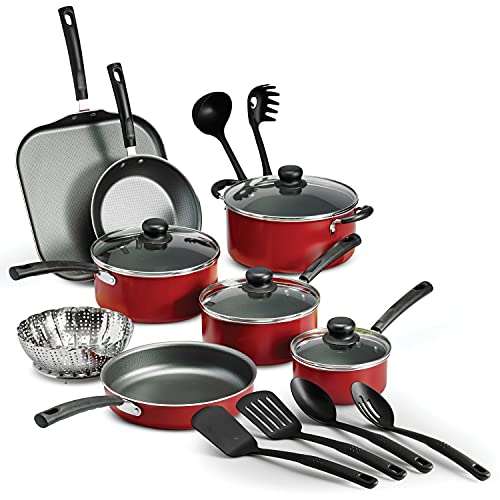
1. Tramontina PrimaWare 18-Piece Nonstick Set — Best Overall Value
No set in this guide puts more cooking on the stove for the money. The PrimaWare’s eighteen pieces resolve into real coverage: an 8-inch sauté pan, a 9-inch deep sauté pan, an 11-inch square griddle, 1, 2 and 3-quart covered saucepans, a 4-quart covered Dutch oven, a stainless steel steamer and six utensils. Three saucepans at this tier is unheard of — most budget rivals give you two and a bigger box — and the griddle earns its place for pancakes, grilled sandwiches and bacon. The bodies are nonstick aluminium in the Brazilian-made Tramontina tradition: light, fast and forgiving.
Strengths
- Three saucepans, a griddle and a steamer — the broadest vessel coverage in this guide at a budget tier.
- Tempered glass lids and riveted handles throughout, where rivals cut to plastic knobs and screws.
- Tramontina’s support and consistency behind a budget line — the pans match the description, year after year.
Trade-offs
- Six of the eighteen pieces are utensils — the vessel count is strong, but know the arithmetic.
- Thin-gauge nonstick aluminium: fine for everyday heat, not for aggressive searing or empty-pan preheating.
- Not induction compatible, and availability of the exact bundle fluctuates between sellers.
| Specifications (from the manufacturer’s listing) | |
|---|---|
| Pieces | 18 (9 vessels, 3 lids, steamer, 6 utensils) |
| Construction | Aluminium, nonstick interior |
| Contents | 8″ sauté pan; 9″ deep sauté pan; 11″ square griddle; 1 qt, 2 qt and 3 qt covered saucepans; 4 qt covered Dutch oven; stainless steamer; 6 utensils |
| Lids | Tempered glass |
| Cooktops | Gas, electric, ceramic glass (not induction) |
| Origin | Made in Brazil |
The PrimaWare is the set we recommend to anyone furnishing a kitchen from zero on a strict budget — a student house, a first flat, a rental — because it leaves almost no cooking task uncovered. Its honest ceiling is intensity: treat it as a medium-heat, everyday set and it will give several good years; treat it like restaurant equipment and the thin bodies will tell you so. Within its brief, nothing at the tier touches it.
Best for: furnishing a whole kitchen on the smallest sensible budget / Not suited for: induction owners or high-heat searing devotees.
Check the current price on Amazon

2. GreenLife Soft Grip 16-Piece Ceramic Set — Best Ceramic
GreenLife’s 16-piece is the default affordable ceramic set, and its contents show why: a 4-inch mini frypan, 7 and 9.5-inch frypans, 1 and 2-quart saucepans with lids, a 5-quart stockpot with lid, a 2.5-quart sauté pan with lid, a stainless steamer and four kitchen utensils. The ceramic nonstick is the maker’s sand-derived coating, free of PFAS, PFOA, lead and cadmium, on aluminium bodies with Bakelite Soft Grip handles that stay cool and feel secure. Everything is sized for family weeknights rather than dinner parties, and the set is dishwasher safe per the maker — a convenience the more delicate ceramic brands hesitate to claim.
Strengths
- PFAS-free ceramic nonstick across a complete family configuration, steamer included.
- Soft Grip handles are genuinely the most comfortable in this guide at any tier.
- Wobble-free bases and dishwasher-safe convenience at a budget price point.
Trade-offs
- Oven safe only to 350°F, and not induction compatible.
- The largest frypan is 9.5 inches — family frying is a two-batch affair.
- Ceramic lifespan rules apply: the frypans are few-year items with daily use.
| Specifications (from the manufacturer’s listing) | |
|---|---|
| Pieces | 16 (7 vessels, 4 lids, steamer, 4 utensils) |
| Construction | Aluminium, ceramic nonstick (PFAS-free per maker) |
| Contents | 4″ mini frypan; 7″ and 9.5″ frypans; 1 qt and 2 qt saucepans with lids; 5 qt stockpot with lid; 2.5 qt sauté pan with lid; steamer; utensils |
| Oven safe | Up to 350°F |
| Handles | Bakelite Soft Grip, stay-cool |
| Cooktops | Gas, electric, ceramic glass (not induction) |
If your household’s priority is avoiding fluoropolymer coatings without leaving the budget tier, this is the set — it is the pick our ceramic coverage keeps returning to because the arithmetic, the handles and the coating documentation are all honest. Buy it with the ceramic care routine in mind (medium heat, soft utensils, protected storage, all detailed in the how-to section below) and it will repay you in the easiest cleanup in this guide.
Best for: families who want PFAS-free nonstick on a budget / Not suited for: induction stoves, oven-heavy cooking, or cooks who need a big frypan.
Check the current price on Amazon
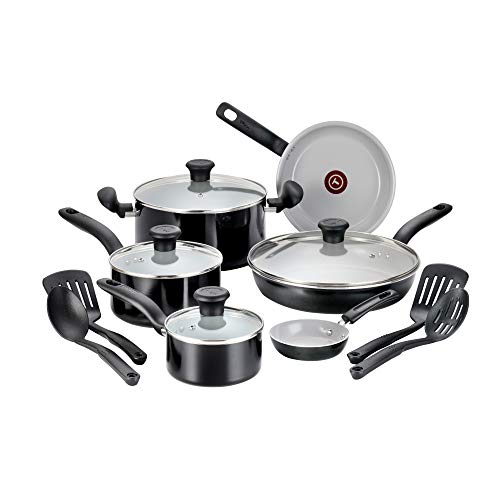
3. T-fal Initiatives Ceramic 14-Piece Set — Best for Beginners
T-fal built the Initiatives Ceramic line for people learning to cook, and two features show it. The first is the Thermo-Spot: a heat indicator in the frypans that turns solid red when the pan is properly preheated, quietly teaching the single most important nonstick skill. The second is the body material — 100% recycled aluminium under a ceramic nonstick interior, light enough for a new cook to handle confidently. The fourteen pieces include 8.5 and 11-inch frypans (the 11-inch covered), 1 and 2-quart covered saucepans, a 5-quart covered Dutch oven, a dedicated egg pan and four nylon tools that are safe for the coating from day one.
Strengths
- Thermo-Spot indicator teaches preheating — the feature beginners actually need.
- Recycled aluminium bodies with ceramic nonstick and an 11-inch covered frypan, rare at this tier.
- The included egg pan and nylon tools make the set self-contained for a first kitchen.
Trade-offs
- Oven and broiler ceiling is 350°F — a stovetop set at heart.
- Four of the fourteen pieces are tools; vessel count is six plus lids.
- Not induction compatible.
| Specifications (from the manufacturer’s listing) | |
|---|---|
| Pieces | 14 (6 vessels, 4 lids, 4 nylon tools) |
| Construction | Recycled aluminium, ceramic nonstick |
| Contents | 8.5″ frypan; 11″ covered frypan; 1 qt and 2 qt covered saucepans; 5 qt covered Dutch oven; egg pan; 4 nylon tools |
| Oven safe | Up to 350°F |
| Feature | Thermo-Spot heat indicator |
| Cooktops | Gas, electric, ceramic glass (not induction) |
As a first set — for a graduate, a new flat, a teenager learning family cooking — the Initiatives Ceramic is the kindest option here: light pans, a preheat teacher in the base, tools that cannot hurt the coating, and a Dutch oven big enough for the soups and pastas beginners actually make. Experienced cooks will find the 350°F ceiling and thin bodies limiting within a year; beginners will find a set that helps them succeed, which is the entire brief.
Best for: first kitchens and learners / Not suited for: oven-heavy cooks or induction owners.
Check the current price on Amazon

4. Farberware EcoAdvantage Ceramic Nonstick 13-Piece Set — Best Eco Pick
The EcoAdvantage’s pitch is materials honesty: bodies made from 100% recycled aluminium, per Farberware, with a ceramic nonstick interior and a feature list aimed at convenience — dishwasher-safe construction, pour spouts on the saucepans, and a 13-piece assortment spanning frypans, saucepans, a stockpot, lids and tools. It sits at the sharp end of the budget tier, and unlike many eco-labelled products it does not ask a premium for the story: the recycled construction is the reason it can be both greener and cheaper, since recycled aluminium is simply less energy-hungry to produce.
Strengths
- Recycled aluminium bodies with ceramic nonstick — the sustainability pick that is also the budget pick.
- Dishwasher safe throughout, with pour spouts that make draining genuinely easier.
- Scratch-resistant ceramic positioning and a complete starter assortment.
Trade-offs
- Part of the thirteen is tools; vessel-for-vessel it is smaller than the PrimaWare.
- Thin bodies heat fast but unevenly at high settings — a medium-heat set.
- Maker specification detail is thinner than the big brands’; confirm oven limits on the listing.
| Specifications (from the manufacturer’s listing) | |
|---|---|
| Pieces | 13 (vessels, lids and tools) |
| Construction | Recycled aluminium, ceramic nonstick |
| Contents | Frypans, saucepans, stockpot, lids and tools (confirm exact bundle on the listing) |
| Features | Pour spouts on saucepans |
| Care | Dishwasher safe |
| Tier | Budget |
Buy the EcoAdvantage if the recycled story matters to you or if it is simply the best-priced credible ceramic set on the day — both are good reasons, and the second needs no apology. It cooks like what it is: a light, easy, medium-heat ceramic set for everyday meals. Households that sear hard and often should look at the Cuisinart below instead; households that simmer, fry and reheat will never notice the difference.
Best for: eco-conscious budget buyers and gentle everyday cooking / Not suited for: high-heat searing or buyers who want every spec documented in depth.
Check the current price on Amazon

5. Cuisinart Chef’s Classic 10-Piece Set (77-10P1) — Best Affordable Stainless
This is the pick that reframes the whole guide: the most affordable set over a ten-year horizon is the one you buy once. The Chef’s Classic is 18/10 stainless steel with a pure aluminium disc encapsulated in each base — no coating to wear, nothing to baby — and its contents are the classic ten: 1.5 and 3-quart covered saucepans, a 3.5-quart covered sauté pan with helper handle, an 8-quart covered stockpot and 8 and 10-inch skillets. It is induction compatible, dishwasher safe, and covered by Cuisinart’s lifetime warranty. It costs more upfront than the coated sets above; it then outlasts two or three of them.
Strengths
- Uncoated 18/10 stainless: the only pick here with a decades-long service expectation.
- Encapsulated aluminium base heats quickly and evenly for everyday cooking.
- Full-size 8-quart stockpot, Cool Grip handles, induction ready, lifetime warranty.
Trade-offs
- Highest upfront cost in this guide — affordable by the year, not by the receipt.
- Stainless needs technique for eggs and delicate fish; there is no nonstick safety net.
- Disc base, not clad: sidewalls heat less evenly for delicate sauces.
| Specifications (from the manufacturer’s listing) | |
|---|---|
| Pieces | 10 (6 vessels, 4 lids) |
| Construction | 18/10 stainless, aluminium encapsulated base |
| Contents | 1.5 qt and 3 qt saucepans with lids; 3.5 qt sauté pan with lid; 8 qt stockpot with lid; 8″ and 10″ skillets |
| Handles | Cool Grip riveted stainless |
| Cooktops | All, including induction |
| Warranty | Lifetime |
Who should stretch to it? Anyone who has already replaced one cheap set and felt the annoyance, anyone cooking for a household rather than a season, and anyone whose stove is induction — it is the only pick here that covers every hob. Pair it with one inexpensive nonstick egg pan and you have the two-part kitchen that experienced cooks actually run: steel for work, a small coated pan for breakfast.
Best for: buy-once budget shoppers and induction owners / Not suited for: the smallest upfront budgets, or cooks who want nonstick release for everything.
Check the current price on Amazon

6. GreenLife Soft Grip 12-Piece Ceramic Set — Best for Small Kitchens
The 12-piece Soft Grip is GreenLife’s compact configuration: 7 and 9.5-inch frypans, a 2-quart saucepan with lid, a 5-quart stockpot with lid, a 2.5-quart sauté pan with lid, a stainless steamer, and a ladle, turner and measuring spoons in the count. It is the 16-piece’s little sibling — same sand-derived ceramic coating, same stay-cool Bakelite handles, same PFAS-free documentation — trimmed for one or two people. The stockpot stays a useful 5 quarts, which is the detail small sets usually sacrifice and this one does not.
Strengths
- The full small-kitchen map — fry, sauce, sauté, stock, steam — in a compact, storable box.
- Same PFAS-free ceramic and Soft Grip handles as the larger GreenLife, at a lower tier.
- A real 5-quart stockpot, not the 3-quart token small sets often include.
Trade-offs
- Three of the twelve pieces are the ladle, turner and measuring spoons.
- Not induction compatible, and oven headroom is the Soft Grip line’s usual modest figure.
- Frypans top out at 9.5 inches — couples yes, dinner parties no.
| Specifications (from the manufacturer’s listing) | |
|---|---|
| Pieces | 12 (5 vessels, 3 lids, steamer, 3 tools) |
| Construction | Aluminium, ceramic nonstick (PFAS-free per maker) |
| Contents | 7″ and 9.5″ frypans; 2 qt saucepan with lid; 5 qt stockpot with lid; 2.5 qt sauté pan with lid; steamer; ladle, turner, measuring spoons |
| Handles | Bakelite Soft Grip, stay-cool |
| Cooktops | Gas, electric, ceramic glass (not induction) |
| Colour | Sold in pink and other colourways |
For a studio flat, a caravan, a downsizer’s kitchen or a couple who cook simply, this is the affordable set with nothing wasted. Its pieces map one-to-one onto a week of real meals, it stores on a single shelf, and the steamer stretches it toward healthier cooking without another purchase. If your household grows, it graduates gracefully into the backup set every kitchen eventually wants.
Best for: singles, couples and small spaces / Not suited for: families, induction stoves, or big-batch cooking.
Check the current price on Amazon
Comparison Table
| Pick | Badge | Key spec | Best for |
|---|---|---|---|
| Tramontina PrimaWare 18-Pc | Best Overall Value | 3 saucepans, griddle, steamer | Whole-kitchen furnishing |
| GreenLife Soft Grip 16-Pc | Best Ceramic | PFAS-free ceramic, steamer, 350°F | Families avoiding PFAS |
| T-fal Initiatives Ceramic 14-Pc | Best for Beginners | Thermo-Spot, recycled aluminium | First kitchens, learners |
| Farberware EcoAdvantage 13-Pc | Best Eco Pick | Recycled aluminium, dishwasher safe | Eco-conscious budgets |
| Cuisinart Chef’s Classic 10-Pc | Best Affordable Stainless | 18/10 steel, induction, lifetime warranty | Buy-once shoppers |
| GreenLife Soft Grip 12-Pc | Best for Small Kitchens | Compact ceramic, 5 qt stockpot | Singles and couples |
How to Choose an Affordable Cookware Set
Decide which “affordable” you mean first. If the constraint is the receipt — the set must cost as little as possible today — the PrimaWare and EcoAdvantage are your honest options, and you should choose between them on coverage (PrimaWare) versus dishwasher-and-eco convenience (Farberware). If the constraint is the year — the lowest cost over the set’s life — the Cuisinart Chef’s Classic wins by a distance, and the ceramic sets sit in the middle: gentle prices, gentle lifespans. Neither definition is wrong; confusing them is how buyers end up disappointed.
Then run three checks that matter more than brand. First, vessel arithmetic: count pots and pans, not pieces, and make sure two saucepans and a stockpot of at least 5 quarts are among them. Second, stove fit: if there is any chance of induction in the set’s lifetime — a house move, a new hob — only the Cuisinart here survives the change, which is a real argument for it at this tier. Third, the replacement question: for coated sets, check whether the brand sells the frypan separately. Affordable sets are a system; the brand that lets you replace the one piece that wears out is the brand whose set stays affordable in year four.
How to Make a Budget Set Last: The Care Routine That Doubles Lifespan
Affordable sets die early from habits, not from birthdays. Five routines change the arithmetic. Cook on medium heat as your default — thin aluminium bodies heat fast, and high heat is what warps bases and ages coatings. Never preheat a coated pan empty for minutes at a time; a minute to warm, oil in, food in. Skip aerosol sprays, whose additives bake into nonstick and ceramic surfaces and masquerade as coating failure. Wash by hand with a soft sponge when you can — the dishwasher-safe labels here are honest, but detergents and jostling shorten any coating’s life — and let pans cool before they meet water, because thermal shock is the budget pan’s silent warper.
Store with something between the pieces: a folded towel, pan protectors, or simply nesting smallest-to-largest with lids inverted. Most coating damage in budget kitchens happens in the cupboard, pan on pan. Follow those five habits and the coated sets in this guide give you their full design life instead of half of it — which, at this tier, is the difference between a genuine bargain and a false economy that costs you twice.
Common Buying Mistakes
- Ranking by sticker price alone. Cost per year is the real metric; the cheapest box is often the dearest set.
- Counting utensils as cookware. An 18-piece set may hold nine vessels. Compare vessel lists, not box numbers.
- Buying coated sets for an induction future. Most budget aluminium sets are not induction compatible — the Cuisinart here is the exception.
- Cooking budget pans like restaurant pans. High heat and empty preheats warp thin bases and kill coatings. Medium heat is the budget set’s home.
- Ignoring the replacement path. If the brand does not sell the frypan separately, the whole set is on the frypan’s clock.
- Skipping the stockpot check. Affordable sets shrink the big pot first. Confirm at least 5 quarts for family pasta and soups.
Final Recommendation
Furnishing a kitchen from zero on a tight budget: take the Tramontina PrimaWare 18-piece. Wanting PFAS-free ceramic for a family: the GreenLife Soft Grip 16-piece. Buying for a beginner: the T-fal Initiatives Ceramic. Shopping your values: the Farberware EcoAdvantage. Able to stretch once and stop shopping for a decade: the Cuisinart Chef’s Classic. Cooking for one or two in a small space: the GreenLife 12-piece. Every one of those is a defensible answer — the mistake is only in buying a set whose definition of affordable is not yours, or in letting a headline piece count do your thinking for you.
If you take one sentence from this guide, take this one: affordable is a strategy, not a price tag — the set that fits your stove, your meals and your horizon, bought from a maker who documents what they sell, will always beat the set that was merely cheapest on the day. The six picks above were chosen to make that strategy easy to execute at three different budgets and four different cooking styles.
Shopping with a specific stove or format in mind? See Best Affordable Cookware Sets For Gas Stove for flame-specific picks, Best Affordable Induction Cookware Sets for magnetic-base budget sets, Best Affordable Nonstick Cookware Sets for the coated field in depth, and Best 8 Ceramic Cookware Sets for the compact ceramic niche. Colour-led shoppers should look at Best Affordable Cookware Sets Orange.
Where Affordable Sets Cut Corners — and Which Corners Actually Matter
Every set in this guide is cheap because something was left out, and knowing what separates a smart cut from a fatal one. The harmless cuts: thinner exterior finishing, simpler lid knobs, fewer decorative details, utensils bundled instead of bought, and boxes that mix colourways to clear production runs. None of these touches a meal. The tolerable cuts: disc bases instead of cladding (you lose sauce finesse, not dinners), glass lids with lower oven limits (you lose broiler finishes), and frypans capped at 9.5 or 10 inches (you lose one-batch family frying, and gain it back with a single open-stock pan later).
The cuts that matter are three. Base gauge: a pan too thin warps, and a warped pan on a glass hob is a daily irritation that never improves — this is why the picks here come from makers whose budget lines still use respectable gauges. Coating documentation: an unnamed coating from an unnamed maker is a claim you cannot check, and in a product category built on health positioning, unchecked claims are the one corner that should disqualify a set outright. And handle attachment: screwed handles loosen and rivets do not, so at any tier, run a finger over the inside wall — two rivet heads are the sign of a pan built to be tightened never and trusted daily. Judge budget sets by those three corners and you will rarely be fooled.
The Two-Part Kitchen: Pairing a Budget Set With One Good Pan
Here is the strategy experienced cooks quietly recommend to friends furnishing first kitchens: buy the affordable set for coverage, then spend the price of one nice dinner out on a single serious pan where it counts. The set handles boiling, simmering, steaming, reheating and gentle frying — eighty percent of cooking. The one good pan handles the other twenty: a heavy 12-inch stainless or cast-iron skillet for searing, or a quality nonstick dedicated to eggs. This pairing routinely out-cooks a mid-range set costing more in total, because it puts the money where physics rewards it — in the pan that meets high heat daily.
The pairing works with every pick here. PrimaWare plus a cast-iron skillet is a complete first kitchen. GreenLife plus a stainless frypan covers the PFAS-free household that still wants a proper sear. And the Cuisinart Chef’s Classic inverts the strategy: it is the durable core, and the “one good pan” to add is a small budget nonstick for eggs — the cheapest pan in this entire guide’s world, replaced without tears when it fades. However you assemble it, the principle holds: coverage from the set, excellence from one pan.
Affordable Sets for Specific Situations
Renters and house-shares: choose the PrimaWare or EcoAdvantage. They survive other people’s cooking habits, replace without grief, and their glass lids and light bodies suit unfamiliar stoves. Students: the GreenLife 12-piece or the T-fal Initiatives — compact, forgiving, and sized for the meals students actually cook; the T-fal’s Thermo-Spot is a genuine teacher. Second homes and holiday lets: the Cuisinart Chef’s Classic, because it tolerates neglect, dishwashers and a winter of disuse, and asks nothing on your return. Gifting: the GreenLife 16-piece in a cheerful colourway — it looks generous, cooks kindly, and its PFAS-free documentation makes it an easy gift to defend. Just confirm the recipient’s stove first: a non-induction set gifted to an induction kitchen is a return waiting to happen.
Downsizers: the GreenLife 12-piece again, or the Cuisinart if the new kitchen is a long-term one — smaller households cook smaller meals, and both sets respect that arithmetic without feeling like compromises. In every case the logic is the same: match the set’s lifespan to the situation’s horizon, and affordable stops being a euphemism and becomes a plan.
Cost Per Year: The Only Maths That Matters in This Tier
Run the comparison the way an accountant would, using lifespans instead of prices — because we do not print prices, and because lifespan is where this tier is won and lost. A coated budget set that serves four years has a simple story: divide its shelf price by four. A stainless set that serves twenty divides by twenty. That is how the Cuisinart, the most expensive box in this guide on the day you buy it, becomes the cheapest set in this guide across a decade — and how a rock-bottom no-name set that fails in eighteen months becomes the most expensive. The middle cases are the ceramic sets: mid prices, mid lifespans, and a cost per year that lands exactly where you’d expect, which is why they are the honest default for households whose plans run three to five years.
Two refinements keep the maths honest. First, count the frypan separately: in coated sets the frypan dies years before the saucepans, so a brand that sells replacement frypans (or whose sets are cheap enough that a second small set is the replacement strategy) changes the division entirely. Second, count your own time at something above zero: a set that needs babying, hand-washing everything and tiptoeing around a failing coating is charging you rent. The picks in this guide were ranked with both refinements in mind — which is why the PrimaWare’s coverage, the GreenLife’s replaceability and the Cuisinart’s permanence each earn their badge.
First Week With a Budget Set: Setup Checks That Save Returns
Affordable sets reward a deliberate first week, because the return window is when their few real risks are free to discover. Day one: wash everything, then set each pan on your hob and check for rocking — a budget pan that spins on a glass top will not settle in, so exchange it now. Check lid fit on every pot; a lid that rattles at a simmer is a listing error, not a personality trait. Day two or three: run the water test — boil a litre in the mid saucepan and the stockpot and watch whether the boil is even or ring-shaped, and time it, because a slow budget stockpot will annoy you weekly. Cook eggs in the main frypan at medium heat, and simmer a tomato sauce in the sauté pan to check for catching at the edges.
While you run those checks, pay attention to the handles under real weight — a full saucepan carried to the sink is the moment budget handle design tells the truth about itself — and to how the lids behave at a rolling boil, where a poor fit rattles and spits. These are five-second observations that predict years of daily satisfaction or daily irritation.
By the end of the week, cook one full normal dinner with the set — not a test menu, your actual food — and wash up by your actual method. If the set passes your stove, your meals and your sink, keep it with confidence and start the care routine from the section above. If it fails one of the three, the window is still open, and the next tier up in this guide is the fix. Budget buying done this way is not gambling; it is trialling with an exit.
The Other Budget Route: Second-Hand Premium vs New Affordable
Every affordable guide should acknowledge the rival strategy: buying used premium cookware. Stainless and cast iron are the second-hand stars — a decade-old clad saucepan is functionally new — and patient shoppers do assemble remarkable kitchens that way. We still steer most readers to the new sets in this guide, for three practical reasons. Coated pans should never be bought used, because their remaining life is unknowable; that removes half the affordable category from the second-hand route at a stroke. Completeness is the second: a matched new set arrives with lids that fit and sizes that nest, while the used route is a months-long jigsaw. And warranties are the third — the Cuisinart’s lifetime cover, for example, belongs to its purchaser. The honest verdict: if you love the hunt and cook mostly in steel, second-hand premium is a fine path; if you need a working kitchen this week, the new affordable sets here are the rational buy, and they are better than they have ever been.
A Note on Colour, Bundles and Seasonal Boxes in the Budget Tier
One last piece of street-level knowledge for this tier: affordable sets are sold in more bundle variants than any other category, and the variants are not cosmetic. The same GreenLife line appears in 12, 16 and 23-piece boxes and a dozen colours; the PrimaWare circulates in red and steel-grey bundles with slightly different utensil counts; T-fal reboxes the Initiatives line seasonally. None of this is sinister — it is how budget manufacturing clears production — but it means the contents list on the specific listing you buy from is the only version of the truth. Screenshot it at purchase. If the box that arrives does not match it, you have both a return case and a data point about that seller. Every pick in this guide was verified against a specific current listing for exactly this reason, and the reviews note the bundles where variation is common.
Related guides
Frequently Asked Questions
Can I put affordable nonstick and ceramic sets in the dishwasher?
The sets in this guide are labelled dishwasher safe by their makers, and occasional cycles will not hurt them. But detergents are abrasive and racks cause knocks, so daily dishwashing shortens any coating’s life measurably. The economical routine is a quick hand wash — nonstick and ceramic clean in seconds — with the dishwasher reserved for the stainless Cuisinart and for genuinely exhausted evenings.
What is the single most important piece in an affordable set?
The mid-size saucepan, because it works every day — rice, sauces, reheating, grains, eggs in a pinch — and its quality decides whether the set feels adequate or annoying. It is why the PrimaWare’s three-saucepan layout scores so well here, and why, when you test a new set in its first week, the saucepan’s simmer behaviour deserves your closest attention.
What is a realistic budget for a decent cookware set?
Think in tiers rather than figures, because prices move constantly. The sets in this guide occupy the budget and lower-mid tiers, and the honest dividing line is construction: below the stainless tier you are buying coated aluminium with a few-year horizon; at the Cuisinart’s tier you are buying uncoated steel with a decades-long one. Both are legitimate definitions of affordable — pick by cost per year, not by the receipt.
Do cheap cookware sets warp?
Thin bases can, especially when overheated empty or shocked with cold water. The sets here use reasonable gauges for their tier, and the care routine in this guide — medium heat, cool before washing — prevents most warping. A slight rock on a glass hob in the first week is a return-window issue, not something to live with.
Are affordable ceramic sets safe?
The ceramic sets here — GreenLife, T-fal Initiatives and Farberware EcoAdvantage — document their coatings as free of PFAS, PFOA, lead and cadmium, and they come from makers with public specifications and support operations. That documentation is exactly why this guide excludes anonymous marketplace sets whose coating claims cannot be checked.
Which affordable set works on induction?
Of these six, the Cuisinart Chef’s Classic — its stainless construction includes a magnetic base. The aluminium sets (PrimaWare, both GreenLife sets, T-fal, Farberware) are not induction compatible. If induction is in your future, that single fact may decide the guide for you.
How long should an affordable set last?
Coated aluminium sets: several years of daily use with decent care, with frypans wearing first. The stainless Cuisinart: decades, backed by a lifetime warranty. Anyone promising you a lifetime from a budget coating is selling something; this guide would rather set the expectation honestly.
Are the utensils in big-count budget sets worth anything?
More than snobbery suggests. The nylon and silicone tools bundled with the PrimaWare, GreenLife and T-fal sets are the correct tools for their own coatings — using them instead of metal is the easiest lifespan decision a new owner makes — and the measuring spoons and steamers in these boxes genuinely get used. Value them modestly in the arithmetic, but do not dismiss them: a set that arrives with safe tools protects itself.
Is it better to buy a cheap set or save for a mid-range one?
If you cook daily and will still be in the same kitchen in five years, saving for the durable option — here, the Chef’s Classic, or a clad set from our other guides — is the cheaper path. If your situation is temporary (a student year, a furnished-let gap, a second home), the budget coated sets are the rational buy: they are good at being temporary, and there is no shame in buying exactly that.

