Disclosure: airfryerkitchensupply.com is reader-supported. When you buy through links on our site, we may earn an affiliate commission at no extra cost to you.
Where to buy
Every set below is sold on Amazon, and each was checked for a genuinely magnetic, induction-compatible base — the filter that removes half the so-called induction sets from contention. The strongest starting points are the Cuisinart Chef’s Classic 11-Piece Set 77-11G, CAROTE 21-Piece Detachable Handle Set, KitchenAid Hard-Anodized Induction Nonstick 10-Piece. Also linked in this guide: the Cuisinart MultiClad Pro 12-Piece, Tramontina Tri-Ply Clad 12-Piece, CAROTE 21-Piece Induction Cooking Set with Egg Pan. Check the current price on Amazon for each pick before you order, and confirm the exact configuration on the product page, because bundles and colourways change.
Introduction
The best affordable induction cookware sets solve a specific problem: induction hobs reject any pan whose base is not magnetic, and the sets that work reliably — fully clad stainless, or nonstick built on a magnetic base — usually sit in premium tiers. This guide finds the six sets that bring real induction compatibility down to an affordable tier without resorting to thin disc bases that buzz, warp and heat in rings.
Induction works by magnetically heating the pan base, so a set is only induction-ready if its base contains magnetic material — fully clad stainless and purpose-built nonstick bases qualify, plain aluminium does not. That single fact shapes the whole shortlist. Plain aluminium sets, however cheap, are invisible to an induction hob unless they carry a bonded magnetic plate, and the cheapest plates are the ones most likely to separate, buzz loudly or create a hot ring with cold edges. Every pick below was chosen because its base construction is documented and suited to induction, not merely labelled compatible.
Affordable here means honest value over years, not the lowest ticket on the page. A clad stainless set at this tier will outlive three bargain nonstick sets, while a well-made induction nonstick set earns its place if you cook eggs and fish daily and accept a finite coating life. The six picks split across those two philosophies so you can choose your own definition of value.
In this guide
Quick Picks
- Best Overall Value — Cuisinart Chef’s Classic 11-Piece Set 77-11G: The value anchor: stainless durability and an induction-ready base at the tier induction owners can actually afford.
- Best Space-Saving Nonstick — CAROTE 21-Piece Detachable Handle Set: The small-kitchen system: detachable handles, nesting pans and an induction-compatible nonstick build.
- Best Mainstream Nonstick — KitchenAid Hard-Anodized Induction Nonstick 10-Piece: The branded nonstick route: hard-anodized bodies, an induction base and a 500°F oven rating.
- Best Clad Upgrade — Cuisinart MultiClad Pro 12-Piece: The step-up set: full tri-ply clad construction at a price still inside an affordable brief for serious cooks.
- Best Clad Alternative — Tramontina Tri-Ply Clad 12-Piece: The clad value rival: tri-ply construction and generous coverage from the market’s clad price-fighter.
- Best Budget Nonstick Coverage — CAROTE 21-Piece Induction Cooking Set with Egg Pan: The coverage pick: a broad nonstick vessel list with an induction base and a dedicated egg pan.
How These Picks Were Chosen
Induction suitability was assessed from construction — tri-ply clad stainless is magnetic throughout its base, and the nonstick picks are models whose listings explicitly state induction compatibility.
We weighted base quality first: clad construction or a substantial bonded base, flatness for full hob contact, and pan weights that sit stably on glass. Then coverage — the saucepans, frypans and stockpot a household actually uses — then handle comfort and oven limits, and finally the honesty of the piece count, discounting lids and utensils where brands inflate them.
The shortlist deliberately includes one detachable-handle nonstick system for small kitchens, one hard-anodized induction nonstick set from a mainstream maker, and four stainless routes at ascending levels of clad quality, because induction owners split sharply between coating convenience and stainless permanence.
The 6 Best Affordable Induction Cookware Sets

Cuisinart Chef’s Classic 11-Piece Set 77-11G — Best Overall Value
The Chef’s Classic 11-piece is the set this guide is built around: stainless construction with an encapsulated aluminium-core base that is magnetic, flat and induction-ready — its Amazon listing names it induction cookware outright. Cool-grip handles, a sensible vessel mix and stainless permanence make it the affordable induction default for buyers who want to purchase once.
Strengths
- Induction-ready encapsulated base heats evenly without clad-set pricing
- Stainless interior never wears out — sear, deglaze and scrub freely
- Cool-grip handles and a proven, widely owned design with easy replacements
Trade-offs
- Encapsulated disc base heats slightly less evenly up the sidewalls than full tri-ply
- Stainless shows water marks and needs a cleanser to stay bright
- Eggs and delicate fish need fat and heat discipline compared with nonstick
| Specification | Detail |
|---|---|
| Pieces | 11 (per Amazon title) |
| Material | Stainless steel, PFAS-free cooking surface |
| Handles | Cool-grip (per Amazon title) |
On an induction hob this set simply works: the base is recognised instantly, sits flat, and does not produce the buzzing that plagues thin disc bases. Boils are quick, simmers are controllable, and the vessels move to gas or radiant hobs without complaint if your kitchen changes.
As an ownership proposition it is the affordable tier at its best — nothing to peel, nothing to baby, and a shape of set that has been sold for years because households keep it for years. If your budget stretches to one set for an induction kitchen, start here and add a single nonstick frypan for eggs.
Best for: Induction owners wanting one durable, affordable stainless set / Not suited for: Cooks who want nonstick release for daily eggs and fish
Check the current price on Amazon

CAROTE 21-Piece Detachable Handle Set — Best Space-Saving Nonstick
CAROTE’s detachable-handle system is the nonstick answer for induction owners short on cupboard: handles clip off, pans nest tightly, and the same vessels move from hob to oven to table. Its listing states induction compatibility directly. Piece counts in this system include handles and accessories, so judge it by the vessel list — which is genuinely comprehensive for compact kitchens, flats and RVs.
Strengths
- Nesting storage transforms small-kitchen and RV cookware storage
- One handle system across pans simplifies washing and cupboard organisation
- Induction-compatible nonstick at a strongly affordable tier
Trade-offs
- Nonstick coating has a finite life, especially at high induction power settings
- Detachable handles must be clicked fully home — build the checking habit
- Headline piece count flatters the set; count vessels, not accessories
| Specification | Detail |
|---|---|
| Pieces | 21 including handles and accessories (per Amazon title) |
| System | Detachable handle, nesting storage |
| Compatibility | Induction compatible (per Amazon title) |
Induction and detachable handles pair surprisingly well: the flat magnetic bases sit securely, and removing the handle lets a pan become an oven dish or serving bowl without a transfer. For studio flats and camper kitchens, that triple duty is worth more than a marginally better coating.
Treat the coating kindly — medium power on induction is more heat than most cooks expect, and nonstick dies by overheating more than by scratching. Used at sane temperatures, this system delivers years of easy-release cooking in a fraction of the storage space.
Best for: Small kitchens, flats and RV cooks needing induction nonstick / Not suited for: Buyers wanting a buy-once stainless set
Check the current price on Amazon

KitchenAid Hard-Anodized Induction Nonstick 10-Piece — Best Mainstream Nonstick
KitchenAid’s hard-anodized set is the induction nonstick pick for buyers who prefer an established kitchen brand behind the coating. Hard-anodized bodies resist warping better than plain aluminium, the base is built for induction, and the set is dishwasher safe and oven safe to 500°F per its listing — a higher oven ceiling than most nonstick sets allow.
Strengths
- Hard-anodized bodies stay flatter on powerful induction hobs than thin aluminium
- 500°F oven rating widens finishing options beyond most nonstick rivals
- Mainstream brand support, availability and replacement pieces
Trade-offs
- Coating life is still finite — this is a convenience purchase, not a lifetime one
- Matte black finish shows dried water spots after dishwashing
- Heavier than basic aluminium nonstick sets
| Specification | Detail |
|---|---|
| Pieces | 10 (per Amazon title) |
| Body | Hard-anodized nonstick |
| Oven safe | To 500°F (per Amazon title) |
Warping is the silent killer of induction nonstick: a bowed base loses hob contact, heats unevenly and can buzz. Hard-anodized construction is the practical defence at this tier, and it is the main reason this set outranks cheaper induction nonstick options in this guide.
Cook on it as induction deserves — preheat on medium, let the pan’s mass do the work, and reserve maximum power for boiling water in the stockpot. That discipline doubles the useful life of any induction nonstick set, this one included.
Best for: Brand-trusting cooks wanting durable induction nonstick / Not suited for: Buy-once shoppers — choose the stainless picks instead
Check the current price on Amazon

Cuisinart MultiClad Pro 12-Piece — Best Clad Upgrade
MultiClad Pro is where affordable meets genuinely clad: tri-ply construction with aluminium core running through base and walls, so induction heats the whole vessel evenly rather than a disc at the bottom. It costs more than the Chef’s Classic and returns the difference every time a sauce holds a bare simmer without a scorched ring. For induction owners who cook seriously, this is the value ceiling worth reaching.
Strengths
- Full clad construction gives the most even induction heating in this guide
- Tri-ply walls eliminate the hot-ring pattern of disc-base pans
- Professional vessel shapes and a comprehensive 12-piece coverage
Trade-offs
- Top of this guide’s affordable tier — check price on Amazon and buy it as a long-term set
- Heavier in the hand than disc-base stainless
- Brushed finish still benefits from occasional specialist cleanser
| Specification | Detail |
|---|---|
| Pieces | 12 (per Amazon title) |
| Construction | Tri-ply clad, heat-surround core (per Amazon title) |
| Finish | Brushed stainless steel |
On induction, clad cookware shows its quality fastest: the magnetic exterior responds instantly, the core spreads the energy, and the pan simmers at settings where disc-base pans pulse and catch. If you make sauces, custards or risottos weekly, you will feel the upgrade in the first month.
This is also the natural stepping stone before the All-Clad tier covered in our sister guide. Many cooks buy MultiClad Pro, use it for a decade, and never feel the need to climb further — the highest compliment an affordable set can earn.
Best for: Serious home cooks wanting clad performance without the premium tier / Not suited for: Tight budgets — the Chef’s Classic serves better there
Check the current price on Amazon

Tramontina Tri-Ply Clad 12-Piece — Best Clad Alternative
Tramontina’s Tri-Ply Clad 12-piece is the perennial clad value champion: genuine tri-ply construction, magnetic stainless exterior for induction, and a generous vessel mix at a tier below the famous clad brands. It goes head to head with MultiClad Pro in this guide, and the choice between them is handles, shapes and current pricing rather than cooking physics.
Strengths
- Real tri-ply clad performance at the tier’s most aggressive value position
- Induction-ready magnetic exterior with even core heating
- Comprehensive coverage including the stockpot family cooking needs
Trade-offs
- Fit and finish a half-step below the premium clad brands
- Handles divide opinion — try the grip shape if you can
- Like all stainless, it asks for fat and preheating discipline for delicate foods
| Specification | Detail |
|---|---|
| Pieces | 12 |
| Construction | Tri-Ply Clad stainless steel (per Amazon title) |
Tramontina built its reputation by selling clad construction without clad marketing, and induction owners benefit directly: the money is in the metal, where it affects every meal. Side by side with disc-base sets on the same hob, the evenness difference is visible in the first pan sauce.
Choose between this and the MultiClad Pro by handling preference and the day’s pricing when you check price on Amazon. Either is a decade-class purchase; neither will make you wish you had spent premium-tier money for weeknight cooking.
Best for: Value-focused cooks wanting genuine clad for induction / Not suited for: Buyers loyal to a specific premium brand’s handle design
Check the current price on Amazon
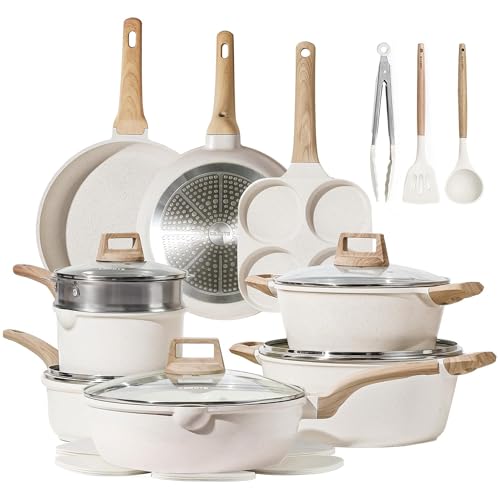
CAROTE 21-Piece Induction Cooking Set with Egg Pan — Best Budget Nonstick Coverage
This CAROTE induction set competes on coverage: a broad spread of pans including a dedicated egg pan, an induction-ready base across the set, and easy-release nonstick throughout, at the most affordable tier in this guide. It is the pick for new induction owners equipping a first kitchen who would rather replace a coating in some years than under-equip themselves today.
Strengths
- Widest vessel coverage here, including the small egg pan breakfast cooks love
- Induction base across the set — no odd pan out on your hob
- Lowest commitment tier for first induction kitchens
Trade-offs
- Judge by vessels, not the 21 headline — accessories pad the count
- Coating longevity at this tier depends entirely on gentle temperatures
- Bases are thinner than the hard-anodized KitchenAid pick
| Specification | Detail |
|---|---|
| Pieces | 21 including accessories (per Amazon title) |
| Base | Induction cooking base (per Amazon title) |
| Includes | Dedicated egg pan (per Amazon title) |
First-kitchen logic is legitimate: a complete, compatible set today beats a perfect pan someday, and this set’s breadth means no missing vessel forces a compromise meal. The egg pan alone earns daily use in breakfast households.
Protect the investment with induction discipline — medium power for preheating, no empty-pan blasting on boost, wooden or silicone tools. Affordable nonstick treated that way serves respectably; treated roughly, no tier of nonstick survives.
Best for: First induction kitchens wanting maximum coverage per spend / Not suited for: Experienced cooks ready for a clad lifetime set
Check the current price on Amazon
Comparison Table
| Pick | Badge | Key spec | Best for |
|---|---|---|---|
| Cuisinart Chef’s Classic 11-Piece Set 77-11G | Best Overall Value | 11-piece stainless, induction-ready base, cool-grip handles | Induction owners wanting one durable, affordable stainless set |
| CAROTE 21-Piece Detachable Handle Set | Best Space-Saving Nonstick | 21-piece nonstick, detachable handles, induction compatible | Small kitchens, flats and RV cooks needing induction nonstick |
| KitchenAid Hard-Anodized Induction Nonstick 10-Piece | Best Mainstream Nonstick | 10-piece hard-anodized, induction base, oven safe to 500°F | Brand-trusting cooks wanting durable induction nonstick |
| Cuisinart MultiClad Pro 12-Piece | Best Clad Upgrade | 12-piece tri-ply clad stainless | Serious home cooks wanting clad performance without the premium tier |
| Tramontina Tri-Ply Clad 12-Piece | Best Clad Alternative | 12-piece tri-ply clad stainless | Value-focused cooks wanting genuine clad for induction |
| CAROTE 21-Piece Induction Cooking Set with Egg Pan | Best Budget Nonstick Coverage | 21-piece nonstick, induction base, egg pan included | First induction kitchens wanting maximum coverage per spend |
How to Choose Affordable Induction Cookware Without Buying Twice
Test magnetism mentally before you shop: a set works on induction only if a magnet would grip its base firmly. Fully clad stainless passes by construction. Nonstick passes only when built on a magnetic base — look for the listing to state induction compatibility explicitly, as the nonstick picks in this guide do, and be suspicious of vague all-hob language.
Prioritise base flatness and substance. Induction concentrates energy in the base footprint; thin bases warp, lose contact and buzz. Hard-anodized bodies and clad construction are the affordable defences. Then check vessel coverage against your real cooking: two saucepans, two frypans, a sauté pan and a stockpot cover most households; exotic pieces you never use are not value at any price.
Finally, decide your coating philosophy honestly. Stainless is the buy-once answer and the backbone of this guide. Nonstick is a renewable convenience with a finite life — legitimate if you cook delicate foods daily and budget for eventual replacement. Mixing both, stainless set plus one nonstick frypan, is what most experienced induction cooks actually do.
Induction Cooking Habits That Protect Your Pans
Induction heats faster than new owners expect. Preheat on medium, add food when the pan is ready, and reserve boost modes for boiling water. Sliding pans across glass hobs grinds grit into both surfaces — lift instead. Match pan size to the hob zone: an undersized pan on a large zone wastes nothing but may not be detected, while oversized bases overhang and heat unevenly at the edges.
For stainless, the preheat-and-fat sequence prevents sticking: warm the pan, add oil until it shimmers, then add food and leave it until it releases naturally. For nonstick, never preheat empty on high, and let pans cool before washing to protect both coating and base flatness.
How to Check Your Kitchen for Induction Compatibility Before You Buy
Run the magnet test on everything you already own. A fridge magnet that grips a pan’s base firmly means the pan will very likely work on induction; a weak grip or no grip means it will not. This five-minute audit tells you exactly how much of your current kit a new hob would orphan.
Measure your hob zones. Note each zone’s diameter and buy sets whose main frypans and stockpot match those footprints. A pan much smaller than its zone may not register; much larger wastes the overhang.
Check flatness with a ruler across each base. Any visible rocking or gap predicts buzzing and uneven heating on induction. New sets in this guide are built flat; older inherited pans are the usual offenders.
Plan the transition purchase. If half your kit fails the magnet test, a clad stainless set from this guide replaces the core in one purchase, and one induction nonstick frypan covers delicate cooking while you rebuild around it.
Common Buying Mistakes
The expensive mistake is assuming a set labelled for all hobs truly suits induction, then discovering weak bases that buzz, crawl on the glass and heat in rings. The second is buying plain aluminium for an induction hob — it will not heat at all, however good the bargain looked.
Overheating nonstick on induction boost is the third classic error; induction’s speed destroys coatings that would survive years on gas. Fourth is piece-count shopping: a 21-piece box of thin pans is worse value than a 10-piece set of clad substance. Count vessels, weigh bases, and read the induction statement in the listing before anything else.
Final Recommendation
Start with the Cuisinart Chef’s Classic 11-piece if you want the affordable induction default in stainless. Reach for MultiClad Pro or Tramontina Tri-Ply if clad evenness matters and the tier allows. Choose the KitchenAid hard-anodized set for branded nonstick durability, and the CAROTE systems for small kitchens or maximum first-kitchen coverage. Check price on Amazon for your pick and confirm induction compatibility on the product page before ordering.
More cookware guidance — including the premium clad tier and aluminium options — is linked below.
Start your shortlist here: Cuisinart Chef’s Classic 11-Piece Set 77-11G CAROTE 21-Piece Detachable Handle Set KitchenAid Hard-Anodized Induction Nonstick 10-Piece. Check price on Amazon for each, read the configuration carefully, and buy the one whose trade-offs you can live with longest.
Best Affordable Cookware Sets Best Affordable Nonstick Cookware Sets Best All Clad Cookware Sets Best Aluminum Cookware Sets
Living With Each Pick: Induction Notes
Cuisinart Chef’s Classic 11-Piece Set 77-11G
Owners on induction praise the boring virtues: every piece registers instantly on every zone, nothing buzzes, and the set simply cooks. The encapsulated base delivers quick boils and steady simmers, and the stainless interiors develop the honest patina of a working kitchen. The common upgrade path is a single nonstick frypan for eggs — after which owners typically report the kitchen feels complete for years.
CAROTE 21-Piece Detachable Handle Set
CAROTE owners talk about space the way other owners talk about searing: cupboards reclaimed, pans stacked in a drawer, a full set travelling to a holiday rental in one bag. The handle click becomes a checked habit, like a seatbelt. On induction the flat bases sit securely, and the system’s oven transfer trick — hob to oven to table in the same vessel — is used far more than buyers expected.
KitchenAid Hard-Anodized Induction Nonstick 10-Piece
KitchenAid owners bought induction nonstick that would not embarrass the hob, and the hard-anodized bodies deliver: flat bases after years, no buzzing, and a coating that ages gracefully under medium-heat discipline. The 500°F oven rating gets used for frittatas and finishes more than expected. It is the nonstick set induction owners recommend to other induction owners.
Cuisinart MultiClad Pro 12-Piece
MultiClad Pro owners are the cooks who notice simmer quality: sauces that hold a lazy bubble at the lowest setting, risottos that never catch, custards without a scorched ring. The clad walls change induction cooking from base-only heating to whole-vessel heating, and owners describe it as the set that made their hob feel professional. It is also the set least often replaced — owners add pieces rather than starting over.
Tramontina Tri-Ply Clad 12-Piece
Tramontina owners enjoy the arbitrage: clad performance their friends paid premium tiers for, bought at a value position. The set handles induction’s speed without hot rings, and its owners are evangelical about cost per year. The recurring note is handle preference — a minority find the grip less comfortable under a full stockpot — which is why our guide suggests handling any clad set before committing.
CAROTE 21-Piece Induction Cooking Set with Egg Pan
Owners of this CAROTE set are equippers: first flats, first induction hobs, kitchens built in one purchase. The egg pan becomes a daily ritual object in breakfast households. Owners are realistic about the coating’s tier — gentle heat, soft tools — and report that treated kindly, the set’s breadth keeps delivering long after the first-kitchen phase it was bought for.
Induction Hobs and Pan Bases: The Physics in Plain Language
An induction hob generates a magnetic field that induces electric currents directly in a magnetic pan base; the pan becomes the heating element. That is why the base must be ferromagnetic, why it must sit flat to couple efficiently with the field, and why pan diameter should roughly match the zone: the field exists where the zone is drawn, and a pan much smaller may not even be detected, while a much larger one heats only across the zone’s footprint.
Clad stainless exploits this beautifully — its magnetic exterior couples with the field, its aluminium core spreads the induced heat, and its interior gives a stable cooking surface. Disc-base pans couple only at the disc, which is why cheap versions can buzz as the layered base vibrates, and why they heat in a ring if the disc is thin. The sets in this guide were chosen to avoid those failure modes at an affordable tier.
Response is induction’s gift and its hazard. A clad pan on boost can go from cold to smoking oil faster than a cook expects, which is why the preheat-on-medium habit appears throughout this guide. Learn your hob’s middle settings with a saucepan of water and a thermometer if you like; an afternoon of calibration makes every pan you own cook better.
Building the Rest of an Induction Kitchen Around Your Set
A set is the core, not the whole kitchen. Most induction households add three things over time: one nonstick frypan for eggs and fish if the core set is stainless, one heavy cast iron or enamelled piece for sustained searing and oven work (cast iron is naturally induction-compatible), and a kettle or saucepan solution sized to the smallest zone for drinks and sauces. Each addition should pass the same magnet and flatness tests as the set itself.
Storage deserves a thought unique to induction: glass hobs scratch when grit is trapped under pans, so store pans clean-based, avoid dragging them across the hob, and wipe the glass before cooking. Pan protectors between stacked clad pieces preserve both the pans and, indirectly, the hob they will sit on.
Finally, keep one eye on the future: induction is where regulation and building design are heading in many markets, and a clad set bought today is hob-proof against gas, radiant and induction alike. That universality is part of what makes the stainless picks in this guide such durable value — they will outlast not just coatings, but kitchens.
Reading an Induction Listing Like an Engineer
Induction listings reward sceptical reading. The phrases that matter are specific: induction compatible, magnetic base, clad construction with named layers. The phrases that warn are vague: suitable for all stovetops on a plain aluminium set, or induction-friendly without a base description. Cross-check the vessel list against the hob you own — a set whose stockpot is its only magnetic piece is not an induction set in any useful sense.
Piece counts deserve the same engineering eye. Count vessels, then lids, then accessories, and price the set by its vessels. A 21-piece box may hold nine vessels; an 11-piece clad box may hold nine better ones. The guide’s picks were counted this way, which is why some headline numbers here are smaller and the cooking value larger.
Finally, read the care and oven statements as specifications, not boilerplate. Oven ceilings reveal handle materials and construction honesty; dishwasher claims reveal finish durability. A set whose listing answers every such question plainly — as the verified listings behind this guide do — is a set whose maker expects scrutiny. That expectation is itself a quality signal.
The One-Pan Additions That Complete an Induction Set
No set, however well chosen, is the whole kitchen. Induction households most often add a cast iron skillet first: naturally magnetic, a peerless searing tool, and the correct home for the high-heat work that protects nonstick and challenges stainless technique. It costs little, lasts forever, and its induction performance is total.
Second is the specialist your cooking actually uses — a wok with a flat magnetic base for stir-fry households, a wide Dutch oven for braise households, a small milk pan for sauce households. Bought after the set, in response to real friction, these additions are always used. Bought speculatively with the set, they are the pieces found untouched in cupboards years later.
Third, for stainless-set owners, is the single nonstick frypan for eggs and fish, induction-based and replaceable. It is a consumable by design, bought without guilt and replaced without ceremony, and it protects the stainless set from being judged by the one job it does least willingly. That three-layer kitchen — clad set, iron skillet, one nonstick pan — is the configuration experienced induction cooks converge on, and this guide’s picks are chosen to serve as its core.
Choosing by Household: Who Should Buy What
For a first induction flat
The CAROTE detachable set or the Chef’s Classic, depending on whether storage or permanence rules the kitchen. Both are complete on day one; they simply optimise different scarcities.
For a family upgrading from gas
The clad picks — MultiClad Pro or Tramontina Tri-Ply — will feel like the revelation induction can be. Budget for one of them rather than a nonstick set you will replace while learning the hob.
For delicate-food households
The KitchenAid hard-anodized set, or a stainless core plus the understanding that eggs want their own pan. Induction’s speed makes nonstick technique easier, not unnecessary.
Induction and Energy: Running Costs in Plain Terms
Induction transfers energy into the pan with an efficiency gas cannot approach, because gas heats the kitchen around the pan as enthusiastically as the pan itself. For households watching energy use, the practical effect is faster boils with less waste heat — most noticeable in summer, when a gas hob’s spillover heat fights the room’s cooling.
Pan choice modulates the advantage. A well-coupled clad pan converts the hob’s field efficiently across its whole base; a poorly coupled disc pan wastes the field’s edges and may cycle the hob’s power as contact varies. The affordable sets in this guide were chosen to preserve the hob’s efficiency rather than squander it, which is a running-cost argument for base quality that never appears on a price tag.
Future-Proofing: Sets That Survive a Hob Change
Kitchens change hobs more often than they change good pans. Clad stainless works on every hob type yet devised — gas, radiant, halogen, induction — which makes the stainless picks in this guide the safest long-horizon purchase in the category. A household that moves from induction to gas, or inherits a different kitchen, keeps its set without a thought.
Nonstick induction sets are hob-specific by construction and should be bought with the current kitchen’s horizon in mind. That is not a flaw; it is a scoping fact, and it is why this guide frames nonstick as a renewable convenience and stainless as infrastructure. Buy each with the right expectation and neither will disappoint you.
Induction for Renters, Movers and Shared Kitchens
Renters face a specific induction problem: the hob is not theirs, its zones are unknown sizes, and the kitchen may change in a year. The rational renter’s set is clad stainless from this guide — it works on the current hob, the next flat’s gas hob, and any hob after that — or the detachable CAROTE system, whose storage virtues suit transient kitchens and whose cost of replacement is survivable if a move damages it.
Shared kitchens add a second filter: abuse tolerance. Housemates will use metal tools, blast heat and stack pans bare. Stainless clad survives that environment with cosmetic complaints; coatings do not. A shared household that buys nonstick should buy it as a known consumable, priced accordingly, and the KitchenAid or CAROTE tiers in this guide are the sensible ceiling for that environment.
Movers should weigh the set literally. Clad stainless is the heaviest luggage in the kitchen and the most survivable; thin sets dent in transit and arrive warped, which on induction means arriving useless. If a move is imminent, it can be rational to cook in a minimal interim kit and buy the real set at the destination, sized to the destination’s hob zones — which you cannot measure from the old kitchen.
Students and first-hob households sit between these cases: limited storage, limited budget, genuine cooking ambitions. The guide’s value picks serve them deliberately, and the magnet test on any inherited or borrowed pans should be their first act in the new kitchen — half of a typical inherited kit fails it, and knowing that on day one prevents a week of confusion.
Across all transient situations the principle is constant: match the set’s permanence to the kitchen’s permanence. Infrastructure pans for stable homes, flexible systems for moving ones, and no premium coatings where other people’s habits will decide their lifespan.
Reader Questions, Answered in Depth
Will these sets work if I change hobs later is the question that decides more purchases than any other, and it splits the guide cleanly. The stainless picks — Chef’s Classic, MultiClad Pro, Tramontina — work on every hob type, full stop. The nonstick picks are induction-built for the kitchen you have; a move to gas keeps them working, since magnetic bases still conduct on flame, but a move should be part of the calculation only if it is genuinely likely. For most households, the current kitchen is the right basis for the decision.
Readers ask why clad costs more than disc-base stainless when both are magnetic and shiny. The answer is in the walls: clad carries its aluminium core up the sides, so the whole vessel heats and holds temperature as one body, while a disc-base pan heats from a plate at the bottom and leaves its walls as passengers. On induction the difference announces itself in sauces, which scorch in rings in disc pans and simmer evenly in clad ones. Whether that difference is worth the step up depends on how much of your cooking is sauce, simmer and reduction — the guide’s clad picks exist for households where the answer is a lot.
The buzzing question returns in every induction discussion, so let it be settled here: a faint hum at high power is the hob and pan interacting normally, while loud buzzing, rattling or a pan that creeps across the glass indicates a thin, layered or warped base. Every pick in this guide was chosen for base substance precisely to avoid the second category. If a pan you already own buzzes loudly, it is telling you about its base, not about your hob.
Piece-count scepticism is healthy and this guide shares it, which is why the reviews count vessels and name them. A reader comparing a 21-piece nonstick box with an 11-piece clad box is not comparing sizes; they are comparing philosophies — breadth now versus depth for decades. Neither is a trick, provided the count is honest, and the listings verified for this guide support the counts used in its reviews.
On care, the question is whether induction demands anything special of the cook beyond the magnet rule. Two habits cover it: lift rather than slide, to protect the glass; and preheat on medium, because induction’s speed punishes the empty-pan habits that gas forgave. Stainless owners add the preheat-and-fat sequence for delicate foods, detailed in this guide, and nonstick owners add the coating disciplines from our sister guides.
The final reader question is always some form of which one, and the guide’s answer is deliberately short: Chef’s Classic for the durable default, MultiClad or Tramontina for clad evenness, KitchenAid for branded nonstick, CAROTE for space or coverage. If you recognise your kitchen in one of those phrases, your decision is made, and the remaining work is only to check the price and the piece list on the day.
A Final Word on Buying Once, Properly
Induction cookware is where the buy-once argument is strongest in the whole kitchen, because the hob exposes weak bases immediately and rewards substance audibly, visibly and daily. A clad set that sits silent and flat, heats as one body and survives every hob change is not a luxury purchase; it is the elimination of a recurring problem. The affordable clad picks in this guide exist to make that elimination reachable without premium money.
For households that choose nonstick, the same principle applies in its renewable form: buy the best-based, best-supported nonstick the tier allows, keep the heat discipline, and refresh the working pieces on schedule. Properly bought once does not always mean bought forever; it means bought with a plan, and every set in this guide was selected to support one.
Measure your zones, run your magnet test, count your vessels, and then commit without second-guessing. An induction kitchen equipped deliberately cooks faster, cleaner and more precisely than the kitchen it replaced — and the set at its centre should feel, within a week, less like a purchase and more like an upgrade to the house itself.
Frequently Asked Questions
How can I tell if a cookware set really works on induction?
Look for an explicit induction statement in the listing and a magnetic base: fully clad stainless qualifies by construction, and nonstick sets must be built on a magnetic base. If you already own a pan, a fridge magnet gripping its base firmly is the quick home test.
Why does my induction pan buzz or hum?
Buzzing usually comes from a thin, layered or slightly warped base vibrating under the magnetic field. Substantial clad or hard-anodized bases, sitting perfectly flat, are the cure — which is why this guide weights base construction so heavily.
Is stainless or nonstick better for induction?
Stainless wins on longevity and searing; nonstick wins on delicate foods and cleanup. Most experienced induction cooks own a stainless set for the core work and one induction nonstick frypan for eggs and fish.
Can I use my existing aluminium pans on induction?
Plain aluminium is not magnetic and will not heat. Aluminium pans with a bonded magnetic induction base will work — check the base with a magnet. If yours fail the test, the sets in this guide are the affordable replacement route.
What sizes matter most in an induction set?
Match your most-used pans to your hob zone diameters. A frypan and stockpot that fit their zones exactly heat most evenly and are detected most reliably by the hob’s sensors.
Do I need special care for induction cookware?
Lift pans instead of sliding them to protect the glass hob, preheat on medium rather than boost to protect bases and coatings, and keep bases clean and flat. Those habits preserve both the cookware and the hob.

