Disclosure: airfryerkitchensupply.com is reader-supported. When you buy through links on our site, we may earn an affiliate commission at no extra cost to you.
Where to buy
All six sets below are sold on Amazon. This guide takes the ceramic-first view of affordable nonstick: PFAS-free coatings, easy release and honest expectations about ceramic’s lifespan. The strongest starting points are the GreenLife Soft Grip 16-Piece Ceramic Set, GreenPan Valencia Pro 11-Piece, GreenLife Soft Grip 12-Piece Ceramic Set (Pink). Also linked in this guide: the T-fal Initiatives Ceramic 14-Piece, Farberware EcoAdvantage 13-Piece, Caraway 12-Piece Cookware Set (Cream). Check the current price on Amazon for each pick before you order, and confirm the exact configuration on the product page, because bundles and colourways change.
Introduction
The best affordable nonstick cookware sets in 2026 are increasingly ceramic, and for a clear reason: many buyers now want easy-release cooking without traditional nonstick chemistry, at a tier that does not require a premium brand. Ceramic coatings — silica-based, PFAS-free by design — deliver genuinely slick performance and cheerful colours, and the affordable end of the market has matured from fragile novelty to credible everyday cookware.
Honesty about ceramic matters more than hype. Ceramic coatings lose slickness gradually with heat and use; a well-kept ceramic set gives several good years, not a decade, and its prime is its first phase of life. That trade is worth making for many households — especially those cooking eggs, fish and sauces daily — provided it is made knowingly. This guide ranks the affordable ceramic sets by coating quality, body substance and coverage, with the conventional alternative noted where it genuinely serves better.
Every set here was verified, and every review states the care habits its coating needs. If you finish this guide and decide ceramic’s lifespan trade is not for you, the hard-anodized guide linked below is the other honest answer to the same brief.
In this guide
Quick Picks
- Best Overall Ceramic Value — GreenLife Soft Grip 16-Piece Ceramic Set: The ceramic value standard: sixteen pieces of PFAS-free ceramic nonstick with comfortable soft-grip handles.
- Best Ceramic Upgrade — GreenPan Valencia Pro 11-Piece: The step-up ceramic: hard-anodized bodies under GreenPan’s premium ceramic coating for a longer prime.
- Best for Small Kitchens — GreenLife Soft Grip 12-Piece Ceramic Set (Pink): The compact ceramic set: twelve pieces, PFAS-free coating and small-kitchen proportions in a cheerful finish.
- Best Beginner Ceramic — T-fal Initiatives Ceramic 14-Piece: The beginner-friendly ceramic: fourteen pieces from a mainstream maker with an easy learning curve.
- Best Eco-Minded Pick — Farberware EcoAdvantage 13-Piece: The recycled-body ceramic: thirteen pieces built from recycled aluminium with a ceramic cooking surface.
- Best Design-Led Ceramic — Caraway 12-Piece Cookware Set (Cream): The design-led ceiling: ceramic performance with the storage system and finish design kitchens are built around.
How These Picks Were Chosen
Selection weighted coating credibility first — established ceramic systems over anonymous coatings — then body material and thickness, since ceramic on a warped body fails as fast as any coating. Coverage, lid quality, handle comfort and colourway stability across replacement purchases completed the assessment.
The shortlist spans the ceramic category’s real range: GreenLife’s soft-grip value lines in two sizes, GreenPan’s Valencia Pro and Reserve tiers for buyers stepping up, T-fal’s ceramic entry, Farberware’s recycled-body set, and Caraway’s design-led box as the tier’s ceiling.
The 6 Best Affordable Nonstick Cookware Sets

GreenLife Soft Grip 16-Piece Ceramic Set — Best Overall Ceramic Value
GreenLife’s Soft Grip 16-piece is the set that made ceramic nonstick a mainstream affordable choice: a complete vessel list, PFAS-free ceramic coating, soft-grip handles that stay comfortable, and colours that make the set pleasant to live with. In black, as listed here, it also hides the minor staining ceramic exteriors can collect. For most ceramic-first buyers, this is the starting point and often the finishing point.
Strengths
- Complete coverage at the tier where ceramic makes most sense
- PFAS-free ceramic release that excels at eggs, fish and sauces
- Soft-grip handles and light bodies suit everyday, all-household cooking
Trade-offs
- Ceramic slickness fades gradually — expect a strong prime, not permanence
- Bodies are light aluminium; avoid maximum heat to protect coating and flatness
- Dark interiors in some colourways make browning harder to judge than light ceramic
| Specification | Detail |
|---|---|
| Pieces | 16 (per Amazon title) |
| Coating | Ceramic nonstick |
| Handles | Soft grip |
The Soft Grip formula works because it is honest: light aluminium bodies keep the tier low and the pans easy to handle, while the ceramic does the one job asked of it — release — very well in its prime. Households that cook delicate foods daily get more daily pleasure from this set than from a theoretically longer-lived pan they find heavy or sticky.
Plan ownership realistically: rotate the two frypans, keep heat at medium, and the set serves well for years. When the hardest-used frypan eventually tires, GreenLife sells pieces separately, so the set retires gradually rather than all at once.
Best for: Ceramic-first households wanting complete affordable coverage / Not suited for: Buyers expecting a ten-year buy-once set
Check the current price on Amazon

GreenPan Valencia Pro 11-Piece — Best Ceramic Upgrade
Valencia Pro is what ceramic buyers graduate to: hard-anodized bodies that stay flat and spread heat, GreenPan’s premium ceramic coating, and a build quality that extends ceramic’s prime noticeably beyond the value lines. It costs more than the GreenLife sets and returns it in evenness, durability and the confidence to use the pans daily without ceremony.
Strengths
- Hard-anodized bodies give ceramic its most durable affordable foundation
- Premium ceramic system with a longer slick prime than value coatings
- Balanced, professional feel that suits enthusiastic daily cooks
Trade-offs
- Top of the affordable ceramic tier — check price on Amazon
- Still ceramic: heat discipline decides its lifespan
- Eleven pieces is coverage for most, but large families may want a supplementary stockpot
| Specification | Detail |
|---|---|
| Pieces | 11 (per Amazon title) |
| Body | Hard-anodized with ceramic coating (Valencia Pro line) |
Body quality is ceramic’s secret variable. A premium coating on a thin body dies by warping and hot spots; on Valencia Pro’s anodized bodies, the same class of coating cooks evenly and ages gracefully. If ceramic is your chosen surface and you cook daily, this is the tier where it stops feeling like a compromise.
Pair it with the habits in this guide’s how-to section — medium heat, soft tools, protectors in storage — and Valencia Pro is the ceramic set most likely to still please you in year four.
Best for: Daily cooks committed to ceramic who want its best affordable form / Not suited for: Occasional cooks — the GreenLife value lines serve better
Check the current price on Amazon

GreenLife Soft Grip 12-Piece Ceramic Set (Pink) — Best for Small Kitchens
The 12-piece Soft Grip set trims the 16-piece formula to the vessels small kitchens actually store: core frypans, saucepans and a stockpot in the same PFAS-free ceramic, listed here in pink with other colourways sharing the line. For couples, small families and first flats, it is the ceramic set that fits both cupboard and budget without leaving a daily vessel behind.
Strengths
- Right-sized coverage — no orphan pieces eating cupboard space
- Same PFAS-free ceramic and soft-grip comfort as the larger set
- Light, colourful and welcoming for new cooks
Trade-offs
- Growing families will outgrow the stockpot and frypan sizes
- Ceramic care rules apply in full — medium heat, soft tools
- Colourways can drift between production runs; buy spares in the same order if colour matching matters
| Specification | Detail |
|---|---|
| Pieces | 12 (per Amazon title) |
| Coating | PFAS-free ceramic nonstick (per Amazon title) |
| Care | Dishwasher safe (per Amazon title) |
Small-set discipline is underrated. Every piece here earns its shelf, which means every piece gets used, washed gently and stored properly — the exact conditions ceramic needs. Oversized sets in small kitchens get stacked, chipped and abused; this one gets cared for almost by default.
Choose it over the 16-piece when your household is one to three people or your storage is genuinely tight. The cooking experience is the same; only the extremes of batch size differ.
Best for: Couples and small kitchens wanting ceramic without clutter / Not suited for: Large families cooking in bulk
Check the current price on Amazon
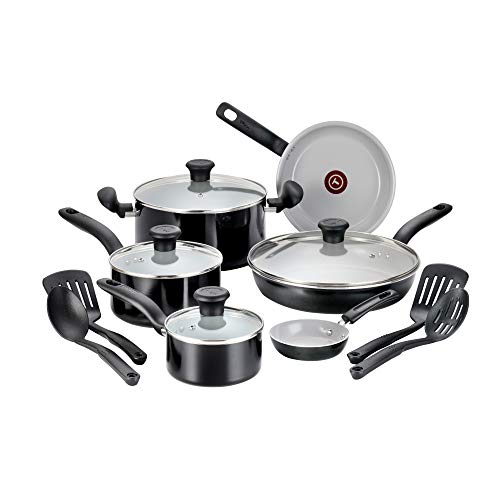
T-fal Initiatives Ceramic 14-Piece — Best Beginner Ceramic
T-fal’s Initiatives Ceramic set is the gentle on-ramp to ceramic cooking: fourteen pieces, a mainstream brand’s quality control, and bodies with recycled content that suit buyers weighing environmental factors alongside release performance. For households leaving traditional nonstick for the first time, it is the lowest-risk way to learn ceramic’s habits.
Strengths
- Mainstream brand consistency at an entry tier
- Generous fourteen-piece coverage for households equipping fully
- A forgiving set on which to learn ceramic heat discipline
Trade-offs
- Entry-tier bodies — treat heat gently to keep bases flat
- Ceramic prime is shorter than the GreenPan upgrade pick
- Oven limits on ceramic lines are modest; check your listing’s stated ceiling
| Specification | Detail |
|---|---|
| Pieces | 14 (per Amazon title) |
| Coating | Ceramic nonstick (Initiatives line) |
Beginners destroy coatings by overheating, and ceramic forgives learning better than its reputation suggests provided the heat stays medium. This set’s value is that it teaches those habits across a full kitchen of vessels, so the lesson transfers when you upgrade.
If you already know you love ceramic and cook daily, skip a step and buy the Valencia Pro. If you are testing the surface for the first time, this is the sensible tuition.
Best for: First-time ceramic buyers equipping a full kitchen / Not suited for: Experienced ceramic cooks ready for the premium tier
Check the current price on Amazon

Farberware EcoAdvantage 13-Piece — Best Eco-Minded Pick
EcoAdvantage builds its ceramic set on recycled aluminium bodies, giving the eco-minded buyer a coherent story: recycled metal below, PFAS-free ceramic above, and a thirteen-piece vessel list that covers a household properly. Farberware’s long mass-market history also means replacements and support are easy to find.
Strengths
- Recycled-body construction for buyers minimising new-material footprint
- Complete thirteen-piece coverage from an established brand
- Ceramic release with easy, low-effort cleanup
Trade-offs
- Light bodies need the usual ceramic heat discipline
- Grey finish is practical but the least decorative here
- Not an induction set — aluminium bodies need a magnetic base
| Specification | Detail |
|---|---|
| Pieces | 13 (per Amazon title) |
| Body | Recycled aluminium with ceramic nonstick (EcoAdvantage line) |
Sustainability claims in cookware are often garnish; here the recycled body is the product’s actual construction, which makes the EcoAdvantage the coherent choice for buyers who rank material footprint alongside cooking performance. The cooking itself is standard good ceramic: slick, light and gentle-heat dependent.
It competes most directly with the GreenLife 16-piece: choose Farberware for the recycled construction and brand, GreenLife for the extra coverage and colour choice.
Best for: Eco-minded buyers wanting ceramic on recycled bodies / Not suited for: Induction owners
Check the current price on Amazon

Caraway 12-Piece Cookware Set (Cream) — Best Design-Led Ceramic
Caraway’s 12-piece set is affordable ceramic’s design ceiling: a ceramic-coated set sold as much on its storage system and kitchen-present finish as on its cooking. The cream listing here is the line’s signature look. It sits at the top of this guide’s tier, and its buyers are paying for the total object — pans, organisers and appearance — not merely for release performance.
Strengths
- Storage organisers keep ceramic protected — the care habit most sets leave to chance
- Design and finish that suit open-plan, display kitchens
- Ceramic cooking performance matching the category’s better sets
Trade-offs
- Highest tier here by a margin — check price on Amazon and buy it for the design, knowingly
- Cream exteriors show cooking marks more than dark finishes
- Ceramic lifespan rules are unchanged by the premium presentation
| Specification | Detail |
|---|---|
| Pieces | 12 (per Amazon title) |
| Coating | Ceramic nonstick (Caraway line) |
| Colourway | Cream (per Amazon title) |
Caraway’s insight is organisational: ceramic dies by stacking and chipping as much as by heat, and a set that arrives with its own storage defence protects the coating from day one. That, plus genuine aesthetic pleasure, is a rational purchase for design-led kitchens.
Go in clear-eyed that you are buying the category’s best-presented ceramic, not a different lifespan class. With medium heat and its own organisers, it will serve as well as any ceramic here — and look better doing it.
Best for: Design-led kitchens wanting ceramic with built-in storage care / Not suited for: Value-first buyers — GreenLife delivers the cooking for less
Check the current price on Amazon
Comparison Table
| Pick | Badge | Key spec | Best for |
|---|---|---|---|
| GreenLife Soft Grip 16-Piece Ceramic Set | Best Overall Ceramic Value | 16-piece ceramic nonstick, soft-grip handles | Ceramic-first households wanting complete affordable coverage |
| GreenPan Valencia Pro 11-Piece | Best Ceramic Upgrade | 11-piece hard-anodized ceramic, premium ceramic tier | Daily cooks committed to ceramic who want its best affordable form |
| GreenLife Soft Grip 12-Piece Ceramic Set (Pink) | Best for Small Kitchens | 12-piece ceramic, PFAS-free, dishwasher safe | Couples and small kitchens wanting ceramic without clutter |
| T-fal Initiatives Ceramic 14-Piece | Best Beginner Ceramic | 14-piece ceramic, recycled-body line | First-time ceramic buyers equipping a full kitchen |
| Farberware EcoAdvantage 13-Piece | Best Eco-Minded Pick | 13-piece ceramic, recycled aluminium bodies | Eco-minded buyers wanting ceramic on recycled bodies |
| Caraway 12-Piece Cookware Set (Cream) | Best Design-Led Ceramic | 12-piece ceramic, storage system included in the line | Design-led kitchens wanting ceramic with built-in storage care |
How to Choose an Affordable Ceramic Nonstick Set
Start with the coating’s maker, not its colour. Established ceramic systems from GreenPan, GreenLife and the mainstream brands have predictable primes and replacement availability; anonymous ceramic at a suspicious tier usually has neither. Then weigh the body: hard-anodized foundations extend ceramic life, light aluminium lowers the tier and demands gentler heat.
Count vessels against your cooking, and prefer sets whose frypans are sold separately — the frypan is always the first piece to tire, and a replaceable frypan turns a dying set into a maintained one. Finally, choose colour with your eyes open: light interiors show browning beautifully and show stains honestly; dark exteriors hide the marks of daily cooking.
Ceramic vs Traditional Nonstick: The Honest Comparison
Ceramic wins on chemistry preference — PFAS-free by design — on high-heat tolerance in short bursts, and on the cooking feel of its slick prime. Traditional hard-anodized nonstick wins on lifespan: its prime lasts longer, which is why our sister guide recommends it for durability-first buyers. Neither is the correct answer for everyone; the correct answer is the trade you will be happiest living with in year two, not month two.
Many households split the difference: ceramic for the daily egg-and-sauce work where its prime shines, and a stainless or cast iron pan for searing. That combination outlasts any single-surface strategy and is worth considering before buying any full set.
How to Care for Ceramic Nonstick So It Stays Slick Longer
Cook on medium. Ceramic’s enemy is sustained high heat, which degrades the coating’s release. Preheat briefly on medium, cook at the lowest effective setting, and let a different pan — stainless or cast iron — handle true searing.
Use a little fat even though the pan is nonstick. A thin film of oil or butter protects the surface, improves browning and dramatically extends the slick prime. Dry-cooking at high heat is the fastest way to age ceramic.
Wash soft and cool first. Let pans cool before washing, use a soft sponge, and for stubborn film soak in warm soapy water rather than scrubbing. A paste of bicarbonate of soda lifts most ceramic staining without abrasion.
Store separated. Use the organisers or protectors between pans; rim chips from stacking are where ceramic flaking starts. A set stored carefully keeps its prime measurably longer.
Common Buying Mistakes
The ceramic-specific mistake is cooking like it is stainless — maximum heat, dry pans, metal tools — then concluding ceramic does not work. The second is buying by colourway alone from an unknown coating maker, with no replacement frypan available when the first one tires.
Third is expecting permanence. A buyer who understands ceramic as a several-year surface with a brilliant prime will be delighted; a buyer promised a lifetime pan will be disappointed by any brand. Read trade-offs before tiers, and ceramic will treat you well.
Final Recommendation
For most ceramic-first buyers, the GreenLife Soft Grip 16-piece is the best affordable nonstick cookware set: complete, comfortable and fairly tiered. Step up to GreenPan Valencia Pro for a longer prime on hard-anodized bodies, choose the 12-piece GreenLife for small kitchens, T-fal Initiatives for a first ceramic kitchen, Farberware EcoAdvantage for recycled construction, and Caraway when design and storage matter as much as cooking. Check price on Amazon and confirm the colourway and piece list before ordering.
If lifespan outranks coating chemistry in your priorities, the hard-anodized guide linked below is your other honest route.
Start your shortlist here: GreenLife Soft Grip 16-Piece Ceramic Set GreenPan Valencia Pro 11-Piece GreenLife Soft Grip 12-Piece Ceramic Set (Pink). Check price on Amazon for each, read the configuration carefully, and buy the one whose trade-offs you can live with longest.
Best Affordable Non-stick Cookware Sets Best Affordable Cookware Sets Best Affordable Induction Cookware Sets Best 8 Ceramic Cookware Sets Best Aluminum Cookware Sets
Living With Each Pick: Ceramic Ownership Notes
GreenLife Soft Grip 16-Piece Ceramic Set
Soft Grip owners describe an easy daily relationship: eggs slide, sauces rinse away, and the pans’ lightness makes the full set manageable for every cook in the house. The prime is genuinely delightful, and owners who rotate the frypans and keep heat moderate report that prime stretching well beyond sceptics’ predictions. The black finish of this listing hides the exterior marks that lighter colourways show honestly.
GreenPan Valencia Pro 11-Piece
Valencia Pro owners are ceramic’s committed: they wanted the surface without the fragility, and the hard-anodized bodies deliver it. The set cooks with an evenness value ceramic cannot match, and its prime lasts accordingly. Owners treat it like the premium object it is — protectors, soft tools, medium heat — and are repaid with the longest ceramic service in this guide.
GreenLife Soft Grip 12-Piece Ceramic Set (Pink)
The 12-piece set’s owners are small-kitchen realists: every piece used weekly, nothing stored in exile. The pink finish divides visitors and delights owners, which is the correct order of priorities. Because the set is small, it is cared for almost automatically — no desperate stacking, no forgotten pan at the cupboard’s back — and ceramic rewards exactly that environment.
T-fal Initiatives Ceramic 14-Piece
Initiatives owners are often ceramic’s first-timers, and their accounts read like learning curves: early overheating mistakes, then the medium-heat habit, then genuine attachment to the surface’s release and cleanup. The set’s breadth lets the lesson happen across every vessel type at once, so graduates of this set know ceramic thoroughly when they choose their next tier.
Farberware EcoAdvantage 13-Piece
EcoAdvantage owners bought a story they could verify — recycled bodies, ceramic surface — and found a competent daily set attached to it. The grey finish is the pragmatist’s choice, hiding marks and suiting any kitchen. Owners on gas and radiant hobs report easy service; the set’s lightness suits the smaller households that form its natural audience.
Caraway 12-Piece Cookware Set (Cream)
Caraway owners bought an object as much as a tool, and the organisers turn out to be the functional heart of it: pans stored separated, coating unchipped, the set permanently ready. The cream finish demands a wipe-down honesty that dark sets forgive, and owners who accept that bargain get the category’s most pleasurable daily ritual — cooking from a set that looks like it was designed, because it was.
Ceramic’s Prime: Getting the Most From the Slick Years
Ceramic ownership is best understood as enjoying a prime rather than fighting a decline. In its prime — which good care stretches across years — a ceramic pan releases better than almost anything, cleans with a wipe, and handles eggs, fish, and sauces with a grace that explains the category’s popularity. The strategies in this guide all serve one goal: keeping the prime long. Medium heat, a little fat, soft tools, separated storage. None is burdensome; together they are the difference between a two-year set and a five-year set.
When the prime fades, it fades gradually and honestly: first a little more fat is needed, then delicate foods need a watchful eye. Many owners demote a tired frypan to reheating and vegetable duty, where it serves happily, and replace only that pan. The set-as-system view — refresh the hardest worker, keep the rest — applies to ceramic exactly as it does to traditional nonstick.
There is also a pleasure argument that pure durability analysis misses. A household that cooks eggs every morning in a pan it loves, at a tier it can refresh without pain, may be better served by ceramic’s renewable prime than by a theoretically permanent pan it finds heavy and grabby. Value lives in the cooking, not only in the years.
What to Cook in Ceramic (and What to Cook Elsewhere)
Ceramic’s home ground is the delicate and the saucy: eggs in every form, fish fillets, pancakes, quesadillas, reheated grains, and any sauce that would cement itself to stainless. Its release and easy cleanup turn these from technique tests into weeknight trivialities, which is why ceramic frypans earn daily use in the households that own them.
Its away ground is sustained high heat: hard sears, blackening, and dry high-temperature work belong to cast iron or stainless, which shrug off temperatures that age ceramic quickly. Owning one heavy searing pan beside a ceramic set is not an admission of failure; it is the standard professional division of labour, scaled to a home kitchen.
Saucepans are ceramic’s quiet triumph. Porridge, custards, caramel-adjacent sauces and reheated soups release and rinse in ways that make stainless feel laborious, and because saucepan cooking is liquid-capped in temperature, the coating ages slowly there. If a full ceramic set is beyond the brief, a ceramic saucepan plus a ceramic frypan captures most of the category’s daily joy.
Ceramic Colours, Interiors and Reading Browning
Ceramic’s colours are not merely decorative; interior colour changes how you cook. Light interiors — the creams and whites of the category — show browning, fond and sauce colour honestly, which makes them the better teacher and the better tool for anything judged by eye. They also show staining honestly, and a household that cannot abide a pan that looks used should choose with that knowledge.
Dark interiors hide both sins: they conceal staining and minor wear, and they conceal the browning cues a cook needs. For egg-and-breakfast sets, where browning barely matters, dark is the pragmatic choice. For a set expected to make pan sauces and sear-adjacent dishes, light interiors earn their maintenance. The picks in this guide span both, and the reviews note which way each leans.
Exterior colour follows the same logic at lower stakes: dark exteriors hide the marks of gas flames and oven racks; light exteriors show a kitchen’s care. Caraway’s cream is a commitment to wiping down; GreenLife’s black is a commitment to not worrying. Neither is wrong — but choose the commitment you will actually keep.
Your First Month With Ceramic: Building the Right Habits Early
Month one decides a ceramic set’s lifespan more than any later month, because habits form while the pans are new and forgiving. Cook the first fortnight entirely on medium heat, even when impatience argues otherwise, and watch how much cooking ceramic actually does at those settings — most new owners are surprised, and the surprise recalibrates their instincts permanently.
Use the first month to learn the fat film: a teaspoon of oil spread across the warm pan before eggs, a knob of butter before fish. Ceramic in its prime needs little, but that little is protective as well as culinary, and the habit built now will carry the pans through their later, less slick years with grace.
Finally, set the storage system in week one — protectors, organisers, a rule that ceramic is never stacked bare. Retrofitting storage discipline after the first chips appear is possible but melancholy. The households whose ceramic still delights them in year three are, almost without exception, the ones whose month one looked like this.
Choosing by Household: Who Should Buy What
For a PFAS-free family kitchen
The GreenLife 16-piece is the default: complete coverage, comfortable handles, a tier that permits refresh without pain. It is the set this guide hands to family buyers first.
For a committed daily cook
Valencia Pro, without hesitation. Ceramic on hard-anodized bodies is the category’s best self, and a daily cook extracts its value in months.
For a design-led renovation
Caraway, bought knowingly: the organisers protect the coating, the finish dignifies the kitchen, and the cooking matches the category’s better sets. Buy the look with open eyes and it will not disappoint.
Ceramic and Dishwashers, Ovens and Broilers: Reading the Limits
Most ceramic sets are listed as dishwasher safe, and most ceramic owners who hand wash keep their primes longer — both statements are true, and the second is the one that matters. Dishwasher detergents are alkaline and abrasive in effect over hundreds of cycles; a soft sponge is neither. Treat dishwasher safety as accident insurance, not a routine.
Oven limits on ceramic sets are set by handles and coatings together, and they vary by line, so the listing’s stated ceiling for your specific set governs. Broilers are ceramic’s hardest environment — direct radiant heat at maximum intensity — and most ceramic should simply not go there. A household that broils often needs one broiler-safe pan in another material, which this guide’s mixed-kitchen advice already provides.
The Refresh Purchase: Replacing One Ceramic Frypan Well
When the first frypan tires, the refresh purchase deserves the same care as the original set. Match the line if it served you well — coating generations are consistent within a brand, and handles and lids stay familiar. If it disappointed, the refresh is the moment to change families: GreenLife owners step to GreenPan, value-line owners step to hard-anodized bodies, and everyone steps with evidence.
Keep the retired pan for reheating and vegetable duty if its surface is intact but less slick; demotion extends the system’s value and delays waste. When a coating is genuinely worn or damaged, retire the pan fully and replace it without nostalgia. Ceramic ownership done well is a rhythm of enjoyment and timely refresh, not a vigil over a declining surface.
Ceramic for Breakfast, Lunch and the Working Week
Ceramic’s case is ultimately a weekday case, and it is worth walking the day. Breakfast is the surface’s parade ground: eggs, pancakes, reheated hashes and grilled sandwiches all release cleanly at medium heat, and the pan rinses in seconds before the school run. No other surface starts a household’s day with less friction, and that daily experience — repeated hundreds of times — is what ceramic owners are actually buying.
Lunch extends the pattern: quesadillas, reheated grains that crisp at the edges without cementing, fish fillets that leave the pan intact. The ceramic saucepan reheats soup and porridge without the scorched ring that makes stainless a chore at midday. These are small mercies, but lunch is a small meal, and mercies at that scale decide whether home cooking happens at all on busy days.
Dinner is where the mixed kitchen takes over: ceramic keeps the delicate work — the fish, the sauce, the eggs for a breakfast-for-dinner plate — while the heavy pan sears and the stockpot boils. Judged as a dinner-only purchase, ceramic looks partial; judged as the surface that carries two meals a day flawlessly, it looks like the hardest-working cookware in the house.
That framing also sets the refresh economics correctly. A pan used twice daily that gives three strong years has delivered thousands of low-friction meals; its cost per meal is trivial, and replacing it is maintenance, not failure. Ceramic bought with weekday expectations and refreshed on schedule may be the most rational cookware purchase in this entire guide series.
The households that sour on ceramic are those that bought it for the wrong shift — the searing, the broiling, the dinner-party heroics. Buy it for the working week it was made for, and it will not sour on you.
Reader Questions, Answered in Depth
Is ceramic really nonstick, or just marketed that way, is the sceptic’s opening question, and it deserves a factual answer: a fresh ceramic coating is genuinely, impressively slick — eggs slide, cheese releases, sauces rinse away. What ceramic is not is permanently slick. Its release declines gradually with heat exposure, which is why this guide speaks of a prime rather than a lifespan and why every review pairs its praise with the habits that stretch that prime. Scepticism aimed at permanence is justified; scepticism aimed at performance is not.
Readers ask how ceramic compares with the hard-anodized sets in our sister guide on the specific work of eggs and fish, and the honest verdict is that ceramic in its prime is the more pleasurable surface for both — slicker, gentler, easier to clean — while hard-anodized traditional nonstick is the surface still performing in year four. Households that cook eggs daily and refresh willingly choose ceramic happily; households that buy once choose the sister guide. The guides are complements, not rivals, and many kitchens eventually own one set of each kind across a decade.
The staining question is practical: light ceramic interiors will show turmeric, tomato and high-heat marks over time, and most lift with a bicarbonate soak rather than scrubbing. Owners who find honest wear marks distressing should choose dark interiors or exteriors from the start — the GreenLife black listing in this guide exists for exactly that temperament — rather than fighting their own standards with bleach and abrasives that harm the coating they are trying to beautify.
Metal utensils prompt a nuanced answer. Ceramic is harder than traditional coatings and tolerates occasional metal contact without immediate damage, but the habit this guide teaches is soft tools as the default and metal tolerance as insurance. The distinction matters because coating damage is cumulative and invisible until it is not; a household that treats tolerance as permission will shorten its prime measurably.
On oven use, the governing fact is that limits are set per line and per handle material, and the only safe number is the one stated for your specific set. Ceramic itself tolerates heat well; handles and exterior finishes set the ceiling. This guide’s reviews flag the question wherever it matters, and the product page for your chosen set is the authority to check before the first oven finish — a thirty-second verification that protects a multi-year purchase.
The closing question — which set — has the guide’s usual short answer: GreenLife 16-piece for most ceramic buyers, Valencia Pro for the committed, the 12-piece GreenLife for small kitchens, T-fal Initiatives for beginners, Farberware for recycled construction, Caraway for design. Ceramic rewards the buyer who matches the set to their temperament as much as to their cooking, because the care habits are the product as surely as the coating is.
A Final Word on Choosing Ceramic With Open Eyes
Ceramic asks its buyers for one thing in exchange for its pleasures: honesty about time. Its prime is real, its decline is gradual, and its value is delivered in thousands of easy meals rather than in decades of service. Buyers who accept that bargain explicitly — as this guide has asked at every stage — report the highest satisfaction in the category, because nothing about their ownership comes as a betrayal.
The sets ranked here span the bargain’s range, from the refresh-friendly GreenLife boxes to the hard-anodized Valencia Pro and the design-complete Caraway. Each is the right answer for a temperament as much as for a kitchen. Match yours — the gentle daily cook, the committed ceramicist, the design-led renovator — and the set will feel chosen rather than merely bought.
Then cook breakfast in it tomorrow morning. Eggs sliding onto the plate, the pan rinsing clean in seconds, the day starting without friction: that small, repeatable pleasure, multiplied across years, is ceramic’s whole case — and for the households in this guide, it is case enough.
One More Consideration: Ceramic Across the Seasons
Ceramic’s value shifts pleasantly with the cooking calendar, and owners who keep a set across a full year see the pattern. Spring and summer belong to its lightness: eggs, fish, vegetables and reheats in a kitchen that does not want heavy pans or heavy washing. Autumn brings sauces and porridges, where the saucepans’ release earns its keep daily. Winter is the mixed kitchen’s season, with ceramic carrying the delicate work beside the heavy pans that braise.
That seasonal rhythm is worth anticipating at purchase, because a set bought in one season is judged by another’s cooking soon enough. The complete boxes in this guide — GreenLife’s above all — were chosen to hold their value across the whole calendar rather than shine in a single season. A set that serves breakfast in July and custards in December has earned its cupboard space twice over.
One last habit ties every section of this guide together: spend the first fortnight cooking in the set deliberately — breakfast eggs, a fish dinner, a saucepan of porridge, a reheated lunch — so the ceramic’s prime, the handles’ comfort and the vessel sizes prove themselves against your real cooking while returns are still simple. A ceramic set that earns your respect in that fortnight, handled gently and stored apart, will go on earning it through season after season of easy, low-friction meals.
That fortnight test, applied honestly, is the closest thing cookware buying has to a guarantee. It converts a purchase made from listings and reviews into a judgement made from your own cooking, in your own kitchen, with your own hands on the handles and your own breakfasts in the pans. Every guide in this series ends with the same advice because it works for every material and every tier: buy deliberately, test immediately, keep what proves itself, and let the habits in these pages carry the set the rest of the way.
Cook well, store carefully, refresh on schedule, and ceramic will keep its side of the bargain for a long and pleasurable prime.
Frequently Asked Questions
Is ceramic nonstick really PFAS-free?
Yes — ceramic coatings are silica-based sol-gel surfaces and are PFAS-free by design, which is the main reason buyers choose them. Every ceramic pick in this guide was selected with that preference in mind.
How long does affordable ceramic nonstick last?
Expect a strong slick prime followed by gradual decline over several years of daily use with medium heat and soft tools. Hard-anodized bodies, like the Valencia Pro pick, extend the prime; high heat shortens it sharply.
Why did my ceramic pan lose its nonstick quality?
Sustained high heat and dry cooking are the usual causes, followed by abrasive cleaning and stacking damage. A gentle bicarbonate soak restores mildly filmed pans; a pan whose coating is worn through needs replacement.
Can ceramic pans go in the oven?
Most ceramic sets tolerate moderate oven temperatures, but limits vary by handle material and line. Check the stated ceiling for your specific set on its product page and never exceed it, especially under a grill or broiler.
Ceramic or hard-anodized nonstick — which should I buy?
Choose ceramic if PFAS-free chemistry and easy delicate cooking matter most and you accept a finite prime. Choose hard-anodized traditional nonstick if maximum coating lifespan is the priority. Our linked sister guide ranks that side in full.
Do ceramic sets work on induction?
Only if built on a magnetic base, which most aluminium ceramic sets are not. Induction owners should verify compatibility explicitly or start from our induction cookware guide.

