Disclosure: airfryerkitchensupply.com is reader-supported. When you buy through links on our site, we may earn an affiliate commission at no extra cost to you.
Where to buy
All six sets below are sold on Amazon and were each checked against their current listings before inclusion. Gas-stove shoppers should really start with the T-fal Ultimate Hard Anodized 17-piece set for the best all-round flame performance at a fair tier, or the Cuisinart Chef’s Classic 10-piece set if stainless durability matters more than nonstick ease. Also covered and linked below: the Calphalon Classic Stainless 10-piece set, the Ninja NeverStick Premium 12-piece set, the Tramontina PrimaWare 18-piece set and the GreenLife Soft Grip 16-piece ceramic set.
Introduction
The best affordable cookware sets for gas stove cooking are chosen by different rules than cookware in general, because an open flame is both the most forgiving and the most revealing heat source in the whole kitchen, rewarding good equipment instantly and exposing weak equipment just as fast. Forgiving, because almost any pan material works over gas — no magnetic bases, no flatness demands from a glass hob. Revealing, because gas exposes cheap pans instantly: a thin base hotspots over the flame ring, a lightweight pan rocks on the grates, a plastic-heavy handle sits too close to a licking flame, and a pretty exterior finish blackens with soot in a month. Affordable sets fail on gas in ways they never would on electric — which is why this guide exists separately from our general affordable roundup, and why its picks were re-earned rather than copied across.
The six picks below were filtered for flame life specifically. Heavy, flat bases that spread a ring of fire into an even disc of heat. Bodies that sit stable on grates. Handles positioned and built to tolerate the way gas heat wraps around a pan’s sides. Exteriors that either shrug off soot or clean up from it easily. And across all of that, the affordable brief still holds firm: every set here sits in the budget or lower-mid tier, from makers who document what they sell and stand behind it afterwards. The T-fal Ultimate leads on sheer gas competence per unit of money spent; the two stainless sets answer for cooks who want a full decade from the purchase; the Ninja is the premium nonstick that treats gas like its first language; the PrimaWare is the undisputed budget coverage king; and the GreenLife is the ceramic option, included with honest handling notes for cooking over open flame.
We also want to be upfront about what “affordable” means in a gas context, because flame quietly taxes cheap equipment in ways the shelf price hides. A thin pan that warps over a power burner costs a replacement; a handle that cannot tolerate radiant heat costs confidence; a finish that holds soot costs cleaning time every week. The sets below were priced, in our judgement, on total cost of ownership over a gas stove — purchase, behaviour and upkeep together — which is why a couple of famous rock-bottom sets did not survive the filter even though their stickers were lower.
Every pick was verified against its current Amazon listing. One availability note: the PrimaWare bundle circulates through several sellers and its exact utensil count drifts — the article flags where to check, as it did in our general affordable guide.
In this guide
Quick Picks
- Best Overall for Gas — T-fal Ultimate Hard Anodized 17-Piece Set. Heavy-gauge hard-anodised bodies, titanium nonstick, riveted handles and Thermo-Spot — built for flame. Check the current price on Amazon
- Best Stainless for Gas — Cuisinart Chef’s Classic 10-Piece Set. Flat encapsulated base sits dead-stable on grates; 18/10 steel shrugs off soot and high heat. Check the current price on Amazon
- Best for Simmer Control — Calphalon Classic Stainless 10-Piece Set. Impact-bonded base smooths out a big burner’s temperament; measuring marks and straining lids included. Check the current price on Amazon
- Best Premium Nonstick for Gas — Ninja NeverStick Premium 12-Piece Set (C39800). Plasma-fused surface, heavy 4.5mm-class bases, oven safe to 500°F, gas-rated across the range. Check the current price on Amazon
- Best Budget for Gas — Tramontina PrimaWare 18-Piece Set. The coverage champion at the lowest tier — three saucepans, griddle, Dutch oven and steamer. Check the current price on Amazon
- Best Ceramic for Gas — GreenLife Soft Grip 16-Piece Set. PFAS-free ceramic that works happily over flame, with handle-placement notes for gas cooks. Check the current price on Amazon
How These Picks Were Chosen
We started from the affordable field and re-filtered it through a gas lens. Four tests decided the list. Base behaviour: the pan must spread a flame ring without a scorched centre, which favours heavy-gauge aluminium and encapsulated or bonded bases over thin stamped pans. Grate stability: flat, wide bases that cannot rock or tip when a spoon rests in them. Handle realism: on gas, heat climbs the pan’s sides, so handle material and placement were judged by flame reality, not by a spec sheet — and where a set’s handles need care (the GreenLife’s Bakelite), the review says so plainly. Exterior tolerance: soot happens; finishes were judged on how they clean, not on pretending otherwise.
Every finalist was verified against its live Amazon listing, and gas compatibility was confirmed from the maker’s own cooktop specifications rather than assumed. Two well-known budget sets were cut at this stage: one for a base too thin to survive a high-BTU burner without warping, and one whose handles sit directly in the flame path of its own frypans. What remains is six sets that treat a gas stove as their home turf.
The 6 Best Affordable Cookware Sets for Gas Stove Cooking

1. T-fal Ultimate Hard Anodized 17-Piece Set — Best Overall for Gas
The Ultimate is T-fal’s heavy-gauge line, and gas is where heavy gauge earns its keep. The hard-anodised bodies are substantially thicker than the brand’s entry sets, so a flame ring spreads instead of branding the pan’s centre; the titanium-reinforced nonstick is rated by the maker at three times the life of its basic coating; and the Thermo-Spot indicator in the frypans turns solid red at proper preheat — over gas, where temperature judgement is by eye and instinct, that little disc is a genuine instrument. The seventeen pieces cover the full map: 1, 2 and 3-quart covered saucepans, 8 and 10-inch frypans, an 11.5-inch covered frypan, a 10.25-inch griddle, a 3.5-quart sauté pan, a 5-quart Dutch oven and a steamer insert among them.
Strengths
- Heavy-gauge hard-anodised construction spreads flame heat evenly — no scorched ring over the burner.
- Riveted silicone handles stay grippy and tolerate the heat that climbs a pan’s sides on gas.
- Thermo-Spot preheat indicator plus vented glass lids: control and visibility, the two things gas cooks manage by feel.
Trade-offs
- Oven ceiling is 400°F for pans and 350°F for lids — fine for finishing, not for broiling.
- Not induction compatible, if a future move might change your stove.
- The nonstick, however reinforced, is still a coating with a lifespan — the stainless picks below outlive it.
| Specifications (from the manufacturer’s listing) | |
|---|---|
| Pieces | 17 (vessels, lids, griddle and steamer insert) |
| Construction | Hard-anodised aluminium, titanium-reinforced nonstick |
| Contents | 1 qt, 2 qt and 3 qt covered saucepans; 8″ and 10″ frypans; 11.5″ covered frypan; 10.25″ griddle; 3.5 qt sauté pan; 5 qt Dutch oven; steamer insert |
| Oven safe | Pans to 400°F, lids to 350°F |
| Cooktops | Gas, electric, ceramic glass (not induction) |
| Feature | Thermo-Spot heat indicator; vented glass lids |
Over a month of weeknight cooking, this is the set whose pans behave most like they cost more: the Dutch oven holds a bare simmer on a small burner without constant adjustment, the griddle takes pancakes evenly across its square, and the frypans sear without the pale-and-scorched patchwork thin pans produce over flame. For gas households that want nonstick ease without babying thin equipment, it is the strongest affordable answer we found.
Best for: gas households wanting durable nonstick and full coverage / Not suited for: induction futures, broiler fans, or buy-it-for-life shoppers.
Check the current price on Amazon

2. Cuisinart Chef’s Classic 10-Piece Set (77-10P1) — Best Stainless for Gas
Stainless and gas are old friends, and the Chef’s Classic is the affordable expression of the pairing. The pure aluminium disc encapsulated in each base sits machined-flat, so pans plant themselves on the grates without a hint of rock, and the disc spreads the flame’s ring into an even cooking surface. The 18/10 steel exterior takes soot as a cosmetic event rather than damage — a soda paste or stainless cleanser restores it — and there is no coating to degrade when a burner runs hot. Contents are the classic ten: 1.5 and 3-quart covered saucepans, a 3.5-quart covered sauté pan with helper handle, an 8-quart covered stockpot and 8 and 10-inch skillets.
Strengths
- Flat, stable bases and steel’s total indifference to flame heat and soot.
- No coating to fail — the affordable set with a decades-long horizon.
- Cool Grip handles stay comfortable even as gas heat climbs the pan walls.
Trade-offs
- Stainless technique required for eggs and fish — preheat discipline is on you.
- Disc base rather than clad: delicate sauces need a watchful burner hand.
- Soot will mark the exterior between cleanings; steel owners accept the patina or polish it.
| Specifications (from the manufacturer’s listing) | |
|---|---|
| Pieces | 10 (6 vessels, 4 lids) |
| Construction | 18/10 stainless, aluminium encapsulated base |
| Contents | 1.5 qt and 3 qt saucepans with lids; 3.5 qt sauté pan with lid; 8 qt stockpot with lid; 8″ and 10″ skillets |
| Handles | Cool Grip riveted stainless |
| Cooktops | All, including gas and induction |
| Warranty | Lifetime |
Choose this set if your gas cooking runs hot and often — stir-fries, seared meats, sauces reduced hard — and you want equipment that treats flame as a friend. It is also the only pick here that survives a future induction move, which makes it the thinking household’s affordable gas set: bought for today’s flame, still right for tomorrow’s hob.
Best for: high-heat gas cooks and buy-once budgets / Not suited for: cooks who want nonstick release, or anyone who hates polishing soot.
Check the current price on Amazon
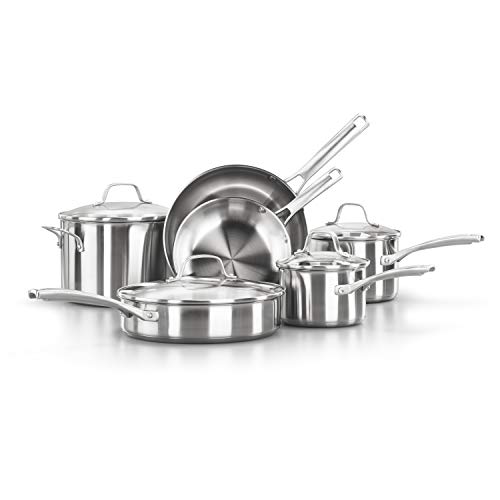
3. Calphalon Classic Stainless 10-Piece Set — Best for Simmer Control
Gas burners are powerful and imprecise; the Calphalon Classic’s impact-bonded aluminium base is the buffer between the two. Impact bonding fuses the base under pressure, giving the pan a thick, even heat reservoir that smooths a big burner’s surges into a steady simmer — the quality you feel when a sauce holds a lazy bubble for twenty minutes without catching. Add the line’s practical furniture — interior measuring marks, pour spouts, straining covers, long stay-cool handles — and you have the gas set for cooks whose food is sauces, grains and braises rather than sears. Contents: 8 and 10-inch fry pans, 1.5 and 2.5-quart covered saucepans, a 3-quart covered sauté pan and a 6-quart covered stockpot.
Strengths
- Impact-bonded base evens out fierce burners — the best simmer manners in this guide.
- Straining covers and pour spouts remove the colander from pasta and vegetable nights.
- Stay-cool long handles keep hands clear of the flame’s wrap-around heat.
Trade-offs
- Oven ceiling of 450°F is the stainless sets’ lowest here.
- Disc-base sidewalls, like the Cuisinart — clad pans still win for delicate wall-heated sauces.
- 6-quart stockpot is a size down from the Cuisinart’s 8-quart.
| Specifications (from the manufacturer’s listing) | |
|---|---|
| Pieces | 10 (6 vessels, 4 lids) |
| Construction | Stainless steel, impact-bonded aluminium base |
| Contents | 8″ and 10″ fry pans; 1.5 qt and 2.5 qt saucepans with lids; 3 qt sauté pan with lid; 6 qt stockpot with lid |
| Oven safe | Up to 450°F |
| Features | Measuring marks, pour spouts, straining covers |
| Cooktops | All, including gas and induction |
Between this and the Cuisinart, the gas-specific difference is temperament: the Cuisinart is the rugged all-rounder, the Calphalon the control specialist. If your burners run fierce and your cooking runs gentle — risottos, custards, slow sauces — the Calphalon’s base earns its place every single evening.
Best for: sauce, grain and simmer cooks on powerful burners / Not suited for: cooks needing an 8-quart pot or a 500°F oven rating.
Check the current price on Amazon
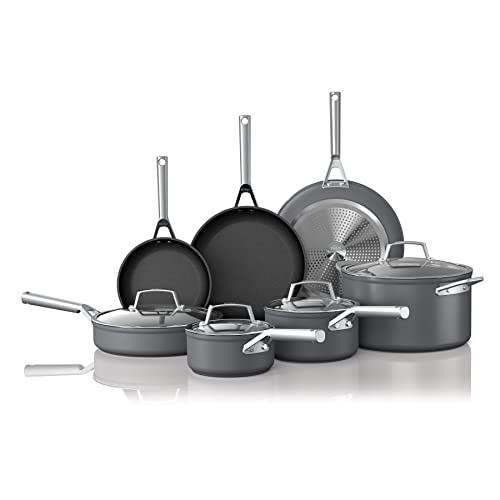
4. Ninja NeverStick Premium 12-Piece Set (C39800) — Best Premium Nonstick for Gas
The NeverStick Premium is what happens when a nonstick line is engineered by people who respect high heat. The plasma-fused surface is bonded at extreme temperature, the hard-anodised bodies are shot-blasted and thick — the line’s bases run a heavy gauge designed to prevent hot spots — and the whole set, lids and handles included, is oven safe to 500°F. Over gas that translates to nonstick pans that sear like they mean it: the surface tolerates the preheat that eggs and fish actually need, and the maker rates the cookware for gas alongside every other range type. The 12-piece configuration covers frypans, saucepans, a sauté pan and a stockpot with glass lids in the line’s slate grey.
Strengths
- Heavy bases spread flame heat evenly — the nonstick set that does not hotspot over a burner ring.
- Metal-utensil safe, dishwasher safe and oven safe to 500°F, lids and handles included.
- Sears credibly for a nonstick set, thanks to the textured fused surface and real preheat tolerance.
Trade-offs
- The premium end of this guide’s pricing — affordable is a stretch it just barely makes on longevity.
- Heavy for nonstick; smaller cooks should handle the big frypan before committing.
- Textured surface browns differently from smooth steel or PTFE — a character, not a flaw, but noticeable.
| Specifications (from the manufacturer’s listing) | |
|---|---|
| Pieces | 12 (vessels and glass lids) |
| Construction | Hard-anodised aluminium, NeverStick plasma-fused nonstick |
| Contents | Fry pans, saucepans, sauté pan and stockpot with glass lids (12-piece configuration; confirm sizes on listing) |
| Oven safe | Up to 500°F including lids and handles |
| Cooktops | All range types, including gas and induction |
| Care | Dishwasher safe; metal utensil safe |
Buy the Ninja if your gas cooking is daily, your current nonstick sets die young, and you would rather pay the tier once than the budget twice. It is the only coated set here whose relationship with a fierce burner is genuinely relaxed, and for flame-first kitchens that is the whole argument.
Best for: daily gas cooks who burn through ordinary nonstick / Not suited for: the strictest budgets, or cooks who prefer featherweight pans.
Check the current price on Amazon
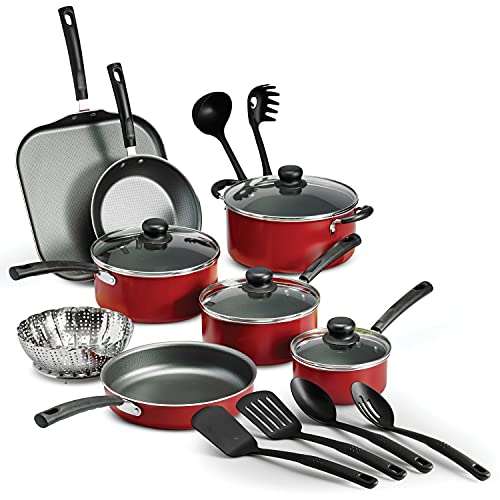
5. Tramontina PrimaWare 18-Piece Set — Best Budget for Gas
The PrimaWare is the budget pick from our general affordable guide, and it earns its place here on coverage and temperament: light aluminium pans heat fast over flame, respond instantly when you lift or lower the burner — the gas cook’s favourite feedback loop — and the set’s map is unmatched at the tier: 8-inch sauté pan, 9-inch deep sauté pan, 11-inch square griddle, 1, 2 and 3-quart covered saucepans, a 4-quart covered Dutch oven, a stainless steamer and six utensils. On gas, light pans are a double-edged virtue — responsive but easier to scorch — so this set rewards cooks who use the burner dial actively rather than setting and forgetting.
Strengths
- Unmatched coverage at the tier: three saucepans, a griddle and a steamer over any burner you own.
- Light aluminium responds instantly to flame adjustments — true gas cooking feel.
- Glass lids throughout for simmer-watching without lifting.
Trade-offs
- Thin bases hotspot if you park a small pan over a big flame — match pan to burner religiously.
- Six pieces are utensils; vessel count is nine plus steamer.
- Bundle availability fluctuates between sellers; verify contents on the listing.
| Specifications (from the manufacturer’s listing) | |
|---|---|
| Pieces | 18 (9 vessels, 3 lids, steamer, 6 utensils) |
| Construction | Aluminium, nonstick interior |
| Contents | 8″ sauté pan; 9″ deep sauté pan; 11″ square griddle; 1 qt, 2 qt and 3 qt covered saucepans; 4 qt covered Dutch oven; stainless steamer; 6 utensils |
| Lids | Tempered glass |
| Cooktops | Gas, electric, ceramic glass (not induction) |
| Origin | Made in Brazil |
For a first gas kitchen, a rental, or a household that cooks widely but gently, the PrimaWare remains the value answer — with one gas-specific instruction that decides its fate: use the right burner for the pan. Small saucepan, small burner; griddle centred over a medium flame; and the set will cook far above its tier for years.
Best for: budget furnishing for gas kitchens, gentle-to-medium heat cooking / Not suited for: high-BTU searing or cooks who will not match pan to burner.
Check the current price on Amazon

6. GreenLife Soft Grip 16-Piece Ceramic Set — Best Ceramic for Gas
Ceramic and gas pair better than many assume: the flame’s instant response suits ceramic’s medium-heat sweet spot, and the coating never meets the induction question at all. GreenLife’s 16-piece — 4-inch mini frypan, 7 and 9.5-inch frypans, 1 and 2-quart saucepans with lids, a 5-quart stockpot with lid, a 2.5-quart sauté pan with lid, a steamer and utensils — brings the PFAS-free, sand-derived ceramic coating and the line’s stay-cool Soft Grip handles to the flame. The gas-specific honesty: Bakelite handles and open flame require positioning sense. Keep handles turned inward, away from neighbouring burners, and never let a side flame lick up the pan wall into the handle’s base — ordinary gas craft that every cook should practise with any handled pan.
Strengths
- PFAS-free ceramic nonstick that loves gas’s instant medium-heat response.
- Complete family configuration with steamer, at a budget tier.
- Wobble-free bases sit stable on grates — not a given among light ceramic sets.
Trade-offs
- Bakelite handles demand flame awareness: position handles away from adjacent burners.
- Oven ceiling is 350°F; this is a stovetop set in spirit.
- Ceramic lifespan rules apply — frypans first to fade, medium heat always.
| Specifications (from the manufacturer’s listing) | |
|---|---|
| Pieces | 16 (7 vessels, 4 lids, steamer, 4 utensils) |
| Construction | Aluminium, ceramic nonstick (PFAS-free per maker) |
| Contents | 4″ mini frypan; 7″ and 9.5″ frypans; 1 qt and 2 qt saucepans with lids; 5 qt stockpot with lid; 2.5 qt sauté pan with lid; steamer; utensils |
| Oven safe | Up to 350°F |
| Handles | Bakelite Soft Grip, stay-cool (position away from flame) |
| Cooktops | Gas, electric, ceramic glass (not induction) |
If your household wants ceramic’s clean chemistry and cooks on gas, this is the set — with the handle note understood, it asks nothing exotic of you. Flame cooks who already turn handles inward by habit (as every gas cook should) will find it the easiest-cleaning set in this guide.
Best for: PFAS-free households cooking on gas / Not suited for: unattended high-flame cooking or oven-heavy recipes.
Check the current price on Amazon
Comparison Table
| Pick | Badge | Key spec | Best for |
|---|---|---|---|
| T-fal Ultimate Hard Anodized 17-Pc | Best Overall for Gas | Heavy gauge, Thermo-Spot, titanium nonstick | All-round flame cooking |
| Cuisinart Chef’s Classic 10-Pc | Best Stainless for Gas | 18/10 steel, flat stable base | High heat, buy-once |
| Calphalon Classic Stainless 10-Pc | Best for Simmer Control | Impact-bonded base, straining lids | Sauces and gentle cooking |
| Ninja NeverStick Premium 12-Pc | Best Premium Nonstick | Fused surface, 500°F oven rating | Daily heavy use |
| Tramontina PrimaWare 18-Pc | Best Budget for Gas | 3 saucepans, griddle, steamer | Whole-kitchen coverage |
| GreenLife Soft Grip 16-Pc | Best Ceramic for Gas | PFAS-free ceramic, wobble-free base | Gentle, easy-clean cooking |
How to Choose a Cookware Set for a Gas Stove
Match three things. First, base to burner: your most-used pan should roughly match your most-used burner’s diameter, because a flame wider than the base wastes heat up the sides (and into handles), while a base much wider than the flame cooks in a ring. Heavy bases forgive mismatch; thin ones punish it. Second, material to temperament: if you cook hot and fast, steel or the Ninja’s heavy nonstick; if you cook gently and value cleanup, the ceramic and T-fal; if you cook everything, the T-fal Ultimate is the honest middle. Third, handles to habit: metal handles forgive sloppy positioning; silicone tolerates it; Bakelite asks for the inward-turn habit — be honest about which cook you are at 7pm with a crying child, not the cook you are on a calm Sunday.
Then check the set-level details gas makes important: lids that sit tight (gas simmers evaporate faster under loose lids), a stockpot big enough that boil-overs do not become a weekly grate-cleaning, and exteriors you can clean — because soot is not a defect of gas cooking, it is a feature of it, and the sets here were chosen partly for how gracefully they wear it.
How to Cook on Gas Without Wrecking an Affordable Set
Five habits protect budget pans on flame. Centre the pan on the grate and size the flame to the base — the flame’s tips should kiss the pan’s underside, not curl around its walls. Preheat on medium, not high: thin and mid-gauge pans reach temperature fast over gas, and most “nonstick failure” on flame stoves is really preheat abuse. Turn handles inward, always, so a passing sleeve or a neighbouring burner never finds them. Let pans cool before washing; a hot budget pan under a cold tap is how bases warp. And clean soot early with a soda paste rather than late with a scourer — five minutes monthly beats an hour yearly, and the gentler method spares every finish in this guide.
One more, for simmering specifically: if your smallest burner still runs fierce, a heat diffuser plate — a cheap flat disc that sits between flame and pan — turns any of these sets into a gentle-cooking system for sauces, custards and rice. It is the best small accessory a gas household can own, and it makes the budget sets here behave like cookware a tier above.
Common Buying Mistakes
- Buying for the hob you wish you had. Gas rewards heavy bases and flame-tolerant handles; a set designed for glass hobs may rock on grates and scorch over rings.
- Ignoring handle material. On gas, handles live near fire. Know what yours are made of and position them accordingly.
- Running big flames under small pans. It wastes gas, soots the walls and overheats handles. Match flame to base, every time.
- Judging a set by its first-week shine. Gas marks exteriors. Judge by how the finish cleans, not by whether it marks.
- Assuming nonstick cannot sear on gas. Heavy-gauge sets like the T-fal Ultimate and the Ninja sear credibly — thin ones cannot. Gauge is the difference.
- Forgetting the simmer end of the dial. Most gas cooking problems are at the low end. Sets with massive bases (Calphalon) simmer kindly; thin pans need a diffuser.
Final Recommendation
For most gas households the T-fal Ultimate Hard Anodized 17-piece set is the answer: heavy, controlled, complete and fairly priced. If you cook hot and want a decade from the purchase, take the Cuisinart Chef’s Classic; if your cooking is sauces and simmers, the Calphalon Classic. The Ninja NeverStick Premium is the upgrade for daily cooks who kill ordinary nonstick, the PrimaWare is the budget furnishing answer, and the GreenLife is the ceramic route with one handle habit to learn.
A final thought for flame cooks specifically: gas rewards attention more than any other heat source, and the sets that thrive on it are the ones that give attention somewhere to go — a visible preheat cue, a base that answers the dial honestly, a lid that lets you watch. That is the thread connecting all six picks, from the budget PrimaWare to the Ninja: over an open flame, information is a feature, and these sets provide it at prices that leave room in the budget for the food itself.
Comparing across the wider programme? Start with Best Affordable Cookware Sets for the all-stove budget field, then Best 10 Pc Cookware Sets for the classic configuration, Best Affordable Induction Cookware Sets if a stove change is coming, and Best 18 10 Stainless Cookware Sets for the premium steel story. Colour shoppers: Best Affordable Cookware Sets Orange.
Know Your Burners: Power, Simmer Rings and Grates
A gas stove is not one heat source but three or four different ones sharing a top, and affordable sets live or die by how you pair them. The power burner — the big front ring — is for boiling and searing; park the stockpot and the largest frypan there and almost nothing else. The medium burners are the daily drivers for saucepans and sauté pans. The small simmer burner, often at the back, is the most underused asset in the kitchen: it holds sauces, rice and custards at a bare bubble that the big burners cannot imitate without a diffuser. Half of “this pan scorches everything” complaints are really “this pan has only ever met the power burner.”
Grates matter too. Continuous grates let you slide a pan from a fierce burner to a gentle one without lifting — the gas cook’s throttle — and they forgive slightly smaller bases. Individual grates demand pans whose bases span the ring securely; measure your smallest saucepan against your smallest grate before buying any set, because a 1-quart pan that tips on its grate is a hazard no bargain justifies. Every pick in this guide uses bases wide enough for standard domestic grates, but your stove is the final judge, and the first-week checks in our affordable guide apply here with double force.
Gas Cooking Troubleshooting: Problem, Cause, Fix
Problem: a ring of scorched food matching the burner shape. Cause: thin base plus a flame at full size. Fix: drop the flame until its tips just touch the base, stir sauces off the ring, and for repeat offences use a diffuser or graduate to the heavier-based sets above. Problem: the pan rocks or spins on the grate. Cause: a warped base or a base too small for the grate span. Fix: check the base cold on a flat counter — a warp present from new is a return; a size mismatch is solved by using a different burner, not by balancing acts.
Problem: handles too hot to hold. Cause: flame climbing the walls or a neighbouring burner. Fix: size flames to bases, turn handles inward, and use a side towel for long simmers — steel handles warming is physics, not defect. Problem: yellow, sooty flames marking every pan. Cause: that is a stove issue, not a cookware one — burner ports clogged with boil-over residue. Fix: clean the burner caps and ports; a healthy gas flame is blue with a defined cone, and cookware cleaned monthly with soda paste will stay ahead of normal soot. Problem: boil-overs crusting the grates weekly. Cause: a stockpot too small for the job or heat too high for the liquid. Fix: the 8-quart pots in this guide exist precisely for pasta; use them, and boil at a rolling simmer rather than a volcanic one.
Why These Picks Differ From Our General Affordable Guide
Readers who compare this list with our all-stove affordable roundup will notice both overlap and divergence, and the differences are the gas lens at work. The PrimaWare, GreenLife and Cuisinart appear in both, because coverage, ceramic value and steel durability translate to any hob. But the T-fal Ultimate leads here rather than the PrimaWare, because over flame its heavy gauge is a decisive advantage rather than a nice one; the Calphalon earns a place here for its simmer manners, which matter twice as much when the heat source surges; and some fine electric-and-induction sets from the wider field are absent because their bases or handles were not designed with open flame in the room. Same budget philosophy, different physics — which is the entire reason stove-specific guides exist.
Three Cheap Accessories That Upgrade Any Budget Set on Gas
Before upgrading a set, upgrade its support crew — three inexpensive accessories change budget cookware’s life on flame more than any single pan swap. The heat diffuser, already praised above, is first: a flat perforated plate that turns a fierce burner into a gentle one and ends scorched sauces for the price of a pizza. Second, a long-handled splatter screen, which keeps the stovetop — and the undersides of your cabinets — free of the grease mist that gas searing throws, and which doubles as a steamer base and a cooling rack. Third, a set of silicone handle sleeves for steel-handled pans: they slip on for the lift and off for the oven, and they end the towel-juggling that causes drops.
Honourable mentions: a trivet habit (hot pans scar worktops and crack cold stone), a wooden spoon rest that keeps sugary sauces off the grate, and a cheap oven thermometer — because the cook who knows their oven’s true temperature finishes dishes in these sets’ pans far more successfully than the cook who trusts the dial. None of this is glamorous. All of it is the difference between a budget set that feels budget and one that simply feels like your kitchen.
Gas Safety Notes Every Cookware Buyer Should Practise
Cookware choice and gas safety overlap more than most guides admit, so the essentials belong here. Keep pan handles turned inward — the single habit that prevents the worst kitchen accidents, especially in homes with children. Never leave a pan unattended on a high flame in its first minutes; budget pans heat fast and oil smokes sooner than instinct suggests. Keep the area around burners free of towels, paper and the set’s own packaging (a surprising number of first-week fires are cardboard). If a pan of oil ever catches, do not move it and never use water: turn off the burner if you safely can, and smother the pan with its lid or a baking sheet.
Ventilation deserves its sentence too: gas cooking produces moisture and combustion by-products, so run the extractor or open the window when burners run long — it protects your lungs, your walls and, not incidentally, the finishes of the pans themselves, which stay cleaner in moving air.
Two equipment checks belong to set ownership. Confirm each new pan sits stable on its grate before it ever holds hot liquid — a wobble discovered with water is a lesson, with soup it is an injury. And know where your gas shut-off is before you need it. None of the sets in this guide asks anything exotic of you; they ask for the standard disciplines of flame cooking, practised until they are boring. Boring is the goal.
A Week on the Burners: How the Picks Divide Real Cooking
Abstract comparisons sharpen when you assign a week of real meals. Monday’s pasta and jarred-sauce upgrade belongs to the Calphalon or Cuisinart stockpots — big water, steady boil, straining lids earning their keep. Tuesday’s stir-fry wants the T-fal Ultimate’s big covered frypan or the Ninja’s 12-inch-class skillet, heat high and responses instant. Wednesday’s soup-and-grilled-cheese is PrimaWare weather: the Dutch oven simmers, the square griddle takes two sandwiches at once, and the whole meal costs less in equipment than in ingredients. Thursday’s eggs-and-greens breakfast is GreenLife’s home turf, ceramic release doing its gentle best. Friday’s seared chicken with a pan sauce goes to the Cuisinart skillets, because fond is steel’s love language and gas is its favourite correspondent.
The point of the exercise is that no household cooks one style of meal, which is why this guide keeps six sets with different centres of gravity rather than crowning one and dismissing the rest. Your week will have its own pattern — more braises, more stir-fries, more reheated leftovers — and the right pick is the one whose best day matches your most common day. Read the badges with your own week in mind and the choice usually makes itself.
Altitude, Propane and Other Gas Variations Worth Knowing
Not all gas cooking is a city natural-gas hob, and affordable sets meet the variations differently. Many rural and RV kitchens run propane, which burns hotter and demands the same medium-heat discipline with less margin — the heavy-based picks (T-fal Ultimate, Ninja, the two stainless sets) forgive propane’s enthusiasm better than the thin PrimaWare, which propane cooks should treat as a low-and-medium set. At altitude, water boils cooler and simmering stretches longer; lids that fit well — a quiet strength of the Calphalon and Cuisinart here — matter more than any other single feature, because evaporation is your enemy when the boil is weak. And on older stoves with worn, uneven grates, base width becomes a safety feature: the wider the pan’s footprint relative to the grate span, the steadier the pot, which is one more reason the big-based sets anchor this guide.
None of these variations changes the ranking’s logic. They change the emphasis: propane and altitude cooks should weight base mass and lid fit even higher, and treat the budget-light picks as specialist tools rather than defaults. Know your flame, and the guide reads the same — only clearer.
Related guides
Frequently Asked Questions
What cookware material is best for gas stoves?
Gas is the most material-friendly heat source: stainless steel, hard-anodised aluminium, cast iron, carbon steel and ceramic-coated aluminium all work. The differences are in gauge and base design, not compatibility. Heavy bases spread the flame ring; that single trait matters more than the material label.
Why does food scorch in the middle of my pan on gas?
Because the flame is a ring and a thin base conducts it straight through as a ring of heat. The fixes are a heavier base (the T-fal Ultimate or Ninja here), a flame sized to the pan, and stirring with intent for sauces. A heat diffuser solves it completely for delicate work.
Is nonstick safe to use over a gas flame?
Yes, within the maker’s temperatures. The risk is not the flame itself but overheating an empty pan, which gas makes easy because it heats fast. Preheat on medium, add oil or food promptly, and keep to the set’s stated oven and stovetop guidance — the heavy-gauge sets in this guide are built for exactly this use.
How do I stop my pan handles getting hot on gas?
Position handles inward, away from neighbouring burners, and keep flames sized to the base so heat does not climb the walls. Steel handles will still warm on long simmers — that is normal; a side towel is the professional’s grip. Silicone-wrapped handles, like the T-fal’s, stay kindest.
Does gas cooking ruin pan exteriors?
It marks them with soot and heat tint; it does not ruin them, and any honest gas kitchen carries a little of that patina as proof of use. What separates the sets here is that their finishes release the marks willingly instead of holding them as permanent stains. Stainless cleans back with a soda paste or steel cleanser, hard-anodised finishes wipe down, and dark exteriors hide the story entirely. Judge a gas set by how it cleans, and clean monthly rather than yearly.
What size flame should I use under a saucepan?
One whose tips just reach the pan’s base edge — visible as a blue ring slightly smaller than the pan itself. A flame wider than the base wastes fuel, soots the walls and overheats the handle; a much smaller flame is merely slow. On most domestic burners that means medium for a mid saucepan, and reserving high for the stockpot’s boil and the frypan’s sear.
Are glass lids okay over gas?
Yes — tempered glass lids are designed for stovetop use, and every lidded set here uses them or steel appropriately. Two cautions: let a hot glass lid cool before it meets cold water, because thermal shock is glass’s one weakness, and remember the lid’s oven rating is lower than the pan’s, as the spec boxes note for the T-fal and others.
Can these sets move to an induction stove later?
Two of the six can: the Cuisinart Chef’s Classic and the Calphalon Classic are induction compatible, as is the Ninja NeverStick line. The T-fal, PrimaWare and GreenLife sets are not. If a stove change is plausible within the set’s life, that fact alone may be worth choosing steel.

