Disclosure: airfryerkitchensupply.com is reader-supported. When you buy through links on our site, we may earn an affiliate commission at no extra cost to you.
Where to buy
The best 8 channel mixers with echo and eq are small analog boards bought for one reason: a voice — a singer, a preacher, a karaoke host, a streamer — needs to sound finished without a rack of outboard gear. ‘Echo’ in this category means the built-in effects section (delay and reverb), and ‘EQ’ means both the per-channel tone controls and, on some boards, a master graphic. This guide verified every pick as a current Amazon listing, counted mic channels honestly, and ranked the six boards whose echo and EQ genuinely earn their place on the panel.
- Pyle 8 Channel Bluetooth Studio Mixer (PMXU83BT.5) — check price on Amazon; choose the listing sold or shipped by Amazon or the brand’s own store, and confirm the exact model variant before you buy.
- Yamaha MG10XU Mixer — check price on Amazon; choose the listing sold or shipped by Amazon or the brand’s own store, and confirm the exact model variant before you buy.
- Behringer XENYX X1204USB Mixer — check price on Amazon; choose the listing sold or shipped by Amazon or the brand’s own store, and confirm the exact model variant before you buy.
- Mackie ProFX10v3+ Mixer — check price on Amazon; choose the listing sold or shipped by Amazon or the brand’s own store, and confirm the exact model variant before you buy.
- Soundcraft Notepad-8FX Mixer — check price on Amazon; choose the listing sold or shipped by Amazon or the brand’s own store, and confirm the exact model variant before you buy.
- Allen & Heath ZED-10FX Mixer — check price on Amazon; choose the listing sold or shipped by Amazon or the brand’s own store, and confirm the exact model variant before you buy.
Search for the best 8 channel mixers with echo and eq and you are really shopping for two features wearing a trench coat. The echo — delay and reverb generated inside the mixer — is what makes a dry microphone sound like a performance instead of an announcement. The EQ is what makes that performance intelligible: cutting the boxiness from a voice, taming a harsh room, giving a keyboard its own space. Everything else on the board — the channel count, the USB port, the brand — is in service of those two jobs.
That focus changes how the class should be ranked. A mixer with a beautiful effects engine but crude one-knob tone control will frustrate you weekly; a mixer with musical three-band EQ and a single decent reverb will be forgiven almost anything. This guide weighs both halves of the keyword, and it is honest about the category’s labelling games: ‘8-channel’ boards in this class typically carry four to six mic preamps plus stereo line channels, and the effects count (’99 effects!’) matters far less than whether the two or three effects you will actually use sound good.
The six picks span the real market, from a value-packed Pyle built exactly around this search, through the class standards from Yamaha, Behringer and Mackie, to Soundcraft’s Lexicon-flavoured compact and Allen & Heath’s premium ZED. Karaoke hosts, small churches, streamers, podcasters and little bands will each find their board below — with the trade-offs stated as plainly as the strengths, because an effects section you cannot tame is worse than none at all.
In this guide
Quick Picks
The Pyle PMXU83BT.5 is the search’s most direct answer — 8 channels, DSP echo effects and 3-band EQ at a value tier. The Yamaha MG10XU is the sound-quality pick, and the Allen & Heath ZED-10FX is the premium board for voices that matter.
- Best Overall: Pyle 8 Channel Bluetooth Studio Mixer (PMXU83BT.5) — the keyword in one box — 8 channels, 16-bit DSP echo effects, 3-band EQ per channel, Bluetooth and USB recording at a value price. — Check on Amazon
- Best Sound Quality: Yamaha MG10XU Mixer — Yamaha’s MG formula — D-PRE preamps, SPX effects and musical EQ in a 10-input frame that serves the 8-channel brief. — Check on Amazon
- Best for Recording: Behringer XENYX X1204USB Mixer — British EQ, a 24-bit multi-effects engine, channel compressors and a USB interface — the most processing per dollar in the class. — Check on Amazon
- Best for Streaming: Mackie ProFX10v3+ Mixer — GigFX+ effects, Onyx preamps, Bluetooth and multi-mode USB recording — the modern creator’s version of this search. — Check on Amazon
- Best Compact: Soundcraft Notepad-8FX Mixer — Lexicon effects in a small-format board with USB — the compact pick for desks, classrooms and small stages. — Check on Amazon
- Best Premium: Allen & Heath ZED-10FX Mixer — the professional’s small board — ZED build quality, proper DI inputs, onboard FX and USB, made in the touring tradition. — Check on Amazon
How These Picks Were Chosen
Verification first: each board was confirmed as a current Amazon listing, with its effects and EQ configuration taken from the listing title. In a category flooded with lookalike boards under rotating names, that check is what separates this guide’s picks — every one from a maker with manuals, support and a model number that will still mean something in five years — from the anonymous end of the market.
Ranking then scored the search’s two halves directly. For echo: the quality and controllability of the reverb and delay, whether effects can be sent per-channel in sensible amounts, and whether a footswitch or mute keeps them from swamping spoken passages. For EQ: the number of bands, whether the midrange is sweepable or well-chosen, and how the board’s high-pass filters clean up stage rumble and handling noise before it reaches the mix.
- Verified current listing from a maker with real support
- Built-in echo (delay/reverb) that is controllable per channel
- Per-channel EQ with at least three bands, sensibly voiced
- Mic-preamp count stated honestly for the 8-channel class
- High-pass filtering or equivalent low-end management
- A sensible route to speakers or recording: main outs, USB or both
The 6 Best 8 Channel Mixers With Echo and EQ

Pyle 8 Channel Bluetooth Studio Mixer (PMXU83BT.5) — Best Overall
If a product brief were written from this search alone, it would describe the PMXU83BT.5: an 8-channel board with a 16-bit DSP effects section for echo and ambience, 3-band EQ on its channels, XLR combo inputs, 48V phantom power, Bluetooth streaming, an MP3 player and USB computer recording — at the value end of the market. It suits karaoke hosts, small venues, home streamers and party rigs that want the echo-and-EQ formula complete in one affordable purchase, without assembling workarounds.
Strengths
- The full keyword checklist in one box: DSP echo, 3-band EQ, 8 channels
- Bluetooth and MP3 playback cover break music and karaoke tracks natively
- USB recording gives a simple stereo capture of the night
Trade-offs
- Effects are preset-driven — less sculpting than the premium boards’ engines
- Preamps are workmanlike; critical recording will hear the difference
- Pyle’s long-term support trails the legacy pro-audio brands
| Model | PMXU83BT.5 |
| Channels | 8 |
| EQ | 3-band per channel (per listing title) |
| Effects | 16-bit DSP FX |
| Inputs | XLR combo inputs, 48V phantom power |
| Extras | Bluetooth, MP3 player, USB computer recording |
The Pyle’s virtue is completeness at a price. Every feature this search’s shoppers list — echo for the voice, EQ to shape it, channels for a small line-up, Bluetooth for the tracks, USB to record it — is present and working in one box, which is more integration than boards costing several times more offered a generation ago. For a karaoke night, a small service or a stream, the workflow is genuinely simple: voice in, a touch of echo, a small EQ correction, music under, done.
Its limits are the value tier’s limits. The DSP effects are chosen from presets rather than sculpted, so you select the echo that fits rather than building it; the preamps are honest but not quiet in the Yamaha sense; and the panel’s fit and finish announce the price. None of that matters to its audience the way the checklist does — and for readers whose alternative is a board with no echo at all, the Pyle is not a compromise but the point of the search.
Buy it as a complete small system and keep levels sensible, and it will run karaoke nights and small events for years. Buy it expecting studio-grade effects editing and you have misread its badge: the boards below exist for that reader, at their prices.
Best for: karaoke hosts, small venues and streamers wanting the complete echo-and-EQ package affordably / Not suited for: critical recording or buyers who want to sculpt effects in detail
Check on Amazon — check the current price on Amazon and confirm the variant, included accessories and seller before ordering.

Yamaha MG10XU Mixer — Best Sound Quality
The MG10XU is the class standard against which small mixers are measured, and its presence here is about the quality of the two headline features: Yamaha’s SPX effects — reverbs and delays with a polish the budget boards cannot match — and EQ voiced by a company that has tuned small mixers for decades. Marketed as a 10-input board, it serves the eight-channel brief with four mic preamps plus stereo channels. It suits small bands, churches and creators who hear the difference between adequate effects and good ones, and who expect a board to last.
Strengths
- SPX effects are the class benchmark for built-in echo and reverb
- D-PRE mic preamps stay quiet and clean at working gains
- Yamaha build and support — a board for a decade, not a season
Trade-offs
- Four mic preamps — line-ups with five-plus mics need a bigger board
- No Bluetooth; playback arrives by cable
- Costs more than the value picks for quality you must value to justify
| Model | MG10XU |
| Inputs | 10-input stereo mixer (per listing title) |
| Effects | Built-in SPX effects |
| USB | USB audio interface for recording |
Effects quality is where small mixers separate, and the MG10XU’s SPX section is the reason this board anchors so many small rigs. Its reverbs have the smooth decay that makes a voice sound recorded rather than echoed, and its delays sit in tempo without the metallic edge of cheap DSP. Paired with per-channel sends, you can give the lead voice a halo, keep the announcements dry, and ride the balance like a grown-up — the exact workflow this search describes, executed at the class’s highest standard.
The EQ follows the same philosophy: three bands, chosen frequencies, musical results. It will not do surgical repair — no board at this size will — but for the daily work of warming a thin voice, clearing a muddy one and keeping a keyboard out of the vocal’s way, it is precisely judged. Add the D-PRE preamps’ quiet gain and the board simply sounds expensive in the ways audiences perceive without analysing.
Count the mic preamps before you commit: four is the honest ceiling, and a five-singer line-up should step to a larger MG or the guide’s other picks. Within that ceiling, the MG10XU is the sound-quality answer to this search, full stop — the board the other picks are compared against, including in this guide.
Best for: small bands, churches and creators who prioritise echo and EQ quality / Not suited for: line-ups needing more than four mic preamps
Check on Amazon — check the current price on Amazon and confirm the variant, included accessories and seller before ordering.

Behringer XENYX X1204USB Mixer — Best for Recording
The X1204USB is the processing maximalist: a 12-input board whose mic channels carry compressors, whose EQ is the famed ‘British’ voicing modelled on classic consoles, and whose 24-bit multi-effects processor supplies the echo and ambience — with a USB interface to capture the result. It suits home recordists, podcasters and small bands who want studio-flavoured tools at a working price, and who will use the compressors that most small boards omit entirely. The channel count exceeds the brief; the processing is the reason it is here.
Strengths
- British EQ voicing flatters voices with very little effort
- One-knob compressors control dynamics the way recordings need
- 24-bit effects plus USB interface — a complete small-studio centre
Trade-offs
- Four mic preamps despite the 12-input headline
- Feature density makes the panel busier for live volunteers
- Effects editing is preset-based rather than deep
| Model | XENYX X1204USB |
| Inputs | 12-input, 2/2-bus |
| EQ | British EQ |
| Effects | 24-bit multi-FX processor |
| Processing | Compressors on mic channels |
| Interface | USB/audio interface |
The British EQ is not a gimmick; it is a voicing — broad, forgiving curves that make voices sound warmer and more expensive with small movements, which is why the consoles it imitates became classics. For spoken word and sung vocals alike, it shortens the distance between a raw mic and a finished sound more than any specification on the panel. Paired with the one-knob compressors, which tame a loud chorus or an animated guest without audible fuss, the X1204USB gives a home recordist the two tools that most define a produced sound: tone and dynamics.
The effects engine completes the keyword honestly: a 24-bit processor with the reverbs and delays a small board needs, sent per channel in the usual way. It will not replace a studio plug-in chain, but for live-to-tape work — the podcast recorded as-live, the band demo, the stream — it is entirely convincing, and the USB interface captures the stereo mix without extra hardware.
As with the Yamaha, the mic count is the ceiling to respect: four preamps. Podcasters with two hosts and a guest, singer-plus-band demos, and small live rigs fit beautifully; a six-mic band does not. Buy it for processing, within that count, and it is the best value in this guide by a wide margin.
Best for: podcasters, home recordists and small bands wanting EQ character and compression / Not suited for: line-ups needing more than four mic preamps
Check on Amazon — check the current price on Amazon and confirm the variant, included accessories and seller before ordering.

Mackie ProFX10v3+ Mixer — Best for Streaming
The ProFX10v3+ updates the echo-and-EQ formula for the streaming era: Mackie’s Onyx mic preamps, the GigFX+ effects engine, Bluetooth playback and multi-mode USB recording that can send a mix-minus to your stream while you monitor yourself without latency confusion. Its listing names its people — streamers, podcasters, band practice — and the design serves them directly. It suits creators whose mixer lives between a microphone, a computer and an audience that may be in the room or on the internet, and small acts who rehearse and record through the same board.
Strengths
- Multi-mode USB recording is genuinely streamer-smart
- GigFX+ gives voices a polished, produced sheen quickly
- Bluetooth playback integrates phones and tracks without cables
Trade-offs
- Creator-focused layout is less traditional for pure live-sound volunteers
- Mic count serves small line-ups, not full bands
- App-era conveniences add learning curve for the purely analog-minded
| Model | ProFX10v3+ |
| Channels | 10-channel (per listing title) |
| Effects | GigFX+ engine |
| Preamps | Onyx mic preamps |
| Extras | Bluetooth, multi-mode USB recording |
Streaming exposes the weakness of traditional small mixers: the USB feed is an afterthought, and the host hears themselves twice or not at all. The ProFX10v3+ was designed against that complaint — its USB modes let you route a clean mix to the computer while monitoring directly, and Bluetooth pulls phone audio into the board without a cable nest. For the creator, those are not extras; they are the product, and Mackie executes them with the confidence of a company that watched the market change and changed with it.
The GigFX+ engine handles the search’s echo brief with a modern accent: effects tuned for voice-forward content, quick to dial, hard to make ugly. Combined with Onyx preamps — clean, with headroom — the board produces the broadcast-adjacent sound that streaming audiences now expect as a baseline. Band-practice duties are equally well served: four-ish mic inputs, quick EQ, effects for the singer, and a recording of the rehearsal over USB without a separate interface.
If your mixer must serve a room and a stream at once, this is the guide’s answer. Pure live-sound traditionalists may prefer the Yamaha’s restraint; pure recordists the Behringer’s compressors. The Mackie owns the hybrid middle, which is where most small audio work now actually happens.
Best for: streamers, podcasters and hybrid live/online performers / Not suited for: traditional live rigs with no computer in the chain
Check on Amazon — check the current price on Amazon and confirm the variant, included accessories and seller before ordering.
Soundcraft Notepad-8FX Mixer — Best Compact
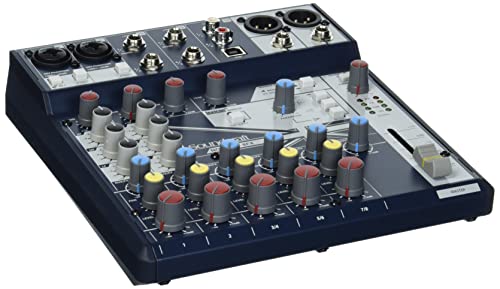
The Notepad-8FX shrinks the formula without cheapening its soul: a small-format analog console with USB I/O and Lexicon effects — the effects family whose reverbs defined studio polish for a generation. It suits presenters, teachers, small worship spaces, acoustic acts and desk-bound creators who need real echo and EQ in the smallest credible footprint. Where the Pyle maximises features per dollar, the Soundcraft maximises pedigree per inch — and for a board that lives on a desk or a lectern, that trade is often the right one.
Strengths
- Lexicon effects bring genuine studio lineage to a tiny board
- Compact format suits desks, lecterns and small stages
- USB I/O covers recording and playback without extra boxes
Trade-offs
- Smallest channel and mic count here — a genuinely small line-up board
- Fewer hands-on controls than the full-size picks
- No Bluetooth; sources arrive by cable or USB
| Model | Notepad-8FX |
| Format | Small-format analog console |
| Effects | Lexicon effects |
| Interface | USB I/O |
Lexicon’s name on a compact board is not decoration. The company’s reverbs are the reference sound of polished vocals, and the Notepad’s effects carry that DNA at small-board scale: a voice with a Lexicon halo sounds finished in a way preset-count rivals rarely achieve. For spoken word especially — the lecture, the service, the presentation — that polish is the difference between a mic feed and a production, delivered from a box that fits beside a laptop.
The rest of the board respects its brief: Soundcraft preamps with a clean, unhyped character, straightforward EQ, and USB for the record-or-playback duties small installations need. It is not trying to mix a band; it is trying to make two or three sources sound excellent in a small room, and at that job it is arguably the most refined tool in this guide.
Choose it when your line-up is small and permanent — the classroom, the chapel corner, the acoustic duo, the desk studio — and the board’s footprint matters as much as its facilities. Line-ups grow out of it honestly; the larger Notepad-12FX and this guide’s other picks are the growth path, and the effects quality will make you reluctant to leave the family.
Best for: small, fixed line-ups wanting premium effects in a compact board / Not suited for: bands or growing line-ups needing channel headroom
Check on Amazon — check the current price on Amazon and confirm the variant, included accessories and seller before ordering.

Allen & Heath ZED-10FX Mixer — Best Premium
The ZED-10FX is the premium answer: Allen & Heath’s small-format board built to the standards of a company whose large consoles run theatres and tours. Its configuration is honest and specific — mic/line/DI channels with proper instrument inputs, stereo line channels, onboard effects and USB I/O — in a chassis that feels machined rather than moulded. It suits musicians and venues for whom the mixer is a working instrument: acoustic acts, small theatres, quality-led churches and engineers who buy tools the way carpenters do, once and properly.
Strengths
- Build quality and control feel are a class above the rest of this guide
- Proper DI inputs make acoustic instruments sound right without extra boxes
- Onboard FX and USB complete the small-board brief without fuss
Trade-offs
- Premium pricing — the highest in this guide
- Mic/DI channel count is modest; it is a quality-over-quantity board
- No Bluetooth or playback frills — a professional’s priorities
| Model | ZED-10FX |
| Channels | 10-channel analog mixer |
| Inputs | Mic/Line/DI channels plus 3 stereo line (per listing title) |
| Effects | Onboard FX |
| Interface | USB I/O |
Some of the ZED’s superiority is tactile and immediate: faders and knobs with weight and precision, a panel laid out by people who mix under pressure, and a chassis that shrugs off the boot of a car. The rest is sonic — preamps with headroom and calm, EQ that corrects without thinning, and effects that flatter without announcing themselves. An acoustic duo through a ZED sounds like a record of an acoustic duo; that is the entire case, and it is enough for the buyers this board is made for.
The DI inputs deserve their sentence. Acoustic guitars and basses plugged straight into ordinary line inputs sound thin and quacky; the ZED’s high-impedance DI channels are voiced for them, which quietly removes a whole category of small-gig disappointment. It is the kind of detail that separates a musicians’ board from a features list, and this board is full of them.
Buy it if your small rig is a long-term professional tool and the budget can stretch once. The guide’s other picks are better value by any spreadsheet; the ZED is better by the hand and the ear, and over a decade of weekly use that is its own kind of value — the kind its owners rarely regret paying for.
Best for: acoustic acts, small theatres and quality-led venues buying once / Not suited for: budget shoppers or feature-count comparisons
Check on Amazon — check the current price on Amazon and confirm the variant, included accessories and seller before ordering.
Comparison Table
| Pick | Badge | Key spec | Best for |
|---|---|---|---|
| Pyle 8 Channel Bluetooth Studio Mixer (PMXU83BT.5) — Check on Amazon | Best Overall | 8 ch, DSP FX, 3-band EQ, USB | karaoke hosts, small venues and streamers wanting the complete echo-and-EQ package affordably |
| Yamaha MG10XU Mixer — Check on Amazon | Best Sound Quality | 10-input, SPX FX, USB | small bands, churches and creators who prioritise echo and EQ quality |
| Behringer XENYX X1204USB Mixer — Check on Amazon | Best for Recording | 12-input, British EQ, USB, FX | podcasters, home recordists and small bands wanting EQ character and compression |
| Mackie ProFX10v3+ Mixer — Check on Amazon | Best for Streaming | 10 ch, GigFX+, Bluetooth, USB | streamers, podcasters and hybrid live/online performers |
| Soundcraft Notepad-8FX Mixer — Check on Amazon | Best Compact | Compact, Lexicon FX, USB | small, fixed line-ups wanting premium effects in a compact board |
| Allen & Heath ZED-10FX Mixer — Check on Amazon | Best Premium | 10 ch, DI inputs, FX, USB | acoustic acts, small theatres and quality-led venues buying once |
Effects quality does not appear in any spec column — it is the reason the reviews describe each engine’s character in words. If you take one shortcut from this table, take this: match the mic-preamp count to your line-up first, then choose the effects-and-EQ personality you want to live with for many years to come in your working live rig.
How to Choose an 8 Channel Mixer With Echo and EQ
Echo, reverb and delay: what the words actually mean
Listings use ‘echo’ loosely, and untangling it helps you buy well. Reverb is the sound of a space — the wash that makes a voice feel placed in a hall rather than pasted on top of silence. Delay (the true echo) is a distinct repeat of the sound, timed in milliseconds or beats, that thickens vocals and fills gaps. Most small mixers generate both from one DSP section, with presets named for rooms, halls, plates and echoes. For voices, you will live on two or three presets: a medium hall or plate for singing, a short delay-plus-reverb blend for presence, and dry for speech. A board whose those three sound good beats a board advertising a hundred presets you will never open.
Control matters as much as sound. Per-channel effects sends let the singer swim while the announcements stay dry; a master effects return lets you ride the overall wetness against the room; and a mute or footswitch lets you kill the echo between songs so spoken introductions do not arrive wearing a halo. Check for those three controls — they separate a usable live effects section from a demo feature.
EQ on a small board: three bands, used well
Per-channel EQ on boards this size is usually three bands — high, mid, low — sometimes with a sweepable mid on premium models. That is enough, if you work it in the right order. Start with the high-pass filter (where fitted) to remove rumble, handling noise and proximity boom from every mic channel; it is the single most clarifying control on the board. Then cut before you boost: pull a little low-mid from a boxy voice, a little harshness from the top of a shrill one. Boosts are for character; cuts are for clarity, and clarity is what small rooms lack.
The master section is the second half. A graphic EQ on the main output tunes the system to the room — the same ring-out discipline described in this cluster’s powered-mixer guides — while boards without one rely on the speakers and the room behaving. If your venue is reflective and difficult, weight that difference in your choice.
- High-pass every mic channel as your default starting point
- Cut for clarity first; boost for character second, sparingly
- Judge an EQ by its mid band — that is where voices live
How many mic channels does ‘8-channel’ really give you?
In this class, typically four to six. The rest of the count is stereo line channels for keyboards, phones and playback — useful, but they do not take microphones. Write your line-up down, count the mics, and let that number filter the field before effects and EQ seduce you: the Yamaha and Behringer here carry four mic preamps, the Pyle’s combo inputs serve its karaoke brief, and the ZED trades count for quality with its DI-equipped channels. A board that fits your mics and charms your ears beats a board that only does one of those.
Phantom power, combo inputs and other quiet essentials
Two specification details quietly decide whether a small board fits your microphones. Phantom power — 48V, supplied through the mic cables — is required by condenser microphones, the kind used for choirs, acoustic instruments and much studio-style recording; dynamic mics ignore it safely. If your future includes condensers, confirm the board supplies it (the Pyle here does, at full voltage) before the board, not after the mic, arrives. Combo XLR inputs, which accept both XLR and quarter-inch plugs in one socket, are the other quiet convenience: they forgive the mixed cable collections of real small rigs and make a board’s channel count genuinely usable rather than theoretically so.
Neither feature headlines a listing the way effects counts do, and both will matter on the third gig more than the thirty-second preset ever will. Read for them the way this guide did: in the specification, not the banner.
Budget tiers for echo-and-EQ boards
The value tier (the Pyle) buys the complete checklist with preset-level control. The mid tier (Behringer, Mackie, Yamaha) buys better preamps, better effects engines and one speciality each — compression, streaming smarts, or class-standard polish. The premium tier (Soundcraft’s lineage in compact form, Allen & Heath outright) buys build, feel and sonic refinement. The right tier is the one your ears and your line-up justify; the wrong purchase is paying premium money for features your two-mic venue will never open, or saving small money on a board whose echo you will apologise for weekly.
A Practical Effects Recipe for Live Voices
Start dry and earn every drop of wetness. Set the voice’s EQ first — high-pass engaged, boxiness trimmed — because effects applied to a muddy voice produce polished mud. Then choose a medium hall or plate reverb and raise the channel’s effects send until the voice just begins to bloom at the ends of phrases; stop there, and resist the soundcheck temptation to add more, because a full room absorbs echo and the empty-room setting will sound wetter at showtime, not drier.
For upbeat material, a short slap delay under the reverb adds energy without wash; for ballads, a longer reverb with the delay muted keeps the space honest. Between songs, mute the effects return for announcements — the contrast makes the music sound bigger and the speech sound professional. Write your two working presets and their send levels on the setup card; consistency is what turns a small board’s effects from a novelty into a signature.
From Board to Audience: Completing the Chain
An unpowered mixer like every pick here needs amplification and speakers to reach an audience — a powered speaker pair is the modern default, and this cluster’s powered-mixer guides cover the alternative architecture. Budget the chain whole: the board, a pair of powered speakers sized to your room, stands, and cables. The echo-and-EQ quality you are buying in this guide only reaches ears through that chain, and a starved speaker budget will waste a premium board faster than a modest board wastes good speakers.
If recording matters equally, note which picks carry USB and what it captures: in this class, USB means the stereo mix — the same blend the audience hears — which is perfect for services, demos and streams, and not a multitrack studio feed. Buy with that understanding and the board will meet your expectations exactly, which is the definition of a good purchase.
How to Set Up Echo and EQ for a Live Vocal
Ten minutes, one microphone, in this order — the same sequence working engineers use on boards a hundred times this size.
- Connect the mic, set the channel fader to its unity mark, and bring the gain up until the loudest sung note nearly peaks — then back off a touch.
- Engage the high-pass filter on the vocal channel to remove rumble and proximity boom before touching any EQ band.
- With effects off, shape the dry voice: trim low-mid if it is boxy, ease the top if it is harsh, and leave the mid alone unless the voice hides behind the instruments.
- Choose a medium hall or plate reverb preset; raise the channel’s effects send until phrase endings just bloom, then stop.
- Add a short delay only if the material wants energy; keep its level below the reverb’s so it thickens rather than repeats.
- Walk the room while someone sings or speaks: adjust the master level and, if fitted, the graphic EQ for the space’s boom or ring.
- Set a second, dry scene in your head for speech: effects return muted, same EQ — and practise switching between the two.
- Write the settings on a setup card: gain, EQ positions, preset name, send level. Photograph the panel as a backup.
Revisit the card after the first real audience: rooms full of people absorb high frequencies and echo, so the show setting usually wants a touch more level and a touch less reverb than the empty-room soundcheck suggested. One correction, noted on the card, and your second event starts where the first one ended — ahead.
Common Buying Mistakes
- Counting effects presets instead of judging three. You will live on a hall, a plate and a slap delay. If those three sound cheap, ninety-six more presets will not save the board.
- Leaving echo on for speech. Announcements and sermons wearing reverb sound amateur instantly. Mute the effects return for spoken passages.
- Boosting EQ before cutting. Boosts add noise and harshness; cuts create clarity. High-pass first, trim the boxiness, then season.
- Ignoring the mic count inside ‘8 channels’. Stereo line channels do not take microphones. Count preamps against your line-up before falling for an effects engine.
- Skipping the high-pass filter. It is the highest-value control on a small board for live voices — rumble removed there never reaches the EQ, the effects or the audience.
- Buying the board and starving the speakers. The chain reaches ears through speakers and stands. Budget the whole system, not just the mixer with the pretty effects.
Final Recommendation
For the keyword taken literally and served completely, the Pyle PMXU83BT.5 is the value answer. For sound quality, the Yamaha MG10XU remains the class standard; for recording character, the Behringer X1204USB; for streaming, the Mackie ProFX10v3+; for compact pedigree, the Soundcraft Notepad-8FX; and for a professional’s small board, the Allen & Heath ZED-10FX. Each is the right buy for the reader its badge names — and the wrong buy for the others, which is what badges are for.
Confirm the mic-preamp count and the effects controls in the listing, buy by exact model number, and check price on Amazon when you order. Small mixers are sold in lookalike variants; the model number is how you get the board this guide actually reviewed.
Keep exploring the cluster: Best 8 Channel Usb Recording Mixers Best 6 Channel Power Mixers Best 8 Channel Power Mixers Best 2 Mic Mixers For Podcasting Best Affordable Recording Mixers Best Affordable Mixers For Streaming
Frequently Asked Questions
What is the difference between echo and reverb on a mixer?
Reverb simulates a space — the continuous wash of reflections that places a voice in a hall. Echo (delay) is a distinct repeat of the sound after a set time. Singers usually want reverb for body and sometimes a short delay for energy; speech wants neither, or only a trace of reverb. Mixers in this guide generate both from a built-in DSP effects section.
How much echo should a live vocal have?
Less than you think at soundcheck. The working rule: raise the effect until you can just hear it bloom at the ends of phrases, then stop — a full room absorbs ambience, but an over-wet mix loses the words, and the words are the job. When in doubt, mute the effect briefly; if the voice suddenly sounds clearer and closer, you had too much.
Do I need a graphic EQ as well as channel EQ?
They do different jobs. Channel EQ shapes each source — this voice, that keyboard. A graphic EQ on the main output shapes the system in the room, taming boom and ringing frequencies. Small, well-behaved rooms can live without the graphic; reflective halls and loud stages benefit from it enough that it should influence your choice.
Can these mixers record to a computer?
Most picks here carry USB that records the stereo mix — the complete blend, exactly as the audience hears it. That suits services, demos, podcasts and streams. It is not multitrack recording with a track per channel; if you need that, this cluster’s USB-recording guide explains the step up and which boards make it.
Why do cheap mixers’ effects sound metallic?
Effects quality is processing quality: converter resolution, algorithm design and the care taken voicing presets. Budget DSP often produces a grainy, ringing decay that reads as ‘metallic’. It is the main audible difference between the value and premium picks in this guide, and the reason effects character — not preset count — drives the ranking.
Is 3-band EQ enough for vocals?
For live small-board work, yes — provided the bands are well chosen and you use the high-pass filter first. Most vocal correction is removing boom and boxiness and managing harshness, all within three bands’ reach. Surgical problems belong to studio EQ; a live voice through a good 3-band, set by the method in this guide, will sound finished to any audience.
Can I use one of these mixers for karaoke at home?
Yes — it is one of the class’s most common jobs, and the Pyle pick is practically designed for it: tracks arrive by Bluetooth or its MP3 player, two mics take the singers, a preset echo flatters every voice, and the EQ keeps the backing track out of the vocals’ way. Connect the main outputs to a powered speaker or your home amplifier’s line input, keep the mic away from the speakers, and the living room becomes the venue.


