Disclosure: airfryerkitchensupply.com is reader-supported. When you buy through links on our site, we may earn an affiliate commission at no extra cost to you.
Where to buy
The best 8 channel power mixers live at the size where a small PA becomes a real band rig: four or five voices, a couple of mic’d instruments, playback for the breaks, and enough amplifier to fill a hall without strain. As with the 6-channel class, the honest count is microphone preamps, not the input total on the box — and this guide counts that way. Every pick was verified as a current Amazon listing on the day of writing, and where a maker’s headline wattage needs translating into real terms, the review does it in plain language.
- Peavey PVi 8500 All In One Powered Mixer — check price on Amazon; choose the listing sold or shipped by Amazon or the brand’s own store, and confirm the exact model variant before you buy.
- Rockville RPM870 8 Channel Powered Mixer — check price on Amazon; choose the listing sold or shipped by Amazon or the brand’s own store, and confirm the exact model variant before you buy.
- Behringer Europower PMP500 Powered Mixer — check price on Amazon; choose the listing sold or shipped by Amazon or the brand’s own store, and confirm the exact model variant before you buy.
- Yamaha EMX7 Powered Mixer — check price on Amazon; choose the listing sold or shipped by Amazon or the brand’s own store, and confirm the exact model variant before you buy.
- Rockville RPM109 V2 12 Channel Powered Mixer — check price on Amazon; choose the listing sold or shipped by Amazon or the brand’s own store, and confirm the exact model variant before you buy.
- Pyle PMX840BT DJ Mixer — check price on Amazon; choose the listing sold or shipped by Amazon or the brand’s own store, and confirm the exact model variant before you buy.
Eight channels is the working band’s size. The best 8 channel power mixers are bought by pub and function bands, larger worship teams, school music departments and community venues whose line-up outgrew the six-channel class: lead and backing vocals, a mic on the guitar cab, one on the kick or the cajón, keys in stereo, and a phone for the interval playlist. A powered mixer still makes sense here — one box that mixes and amplifies, driving the passive speakers half the world’s venues already own — but the stakes rise: more channels mean more chances for feedback, and more power means the difference between headline watts and honest watts starts to matter in money.
This guide therefore ranks on substance. Mic-preamp count first, because that is your real channel count. Amplifier honesty second — the picks that publish an RMS figure earn trust the peak-only listings have to borrow. Then the working tools: graphic EQ for the room, monitor capability for the singers, effects that flatter voices, and cooling that survives a four-hour function in a warm hall.
You will find the class’s honest spread below: Peavey’s proven 8-channel all-in-one, two Rockvilles at opposite ends of the power conversation, Behringer’s value-packed 12-channel Europower, Yamaha’s refined EMX7, and a budget Pyle for karaoke-led rigs. One of them matches your band, your room and your speakers — and the guide’s job is to make the match obvious, including where a pick’s marketing needs a discount applied before it can be compared fairly. Read the verdict lines first if your soundcheck is in an hour; read the buying guide if the purchase meeting is next week. Both routes end at the same shortlist, by design.
In this guide
Quick Picks
The Peavey PVi 8500 is the safest overall buy for an eight-channel brief. The Rockville RPM870 is the power pick — with an RMS figure to back it — and the Yamaha EMX7 is where sound quality lives. Value hunters should study the Behringer PMP500.
- Best Overall: Peavey PVi 8500 All In One Powered Mixer — the 8-channel evolution of Peavey’s all-in-one formula — the default recommendation for bands, events and churches. — Check on Amazon
- Best Power: Rockville RPM870 8 Channel Powered Mixer — the muscle pick — a stated 1500W RMS at 4 ohms, dual graphic EQs, Bluetooth and USB recording in an 8-channel frame. — Check on Amazon
- Best Value: Behringer Europower PMP500 Powered Mixer — a 12-channel Europower with compressors on the mic channels, Klark Teknik effects and FBQ feedback detection at a value tier. — Check on Amazon
- Best Sound Quality: Yamaha EMX7 Powered Mixer — the refined end of the class — Yamaha preamps, polished DSP and the most powerful amplifier in the EMX line. — Check on Amazon
- Best Features: Rockville RPM109 V2 12 Channel Powered Mixer — eight real mic preamps in a 12-channel frame, with 24 effects, Bluetooth, USB/SD and dual cooling fans. — Check on Amazon
- Best Budget for Karaoke Rigs: Pyle PMX840BT DJ Mixer — a budget 8-channel mixer with built-in amplification duties, MP3/SD playback and a cooling fan — the karaoke and mobile-DJ bargain. — Check on Amazon
How These Picks Were Chosen
Every pick was verified as a current Amazon listing, with configuration and power claims taken from the listing titles themselves. Powered mixers have long tails of discontinued stock circulating through third-party sellers, so the verification step is not bureaucracy — it is how this guide avoids recommending a box whose maker moved on years ago.
Ranking weighed mic-preamp count, amplifier specification honesty, monitor and EQ facilities, effects quality and thermal design. We also weighed the maker’s support footprint, because an eight-channel powered mixer is usually bought by an organisation — a band, a church, a school — that will need it to work every week for years, and will need help the first time it does not.
- Verified current listing; configuration from the listing title
- Mic-preamp count that genuinely serves an eight-channel brief
- Amplifier power stated in RMS where possible, peak clearly discounted
- Graphic EQ and feedback management for real rooms
- Monitor send capability for singers and players
- Cooling and construction for regular gigging duty
The 6 Best 8 Channel Power Mixers

Peavey PVi 8500 All In One Powered Mixer — Best Overall
The PVi 8500 takes everything that makes its 6-channel sibling the safe buy and scales it to the eight-channel brief: a full band’s worth of mic inputs, built-in effects for vocals, graphic EQ for the room and a 400-watt-class amplifier, in a format Peavey has refined over decades of small-venue service. Its listing names its habitats plainly — bands and events, karaoke and church setups — and that is exactly where it excels. It suits working small bands and institutions that want one proven box, from a maker with real support, rather than a spec-sheet adventure.
Strengths
- Eight-channel capacity with Peavey’s mature, volunteer-friendly layout
- Built for the exact venues that buy this class: bands, churches, events
- Brand support and parts depth the value brands cannot match
Trade-offs
- Amplifier is honest small-to-medium-room class, not a powerhouse
- Fewer modern conveniences (streaming inputs) than newer rivals
- Traditional format is bulkier than the newest compact designs
| Model | PVi 8500 |
| Format | All-in-one powered mixer |
| Class | 8-channel, 400-watt class (per bundle listings) |
The PVi 8500’s case is accumulated judgement. Peavey has watched small bands and church teams operate PAs for longer than most rivals have existed, and the layout shows it: the controls a singer-engineer needs mid-set are where hands fall, the effects are vocal flavours rather than a novelty menu, and the whole box tolerates the handling a working rig receives. For an organisation spending shared money, that maturity is the feature — the box will be operated by whoever is available, and it is designed to forgive them.
Its amplifier is the honest middle of this class: enough for halls, pubs and marquees with sensible speakers, not enough for outdoor crowds — and the guide’s power pick below exists for readers whose rooms demand more. Within its room size, the Peavey runs cool and composed, which over a four-hour function matters more than a sprint of extra watts.
Ownership seals the badge. Manuals, parts and knowledgeable dealers remain easy to find for Peavey’s small-PA lines, and the model’s long production life means the second-hand and support knowledge around it is deep. For most eight-channel shoppers, this is the box to buy and then stop thinking about — the highest compliment a working tool can earn.
Best for: small bands, churches and event venues wanting a proven 8-channel all-in-one / Not suited for: large or outdoor venues needing serious power headroom
Check on Amazon — check the current price on Amazon and confirm the variant, included accessories and seller before ordering.

Rockville RPM870 8 Channel Powered Mixer — Best Power
The RPM870 is the power statement of this class, and unusually, its headline is backed by a real figure: 1500 watts RMS total at 4 ohms, stated in the listing alongside the 6000-watt peak. Around that amplifier sit the facilities a working eight-channel rig wants — dual seven-band graphic EQs (mains and monitors, the grown-up arrangement), 16 digital effects, Bluetooth playback, USB recording and full 48V phantom power. It suits bands and venues with bigger rooms, hungrier speakers or outdoor-adjacent duties, and buyers who want modern inputs without leaving the powered-mixer format.
Strengths
- Genuinely large RMS output for the class, honestly stated
- Dual graphic EQs for mains and monitors — proper rig control
- Bluetooth, USB recording and 48V phantom cover the modern checklist
Trade-offs
- That power needs suitable speakers; small cabinets will be the limit, not the amp
- Rockville’s long-term support network trails Peavey and Yamaha
- Bigger capability means a bigger, heavier box to move
| Model | RPM870 |
| Channels | 8 |
| Power | 1500W RMS / 6000W peak total at 4 ohms (per listing title) |
| EQ | Dual seven-band graphic |
| Effects | 16 digital effects |
| Extras | Bluetooth, USB recording, 48V phantom power |
Power claims are this category’s original sin, so the RPM870’s listing deserves credit: RMS first-class citizens, peak in its place. Planned around the RMS figure, this is a mixer that can drive two pairs of speakers or a hungrier pair with headroom to spare — the difference between a PA that cruises and one that strains is the difference between a good night and a fatiguing one, and headroom is what this box sells. The dual graphic EQs extend the same seriousness to control: tune the room on one, keep the monitors honest on the other.
The facilities around the amplifier are equally current. USB recording captures the service or the set in stereo; Bluetooth handles break music without a cable ceremony; full 48V phantom runs any condenser the venue owns. For a church upgrading from a tired compact box, or a band whose rooms keep growing, the RPM870 is the one purchase that ends the upgrade conversation for years.
The cautions are about matching and support. Feed this amplifier small, low-handling speakers and they — not the mixer — become the ceiling, possibly a damaged one; budget for cabinets that can use the power. And while Rockville is an established value brand, its service footprint is thinner than the legacy makers’. Neither point dents the badge: as a power-per-price proposition with honest numbers, this is the class leader.
Best for: bands and venues needing real power headroom and dual-EQ control / Not suited for: small rooms with small speakers, where its power is wasted
Check on Amazon — check the current price on Amazon and confirm the variant, included accessories and seller before ordering.

Behringer Europower PMP500 Powered Mixer — Best Value
The PMP500 is the value engineer’s pick: a 500-watt, 12-channel powered mixer whose mic channels carry compressors — a feature this class rarely offers and live vocals constantly need — plus a Klark Teknik multi-effects processor and Behringer’s FBQ feedback detection. The channel count exceeds the eight-channel brief, which at this price is a feature, not a problem: spare channels are where guest singers, a second keyboard and next year’s growth live. It suits budget-conscious bands and venues who think in systems and want processing quality beyond the class norm.
Strengths
- Channel compressors tame loud singers and uneven speakers — rare at this tier
- FBQ feedback detection coaches inexperienced operators through ring-outs
- Twelve channels give an eight-channel brief real headroom to grow
Trade-offs
- 500-watt class amplifier is the range’s modest end — plan rooms accordingly
- Behringer’s feature density means a denser panel for volunteers to learn
- Wireless option requires the add-on receiver
| Model | PMP500 Europower |
| Channels | 12 (per listing title) |
| Power | 500 watt class |
| Processing | Channel compressors, Klark Teknik multi-FX |
| System | FBQ feedback detection |
Compressors are the unglamorous heroes of small-venue sound. A singer who whispers the verse and belts the chorus forces a choice between inaudible and distorted; a compressor makes that choice for you, smoothly, forty times a song. Finding them on a value-tier powered mixer is genuinely unusual, and for bands whose vocalists vary in technique — most bands — the PMP500’s processing can improve the house sound more than a bigger amplifier would. Add FBQ’s feedback coaching and Klark Teknik effects, and the box’s intelligence is its selling point.
The trade is raw power. Five hundred watts in this category’s accounting is small-to-medium-room class, and the RPM870 above will walk away from it in a big hall. Judge your room honestly: if the Peavey class of power has always been enough for your venues, the PMP500 gives you smarter processing for similar money; if your rooms keep defeating modest amplifiers, no compressor will save you and the power pick is yours.
As a system purchase it also ages well. Twelve channels absorb growth that strands an exactly-eight box, and Behringer’s ubiquity means knowledge and accessories are everywhere. For the thinking budget buyer — the band treasurer who reads manuals — this is the guide’s nod.
Best for: budget-conscious bands who value processing and spare channels / Not suited for: large rooms needing high amplifier output
Check on Amazon — check the current price on Amazon and confirm the variant, included accessories and seller before ordering.

Yamaha EMX7 Powered Mixer — Best Sound Quality
The EMX7 is the EMX line’s flagship formula applied to the eight-channel brief: a 12-input stereo powered mixer with Yamaha’s high-grade preamps, a mature DSP effects section and the strongest amplifier in its family. Where the EMX5 serves six-channel rigs with quality, the EMX7 gives larger line-ups the same clarity with more inputs and more headroom. It suits quality-led bands, churches and venues for whom the PA is a long-term fixture and the difference between adequate and clear is worth paying for once.
Strengths
- Yamaha preamp clarity and low noise at working gains
- Generous inputs beyond the eight-channel brief, with stereo capacity
- Strong, composed amplification for medium rooms
Trade-offs
- Premium pricing within the powered-mixer class
- No Bluetooth streaming in this generation’s formula
- More mixer than a four-piece with simple needs will ever use
| Model | EMX7 |
| Inputs | 12-input stereo powered mixer (per listing title) |
| Effects | DSP effects |
| Maker | Yamaha |
Yamaha’s advantage is audible in the first minute of a soundcheck: the preamps stay quiet and open as gains rise, so vocals arrive with their detail intact instead of wrapped in hiss, and the DSP reverbs sit behind a voice rather than around it. For spoken word — sermons, presentations, ceremonies — that clarity is not a luxury; intelligibility is the entire product, and the EMX7 delivers more of it per watt than anything else in this guide.
The amplifier follows the same philosophy: composed rather than boastful, with the headroom to keep a full band clean at the back of a medium hall. Paired with the flexible input count — the eight-channel brief plus stereo sources and spares — the EMX7 is the box a venue buys when it intends to stop buying boxes. Its panel rewards a regular operator, too: everything is where a trained hand expects, which shortens every soundcheck for the life of the rig.
Price is the honest objection, and for a pub band on a knife-edge budget it may be decisive — the Behringer above exists for them. But measured over a decade of weekly use, the EMX7’s cost-per-gig is small, and its sound is the one audiences describe as professional without knowing why. That is the step-up, and it is real.
Best for: quality-led bands and venues prioritising clarity and long service / Not suited for: tight budgets or minimal line-ups
Check on Amazon — check the current price on Amazon and confirm the variant, included accessories and seller before ordering.

Rockville RPM109 V2 12 Channel Powered Mixer — Best Features
The RPM109 V2 is the feature maximalist’s answer, and its listing contains the number this guide cares about most: 8 mic preamps. Around them it packs 24 digital effects, a 7-band EQ, Bluetooth and USB/SD playback and recording, dual SpeakON speaker outputs and dual fan cooling, with power stated as 600W RMS at 4 ohms. It suits bands and venues that want the full modern checklist — streaming, recording, plenty of effects, proper speaker connectors — in one value-priced box, and whose line-up genuinely uses eight microphones.
Strengths
- Eight true mic preamps — the brief fulfilled in the currency that counts
- 24 effects, Bluetooth and USB/SD make it the most connected pick
- Dual SpeakON outputs and dual fans suit working rigs
Trade-offs
- 600W RMS is solid but below the RPM870’s muscle — choose your Rockville by room
- Feature density can overwhelm a novice operator
- Support network thinner than the legacy brands’
| Model | RPM109 V2 |
| Channels | 12 total, 8 mic preamps (per listing title) |
| Power | 600W RMS at 4 ohms / 4800W peak |
| Effects | 24 digital effects |
| EQ | 7-band graphic |
| Extras | Bluetooth, USB/SD, dual SpeakON, dual fan cooling |
Start with the preamps: eight of them means an eight-channel brief is met without borrowing line inputs or splitting hairs, and the remaining channels take keyboards and playback with room to spare. For a worship band with five voices, two instrument mics and a spare, this is the first box in the guide that fits without arithmetic. The 24-effect library and Bluetooth/USB/SD conveniences then cover the modern service: tracks, break music, a stereo recording of the morning, all from the same panel.
Power is where its sibling outranks it: 600 watts RMS is honest, useful muscle for small-to-medium rooms, but the RPM870’s figure is in another league for large spaces. The two Rockvilles are not rivals so much as a fork — features and preamps here, raw output there — and your room size should choose between them. Cooling, at least, is not a fork: dual fans are the right answer for long events in warm halls, and this box has them.
For a feature-hungry band or venue on a value budget, the RPM109 V2 is the most complete single purchase in the class. Its panel asks a little more of the operator than the Peavey’s — the price of all those facilities — but a labelled setup card taped inside the lid solves that in one evening, and the guide’s how-to section below will walk you through writing it.
Best for: eight-mic line-ups wanting the full modern feature set at a value tier / Not suited for: very large rooms, where the RPM870’s power matters more
Check on Amazon — check the current price on Amazon and confirm the variant, included accessories and seller before ordering.
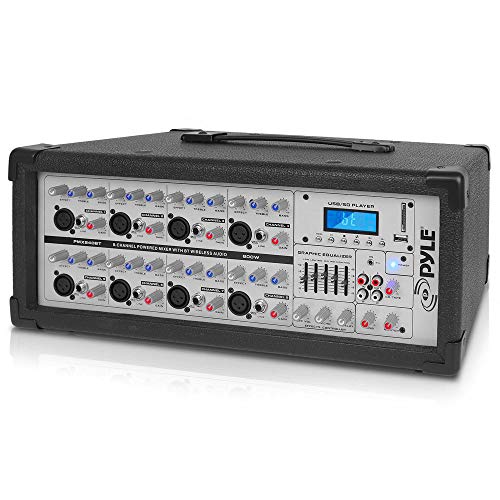
Pyle PMX840BT DJ Mixer — Best Budget for Karaoke Rigs
The PMX840BT closes the guide at the budget floor: an 8-channel Pyle mixer with a built-in cooling fan, USB-A MP3 and SD-card playback and a digital display, aimed at karaoke hosts, mobile DJs and party rigs where tracks matter as much as mics. Pyle’s formula is maximum function per dollar, and for playback-led entertainment that formula fits. It suits hosts and hobbyist rigs that need eight inputs and simple amplification on the smallest sensible budget — with eyes open about what the floor of this market does and does not promise.
Strengths
- The most affordable route to an 8-channel powered rig in this guide
- USB and SD playback built in for track-led shows
- Cooling fan fitted — a working detail many budget boxes skip
Trade-offs
- Build and preamp quality are budget class — adequate, not refined
- Power figures at this tier should be treated as small-room class
- Pyle’s support and longevity trail the guide’s other brands
| Model | PMX840BT |
| Channels | 8 |
| Playback | USB-A MP3 and SD card player |
| Display | Digital LCD |
| Cooling | Built-in fan |
Judge the Pyle by its actual job. A karaoke host needs tracks instantly available, a couple of mics sounding pleasant with a little echo, and a box that survives being carried to pubs four nights a week. The PMX840BT’s built-in media playback removes the laptop from the chain, its fan addresses the heat that kills budget amplifiers in warm rooms, and its price means a backup unit is a realistic line in a working host’s budget — a form of reliability the premium brands achieve differently.
As a band mixer, its ceiling arrives quickly: preamps are workmanlike rather than quiet, EQ is basic, and the amplifier belongs to small rooms. A growing band will outgrow it and should start at the Peavey or Behringer instead. The guide includes the Pyle not as a compromise for bands but as the correct tool for the playback-led rigs that make up a large share of this search’s real searches.
If that is your rig, buy it with a spare mic cable and a second USB stick of your tracks, keep levels sensible, and it will earn its money quickly — which, at this end of the market, is the whole definition of a good buy.
Best for: karaoke hosts and mobile DJs on the smallest sensible budget / Not suited for: bands needing quiet preamps and detailed control
Check on Amazon — check the current price on Amazon and confirm the variant, included accessories and seller before ordering.
Comparison Table
| Pick | Badge | Key spec | Best for |
|---|---|---|---|
| Peavey PVi 8500 All In One Powered Mixer — Check on Amazon | Best Overall | 8-channel all-in-one, Peavey | small bands, churches and event venues wanting a proven 8-channel all-in-one |
| Rockville RPM870 8 Channel Powered Mixer — Check on Amazon | Best Power | 8 ch, 1500W RMS @4Ω, dual EQ | bands and venues needing real power headroom and dual-EQ control |
| Behringer Europower PMP500 Powered Mixer — Check on Amazon | Best Value | 12 ch, compressors, FBQ, 500W class | budget-conscious bands who value processing and spare channels |
| Yamaha EMX7 Powered Mixer — Check on Amazon | Best Sound Quality | 12-input powered, Yamaha DSP | quality-led bands and venues prioritising clarity and long service |
| Rockville RPM109 V2 12 Channel Powered Mixer — Check on Amazon | Best Features | 12 ch / 8 mic pres, 600W RMS | eight-mic line-ups wanting the full modern feature set at a value tier |
| Pyle PMX840BT DJ Mixer — Check on Amazon | Best Budget for Karaoke Rigs | 8 ch, MP3/SD playback, fan | karaoke hosts and mobile DJs on the smallest sensible budget |
Two columns decide this table: mic preamps (your real channel count) and RMS power (your real loudness). The picks that publish RMS figures — both Rockvilles — make comparison easy; for the rest, the reviews translate the class honestly.
How to Choose the Right 8 Channel Power Mixer
Eight channels of what? Counting a band rig properly
Write your line-up as a list of simultaneous sources, marking each as mic or line. A typical eight-channel band: lead vocal, two backing vocals, a mic on the guitar amplifier, a kick or cajón mic, stereo keys (two line channels), and playback. That is five mic preamps and three line inputs — a configuration several ’12-channel’ boxes cannot actually serve if their mic count is four. Shop from the list, not the headline: mic preamps for the mic column, total channels for the whole list, plus one spare of each if growth is likely.
Monitor needs belong in the same arithmetic. Singers who must hear themselves need a monitor send and a wedge; a box without a usable monitor output will frustrate a band no matter how good its mains sound. The dual-EQ RPM870 and the Peavey’s event-proven layout both respect this; check any candidate for a monitor path before the money moves.
Power at eight channels: reading RMS like a grown-up
At this size the rooms get bigger and the wattage games get louder. The discipline from the six-channel guide applies with interest: RMS (continuous) watts into a stated impedance is the only figure worth planning around, and the picks that print it — 1500W RMS for the RPM870, 600W RMS for the RPM109 V2 — deserve the trust that transparency earns. Peak-only listings are not necessarily weak; they are simply unproven, and should be budgeted as a class below their headlines.
Match power to speakers and room together. Efficient cabinets in a pub need a fraction of the watts that hungry cabinets in a marquee demand. If your calculation lands near a box’s ceiling, buy the next box up: headroom is cheaper than the distortion, heat and early failure that come from living at the limit.
- Plan on RMS at your speakers’ impedance — ignore peak in comparisons
- Two speaker pairs or one hungry pair changes the power answer entirely
- Headroom is a sound-quality feature, not a luxury
Effects, EQ and the working checklist
At eight channels the facilities start to separate toys from tools. A graphic EQ on the mains is essential for real rooms; a second EQ or a monitor-specific path is the mark of a rig designed by people who gig. One quality reverb and a delay cover vocals; compressors, where offered, are worth more than a dozen novelty effects. Full 48V phantom matters the day a condenser arrives for the choir or the acoustic guitar. Bluetooth and USB recording are the modern conveniences that genuinely earn their panel space — for break music and for capturing the night without a laptop chain.
Speakers: the other half of every power claim
No powered mixer sounds like anything until speakers translate it, and at eight channels the pairing deserves the same scepticism as the amplifier. Match three numbers: the speakers’ impedance against the mixer’s rated load, their continuous power handling against the amplifier’s RMS output (handling comfortably above output, never below), and their sensitivity — the efficiency figure that decides how loud a watt actually becomes. A sensitive cabinet makes a modest amplifier sound generous; an insensitive one makes a strong amplifier sound tired.
If you are buying the whole rig at once, resist spending the entire budget on the mixer. A sensible split gives the speakers and stands a share rivalling the box itself, because that is where the audience’s experience is actually manufactured. The guides in this cluster return to the point because gigs keep proving it: nobody ever left a venue praising the mixer’s wattage; they praise that they could hear every word.
Budget tiers at this size
The floor buys the Pyle: playback-led utility for hosts and hobbyists. The value tier buys Behringer processing or Rockville features — the thinking band’s territory. The proven tier buys Peavey reliability; the premium tier buys Yamaha clarity and the RPM870’s muscle. None of these tiers is a mistake in itself; the mistake is buying a tier below your room and your line-up, because the second purchase always costs more than the first one would have.
Monitors: The Mix Your Audience Never Hears
Every eight-channel rig eventually discovers that the audience mix is only half the job. Singers who cannot hear themselves sing worse — pitch drifts, voices strain, confidence evaporates — and no mains quality compensates. A monitor path (an aux send feeding a wedge or a small powered speaker) is therefore not an upgrade but a completion of the system, and it should be budgeted with the mixer, not after the first bad gig.
Start simple: one shared monitor mix for the vocalists, placed where the lead singer stands, rung out like the mains. Even that single wedge transforms a small band’s tightness. The dual graphic EQ on the RPM870 exists precisely for this — one EQ for the room, one for the wedge — and it is the clearest sign in this guide of a box designed by people who have stood where your singers stand.
Heat, Fans and the Four-Hour Function
Powered mixers fail in summer, at hour three, in a marquee — because amplification is heat, and heat unmanaged is failure scheduled. The design details that matter are unglamorous: fan cooling with vents that stay unblocked, a chassis that sheds warmth, and an operator who leaves space around the box instead of entombing it in a foam-lined case while it runs. Two picks in this guide advertise dual or built-in fan cooling by name; treat that as a working feature, not a bullet point.
Your part is discipline: never cover the vents, keep the box out of direct sun at outdoor-adjacent gigs, and if the protection circuit ever mutes the amplifier mid-show, believe it — reduce the load or the level rather than restarting into the same wall. A powered mixer that is thermally cruising at your loudest moment will outlive one that sprints, which is the final argument for buying headroom.
When to Leave the Format: Signs You Have Outgrown a Powered Mixer
The powered mixer is the right answer until specific symptoms appear: you need more than one monitor mix; the band records every show in multitrack; the venue list includes rooms where the amplifier is simply not enough; or outboard processing — gates, detailed channel EQ, wireless control — becomes a weekly wish. Those are the signs to move to an unpowered mixer with powered speakers or a separate amplifier, a path this cluster’s USB-recording guide explores from the recording side.
Until those symptoms are real, resist the upgrade itch. A well-chosen eight-channel powered mixer — and every pick above qualifies — covers years of honest gigging. The best rig is the one that is paid for, understood by its operator, and set up the same reliable way every night.
How to Set Up an 8 Channel Powered Mixer for a Full Band
Bigger line-up, same discipline — with two additions: a channel plan written down, and monitors rung out before the mains.
- Write the channel plan before load-in: every source assigned a channel, a mic and a cable, with the spare channel identified.
- Position and connect speakers on stands; verify the total impedance load against the amplifier’s rating before powering anything.
- Connect the monitor wedge from the monitor/aux output and place it for the lead singer, angled at their head, not their knees.
- Set gains channel by channel, quietest source first in your head but loudest moment in your ears — leave headroom on every input.
- Ring out the monitors first: they feed back before the mains do, and a stable wedge makes for a confident soundcheck.
- Ring out the mains with the graphic EQ, cutting the first ringing frequencies a few decibels each.
- Balance the band at performance level, then add vocal effects — reverb until it is just audible in the room, then a fraction less.
- Mark the working positions of master, monitor and effects returns with tape; photograph the panel for next time.
- Tape down or route every cable crossing a walkway — eight channels means enough cable to trip a drummer.
Save the panel photograph and the channel plan together as the rig’s default. Eight-channel setups fail through drift — one borrowed cable, one moved mic — and the documented default is how a band sounds like itself in every room.
Common Buying Mistakes
- Buying total channels instead of mic preamps. Count XLR mic inputs against your mic list. Stereo line pairs do not sing backing vocals.
- Ignoring the monitor path. A band without monitors is a band singing blind. Confirm a monitor send and budget a wedge.
- Comparing peak watts across brands. RMS at a stated impedance is the only honest comparison — and the picks that publish it earn the benefit of the doubt.
- Running the amplifier at its ceiling all night. Heat and distortion are the wages of no headroom. Size the box so your loudest moment is a cruise.
- Blocking the vents with a case or cables. Powered mixers breathe through their panels. Entombed amplifiers protect themselves by shutting down — mid-show.
- Letting effects substitute for balance. Reverb cannot fix a band whose levels are wrong. Balance dry first; decorate second.
Final Recommendation
Most eight-channel shoppers should buy the Peavey PVi 8500 and stop shopping: it is the class’s proven centre. Rooms that defeat ordinary amplifiers want the Rockville RPM870; feature-hungry eight-mic line-ups want its RPM109 V2 sibling; processing-smart budget buyers want the Behringer PMP500; clarity-led venues want the Yamaha EMX7; and karaoke-led rigs on a floor budget are honestly served by the Pyle.
Confirm the mic-preamp count, the monitor path and your speakers’ match in the listing before you order, and check price on Amazon at the moment of purchase. At this size, bundles vary — cables, covers and speaker pairings move the real value more than the headline figure.
Keep exploring the cluster: Best 6 Channel Power Mixers Best 8 Channel Mixers With Echo And Eq Best 8 Channel Usb Recording Mixers Best 10 Channel Mixers Best 12 Channel Audio Mixers Best Affordable Sound Mixers
Frequently Asked Questions
Is 8 channels enough for a five-piece band?
Usually, yes — with planning. Five-piece bands typically need five to seven mic preamps (vocals, one or two instrument mics) plus stereo keys or playback as line inputs. The discipline is the drum kit: in small venues it goes unmic’d or takes a single mic. If your drummer needs a full mic kit, you have left this class — look at 12-mic-preamp systems instead.
What is the difference between the two Rockville picks?
Emphasis. The RPM870 is the power pick — a much larger RMS figure and dual graphic EQs for mains and monitors. The RPM109 V2 is the features pick — eight true mic preamps, 24 effects, more playback and recording conveniences, and a solid but smaller 600W RMS. Big rooms choose the 870; feature-hungry line-ups choose the 109.
Can I use a powered mixer with powered speakers?
You can feed powered speakers from a powered mixer’s line-level outputs (if fitted), but never connect its amplified speaker outputs to a powered speaker’s input — that can damage both. If your future is powered speakers, the unpowered-mixer route in this cluster’s other guides is the cleaner architecture; powered mixers are built for passive cabinets.
Why do two mixers with similar wattage sound so different in loudness?
Because wattage is only one term in the equation. Speaker efficiency, impedance matching, amplifier headroom and room acoustics each move perceived loudness as much as the number on the box. An efficient speaker on a modest amplifier routinely outplays an inefficient speaker on a boastful one — which is why this guide keeps returning to RMS honesty and speaker matching.
Do I need 48V phantom power for a band rig?
Only if you use condenser microphones or certain DI boxes — for choirs, acoustic instruments, overheads or studio-style vocal mics. Dynamic vocal mics, the band standard, do not need it and are unaffected by it. If your rig might grow condensers, a box with full 48V (both Rockvilles here) saves a future workaround.
How do I stop feedback with eight open mics?
Fewer open mics at once, first — mute what is not in use. Then geometry (speakers ahead of the mic line), correct gain staging, and graphic-EQ cuts at the ringing frequencies, monitors rung out before mains. Eight mics raise the stakes on all of it, which is why the setup order in this guide’s how-to section is written the way it is.


