Disclosure: airfryerkitchensupply.com is reader-supported. When you buy through links on our site, we may earn an affiliate commission at no extra cost to you.
Where to buy
All six picks were verified on 2026-11-21 and are sold on Amazon — check price on Amazon through the links below. This roundup deliberately mixes fuels — two induction, two gas, two radiant — because ‘4 burner’ shoppers are usually choosing a technology at the same time as a cooktop. Each review states its fuel in the first lines so you can skip what does not apply.
- Empava Ease 30 Inch Induction Cooktop 4 Burner: check price on Amazon
- ThermoMate 30 Inch Gas Cooktop with 4 Italy Sabaf Burners: check price on Amazon
- Karinear 30 Inch Electric Cooktop 4 Burners Knob Control: check price on Amazon
- Samsung NA30R5310FG 30 Inch 4 Burner Gas Cooktop: check price on Amazon
- GASLAND 30 Inch Induction Cooktop with Bridge Element: check price on Amazon
- Empava 30 Inch Radiant Electric Cooktop 4 Burners: check price on Amazon
The best 4 burner cooktops are the workhorses of the kitchen world: four cooking positions is the configuration most households actually use, in the 30-inch (and occasionally 24-inch) frames most kitchens are built around. Unlike size-specific searches, ‘4 burner’ cuts across every fuel — gas, induction and radiant all field strong candidates — which makes this the roundup where the technology decision matters as much as the model decision.
We have structured it as a fair fight. Two induction picks (Empava Ease and GASLAND) argue for speed and precision. Two gas picks (ThermoMate and Samsung) argue for flame and familiarity. Two radiant picks (Karinear and Empava) argue for compatibility and value. Read the pair that matches your fuel leanings first, then the guide sections, which exist to settle the fuel question honestly.
Every pick is a built-in drop-in. Gas models need a gas line and convert to LP; electrics need a 240V circuit (the radiant and induction models here are hardwired). Cutouts in this class are more standardized than at 36 inches, but ‘more’ is not ‘fully’ — measure before ordering, as always.
A final framing thought: four burners is not a compromise size. It is the size the majority of serious home cooking actually uses, in the frame the majority of kitchens are built around, which is why every fuel fields its most refined mainstream models here rather than its flagships. The flagship money in this category buys width and wattage; the four-burner money buys maturity — proven layouts, deep parts pipelines, designs that have survived a decade of returns data. Shop it as the mature category it is, and the right pick tends to announce itself.
In this guide
Quick Picks
- Empava Ease 30 Inch Induction Cooktop 4 Burner — Best Overall — Induction. 7400W of induction with boost, pause, pan sensor and a 99-minute timer — the most complete four-burner package in this roundup. — check price on Amazon
- ThermoMate 30 Inch Gas Cooktop with 4 Italy Sabaf Burners — Best Gas. Four SABAF burners in 304 stainless with thermocouple protection and CSA certification — the gas purist’s four-burner answer. — check price on Amazon
- Karinear 30 Inch Electric Cooktop 4 Burners Knob Control — Best Radiant — Knob Control. 6700W of radiant power driven by real knobs, with a hot surface indicator — the elder-friendly, glove-friendly radiant pick. — check price on Amazon
- Samsung NA30R5310FG 30 Inch 4 Burner Gas Cooktop — Best Brand-Name Gas. Samsung’s four-burner gas entry in black stainless — big-brand design, support and resale story in the standard 30-inch frame. — check price on Amazon
- GASLAND 30 Inch Induction Cooktop with Bridge Element — Best Induction with Bridge. A bridge element in a 30-inch induction frame, on GASLAND’s matte scratch-resistant glass — griddle capability without upsizing to 36 inches. — check price on Amazon
- Empava 30 Inch Radiant Electric Cooktop 4 Burners — Best Budget Radiant. A dual-zone element for pan-size flexibility, ETL certification and total cookware freedom at the friendliest radiant price tier. — check price on Amazon
Fast picks: Empava Ease if you are going induction, ThermoMate for gas, Karinear for radiant — details and alternatives below.
How These Picks Were Chosen
Verification was per-model against Amazon listing data: four burners, built-in format, and the fuel stated in each listing all had to match before a pick earned its link. Portable hot plates and five-burner models that surfaced in searches were excluded.
The six slots were allocated two-per-fuel to keep the comparison honest, then filled with the strongest verified candidate in each sub-class: a knob-control and a value radiant, a SABAF and a brand-name gas, a mainstream and a bridge-equipped induction.
Within each fuel we weighed control style, burner or zone geometry, safety equipment (thermocouples on gas, locks and pan sensors on induction, hot-surface warnings on radiant), and the realism of long-term support through each brand’s channel.
Why only two per fuel? Because a four-burner shortlist that crowned six induction models would dodge the question this search actually asks. The two-per-fuel structure forces the honest comparison, and each pair contains a clear first choice — so a reader who knows their fuel can decide in minutes, and a reader who does not gets the framework to choose one.
Selection transparency: the two-per-fuel structure meant leaving out strong third candidates in each fuel — notably a second GASLAND induction and additional ThermoMate gas sizes that are reviewed in our size-specific roundups. Readers who settle on a fuel here will find those deeper benches in the linked 30-inch and 36-inch guides.
Finally, a methodological note that applies across all three fuels: we weighted verifiable identity over asserted performance. A model number that exists in the maker’s own materials, a certification that can be looked up, a cutout specification printed where buyers can check it — these earned more trust than any output figure in a title. Where wattage appears in a spec box here, the verified listing states it plainly. That discipline is invisible in the finished roundup, but it is the difference between a list built on evidence and one built on other people’s marketing, and it is the standard every pick above was held to.
Readers who have already settled their fuel can treat the other two pairs in this roundup as due diligence rather than homework: a ten-minute skim of the rival technologies’ best cases is the cheapest confirmation a four-burner decision can buy, and occasionally it changes a mind that needed changing before the countertop was cut rather than after.
The 6 Best 4 Burner Cooktops

Empava Ease 30 Inch Induction Cooktop 4 Burner — Best Overall — Induction
This is the pick if you have decided on induction and want the four-burner version done properly. The pause function, pan sensing and per-zone timer cover the daily details, and 7400W is strong output for a 30-inch frame.
Strengths
- 7400W total with power boost, per the listing
- Pause function and pan sensor included
- ETL certified; safety lock and 99-minute timer
Trade-offs
- Requires magnetic cookware — test your pans
- Nine power levels, as with most of this tier
- Hardwired install; no plug-in option
| Size | 30 inch built-in |
| Fuel | Induction, hardwired |
| Total power | 7400W (per listing) |
| Burners | 4 burners, 9 power levels |
Empava’s Ease line is aptly named: the design goal is clearly an induction cooktop that a household can stop thinking about. Zones detect pans and refuse to run empty, the timer handles the rice while you handle everything else, and pause freezes the whole operation when the doorbell rings. These are the features that separate a cooktop you tolerate from one you like.
Performance matches the brief — fast boils under boost, controlled simmers for a four-burner unit, and glass that returns to wipe-clean in seconds because spills never bake on. The induction prerequisites apply in full: magnetic pans only, a proper circuit, and a magnet test before ordering. Pass those gates and this is the strongest all-round four-burner buy on the page.
Empava ownership is defined by the assists quietly working: the pan sensor that refuses to heat an empty zone, the pause that survives a doorbell, the timer that minds the rice. Empava’s support runs through its substantial Amazon operation, and the Ease line’s documentation is a step above marketplace norms. The glass wants the standard induction regime — wipe, don’t scour — and the electronics want their cabinet airflow kept clear. Owners converting from gas consistently cite the same revelation: cleanup measured in seconds changes how often they cook.
Best for: households converting to induction at the standard 30-inch size / Not suited for: cooks with non-magnetic cookware they refuse to replace
Check the current price on Amazon

ThermoMate 30 Inch Gas Cooktop with 4 Italy Sabaf Burners — Best Gas
Choose the ThermoMate if flame is non-negotiable: visible heat, instant response, every pan welcome including the round-bottom wok. Four SABAF burners in a 30-inch frame is the classic European configuration, executed with proper safety hardware.
Strengths
- Four Italy Sabaf burners with thermocouple protection
- 304 stainless steel, CSA certified
- NG/LPG convertible for propane homes
Trade-offs
- Gas line and professional connection required
- Stainless upkeep around burners is a weekly habit
- No timer or digital assists — it is proudly analog
| Size | 30 inch built-in |
| Fuel | Natural gas, NG/LPG convertible |
| Burners | 4 Italy Sabaf burners |
| Safety | Thermocouple protection, CSA certified |
There is a reason the four-burner gas layout endures: two working burners, one simmer burner, one power burner covers how people actually cook, and SABAF hardware executes each role cleanly. Flames light reliably, adjust in a smooth sweep, and hold a low simmer without the cycling compromises of electric alternatives.
ThermoMate’s execution adds the safety and material details that separate a serious appliance from a cheap import: thermocouples at every burner, 304-grade stainless, certification you can look up. It asks for the standard gas commitments — a line, a fitter, ventilation — and repays them with the most tactile cooking experience in this roundup.
ThermoMate ownership is analog contentment: nothing to update, nothing to configure, burners that any gas technician on earth can service because SABAF hardware is everywhere. The stainless top wants a weekly degrease and the caps a monthly soak; in return the cooktop will likely outlive the kitchen’s next two remodels of fashion. Its support is online, but the product’s serviceability makes support a minor character in its story — the correct relationship between a gas cooktop and its owner.
Best for: gas loyalists who cook by eye and ear / Not suited for: households without a gas line or unwilling to add one
Check the current price on Amazon
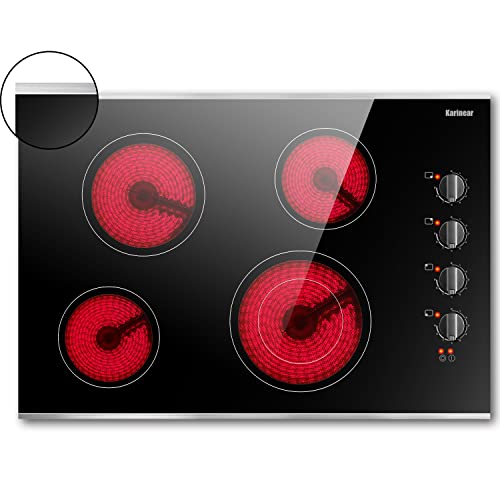
Karinear 30 Inch Electric Cooktop 4 Burners Knob Control — Best Radiant — Knob Control
The Karinear is for cooks who hate touch panels: knobs you can turn with wet hands, read at a glance, and set by feel. It is also the kindest option for older cooks and anyone with reduced fingertip sensitivity, for whom glass touch controls are a genuine barrier.
Strengths
- Physical knobs — usable with wet or floury hands
- 6700W total output verified in the listing
- Hot surface indicator for residual-heat safety
Trade-offs
- No timer or digital features
- Radiant cycling at low settings, as with all radiant
- Knobs need removal for deep cleaning
| Size | 30 inch built-in |
| Fuel | Radiant electric, 220-240V hardwired |
| Total power | 6700W (per listing) |
| Burners | 4 burners, knob control |
Control interfaces are accessibility features whether brands admit it or not. The Karinear’s knobs serve the cook with arthritis, the cook in oven mitts, and the cook who simply refuses to negotiate with a beeping glass panel while a sauce breaks. Turn, glance, cook — the oldest interface in the kitchen remains undefeated for a large share of humanity.
Behind the knobs is a competent radiant core: 6700W across four burners, ceramic glass, and the hot-surface indicator that radiant safety depends on. Expect standard radiant manners — a minute to respond, residual heat after shutoff, universal pan compatibility. For the right household this is not the compromise pick; it is the correct one.
Karinear ownership is gentle: knobs that never confuse, an indicator that guards the household, radiant heat that accepts every pan including the inherited aluminum. The knobs pop off for the monthly deep clean, and the glass takes standard ceramic care. Karinear’s storefront support handles the category routinely. For the households this pick targets — mixed generations, touch-averse cooks — the ownership experience is precisely the absence of friction, which is the highest praise a daily appliance can earn.
Best for: knob loyalists and cooks who struggle with touch panels / Not suited for: feature hunters wanting timers and smart assists
Check the current price on Amazon

Samsung NA30R5310FG 30 Inch 4 Burner Gas Cooktop — Best Brand-Name Gas
Pick the Samsung if your kitchen is a Samsung suite in progress, or if you simply buy appliances the way you buy phones — from a brand whose support number you trust. The black stainless finish is the differentiator in a sea of silver.
Strengths
- Samsung design, parts and service infrastructure
- Black stainless finish resists visible smudging
- Four burners sized for mainstream family cooking
Trade-offs
- Proprietary burners rather than SABAF hardware
- Black stainless can scratch to reveal bright metal
- Premium over functionally similar marketplace gas models
| Size | 30 inch built-in |
| Fuel | Gas |
| Burners | 4 burners |
| Finish | Black stainless steel |
Samsung’s appliance design language is the most distinctive in the mainstream, and this cooktop carries it well: black stainless that reads as intentional design rather than a material compromise, tidy knob placement, and grates with a modern, architectural line. In a Samsung kitchen it is the obvious keystone.
Functionally it is a sound four-burner gas surface with the brand’s usual attention to the details owners touch daily. The ownership argument, as with all legacy brands here, is the decade view: parts pipelines, published documentation, and service coverage that does not depend on a marketplace storefront staying open. Buy it for the ecosystem and the finish; the cooking will take care of itself.
Samsung ownership plugs the cooktop into a real infrastructure: registration, documentation, parts and service all behave like a global brand’s should. The black stainless finish is the maintenance note — it resists smudges beautifully and scratches brightly, so treat it like the finish it is rather than like raw steel. Owners in Samsung suites gain the small coherence of matched design and a single support relationship across appliances, which over a decade of ownership is worth more than any single feature on any spec sheet here.
Best for: Samsung-suite kitchens and brand-first buyers / Not suited for: SABAF hardware purists — the ThermoMate is your pick
Check the current price on Amazon

GASLAND 30 Inch Induction Cooktop with Bridge Element — Best Induction with Bridge
Choose the GASLAND if you want griddle cooking but your kitchen tops out at 30 inches. Bridging two of its four burners creates the long zone a griddle needs, and the matte surface shrugs off the sliding that griddle cooking involves.
Strengths
- Bridge element for griddles in a 30-inch frame
- Matte scratch-resistant surface
- ETL certified with boost, child lock and timer
Trade-offs
- Bridged zones share power; not a true flex area
- Matte glass shows oil smears in angled light
- Magnetic cookware required, as with all induction
| Size | 30 inch built-in |
| Fuel | Induction, 240V |
| Burners | 4 burners with bridge element |
| Surface | Matte scratch-resistant glass |
The bridge is the 30-inch induction feature with the best effort-to-delight ratio: link the left pair, lay down a griddle, and breakfast for four cooks evenly instead of in two lopsided batches. GASLAND pairs it with the matte glass that made its 36-inch sibling a pick in our other roundup, and the combination suits real family kitchens unusually well.
Outside bridge mode it is a competent four-burner induction surface with the standard assists — boost for the pasta pot, lock for the toddler years, timer for the rice. If the Empava Ease is this roundup’s polished all-rounder, the GASLAND is its practical sibling: pick between them on whether a griddle lives in your kitchen.
GASLAND ownership is family-proofing as a feature: the matte glass shrugs off the sliding pans of real breakfast production, the bridge turns two burners into a griddle station without a second appliance, and the lock keeps toddler archaeology out of the controls. Support runs through an experienced cooktop seller. The matte finish’s one vanity is oil smears in raking light — a microfiber pass restores it. For the griddle household at 30 inches, owners report the rare feeling of having bought exactly the right thing.
Best for: 30-inch kitchens that cook on a griddle weekly / Not suited for: buyers who need a fifth zone — step up to 36 inches
Check the current price on Amazon

Empava 30 Inch Radiant Electric Cooktop 4 Burners — Best Budget Radiant
The Empava radiant is the pick for mixed-pan households on a budget: every pot you own works today, the dual-zone element adapts one position to small or large pans, and the price leaves the remodel budget intact.
Strengths
- Dual zone element fits small and large pans in one spot
- Works with all cookware — no magnet test required
- ETL certified, ceramic glass smooth surface
Trade-offs
- Touch-era radiant response: slower than induction
- No knobs for the touch-averse
- Hardwired 220-240V install, no plug
| Size | 30 inch built-in |
| Fuel | Radiant electric, 220-240V hardwired |
| Burners | 4 burners incl. dual zone element |
| Certification | ETL certified |
Radiant’s enduring argument is on this cooktop’s box: all kinds of cookware. The aluminum stockpot, the glass casserole, the copper jam pan — everything works, because radiant is just a very controlled hot surface. For households whose cookware collection is an inheritance rather than a system, that compatibility is worth more than induction’s speed.
The dual zone element is the thoughtful detail: one burner position runs an inner ring for small saucepans or the full diameter for a Dutch oven, which stretches four burners further than their count suggests. Empava’s support runs through its established Amazon presence, and ETL certification keeps the safety paperwork honest. A sensible, unpretentious appliance.
Empava’s radiant model is ownership at its simplest: every pan works, the glass wipes down, the dual-zone element quietly doubles one position’s usefulness. There are no apps, no conversions, no magnet tests in its owner’s future. Support is the same Empava channel as its induction sibling. The trade is speed — radiant will never boil like induction — accepted knowingly by owners whose cookware collections or budgets made the decision. Judged as radiant, it is a well-built, fairly priced appliance that asks almost nothing.
Best for: mixed-cookware households on a radiant budget / Not suited for: speed-focused cooks — induction boils in half the time
Check the current price on Amazon
Comparison Table
| Pick | Badge | Key spec | Best for |
|---|---|---|---|
| Empava Ease 30 Inch Induction Cooktop 4 Burner | Best Overall — Induction | 7400W induction, pause | households converting to induction at the standard 30-inch size |
| ThermoMate 30 Inch Gas Cooktop with 4 Italy Sabaf Burners | Best Gas | 4 SABAF burners, stainless | gas loyalists who cook by eye and ear |
| Karinear 30 Inch Electric Cooktop 4 Burners Knob Control | Best Radiant — Knob Control | 6700W radiant, knobs | knob loyalists and cooks who struggle with touch panels |
| Samsung NA30R5310FG 30 Inch 4 Burner Gas Cooktop | Best Brand-Name Gas | 4 burners, black stainless | Samsung-suite kitchens and brand-first buyers |
| GASLAND 30 Inch Induction Cooktop with Bridge Element | Best Induction with Bridge | Bridge element, matte glass | 30-inch kitchens that cook on a griddle weekly |
| Empava 30 Inch Radiant Electric Cooktop 4 Burners | Best Budget Radiant | Dual zone element, all cookware | mixed-cookware households on a radiant budget |
How to Choose a 4 Burner Cooktop: Start with Fuel
Four burners is the easy part; fuel is the decision. Gas gives instant, visible, pan-agnostic heat and needs a gas line, ventilation and a professional connection. Induction gives speed, precision and a cool surface, and needs magnetic pans plus a healthy electrical circuit. Radiant gives universal compatibility and the lowest prices, and asks for patience on response and respect for residual heat.
Let your infrastructure vote first: an existing gas line tilts the table toward gas; a modern 240V circuit and magnetic pans tilt it toward induction; neither, or a beloved non-magnetic pan collection, makes radiant the pragmatic answer. Then choose within the fuel using the paired reviews above — control style and burner geometry are where daily satisfaction actually lives.
What Size Is a 4 Burner Cooktop, Really?
Most four-burner built-ins are 30 inches wide, the North American standard that matches a standard range footprint. A minority are 24 inches for compact kitchens. The headline class hides cutout variation of an inch or more between brands, so the ritual stands: measure your cutout, compare the listing’s specified cutout, order second.
Burner spacing matters as much as count. Four burners that cannot hold a 12-inch skillet and a saucepan simultaneously are three burners wearing a costume. Check the zone map against your two largest pans — the reviews above flag the layouts with genuinely usable spacing.
Which 4 Burner Cooktop Is Easiest to Keep Clean?
Induction wins this category outright: the surface barely heats, so spills sit on cool glass and wipe away instead of carbonizing. Radiant glass is next — spills bake on, but a ceramic-glass cleaner and a flat razor scraper restore it. Gas is the most work: grates, caps and burner bases all come apart for cleaning, and all collect grease enthusiastically.
Weigh this honestly against cooking style. A household that fries daily will spend real hours on gas upkeep over a decade; a household that mostly simmers may never notice. Cleanability is not a footnote — it is a weekly appointment with your choice.
What Does a 4 Burner Cooktop Cost to Install, by Fuel?
The appliance is only part of the invoice, and the installation share differs sharply by fuel. Radiant and induction drop-ins replacing a like-for-like electric unit are the cheapest projects: an electrician’s visit for the hardwired swap, assuming the circuit already suits. Induction adds potential cookware replacement — the magnet test failures — which can rival the installation cost.
Gas is the project fuel: a line run if none exists, a licensed fitter’s connection and leak test, and ventilation that may need upgrading to a ducted hood. None of this makes gas a bad choice — flame loyalists pay it gladly — but it means the gas picks in this roundup should be compared on total project cost, not sticker against the electrics. Price the whole job for your fuel before falling for any single model.
How to Match Burner Layout to Your Cooking Style
Read every candidate’s zone map against your three most-cooked meals. Pasta night wants a strong rear burner for the big pot and a front burner for the sauce — check that both fit simultaneously. Sauce-heavy cuisines want the honest low end: a dedicated simmer burner on gas, fine low steps on induction, a small dual-zone ring on radiant. Breakfast households want the bridge or dual-zone geometry that fits a griddle.
The four-burner format punishes vague shopping because there is no spare capacity to hide a mismatch. The good news: four positions honestly matched to your meals outperform five generic ones. The paired reviews above are organized to make exactly this comparison — same count, different philosophies — so use them as a layout audition, not just a feature list.
The Four-Burner Layouts, Compared Across Fuels
Each fuel draws the same four positions differently, and the differences are instructive. Gas layouts (ThermoMate, Samsung) place a power burner front or center for access, with a small simmer burner where a sauce can sit watched. Induction layouts (Empava, GASLAND) are free of combustion geometry, so they chase pan-size logic — a large zone for the stockpot, paired zones that bridge for the griddle. Radiant layouts (Karinear, Empava) split the difference, with dual-zone elements substituting flexibility for raw count.
The audition that matters: place your stockpot and your largest skillet on the map simultaneously, then add the saucepan your most-cooked dinner needs. The layout that holds all three without overlap is your layout, whatever its fuel. Four burners forgive nothing — there is no fifth position to absorb a bad map — which is why this unglamorous exercise outranks every feature comparison in the roundup.
When Is a Fifth Burner Worth Moving to 36 Inches?
The honest triggers are frequency and simultaneity. If three weeknights a month find you juggling a pan off the heat to make room, the fifth zone pays rent. If your cooking peaks at holidays, a 36-inch cooktop spends fifty weeks as expensive countertop and one week as a hero — a trade some households happily make and others regret by February.
There is also the two-cook trigger: households where two people genuinely cook together nightly outgrow four positions socially before they outgrow them culinarily. If that is your kitchen, read our 36-inch roundups with our blessing. If it is not, the four-burner format’s maturity, price and fit with standard cabinetry make it the rational center of the cooktop world — which is exactly where this list lives.
Safety Equipment by Fuel: What Each Technology Owes Your Household
Each fuel carries a characteristic hazard, and each pick in this roundup carries the engineered answer to it — knowing the pairing helps you shop beyond this list. Gas’s hazard is unburned fuel and combustion byproducts; its answers are the thermocouple at every burner (both gas picks have them), a reachable shutoff, and ventilation that actually exhausts. If a gas model you find elsewhere omits flame-failure protection, the discount is being taken out of your safety margin.
Induction’s hazards are subtler: a surface safe to touch but controls a child can activate, and strong magnetic fields that deserve distance from implanted medical devices per manufacturers’ guidance. Its answers are the control lock, pan detection that refuses empty operation, and automatic shutoff — all present on both induction picks here. Radiant’s hazard is the one everyone underestimates: invisible residual heat on glass that looks identical hot or cold. Its answer is the hot-surface indicator, present on both radiant picks, and the household rule that the indicator outranks your memory of turning the burner off.
The meta-lesson is that safety in this category is not a trim level. Every pick here, at every price in this roundup, carries its fuel’s full safety architecture — and any model you consider elsewhere should be held to the same line before its features are even discussed.
Total Cost of Ownership Across the Three Fuels
Stretch the horizon to ten years and the fuels reorder themselves interestingly. Radiant is the cheapest ownership story in this roundup: lowest purchase tier, universal pans already owned, elements that are commodity parts, and no infrastructure beyond the circuit. Induction costs more at purchase and possibly in cookware, then repays in speed, minimal cleaning time and electronics that either work or are replaced as units. Gas splits its costs across time: mid-tier purchase, professional installation, ventilation upkeep, and the cheapest per-part repairs of any fuel because its components are mechanical and standardized.
Energy running costs, the figure buyers most often ask about, are honestly the smallest term in the decade equation for all three fuels at household cooking volumes — dwarfed by installation, cookware and repair events. The rational buyer therefore chooses on cooking fit and infrastructure reality, exactly as this guide has argued from its first section, and lets the ten-year arithmetic confirm rather than dictate. Every pick here is defensible on total cost; the indefensible purchases are the ones whose fuel fights the kitchen they land in.
A Word for Landlords and Property Upgraders
A meaningful share of four-burner purchases are not for the buyer’s own kitchen, and rental logic inverts several of this guide’s defaults. Tenants bring unknown pans, which crowns radiant’s universal compatibility; they will not maintain gas burner ports, which argues against gas unless the property already has it and the lease assigns the upkeep; and replacement cost matters more than refinement, which favors the mainstream models with deep stock over anything exotic.
For a quality rental, the Empava radiant in this roundup is the quiet professional choice: ETL certified, pan-agnostic, glass that a property manager can restore between tenancies with a scraper and cleaner. For an owner-occupied upgrade you will live with daily, return to the fuel-first framework — the landlord’s answer is a business decision, and it should not colonize a home cook’s kitchen by accident.
One Final Test Before the Return Window Closes
Whichever fuel you chose, schedule one honest stress dinner in the first week: your biggest pot, your everyday skillet and the saucepan your most-cooked meal needs, all working at once, plus the delicate item — the sauce, the custard, the simmer — that tests the low end. That meal audits the zone map against your real pans, the controls against your real hands, and the safety equipment against your real household, while returns are still simple and the installer’s visit is still fresh. Four burners forgive nothing, so let them confess early.
How to Care for Any Cooktop: The Universal Routine
Whatever the fuel, three habits preserve a cooktop. Clean spills in the same session they happen — residue that survives one heating cycle becomes archaeology. Use the cleaner the surface wants: ceramic-glass cream for glass of any fuel, degreaser and soft cloths for stainless and enamel, nothing abrasive anywhere. And keep the parts that move or sense clean: gas burner ports and igniters, induction’s touch panel, radiant’s indicator lens.
Monthly, do the five-minute inspection: gas flames burning blue and even, induction zones detecting pans promptly, radiant elements glowing uniformly without dark patches. Every fault in this category announces itself early and cheaply to an owner who looks, and late and expensively to one who does not. The cooktop you inspect is the cooktop that lasts.
Pre-Purchase Checklist
Before ordering any pick in this roundup:
- Fuel decided — and infrastructure confirmed (gas line, or 240V circuit)
- If induction: every weekly pan passed the magnet test
- Cutout measured and matched to the chosen model’s listing
- Zone map auditioned against your three most-cooked meals
- Ventilation plan exists for gas picks
- Safety equipment confirmed: thermocouple, lock or hot-surface indicator per fuel
How to Swap a 4 Burner Cooktop Without Changing the Counter
The standard 30-inch class makes like-for-like swaps the most common cooktop project. This sequence keeps a swap countertop-safe and single-visit.
- Measure the old cutout and the old unit’s overall footprint; note the fuel and, for electric, the circuit rating at the panel.
- Shortlist only models whose specified cutout is equal to or slightly larger than yours — smaller leaves a gap no trim fully hides.
- Confirm the new unit’s depth clears the drawer or oven below; induction bodies and junction boxes sit differently from old coil units.
- Shut off fuel or power at the source and have the old unit disconnected by the appropriate professional for its fuel type.
- Dry-fit the new cooktop, set its gasket, and check the surface sits flush and level before final connection.
- After connection, test every burner or zone at high and low settings, and check safety features: thermocouple, lock, or hot-surface indicator per fuel.
Keep the old unit’s manual and the new one’s installation sheet together in the kitchen drawer. The next swap — or the next owner — starts from those two documents, and cutout archaeology is nobody’s favorite hobby.
Common Buying Mistakes
Choosing fuel by fashion. Induction is fashionable; your non-magnetic heirloom pans do not care. Let infrastructure and cookware decide, then optimize within the fuel.
Assuming all 30-inch cutouts match. They cluster, they do not coincide. Measure, compare the specified cutout, then order.
Ignoring ventilation for gas. Four gas burners produce real combustion byproducts and heat. A working hood vented outside is part of the gas package, not an accessory.
Forgetting the simmer test. Every cooktop boils. The one that holds your sauce at a bare bubble without scorching is the one you will love — check low-end behavior in reviews and return windows.
Skipping safety hardware to save money. Thermocouples on gas, locks on induction, hot-surface indicators on radiant — these are the features that matter on the worst day, not the average one.
Final Recommendation
There is no single winner here because there is no single kitchen. Going induction: the Empava Ease is the complete package, and the GASLAND adds a bridge if a griddle lives with you. Staying with gas: the ThermoMate’s SABAF hardware is the enthusiast’s choice and the Samsung is the brand-suite choice. Keeping every pan you own on radiant: the Karinear’s knobs or the Empava’s dual-zone value, depending on your hands and your budget. Decide the fuel honestly, and any of these six will cook well for years.
Start here: Empava Ease 30 Inch Induction Cooktop 4 Burner; ThermoMate 30 Inch Gas Cooktop with 4 Italy Sabaf Burners; Karinear 30 Inch Electric Cooktop 4 Burners Knob Control — check price on Amazon for each and confirm the listing’s cutout specification against your counter before ordering.
Best 4 Burner Gas Cooktops Best 30 Inch Electric Cooktops Best 30 Induction Cooktops
Frequently Asked Questions
Is a 4 burner cooktop big enough for a family?
For most families, yes — four positions cover the standard two-pan dinner plus sides, especially with a dual-zone or bridge feature stretching the layout. Households that regularly run five vessels should look at 36-inch models.
Can I replace a 4 burner electric cooktop with a gas one?
Only with a gas line run to the location, proper ventilation and a licensed fitter — a bigger project than a like-for-like swap. The reverse swap needs a 240V circuit instead.
Which fuel is cheapest to run?
Operating costs vary by local energy prices; gas is often cheaper per unit of heat, induction wastes the least heat into the room. Over a decade the differences are smaller than the installation and cookware costs — decide on cooking fit first.
Do 4 burner induction cooktops need special pans?
Yes — magnetic bases only. Cast iron and most stainless steel work; aluminum and glass do not. The magnet test on each pan takes ten seconds.
What is a dual zone element on a radiant cooktop?
One burner position with two selectable sizes: a small inner ring for saucepans or the full ring for large pots. It makes one position do the work of two, which matters when you only have four.
How long should a 4 burner cooktop last?
Roughly a decade or more with normal care. Gas models often run longer because their parts are mechanical and replaceable; electronic models depend more on the maker’s parts pipeline.
Can I install a 4 burner cooktop myself?
Electric drop-ins are sometimes owner-installed where code allows, but hardwired connections and all gas work are professional jobs in most jurisdictions. When in doubt, hire it out — the visit is cheap insurance.
Which 4 burner fuel is best for renters?
Renters rarely get to choose — the fuel is whatever the unit has. If you own the property, radiant is the tenant-proof option: universal pans, no gas liability, lowest replacement cost.
Is a 4 burner cooktop enough for canning?
A single flat-bottom canner on the largest burner is standard practice where the model’s manual approves it — check weight and diameter limits, especially on glass surfaces. Serious high-volume canning is 36-inch or dedicated-burner territory.
Can a 4 burner induction cooktop run on a 30-amp circuit?
Most 30-inch four-burner induction models specify 40 amps; some smaller units allow less. The listing’s electrical specification governs — have your electrician match the model to the panel before ordering.
Which fuel is safest for a household with young children?
Induction, on balance: the surface stays comparatively cool, locks exist, and zones refuse to run without pans. Gas demands the most supervision; radiant’s residual heat is its specific child hazard. Every fuel is manageable with its safety equipment used properly.
Best 36 Inch Gas Cooktops Best 2 Burner Cooktops Electric Best 30 Gas Cooktops


