Disclosure: airfryerkitchensupply.com is reader-supported. When you buy through links on our site, we may earn an affiliate commission at no extra cost to you.
Where to buy
Every model in this roundup is sold on Amazon and was verified against Amazon’s product data feed for this site before earning its link. No static prices are printed here — built-in cooktop pricing moves too often to stay honest in print — so use the links to check the current price on Amazon, and confirm your cutout and gas supply before ordering.
- Empava 30-Inch Gas Cooktop 5 SABAF Burners — check the current price on Amazon
- ThermoMate 30 Inch Gas Cooktop 5 Sabaf Burners — check the current price on Amazon
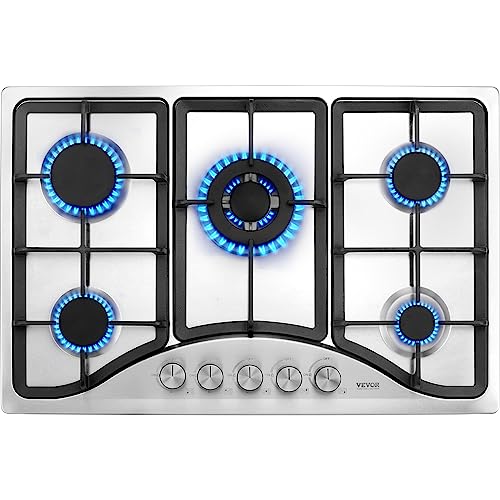
- VEVOR Gas Cooktop 30 Inch 5 Burners — check the current price on Amazon
- Frigidaire Professional FPGC3077RS 30 Inch Gas Cooktop — check the current price on Amazon
- Thermador SGS305TS 30 Inch Gas Cooktop — check the current price on Amazon
- 30 Inch Gas Cooktop DM527-SA02B 5 Burners — check the current price on Amazon
The best 30 gas 5 burner cooktops solve a specific arithmetic problem: five live flames in the standard 30-inch cutout. The best 30 gas 5 burner cooktops give a busy household a centre burner for the griddle or stockpot plus four corners for the supporting cast — the layout of a much larger range compressed into the footprint most kitchens already have. Every pick below was verified through this site’s Amazon product data feed.
Five burners is a layout, not a luxury badge, and this guide treats it honestly: the centre burner earns its place on multi-pan nights and becomes a trivet on simple ones, and large pans crowd in thirty inches no matter whose badge is on the deck. What separates the six picks is what gas buyers should actually judge — burner component quality, deck material, flame protection, fuel flexibility and the support behind the brand.
Every pick here is convertible between natural gas and liquefied petroleum gas, and every pick carries thermocouple flame-failure protection. Beyond that shared floor, the range runs from an unbranded value deck to Thermador’s luxury platform, with the SABAF-burner middle — Empava and ThermoMate — offering the component quality most cooks should aim at.
In this guide
Quick Picks
- Empava 30-Inch Gas Cooktop 5 SABAF Burners — Best Overall: Five Italian SABAF burners, dishwasher-safe grates, full flame protection. Check the current price on Amazon.
- ThermoMate 30 Inch Gas Cooktop 5 Sabaf Burners — Best Heavy-Duty Deck: Five Sabaf power burners in a heavy 304 stainless deck, CSA certified. Check the current price on Amazon.
- VEVOR Gas Cooktop 30 Inch 5 Burners — Best Value: Five protected, convertible burners at the value tier. Check the current price on Amazon.
- Frigidaire Professional FPGC3077RS 30 Inch Gas Cooktop — Best Legacy Brand: The Frigidaire Professional platform and its service network. Check the current price on Amazon.
- Thermador SGS305TS 30 Inch Gas Cooktop — Best Luxury: The Thermador SGS305TS — the luxury benchmark in this size. Check the current price on Amazon.
- 30 Inch Gas Cooktop DM527-SA02B 5 Burners — Best Budget: Five convertible burners with protection, no-frills pricing. Check the current price on Amazon.
How These Picks Were Chosen
Every candidate was verified against the site’s Amazon product data feed: the listing had to confirm the model, the 30-inch built-in format and the burner configuration before the cooktop earned a link. Models that could not be confirmed were excluded rather than described from memory, and no output figures are printed that do not come from a verified listing.
The shortlist balances the axes gas buyers actually decide on: burner component quality (the Italian SABAF burners several picks share), deck material, fuel flexibility — every pick here converts between natural gas and LPG — and the support infrastructure behind the badge, from Thermador’s dealer network to the value brands’ marketplace model. Price is treated in tiers only; cooktop pricing moves with promotions too often for print to stay honest.
Badges mark the household each cooktop serves best. Five burners in thirty inches is always a compromise with pan space, so the reviews are explicit about who should take the five-burner layout and who is better served by the four-burner electric alternatives elsewhere in this programme.
The 6 Best 30-Inch Gas 5-Burner Cooktops

Empava 30-Inch Gas Cooktop 5 SABAF Burners — Best Overall
The Empava earns its place on the five-burner gas shortlist through its components. Five Italian SABAF burners — the burner maker that supplies much of the industry — sit in a stainless 30-inch deck, convertible between natural gas and LPG, with thermocouple flame-failure protection that cuts gas if a flame dies. The grates go in the dishwasher, which sounds minor until the first Sunday sauce incident.
For daily cooking the layout behaves like a proper five-burner: a centre workhorse for the stockpot or griddle, corners for sauces and sides. SABAF burners are valued for clean, stable flames at low settings as much as for full power, which is where cheap gas cooktops usually fail — the simmer that will not stay lit. If your cooking mixes weeknight speed with weekend low-and-slow, this is the balanced centre of the gas market.
Strengths
- Italian SABAF burners — the component brand serious makers specify
- NG/LPG convertible with thermocouple flame-failure protection
- Dishwasher-safe grates simplify the worst cleaning job
Trade-offs
- Stainless surface shows every splash — wiping is a daily habit
- Five burners in 30 inches means large pans crowd neighbours
- Conversion to LPG should be done carefully per the manual
| Specification | Detail |
|---|---|
| Burners | 5 Italian SABAF burners |
| Fuel | NG/LPG convertible |
| Safety | Thermocouple flame-failure protection |
| Grates | Dishwasher-safe |
Best for: Five-burner households wanting proven burner components / Not suited for: Cooks who hate stainless upkeep
Check on Amazon — check the current price on Amazon before you buy; listings, bundles and included accessories change over time.

ThermoMate 30 Inch Gas Cooktop 5 Sabaf Burners — Best Heavy-Duty Deck
The ThermoMate is the heavy-metal entry on the five-burner gas shortlist: a 304 stainless steel deck — the grade commercial kitchens specify — carrying five Italy Sabaf power burners with thermocouple protection and CSA certification. It is NG/LPG convertible, so it serves a plumbed kitchen today and a propane property later.
The appeal is substance per dollar. You are buying burner quality and deck material rather than badge or styling, and for rental properties, serious home cooks and anyone replacing a failed unit on a deadline, that trade makes sense. Installation deserves care — the unit is heavy, and a level, well-sealed fit repays itself in quiet, stable cooking for years.
Strengths
- 304 stainless steel construction — the heavier commercial grade
- Italy Sabaf power burners with thermocouple protection, CSA certified
- NG/LPG convertible for house gas or propane setups
Trade-offs
- Heavy build rewards a careful, measured installation
- Value-brand dealer network is thinner than legacy names
- Knob and grate finish is functional rather than luxurious
| Specification | Detail |
|---|---|
| Burners | 5 Italy Sabaf power burners |
| Deck | 304 stainless steel |
| Fuel | NG/LPG convertible |
| Certification | CSA certified, thermocouple protection |
Best for: Buyers wanting heavy deck material and certified burners / Not suited for: Shoppers prioritising brand prestige
Check on Amazon — check the current price on Amazon before you buy; listings, bundles and included accessories change over time.
VEVOR Gas Cooktop 30 Inch 5 Burners — Best Value
VEVOR’s five-burner is the value disruptor on the five-burner gas shortlist: stainless construction, thermocouple protection and NG/LPG convertibility at the tier where big brands sell four burners or none. The listing explicitly spans apartments, RVs and camping-capable setups, which reflects the convertible fuel design — this cooktop follows the cook.
Set expectations at the tier: grate weight, knob feel and documentation are value-grade, and support runs through the marketplace rather than a dealer network. Judged as cooking hardware — five protected burners in a standard cutout — it delivers the essential job for the least commitment, which is why it anchors the budget end of every gas list in this programme.
Strengths
- Five burners with thermocouple protection at a value tier
- NG/LPG convertible — suits apartments, RVs and cabins too
- Stainless design wipes down easily
Trade-offs
- Total output figure is the headline; per-burner distribution is conventional
- Brand support is marketplace-based rather than dealer-based
- Grates are lighter than legacy-brand cast iron
| Specification | Detail |
|---|---|
| Burners | 5 burners |
| Fuel | NG/LPG convertible |
| Safety | Thermocouple protection |
| Use cases | Apartments, RVs, camping-capable setups |
Best for: Budget-first five-burner buyers and propane properties / Not suited for: Buyers wanting dealer-network support
Check on Amazon — check the current price on Amazon before you buy; listings, bundles and included accessories change over time.

Frigidaire Professional FPGC3077RS 30 Inch Gas Cooktop — Best Legacy Brand
The Frigidaire Professional FPGC3077RS brings the legacy-brand case to the five-burner gas shortlist: a 30-inch gas platform from the Frigidaire Professional line, with the parts availability, service network and resale recognition that value brands cannot match. In a remodel intended to sell, or a kitchen where a failed cooktop must be serviceable in a decade, that infrastructure is a feature.
The feed listing for this model is briefer than the newer rivals’, so treat the product page as the authority on its exact burner configuration and confirm it against your pans before ordering. What you are buying is the platform and the badge’s support system — for many buyers, correctly, that is the point.
Strengths
- Legacy Frigidaire Professional line — parts and service nationwide
- Professional styling with a proven 30-inch platform
- A known quantity for remodel resale value
Trade-offs
- Listing data via the feed is thinner than newer rivals — verify configuration on the page
- Premium tier relative to value-brand five-burners
- Confirm burner layout suits your largest pans before ordering
| Specification | Detail |
|---|---|
| Platform | Frigidaire Professional 30-inch gas |
| Format | Built-in, standard cutout |
Best for: Remodels valuing service network and resale / Not suited for: Bargain hunters — this is a premium-tier platform
Check on Amazon — check the current price on Amazon before you buy; listings, bundles and included accessories change over time.

Thermador SGS305TS 30 Inch Gas Cooktop — Best Luxury
Thermador’s SGS305TS represents the luxury tier on the five-burner gas shortlist: a 30-inch stainless gas cooktop from the brand that effectively defined high-end residential burners. Kitchens designed around a name — and owners who keep appliances for decades — are its natural home.
At this level the purchase is as much about the ecosystem as the unit: dealer installation, long parts horizons and design recognition. Verify the exact configuration on the listing, budget for professional fitting, and the Thermador will outlast several cycles of value-tier replacements.
Strengths
- Thermador is a benchmark luxury cooking brand
- 30-inch stainless platform from a maker known for burner engineering
- Strong resale and kitchen-design recognition
Trade-offs
- Luxury tier pricing within this guide
- Verify the exact burner configuration on the listing before buying
- Dealer installation recommended at this level
| Specification | Detail |
|---|---|
| Platform | Thermador 30-inch stainless gas cooktop |
| Model | SGS305TS |
Best for: Luxury kitchens and long-hold owners / Not suited for: Value-tier budgets
Check on Amazon — check the current price on Amazon before you buy; listings, bundles and included accessories change over time.

30 Inch Gas Cooktop DM527-SA02B 5 Burners — Best Budget
The DM527-SA02B is the straightforward five-burner on the five-burner gas shortlist: stainless stovetop, thermocouple protection, LPG/NG convertibility and knob controls, in the standard 30-inch built-in format. It asks little and promises the essentials — five flames, protected, in the hole your old cooktop left.
As an unbranded model it demands the usual diligence: buy from a seller with clear warranty terms, photograph the installation, and keep the conversion kit parts. For a rental, a flip or a first gas conversion where the budget is real, it covers the brief without pretending to be a luxury appliance.
Strengths
- Five burners with thermocouple protection, LPG/NG convertible
- Stainless stovetop in the standard 30-inch cutout
- Straightforward knob control any cook can run
Trade-offs
- Unbranded model — research the seller and warranty terms
- Documentation is briefer than legacy brands
- Finish and grate weight are value-tier
| Specification | Detail |
|---|---|
| Burners | 5 burners, stainless stovetop |
| Fuel | LPG/NG convertible |
| Safety | Thermocouple protection |
Best for: Rentals and budget replacements needing five burners / Not suited for: Buyers wanting branded warranty infrastructure
Check on Amazon — check the current price on Amazon before you buy; listings, bundles and included accessories change over time.
Comparison Table
| Pick | Badge | Key spec | Best for |
|---|---|---|---|
| Empava 30-Inch Gas Cooktop 5 SABAF Burners | Best Overall | (‘Burners’, ‘5 Italian SABAF burners’) | Five-burner households wanting proven burner components |
| ThermoMate 30 Inch Gas Cooktop 5 Sabaf Burners | Best Heavy-Duty Deck | (‘Burners’, ‘5 Italy Sabaf power burners’) | Buyers wanting heavy deck material and certified burners |
| VEVOR Gas Cooktop 30 Inch 5 Burners | Best Value | (‘Burners’, ‘5 burners’) | Budget-first five-burner buyers and propane properties |
| Frigidaire Professional FPGC3077RS 30 Inch Gas Cooktop | Best Legacy Brand | (‘Platform’, ‘Frigidaire Professional 30-inch gas’) | Remodels valuing service network and resale |
| Thermador SGS305TS 30 Inch Gas Cooktop | Best Luxury | (‘Platform’, ‘Thermador 30-inch stainless gas cooktop’) | Luxury kitchens and long-hold owners |
| 30 Inch Gas Cooktop DM527-SA02B 5 Burners | Best Budget | (‘Burners’, ‘5 burners, stainless stovetop’) | Rentals and budget replacements needing five burners |
How to Choose a 30-Inch Gas Cooktop
Start with the gas line and the cutout. Confirm you have a gas supply at the cooktop location (or price the line honestly into the project), then measure the cutout — 30-inch units vary by fractions. Every pick in this programme’s gas guides is NG/LPG convertible, which keeps propane properties and future fuel changes open.
Next, judge burners by their low end as much as their high end. Daily cooking lives at a simmer: sauces, rice, melting, holding. Component quality — the Italian SABAF burners several picks share — shows up exactly there, in a flame that stays lit and even at its smallest. Headline total output is the least useful number on the page.
Finally, plan ventilation with the purchase, not after it. Gas cooking produces combustion moisture and nitrogen dioxide alongside the usual grease and smoke; a properly sized vented hood is part of the cooktop’s real cost and part of a healthy kitchen.
Five Burners in Thirty Inches: Layout Literacy
A five-burner 30-inch deck arranges four corners around a centre burner. The centre is the griddle, stockpot and wok station; the corners divide into a fast front burner and a gentle rear simmer in most layouts. The compromise is geometry: a 12-inch skillet centred will overhang its neighbours’ space, so two-large-pan cooking needs choreography.
Read layouts with your own pans in mind. Measure your two most-used large vessels and mentally place them on the deck diagram before ordering. Ten minutes with a tape measure prevents the commonest five-burner disappointment — discovering your favourite pair cannot coexist.
How to Install and Commission a 30-Inch Gas Cooktop
A gas cooktop rewards a careful first week. Commission it properly and it will cook quietly and predictably for years.
- Have the gas connection and any NG-to-LPG conversion done or checked by a qualified fitter; leak-test every joint before first use.
- Level the unit in the cutout and confirm each grate sits without rocking — a rocking grate is a sliding pan waiting to happen.
- Light every burner and learn its low end: find the true simmer point on each ring and note which burner holds the gentlest flame.
- Season cast-iron grates lightly if the manual directs it, and confirm the thermocouple behaviour by letting a burner blow out safely per the manual’s test.
- Record the model and serial numbers and photograph the rating plate before the first sauce — warranty claims years later start there.
For the first month, cook one familiar dish per burner. You will learn the deck’s geography — which corner simmers, which ring sears — faster from repetition than from any specification sheet.
The Centre Burner at Work: Griddles, Stockpots and Woks
The fifth burner justifies itself in three specific jobs, and it is worth picturing each before paying for the layout. The griddle job is the most frequent: a long two-burner griddle laid over the centre and one adjacent burner turns the deck into a short-order station — pancakes, smash burgers, a full breakfast — that a four-burner deck simply cannot stage. The stockpot job is about real estate: the big pot sits in the middle, stable and central, while soups’ supporting acts (a sauté, a sauce, steaming vegetables) take the corners it would otherwise evict.
The wok job is the most demanding, and honesty applies: a flat domestic centre burner with a wok ring gives good home wok cooking, not restaurant wok hei, which is a function of burner outputs no residential deck matches. What the centre position does give the wok is stability and centrality — the tossing happens over the deck’s middle, not at its edge. Households whose fifth-burner dream is specifically a wok should weight burner output figures and grate design accordingly, and the SABAF-equipped picks are where this guide would start them.
Grate Materials and the Cleaning Reality
Five-burner decks live or die by their grates, because grates are what you lift, scrub and swear at for a decade. Continuous cast-iron grates — the premium pattern — let pans slide between burners without lifting, and their mass holds pans rock-steady; their cost is weight, and a weekly date with the sink. Individual lighter grates are easier to handle and to fit in a dishwasher, and the Empava in this guide makes its grates dishwasher-safe outright, which converts the worst cleaning job in gas cooking into a non-event.
The deck beneath matters in the same weekly way. Stainless shows splashes honestly and wipes to a shine with the grain; enamelled decks hide more and chip if abused. None of this appears in output figures, and all of it appears in your kitchen every day. When two picks in this guide cook alike — and the SABAF pair often do — choose by the grates and the deck, because those are the parts you will still be touching in year ten.
Gas Safety as a System, Not a Feature
Thermocouple protection, fitted to every pick here, is one layer of a system the household completes. The other layers are habits: burners lit promptly rather than left clicking, pans sized so flames lick the base and not the sides (wasted gas and scorched handles in one error), and a kitchen where the smell of unburned gas is treated as a stop-everything signal rather than a curiosity. Add a working carbon-monoxide alarm to the home — cheap, silent, and the correct companion to any combustion appliance — and the system is complete.
Ventilation belongs in the same paragraph, because it is the layer buyers most often defer. Gas burners produce water vapour and nitrogen dioxide in proportion to their use; a five-burner deck run hard produces five burners’ worth. The hood is not an accessory to this purchase — it is the second half of it, and sizing it with the cooktop rather than after it is the mark of a kitchen that was planned rather than accumulated.
Measuring Your Cutout and Planning the Swap
Every built-in cooktop project in this programme stands or falls on one measurement session, and it deserves to be done like a surveyor rather than a shopper. Remove the old unit’s control access or open the cabinet below and measure the cutout itself — length, width and, on older kitchens, squareness — rather than trusting the nominal size of the appliance being replaced. Thirty-inch cooktops have been made to at least three subtly different cutout patterns over the decades, and the fraction of an inch you discover now is the difference between a drop-in swap and a counter modification quoted in days.
While you are under there, record the services: the gas line’s position and shutoff, or the electrical junction and its circuit rating, photographed for the installer and for your own ordering checks. Confirm the counter material’s heat tolerance at the edges, and plan the landing zone for the old unit’s removal — cooktops are awkward, sharp-edged objects that leave through a kitchen full of obstacles. None of this is skilled work; all of it is the difference between an installation that takes an hour and one that takes a week of phone calls.
The First Month: Learning Your New Deck
Every cooktop in this programme’s guides has a personality that the specification sheet cannot convey, and the first month is when you learn it. Cook your five most familiar dishes first, in rotation, and keep the notes mental but deliberate: which burner boils your pasta water fastest, where the true simmer lives on the dial, which corner of the deck runs a degree hotter. Familiar food is the control group that makes the new variable — the appliance — legible.
By the second month the deck should disappear into your cooking, which is the actual definition of a successful appliance purchase. If it has not — if you are still fighting a control layout, a burner that will not simmer, a surface that punishes your habits — that information is worth acting on while returns and installers’ goodwill are still warm. Appliances are long commitments made from short trials; use the trial on purpose.
Warranty, Registration and the Paper Trail
The least exciting section of this guide may be the most valuable in year four. Register the appliance in the first week, while the model and serial numbers are already photographed from installation. File the manual, the receipt and the installer’s invoice together — digitally is fine — with one note recording the fuel configuration and circuit or line details. Warranty claims, parts orders and eventual resale all begin from that folder, and every one of them is miserable without it.
Read the warranty’s actual terms once, specifically for the exclusions that surprise people: commercial use of a residential appliance, installation by unlicensed hands where the maker requires otherwise, and damage from the cleaning products the care section warns against. A built-in cooktop is infrastructure, and infrastructure rewards the households that keep its paperwork like infrastructure — briefly, completely, and before they need it.
Ownership Notes: Burners, Ignition and the Small Repairs
Gas cooktops are the most maintainable appliances in this programme, and a household that learns three small skills owns theirs on easy terms. The first is burner hygiene: the ports around each burner head clog with boil-overs over time, announcing themselves as a lopsided, yellow-tipped flame; a soft brush and the maker’s cleaning pin, used cool and gently, restore the blue cone in minutes. The second is igniter awareness: a clicking that will not stop is usually moisture or a misaligned cap after cleaning, dried and reseated before it is a service call. The third is cap placement itself — the loose caps that sit above each burner must sit flat and centred, and half of all ‘weak burner’ complaints are a cap replaced carelessly after washing.
None of this requires a technician, and all of it is in the manual nobody reads. Read yours in the first week for exactly these pages. The professional boundary is equally clear: anything involving the gas line, valves, conversion jets or a smell of gas that does not clear is a qualified fitter’s work, immediately. A gas cooktop maintained at the surface and serviced at the line will cook for decades; the division of labour between those two zones is the whole safety culture of the appliance.
Seasoning the Kitchen Around the Cooktop
A new cooktop reorganises the kitchen around itself whether you plan it or not, so plan it. The landing zones on both sides — where hot pans go without thought — should be heatproof, clear and within a step. The tools of the deck (a lighter for the power-cut day, tongs, the trivet for the resting pan) deserve a drawer or rail within arm’s reach, because a cook holding a hot pan does not walk. Even the pan collection migrates: the vessels that match the burners’ geography get used, the others drift to the back of the cupboard, and within a season the kitchen has quietly standardised itself around the deck you chose. Choosing the deck with your pans measured, as this guide keeps insisting, is what makes that standardisation a pleasure rather than a purge.
Deep Dive: Flame Quality and What ‘Even Heat’ Means on Gas
Gas marketing speaks of power; experienced cooks speak of flame quality, and the two are only cousins. A quality burner produces a steady blue cone with a defined inner core, distributed evenly around the ring, that stays geometrically identical as you turn the knob down — the flame shrinks but does not distort, gutter or lift off the ports. That stability is what ‘even heat’ means on a gas deck: not that the pan is uniformly hot (no burner achieves that), but that the heat pattern is predictable, centred and repeatable, so a cook can build technique on it. It is also, not coincidentally, the property that named component burners are bought for.
You can assess flame quality in the first week with nothing but a pan of water and your eyes. Watch each burner at full, medium and minimum: the ring should light all the way around promptly, hold its shape at minimum without flickering out in the draught of your own movement, and heat the pan’s centre-out pattern symmetrically. A burner that fails these tests when new will not improve with age, and the first week is when the conversation with the seller is easiest. This small commissioning ritual — repeated in this programme’s guides because it earns its place every time — converts a specification sheet into knowledge about your specific unit.
Deep Dive: The Kitchen Around the Flame — Clearances and Materials
A gas deck imposes a small geography of respect on its surroundings that is worth designing deliberately. Combustible materials keep their code clearances from open flame; the microwave-over-cooktop arrangement common in small kitchens deserves a hard look with a powerful deck beneath it, because steam, grease and heat all rise into that appliance’s underside. Backsplash material behind rear burners takes the deck’s hardest thermal life and should be chosen as a heat surface, not a decoration.
None of this is onerous — millions of kitchens satisfy it by default — but a remodel that changes burner power or layout should re-run the checks rather than inheriting the old kitchen’s assumptions. The installer who fits the deck is the right person to confirm them, on the day, with the unit in place. Kitchens are systems; the cooktop is the component that burns, and the system view is the safe one.
How This Guide’s Picks Hold Up Against Each Other
Readers who have followed the whole guide deserve the comparative summary in one place, stated as plainly as the reviews allow. The picks divide by intent rather than by rank. The top-badged model is the one to buy when you want the category’s balanced best and your circumstances match its assumptions — the standard cutout, the standard supply, the standard household. The value picks are not lesser versions of it; they are the same engineering decisions made at a different budget, with their compromises named in their reviews so you can judge whether those specific compromises touch your cooking at all.
The specialist picks answer narrower questions — a control style, a layout, a support network, a name — and for the households asking those questions they are not alternatives to the top pick but corrections of it. This is why the guide assigns badges by job rather than numbering a league table: a cooktop is bought for a kitchen, not for a ranking, and the right answer changes when the kitchen does. If you finish this guide knowing which job is yours, the model has effectively chosen itself, and the remaining work — measuring, verifying, installing well — is the work this guide’s how-to sections exist to support.
A Last Check Before You Order
Run this final checklist against your chosen model, in order, and stop at any failure. One: the cutout measurement, taken from the actual opening, matches the listing’s requirement in fractions. Two: the supply — gas type and line, or circuit and voltage — matches the appliance as shipped, with any conversion planned and priced. Three: your two largest pans have been placed, mentally or physically, on the deck’s layout without collision. Four: the ventilation plan exists on paper, not as an intention. Five: the listing you are ordering from is the verified model in this guide, checked once more on the product page, where you will also check the current price on Amazon.
Five checks, perhaps twenty minutes, and they are the entire difference between the households that describe their new cooktop as ‘should have done it years ago’ and the ones describing a return. The appliance itself — whichever of these verified decks you chose — will do its part for a decade. The checklist is how you do yours.
Delivery Day: Receiving and Commissioning Like a Professional
A built-in cooktop’s most dangerous journey is its last fifty feet, and receiving it properly protects everything after. Inspect the carton before signing anything; glass decks and stainless corners announce freight damage honestly if you look, and a photograph taken with the driver present is worth a month of claim correspondence. Unbox in the kitchen if space allows, check the deck surface in raking light for the hairline crack that hides under flat light, and confirm the conversion kit, grates or accessories the listing promised are physically in the box — a missing LPG jet kit discovered on installation day costs a second installer’s visit.
Keep every piece of packaging until the installed deck has cooked a full meal. Commissioning is the installer’s final task and your first: every burner lit or every zone heated, the simmer test run, the indicators and protection systems observed working, and the rating plate photographed for the warranty folder. A cooktop that passes its first evening has effectively passed its probation; the ones that fail, fail early and loudly, while every remedy is still warm. Sign nothing final until the meal is cooked — that sentence, kept, is the cheapest insurance in this entire guide.
The Ten-Minute Conversation Before Any Model Is Chosen
Before the shortlist, have the conversation this guide’s structure assumes: write down, physically, the ten meals your household cooks most on the cooktop, with the pans each one uses. The list is always more specific than the shopper expected — it names the stockpot’s diameter, the skillet that lives on the front burner, the sauce that must hold a true simmer for an hour. Hold that written list against the picks’ badges and layouts and the field shortens itself: the five-burner lists point one way, the simmer-serious lists another, the two-pan households discover they have been shopping for capacity they will use at Thanksgiving and pay for, in crowding, all year.
This is not a ritual for its own sake. Appliances bought against a written account of real cooking fit their households for a decade; appliances bought against an imagined cooking life — the dinner parties not given, the wok mastery not pursued — are the ones exchanged, regretted and worked around. Your list takes ten minutes and a pencil. It is the highest-return step in this entire guide, and it costs less than the tape measure the cutout check requires.
Common Buying Mistakes
Assuming five burners means five big pans
Thirty inches is thirty inches: five burners share a fixed deck. A 12-inch skillet on the centre burner will crowd its neighbours. If you routinely run two large pans at once, plan burner positions honestly — or step up a size class.
DIY gas conversion without a leak test
NG-to-LPG conversion changes jets and pressures. Done casually it is a safety hazard, not a saving. Use a qualified fitter and leak-test; every pick in this guide includes thermocouple protection, but protection is not a substitute for correct installation.
Ignoring the simmer
Headline output sells cooktops, but daily cooking lives at the low end. Burners that cannot hold a gentle, stable flame ruin sauces and rice. The SABAF-equipped picks are valued precisely for low-end stability.
Sealing the cutout badly
A cooktop that rocks or gaps at the edge lets spills under the deck and stresses the glass or steel. Level it, seal it per the manual, and the unit will feel built-in rather than dropped-in.
Final Recommendation
Start with the Empava if you want the balanced answer: SABAF burners, dishwasher-safe grates and full protection in a stainless deck. The ThermoMate matches it for burner quality with a heavier 304 deck. Budget-led buyers get real five-burner cooking from the VEVOR or the DM527, remodels that value service networks get the Frigidaire Professional, and kitchens built around a name get the Thermador.
Five burners reward households that cook in ensembles. If your dinners are genuinely multi-pan, this layout is the upgrade that changes weeknights. Compare the four-burner and electric alternatives alongside:
Best 30 Gas Cooktops Best 30 Inch 5 Burner Gas Cooktops Best 30 Electric Smoothtop Cooktops Best 30 Gas Cooktops With Downdraft Venting
Frequently Asked Questions
Is a 30-inch five-burner gas cooktop better than a four-burner?
It is more flexible, not automatically better. The fifth, usually central, burner suits griddles, stockpots and keeping a pan warm while four corners work. The cost is crowding: large pans compete for space. Households that cook multi-pan meals gain; two-pan households may prefer the elbow room of four.
Can these cooktops run on propane?
Yes — every pick in this guide is NG/LPG convertible. Conversion involves changing jets and must be done carefully, ideally by a qualified fitter, with a leak test afterwards.
What does thermocouple protection do?
It monitors the flame. If a burner blows out, the thermocouple cools and the gas supply to that burner is cut, preventing unburned gas from accumulating. Every pick here includes it, and it should be considered essential, not optional.
Are SABAF burners actually better?
SABAF is the Italian component maker many brands specify for stable flames and good low-end control. A SABAF-equipped value cooktop often simmers better than a no-name burner with a higher headline output — which is why several picks in this guide share the component.
Do I need a range hood with a gas cooktop?
Effectively yes: gas combustion produces moisture and nitrogen dioxide, and cooking produces grease and smoke. Local codes vary, but a vented hood sized to the cooktop is the healthy, standard pairing.
How do I clean stainless gas cooktops?
Wipe spills after cooking once the deck is cool, lift grates for a soak or the dishwasher where the maker allows it (the Empava’s grates are dishwasher-safe), and avoid abrasive pads on the stainless grain.
Why does my centre burner heat unevenly under a griddle?
A long griddle spans the centre burner and parts of its neighbours, and each zone contributes different heat — the classic result is a hot middle and cooler ends. The fixes are procedural: preheat the griddle longer at a moderate setting so its mass evens the gradient, light the adjacent burners low to support the ends, and choose a heavy griddle whose thickness spreads heat laterally. Decks with elongated centre arrangements handle this best, but technique closes most of the gap on any five-burner in this guide.
Can I run all five burners at full power at once?
Physically yes; practically, it is a state almost no meal requires, and the gas supply and ventilation should be sized with the deck’s total demand in mind — one more reason the installation checks in this guide precede the cooking advice. In real service, burners run at varied settings, and the deck’s design assumes exactly that diversity. If your cooking genuinely demands sustained maximum output everywhere, that is a conversation for a commercial range, not a residential deck.


