Disclosure: airfryerkitchensupply.com is reader-supported. When you buy through links on our site, we may earn an affiliate commission at no extra cost to you.
Where to buy
Every pick in this guide to the best 12v dc coffee makers was verified against a current Amazon listing, so the models, capacities and specifications below are the manufacturers’ own.
Every pick below runs from a 12V vehicle outlet, a built-in battery, or USB-C charging you can feed from a car — because a 12V coffee maker that needs a wall socket defeats the point. Stock and configurations of these portable models change often, so confirm the power options on the listing before you order.
- CONQUECO Portable Coffee Machine Travel — 12V Car Espresso Maker with Battery — Check the current price on Amazon
- Portable Single Serve 12V Car Coffee Maker for Pods & Ground Coffee — Check the current price on Amazon
- HAWOK Portable Coffee Maker 12V Travel Espresso Machine, Single Cup 8 oz — Check the current price on Amazon
- OutIn Nano Portable Electric Espresso Machine — Check the current price on Amazon
- Electactic Portable Coffee Maker, 2-in-1 Travel Coffee Maker — Check the current price on Amazon
- zxfcfo Portable Coffee Maker, 20-Bar 3-in-1 Travel Coffee Maker with Battery — Check the current price on Amazon
If you are shopping for the best 12v dc coffee makers, start with an honest picture of the category: the classic plug-in 12V drip coffee pot has largely disappeared from major brands, and what replaced it is better in almost every way. Today’s 12V coffee makers are mostly portable espresso machines and compact single-serve brewers designed for cars, trucks, RVs and campsites. They heat smaller amounts of water, brew one cup at a time, and trade the big glass carafe for battery packs and 12V adapters.
That trade is worth understanding before you buy. A 12V outlet in a typical car delivers limited wattage compared with a wall socket, so no 12V machine heats water as fast as your kitchen brewer. Brew times of five to ten minutes for a single cup are normal, and espresso-style machines dominate because pressurized extraction makes a small amount of water taste like a full coffee. If you need four mugs for a work crew, a 12V machine is the wrong tool — brew at home into a thermos instead. If you need one good coffee at a rest stop, a trailhead or in the cab of a truck, these machines are exactly right.
The six picks below cover the realistic options: true 12V plug-in espresso makers, dual pod-and-grounds car brewers, and battery portables that charge from a 12V outlet or USB-C. Every pick was verified against Amazon’s catalog, so the models and power claims are real, current listings — not the discontinued truck-stop drip pots that still float around old roundup articles.
In this guide
Quick Picks
Short on time? These are the six 12V and portable picks that make sense for real vehicle and camping use, from a true plug-in car espresso maker to a self-heating battery portable.
- Best Overall — CONQUECO Portable Coffee Machine Travel — 12V Car Espresso Maker with Battery: Runs from a 12V car outlet or its own battery, so it brews at rest stops, campsites and job sites without any other gear. Check price on Amazon.
- Best for Mug-Sized Coffee — Portable Single Serve 12V Car Coffee Maker for Pods & Ground Coffee: Brews a familiar mug-sized cup from pods or ground coffee in about 6–8 minutes — the closest thing to the classic 12V drip pot that still exists. Check price on Amazon.
- Best Compact 12V Espresso — HAWOK Portable Coffee Maker 12V Travel Espresso Machine, Single Cup 8 oz: A purpose-built 12V espresso maker that brews a single 8 oz cup — small, simple and made specifically for vehicle outlets. Check price on Amazon.
- Best Self-Heating Portable — OutIn Nano Portable Electric Espresso Machine: Heats its own water and charges over USB-C — brew espresso anywhere, then top the battery up from the car’s USB or 12V adapter. Check price on Amazon.
- Best for RV and Camping — Electactic Portable Coffee Maker, 2-in-1 Travel Coffee Maker: A 2-in-1 portable that takes grounds or pods, sized for RV counters and camp kitchens. Check price on Amazon.
- Best Battery Capacity — zxfcfo Portable Coffee Maker, 20-Bar 3-in-1 Travel Coffee Maker with Battery: A 20-bar portable with a large 7500mAh battery and 3-in-1 compatibility — the most brews per charge in this lineup. Check price on Amazon.
How These Picks Were Chosen
We chose these picks by starting with the power source, because that is what defines this category. A pick had to run from a 12V DC vehicle outlet, carry its own battery, or charge from USB-C in a way a car can supply. Wall-only travel kettles and 120V compact brewers were excluded even when listings used travel language, because they cannot brew from a vehicle system without an inverter.
Next we weighed brew format. Espresso-style portables dominate 12V because pressure extraction suits small water volumes, so most picks are espresso machines; we also kept pod-and-grounds single-serve options for drivers who want a familiar mug-sized coffee rather than a shot. Serving size, heat-up approach (element versus self-heating battery), and compatibility with grounds versus pods all factored into the ranking.
Finally, we checked listing honesty. Several products in this space borrow 12V language while actually being battery-only or USB-only. Where a pick’s vehicle use depends on charging rather than direct 12V brewing, the review says so plainly, so you can match the machine to how your vehicle is actually wired.
The 6 Best 12V DC Coffee Makers

1. CONQUECO Portable Coffee Machine Travel — 12V Car Espresso Maker with Battery — Best Overall
The CONQUECO portable is a 12V car espresso maker with its own battery, designed for camping and road use where a small, real coffee beats a gas-station stop.
The CONQUECO is the pick that most completely answers the brief: it is a portable espresso machine that genuinely works with 12V vehicle power and also carries a battery, so a dead outlet or a walk away from the car does not end coffee. For truck drivers, overlanders and campers, that dual-power flexibility is the whole game — brew plugged in while driving, then carry the machine to a picnic table or tent and brew again on battery.
Strengths
- Runs from a 12V vehicle outlet or its battery — genuinely off-grid espresso
- Self-contained portable format built for camping and road trips
- Espresso-style extraction tastes far better than instant coffee on the road
Trade-offs
- Espresso-size servings only — no drip-pot volume for a group
- Battery and heating element mean slower heat-up than a home machine
- Small water capacity needs refills for back-to-back drinks
| Key spec | 12V car espresso maker with battery, portable travel format |
|---|---|
| Format | 12V plug-in plus battery portable espresso |
Espresso is the right format for 12V because the water volume per serving is small. The CONQUECO heats a shot’s worth of water rather than a pot’s worth, which keeps both brew time and power draw manageable on a vehicle system. In practice you should still brew with the engine running on most vehicles, because any heating appliance pulls hard on a 12V circuit, and a parked car with a weak battery is a bad place to discover that. Used that way, it delivers a real espresso-style coffee that instant granules cannot approach.
The compromises are the category’s compromises: servings are espresso-sized, the water capacity is small, and back-to-back drinks for passengers mean refills and reheats. If your road routine is one or two coffees per stop, none of that matters much. If you regularly caffeinate a full cab, look at the pod-and-grounds option below for mug-sized servings, and accept the longer brew time that comes with heating more water from 12V.
Best for: drivers, campers and overlanders who want real espresso from vehicle power / Not suited for: groups who need multiple large mugs from a single brew cycle
Check on Amazon — check price on Amazon before you buy, since listings and configurations change.

2. Portable Single Serve 12V Car Coffee Maker for Pods & Ground Coffee — Best for Mug-Sized Coffee
This portable single-serve 12V car coffee maker accepts both pods and ground coffee with a reusable filter, brewing a cup in roughly six to eight minutes from a vehicle outlet.
Most 12V machines make espresso shots. This portable single-serve is for drivers who want an ordinary mug of coffee instead: it accepts pods for convenience and ground coffee through its reusable filter, and it brews a full cup in roughly six to eight minutes from a 12V outlet. That is slow by kitchen standards and completely normal for 12V, where the heating element is limited by what a vehicle outlet can supply.
Strengths
- Takes both pods and ground coffee — flexible for mixed households on the road
- Reusable filter included for grounds without pod waste
- 6–8 minute brew time is reasonable for a 12V heating element
Trade-offs
- Generic-brand support and documentation are thinner than big names
- 12V power limits heating speed versus any wall-powered machine
- One cup at a time — passengers queue for their coffee
| Key spec | 12V car coffee maker, pods and ground coffee, reusable filter, 6–8 minute brew |
|---|---|
| Format | 12V plug-in single serve, pods or grounds |
The dual-format design matters on the road. Pods are tidy in a moving vehicle — no loose grounds to spill — while the reusable filter keeps costs down on long trips where you can carry a bag of coffee. The honest weakness is brand depth: this is a generic listing rather than a Keurig or a BUNN, so documentation is thinner and long-term parts support is a question mark. Treat it as an affordable road tool rather than a decade-long appliance.
Power discipline applies here even more than with the espresso picks, because a mug of water is several times the volume of a shot. Brew with the engine running, let the machine finish its cycle before unplugging, and do not run it alongside other heavy 12V loads like a tire inflator. Drivers who build those habits get reliable service; drivers who treat a car outlet like a wall socket eventually blow a fuse and blame the machine.
Best for: drivers who want a normal mug of coffee from pods or grounds in the vehicle / Not suited for: espresso drinkers or anyone in a hurry — 12V heating is patient heating
Check on Amazon — check price on Amazon before you buy, since listings and configurations change.

3. HAWOK Portable Coffee Maker 12V Travel Espresso Machine, Single Cup 8 oz — Best Compact 12V Espresso
HAWOK’s 12V travel espresso machine makes a single 8 oz cup from vehicle power, aimed at drivers and campers who want one real coffee without leaving the car.
The HAWOK keeps the brief narrow and executes it cleanly: plug it into a 12V outlet, brew a single 8 oz cup. There is no battery to manage and no app to pair — it is the closest modern equivalent of the old single-purpose car coffee makers, updated to an espresso-style format. Solo drivers, delivery drivers and rideshare drivers who brew once per shift will appreciate how little there is to think about.
Strengths
- Purpose-built for 12V vehicle power — plugs into the car outlet
- Single 8 oz cup size matches a standard travel mug serving
- Compact enough for a glove-box-adjacent storage spot or camp kit
Trade-offs
- 8 oz servings only; larger mugs need two cycles
- Espresso-style drinks only — no drip or large-batch option
- Vehicle power draw means brewing is best done with the engine running
| Key spec | 12V travel espresso machine, single cup 8 oz |
|---|---|
| Format | 12V plug-in travel espresso, 8 oz single cup |
An 8 oz ceiling is the honest limitation. If your travel mug is a 16 or 20 oz tumbler, you are brewing twice or choosing another pick. The single-cup size does keep water heating fast relative to mug-sized brewers, and the machine’s small footprint stores easily in a door pocket, console bin or camp kitchen box. Like every 12V heater, it is happiest with the engine running.
Consider your vehicle’s outlet rating before ordering: most car 12V sockets are fused around 10–15 amps, which suits this class of machine, but older vehicles and some rear cargo outlets differ. The listing’s simplicity also means fewer failure points — no battery to age out, no charging cables to lose. For a driver who wants one dependable cup per outing, simple is a feature.
Best for: solo drivers who want one straightforward 8 oz coffee from the car outlet / Not suited for: big-mug drinkers or anyone brewing for passengers
Check on Amazon — check price on Amazon before you buy, since listings and configurations change.

4. OutIn Nano Portable Electric Espresso Machine — Best Self-Heating Portable
The OutIn Nano is a self-heating portable espresso machine that charges over USB-C and works in a car setup, heating its own water for a genuine espresso shot anywhere.
The OutIn Nano approaches 12V coffee from the charging side: it is a battery espresso machine that heats its own water, so the vehicle only needs to recharge it between brews via USB-C. That makes it the most flexible pick here — it works in a car, at a campsite, in a site cabin or at a desk, with no outlet required at the moment you brew. For people whose vehicle time and coffee time do not always coincide, that decoupling is valuable.
Strengths
- Self-heating — no kettle needed, it heats its own water for espresso
- USB-C charging makes it easy to top up from a car, laptop or power bank
- Compact, well-reviewed portable format for travel and office drawers
Trade-offs
- Espresso shots only; not a drip coffee maker
- Battery brews per charge are limited, especially when self-heating cold water
- Premium price for a single-purpose portable
| Key spec | Portable electric espresso, self-heating, USB-C charging, car compatible |
|---|---|
| Format | Battery portable espresso, self-heating, USB-C charging |
Self-heating is the feature to understand. Heating cold water from a battery costs several brews’ worth of charge, while adding hot water from a kettle stretches the battery much further. In a car context, the practical routine is to charge while driving and brew while parked, which sidesteps both the fuse question and the engine-running question entirely. Extraction quality is genuinely espresso-like, a clear step above instant or cowboy coffee.
The trade-offs are price and serving size. The Nano sits at a premium tier for a portable, and it makes espresso, not mugs of drip. Buyers cross-shopping cheap 12V kettles should recognize this is a different class of product — a real portable espresso machine that happens to charge beautifully from vehicle power. If that matches your routine, it is the most polished option in this roundup.
Best for: travelers who want espresso anywhere and can charge from the car between brews / Not suited for: budget buyers or drip-coffee drinkers who want a full mug per brew
Check on Amazon — check price on Amazon before you buy, since listings and configurations change.

5. Electactic Portable Coffee Maker, 2-in-1 Travel Coffee Maker — Best for RV and Camping
Electactic’s 2-in-1 portable coffee maker handles ground coffee and pods in a travel format aimed at camping and RV use.
Electactic’s 2-in-1 portable is aimed squarely at camping and RV use, where counter space is measured in inches and coffee preferences vary by whoever is traveling with you. Grounds for the purist, pods for the pragmatist — the machine handles both, which keeps one small appliance serving a mixed group instead of two machines fighting for the same galley shelf.
Strengths
- 2-in-1 compatibility covers both ground coffee and pods
- Positioned and sized for camping and RV counters
- Simpler drip-style drinks suit people who do not want espresso fuss
Trade-offs
- Lesser-known brand with a thinner support network
- Travel-size water capacity — strictly small servings
- Check your vehicle’s outlet rating before relying on it in-car
| Key spec | 2-in-1 travel coffee maker for ground coffee and pods, camping/RV positioning |
|---|---|
| Format | Portable 2-in-1, grounds and pods |
In an RV, the power question is friendlier than in a car: house batteries, inverters and shore power all widen your options, and a compact portable like this fits any of those setups. Its travel format also means it stores in a cabinet rather than living on the counter, which RV owners will recognize as the real luxury. Serving size stays small, as with every pick here — plan on sequential cups for a group.
As a lesser-known brand, Electactic asks you to trade support depth for format flexibility. Check the listing’s stated power options carefully against your rig: RV 12V systems, inverters and campground hookups are all different animals. Bought with that homework done, it is a sensible camp coffee solution that does not commit you to a single coffee format for the life of the machine.
Best for: RVers and campers who want one small machine for both grounds and pods / Not suited for: home kitchen use — better drip machines exist for counters with real space
Check on Amazon — check price on Amazon before you buy, since listings and configurations change.
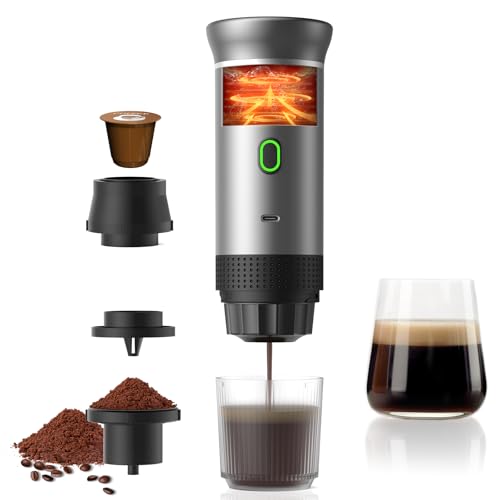
6. zxfcfo Portable Coffee Maker, 20-Bar 3-in-1 Travel Coffee Maker with Battery — Best Battery Capacity
The zxfcfo portable pairs a 20-bar pump with a 7500mAh battery and 3-in-1 pod-and-grounds compatibility for travel espresso without any fixed power source.
The zxfcfo portable leads with two numbers that matter off-grid: a 20-bar pump for proper espresso pressure and a 7500mAh battery that supports multiple brews between charges. Its 3-in-1 compatibility spans ground coffee and common pod formats, so a mixed household or a shared work truck is not locked into one supply. For users who charge at home and brew away from power for days, battery capacity is the spec that decides satisfaction.
Strengths
- 20-bar pump pressure for proper espresso-style extraction
- 3-in-1 compatibility spans grounds and common pod formats
- 7500mAh battery supports multiple brews away from any outlet
Trade-offs
- Battery-powered heating is slower than wall power
- Generic brand — long-term parts availability is uncertain
- Espresso format only; no carafe or large-cup drip mode
| Key spec | 20-bar portable, 3-in-1 compatibility, 7500mAh battery |
|---|---|
| Format | Battery portable espresso, 20-bar, 3-in-1, 7500mAh |
Realistic expectations keep this pick in proportion. Battery espresso machines spend most of their charge on heating water, so ‘multiple brews’ assumes reasonably warm starting water or modest shot counts; cold-water self-heating drains any battery in this class quickly. The 20-bar rating is about extraction pressure headroom, not a promise that every shot tastes like a café’s — grind, coffee freshness and dose still run the show.
Generic-brand caveats apply: fit and finish trail the OutIn, and long-term battery replacement is an open question. What you get for the money is capability — pressure, capacity and format flexibility in one travel-sized unit. For a bug-out bag, a fishing boat or a remote job site, that capability mix is the argument.
Best for: off-grid users who prioritize brews per charge and format flexibility / Not suited for: buyers who value brand support and finish over raw battery capacity
Check on Amazon — check price on Amazon before you buy, since listings and configurations change.
Comparison Table
| Pick | Badge | Key spec | Best for |
|---|---|---|---|
| CONQUECO Portable Coffee Machine Travel — 12V Car Espresso Maker with Battery | Best Overall | 12V car espresso maker with battery, portable travel format | drivers, campers and overlanders who want real espresso from vehicle power |
| Portable Single Serve 12V Car Coffee Maker for Pods & Ground Coffee | Best for Mug-Sized Coffee | 12V car coffee maker, pods and ground coffee, reusable filter, 6–8 minute brew | drivers who want a normal mug of coffee from pods or grounds in the vehicle |
| HAWOK Portable Coffee Maker 12V Travel Espresso Machine, Single Cup 8 oz | Best Compact 12V Espresso | 12V travel espresso machine, single cup 8 oz | solo drivers who want one straightforward 8 oz coffee from the car outlet |
| OutIn Nano Portable Electric Espresso Machine | Best Self-Heating Portable | Portable electric espresso, self-heating, USB-C charging, car compatible | travelers who want espresso anywhere and can charge from the car between brews |
| Electactic Portable Coffee Maker, 2-in-1 Travel Coffee Maker | Best for RV and Camping | 2-in-1 travel coffee maker for ground coffee and pods, camping/RV positioning | RVers and campers who want one small machine for both grounds and pods |
| zxfcfo Portable Coffee Maker, 20-Bar 3-in-1 Travel Coffee Maker with Battery | Best Battery Capacity | 20-bar portable, 3-in-1 compatibility, 7500mAh battery | off-grid users who prioritize brews per charge and format flexibility |
How to Choose a 12V DC Coffee Maker
Start with your power reality. A 12V outlet supplies a fraction of the power of a wall socket, and every coffee maker is fundamentally a water heater. That single fact explains the whole category: small servings, patient brew times, and espresso formats that use little water per cup. If your plan involves an inverter, size the inverter for the machine’s wattage with headroom to spare — or skip the inverter entirely and buy a machine designed for 12V or battery from the start, which is what every pick in this guide does.
Decide between plug-in and battery. Plug-in 12V machines like the HAWOK and the pod-and-grounds brewer are simple and effectively unlimited while the engine runs, but they tether you to the vehicle. Battery portables like the OutIn Nano and the zxfcfo brew anywhere and merely sip vehicle power while charging, at the cost of a premium price and a finite brews-per-charge budget. The CONQUECO splits the difference with both 12V operation and a battery, which is why it leads this roundup.
Match the format to your coffee habit. Espresso portables make small, strong coffees and stretch limited power furthest. Pod-and-grounds single-serve machines make familiar mug-sized cups more slowly. If you drink Americanos, an espresso machine plus hot water gets you there; if you want a diner-style mug with zero fuss, the 12V single-serve format is your pick despite the wait.
Think about water. Every machine here has a small tank or single-cup reservoir, so carry drinking water separately and descale on a schedule — vehicle-stored machines often sit with water inside, which is exactly how stale tastes and mineral buildup start. A quick rinse-and-dry routine after each trip adds years to any of these machines.
12V Power Basics: Fuses, Batteries and Engine-Running Rules
Most vehicle 12V sockets are fused between 10 and 20 amps. A coffee maker is a heating appliance, and heating draws serious current even at 12V. Before your first brew, find your outlet’s fuse rating in the owner’s manual and compare it with the machine’s stated draw. If the numbers are close, brew with the engine running: the alternator supports the load and your starter battery stays out of the equation.
Battery-only brewing deserves the same respect. A healthy car battery can run a small coffee maker, but repeated deep draws shorten battery life, and a battery drained at a remote trailhead is a genuine problem rather than an inconvenience. Battery portables with their own cells — the OutIn and zxfcfo approach — move that wear onto a replaceable device battery instead of your vehicle’s starter battery, which is one of the strongest arguments for the format.
Finally, manage heat and placement. A machine that boils water in a moving vehicle needs a stable, level, heat-safe spot — a parked position, ideally. Brew at stops, not in motion, keep the unit away from airbag deployment zones, and let it cool before stowing it in a closed compartment. Sensible placement is the difference between a beloved road ritual and a mess you clean up once and never repeat.
How to Brew Coffee from a 12V Outlet, Step by Step
Step 1: Park, stabilize, and check power. Park on level ground, set the machine on a flat heat-safe surface, and confirm your outlet works — test with a phone charger if you are unsure. Decide now whether you will brew with the engine running; for plug-in machines, the answer should almost always be yes.
Step 2: Fill with fresh water and your coffee format. Use drinking water you carried for the trip, not water that has sat in the machine since the last outing. Load grounds, a pod or a capsule according to your machine’s design, and seat the travel mug or cup firmly under the outlet — vehicle surfaces vibrate, and a wandering cup is the most common road-coffee failure.
Step 3: Brew and wait for the full cycle. Start the brew and let the machine finish completely before unplugging; interrupting a heating cycle mid-way is hard on both the machine and the fuse. Expect roughly six to eight minutes for mug-sized 12V brews and less for espresso shots. Use the wait — it is a rest stop, after all.
Step 4: Empty, rinse, dry. Dump spent grounds or pods at the stop, rinse the brew path with a splash of clean water, and leave the machine open to dry before stowing it. This two-minute routine prevents the stale, sealed-in smells that ruin the next trip’s first cup and keeps mineral scale from building in a machine that is hard to descale on the road.
What 12V Coffee Actually Costs You: Power, Time and Coffee Budget
Running a 12V coffee maker is nearly free in energy terms — the alternator is already spinning while you drive — but it is not free in time. A mug-sized brew occupies six to eight minutes of a stop. Drivers who build the brew into stops they already make (fuel, restrooms, stretching) experience it as zero-cost ritual; drivers who stop solely for coffee experience it as a chore and quietly return to drive-thru lines. Be honest about which driver you are before spending money.
The coffee itself is where the savings live. Pod users pay pod prices, but even premium pods undercut café and truck-stop cups by a wide margin over a season of driving. Grounds users save more and generate less trash, at the cost of carrying a small container and rinsing a filter at stops. Either way, a machine in the one-to-two-hundred-dollar tier pays for itself within a few months of regular road coffee — the math only fails for people who drive long distances a handful of times a year.
Budget for the small extras, too: a sturdy travel mug that fits your machine’s clearance, a small water container dedicated to brewing, and a descaling supply for the machine’s home base. None of these is expensive, and together they are the difference between a setup that gets used weekly and one that migrates to the garage shelf by spring.
Keeping a 12V Coffee Maker Alive: Storage and Maintenance
Portable coffee machines live harder lives than kitchen appliances — vibration, temperature swings and long storage gaps are their normal environment. The single most protective habit is storing the machine dry and open. A sealed, damp machine in a hot trunk develops stale odors in its water path that no amount of brewing fully flushes, and the first cup after a month of storage announces the neglect immediately.
Descale at home, on a schedule, rather than waiting for performance to sag. Mineral scale in a small heating system has an outsized effect because the water passages are narrow; a machine that takes noticeably longer to brew than it used to is usually scaled, not dying. A vinegar or citric-acid cycle at the kitchen sink every couple of months of regular use keeps heat-up times honest.
Batteries need their own routine in the battery-powered picks. Store them partially charged rather than full or empty, top them up before trips rather than after months on a shelf, and keep the machine out of freezing garages in winter if you can. Lithium cells age fastest at the extremes — a closet shelf beats a frozen trunk for the machine’s working life.
12V Coffee Makers vs. the Alternatives: Thermos, Inverter and Gas Station
The thermos is the 12V coffee maker’s oldest competitor, and it deserves respect: coffee brewed at home and carried in a good vacuum bottle costs almost nothing and tastes right for the first several hours. Its limits are time and quantity — by hour six the coffee is a memory of itself, and a long-haul day outlasts any bottle. A 12V machine exists for the hours after the thermos gives up, which is why many drivers carry both: thermos for the morning, machine for the afternoon revival at a rest stop.
The inverter route — running a household brewer from vehicle power — tempts people who already own a machine they love. It can work with a properly sized pure-sine inverter wired to carry a heating load, but that is a real electrical project with real costs, and the cheap plug-in inverters sold for phone charging are categorically too small for a coffee maker’s heating element. Compared with that project, a native 12V or battery machine at a similar total price is simpler, safer and portable between vehicles.
And then there is the gas station, whose coffee has improved but whose detour has not: every stop costs time, the cup costs several dollars, and remote routes may offer no stop at all. The honest summary is that a 12V coffee maker is not competing with your kitchen — it is competing with the worst coffee situations in your travel life, and against those, even a modest portable machine wins easily.
A Realistic Road-Coffee Routine: How Drivers Actually Use These Machines
The drivers who love their 12V setups tend to converge on the same routine, and it is worth copying rather than reinventing. The machine lives in a fixed spot — a center console bin, a door pocket caddy or a small crate in the trunk with the water container and coffee supply — because a machine that has to be hunted for is a machine that gets skipped. Everything for one brew fits in that one spot: water, coffee, a mug that fits the machine, and a small cloth for the inevitable drips. When the whole ritual is within arm’s reach and takes under ten minutes, it survives busy schedules; when it requires assembly from three corners of the vehicle, it quietly dies within a month.
Timing is the second half of the routine. Successful users brew at stops that already exist — fuel stops, rest areas, the trailhead parking lot, the job-site gate — and they start the brew first, before the other stop tasks, so the coffee finishes while they stretch, check the vehicle or walk the dog. Failed routines share the opposite pattern: the driver stops specifically for coffee, watches the machine for eight minutes, and resents it by the third trip. The machine did not change; the stop did. Build brewing into stops you already make and a 12V machine feels less like an appliance and more like a superpower your vehicle always had.
Finally, restock and reset at home, not on the road. After each trip, the machine comes inside or gets emptied, rinsed and dried; water containers get refilled; pods or grounds get topped up; batteries go on the charger. Ten unhurried minutes at home buys a month of frictionless road coffee, while skipping it guarantees the one morning you actually need the machine is the morning it is empty, scaled or growing last month’s coffee smell. Road reliability is mostly home discipline wearing a disguise.
Safety Checklist for Brewing in a Vehicle
Boiling water and a moving vehicle are a combination that deserves a written checklist rather than good intentions. Brew only while parked, on a level surface, with the machine on a stable base that cannot slide when the vehicle rocks in the wind or a door slams. Keep the machine and its cord clear of pedals, gear selectors and airbag zones, and never hold a brewing machine in your lap — a sudden stop turns a coffee maker into a scald hazard with a power cord attached.
Electrical safety is the quieter half. Use the outlet the manufacturer intends, avoid stacking adapters and splitters on a 12V socket, and stop using any cord that shows heat damage or a loose plug. If a fuse blows, replace it with the same rating and treat a second blown fuse as a diagnosis, not an inconvenience: something in the circuit is drawing more than it should, and the correct response is to find out what, on the ground, before the next brew.
Common Buying Mistakes
- Buying a 120V travel brewer for a 12V outlet. Small ‘travel’ drip machines that plug into wall sockets will not run from a car outlet without an inverter, and a cheap inverter undersized for a heating appliance is a blown fuse waiting to happen. Buy native 12V or battery machines instead.
- Brewing on a parked car battery. Repeated coffee sessions on the starter battery alone will eventually leave you stranded. Brew with the engine running, or use a battery portable with its own cell.
- Expecting kitchen speed. A wall brewer’s 1000-plus watts heat water fast; a 12V system cannot match it. Judging a 12V machine by a three-minute standard guarantees disappointment with a product working exactly as physics allows.
- Ignoring the fuse rating. If the machine’s draw exceeds your socket’s fuse, the best case is a blown fuse and the worst case is damaged wiring. Two minutes with the owner’s manual prevents both.
- Storing the machine wet. Sealed, damp coffee equipment grows stale smells fast. Rinse, dry and store open, and your first cup of the next trip tastes like coffee instead of the last trip.
Final Recommendation
For most drivers, the CONQUECO is the right answer: it brews from 12V power or its own battery, makes real espresso, and asks the least compromise of any pick here. If you want a normal mug instead of a shot, the portable single-serve 12V brewer is your machine, with the HAWOK as the simplest compact espresso option.
Choose the OutIn Nano if your coffee spots are as likely to be a trailhead or a site cabin as a car seat, and the zxfcfo if brews-per-charge is your deciding number. RVers should look hardest at the Electactic for its grounds-and-pods flexibility in a galley-sized footprint. Whichever you pick, respect the power basics — engine running for plug-in brewing, dry storage afterwards — and a 12V machine will serve you for years of road trips.
Shortlist again: CONQUECO Portable Coffee Machine Travel — 12V Car Espresso Maker with Battery, Portable Single Serve 12V Car Coffee Maker for Pods & Ground Coffee and HAWOK Portable Coffee Maker 12V Travel Espresso Machine, Single Cup 8 oz cover the three most common needs in this category.
Keep exploring the same coffee maker cluster: Best 1 Cup Coffee Makers Best 10 Cup Coffee Makers Best 12 Cup Coffee Makers Best 4 Cup Coffee Makers Best 5 Cup Coffee Makers
Frequently Asked Questions
Can a 12V coffee maker run without the engine on?
A battery portable with its own cell can brew anywhere, engine or not. A plug-in 12V machine technically can draw from the battery with the engine off, but heating water pulls hard on a starter battery — brew with the engine running, or keep parked-engine sessions rare and brief.
Why are almost all 12V coffee makers espresso machines?
Power. A 12V outlet supplies limited wattage, and espresso uses very little water per serving, so it heats quickly and extracts under pressure. Mug-sized drip coffee needs several times the water heated, which is why the mug-format 12V machines take six to eight minutes per cup.
What happened to the classic 12V drip coffee pots?
Major brands largely discontinued them as portable espresso and battery machines improved. Vintage-style plug-in drip pots still appear under generic labels, but the verified, well-supported options today are the portable formats in this guide.
Do I need an inverter to use a normal coffee maker in my car?
You would need an inverter sized above the brewer’s wattage with real headroom, plus wiring that can carry the load — most plug-in cigarette-lighter inverters are far too small for a heating appliance. A native 12V or battery machine is simpler, safer and cheaper overall.
How many cups can a battery portable make per charge?
It depends heavily on whether the machine heats the water itself. Self-heating cold water spends most of a charge in a few shots; feeding the machine hot water stretches a charge across many more brews. Treat per-charge claims as best-case and plan charging stops on long trips.
Is 12V coffee maker coffee actually good?
From the espresso portables here, yes — pressurized extraction with fresh coffee is genuinely good, within the limits of a small machine. From any 12V format, freshness of the coffee and water matters more than the machine: carry decent beans or pods and clean water, and the cup follows.


