Disclosure: airfryerkitchensupply.com is reader-supported. When you buy through links on our site, we may earn an affiliate commission at no extra cost to you.
Where to buy
All six machines below are sold on Amazon, and each pick links to its verified listing so you can check the current price on Amazon. We do not print prices — they change too often to stay honest — and every model here was matched against Amazon’s product data feed for this site before it earned a link.
- Ninja CE251 Programmable Brewer — check the current price on Amazon
- Cuisinart Brew Central DCC-1200 — check the current price on Amazon
- KitchenAid KCM1208 Drip Coffee Maker — check the current price on Amazon
- BLACK+DECKER 12-Cup Vortex Coffee Maker — check the current price on Amazon
- Mr. Coffee Easy Measure 12-Cup — check the current price on Amazon
- Keurig K-Duo Gen 2 — check the current price on Amazon
The best 12 cup coffee makers are the default family coffee machine for a reason: one pot covers a household’s whole morning, a table of brunch guests, or a long work-from-home day with refills. But ’12 cups’ is the most misunderstood number in coffee — it means roughly 60 ounces, about five real mugs — and the machines wearing the badge range from budget workhorses to design pieces. This guide sorts the six worth buying, and explains what actually separates them.
Start with the honest sizing math, because it decides satisfaction more than any feature: if your household drinks four or five mugs across a morning, a 12-cup machine is exactly right and a 10-cup will leave someone brewing a second pot. If you drink two mugs, a 12-cup machine will spend its life brewing half pots — which is why every pick here was also judged on its small-batch behavior. Capacity you do not use is not free: it is counter space, carafe washing and weaker small pots, every day.
Every machine below was verified product feed attached to this site, with brand and model matched against live Amazon listings. The six span the category’s real spectrum — programmable workhorse, classic stainless, design-led showerhead engineering, a genuine budget option, a beginner-friendly teacher of a machine, and a dual-format wildcard for pod households.
In this guide
Quick Picks
Six 12-cup machines, six households they fit. Read the badge first, then the review of the one that sounds like your kitchen.
- Ninja CE251 Programmable Brewer — Best Overall: The household default: 24-hour programming, Classic and Rich brew styles, a removable reservoir and a mid-batch function — the features families use, at a fair tier. — Check on Amazon
- Cuisinart Brew Central DCC-1200 — Best Classic Programmable: The stainless classic that has anchored this category for years: full programming, a 1–4 cup setting, brew pause, and a carafe that pours without dripping. — Check on Amazon
- KitchenAid KCM1208 Drip Coffee Maker — Best Design: A design-led 12-cup machine built around a 29-hole spiral showerhead for even saturation — the best-looking brewer here, with extraction engineering to back it up. — Check on Amazon
- BLACK+DECKER 12-Cup Vortex Coffee Maker — Best Budget: Vortex showerhead technology at a budget tier: water swirls through the basket for better saturation than basic budget brewers manage — the value pick of the category. — Check on Amazon
- Mr. Coffee Easy Measure 12-Cup — Best for Beginners: A programmable 12-cup machine designed to teach dosing: color-coded measuring marks pair the water fill to the coffee scoop count, removing the beginner’s biggest error. — Check on Amazon
- Keurig K-Duo Gen 2 — Best Dual-Use: A 12-cup programmable carafe side plus a MultiStream K-Cup side on one 72 oz reservoir — the pick for households split between pots and pods. — Check on Amazon
How These Picks Were Chosen
We shortlisted the 12-cup drip machines that lead this category on Amazon and verified each feed — no pick carries a link unless brand and model matched a live listing with certainty.
Criteria: (1) brew fundamentals — heating power and showerhead distribution, which decide whether the pot tastes like the coffee you bought; (2) honest capacity and small-batch behavior, since 12-cup machines live half their lives at half volume; (3) programming and daily usability — clocks, auto-start, reservoir handling, carafe pour quality; (4) carafe strategy, glass-and-plate versus the alternatives; and (5) ownership — parts availability, descaling, and design longevity. Badges were assigned last, naming the household each machine genuinely serves best.
The 6 Best 12 Cup Coffee Makers

Ninja CE251 Programmable Brewer — Best Overall
The CE251 suits the classic 12-cup household: multiple drinkers, a schedule to keep, coffee expected at wake-up. Its Rich style rescues pots that must carry milk; its removable reservoir makes filling a sink-side job instead of a countertop pour. It does not suit thermal-carafe devotees or minimalists — it is a full-size glass-carafe machine with a warming plate, and proud of it.
Strengths
- Removable reservoir — the daily convenience owners praise most
- Classic/Rich styles give real strength control without a second machine
- Straightforward programming with a clean, readable interface
Trade-offs
- Glass carafe on a plate: coffee left past the hour slowly cooks
- Full-size footprint; check cabinet clearance with the lid open
- No specialty or iced modes — it is a drip specialist
| Capacity | 12-cup glass carafe |
| Programming | 24-hour programmable |
| Brew styles | Classic and Rich |
| Reservoir | Removable |
The CE251 wins this guide by being the machine with the fewest daily frictions. The removable reservoir sounds like a bullet point and behaves like a revelation: no more aiming a carafe of water into a countertop slot under a cabinet. Programming is the set-it-once kind, the control layout never requires the manual after day one, and the mid-size batch function means the machine’s common case — a half pot on a weekday — is a designed mode rather than an afterthought. Brew quality is properly mainstream-plus: hot, even, and with the Rich setting engaged, full enough to stand up to milk and to the slight under-dosing that real households commit. The warming plate keeps the pot at temperature with the usual caveat — drink within the hour for the best of it. Build quality sits a clear step above budget tier, and the carafe pours without the counter-drip that plagues cheaper rivals. Against fancier machines it concedes ultimate temperature precision; against budget machines it wins on every daily touch. That is what ‘best overall’ means in a family category.
Descaling is handled gracefully: the machine prompts for its clean cycle rather than leaving you to diagnose sour coffee. Obey the prompt. Owners who do report the CE251 tasting like itself in year three; owners who ignore it join the ‘machines don’t last’ chorus that is usually a scale chorus.
Best for: families wanting programmable, good-tasting pots with minimal friction / Not suited for: thermal-carafe households or tiny counters

Cuisinart Brew Central DCC-1200 — Best Classic Programmable
The DCC-1200 is for buyers who want the proven mainstream machine — the one with years of owner history, parts on every shelf, and controls a guest can figure out. It suits households that value reliability and a proper 1–4 cup mode. It does not suit design minimalists (its brushed stainless and chunky handle are proudly traditional) or thermal seekers.
Strengths
- 1–4 cup setting that genuinely improves small pots
- Dripless spout and ergonomic handle — the best-pouring carafe here
- Long production history: parts, carafes and knowledge are everywhere
Trade-offs
- Traditional styling will not win design awards
- Glass carafe and warming plate, with the usual sit-time caveat
- Control dial interface feels dated next to modern panels
| Capacity | 12-cup glass carafe |
| Programming | 24-hour programmable with auto-off |
| Small batch | 1–4 cup setting |
| Carafe details | Dripless spout, ergonomic handle |
Longevity in a product line is evidence, and the Brew Central has been Cuisinart’s 12-cup anchor for years because it gets the fundamentals right and keeps getting them right. The brew is properly hot mainstream drip; the programming is complete without being fussy; and the details that owners touch daily — a carafe that pours in a clean stream and stops without a dribble, a handle that stays grippable, a brew-pause that does not shower the plate with drips — are all quietly excellent. The 1–4 cup setting matters in this size class: it adjusts the flow so the weekday half pot extracts instead of washing through. Cuisinart’s charcoal water filter is a real benefit in chlorinated-water towns. The compromises are aesthetic and generational: the styling is early-2000s stainless, the dial-and-button interface will not impress anyone shopping for a touchscreen, and the glass-plus-plate arrangement is traditional in its limits as well as its charms. For households that buy appliances the way they buy tools — proven, serviceable, unglamorous — this remains one of the easiest recommendations in the category.
A maintenance note specific to long-lived machines: replacement carafes and charcoal filters for the DCC-1200 are stocked widely and cheaply, which is part of the value proposition. A machine you can re-carafe in five years for a small sum is a different purchase from a sealed rival at the same price.
Best for: households wanting the proven, serviceable mainstream classic / Not suited for: design-first buyers or thermal-carafe households

KitchenAid KCM1208 Drip Coffee Maker — Best Design
The KCM1208 suits the kitchen where appliances are visible and chosen: it looks like a KitchenAid should, and its spiral showerhead gives the brew a genuine technical story. It fits households that program a daily pot and care how the counter looks. It does not suit bargain hunters, and its warming-plate programmability is a feature you must learn — the plate’s timer confuses some owners at first.
Strengths
- Spiral showerhead with 29 holes saturates the bed evenly
- Design and finish a class above mainstream rivals
- Programmable warming plate keeps coffee hot on your schedule
Trade-offs
- Premium-for-mainstream pricing
- Warming plate settings take a read of the manual to master
- Glass carafe — the usual plate-sitting caveat applies
| Capacity | 12-cup |
| Showerhead | Spiral, 29-hole |
| Warming | Programmable warming plate |
| Extras | Brew strength selection (line features) |
KitchenAid’s entry earns its badge on the two things it visibly does differently. The first is distribution: a spiral showerhead with 29 holes rains water across the whole basket instead of drilling the center, and even saturation is the cheapest extraction quality there is — no dry ring of wasted grounds at the basket’s edge. The second is presence: the KCM1208 is the machine in this guide that looks designed rather than assembled, with the brand’s signature solidity and a control scheme that keeps the front face clean. Functionally it is a full programmable 12-cup brewer with strength selection and a warming plate whose temperature and hold time can be programmed — genuinely useful for households whose drinking window stretches, though the settings take one careful read of the manual to set up the way you want them. Brew quality is a step above the mainstream middle: fuller, more even, less prone to the thin edges of cheap distribution. It asks a premium over the Ninja and Cuisinart for design and distribution rather than for a longer feature list, and for kitchens where the machine lives in view, that is a rational premium.
Measure carefully before ordering: the KCM1208’s design includes a prominent profile, and its lid and reservoir access need the usual open-height check. It rewards the measurement with the guide’s best counter presence — most owners end up placing it where it can be seen on purpose.
Best for: design-conscious households wanting even extraction and a programmable plate / Not suited for: budget buyers or thermal-carafe loyalists

BLACK+DECKER 12-Cup Vortex Coffee Maker — Best Budget
This is the machine for the household that needs a 12-cup pot and has a strict budget — a first home, a rental, an office kitchen. Its Vortex showerhead is a real attempt at even extraction rather than a badge. It does not suit buyers expecting longevity measured in decades or premium materials; the tier’s compromises are in build and refinement, and the carafe and controls are basic.
Strengths
- Vortex showerhead improves saturation over basic budget drippers
- Budget tier pricing for a full 12-cup capacity
- Simple, familiar controls — nothing to learn
Trade-offs
- Budget plastics and finish throughout
- Fewer refinements: basic carafe, basic plate, no frills
- Long-term durability is the tier’s known trade-off
| Capacity | 12-cup |
| Showerhead | Vortex brewing technology |
| Tier | Budget |
| Format | Glass carafe drip |
Budget coffee makers usually fail in the same place: a feeble showerhead that drills a hole through the middle of the grounds and leaves the edges dry, producing coffee that is somehow both weak and bitter. BLACK+DECKER’s Vortex design attacks exactly that failure, spinning the water’s path so the basket saturates more evenly — and at this tier, that single engineering decision matters more than any feature the machine lacks. The coffee is honestly drinkable mainstream drip, a clear step above the generic budget floor. Everything else about the machine is the budget contract: lightweight plastics, a functional carafe, straightforward controls, a warming plate that does its job. Treated with basic care — above all, descaled on schedule, because budget heaters scale like any other — it will serve a household well for years. Treated as disposable, it will oblige. Our advice for budget buyers is to spend the savings where they compound: decent coffee, bought fresh in reasonable quantities, makes a bigger difference in the cup than the step up to a mid-tier machine would.
Office kitchens are this machine’s natural habitat: big pot, simple controls, nobody’s precious about it, and a price that does not require a committee. If the office pot is your use case, stop reading the rest of the guide — this is the pick, and the budget committee will approve it without a meeting.
Best for: budget households, rentals and office kitchens needing a full pot / Not suited for: premium-build seekers or decade-long ownership plans
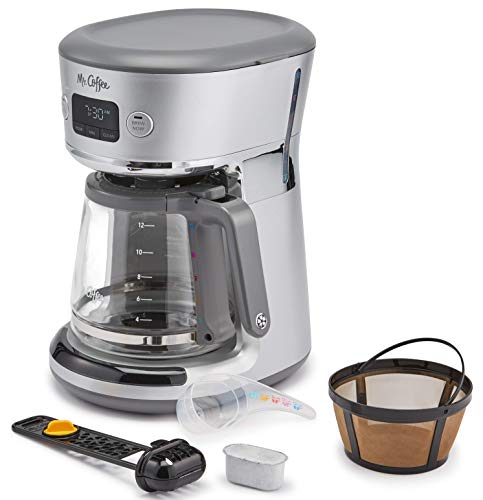
Mr. Coffee Easy Measure 12-Cup — Best for Beginners
The Easy Measure is for households new to drip coffee — or tired of pots that taste different every day. Its measuring system attacks the number-one cause of bad home coffee: inconsistent dosing. It suits first-time buyers and shared houses where several people brew. It does not suit experienced brewers who already dose by scale (the guidance system becomes decoration) or premium-material seekers.
Strengths
- Color-coded water and coffee measurements make dosing foolproof
- Included gold-tone reusable filter ends paper-filter buying
- Full programmability at a mainstream tier
Trade-offs
- Guidance system is training wheels — veterans will ignore it
- Mainstream build and brew performance
- Reusable filter needs a rinse after every pot
| Capacity | 12-cup |
| Dosing system | Easy Measure color-coded marks |
| Filter | Gold-tone reusable filter included |
| Programming | Programmable |
Ask a coffee professional why home drip tastes inconsistent and the answer is never the machine — it is the dose. One day a heaped scoop, the next a scant one, and the pot swings between harsh and watery while the brewer takes the blame. Mr. Coffee’s Easy Measure system is a genuinely clever countermeasure: the water reservoir’s fill marks are color-matched to scoop counts on the coffee side, so ‘fill to blue, add blue scoops’ produces the same ratio whoever brews. For households with multiple brewers of different experience levels, that consistency is worth more than a degree of brew temperature. The machine around the system is a competent mainstream programmable — auto-start, brew-strength options in the line, a reusable gold-tone filter that saves the paper errand forever at the cost of a rinse per pot. Brew quality sits in the honest middle of the category: not the KitchenAid’s evenness or the Moccamaster class’s temperature, but reliably decent coffee made the same way every day. For beginners, reliability of process beats peaks of performance — this machine is built on exactly that insight.
Graduation path: once the household’s taste stabilizes, the Easy Measure’s marks become your reference while you experiment — one scoop more for the strong pot, one less for the afternoon. Training wheels that double as a measuring standard are the best kind.
Best for: beginners and multi-brewer households wanting consistent pots / Not suited for: experienced brewers who dose by scale already

Keurig K-Duo Gen 2 — Best Dual-Use
The K-Duo Gen 2 earns its place in a 12-cup guide as the answer for the split household: the pot drinkers get a programmable 12-cup carafe; the pod drinkers get a modern Keurig side; nobody gets a second machine. It suits genuinely mixed homes. It does not suit pure drip households — you would be paying for a pod side that gathers dust — and its drip side, while good, is not the equal of the best dedicated machines here.
Strengths
- Two formats, one reservoir, one footprint
- MultiStream pod side brews better pods than older dual machines
- Programmable carafe side covers the household pot properly
Trade-offs
- Largest footprint in this guide
- Carafe side is competent rather than class-leading drip
- Pod side is wasted money in a pod-free household
| Carafe capacity | 12-cup, programmable |
| Pod side | K-Cup with MultiStream |
| Reservoir | 72 oz shared |
| Extras | Iced single-serve setting |
Judged purely as a 12-cup drip machine, the K-Duo Gen 2 would place mid-pack in this guide: a programmable glass-carafe brewer of good mainstream quality. Judged as what it is — the one-machine answer to a divided household — it may be the most valuable pick here. The carafe side handles the shared pot with auto-start convenience; the pod side, upgraded with MultiStream extraction, handles the individual cups across the day with better saturation than earlier dual machines managed; and the shared 72 oz reservoir means one water routine for the whole household’s coffee. The compromises are structural: the footprint is the guide’s largest, the drip side will not convert a precision-brewer devotee, and when the machine eventually retires, both formats retire together. Our full dual-brewer guide compares it against the Cuisinart SS-15 and the FlexBrew line in depth. Within this guide its role is simple: if your household’s coffee life includes both a pot and pods every week, start here and only look elsewhere if its drip side is not enough for you.
One usage pattern maximizes it: program the carafe for the household’s shared morning pot, and reserve the pod side strictly for off-schedule cups. Households that run pods for the main morning volume pay pod prices for pot quantities — the most expensive way to use any dual machine.
Best for: split households using both a daily pot and daily pods / Not suited for: pure drip households or the smallest counters
Comparison Table
| Pick | Badge | Key spec | Best for |
|---|---|---|---|
| Ninja CE251 Programmable Brewer | Best Overall | 12-cup programmable, removable reservoir | families wanting programmable, good-tasting pots with minimal friction |
| Cuisinart Brew Central DCC-1200 | Best Classic Programmable | 12-cup programmable, 1–4 cup mode | households wanting the proven, serviceable mainstream classic |
| KitchenAid KCM1208 Drip Coffee Maker | Best Design | 12-cup, 29-hole spiral showerhead | design-conscious households wanting even extraction and a programmable plate |
| BLACK+DECKER 12-Cup Vortex Coffee Maker | Best Budget | 12-cup Vortex showerhead, budget tier | budget households, rentals and office kitchens needing a full pot |
| Mr. Coffee Easy Measure 12-Cup | Best for Beginners | 12-cup, color-coded dosing system | beginners and multi-brewer households wanting consistent pots |
| Keurig K-Duo Gen 2 | Best Dual-Use | 12-cup carafe + K-Cup, shared 72 oz tank | split households using both a daily pot and daily pods |
Use the table to compare roles at a glance, then read the full review of any pick you are seriously considering — the trade-offs matter more than the headline spec.
How to Choose the Best 12 Cup Coffee Maker
Twelve-cup machines divide along three axes: how much you will program them, how the coffee waits, and how much of the pot is your normal brew. Work through them in that order.
Programming: Daily Tool or Dead Feature
Auto-start is the most-used feature in this category and the most overbought. If your household rises at a fixed time, programming earns its money every single morning — the Ninja and Cuisinart are built for you. If your schedule is chaos, you will use the timer twice and the clock will blink at you for years; a simpler machine serves you better. Be honest about which household you are, because the feature cannot be un-bought.
How the Coffee Waits: Plate, and Its Alternatives
Every glass-carafe pick here uses a warming plate, and every plate cooks coffee slowly. Inside 45 minutes, the effect is minor; past an hour, it is the dominant flavor in the cup. Households that linger should either decant into a thermal carafe after brewing (the cheap fix that works with any machine here) or shop our thermal guide for a machine built around insulation. Households that drain the pot quickly can ignore the issue entirely and enjoy glass’s lower prices and dishwasher ease.
Half Pots: Your Real Weekday Brew
Rate any 12-cup machine by its 6-cup behavior, because that is the pot you will brew most. Small-batch modes (Cuisinart’s 1–4 cup, Ninja’s mid-size function) slow the flow for shallow beds; machines without them brew thinner weekday coffee. If a candidate machine has no small-batch story and your weekday pot is small, either plan to brew full pots and refrigerate the extra for iced coffee, or choose a machine from this guide that took the problem seriously.
Showerheads, Heaters and the Anatomy of a Good Pot
Two components decide whether a 12-cup pot tastes like the beans you bought. The heater must bring the full volume to proper brewing temperature and hold it across a long brew — weak heaters are why big cheap machines disappoint more than small cheap ones. The showerhead must distribute that water across a wide basket: look for many holes, a wide pattern, or a named distribution system like KitchenAid’s spiral head or BLACK+DECKER’s Vortex. When a machine’s marketing leads with its clock radio features and says nothing about water, you have learned something. Judge in this order — heater, showerhead, carafe, then features — and the category sorts itself.
The Counter Question: Living With a 12-Cup Machine
These are the largest everyday brewers most kitchens house. Before buying, measure the cabinet clearance with the lid open, confirm the carafe slides out without clearing a obstacle course, and decide where the machine’s ‘service position’ is for filling — top-fill machines need pouring headroom; removable reservoirs (Ninja) need only sink access. Also plan the cord: a machine that must be dragged forward daily to fill will slowly scratch counters and temper alike. The right 12-cup machine fits the kitchen’s geometry as well as its coffee demand; the wrong one is a daily negotiation.
The Economics of the Family Pot
A 12-cup pot is the cheapest coffee a household can make, and it is worth understanding why the math is so lopsided. A full pot uses a modest amount of ground coffee to produce five mugs; the same five servings as pods would cost several times more, and as café drinks, an order of magnitude more. This is why the family pot survives every coffee trend: it is not nostalgia, it is arithmetic. The implication for buying is that the machine’s price is almost irrelevant next to its effect on the coffee itself — a machine that wastes grounds through poor distribution, or ruins the last two mugs on a plate, taxes every pot for years. Spend first on even extraction and a carafe strategy your household respects; the savings versus pods will repay the premium before the first year is out, and the coffee will be better while it happens.
The corollary is about beans: at pot scale, a household drinks enough coffee that bean quality and freshness dominate the cup. Buying decent beans in one- or two-week quantities, storing them airtight away from the brewer’s heat, and grinding reasonably fresh (or buying from a roaster who grinds to order in small batches) improves a 12-cup pot more than any machine upgrade within this guide. The machine’s job is to not squander good coffee; the household’s job is to give it good coffee to work with.
There is a waste corollary, too: the family pot’s economics assume the pot gets drunk. A household that brews twelve cups and pours six down the sink has quietly doubled its per-cup cost and negated the format’s advantage. The fix is behavioral, not mechanical — brew the pot your household actually finishes, using the small-batch modes these machines provide, and let the full 12-cup capacity be the weekend and guest reserve it was designed to be.
Glass Carafe Craft: Getting the Most From a Warmer Plate
Since five of these six picks use glass and a plate, plate craft deserves its own section. First, match the pot to the window: brew the quantity the household will drink in the next 45 minutes, even if that means a designed half pot instead of a full one left to cook. Second, use the plate’s settings if your machine offers them — a lower hold temperature trades a degree of heat for noticeably slower flavor decay, a trade worth making for the second hour. Third, never return the carafe to the plate nearly empty to ‘keep it warm’ — a shallow layer cooks fastest of all and flavors the carafe for the next pot. Fourth, if the household’s pattern is genuinely long, buy the accessory that changes the game: a quality thermal carafe to decant into. It costs less than any machine in this guide and converts every glass brewer into a two-stage system — brew in glass, hold in steel — which is how cafés have handled the problem forever.
And a small glass-care note that saves carafes: never set a hot carafe down on a cold stone counter or a wet surface. Thermal shock cracks more carafes than drops do. A folded towel or a wooden board kept beside the machine is the cheapest insurance in this entire guide, and the simple protective habit takes exactly one second to keep every single busy morning.
Reading 12-Cup Spec Sheets Without Being Fooled
Three numbers on a 12-cup spec sheet deserve translation. ‘Cups’ we have covered: multiply by five ounces and think in mugs. ‘Watts’ is the heater’s muscle — higher is generally better for reaching and holding brew temperature across a big pot, and suspiciously low wattage on a full-size machine is a warning sign. ‘Dimensions’ are given closed; add the lid’s swing and the carafe’s extraction path before trusting that it fits. Two phrases deserve skepticism: ‘gourmet’ and ‘café-style’ mean nothing measurable, while named, testable systems — a showerhead design, a small-batch mode, a stated brew temperature — mean the maker engineered something specific. Finally, weight is a quiet quality signal in this category: heavier machines generally carry more metal in the heater and carafe hardware, and they stay put when you pull the carafe. None of these heuristics replaces the reviews above, but together they will keep a spec sheet from selling you a clock with a coffee maker attached. When two machines tie on everything else, choose the one whose replacement carafe is easier to find — future you, holding a cracked carafe on a Sunday, will be grateful.
A Short History of Why 12 Cups Became the Standard
The 12-cup drip machine is a distinctly American institution, sized for the postwar household and the office break room, and its ‘cup’ — a demitasse-like five ounces inherited from European coffee service — never matched the mugs Americans actually drink from. The format persisted because the ecosystem did: standard basket filters, replacement carafes in every hardware store, and a shared understanding among manufacturers of what a full-size machine is. That ecosystem is now a genuine consumer benefit. Filters cost almost nothing, carafes are replaceable years later, and any houseguest can operate any machine in this guide without instruction. Newer formats — pods, specialty brewers, precision machines — each beat the 12-cup drip on some axis, but none has matched its combination of capacity, simplicity and negligible running cost. When you buy one of the six machines above, you are buying into the most supported, most understood coffee format in the home — and for a family appliance expected to just work every morning, that boring fact is a feature.
It also explains this guide’s conservatism: in a format this mature, the winning machines are rarely the newest. They are the designs that survived a decade of mornings — which is why a long-running Cuisinart, a utilitarian Ninja and a budget BLACK+DECKER with one good idea share this list comfortably.
When 12 Cups Is Too Much Machine
The honest closing note of any 12-cup guide: a meaningful share of shoppers reading this will be better served one size down. If the household is two people and two mugs, the 10-cup machines in our companion guide brew better small pots, wash faster and give back counter space every day — and the two mornings a year when guests overflow the pot are solved by brewing twice, not by owning capacity. If the household is one person, even 10 cups is a compromise; single-serve machines exist for you. Buy the 12-cup machine when five-mug mornings are your ordinary life — for brunch hosts, big families, home offices with colleagues, and households where the pot is a shared utility. Bought for the life you have, it is the best-value appliance in the kitchen. Bought for the life you host twice a year, it is a monument on the counter.
How to Use a 12 Cup Coffee Maker for Consistently Good Pots
Consistency is a routine, not a talent. This one works for every machine in the guide:
- Fresh water, full stop. Dump and refill the reservoir for each day’s first pot. Water that sat overnight in a warm kitchen makes flat coffee in any machine.
- Dose by count, then never improvise. Start at roughly 1–2 tablespoons per 6 ounces of water, taste one full pot, adjust once, and write the household dose where the brewer can see it.
- Use the small-batch mode for small pots. Half the water needs the machine’s slow-flow help to extract a shallow bed. This single habit fixes most ‘weak weekday coffee’ complaints.
- Bloom is not just for pour over. If your machine lacks a pre-infusion pause, you can fake it: start the brew, pause it for 30 seconds after the first water lands (brew-pause makes this easy), then resume. Fresh coffee will reward you visibly.
- Serve the pot on a clock. Best within 45 minutes on the plate. Leftover coffee goes to a preheated thermal carafe, the fridge for iced coffee, or the sink — not back onto the plate for hour three.
- Rinse the carafe hot, wash it weekly. Old coffee film is cumulative seasoning you never asked for. A bottle brush and hot soapy water weekly keeps glass honest; thermal carafes want the same with a soak.
- Descale quarterly. Put it on the calendar with the seasons. Brew temperature — and therefore flavor — depends on a clean heating path more than on any other maintenance you will ever do.
Cleaning and Troubleshooting a 12-Cup Brewer
Most 12-cup problems are hygiene wearing a disguise. Problem: coffee tastes sour and thin → descale first; scale cools the brew. If sourness survives descaling, dose more coffee or grind finer. Problem: coffee tastes bitter and harsh → the pot sat on the plate too long, or the dose crept up; serve sooner and reset the dose to your written standard. Problem: grounds in the pot → the filter is the wrong size, doubled, or collapsed; check the filter before the machine. Problem: basket overflows → too-fine grind or a clogged showerhead; coarsen the grind and wipe the showerhead plate. Problem: the carafe drips when pouring → pour slower at the first tilt; some carafes (the Cuisinart’s dripless design excepted) need a gentler angle until the stream establishes. A monthly five-minute routine — wash the carafe and basket with soap, wipe the showerhead and plate, run a water-only cycle — prevents nearly all of it.
Common Buying Mistakes
The classic 12-cup mistakes, in order of how often they ruin a purchase:
- Sizing by the box number. Twelve cups is five mugs. Count your household’s mugs and buy for them, not for the marketing number.
- Brewing half pots on a machine with no small-batch mode. The weekday pot is the one you drink most; make sure the machine respects it.
- Cooking coffee on the plate. Hot is not the same as fresh. Forty-five minutes is the honest limit for plate-held coffee.
- Skipping the open-lid measurement. A brewer that cannot open under your cabinets will live badly for years. Measure before the box arrives.
- Dosing by mood. Inconsistent scoops are the top cause of ‘this machine is inconsistent’ reviews. Fix the dose; the machine was fine.
- Never descaling a big machine. More water per pot means more mineral per pot. Quarterly descaling is not optional maintenance at this size.
Avoid those and the six machines here separate themselves by fit and preference — which is how a mature category should be bought.
Final Recommendation
The Ninja CE251 is our best overall 12-cup pick: programmable, flexible and friction-free for family duty. The Cuisinart DCC-1200 is the proven classic with the best small-pot mode and carafe; the KitchenAid KCM1208 is the design-and-distribution upgrade; the BLACK+DECKER Vortex is the budget answer that respects extraction; the Mr. Coffee Easy Measure is the beginner’s consistency machine; and the Keurig K-Duo Gen 2 covers households split between pots and pods.
Adjacent sizes and formats are covered in the companion guides:
- Best Overall: Ninja CE251 Programmable Brewer
- Best Classic Programmable: Cuisinart Brew Central DCC-1200
- Best Design: KitchenAid KCM1208 Drip Coffee Maker
- Best Budget: BLACK+DECKER 12-Cup Vortex Coffee Maker
- Best for Beginners: Mr. Coffee Easy Measure 12-Cup
- Best Dual-Use: Keurig K-Duo Gen 2
Best 10 12 Cup Coffee Makers Best 10 Cup Coffee Makers Best 12 Cup Thermal Coffee Makers Best 12 Cup And K Cup Coffee Makers Best 12 Cup Programmable Drip Coffee Makers
Frequently Asked Questions
How many mugs does a 12-cup coffee maker actually make?
About five 12 oz mugs. The manufacturer’s cup is roughly 5 ounces, so a 12-cup carafe holds around 60 ounces. If your household drinks more than five mugs in a morning, you will brew a second pot regardless of brand.
What is the best 12-cup coffee maker for a family?
For most families, a programmable mainstream machine like the Ninja CE251: auto-start for school-day mornings, a rich-brew option for milk drinkers, and a removable reservoir that makes filling easy. Add the Cuisinart DCC-1200 if small pots matter daily.
Why does my 12-cup coffee taste weak when I brew half a pot?
Water races through a shallow bed of grounds and under-extracts. Use the machine’s small-batch or 1–4 cup mode if it has one — it slows the flow. If it does not, grind slightly finer for half pots and keep the dose proportional.
Is a glass carafe or thermal carafe better at 12 cups?
Glass with a warming plate is cheaper and fine if the pot is drunk within about 45 minutes. For longer holding, thermal wins on flavor — see our 12 cup thermal coffee makers guide for machines built around insulation.
How long can coffee sit on a warming plate?
About 45 minutes before the flavor noticeably degrades; by two hours it tastes cooked. Decant leftovers into a preheated thermal carafe if you want them later, or refrigerate for iced coffee.
How often should a 12-cup coffee maker be descaled?
Roughly every three months with typical water, more often with hard water. Large machines move a lot of water, so scale accumulates steadily — descale by the calendar rather than waiting for slow, sour brews.

