Disclosure: airfryerkitchensupply.com is reader-supported. When you buy through links on our site, we may earn an affiliate commission at no extra cost to you.
Where to buy
The machines in this guide to the best 5 cup coffee makers are all sold through Amazon, where you can check the current price on Amazon for each model, confirm the exact variant, and read the manufacturer’s full listing before you buy. Prices and availability in this category move often, so this guide never prints a fixed price — use the links below to see today’s figure for the pick you choose.
- Cuisinart 5-Cup Coffee Maker with Stainless Steel Carafe (DCC-5570) — Check the current price on Amazon
- Zojirushi ZUTTO EC-DAC50 Coffee Maker, 5 Cups — Check the current price on Amazon
- KRUPS Simply Brew Compact 5 Cup Coffee Maker — Check the current price on Amazon
- Hamilton Beach 5 Cup Drip Coffee Maker with FrontFill Basket (46112) — Check the current price on Amazon
- Mr. Coffee Programmable Coffee Maker, 5-Cup — Check the current price on Amazon
- Mr. Coffee 5-Cup Mini Brew Switch Coffee Maker — Check the current price on Amazon
The best 5 cup coffee makers hold the sweet spot of the small-brewer market: about 25 ounces, two generous mugs, in the size class manufacturers actually engineer well. Unlike the neglected 4-cup and phantom 6-cup formats, 5-cup machines get real design attention — timers, steel carafes, front-loading baskets — which makes this the most competitive guide in the series.
Every pick below was verified against its manufacturer’s Amazon listing, and the six finalists each own a distinct job, from the one-switch budget classic to a Japanese-engineered premium brewer. If your household drinks two mugs a morning, this is the definitive shortlist — start with the badge that sounds like your kitchen.
In this guide
Quick Picks: The Best 5-Cup Coffee Makers
- Best Overall — Cuisinart 5-Cup Coffee Maker with Stainless Steel Carafe (DCC-5570): Stainless thermal-style carafe, charcoal filter, removable reservoir. Check price on Amazon
- Best Premium — Zojirushi ZUTTO EC-DAC50 Coffee Maker, 5 Cups: Japanese-engineered 5-cup brewer, PFAS-free listing. Check price on Amazon
- Best Design — KRUPS Simply Brew Compact 5 Cup Coffee Maker: Stainless design, drip-free carafe, reusable filter. Check price on Amazon
- Best for Under-Cabinet Kitchens — Hamilton Beach 5 Cup Drip Coffee Maker with FrontFill Basket (46112): FrontFill swing basket, smart-plug compatible. Check price on Amazon
- Best Programmable — Mr. Coffee Programmable Coffee Maker, 5-Cup: Brew Later timer, 25 oz carafe with ounce markings. Check price on Amazon
- Best Budget — Mr. Coffee 5-Cup Mini Brew Switch Coffee Maker: One-switch brew, compact footprint. Check price on Amazon
How These Picks Were Chosen
Every machine in this guide to the best 5-cup coffee makers was checked against the manufacturer’s own listing through Amazon’s catalogue data before it earned a place. That verification step matters more in this corner of the market than in most, because small brewers are sold under shifting model names, colour variants get listed as separate products, and capacity claims are notoriously elastic. If a model’s identity or capacity could not be confirmed, it did not get a link — full stop.
From the verified shortlist, machines were shortlisted on five criteria. First, honest capacity: the carafe or brew size had to match the size class in the search, using the coffee industry’s small ‘cup’ measure rather than mug marketing. Second, the features people actually use weekly — pause-and-pour, reusable filters, readable water windows, auto shut-off — counted for more than novelty extras. Third, parts and carafe availability were weighed, because a small brewer with an unreplaceable glass pot is a disposable product. Fourth, footprint and loading style were matched to the kitchens these machines live in: under cabinets, in dorms, on desks. Fifth, each pick had to own a distinct job. Six near-identical black boxes would be a worse guide than six machines that each win for a different household.
With the deepest candidate pool of any small size, this guide could afford the strictest cuts. Machines were eliminated for unverifiable listings, for carafes with no replacement path, and for feature lists that duplicated a stronger pick without a price or design argument. The six survivors were then ordered by how completely each serves its intended household, not by brand size or novelty.
One more rule governed the final list: nothing with a known safety recall was eligible, and no machine was included on the strength of a headline feature its listing could not support. Where a size tier turned out to be thin or effectively empty in today’s market, this guide says so in plain language rather than padding the list with oversized machines relabelled as small ones.
The Best 5-Cup Coffee Makers Reviewed

Cuisinart 5-Cup Coffee Maker with Stainless Steel Carafe (DCC-5570) — Best Overall
The Cuisinart DCC-5570 is the machine for people who have already broken one glass carafe — or know they eventually will. Its stainless steel carafe removes the most fragile part of every other brewer in this list, and because steel holds heat without a hot plate cooking the coffee, a pot brewed at seven still tastes respectable at eight. Add a removable water reservoir you can fill at the tap and a charcoal filter for the water itself, and nearly every small daily friction of the category has been thought about.
The DCC-5570 wins the most competitive class in small coffee by removing its two biggest failure modes: the carafe cannot break, and the coffee is not cooked by a plate while it waits. Add the removable reservoir and charcoal filtration and it is the most thought-through 25 ounces in the category — the default recommendation.
Strengths
- Stainless steel carafe cannot shatter on a tile floor and keeps coffee hotter without a scorching plate
- Removable reservoir fills at the sink — no more aiming a carafe into a cramped machine top
- Charcoal water filter noticeably softens the taste of chlorinated tap water in small batches
Trade-offs
- Keep warm runs about 30 minutes, shorter than plate models that stay on indefinitely
- Stainless carafe hides the coffee level, so you cannot see how much is left at a glance
- The premium pick of this roundup — budget shoppers get similar brew volume for much less
| Capacity | 5-cup stainless steel carafe |
| Water | Removable reservoir with charcoal water filter (manufacturer listing) |
| Features | Brew Pause, 30-minute keep warm (manufacturer listing) |
The design choices cut both ways, and honesty matters here: you cannot see the coffee level through steel, and the roughly 30-minute keep-warm window is a nudge to drink promptly rather than graze all morning. The brew itself benefits from the filtered water more than from any exotic extraction tech — with hard, chlorinated tap water the difference over an unfiltered budget machine is real. For a household that values durability and drinks its pot within the hour, this is the most complete small brewer in the roundup.
The steel carafe changes maintenance for the better: no glass to baby, no plate scale ring, and it can take a bottle brush without anxiety. The charcoal filter is the one recurring consumable — replacements are a standard Cuisinart part. The removable reservoir also makes descaling honest work: you can see the solution, and the scale, at the sink.
Best for: Households tired of replacing broken glass carafes / Not suited for: Slow all-morning grazers who want a plate keeping coffee hot for hours
Check the current price on Amazon
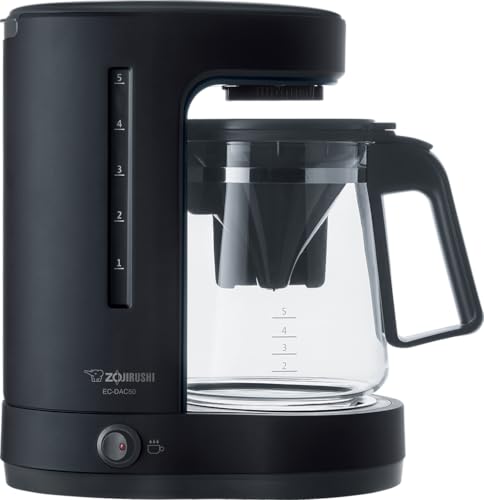
Zojirushi ZUTTO EC-DAC50 Coffee Maker, 5 Cups — Best Premium
Zojirushi is the brand rice-cooker devotees swear by, and the ZUTTO EC-DAC50 applies the same philosophy to a 5-cup pot: do a simple thing with unusual care. The machine is compact and spare — no sprawling control panel — but the tolerances, the carafe fit, and the consistency from pot to pot are where the money goes. For drinkers who use good beans and have been disappointed by tepid, uneven small brewers, this is the upgrade candidate in the category.
If the Cuisinart is the practical premium, the ZUTTO is the purist’s: extraction consistency and build quality above all, features deliberately few. Coffee-first households that have outgrown a basic brewer’s flat small pots will taste exactly what the extra money bought, every morning.
Strengths
- Zojirushi’s build quality and fit-and-finish are a clear step above the budget tier
- Brew temperature consistency is this brand’s calling card, and small pots benefit most
- Compact, tidy industrial design that suits minimalist and Japanese-style kitchens
Trade-offs
- Premium pricing for a machine with a deliberately simple feature set
- No programmable timer — convenience seekers should look at the Mr. Coffee Programmable
- Replacement carafes are brand-specific and pricier than the generic glass pots
| Capacity | 5 cups |
| Design | ZUTTO series compact brewer (manufacturer listing) |
| Listing note | Marketed as PFAS-free (manufacturer listing) |
What you do not get is theatre: no timer, no strength dial, no app. The ZUTTO’s case is that extraction fundamentals — water hot enough, distributed evenly, at a repeatable volume — matter more at 25 ounces than at 60, because there is less margin for error in a small batch. It is also the pick most likely to still be on the counter in a decade. Buy it as a long-term appliance, not as a gadget, and the premium makes sense; buy it expecting features and you will feel short-changed.
Zojirushi ownership is the long game: descale on schedule, treat the carafe as the precision part it is, and the machine simply continues. Spare carafes and parts are brand-channel purchases — pricier than generic glass, but they exist, which is the entire point. Owners tend to measure this machine’s life in decades and hand it down rather than upgrade it.
Best for: Quality-first buyers who keep appliances for years / Not suited for: Feature hunters who want timers and strength settings
Check the current price on Amazon

KRUPS Simply Brew Compact 5 Cup Coffee Maker — Best Design
KRUPS built its reputation on tidy European design, and the Simply Brew Compact is what that philosophy looks like at 5 cups. The stainless-accented body sits more handsomely on the counter than the all-plastic competition, and the drip-free carafe is a small daily mercy — the spout geometry genuinely pours without the trailing dribble that plagues cheap glass pots. Pause & Brew, a keep-warm plate, and an included reusable filter complete a spec with no obvious holes.
The KRUPS is the 5-cup machine as an object you enjoy: stainless accents, a carafe that pours like it was designed by someone who had wiped up drips, and the full practical checklist underneath. On an open counter it earns its premium in appearance and pour quality alone.
Strengths
- Drip-free carafe spout is the best pourer in this class — no counter-wiping after every pot
- Stainless-accented body looks and feels a class above the all-plastic budget machines
- Reusable filter, keep warm, and Pause & Brew cover the full small-brewer checklist
Trade-offs
- Costs more than the basic switch models while brewing a similar-strength cup
- Keep warm is plate-based, so the last cup still stales if it sits too long
- Compact reservoir opening can be awkward to fill from a large jug
| Capacity | 5-cup carafe |
| Design | Stainless steel accents (manufacturer listing) |
| Features | Pause & Brew, keep warm, reusable filter, drip-free carafe (manufacturer listing) |
Blindfolded, its coffee is close to the other good 5-cup drip machines; you are paying for design, pour quality, and finish rather than a transformation in the cup. That is a legitimate reason to buy — this is an appliance that lives on your counter in plain sight — as long as you go in knowing the premium is cosmetic and ergonomic. The reservoir mouth is the one ergonomic miss: fill it from a small jug or the carafe itself rather than a wide kettle spout.
KRUPS ownership is about keeping the finish: the stainless accents reward a wipe with a soft cloth and punish abrasive pads. The drip-free carafe is not just a pour pleasure — fewer drips mean a cleaner plate and less baked-on coffee to scrub. The reusable filter and standard sizing keep consumables at zero and spares straightforward.
Best for: Design-conscious small kitchens that keep the brewer on display / Not suited for: Strict budget buyers — simpler models brew a comparable cup for less
Check the current price on Amazon

Hamilton Beach 5 Cup Drip Coffee Maker with FrontFill Basket (46112) — Best for Under-Cabinet Kitchens
The Hamilton Beach 46112 solves the most annoying physical problem of small brewers: filling them. Most machines load from the top, which means dragging the brewer out from under the wall cabinet every morning. The FrontFill basket swings out from the front instead, so water and grounds go in while the machine stays parked. Its second trick is subtler — it is designed to work with smart plugs, so a plug you may already own provides scheduling, voice control, and auto-off timers that the machine itself omits.
Hamilton Beach solved the size class’s most common physical complaint — top-loading under a cabinet — with the FrontFill basket, then added smart-plug readiness for households that schedule everything. If your brewer lives in a galley or under low cabinets, this is the one designed for your kitchen’s geometry.
Strengths
- FrontFill basket swings out toward you — fill it without pulling the machine out from under the cabinet
- Smart-plug compatibility gives you app or voice scheduling without a built-in clock to program
- Auto Pause and Pour handles the mid-brew first cup cleanly
Trade-offs
- No built-in timer — scheduling depends on owning or buying a smart plug
- Glass carafe and warming plate, so late cups stale like every plate model
- Front-swinging basket needs clear counter space in front of the machine
| Capacity | 5-cup glass carafe |
| Access | FrontFill swing-out brew basket (manufacturer listing) |
| Features | Works with smart plugs, Auto Pause and Pour (manufacturer listing) |
That division of labour is either clever or annoying depending on your kitchen. If you already run smart plugs, this is the most connected small brewer here for the least built-in complexity — and a mechanical-style brew switch is exactly what a smart plug needs to work reliably. If you do not, the Mr. Coffee Programmable gives you the timer in the box. Either way the brew itself is solid daily coffee, the carafe pours well, and Hamilton Beach’s parts network is one of the stronger ones in the value tier.
The FrontFill mechanism is the ownership headline: because filling is easy, the machine stays in place, and machines that stay in place get descaled and wiped more often. The smart-plug pairing adds an ownership upgrade path — schedules and auto-off rules can improve without replacing the brewer. Hamilton Beach’s parts network is a further quiet strength.
Best for: Under-cabinet kitchens and smart-home households / Not suited for: Buyers who want a self-contained timer with no extra accessories
Check the current price on Amazon

Mr. Coffee Programmable Coffee Maker, 5-Cup — Best Programmable
Most 5-cup brewers make you choose between simplicity and a wake-up timer; this Mr. Coffee Programmable model is the exception in the small class. Its Brew Later function lets you load water and grounds the night before and have a 25-ounce pot ready when the alarm goes off. The carafe’s ounce markings sound like a trivial detail until you start brewing half-pots for one person — measuring 12 or 15 ounces accurately is what keeps a small batch from tasting watery or sludge-thick.
Brew Later in a true 5-cup format, with an ounce-marked carafe for precise half batches: the programmable Mr. Coffee is the routine machine, priced like a basic one. For alarm-clock households it is the highest-value feature in this entire guide.
Strengths
- Brew Later programming means a fresh small pot can be ready at wake-up time — rare at this size and price tier
- Ounce markings moulded into the carafe make repeatable small batches and half-pots easy to measure
- Compact footprint keeps the timer convenience without giving up much counter space
Trade-offs
- More electronics than a switch model, so there is more to fail over a long service life
- The clock and program need resetting after power cuts, a small but recurring annoyance
- Glass carafe on a warming plate will stale coffee left sitting for hours
| Capacity | 5 cups / 25 oz glass carafe with ounce markings |
| Controls | Programmable Brew Later auto-start |
| Design | Compact body, ergonomic carafe (manufacturer listing) |
Living with it is mostly about rhythm: rinse the carafe at night, load the basket, set the time, and mornings take care of themselves. The brew quality is squarely in the good-daily-driver band for the category — hot, consistent, and better with a medium grind than with very fine or very coarse coffee. Where it loses ground to simpler rivals is longevity risk: a display, a clock, and programming buttons are extra failure points a one-switch machine simply does not have. If the timer is a feature you will genuinely use five mornings a week, that trade is worth it; if not, buy the simpler machine.
Ownership adds one chore to the simple life: the clock. After every power cut the time and programme need resetting, and households that skip it wake to a silent machine. Keep the manual’s programme sequence on a phone note for the first month. The carafe is shared with other Mr. Coffee small models, which keeps replacements easy to source.
Best for: Early risers who want a small pot waiting when they wake up / Not suited for: Buyers who prefer the longest possible service life from the fewest parts
Check the current price on Amazon

Mr. Coffee 5-Cup Mini Brew Switch Coffee Maker — Best Budget
The Mr. Coffee 5-Cup Mini Brew Switch is the small brewer reduced to its essentials: fill the reservoir, add grounds to the basket, set the glass carafe on the plate, and flip one switch. There is no timer, no strength selector, and no digital display, and for a certain kind of household that restraint is exactly the point. It suits one or two drinkers who brew a small pot in the morning, drink it within the hour, and want a machine that a guest, a teenager, or a half-awake partner can operate without instructions.
The Mini Brew Switch is the class’s honest floor: a small pot, one switch, no failure-prone extras, and a long-running design with available carafes. As a first machine, a second-location machine, or a deliberate rejection of feature creep, it remains undefeated at its tier.
Strengths
- Dead-simple one-switch operation — no menus, no clock to set, nothing to misconfigure on a groggy morning
- Compact body fits under low cabinets and in corners where a full-size brewer will not
- Replacement glass carafes for this long-running design are widely available, which extends the machine’s working life
Trade-offs
- No programmable auto-start, so coffee cannot be waiting when you wake up
- No auto shut-off beyond the warming plate switch — you have to remember to turn it off
- Basic showerhead coverage can under-extract if you overload the basket with fine grounds
| Capacity | 5 cups / 25 oz glass carafe |
| Controls | Single brew switch with indicator light |
| Design | Compact countertop footprint (manufacturer listing) |
In daily use the appeal is predictability. The brew cycle is short because the water volume is small, the carafe pours cleanly for its class, and the whole machine wipes down in seconds. The trade-off for that simplicity shows up in the cup: with no bloom phase and a basic spray pattern, very fresh light-roast beans will taste a little flatter here than in a brewer with better water distribution. Use a medium grind, keep the dose consistent, and descale on schedule, and it produces a honest, hot, repeatable small pot — which is all most buyers in this size class are actually asking for.
Ownership is as simple as the machine: the carafe and basket tolerate daily dishwashing, the plate wipes clean, and the only recurring task is descaling when the brew slows. Because the design has been sold for years, a replacement carafe is a commodity purchase rather than a treasure hunt — the single biggest predictor of a small brewer’s total lifespan.
Best for: Solo drinkers and couples who want a small pot with zero learning curve / Not suited for: Anyone who wants coffee brewed automatically before they wake up
Check the current price on Amazon
Comparison Table
| Pick | Badge | Key spec | Best for |
|---|---|---|---|
| Cuisinart 5-Cup Coffee Maker with Stainless Steel Carafe (DCC-5570) | Best Overall | Stainless thermal-style carafe, charcoal filter, removable reservoir | Households tired of replacing broken glass carafes |
| Zojirushi ZUTTO EC-DAC50 Coffee Maker, 5 Cups | Best Premium | Japanese-engineered 5-cup brewer, PFAS-free listing | Quality-first buyers who keep appliances for years |
| KRUPS Simply Brew Compact 5 Cup Coffee Maker | Best Design | Stainless design, drip-free carafe, reusable filter | Design-conscious small kitchens that keep the brewer on display |
| Hamilton Beach 5 Cup Drip Coffee Maker with FrontFill Basket (46112) | Best for Under-Cabinet Kitchens | FrontFill swing basket, smart-plug compatible | Under-cabinet kitchens and smart-home households |
| Mr. Coffee Programmable Coffee Maker, 5-Cup | Best Programmable | Brew Later timer, 25 oz carafe with ounce markings | Early risers who want a small pot waiting when they wake up |
| Mr. Coffee 5-Cup Mini Brew Switch Coffee Maker | Best Budget | One-switch brew, compact footprint | Solo drinkers and couples who want a small pot with zero learning curve |
How to Choose the Right Small Coffee Maker
Start with the only number that decides satisfaction in this category: how much coffee your household actually drinks in one sitting, measured honestly. Coffee makers do not measure cups the way your mug does. A coffee-maker ‘cup’ is roughly five ounces, so a 5-cup carafe holds about 25 ounces — two generous mugs, or one mug plus a refill. A 4-cup machine holds about 20 ounces. Buyers who skip this conversion are the ones leaving disappointed reviews on perfectly good machines, so do the mug maths first: count your household’s mugs, multiply by their real size, and let that total choose the carafe.
Glass Carafe, Steel Carafe, or No Carafe at All
Glass is the default because it is cheap, light, and lets you see the coffee level — but it is also the part of the machine most likely to end its life against a sink edge or a tile floor. A stainless steel carafe, like the Cuisinart’s in this guide, removes the breakage risk and holds heat without a warming plate cooking the coffee, at the cost of hiding how much is left. The third option is no carafe: a single-serve machine brews straight into your mug, which eliminates staling entirely but commits you to brewing one cup at a time. None of these is objectively best; the right answer depends on whether your household drinks together or one mug at a time.
The Features That Matter at This Size — and the Ones That Do Not
At 4 and 5 cups, four features earn their keep. Pause-and-pour stops the ‘first cup can’t wait’ drip disaster. A reusable filter quietly saves money every single week. A readable water window is the difference between a consistent pot and a daily guess, because at this scale being off by half a cup of water is being off by a fifth of the recipe. And auto shut-off is a genuine safety feature in any home that rushes out the door. Features that matter far less than marketing suggests: strength selectors on basic drip machines (dose and grind do that job better), built-in grinders (hard to clean at this size), and app connectivity on a machine with one job.
Budget Tiers, Explained Without the Hype
Small brewers fall into three honest tiers. The budget tier is the simple switch machines: they brew a decent pot, they ask you to manage the warmer, and their carafes are the fragile kind. The mid tier adds the conveniences — timers, front-loading baskets, better carafes, branded build quality. The premium tier at this size is small: a steel-carafe machine like the Cuisinart, or a Japanese-engineered brewer like the Zojirushi, where the money buys durability and consistency rather than features. Spend according to how long you intend to keep the machine. A dorm machine and a decade-long counter resident should not be the same purchase, and pretending otherwise wastes money in both directions.
What the Listings Do Not Tell You
Manufacturer listings for small drip machines share a blind spot: they photograph the machine empty, on an empty counter, in a kitchen with no cabinets. Reality adds a cabinet underside at exactly lid height, a mug that does not fit the marketing photo’s scale, and a second person trying to make toast in the same square metre. Before buying, act out your morning with a tape measure: where the machine stands, how the lid or basket opens, where the carafe travels to the sink. Ten minutes of this pantomime prevents the most common return reason in the category — not bad coffee, but bad fit.
Listings also stay silent about sound and steam. A small drip machine vents a surprising amount of steam for its size, which matters under wooden cabinet fronts; a machine placed permanently under a low cabinet should be pulled forward while brewing, or chosen in a front-loading design. And the last unlisted truth is the kindest: these machines improve noticeably in their second week, not because they change, but because you do — dose, grind, and timing settle into a routine, and the routine is where good small-pot coffee actually comes from.
Small Pots and Sustainability, Briefly
A right-sized brewer is quietly the greener choice in coffee: less water heated, less coffee brewed and discarded, and less energy holding a large plate warm. The reusable-filter machines in this guide remove the daily paper filter from the waste stream entirely, while the single-serve format in the wider series trades that away for per-cup packaging. None of this should override fit and flavour — a machine you replace in a year because it was wrong is the least sustainable outcome of all — but it is worth knowing that the frugal choice and the sustainable choice in this category are usually the same machine.
How to Set Up and Use Your Small Drip Coffee Maker
Step 1 — Wash before the first pot. Rinse the carafe, lid, and filter basket in warm soapy water, then run one full cycle of plain water through the machine. New small brewers carry factory dust and plastic notes that will otherwise season your first pot.
Step 2 — Measure water by the carafe, not the reservoir marks. Fill the carafe to the line for the batch you want, pour it into the machine, and you will never overfill or underfill. This one habit also teaches you your machine’s true capacity in mugs within two days.
Step 3 — Dose, level, and start. Add medium-ground coffee — start with one level tablespoon per coffee-maker cup and adjust — shake the basket gently to level the bed, seat the carafe fully so the pause-and-serve valve opens, and switch on.
Step 4 — Give it a minute. Let the full cycle finish and rest for about a minute before pouring; the last drips are the strongest part of the pot and the first pour is the weakest. Stirring the carafe once with a spoon evens out a small pot noticeably.
Step 5 — Rinse now, descale monthly. Dump grounds and rinse the basket and carafe immediately; coffee oils go rancid on plastic and glass alike. Descale every one to three months depending on your water — white vinegar solution or a descaler, followed by two plain-water cycles — because scale is the silent killer of brew temperature in small machines.
Why 5 Cups Became the Industry’s Favourite Small Size
Five cups — 25 ounces — is where the economics and the ergonomics of small coffee meet. It is large enough to justify real engineering: a proper heating element, a carafe worth tooling in both glass and steel, a basket that extracts evenly. It is small enough to brew in minutes and to match the two-mug household that dominates morning-coffee surveys. And it sits at the exact volume where a warming plate, a thermal carafe, and a drink-it-now household all remain plausible strategies, which is why this single size supports more distinct product philosophies than 4 and 6 cups combined.
The practical consequence for buyers is pleasant: competition at 5 cups is genuine, so the second-best machine in this guide would headline most other sizes. Choose by the job — durability, purity, design, access, routine, or budget — and know that at this size, every one of those jobs has a machine that does it properly. That has not always been true in small coffee, and it is worth enjoying while it lasts.
The Only Accessories Worth Buying at This Size
Small brewers attract accessory clutter; most of it is junk, but four items earn their drawer space. A small burr grinder is the first and only transformative one — it improves every machine in this guide more than upgrading the machine would, because grind consistency is the ceiling on all of them. A simple scale or a dedicated dose spoon is the second: whichever you will actually use daily, since a measured dose repeated beats a perfect dose abandoned. A bottle brush sized for carafes is the third, unglamorous and decisive for keeping glass sweet over years. And a spare carafe — bought when you buy the machine, while the model is current — is the fourth: it converts the category’s most common appliance death into a thirty-second swap.
The skip list is equally useful. Descaling pods and proprietary cleaning tablets do nothing a standard descaling solution does not. Gold-tone filters marketed as upgrades are the same mesh in a different tint. And a thermal server, while genuinely useful for all-morning households, should be bought only after the warmer has actually disappointed you — many households discover the 45-minute rhythm of a 5-cup pot fits their morning perfectly well.
The pattern underneath both lists: accessories that fix measurement, grinding, and breakage are investments; accessories that promise flavour transformation from a gadget are rent on hope. At 5 cups, your technique is the flavour upgrade — the accessories just protect it.
Troubleshooting: The Five Faults Every 5-Cup Owner Meets
Problem: the pot tastes weak suddenly → check the dose first, then the scale. A new bag of coffee ground finer can choke the basket and overflow grounds into the pot (which reads as weak and gritty at once), while a scaled heater quietly lowers brew temperature over months. One fault is fixed with a scoop; the other with a descale.
Problem: coffee on the counter under the machine → suspect the carafe’s seating before the machine’s seals. A carafe pushed in carelessly holds the pause-and-serve valve half open; a carafe with a chipped rim does the same. Seat it deliberately and inspect the rim.
Problem: the timer brewed at the wrong hour → the clock was set to p.m. instead of a.m., or a power cut reset it. It is always this. Every programmable owner does it once a year.
Problem: the first cup is strong, the last is weak → the pot was not stirred, or the first cup was poured mid-brew before the full cycle equalised. Let the cycle finish, stir once, then pour.
Problem: a plastic taste in a new machine → run two full plain-water cycles and wash the carafe again; the taste is factory residue and it leaves. If it persists past the third pot, exchange the machine — you are not imagining it, and it does not improve.
The 5-Cup Machine and the Household’s Second Year
Reviews are written in week one, but this size class is judged in year two — when the novelty is gone, the descaling calendar has been tested, and the machine is simply how coffee happens. The picks that survive year two share a profile visible right now: parts that can be replaced, controls that never needed relearning, and a size matched to the household’s true pot. That is the real ranking underneath this guide’s badges, and it is why the final recommendation keeps returning to fit and support over features. Buy the machine your second year will thank you for.
One Last Thing: The Crowded Shelf Is Your Friend
End with the good news this guide opened with: 5 cups is the size the industry competes hardest at, and competition is the buyer’s oldest ally. It is why this list can demand verified listings, replaceable carafes, and distinct virtues from every pick and still fill six slots without strain. Somewhere in those six is the machine whose badge reads like your kitchen’s biography. Find it, buy it once, descale it monthly, and let the most contested size in small coffee do what competition trained it to do.
Common Buying Mistakes
Trusting the cup number on the box. The single most expensive misunderstanding in this category. A coffee-maker cup is about five ounces; your mug is probably ten to sixteen. Always convert the carafe to ounces and compare it with your real mugs before buying.
Buying the size you wish you drank. People buy the 12-cup machine ‘for guests’ and then brew four cups in it daily, badly, because big machines under-extract small batches. Buy for the daily pot; guests can wait four minutes for a second brew.
Ignoring the carafe’s afterlife. Glass breaks. Before choosing any glass-carafe model, check that a replacement carafe exists and is easy to order. If it is not, price the machine as a disposable.
Leaving the warmer to do the thinking. Machines without auto shut-off will happily cook coffee — and eventually themselves — all day. If your household is forgetful, make auto shut-off a hard filter, not a nice-to-have.
Judging the machine before fixing the ratio. Weak or bitter first pots are usually dose and grind problems. Give any new small brewer a week of consistent ratios before concluding the machine is at fault.
Final Recommendation
The Cuisinart DCC-5570 is the default buy at 5 cups; the Zojirushi is the connoisseur’s buy; the programmable Mr. Coffee is the routine buy; and its switch-operated sibling is the budget buy that embarrasses machines twice its complexity. Pick by household job, and this size class will not disappoint you.
Start with Cuisinart 5-Cup Coffee Maker with Stainless Steel Carafe (DCC-5570), Zojirushi ZUTTO EC-DAC50 Coffee Maker, 5 Cups, KRUPS Simply Brew Compact 5 Cup Coffee Maker — the three picks most readers of this guide end up choosing between.
Related guides in this series: Best 4 5 Cup Coffee Makers; Best 4 Cup Coffee Makers; Best 6 Cup Coffee Makers; Best 5 To 10 Cup Coffee Makers; Best 4 Or 5 Cup Coffee Makers.
Frequently Asked Questions
How many mugs does a 5-cup coffee maker fill?
About two standard 12-ounce mugs, with a little left for a top-up. The coffee-maker cup is roughly five ounces, so the full carafe is about 25 ounces — the two-mug household is precisely who this size was designed for.
What is the best 5-cup coffee maker overall?
The Cuisinart DCC-5570, for its unbreakable steel carafe, removable reservoir, and charcoal water filtration. The Zojirushi ZUTTO is the better pick only for buyers who rank pure brew consistency and build quality above those practical advantages.
Are 5-cup coffee makers good for a single person?
Yes, if that person drinks a mug now and a mug within the hour, or one very large mug. Brew a measured half batch on light days — the ounce-marked and window-equipped models here make that easy — and the size stops being ‘too big’ entirely.
Do 5-cup machines brew hotter than cheaper small machines?
The established brands’ 5-cup models are properly calibrated, and this is the size where the difference between a calibrated machine and a bargain-bin one is most noticeable in the cup. Every pick in this guide comes from a maker with a real engineering reputation at this format.
How long will a 5-cup coffee maker last?
A simple switch model or a premium build can serve five to ten years with descaling and a surviving carafe; budget programmable models typically serve fewer years because their electronics age first. Carafe replaceability is the strongest single predictor of total lifespan.
What grind and dose suit a 5-cup pot?
Medium grind, one level tablespoon per coffee-maker cup — five tablespoons for a full pot — adjusted in small steps to taste. Keep the dose identical for a week before judging; small pots reward consistency more than experimentation.


