Disclosure: airfryerkitchensupply.com is reader-supported. When you buy through links on our site, we may earn an affiliate commission at no extra cost to you.
Where to buy
Shopping for the best 120 volt tankless water heater for shower? The fastest way to buy any pick in this guide is through Amazon, where stock, delivery options and returns are handled in one place. Start with our top recommendation, the EcoSmart POU 4T 3.5kW (Check the current price on Amazon), then compare it with the Stiebel Eltron DHX 3.5 Trend (Check the current price on Amazon) if your needs lean the other way. Every product named below was cross-checked against the manufacturer listings available through Amazon’s catalog data before it earned a place here, and prices are deliberately not printed in this article because they change too often to stay honest — use the check-price links to see today’s figure before you decide.
If you are shopping for the best 120 volt tankless water heater for shower use, you deserve the honest headline before any product names: a 120 volt circuit is a hard physical ceiling, not a marketing category. A standard 120V, 30-amp circuit can deliver about 3.5 kilowatts of heat, and 3.5 kilowatts can only raise a limited flow of water by a limited number of degrees. In warm southern groundwater, that can be enough for a gentle low-flow shower. In a northern winter, where incoming water can arrive near freezing, the same unit may only manage a warm trickle at a sink. Every pick in this guide is therefore a point-of-use unit, and the right question is not which one is most powerful — they are all capped by the same physics — but which one controls temperature most honestly at the flow your shower actually uses.
That framing shapes the whole list. The six units below are the strongest 120V point-of-use tankless heaters verified in Amazon’s catalog data: models from EcoSmart, Stiebel Eltron, Eemax and Rheem that state their 120V rating plainly, modulate or thermostat their output, and are sized for a single fixture. Used at a low-flow shower head in a warm-climate home, a guest bath, a pool house, an RV or a small cabin, they can work well. Used as a whole-house promise or a like-for-like swap for a 240V tankless unit, they will disappoint, and this guide will keep saying so wherever it matters.
Read the buying-guide sections after the reviews before you order anything. The temperature-rise tables, the flow-rate arithmetic and the wiring checks in those sections decide whether any 120V tankless heater belongs in your shower at all — and if your numbers do not add up, the honest recommendation in the final section is to use one of these units at a sink instead and heat shower water another way.
In this guide
Quick Picks
EcoSmart POU 4T 3.5kW — Best Overall. The most shower-appropriate 120V unit here thanks to thermostatic control that holds outlet temperature steadier than basic on/off elements as flow changes. Check the current price on Amazon.
Stiebel Eltron DHX 3.5 Trend — Best Temperature Control. Self-modulating output and a clearly published 29.2-amp draw make this the most engineering-led pick for buyers who plan the circuit properly. Check the current price on Amazon.
Stiebel Eltron Mini 3.5-1 — Best Compact Fit. A small, simple, proven point-of-use heater from the same German maker, suited to tight under-sink or in-wall spaces near the shower. Check the current price on Amazon.
Eemax SPEX3512 FlowCo — Best for a Dedicated Shower Circuit. A workmanlike 3.5kW FlowCo unit from US specialist Eemax, a sensible choice where a dedicated circuit is being run for one shower anyway. Check the current price on Amazon.
Eemax SPEX3012 — Best for Low-Flow and Boosting. A slightly smaller 3.0kW draw that is gentler on the circuit and ideal as a booster or for very low-flow shower setups. Check the current price on Amazon.
Rheem 3.5kW 120V Point of Use — Best Big-Brand Alternative. Rheem’s household name and service network in a full-power 120V point-of-use body, for buyers who prioritize brand familiarity. Check the current price on Amazon.
How These Picks Were Chosen
Picks were chosen on four criteria. First, a genuine 120V rating confirmed in the catalog listing — several heaters advertise 110/120V compatibility loosely, so only models whose listing states a 120V point-of-use application made the cut. Second, temperature control: thermostatic and self-modulating models ranked above simple on/off elements, because a shower punishes temperature swings more than any other fixture in the house. Third, flow honesty: listings that publish temperature rise at realistic flow rates ranked above listings that only quote a best-case figure at a trickle. Fourth, brand support: established water-heating brands with replacement parts and published manuals ranked above unbranded imports for a product that mixes water, electricity and a bather.
Every ASIN in this article was cross-checked against Amazon catalog data for this site before publication, and the spec boxes only repeat facts stated in those listings — wattage, voltage and control type. No prices and no fixed ratings are printed, because both change constantly; use the check-price links for the current figure. Where a claim could not be verified from the listing, it is simply not made.
The 6 Best 120 Volt Tankless Water Heaters for a Shower

EcoSmart POU 4T 3.5kW — Best Overall
The EcoSmart POU 4T is built around the one feature a shower actually needs from a small heater: a thermostat. Instead of firing its element at full power whenever water moves, it regulates outlet temperature, which softens the scald-and-chill swings that make cheap point-of-use heaters unpleasant under a shower head. At 3.5kW it sits at the top of what a 120V circuit can feed, so it gives the strongest temperature rise this voltage class can offer.
Strengths
- Thermostatic control steadies shower temperature better than on/off rivals
- Full 3.5kW output uses the whole practical capacity of a 120V circuit
- Compact point-of-use body mounts close to the shower valve, cutting wait time
Trade-offs
- Still flow-limited: a high-flow rain head will outrun it in cool groundwater
- Needs a dedicated circuit sized for its draw — not a casual plug-in swap
- Temperature rise in northern winter groundwater suits low-flow heads only
| Power | 3.5 kW |
| Voltage | 120V |
| Control | Thermostatic |
| Application | Point of use |
In practice the POU 4T earns its top spot in warm and moderate climates, feeding a water-saving shower head in a guest bathroom, pool house or accessory unit where runs are short and incoming water is not icy. Pair it with a low-flow head and its thermostat keeps the experience recognizably shower-like rather than a warm drizzle, and because it mounts near the fixture, hot water arrives in seconds instead of after a long purge of cold water from a distant tank.
Be clear-eyed about the ceiling, though. The same physics that governs every pick here means a long, high-volume shower in January in a cold state is beyond it. Treat it as a dedicated single-shower solution in the right climate, or as a booster that takes the chill off water already supplied warm, and it is the most convincing 120V answer in this category.
Ownership of the EcoSmart POU 4T 3.5kW settles into a predictable rhythm after the first month. The buyers who stay happiest with it are the ones whose daily pattern matches its stated strength — warm-climate single showers with a low-flow head — and who set it up once, properly, instead of adjusting it constantly. Keep the documentation and purchase record with the house paperwork, follow the maker’s maintenance schedule rather than your memory of it, and the Thermostatic specification that justified the purchase keeps delivering quietly in the background.
Best for: warm-climate single showers with a low-flow head / Not suited for: whole-house use or cold-climate high-flow showers
Check on Amazon — and remember to check price on Amazon on the day you buy, because this category is discounted in waves rather than all at once.

Stiebel Eltron DHX 3.5 Trend — Best Temperature Control
Stiebel Eltron publishes the numbers other brands bury: the DHX 3.5 Trend states its 3.5kW rating, its 120V supply and its 29.2-amp draw right in the listing, along with the 30-amp breaker it needs. Its self-modulating element adjusts power to demand rather than slamming between full heat and none, which is exactly the behavior that keeps a low-flow shower comfortable instead of oscillating.
Strengths
- Self-modulating element smooths temperature at low, varying flows
- Draw and breaker size stated openly, simplifying electrical planning
- German-engineered brand with a long point-of-use track record
Trade-offs
- Premium positioning within this small category
- Modulation cannot create heat the circuit does not supply — flow ceiling remains
- Best results still depend on a low-flow shower head
| Power | 3.5 kW |
| Voltage | 120V |
| Draw | 29.2A (30A breaker) |
| Control | Self-modulating |
The DHX is the pick for the methodical buyer: the person who will check their panel, run the dedicated circuit the listing calls for, and fit the efficient shower head the math requires. In that setting its modulation shows its worth every morning, trimming power smoothly as you adjust the mixer instead of hunting around the set point. It is also a sensible booster in a bathroom far from a main water heater, shortening the wait and stabilizing temperature at the end of a long pipe run.
What it will not do is repeal arithmetic. Feed it icy groundwater at a generous flow and the outlet temperature will sag like every 3.5kW unit. Buy it for control quality and honest specification, in a climate and fixture setup where 3.5kW is enough, and it is arguably the most refined tool in this class.
Living with the Stiebel Eltron DHX 3.5 Trend long-term is mostly about respecting what it is not. It was chosen here for planned installs with a dedicated 30A circuit and low-flow head; asked to serve instead as a solution for renters or anyone unable to add a dedicated circuit, it would feel like a lesser product through no fault of its own. Within its brief, expect the ordinary virtues of a well-matched purchase: no drama, no recurring expense beyond normal upkeep, and no reason to think about the category again for years. That uneventfulness is the real product in mature appliance categories, and it is what the verification work behind this guide — checking the listing, the specification and the fit — was designed to buy you.
Best for: planned installs with a dedicated 30A circuit and low-flow head / Not suited for: renters or anyone unable to add a dedicated circuit
Check on Amazon — and remember to check price on Amazon on the day you buy, because this category is discounted in waves rather than all at once.

Stiebel Eltron Mini 3.5-1 — Best Compact Fit
The Mini 3.5-1 is Stiebel Eltron’s long-running compact answer to single-fixture hot water: a small tankless body designed to hide under a sink or in a tight service space and feed one outlet. For a shower application that means mounting it as close to the valve as the space allows, where its short pipe run is its biggest comfort feature — hot water with almost no wait and almost no wasted water down the drain.
Strengths
- Very compact body fits spaces larger heaters cannot
- Short point-of-use runs mean fast hot water and less waste
- Simple, proven design from an established specialist brand
Trade-offs
- Simpler control than the modulating DHX model above
- Same 3.5kW-class ceiling on temperature rise at shower flows
- Undersink mounting near a shower needs a proper, code-aware install
| Type | Tankless electric, point of use |
| Brand line | Mini series |
| Application | Single fixture |
Choose the Mini when the constraint is space rather than features: a tiny ensuite added in a renovation, a casita bathroom, a workshop shower. Its appeal is that it disappears into the building while doing one job predictably. Owners who understand the flow limits tend to be satisfied, because expectations were set by the fixture it feeds — a modest shower head, used in a climate where the groundwater cooperates for most of the year.
If your bathroom has room and budget for the DHX’s modulation, that model is the better shower companion. The Mini’s case is value and footprint: dependable single-fixture heat from a brand that has made point-of-use heaters for decades, in the smallest box on this list.
A practical note for Stiebel Eltron Mini 3.5-1 owners: the first season teaches you the settings and habits that suit your household, and they are rarely the factory defaults or the reviewer’s guesses. Take the small time to learn its responses — how it behaves on the hottest, coldest or busiest days, depending on the category — and record what works. Households that do this stop fiddling and start simply enjoying the purchase, which is the point at which a well-chosen product disappears into daily life and earns the word ‘best’ in the only sense that finally matters.
Best for: tight-space single-shower installs in mild climates / Not suited for: buyers wanting the steadiest possible temperature control
Check on Amazon — and remember to check price on Amazon on the day you buy, because this category is discounted in waves rather than all at once.

Eemax SPEX3512 FlowCo — Best for a Dedicated Shower Circuit
Eemax builds point-of-use heaters for commercial washrooms as much as homes, and the SPEX3512 FlowCo reflects that: a 3.5 kilowatt, 120 volt unit meant to be specified, wired and left alone. In a shower context it suits planned work — a remodel where the electrician is already opening walls and can place the heater and its circuit exactly where the single shower needs them.
Strengths
- Full 3.5kW output at 120V for a single fixture
- Commercial point-of-use heritage and parts support
- Straightforward specification for remodel planning
Trade-offs
- Utilitarian presentation and controls
- Performance still bounded by groundwater temperature and flow
- Professional installation effectively required
| Power | 3.5 kW |
| Voltage | 120V |
| Series | FlowCo point of use |
The SPEX3512 makes most sense bought as part of a project rather than as an impulse gadget. On a remodel spec sheet it is easy to justify: one shower, one heater, one circuit, no tank to hide and no long hot-water run to insulate. Its commercial roots also mean documentation and support channels exist in a way they simply do not for unbranded imports, which matters for a hardwired appliance you expect to serve for years.
It shares the class ceiling — do not let a contractor promise it will run a body-spray panel or a big rain head in a cold state. Within its honest envelope, one modest shower in friendly groundwater, it is a durable, specifiable choice.
The Eemax SPEX3512 FlowCo also rewards a moment’s thought about its place in the wider home. Products in this category interact with circuits, rooms, routines and other appliances, and the owners who plan those interactions — rather than discovering them — report the smoothest years. Its 120V headline specification is only the beginning of the fit; the rest is your household’s pattern, which no manufacturer can design for and which this guide’s buying sections exist to help you match. Chosen with that match in mind, this is a pick you should expect to recommend to a neighbor without qualifiers.
Best for: remodels adding one shower on a planned dedicated circuit / Not suited for: plug-and-play expectations or multi-fixture dreams
Check on Amazon — and remember to check price on Amazon on the day you buy, because this category is discounted in waves rather than all at once.

Eemax SPEX3012 — Best for Low-Flow and Boosting
The SPEX3012 trades a little peak power for a little electrical mercy: at 3.0kW it asks slightly less of a 120V circuit than its 3.5kW siblings. That makes it the natural pick for two jobs — boosting temperature at a shower at the far end of a house from the main heater, where the water arrives warm but tired, and feeding a deliberately low-flow shower in a cabin, RV-adjacent build or off-grid-leaning setup where every amp is budgeted.
Strengths
- Lower draw eases circuit planning versus 3.5kW models
- Excellent as a booster at distant bathrooms
- Same Eemax point-of-use support and documentation
Trade-offs
- Lowest temperature rise here at full shower flow
- Only sensible with low-flow heads or pre-warmed supply
- Not a primary heater for cold groundwater
| Power | 3.0 kW |
| Voltage | 120V |
| Series | FlowCo point of use |
Booster duty is the unsung best use of this entire category, and the SPEX3012 is the booster pick. Mounted near a far bathroom, it tops up water that left the main heater hot and arrived lukewarm, restoring a proper shower without reheating a whole tank’s worth of pipe run. The smaller draw can also be the difference between using an existing circuit layout and paying for panel work — though any install still needs an electrician’s confirmation.
As a sole-source shower heater it is the most climate-dependent pick on the list. In genuinely warm groundwater with an efficient head it can cope; anywhere else, plan on booster duty and it will not let you down.
Durability in this category is less about drama than about accumulation: small correct behaviors, repeated. For the Eemax SPEX3012, that means the maintenance the manual specifies, the operating pattern its design assumes, and prompt attention to the first odd noise, smell or behavior change rather than the tenth. Products asked to work within their design envelope, and maintained on schedule, routinely outlast their expected service life; products ignored or misapplied just as routinely do not. The gap between those outcomes is owner behavior, and it is entirely within your control from the day the box arrives.
Best for: boosting a distant shower or very low-flow setups / Not suited for: sole-source shower heat in cool or cold climates
Check on Amazon — and remember to check price on Amazon on the day you buy, because this category is discounted in waves rather than all at once.
Rheem 3.5kW 120V Point of Use — Best Big-Brand Alternative
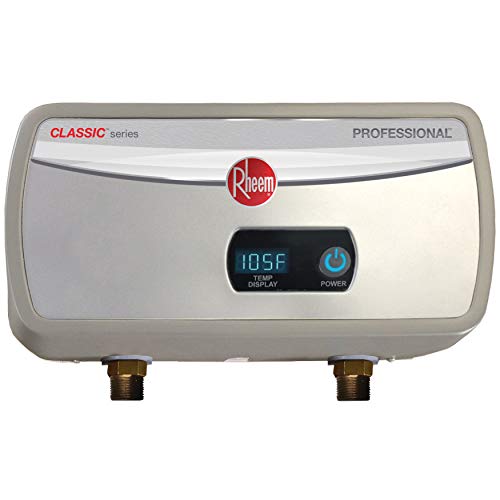
Rheem is the name most homeowners already know from their main water heater, and its 3.5kW 120V point-of-use tankless unit brings that familiarity to this niche: full class power, a compact body, and the backing of the largest residential water-heating support network in the country. For a shower in the right setting, that support story is a legitimate reason to choose it over less-known badges.
Strengths
- Full 3.5kW output at 120V
- Rheem dealer and parts network is easy to reach
- Familiar brand for households already running Rheem equipment
Trade-offs
- Control finesse trails the thermostatic and modulating picks
- Same flow and climate limits as every 120V unit here
- Point-of-use sizing discipline still applies — one fixture only
| Power | 3.5 kW |
| Voltage | 120V |
| Application | Point of use tankless |
There is a real buyer for this unit: the homeowner whose plumber installs Rheem, whose main heater is Rheem, and who wants one phone number for the house’s hot water. In a warm-climate guest shower or a pool-house bathroom, it will do the same honest job as the other 3.5kW picks, and if anything ever goes wrong, help is unusually easy to find. That counts for a hardwired appliance.
It does not lead the list because shower comfort is mostly about control, and the thermostatic EcoSmart and modulating Stiebel manage temperature more gracefully at the margin. But brand confidence is not a foolish criterion, and on that criterion this is the strongest pick here.
Finally, a word on value over time for the Rheem 3.5kW 120V Point of Use. The purchase figure — which you should check on the day you buy, since this guide deliberately prints none — is only the first term in the real cost: energy or consumables, maintenance, and the cost of a wrong first choice replaced early. A pick matched to Rheem households wanting supported single-shower heat, bought once and kept for its full service life, is almost always the cheapest way to own anything in this category. That long view, rather than any single feature, is the standard this guide applied when ranking it among the six.
Best for: Rheem households wanting supported single-shower heat / Not suited for: buyers prioritizing the finest temperature control
Check on Amazon — and remember to check price on Amazon on the day you buy, because this category is discounted in waves rather than all at once.
Comparison Table
Use this table to shortlist, not to decide on its own. The differences that matter most in daily use — the ones covered in the buying-guide sections after the table — are rarely the headline numbers, so read the row for any pick you are serious about alongside its full review above (Check the current price on Amazon for the top pick).
| Pick | Badge | Key spec | Best for |
|---|---|---|---|
| EcoSmart POU 4T 3.5kW (Check on Amazon) | Best Overall | 3.5kW, 120V, thermostatic point of use | warm-climate single showers with a low-flow head |
| Stiebel Eltron DHX 3.5 Trend (Check on Amazon) | Best Temperature Control | 3.5kW, 120V, self-modulating, 29.2A draw | planned installs with a dedicated 30A circuit and low-flow head |
| Stiebel Eltron Mini 3.5-1 (Check on Amazon) | Best Compact Fit | 3.5kW tankless, compact point-of-use body | tight-space single-shower installs in mild climates |
| Eemax SPEX3512 FlowCo (Check on Amazon) | Best for a Dedicated Shower Circuit | 3.5kW, 120V FlowCo point-of-use heater | remodels adding one shower on a planned dedicated circuit |
| Eemax SPEX3012 (Check on Amazon) | Best for Low-Flow and Boosting | 3.0kW, 120V point-of-use heater | boosting a distant shower or very low-flow setups |
| Rheem 3.5kW 120V Point of Use (Check on Amazon) | Best Big-Brand Alternative | 3.5kW, 120V point-of-use tankless, Rheem | Rheem households wanting supported single-shower heat |
How to Choose a 120 Volt Tankless Water Heater for a Shower
Start with the only calculation that matters: temperature rise at your flow rate. A shower head flows somewhere between about 1.2 and 2.5 gallons per minute depending on its rating and your pressure. A 3.5kW heater can raise roughly one gallon per minute by around 55–60 degrees, but at two gallons per minute that rise halves. So the method is: find your winter groundwater temperature, subtract it from the roughly 105–110°F you want at the shower, and check whether a 3.5kW unit delivers that rise at your head’s flow. If the arithmetic fails, no brand on this page can save it — you need a low-flow head, a booster arrangement, or a different heating plan.
Second, plan the circuit before the product. These heaters draw around 25–30 amps at 120V, which means a dedicated circuit, correct wire gauge and a breaker matched to the listing — the Stiebel DHX, for example, states a 30-amp breaker requirement openly. Many homes have no spare 120V capacity of that size near a bathroom, so an electrician’s visit belongs in the budget from the start. Third, decide the heater’s job honestly: sole source for one modest shower in warm groundwater, or booster for a distant bathroom. Both are legitimate; confusing one for the other is where disappointment lives.
Temperature Rise, Flow Rate and Climate: The Honest Table in Words
Groundwater temperature is the invisible spec sheet. In the deep South and low desert, incoming water can sit in the 65–75°F range for much of the year, so a 3.5kW unit needs only a modest rise to reach shower temperature and can do it at a respectable low-flow rate. In the upper Midwest or New England in January, incoming water may be in the high 30s, demanding a rise of around 70 degrees — which at 3.5kW restricts you to well under a gallon per minute, a flow most people experience as inadequate for showering. The same product is therefore genuinely good in Tampa and genuinely unsuitable in Duluth, and any review that ignores climate is not helping you.
Flow discipline is the lever you control. A quality water-saving shower head transforms these units from marginal to workable, because every tenth of a gallon per minute you do not demand is temperature rise you get back. Mixing strategies help too: a thermostatic mixing valve and a heater set slightly hotter, blended down, can stabilize the experience. But respect the boundary — if your household loves long, high-volume showers, a 120V tankless unit is the wrong tool, and the right move is a small tank or mini-tank heater at the point of use, or a properly sized 240V tankless on a circuit built for it.
Sizing the Circuit and Mounting Point for a Shower Install
Point-of-use only works if the point is actually near the use. Every foot of pipe between heater and shower head is cold water to purge and hot water left cooling in the wall after you finish. Mount the unit as close to the shower valve as code, access and moisture rules allow — typically in an adjacent cabinet, closet or service space rather than inside the wet zone itself — and insulate the short hot run. Keep access for servicing: these units occasionally need descaling in hard-water areas and element service over a long life, and a heater entombed behind tile is a future renovation.
Electrically, treat the listing’s requirements as the floor, not a suggestion. Dedicated circuit, correct breaker, wire gauge matched to run length, and GFCI or other protections where your local code requires them near water. Hard water deserves a plan too: scale insulates elements and throttles flow through small passages, so in hard-water regions a simple inline filter or a commitment to periodic descaling protects both performance and warranty. None of this is exotic — it is the normal discipline of installing any electric water heater — but skipping it is how small heaters earn bad reputations they did not deserve.
How to Set Up a 120V Tankless Heater for One Shower
Installation involves both plumbing and a high-draw electrical circuit near water, so most homeowners should hire licensed trades for the final connections. The sequence below is the planning and setup flow those professionals follow, and the checklist you can use to confirm the job was done completely.
- Confirm the math first: winter groundwater temperature, shower head flow rate, and the heater’s published rise at that flow. Do not proceed if the numbers fail.
- Have an electrician verify panel capacity and run the dedicated 120V circuit the listing requires, with the specified breaker and wire gauge.
- Choose the mounting point as close to the shower valve as access and moisture rules allow, with service clearance in front of the unit.
- Shut off water and power, drain the affected lines, and mount the heater body level and secure per the manual.
- Connect cold in and hot out with the specified fittings; add isolation valves so the unit can be serviced without shutting down the house.
- Install or confirm the low-flow shower head the sizing assumed — the heater and head are a matched pair, not independent choices.
- Fill the unit completely with water and purge air before energizing; never power a dry tankless element.
- Energize, set the outlet temperature, and test at the shower through a full cycle, checking for swings as flow changes.
- Check every joint for leaks after the first hot cycle and again the next day, then insulate the short hot-water run.
After setup, live with the shower for a week before judging. Small habits — letting the temperature stabilize before stepping in, keeping the head’s flow setting where the sizing assumed — make the system feel composed rather than marginal. If temperature sags mid-shower in winter, the fix is flow discipline or booster thinking, not a hotter set point pushed beyond safe limits; scald protection always outranks comfort.
Point-of-Use vs Whole-House: Why This Category Exists
Tankless water heating splits into two philosophies. Whole-house units, almost always 240V and sized in tens of kilowatts, promise endless hot water to every fixture from one appliance. Point-of-use units invert the logic: small heaters at each fixture, eliminating the wait and the wasted water of long pipe runs, at the cost of modest flow at each point. The 120V class belongs entirely to the second philosophy, and judging it by the first philosophy’s standards — endless showers for a family, simultaneously — is the category error behind most disappointed reviews. Judged by its own standard — hot water, instantly, at one modest fixture, from an ordinary household circuit — it is a genuinely elegant solution, especially in additions, conversions and guest spaces where running new high-power circuits or long hot-water lines is impractical or prohibitively expensive. The addition of a bathroom in a converted garage, a pool house, a workshop with a shower, a casita for family: these are the projects where a 120V point-of-use heater is not a compromise but the correct engineering answer, and where the six picks in this guide earn their keep every single day.
Descaling, Water Quality and the Life of a Small Heater
A point-of-use tankless heater’s enemies are scale and neglect, in that order. Every gallon of hard water that flashes across its element leaves a whisper of mineral behind, and over seasons those whispers become insulation on the element and narrowing in the passages — output falls, temperature control wanders, and eventually the unit faults. The defense is boring and total: follow the manual’s descaling interval for your water hardness, fit inlet filtration where the maker recommends it, and treat any drop in performance as a maintenance signal rather than a product failure. Softened water extends everything. Owners in hard-water regions who build the annual vinegar-or-descaler flush into their calendar routinely double the useful life of small tankless units compared with owners who install and forget. Given that the heater itself is the smaller part of the installed cost — the circuit and plumbing dominate — protecting it with an hour of yearly maintenance is the best-value hour in this entire category.
Safety Set Points and Scald Protection at the Shower
A shower is the one fixture where water temperature is a safety system, not a preference, because the bather is immersed in the output and may be a child, an elderly parent or a guest unfamiliar with the controls. Set the heater’s outlet temperature conservatively — comfortably hot for showering without needing cold-water heroics at the mixer — and rely on the shower valve’s own anti-scald behavior as the second layer. Never chase marginal performance by pushing a small heater’s set point to extremes: the flow-limited physics of 120V means a hotter set point mostly buys scald risk, not a better shower. If the household includes anyone vulnerable, a thermostatic mixing valve at the shower is money better spent than any upgrade within this category, and it pairs naturally with the thermostatic and self-modulating picks ranked highest in this guide. Comfort in a shower is a steady, predictable temperature — everything in this article, from pick order to installation advice, is organized around delivering exactly that.
Common Buying Mistakes
Expecting whole-house performance from a point-of-use unit
The single most common failure in this category is scope creep: a heater bought for one shower gets asked to feed a tub filler, a second bathroom, or a kitchen as well. Every added fixture divides a fixed 3.5kW, and the shower — the fixture least tolerant of lukewarm water — suffers first. Buy one unit per shower, or choose a different heating architecture.
Ignoring groundwater temperature
Shoppers in cold states buy on the strength of reviews written in warm ones. A heater that delights in Florida can genuinely fail in Minnesota, through no defect of its own. Always run the temperature-rise arithmetic with your own winter groundwater figure before ordering, and be skeptical of any listing that quotes flow without stating the rise it assumes.
Skipping the dedicated circuit
A 25–30 amp continuous draw does not belong on a shared bathroom circuit with a hair dryer and lights. Tripped breakers are the polite outcome; overheated wiring is the other one. The circuit is part of the product’s real cost, and any budget that omits it is fiction.
Pairing the heater with a high-flow rain head
Oversized rain heads and body sprays can demand two to three times the flow a 120V heater can warm. The result is a beautiful fixture delivering a tepid drizzle. Match the head to the heater — modern low-flow heads feel far better than their ratings suggest, especially at the warmer, steadier temperatures these systems prefer.
Mounting it far from the shower
A point-of-use heater installed twenty feet of pipe away from the shower delivers the worst of both worlds: you still purge cold water, and the heater’s limited output now also heats the pipe run. Distance quietly eats the entire point-of-use advantage, so fight for the closest practical mounting location.
Final Recommendation
For most buyers who have done the climate and flow math and know a 120V unit fits their shower, the EcoSmart POU 4T is the first name to check, for its thermostatic steadiness at full class power. If your install is planned and wired deliberately, the Stiebel Eltron DHX 3.5 Trend is the connoisseur’s version of the same idea, with modulation and unusually honest published electricals. For boosting a distant bathroom rather than primary heat, drop a size to the Eemax SPEX3012 and let it top up water that arrives mostly warm.
And keep the honest exit in view: if your groundwater is cold, your shower head is generous, or your panel cannot spare the circuit, none of these is your product — a mini-tank at the point of use or a properly wired 240V system will serve you better. The best purchase in this category is the one whose arithmetic you verified before the box arrived.
Keep researching the wider category with these related guides from our Batteries & Voltage coverage: Best 120 Volt Thermostat Best 120 Volt Underfloor Heating System Best 120 Volt Ventless Dryer Best 120 Volt Washer And Dryer Combo Best 120 Volt Window Air Conditioner
Shortlist for a final comparison: check price on Amazon for the EcoSmart POU 4T 3.5kW; check price on Amazon for the Stiebel Eltron DHX 3.5 Trend; check price on Amazon for the Stiebel Eltron Mini 3.5-1; check price on Amazon for the Eemax SPEX3512 FlowCo; check price on Amazon for the Eemax SPEX3012; check price on Amazon for the Rheem 3.5kW 120V Point of Use; — one link per pick, so you can compare today’s terms across the full shortlist before deciding.
Frequently Asked Questions
Can a 120 volt tankless water heater really run a shower?
Yes, within limits. In warm groundwater with a low-flow shower head, a 3.5kW point-of-use unit can deliver a comfortable single shower. In cold winter groundwater or with a high-flow head, the temperature rise available from 120V is not enough, and the same unit will feel inadequate. Climate and flow decide the answer, not the brand.
How many amps does a 120V tankless shower heater draw?
Models in this class draw roughly 25 to 30 amps — the Stiebel Eltron DHX 3.5 Trend, for example, publishes a 29.2-amp draw and a 30-amp breaker requirement. That means a dedicated circuit installed to the listing’s specification; these are hardwired appliances, not plug-in gadgets.
What flow rate can I expect at shower temperature?
Expect roughly one to one and a half gallons per minute at a comfortable shower temperature in favorable conditions, less in cold groundwater. That is why every recommendation in this guide assumes a water-saving shower head and a single shower per heater.
Is a mini-tank heater better than tankless at 120V for a shower?
For many showers, honestly, yes. A small mini-tank stores a few gallons of fully hot water, so it can deliver a normal-feeling shower at normal flow for a few minutes, then recover. Tankless wins on endless low-flow supply and tiny footprint; mini-tank wins on flow and temperature certainty. Choose by which shower experience you actually want.
Can I install one of these myself?
The plumbing is within reach of an experienced DIYer, but the dedicated high-draw circuit near water is licensed-electrician territory in most jurisdictions, and permits may apply. At minimum, have an electrician own the circuit and final connection, and never energize the unit before it is completely filled with water.
Will hard water damage a point-of-use tankless heater?
Scale builds on elements and in narrow passages, reducing output and eventually causing faults. In hard-water areas, fit the filtration the manufacturer suggests and follow the descaling schedule in the manual. It is light maintenance, but skipping it is the main reason small tankless units die early.