Disclosure: airfryerkitchensupply.com is reader-supported. When you buy through links on our site, we may earn an affiliate commission at no extra cost to you.
Where to buy
Every pick in this guide to the best 12 volt coolers for cars was verified against its manufacturer’s own Amazon listing before it earned a place here. The shortlist: Alpicool C20, Alpicool C15, BougeRV 23 Quart, Alpicool 28 Quart, TopAutoGear 26.5 Quart, Igloo IE24. All six coolers were verified in their manufacturers’ Amazon listings. The Alpicool C20 is the roundup’s default recommendation, the BougeRV 23 Quart is the fast-cooling step-up, and the TopAutoGear 26.5 Quart covers the budget thermoelectric tier. Check the current price on Amazon for each pick, and measure your car’s space against the listing dimensions before ordering — in this category, fit decides satisfaction more than features do.
Introduction
This roundup of the best 12 volt coolers for cars casts a wider net than a single recommendation: six boxes spanning the two cooling technologies, three size classes and every budget tier a car owner realistically shops. Four are compressor refrigerators that hold a true set temperature in any weather; two are thermoelectric cooler-warmers that cost and weigh far less, included with their limits stated in plain language, because for day trips and daily driving those limits often do not matter.
Cars impose the rules of this list. Space is scarce and oddly shaped, so the picks run from a 16-quart footwell fridge to a 28-quart family cargo box. Power comes from the vehicle, so battery behavior matters and gets its own section below. And most car coolers live double lives — errands in the week, trips at the weekend — so dual power for home pre-chilling appears wherever the manufacturers offer it.
Every product was verified against its manufacturer’s Amazon listing, with capacities, ranges and power inputs taken from those listings. Prices are not printed, as they change constantly — check price on Amazon for the current figure on any pick that fits your car.
In this guide
Quick Picks
Best Overall — Alpicool C20 Portable Compressor Fridge Freezer (21 Quart): The default car cooler: a 20-liter compressor fridge-freezer with dual power that pre-chills at home. Check the current price on Amazon.
Best Compact — Alpicool C15 Portable Car Freezer (16 Quart): True refrigeration in 16 quarts that fits footwells and behind-seat spaces other fridges cannot use. Check the current price on Amazon.
Best Fast Cooling — BougeRV 12V Refrigerator 23 Quart Portable Freezer: The quick-recovery pick: a stated 15 minutes to 32°F and a -8°F floor in a 23-quart car fridge. Check the current price on Amazon.
Best Mid-Size for Families — Alpicool 28 Quart 12 Volt Refrigerator: The family car pick: 28 quarts of compressor fridge-freezer space for the vehicle that does everything. Check the current price on Amazon.
Best Budget Thermoelectric — TopAutoGear Portable Electric Cooler & Warmer (26.5 Quart): The budget day-trip pick: 26.5 quarts of cooler-warmer with a carry handle, for picnics and mild days. Check the current price on Amazon.
Best Cooler-Warmer — Igloo IE24 Thermoelectric Cooler & Warmer: The honest all-season pick: stated 36°F-below-ambient cooling and heating to a stated 136°F, from a legacy cooler brand. Check the current price on Amazon.
How These Picks Were Chosen
A roundup earns its name by range, so this set was built deliberately across four axes. Technology: four compressor models for guaranteed cold, two thermoelectric models for honest budget duty, each labeled. Size: 16 to 28 quarts, matched to footwells, trunks and family cargo areas. Budget: a genuine budget tier, a value core and faster or larger step-ups. Use: daily commuting, errands, family duty and day trips are each represented by a pick chosen for that life.
Every candidate had to pass verification: capacity, temperature behavior and power inputs confirmed in the manufacturer’s own Amazon listing, with all claims in this guide tracing to those listings. Models that could not be verified were excluded, as was anything subject to a safety recall. The result is not six versions of one cooler — it is a map of the category, with a recommended starting point for each kind of driver.
The 6 Best 12 Volt Coolers for Cars Picks, Reviewed in Detail

Top pick
1. Alpicool C20 Portable Compressor Fridge Freezer (21 Quart)
Badge: Best Overall
Roundups need a center, and the C20 is this one’s: the cooler we would hand to the widest range of car owners without asking follow-up questions. Twenty liters of true compressor refrigeration — a fridge and a freezer in one single-zone box — powered by 12/24V DC in the car and 110V AC at home, sized for a rear seat or trunk corner in most vehicles. It provisions a couple’s weekend, a week’s lunches, or a serious grocery run with equal indifference.
The C20 sits in the sweet spot of the 12-volt market: a genuine compressor fridge-freezer in a 20-liter body that most vehicles can carry without rearranging everything else. The listing confirms both halves of its job title — it works as a fridge and as a freezer — and it runs from 12V/24V DC in the vehicle and 110V AC at home, at a campsite with hookups, or in a hotel room. That dual-power design matters more than it sounds. A cooler that only runs in the car stops being useful the moment you park for two days; the C20 simply moves indoors and keeps working. For buyers cross-shopping thermoelectric boxes, the difference to understand is that a compressor unit like this one cools to a set point and holds it, while a thermoelectric unit only cools relative to the air around it.
Strengths
- Compressor cooling at a 20-liter size that still fits most rear seats and cargo areas
- Dual DC and AC power covers the drive and the destination with no adapter hunt
- Big enough for a weekend of food for two without swallowing the whole trunk
Trade-offs
- Single temperature zone, so frozen items and fresh food share one setting
- 20 liters is a weekend box, not a week-long family solution
- No built-in battery, so engine-off runtime depends on your vehicle or a power station
| Key specs (from the manufacturer’s listing) | |
|---|---|
| Capacity | 21 quart (20 liter) |
| Power | 12V/24V DC and 110V AC |
| Cooling type | Compressor fridge-freezer |
What lifts it above the other compressor boxes in this roundup is balance rather than any single superlative. The BougeRV below cools faster; the 28-quart Alpicool carries more; the C15 fits smaller spaces. The C20 is the one with no asterisk for the median driver: cold that is guaranteed rather than weather-dependent, a size that neither starves a trip nor colonizes the car, and a second life at home, in hotel rooms and at campsites through its AC input. If your shortlist is long and your patience is short, this is the shortlist of one.
Best for: The widest range of car owners: commuters, road-trippers and errand-runners who want one guaranteed-cold box for everything. / Not suited for: Drivers with only a footwell to spare, or families needing real volume — the picks on either side of it exist for you.
Check the Alpicool C20 on Amazon — check price on Amazon for the current figure, and confirm the included cords and dimensions on the listing before you order.

2. Alpicool C15 Portable Car Freezer (16 Quart)
Badge: Best Compact
The C15 earns its place in a cars roundup by solving the constraint that eliminates most fridges from most cars: space. Sixteen quarts of compressor refrigeration with a stated -4°F to 68°F range, in a box that rides in a rear footwell or behind a front seat, reachable from the driver’s seat and out of the cargo area entirely. For compact cars and tidy owners, that placement is not a compromise — it is the whole point.
The C15 is the smallest member of Alpicool’s compressor family, and that smallness is the entire point. A 15-liter box disappears into the places a 40- or 50-quart fridge simply cannot: the rear footwell of a sedan, the gap behind a truck’s front seats, the corner of a campervan floor that is left over after the bed and the storage boxes take their share. Because it is a real compressor refrigerator rather than a thermoelectric box, it holds the temperature you set — the listing states a range from -4°F to 68°F — whether the cabin is cool in the morning or baking by mid-afternoon. It also runs on 100-240V AC as well as 12/24V DC, which means you can chill it down on the kitchen counter the night before and carry it out to the vehicle already cold, so the compressor is maintaining temperature on the road instead of fighting to pull a warm box down from room temperature.
Strengths
- True compressor cooling that holds a set temperature instead of chasing the weather outside the vehicle
- Compact 16-quart footprint that fits behind a seat or in a footwell where bigger fridges cannot go
- Runs on both vehicle DC and household AC, so it can pre-chill at home before a trip
Trade-offs
- 16 quarts fills up fast once drinks for more than two people go in
- Single zone, so fridge and freezer items share one temperature compromise
- Too small to serve as the only cold storage for a long group trip
| Key specs (from the manufacturer’s listing) | |
|---|---|
| Capacity | 16 quart (15 liter) |
| Temperature range | -4°F to 68°F (per listing title) |
| Power | 12/24V DC and 100-240V AC |
| Cooling type | Compressor |
Its working life in a car is the daily one: lunches kept at a true fridge temperature, medication held at a set point across a summer of errands, a few drinks and the good groceries cold on the way home. The 100-240V AC input lets it pre-chill at home and serve in hotel rooms. What it will not do is provision groups, and this roundup does not pretend otherwise — the 28-quart pick below is the family answer. The C15 is for the driver whose car is small, whose loads are personal, and whose standards for cold are not.
Best for: Compact-car owners and solo drivers who need guaranteed cold in the smallest serious package. / Not suited for: Anyone whose typical load exceeds one person’s weekend; size up within this roundup.
Check the Alpicool C15 on Amazon — check price on Amazon for the current figure, and confirm the included cords and dimensions on the listing before you order.
3. BougeRV 12V Refrigerator 23 Quart Portable Freezer
Badge: Best Fast Cooling
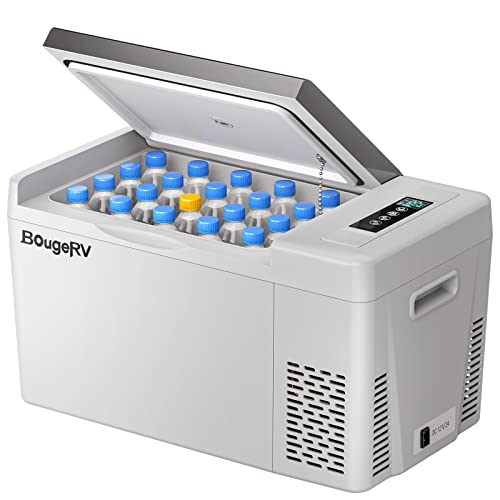
Cars generate warm loads like no other environment: groceries that sat in a hot parking lot, takeout, market hauls, the cooler itself baking in a parked cabin all day. The BougeRV 23 Quart is the roundup’s answer to warm starts — its listing states a cool-down to 32°F in 15 minutes, so the box reaches fridge temperature during the first leg of the drive instead of the last, and its -8°F stated floor is the deepest cold in this list.
BougeRV’s 23-quart unit competes on speed and depth of cold. The listing states a range from -8°F to 50°F — a lower floor than most of its class — and a 15-minute cool-down to 32°F, which is the feature you feel when the grocery run, the forgotten pre-chill or the late departure puts warm food into the box at the start of a drive. Inside the first quarter hour the box is already at fridge temperature instead of spending the first hour of the trip getting there. It runs on 12/24V DC and 110V AC, works as fridge or freezer, and is sized and priced for the camping and road-trip duty the listing names. For a single traveler or a couple, 23 quarts is the size that keeps giving: big enough to provision properly, small enough to live behind a seat.
Strengths
- Fast stated cool-down — 32°F in 15 minutes — for late starts and warm loads
- -8°F low end undercuts most rivals, giving real freezer headroom
- 23 quarts is the road-trip size: two people’s weekend, one person’s week
Trade-offs
- Single zone, so freezing and chilling share one setting
- Fast-cool modes on compressor boxes draw harder while they work
- Grey finish shows dust and campsite scuffs honestly
| Key specs (from the manufacturer’s listing) | |
|---|---|
| Capacity | 23 quart |
| Temperature range | -8°F to 50°F (per listing title) |
| Cool-down | To 32°F in 15 minutes (per listing title) |
| Power | 12/24V DC and 110V AC |
Twenty-three quarts is also the roundup’s sweet-spot size for couples: a weekend of provisions or a big weekly shop, in a box that still fits a trunk without negotiation. Dual power — 12/24V DC and 110V AC — gives it the home-and-hotel second life. Drivers whose cooler lives a stop-start life of errands and warm loads will feel this pick’s advantage weekly; drivers who always pre-chill and load cold will feel it less, and may prefer the C20’s balance or the 28-quart’s room.
Best for: Errand-heavy drivers and couples who load warm, forget to pre-chill, and want the fastest recovery and deepest freeze in a car-sized box. / Not suited for: Drivers who need two temperatures at once; this is a single-zone box.
Check the BougeRV 23 Quart on Amazon — check price on Amazon for the current figure, and confirm the included cords and dimensions on the listing before you order.

4. Alpicool 28 Quart 12 Volt Refrigerator
Badge: Best Mid-Size for Families
Family vehicles run a cooler harder than any other car: the weekly big shop, the tournament-day drinks and snacks, the holiday drive with a baby’s food and a week’s breakfasts. The 28-quart Alpicool is the roundup’s family answer — enough compressor space for all three duties, holding set temperatures in a hot parked car in a way no thermoelectric box on this page can, with 12/24V DC on the road and 110-240V AC at the destination.
This 28-quart Alpicool is the middle child of the range, and for many vehicles it is the right size: meaningfully more room than the compact 15- and 20-liter boxes, without the cargo commitment of the 40-liter-plus models. The listing describes a portable freezer and fridge in one, powered by 12/24V DC on the road and 110-240V AC on mains, and names trucks, RVs, campers and SUVs as its home turf. As a compressor unit it holds a set temperature rather than a relative one, which is what makes it a legitimate food-storage appliance rather than a drinks accessory. Buyers stepping up from a thermoelectric cooler will notice the difference on the first hot day: the temperature inside this box is the temperature you chose, not a compromise negotiated with the weather.
Strengths
- 28 quarts splits the difference between day-trip boxes and full expedition fridges
- Fridge-freezer compressor design holds real food-safe temperatures
- Aimed squarely at truck, RV, camper and SUV use, with the power inputs to match
Trade-offs
- Single zone, like most boxes at this size and tier
- Mid-size in every sense — keen campers may still outgrow it
- No integrated battery for parked runtime
| Key specs (from the manufacturer’s listing) | |
|---|---|
| Capacity | 28 quart |
| Power | 12/24V DC and 110-240V AC |
| Cooling type | Compressor fridge-freezer |
Its listing names trucks, RVs, campers and SUVs, and the family SUV or minivan is its natural habitat: resident in the cargo area, dry inside because there is no ice, and big enough that ‘will it fit?’ stops being the first question of every shop. Families graduating from a melting ice chest will recognize the upgrade immediately; families graduating from a smaller compressor box will recognize the room. Either way, this is the size where a car cooler becomes family infrastructure.
Best for: Families whose car does groceries, sports and holidays, and who want one compressor box sized for all of it. / Not suited for: Solo drivers and small cars; the capacity will be mostly air and the footprint mostly annoyance.
Check the Alpicool 28 Quart on Amazon — check price on Amazon for the current figure, and confirm the included cords and dimensions on the listing before you order.
5. TopAutoGear Portable Electric Cooler & Warmer (26.5 Quart)
Badge: Best Budget Thermoelectric
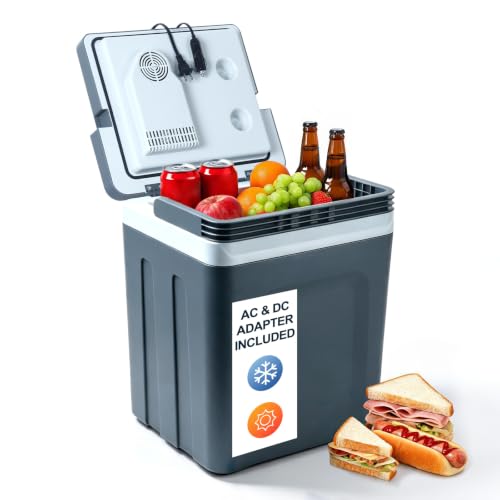
A roundup of car coolers that only listed compressor fridges would be lying about how many drivers actually use these products. The TopAutoGear represents the honest budget majority: 26.5 quarts of thermoelectric cooling and warming with a carry handle, running on 110V AC and 12V DC, built for travel and picnics. For drinks, fruit, sandwiches and day food in mild-to-warm weather, it does the job at a fraction of compressor cost and weight.
The TopAutoGear is built around a handle and a simple promise: pick it up, plug it in, and have cool drinks or warm food wherever the day ends. The listing describes a 26.5-quart thermoelectric cooler and warmer with both 110V AC and 12V DC power, aimed at travel and picnics. Like every thermoelectric pick in this guide, its cooling is relative to ambient temperature — it will not freeze, and it will not hold refrigerator temperatures in a hot parked car — but within its design brief it is hard to argue with: no ice, no meltwater, no compressor weight, and a warmer mode that earns its keep on the cold half of the year. Think of it as the electric successor to the family picnic cooler, and judge it by that standard.
Strengths
- Carry handle and picnic-first design make it the grab-and-go option
- Cooler and warmer modes in one simple box
- Dual AC and DC power, so it works at the park and back at home
Trade-offs
- Thermoelectric limits apply in full: relative cooling, no freezing
- Basic controls — no digital temperature setting to dial in
- At 26.5 quarts it is a drinks-and-food box, not expedition storage
| Key specs (from the manufacturer’s listing) | |
|---|---|
| Capacity | 26.5 quart |
| Function | Cooler and warmer |
| Power | 110V AC and 12V DC |
| Carry | Handle (per listing title) |
Its limits are stated here as plainly as its virtues: thermoelectric cooling is relative to the air around the box, so on the hottest days the interior is cool rather than cold, it cannot freeze, and raw perishables in a hot parked car are beyond its brief. Drivers who understand that — and whose cooler life is picnics, beach days, school runs and the drive home with warm takeout — get a simple, light, inexpensive box that never needs ice. The handle sounds trivial until you carry a loaded 26 quarts from car to picnic table; then it reads as the feature.
Best for: Budget-conscious drivers whose cooler duty is day trips, picnics and drinks in mild weather. / Not suited for: Anyone storing raw food in hot parked cars, or expecting freezer performance at any price of thermoelectric.
Check the TopAutoGear 26.5 Quart on Amazon — check price on Amazon for the current figure, and confirm the included cords and dimensions on the listing before you order.

6. Igloo IE24 Thermoelectric Cooler & Warmer
Badge: Best Cooler-Warmer
The IE24 closes the roundup with the most honest spec sheet in its class: Igloo states outright that it cools 36°F below the surrounding air and heats to 136°F. That transparency lets a car owner plan precisely — on an 80°F day, expect an interior in the mid-40s, right for drinks and day food; the warmer side, meanwhile, is hot enough to matter, turning the box into a genuine food warmer for winter pickups and cold commutes.
Igloo does something refreshing with the IE24: it prints the thermoelectric truth right in the title. This box cools 36°F below ambient and heats to 136°F. That single honest number lets you plan properly — on an 80°F day the interior sits in the mid-40s, fine for drinks and sandwiches; on a 100°F day it sits in the mid-60s, which is a drinks-only proposition. The warmer side is unusually capable, with a stated 136°F that keeps food genuinely hot. The listing aims it at trucks, RVs, cars and home, with AC/DC power to match, and Igloo’s long cooler-making history shows in a product that knows exactly what it is. Buy it as a powered picnic-and-cab box and it will not disappoint you; buy it expecting a refrigerator and it will.
Strengths
- Igloo states its cooling honestly: 36°F below the surrounding air
- Warmer mode reaches a stated 136°F — properly hot food, not lukewarm
- AC/DC power and a truck/RV/car/home brief from a legacy cooler brand
Trade-offs
- The 36°F-below-ambient figure means a 100°F cabin yields roughly 64°F inside — drinks, not food safety
- No freezer capability of any kind
- Thermoelectric fan noise is part of the package
| Key specs (from the manufacturer’s listing) | |
|---|---|
| Capacity | Holds 32 cans (per listing title) |
| Cooling | 36°F below ambient (per listing title) |
| Heating | To 136°F (per listing title) |
| Power | AC/DC |
With AC/DC power and a brief spanning truck, RV, car and home, it is the roundup’s all-season utility pick: summer drinks box, winter food warmer, hotel-room drinks fridge on its AC side. The thermoelectric ceiling applies in full — no freezing, no heat-wave food safety — but Igloo’s framing invites you to judge it as what it is, and what it is, is useful in more months of the year than any pure cooler here. Drivers who want one inexpensive box that earns its trunk space in January as well as July will find it here.
Best for: Drivers who want one budget box for both summer cooling and winter food-warming, with honestly stated limits. / Not suited for: Drivers needing guaranteed refrigerator temperatures in summer heat; that is compressor work, above.
Check the Igloo IE24 on Amazon — check price on Amazon for the current figure, and confirm the included cords and dimensions on the listing before you order.
Comparison Table
| Pick | Badge | Key spec | Best for |
|---|---|---|---|
| Alpicool C20 | Best Overall | 21 qt (20 L) compressor fridge-freezer, 12V/24V DC + 110V AC | The widest range of car owners: commuters, road-trippers and errand-runners who… |
| Alpicool C15 | Best Compact | 16 qt (15 L) compressor fridge-freezer, -4°F to 68°F, 12/24V DC + 100-240V AC | Compact-car owners and solo drivers who need guaranteed cold in the… |
| BougeRV 23 Quart | Best Fast Cooling | 23 qt compressor fridge/freezer, -8°F to 50°F, cools to 32°F in 15 min (per listing), 12/24V DC + 110V AC | Errand-heavy drivers and couples who load warm, forget to pre-chill, and… |
| Alpicool 28 Quart | Best Mid-Size for Families | 28 qt compressor fridge-freezer, 12/24V DC + 110-240V AC | Families whose car does groceries, sports and holidays, and who want… |
| TopAutoGear 26.5 Quart | Best Budget Thermoelectric | 26.5 qt thermoelectric cooler-warmer with handle, 110V AC + 12V DC | Budget-conscious drivers whose cooler duty is day trips, picnics and drinks… |
| Igloo IE24 | Best Cooler-Warmer | Thermoelectric, holds 32 cans, cools 36°F below ambient, heats to 136°F (per listing), AC/DC | Drivers who want one budget box for both summer cooling and… |
How to Choose Among 12 Volt Coolers for Cars
Decide the technology first, because it decides everything else. If your cooler must protect real food — groceries, medication, perishables — in a parked car or summer heat, only a compressor model holds a guaranteed temperature, and the four compressor picks above are your shortlist. If your cooler carries drinks, lunches and picnic food mostly while you drive in air conditioning, a thermoelectric box does that job for far less money and weight, and the two below the compressor picks are honest examples.
Then size to your car’s real space, not its brochure space. Footwells and behind-seat gaps take the compact class around 16 quarts; trunks and rear seats take the low-to-high 20s; family cargo areas take the family sizes — and every box also needs lid clearance and vent room, so measure with those included. Finally, weigh the second life: models that also run on household AC pre-chill at home, work in hotel rooms and serve during outages, which for many households is worth more than a few extra quarts.
Compressor vs Thermoelectric Car Coolers: An Honest Comparison
A compressor cooler is a refrigerator: it holds the temperature you set, down to freezing on the models that state sub-zero ranges, in any weather, cycling on and off to sip power once cold. It costs more, weighs more, and contains real refrigeration machinery. A thermoelectric cooler is a powered chill box: a Peltier element and a fan that cool a fixed amount below the surrounding air, warming mode included on most. It is light, simple and inexpensive — and on a 100°F day its interior may sit in the 60s, which is a drinks temperature, not a food temperature.
The ownership pattern in the real world is that drivers often end up with one of each: a compressor box as the car’s refrigerator, and an inexpensive thermoelectric for drinks overflow, picnics and winter food-warming. This roundup is built to serve either purchase — but buy them in the right order. The compressor box is the foundation; the thermoelectric is the accessory.
Will Running a Cooler Drain My Car’s Battery?
While driving, no — the alternator carries the load. Parked, it depends on the technology and the duration. Compressor fridges cycle and draw a modest average; with battery protection enabled — a feature to insist on — they cut themselves off before the battery approaches a no-start. Thermoelectric boxes draw continuously while they run and should be unplugged for any long parking. As working rules: an afternoon with a protected compressor fridge on a healthy battery is fine; an overnight or weekend is a plan, not an accident — unplug, or power the box separately.
Two habits protect you completely. Make unplugging part of your parking routine for any cooler without battery protection. And respect the combination that actually strands people: an old battery, a hot day, and a cooler left running ‘just for a few hours’ that became a day. Managed with ordinary care, a 12V cooler never strands anyone; the stranded stories all begin with a cooler treated as if it drew nothing at all.
The Upgrade Path: How Car Cooler Owners Actually Progress
Talk to enough owners and a pattern emerges — most drivers do not buy their final car cooler first. The typical path starts with a budget thermoelectric for drinks and day trips, which delights in mild weather and disappoints on the first hot trip with real food aboard. That disappointment teaches the technology lesson no review can teach as well, and the second purchase is a compact compressor box — often the C15 class — which then serves for years as the car’s true refrigerator.
The third purchase, when it comes, is not a replacement but a specialization: a bigger compressor box for the family vehicle, a dual-zone for the camping setup, or a second small box dedicated to a work vehicle. Owners describe the endpoint consistently — the coolers stop being products and become assigned infrastructure, each living in its vehicle with its job. This roundup is organized to let you enter that path at the right point: if you already know your loads are serious, skip the first step and buy the compressor box now; the ‘cheap first cooler’ is only cheap if it does not spoil a trip on its way to being replaced.
There is also a legitimate final answer at step one. Drivers whose cooler life is genuinely drinks, picnics and winter food-warming never need the compressor lesson, and the thermoelectric picks here will serve them for years. The path is only a trap for those who walk it with the wrong loads.
Car Cooler Care: Keeping Any of These Boxes Working for Years
The maintenance that decides whether a car cooler lasts two years or ten fits on an index card. After trips: empty it, wipe the interior with a damp cloth, dry it fully, and store it with the lid ajar — a closed damp box grows the smell that owners then blame on the product. Monthly in daily use: vacuum or brush the vents and fan areas, because a car supplies dust, pet hair and crumbs at industrial rates, and a compressor that cannot breathe runs hot and dies young.
Seasonally: inspect the power lead for chafing where it passes seats and doors, check the lid seal for compression and cracks, and run the box for an hour to confirm it still pulls down to temperature crisply. Thermoelectric owners add one check — the fan should spin freely and quietly; a grinding fan is the whole cooling system asking for help. None of this takes more than minutes, and it is the entire difference between the owners who review these products fondly at year five and those who review them bitterly at year two.
Storage has one more rule worth stating: keep the box somewhere temperate and dry, not in a trunk through a winter or a damp garage corner. Electronics and seals age fastest at the extremes, and the car cooler that lives indoors between adventures is the one still working when the adventure budget finally buys the big trip.
New to 12 Volt Coolers? Your First Month, Week by Week
Week one is learning the box. Run it at home on AC if it has it; learn its sounds, its control logic and how long a pull-down takes. Put it in the car empty and drive with it, so placement, cable routing and reach are solved before food depends on them. Week two is the first real duty — the grocery run, the lunch routine — with a thermometer inside, because this is the week you calibrate trust: you are learning what your box actually holds in your car’s actual heat, and the numbers will either confirm the purchase or tell you which habit to fix.
Week three is the first trip, and the first time the second life appears: the box in a hotel room, a rental, a relative’s kitchen. By week four the routine has set — pre-chill, load in order, plug in with the engine, unplug when parked — and the cooler has stopped being a product you own and become a feature your car has. Owners who quit these products almost always quit in week one, over friction that a single deliberate setup session would have solved.
That is the honest promise of this roundup: not that any box is magic, but that a month of small habits turns the right box into infrastructure. Choose by fit, technology and load — the three questions every section above returns to — and the first month will do the rest.
How to Get the Most From a 12 Volt Cooler in Your Car
Six coolers, one set of habits. These practices make any of them colder, thriftier and longer-lived.
- Pre-chill at home if your model runs on AC. A box that starts the drive already cold spends the trip maintaining temperature instead of fighting toward it — the cheapest performance upgrade in this entire guide.
- Load cold and load in order. Cold contents in, tonight’s needs on top, drinks where a hand can reach them without a full excavation at the rest stop.
- Place for shade and airflow. Out of direct sun where you can, vents always clear. A cooler buried under luggage works harder, cools worse and drinks more battery doing it.
- Plug in when the engine starts; unplug (or trust battery protection) when you park for long. Make it as automatic as the seatbelt and battery worries disappear from this category.
- Keep it full-ish. A reasonably full box holds temperature through openings and stops far better than a nearly empty one. Fill gaps with drinks or a towel rather than warm air.
- Clean and air it after trips. A wipe, a dry, and storage with the lid ajar keep every box in this roundup ready for the next run and free of the cooler smell everyone recognizes.
None of this is effortful — it is a week of practice that becomes the way you drive. The coolers reward it out of all proportion to the effort.
Common Buying Mistakes
Assuming all 12V coolers cool the same way. A thermoelectric box and a compressor fridge share a plug and nothing else. Buying the cheap technology for the demanding job is the category’s most expensive mistake.
Buying the biggest box the budget allows. In cars, unused capacity is a daily tax in space and weight. Buy the largest box that fits your space and your load — in that order.
Forgetting the vents in a packed car. Holiday packing buries coolers under everything. A starved cooler runs constantly and still disappoints; leave it breathing room even when the car is full.
Leaving a thermoelectric running in a parked car. Continuous draw plus relative cooling is the worst combination: a flat battery protecting lukewarm drinks. Unplug thermoelectrics when you park.
Never pre-chilling because ‘the car will cool it’. The car will — slowly, at maximum draw, in the hottest conditions. Ten minutes of home AC saves hours of vehicle work.
Final Recommendation
Start the shortlist with the Alpicool C20 — it is the cooler most car owners should buy, balancing guaranteed compressor cold, usable size and dual power. Fit the Alpicool C15 where space is tight, choose the BougeRV 23 Quart for fast recovery and the deepest freeze, and give family vehicles the Alpicool 28 Quart. Budget day-trippers are honestly served by the TopAutoGear 26.5 Quart, and all-season utility seekers by the Igloo IE24’s warming talent.
The wider cluster continues with Best 12 Volt Cooler For Car, Best 12 Volt Cooler, Best 12 Volt Cooler For Travel, Best 12 Volt Cooler For Camping and Best 110 12 Volt Cooler. Check price on Amazon for the pick that fits your space, measure before you order, and drive with cold drinks on purpose.
If you want the shortest path: start with the Alpicool C20, Alpicool C15, BougeRV 23 Quart — check price on Amazon for each, compare them against your space and your power plan, and you will land on the right box for your pattern of use.
Frequently Asked Questions
What is the best size 12V cooler for a car?
For most drivers, 20–23 quarts balances capacity against car space. Compact cars and solo drivers do well at 10–16 quarts; families should look at 28 quarts and up. The real answer is your measured space — footwell, trunk or cargo area — with room for the lid and vents.
Are thermoelectric car coolers worth it?
For drinks, lunches, picnics and winter food-warming at a budget tier, yes — provided you understand they cool relative to the surrounding air and cannot protect perishables in a hot parked car. For guaranteed cold, a compressor model is the purchase. Many drivers eventually own one of each.
Can a 12V cooler stay in the car all the time?
It can live in the car, but it should not stay powered all the time. Unplug it or rely on battery protection when parked for long periods, and in hot climates remember that a parked cabin’s heat is the hardest environment any cooler faces. Many owners bring compact models indoors between trips, where dual-power models double as a spare fridge.
Do car coolers work when the engine is off?
They run from the battery, so yes — with limits. Compressor models with battery protection are designed for parked running over stops and afternoons. Thermoelectric models draw continuously and warm relative to a heating cabin, so engine-off is their weakest mode. Long parked running of any cooler calls for a power plan.
How do I power a 12V cooler at home or in a hotel?
Models with AC input — most compressor picks in this roundup — plug straight into a wall outlet. DC-only models need an AC-to-DC adapter with a vehicle socket. At home this enables pre-chilling; in hotels, check that the room’s outlets stay live when the key card is removed.
Why does my car cooler get warm on hot days?
If it is thermoelectric, that is the technology’s ceiling: it cools a fixed amount below cabin temperature, and a hot cabin leaves a warm interior. If it is a compressor model, check the vents for blockage, the box for sun exposure, and your expectations after a large warm load. Shade, airflow and pre-chilling fix most cases.


