Disclosure: airfryerkitchensupply.com is reader-supported. When you buy through links on our site, we may earn an affiliate commission at no extra cost to you.
Where to buy
Every pick in this guide to the best 12 volt cooler for camping was verified against its manufacturer’s own Amazon listing before it earned a place here. The shortlist: Alpicool C20, BougeRV CRD2 V2 52QT, Dometic CFX2 37L, Alpicool C15, BougeRV 23 Quart, AooDen 26 Quart. For camping, buy the power story as much as the box: the compressor picks below were verified as dual-power (vehicle DC plus household AC) in their own listings unless noted, so you can pre-chill at home. The Alpicool C20 is the default recommendation, the BougeRV CRD2 V2 covers off-grid pitches with its built-in battery, and the AooDen 26 Quart serves mild-weather budgets. Check the current price on Amazon for each pick, and confirm the cords included in the box on the exact listing before ordering.
Introduction
Finding the best 12 volt cooler for camping starts with admitting what camping does to a cooler. It sits in a hot vehicle on the drive out, gets opened twenty times a day at the pitch, runs for hours or days with the engine off, and is expected to keep real food — not just drinks — safe in weather that can swing from cool dawn to a baking afternoon. That duty cycle is why the honest answer to this keyword is mostly a list of compressor refrigerators, with one budget thermoelectric included for the milder trips where it genuinely suffices.
The divide that matters is cooling technology. A compressor cooler is a true refrigerator: you set a temperature and it holds that temperature, down to freezing and below, almost regardless of the weather. A thermoelectric cooler only cools a fixed amount below the surrounding air, which is fine for drinks and day food in mild conditions and genuinely inadequate for raw food in a heat wave. Every pick below is labeled with its technology, and the thermoelectric entry carries its limits in plain language.
The second divide is power. All six picks run from a 12V vehicle supply; most also run on household AC, which lets you pre-chill at home — the single easiest way to cut power draw and food risk on a trip. One pick carries its own battery for engine-off hours. All product details below were verified against the manufacturers’ own Amazon listings, and prices are deliberately not printed — check price on Amazon for the current figure on any pick.
In this guide
Quick Picks
Best Overall — Alpicool C20 Portable Compressor Fridge Freezer (21 Quart): The all-rounder for tent and car camping: real compressor cold in a 20-liter box that pre-chills at home on AC and runs on DC at the pitch. Check the current price on Amazon.
Best for Off-Grid Camping — BougeRV CRD2 V2 52 Quart 12V Refrigerator with 240Wh Battery: The self-powered option: a built-in 240Wh battery, dual zones and wheels, so the cold survives engine-off hours and the walk from car to pitch. Check the current price on Amazon.
Best Premium — Dometic CFX2 37L Electric Cooler: The deep-freeze, deep-support option: a stated -7°F floor, 3-stage battery protection and app control from the category’s founding brand. Check the current price on Amazon.
Best Compact for Small Cars — Alpicool C15 Portable Car Freezer (16 Quart): True compressor refrigeration in a 16-quart box that fits the footwells and corners small cars actually have left over. Check the current price on Amazon.
Best Fast Cool-Down — BougeRV 12V Refrigerator 23 Quart Portable Freezer: The late-start specialist: a stated 15-minute cool-down to 32°F and a -8°F floor, for campers who load warm and leave late. Check the current price on Amazon.
Best Budget Thermoelectric — AooDen Electric Car Cooler and Warmer (26 Quart): The honest budget pick: 26 quarts of iceless cooling and warming for mild-weather camping, drinks and day trips — not a refrigerator substitute. Check the current price on Amazon.
How These Picks Were Chosen
These six picks were chosen by camping duty, not by spec-sheet bragging. First, cooling technology had to match the job: compressor models anchor the list because camping means multi-day food storage in uncontrolled temperatures, and the single thermoelectric pick is included only where its limits are survivable — drinks, day food and mild weather. Second, capacity was matched to real camping units: the solo camper, the couple, the family and the group each get a size that provisions them without wasted space.
Third, engine-off behavior was weighted heavily, because camping is mostly parked. Battery protection systems, a built-in battery option, and efficient hold-over once cold all counted. Fourth, every product had to be verifiable: each pick’s capacity, temperature range and power inputs were confirmed in its manufacturer’s Amazon listing, and any claim in this guide traces to that listing. Products that could not be verified, and any model subject to a safety recall, were excluded. Finally, the set was balanced across budget tiers — one honest budget option, a value core, and a premium tier — rather than six versions of the same box.
The 6 Best 12 Volt Cooler for Camping Picks, Reviewed in Detail

Top pick
1. Alpicool C20 Portable Compressor Fridge Freezer (21 Quart)
Badge: Best Overall
Start with the load a typical camping weekend actually involves: two days of food and drink for two people, packed once, opened often, in weather you do not control. That is the test the C20 passes most completely. It is big enough to provision properly — breakfast, two dinners, drinks and the condiments that make camp cooking worth doing — yet small enough to ride in a footwell or a packed cargo area without becoming the thing everything else packs around.
The C20 sits in the sweet spot of the 12-volt market: a genuine compressor fridge-freezer in a 20-liter body that most vehicles can carry without rearranging everything else. The listing confirms both halves of its job title — it works as a fridge and as a freezer — and it runs from 12V/24V DC in the vehicle and 110V AC at home, at a campsite with hookups, or in a hotel room. That dual-power design matters more than it sounds. A cooler that only runs in the car stops being useful the moment you park for two days; the C20 simply moves indoors and keeps working. For buyers cross-shopping thermoelectric boxes, the difference to understand is that a compressor unit like this one cools to a set point and holds it, while a thermoelectric unit only cools relative to the air around it.
Strengths
- Compressor cooling at a 20-liter size that still fits most rear seats and cargo areas
- Dual DC and AC power covers the drive and the destination with no adapter hunt
- Big enough for a weekend of food for two without swallowing the whole trunk
Trade-offs
- Single temperature zone, so frozen items and fresh food share one setting
- 20 liters is a weekend box, not a week-long family solution
- No built-in battery, so engine-off runtime depends on your vehicle or a power station
| Key specs (from the manufacturer’s listing) | |
|---|---|
| Capacity | 21 quart (20 liter) |
| Power | 12V/24V DC and 110V AC |
| Cooling type | Compressor fridge-freezer |
For camping specifically, the dual power story is the deciding detail. Pre-chill the box at home on its 110V AC input the night before, load it cold, and the compressor spends the drive maintaining temperature instead of fighting a warm box — which is when 12V fridges draw hardest and when a marginal vehicle battery feels it. At a hookup pitch it goes back on AC; at a wild pitch it sips DC once cold. Campers upgrading from an ice chest will feel the second benefit daily: no meltwater, so the cheese, the salad and the cardboard-packaged food survive day two in the condition you packed them.
Best for: Campers who want one box that handles two-person weekends in any weather, and who value the home pre-chill as much as the road performance. / Not suited for: Groups of four or more cooking from one box, or anyone camping for a week without a resupply run — step up to a 40-quart-plus model.
Check the Alpicool C20 on Amazon — check price on Amazon for the current figure, and confirm the included cords and dimensions on the listing before you order.

2. BougeRV CRD2 V2 52 Quart 12V Refrigerator with 240Wh Battery
Badge: Best for Off-Grid Camping
Most camping fridges have an unspoken condition attached: they work while the vehicle works. The CRD2 V2 removes that condition with its built-in 240Wh LiFePO4 battery, which keeps the compressor running through the parked hours — the afternoon at the lake, the night at a no-hookup pitch, the long lunch stop — without drawing a single watt from your starter battery. For campers, that is the difference between a fridge and a worry.
The CRD2 V2 attacks the two oldest complaints about 12-volt fridges at once. First: what happens when the engine stops? Its built-in 240Wh LiFePO4 battery keeps the compressor running through stops, overnight parking and campsite hours without touching the starter battery. Second: how do you move a loaded 52-quart box? With the wheels and telescopic handle the listing specifies — the same rolling logic as the cooler it replaces. Between those answers sits a dual-zone interior with independent temperature control across a stated -4°F to 68°F span, so frozen and fresh food stop negotiating. BougeRV names outdoor camping and RV use, and that is exactly where a self-powered rolling fridge earns its keep: from the vehicle to the pitch, cold the whole way, with no ice run in between.
Strengths
- Built-in 240Wh battery keeps food cold with the engine off and no power station
- Dual zone with independent control — freezer and fridge in one rolling box
- Wheels and a telescopic handle make 52 quarts genuinely movable when loaded
Trade-offs
- Battery and dual-zone hardware make it one of the heavier, pricier options
- 240Wh is hours of parked runtime, not days — multi-day off-grid still needs charging input
- Rolling design suits campsites and tailgates better than tight vehicle footwells
| Key specs (from the manufacturer’s listing) | |
|---|---|
| Capacity | 52 quart, dual zone |
| Temperature range | -4°F to 68°F (per listing title) |
| Battery | Built-in 240Wh LiFePO4 |
| Control | Independent temperature control per zone |
| Mobility | Wheels and telescopic handle |
The camping case gets stronger from there. The dual-zone interior means frozen burgers and ice cream on one side, fresh food and drinks on the other, each at its own temperature — the full campsite kitchen in one box. And when the pitch is a hundred meters from the parking spot, the wheels and telescoping handle turn a loaded 52-quart carry, which nobody enjoys, into a roll. Pair it with sunshine hours and a folding solar panel or recharge it on driving days, and multi-day off-grid camping stops revolving around ice availability — because there is no ice.
Best for: Off-grid and no-hookup campers who park for long stretches and want freezer-plus-fridge capacity that keeps working with the engine off. / Not suited for: Backpackers and minimalist car campers — this is a drive-to basecamp appliance, not a carry-in one.
Check the BougeRV CRD2 V2 52QT on Amazon — check price on Amazon for the current figure, and confirm the included cords and dimensions on the listing before you order.

3. Dometic CFX2 37L Electric Cooler
Badge: Best Premium
Some campers buy a fridge; others buy into a system. The CFX2 37L is for the second group. Its stated freeze floor of -7°F is the deepest in this guide, which matters for the camping loads that punish lesser boxes: ice cream that should stay scoopable-hard, frozen bait, and meat that must stay properly frozen on day four of a hot trip, not merely cold. The 48-can stated capacity covers a couple’s long weekend or a small family’s short one.
The CFX2 37L is the step up that most serious buyers end up considering: 37 liters and a stated 48-can capacity, the same -7°F freeze floor as its smaller sibling, 3-stage battery protection and app control. Dometic’s proposition is not a longer spec sheet — it is depth: decades of mobile refrigeration, a support and parts network that value brands do not match, and battery protection tuned by a company whose customers run fridges in vehicles for a living. The 3-stage protection deserves emphasis, because it lets you choose how aggressively the fridge defends your starter battery, which is the setting that decides whether a parked fridge is a convenience or a risk. The listing states 12/24V power; check the listing for the AC solution if you plan to run it at home as well.
Strengths
- 48-can capacity with a stated -7°F freeze floor — the premium all-rounder
- 3-stage battery protection for confident engine-off running
- App control plus Dometic’s support network and accessory ecosystem
- 37 liters is the size most couples and small families actually need
Trade-offs
- Costs a premium over value brands with similar stated ranges
- Listing states 12/24V — verify the home-power arrangement if AC running matters
- Single zone at a size where some rivals offer two
| Key specs (from the manufacturer’s listing) | |
|---|---|
| Capacity | 37 liter — holds 48 cans (per listing title) |
| Low temperature | Freezes to -7°F (per listing title) |
| Battery care | 3-stage battery protection |
| Control | App control |
| Power | 12/24V |
Two camping-specific details stand out. The 3-stage battery protection lets you decide how defensively the fridge guards your starter battery — set it conservatively for a single-battery vehicle at a remote trailhead, less so if you run a dual-battery setup. And app control means the 2 a.m. temperature check happens from the sleeping bag, not by unzipping the tent and opening the lid, dumping the cold you paid to make. The listing states 12/24V power, so confirm the home-charging arrangement on the listing if you want to pre-chill indoors.
Best for: Serious campers who run one vehicle battery, camp far from help, and want the deepest freeze and the strongest support network in the category. / Not suited for: Occasional weekend campers, for whom a value compressor box delivers the same cold at a friendlier tier.
Check the Dometic CFX2 37L on Amazon — check price on Amazon for the current figure, and confirm the included cords and dimensions on the listing before you order.

4. Alpicool C15 Portable Car Freezer (16 Quart)
Badge: Best Compact for Small Cars
Small-car camping has a packing geometry problem: after the tent, bags and pads, the remaining space is footwells and odd corners, not a cargo bay. The C15 is shaped by that reality. Sixteen quarts of genuine compressor refrigeration — with a stated range down to -4°F — in a box that can live behind a front seat, which also puts drinks and snacks within reach of the passengers instead of buried in the trunk.
The C15 is the smallest member of Alpicool’s compressor family, and that smallness is the entire point. A 15-liter box disappears into the places a 40- or 50-quart fridge simply cannot: the rear footwell of a sedan, the gap behind a truck’s front seats, the corner of a campervan floor that is left over after the bed and the storage boxes take their share. Because it is a real compressor refrigerator rather than a thermoelectric box, it holds the temperature you set — the listing states a range from -4°F to 68°F — whether the cabin is cool in the morning or baking by mid-afternoon. It also runs on 100-240V AC as well as 12/24V DC, which means you can chill it down on the kitchen counter the night before and carry it out to the vehicle already cold, so the compressor is maintaining temperature on the road instead of fighting to pull a warm box down from room temperature.
Strengths
- True compressor cooling that holds a set temperature instead of chasing the weather outside the vehicle
- Compact 16-quart footprint that fits behind a seat or in a footwell where bigger fridges cannot go
- Runs on both vehicle DC and household AC, so it can pre-chill at home before a trip
Trade-offs
- 16 quarts fills up fast once drinks for more than two people go in
- Single zone, so fridge and freezer items share one temperature compromise
- Too small to serve as the only cold storage for a long group trip
| Key specs (from the manufacturer’s listing) | |
|---|---|
| Capacity | 16 quart (15 liter) |
| Temperature range | -4°F to 68°F (per listing title) |
| Power | 12/24V DC and 100-240V AC |
| Cooling type | Compressor |
For camping, the honest framing is that this is a one-to-two-person box. It holds a weekend’s fresh food for a solo camper or a couple who eat simply, keeps medication reliably cold, and freezes a couple of ice packs to rotate into a day pack. It will not cater a group, and it is not pretending to. Its AC input means it pre-chills at home like its bigger siblings, and once cold its small interior volume is quick for the compressor to hold, which is kind to a small car’s battery on parked stops. Pair it with a simple dry-goods box and a small passive cooler for drinks overflow and a small car camps surprisingly well.
Best for: Solo campers, couples in compact cars, and anyone whose vehicle space — not budget — is the binding constraint. / Not suited for: Families and group campers; you will out-pack 16 quarts before you leave the driveway.
Check the Alpicool C15 on Amazon — check price on Amazon for the current figure, and confirm the included cords and dimensions on the listing before you order.
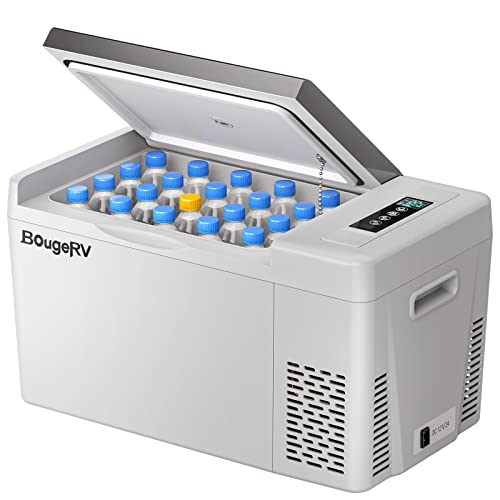
5. BougeRV 12V Refrigerator 23 Quart Portable Freezer
Badge: Best Fast Cool-Down
Every camper knows the trip that starts wrong: the shopping done on the way, the box loaded warm at noon, the drive beginning in full heat. The BougeRV 23 Quart is built for that trip. Its listing states a cool-down to 32°F in 15 minutes, which means the food enters a fridge-temperature box during the first leg of the drive instead of slowly approaching safety over hours, and its -8°F floor is the deepest stated low in this roundup alongside the premium Dometic.
BougeRV’s 23-quart unit competes on speed and depth of cold. The listing states a range from -8°F to 50°F — a lower floor than most of its class — and a 15-minute cool-down to 32°F, which is the feature you feel when the grocery run, the forgotten pre-chill or the late departure puts warm food into the box at the start of a drive. Inside the first quarter hour the box is already at fridge temperature instead of spending the first hour of the trip getting there. It runs on 12/24V DC and 110V AC, works as fridge or freezer, and is sized and priced for the camping and road-trip duty the listing names. For a single traveler or a couple, 23 quarts is the size that keeps giving: big enough to provision properly, small enough to live behind a seat.
Strengths
- Fast stated cool-down — 32°F in 15 minutes — for late starts and warm loads
- -8°F low end undercuts most rivals, giving real freezer headroom
- 23 quarts is the road-trip size: two people’s weekend, one person’s week
Trade-offs
- Single zone, so freezing and chilling share one setting
- Fast-cool modes on compressor boxes draw harder while they work
- Grey finish shows dust and campsite scuffs honestly
| Key specs (from the manufacturer’s listing) | |
|---|---|
| Capacity | 23 quart |
| Temperature range | -8°F to 50°F (per listing title) |
| Cool-down | To 32°F in 15 minutes (per listing title) |
| Power | 12/24V DC and 110V AC |
That speed also forgives the most common camping mistake — skipping the pre-chill. Ideally you still cool the box at home on its AC input, but when life intervenes, a fast pull-down limits the time food spends in the temperature zone where quality and safety drain away. Twenty-three quarts provisions two campers for a weekend or one camper for most of a week, and the fridge-or-freezer flexibility means the same box can be the drinks fridge on one trip and the ice-cream freezer on the next. For disorganized campers — a larger tribe than admits it — this is the forgiving choice.
Best for: Campers who load late, shop on the way, or forget to pre-chill, and anyone who wants freezer depth without premium pricing. / Not suited for: Campers who need two temperatures at once; a single zone means frozen and fresh share one setting.
Check the BougeRV 23 Quart on Amazon — check price on Amazon for the current figure, and confirm the included cords and dimensions on the listing before you order.

6. AooDen Electric Car Cooler and Warmer (26 Quart)
Badge: Best Budget Thermoelectric
Not every camping trip needs a refrigerator. For a mild-weather weekend, a festival, or a day-trip basecamp, the AooDen’s thermoelectric proposition is enough: 26 quarts that keep drinks cold and food fresh without ice, then flip to warming mode for the drive home with takeout. It runs on 12V DC at the pitch-side vehicle and 120V AC at home, so it can pre-cool indoors before you leave.
The AooDen is the honest thermoelectric proposition: 26 quarts, no ice, a cooler in summer and a warmer in winter, powered by 12V DC in the vehicle and 120V AC at home. What it will not do — and no thermoelectric box will — is guarantee a temperature. Its cooling is measured against the air around it, so on a mild day drinks get properly cold, while in a heat-wave cabin it keeps things cooler than they would otherwise be rather than fridge-cold. Used with that understanding, it is a genuinely useful travel box: picnic loads, road-trip drinks, keeping takeout warm on the drive home, a hotel-room drinks fridge. The black and orange finish also makes it easy to spot in a loaded cargo area, a small mercy at a dark campsite.
Strengths
- Cools and warms — one box for summer drinks and winter takeout runs
- Both 12V DC and 120V AC power included in its design, car to home with no extras
- 26 quarts of simple, light, no-fuss storage with no compressor to baby
Trade-offs
- Thermoelectric cooling is relative to ambient air — it cannot freeze and struggles in extreme heat
- Not a food-safety appliance for raw meat and dairy on hot days
- Fan runs whenever it is working, so it is not silent
| Key specs (from the manufacturer’s listing) | |
|---|---|
| Capacity | 26 quart |
| Function | Cooler and warmer |
| Power | 12V DC and 120V AC |
| Cooling type | Thermoelectric (iceless) |
The limit must be stated plainly, because it decides whether this pick delights or disappoints: thermoelectric cooling is relative to the air around the box. In a heat wave, the interior will be cooler than the tent — not fridge-cold — and raw meat and dairy should not be trusted to it in those conditions. Camp with that understanding and it is a cheerful, simple, light box: no compressor to protect, no ice to buy, no meltwater in the sandwiches. Many campers run exactly this hybrid: a thermoelectric for drinks and day food, with perishables kept in a small compressor box or eaten on day one.
Best for: Mild-weather campers, festival-goers and day-trippers whose load is drinks, snacks and sturdy food rather than raw ingredients in summer heat. / Not suited for: Hot-climate campers and anyone whose food safety depends on guaranteed refrigerator temperatures — buy a compressor box instead.
Check the AooDen 26 Quart on Amazon — check price on Amazon for the current figure, and confirm the included cords and dimensions on the listing before you order.
Comparison Table
| Pick | Badge | Key spec | Best for |
|---|---|---|---|
| Alpicool C20 | Best Overall | 21 qt (20 L) compressor fridge-freezer, 12V/24V DC + 110V AC | Campers who want one box that handles two-person weekends in any… |
| BougeRV CRD2 V2 52QT | Best for Off-Grid Camping | 52 qt dual zone, -4°F to 68°F, built-in 240Wh LiFePO4 battery, wheels + telescopic handle | Off-grid and no-hookup campers who park for long stretches and want… |
| Dometic CFX2 37L | Best Premium | 37 L compressor cooler, holds 48 cans, freezes to -7°F, 3-stage battery protection, app control, 12/24V | Serious campers who run one vehicle battery, camp far from help,… |
| Alpicool C15 | Best Compact for Small Cars | 16 qt (15 L) compressor fridge-freezer, -4°F to 68°F, 12/24V DC + 100-240V AC | Solo campers, couples in compact cars, and anyone whose vehicle space… |
| BougeRV 23 Quart | Best Fast Cool-Down | 23 qt compressor fridge/freezer, -8°F to 50°F, cools to 32°F in 15 min (per listing), 12/24V DC + 110V AC | Campers who load late, shop on the way, or forget to… |
| AooDen 26 Quart | Best Budget Thermoelectric | 26 qt thermoelectric cooler-warmer, 12V DC + 120V AC | Mild-weather campers, festival-goers and day-trippers whose load is drinks, snacks and… |
How to Choose a 12 Volt Cooler for Camping
Start with the longest, hottest trip you realistically take, and choose for that trip — not for the average one. If any trip on your calendar involves raw meat, dairy or medication spending two or more days in summer heat, you need a compressor cooler, full stop. Thermoelectric boxes are fair-weather tools: their cooling is measured down from the surrounding air, so the hotter the campsite, the warmer your food. Compressor boxes hold a set temperature, which is the entire basis of food safety on a multi-day trip.
Next, size by people and days. As a working rule, a solo camper provisions well in 15–23 quarts, a couple in 20–37 quarts, and a family or group in 43 quarts and up — assuming drinks share space with food. If your group drinks a lot of canned beverages, either size up or run a cheap second box for drinks, because drink volume is what silently eats a camping fridge. Dual-zone models earn their complexity when you genuinely need frozen and fresh at once — ice cream, frozen meat, ice packs — across several days.
Finally, plan the parked hours before you buy. A compressor fridge draws power whenever it runs, and at a no-hookup pitch that power comes from your vehicle battery, a power station, solar, or a built-in battery like the BougeRV CRD2’s. Boxes with battery-protection systems let you set how defensively they guard the starter battery. Decide your parked-power answer first; the right cooler is the one that fits it.
Compressor vs Thermoelectric: Which Cooling Technology Suits Camping?
A compressor cooler works like your kitchen fridge, scaled down: a refrigerant cycle that moves heat out of the box regardless of the weather. Set 38°F and it holds 38°F in a cool dawn or a 100°F afternoon; set it below zero and it freezes. That certainty is what you are paying for, and for multi-day food storage it is not a luxury. Compressor boxes also sip power once cold, cycling on and off, rather than drawing constantly.
A thermoelectric cooler uses a Peltier element: simple, light, cheap and quiet-ish, with one moving part — a fan. Its cooling is relative, typically a fixed drop below ambient air. In mild weather that drop lands drinks at a pleasant temperature. In serious heat it lands food in the zone where bacteria thrive. Thermoelectrics also draw power continuously while they run. The fair summary: thermoelectric for drinks, day trips and mild weekends; compressor for food, heat and duration. Most experienced campers who start thermoelectric end up owning a compressor box too, and running drinks in the old box — which is exactly the AooDen’s role in this guide.
How Much Power Does a Camping Fridge Use, and How Do You Run One Parked?
A 12V compressor fridge typically cycles: drawing a moderate load while the compressor runs, then nothing while it rests. Total daily consumption depends on ambient heat, how often the lid opens, and the temperature you set — a freezer setting in a hot vehicle uses several times the energy of a fridge setting in mild weather. Pre-chilling at home on AC, loading cold food, and parking in shade all cut consumption more than any spec-sheet number does.
Parked, you have four power answers. One: run from the starter battery with the fridge’s battery-protection set conservatively, and drive most days — fine for overnight stops. Two: a portable power station, sized to your trip length, which keeps the vehicle electrically uninvolved. Three: solar charging into either of the above on longer stays. Four: a fridge with its own built-in battery, like the CRD2 V2 in this guide, which covers stops and nights and recharges while you drive. The mistake to avoid is arithmetic-free optimism: know your battery’s usable capacity, and never let a fridge be the reason a remote morning starts with a jump pack.
What Size Cooler Do You Need for a Camping Trip? A Packing Walkthrough
Abstract quart figures become real the moment you pack one, so here is a 21-quart box — the C20’s size — loaded for a couple’s two-night trip. Bottom layer: two frozen portions of stew and a pack of sausages, frozen flat. Middle: cheese, eggs in their carton, butter, a small milk, salad vegetables in a sealed container. Top: six drinks, condiments, and tonight’s fresh bread rolls riding where the first opening finds them. It fits — with discipline. Add a third night or a third person and you are negotiating; that negotiation is exactly what the 37- and 43-quart picks exist to end.
Now load the same trip into 16 quarts — the C15’s world. The frozen layer shrinks to one portion, drinks drop to four and ride outside the box after day one, and the menu leans on shelf-stable lunches. It works beautifully for a solo camper, adequately for a minimalist couple, and not at all for a family — which is why this guide treats size as a matching exercise rather than a virtue. The campers who love their cooler chose it against a written menu for their longest trip, not against a photograph of an empty box.
At the other end, a 47- to 52-quart box changes the packing question from ‘what fits’ to ‘what is the menu’. Whole melons, a second milk, the big salad bowl, frozen desserts, and drinks for the group all fit at once — and the new discipline becomes weight and cold management rather than space: keep it full, keep it shaded, and let wheels or a second pair of hands handle the move from vehicle to pitch.
How Long Does Food Stay Safe in a 12 Volt Cooler While Camping?
In a compressor cooler holding 40°F or below, camping food follows the same clock as food in your home fridge: cooked leftovers are a three-to-four-day proposition, raw meats one to two days unless frozen, and anything that has spent more than about two cumulative hours above 40°F — one hour in serious heat — should be discarded rather than debated. A fridge thermometer inside the box converts these rules from anxiety into arithmetic, and it costs almost nothing.
Frozen changes the clock entirely. Food held at 0°F or below in a compressor freezer or freezer zone stays safe indefinitely in the safety sense, with quality measured in weeks to months. This is the practical reason dual-zone and deep-freeze picks appear throughout this guide: they let a trip’s back half eat as safely as its front half, instead of racing a thaw.
The thermoelectric exception must be repeated here because it is the dangerous one: in hot weather a thermoelectric box may never reach 40°F at all, which means the home-fridge clock never starts. Treat its contents as picnic food — eaten the same day, chosen sturdily — and the technology is a pleasure. Treat them as refrigerated storage and the same box becomes the trip’s worst decision.
How to Set Up and Run a 12 Volt Cooler at a Campsite
A 12V camping fridge rewards a small amount of ritual. Follow these steps and the box will hold temperature on a fraction of the power, with food that comes home as safe as it left.
- Pre-chill at home. Plug the cooler into a wall outlet the night before (or use its fastest cooling mode in the vehicle) and load food that is already cold or frozen. A fridge that starts cold mostly maintains; a fridge that starts warm works hard for hours.
- Pack in eating order, frozen at the bottom. Put the last day’s food deepest and the first evening’s food on top, so each opening is short and shallow. Fill gaps with drinks or a towel — a full box holds temperature better than a half-empty one full of warm air.
- Position for airflow at the pitch. Keep the cooler’s vents unobstructed, out of direct sun, and off hot ground where possible. A windshield shade, a light-colored cover or simple shade from the vehicle itself can cut the compressor’s workload noticeably.
- Set the temperature deliberately. Around 37–40°F suits mixed fresh food; a freezer zone or box should sit at 0°F or below for multi-day frozen storage. Resist ultra-cold settings for fresh food — they waste power and freeze the salad.
- Connect parked power with protection on. If you run from the vehicle, enable the battery-protection feature and choose a conservative level for a single-battery vehicle. If you run from a power station or built-in battery, check its state at dusk and dawn until you know your consumption rhythm.
- Open like you mean it. Decide what you need before lifting the lid, take it out in one motion, and close the lid fully. Most cold loss at a campsite is behavioral, not mechanical.
- Clean and dry before storage. Empty the box at home, wipe it out, and store it with the lid ajar so seals and interior stay fresh for the next trip.
Do this twice and it becomes habit: the pre-chill, the shaded spot, the protected battery. Those three habits are worth more than any single feature on a spec sheet.
Common Buying Mistakes
Buying thermoelectric for a compressor job. The classic camping cooler mistake. A thermoelectric box on a hot multi-day trip cannot hold food-safe temperatures, and the savings evaporate with the first load of spoiled food. Match the technology to the hottest trip you take.
Sizing for the average trip instead of the big one. A box that is perfect for solo weekends and useless for the family trip gets replaced, not supplemented. If group trips are on your calendar, size for them or plan a deliberate two-box system.
Loading a warm box with warm food at noon. You are asking the compressor to do its hardest work in the hottest conditions on vehicle power. Pre-chill the box and the food at home on wall power whenever you can.
Ignoring the parked-power question until the first dead battery. Fridges run while you sleep. Decide before the trip — battery protection settings, a power station, solar, or a self-powered fridge — how the parked hours are powered.
Blocking the vents with camping gear. A compressor cooler buried under sleeping bags in a packed car cannot shed heat, so it runs constantly, draws more, and cools worse. Leave the vents breathing room on the drive and at the pitch.
Final Recommendation
For most campers, the Alpicool C20 is the recommendation: genuine compressor cold, a couple-sized 20 liters, and dual power that pre-chills at home and runs anywhere. Camp off-grid and park for long stretches, and the BougeRV CRD2 V2 earns its premium with a built-in battery, dual zones and wheels. Small cars point to the Alpicool C15; deep-freeze confidence and brand support point to the Dometic CFX2 37L; late starters should look at the fast-cooling BougeRV 23 Quart; and mild-weather, drinks-first campers can honestly save with the AooDen 26 Quart, limits understood.
Round out your camp kitchen research with our related guides: Best 12 Volt Cooler, Best 12 Volt Cooler For Car Camping, Best 12 Volt Cooler Freezer, Best 12 Volt Cool Box and Best 12 Volt Cooler For Travel. Whichever pick you choose, check price on Amazon, pre-chill before you leave, and let the ice age end.
If you want the shortest path: start with the Alpicool C20, BougeRV CRD2 V2 52QT, Dometic CFX2 37L — check price on Amazon for each, compare them against your space and your power plan, and you will land on the right box for your pattern of use.
Frequently Asked Questions
Can a 12 volt cooler really replace an ice chest for camping?
A compressor model can, and improves on it: no ice runs, no meltwater, and a set temperature that holds for days. A thermoelectric model replaces an ice chest only for drinks and mild-weather day food — its cooling is relative to the air temperature, so it cannot guarantee food-safe cold in heat.
How long will a 12V camping fridge run on my car battery?
It depends on the fridge’s draw, your battery’s size and health, the weather and the temperature you set. With battery protection enabled and a healthy battery, an efficient compressor fridge at fridge temperatures typically handles overnight stops comfortably, but multi-day parked running calls for a power station, solar input or a fridge with its own battery. Never disable battery protection on a single-battery vehicle.
What temperature should I set for camping food?
Around 37–40°F for mixed fresh food, matching your home fridge. Frozen food keeps best at 0°F or below. Avoid setting a fresh-food box colder than needed: it wastes power and can freeze produce and eggs.
Is a dual-zone cooler worth it for camping?
If your trips involve both frozen and fresh food for several days — frozen meat plus produce and dairy, or ice cream as a campsite institution — yes. If you mostly chill drinks and fresh food, a single zone is simpler, cheaper and gives you more usable space at the same footprint.
Can I run a 12V cooler from a portable power station or solar?
Yes — most campers who stay parked for days do exactly that. Match the power station’s capacity to your fridge’s daily consumption with margin for hot weather, and size solar to refill what a day and night use. A fridge with a built-in battery, like the BougeRV CRD2 V2, builds this answer into the box itself.
Why does my cooler work worse on hot trips?
Every cooler fights the gap between inside and outside temperatures. Heat leaks in faster, the compressor runs longer, and thermoelectric models — which cool a fixed amount below ambient — may not reach food-safe temperatures at all. Shade, pre-chilling, short lid openings and a full box all help; for hot climates, a compressor model is the real fix.


