Disclosure: airfryerkitchensupply.com is reader-supported. When you buy through links on our site, we may earn an affiliate commission at no extra cost to you.
Where to buy
Every pick in this guide to the best 12 volt cooler for car was verified against its manufacturer’s own Amazon listing before it earned a place here. The shortlist: Alpicool C15, BougeRV 23 Quart, Alpicool 10 Quart, Alpicool 28 Quart, Koolatron 18 Quart, Wagan EL6214. All six picks were verified in their manufacturers’ Amazon listings; the compressor models also run on household AC for pre-chilling at home, as their listings state. The Alpicool C15 is the default car recommendation, the BougeRV 23 Quart is the faster, larger step-up, and the Wagan EL6214 covers the personal-box budget. Check the current price on Amazon for each, and measure your footwell or trunk space against the listing dimensions before ordering — in a car, fit is the first feature.
Introduction
Choosing the best 12 volt cooler for car use is mostly a question of fit — not features. A car offers a cooler a footwell, the space behind the front seats, or a section of trunk, and it offers power only while the engine runs or the battery lasts. The picks below were chosen for that reality: compact compressor refrigerators that hold a true set temperature in the spaces cars actually have, plus two thermoelectric boxes for the lighter daily duties where their simpler, cheaper cooling is honestly enough.
The technology divide matters in a car for a specific reason: parked cars get hot. A compressor cooler holds its set temperature whether the cabin is mild or baking, which is what you want for medication, groceries and real food. A thermoelectric cooler only cools relative to the cabin air — pleasant for drinks on a drive, unreliable for perishables in a parked car in July. Each pick below is labeled, and the thermoelectric entries say exactly where their limits fall.
Every product here was verified against its manufacturer’s Amazon listing, with capacities and power inputs taken from those listings. Prices are not printed, because they move — check price on Amazon for the current figure on any pick that fits your car and your routine.
In this guide
Quick Picks
Best Overall — Alpicool C15 Portable Car Freezer (16 Quart): The car-first compressor pick: 16 quarts of true refrigeration that fits a footwell or behind a seat and pre-chills at home on AC. Check the current price on Amazon.
Best Compressor for Cars — BougeRV 12V Refrigerator 23 Quart Portable Freezer: The step-up car fridge: 23 quarts, the deepest stated freeze here, and a 15-minute cool-down for warm grocery loads. Check the current price on Amazon.
Best for Small Spaces — Alpicool 10 Quart Portable Car Fridge: The smallest true fridge here: 9 liters of compressor cold, down to a stated -4°F, for cabs, consoles and tight trunks. Check the current price on Amazon.
Best for Family Cars — Alpicool 28 Quart 12 Volt Refrigerator: The family-size car pick: 28 quarts of compressor fridge-freezer space for the school-run-to-weekend family vehicle. Check the current price on Amazon.
Best Thermoelectric for Cars — Koolatron 12V Iceless Cooler & Warmer (18 Quart): The simple car companion: 18 quarts of hard-sided iceless cooling and warming from a 12V specialist brand. Check the current price on Amazon.
Best Personal Cooler — Wagan EL6214 Personal Thermoelectric Cooler/Warmer (14 Liter): The personal pick: 14 liters of UL Listed thermoelectric cooling and warming that lives beside one driver. Check the current price on Amazon.
How These Picks Were Chosen
These picks were chosen for car-shaped lives. The first filter was physical: every model had to fit and function in the spaces a car offers, from a footwell to a family SUV’s cargo area, and the set spans that range deliberately — personal 14-liter and 9-liter boxes at one end, a 28-quart family box at the other. The second filter was cooling honesty: compressor models anchor the guide because cars get hot when parked, and the two thermoelectric picks are included only for in-motion, air-conditioned duty, with their limits stated rather than hidden.
The third filter was verification. Each product’s capacity, temperature behavior and power inputs were confirmed in its manufacturer’s own Amazon listing; claims in this guide trace to those listings, and nothing here relies on a render or a rumor. Models that could not be verified were left out, as was any product subject to a safety recall. The result is a set balanced across the ways cars are actually used: commuting, errands, family duty, road trips and solo work driving.
The 6 Best 12 Volt Cooler for Car Picks, Reviewed in Detail

Top pick
1. Alpicool C15 Portable Car Freezer (16 Quart)
Badge: Best Overall
Car use imposes a shape test before any other: the cooler must fit the spaces a car actually offers — a rear footwell, the gap behind the front seats, a corner of the trunk — and stay reachable without unloading the vehicle. The C15 passes that test better than anything else here. Sixteen quarts of genuine compressor refrigeration, with a stated range from -4°F to 68°F, in the smallest serious box in this guide.
The C15 is the smallest member of Alpicool’s compressor family, and that smallness is the entire point. A 15-liter box disappears into the places a 40- or 50-quart fridge simply cannot: the rear footwell of a sedan, the gap behind a truck’s front seats, the corner of a campervan floor that is left over after the bed and the storage boxes take their share. Because it is a real compressor refrigerator rather than a thermoelectric box, it holds the temperature you set — the listing states a range from -4°F to 68°F — whether the cabin is cool in the morning or baking by mid-afternoon. It also runs on 100-240V AC as well as 12/24V DC, which means you can chill it down on the kitchen counter the night before and carry it out to the vehicle already cold, so the compressor is maintaining temperature on the road instead of fighting to pull a warm box down from room temperature.
Strengths
- True compressor cooling that holds a set temperature instead of chasing the weather outside the vehicle
- Compact 16-quart footprint that fits behind a seat or in a footwell where bigger fridges cannot go
- Runs on both vehicle DC and household AC, so it can pre-chill at home before a trip
Trade-offs
- 16 quarts fills up fast once drinks for more than two people go in
- Single zone, so fridge and freezer items share one temperature compromise
- Too small to serve as the only cold storage for a long group trip
| Key specs (from the manufacturer’s listing) | |
|---|---|
| Capacity | 16 quart (15 liter) |
| Temperature range | -4°F to 68°F (per listing title) |
| Power | 12/24V DC and 100-240V AC |
| Cooling type | Compressor |
In a car, that size buys a specific daily life: a week’s lunches kept properly cold for a commuter who hates the office fridge, medication held at a set temperature on a long drive, groceries kept safe on the slow errand run home in summer, and drinks that are cold because the box is a refrigerator, not because the weather cooperated. Its 100-240V AC input means it can live at home or in a hotel room between drives. Bigger boxes do more, but they do it by colonizing the trunk; the C15 does its job from the leftover space.
Best for: Drivers who want guaranteed cold in the space a car actually has — commuters, errand-runners, and anyone carrying medication or perishables. / Not suited for: Families provisioning for a weekend away; 16 quarts will frustrate you by Saturday lunch.
Check the Alpicool C15 on Amazon — check price on Amazon for the current figure, and confirm the included cords and dimensions on the listing before you order.
2. BougeRV 12V Refrigerator 23 Quart Portable Freezer
Badge: Best Compressor for Cars
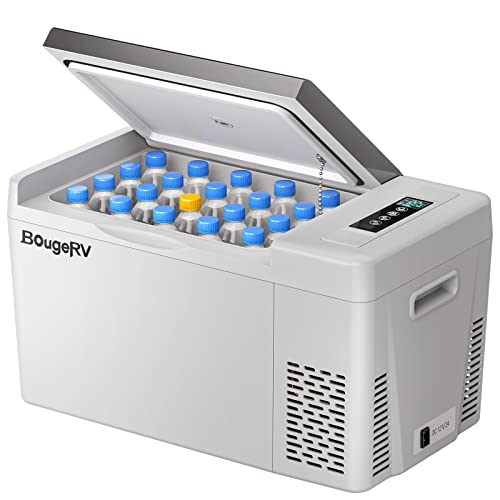
If the C15 is the right size but you want more of everything — more capacity, deeper cold, faster recovery — the BougeRV 23 Quart is the natural step up for car use. Twenty-three quarts provisions a couple’s weekend from the trunk or rear seat, the stated range reaches -8°F, and the headline trick is speed: the listing states a cool-down to 32°F in 15 minutes.
BougeRV’s 23-quart unit competes on speed and depth of cold. The listing states a range from -8°F to 50°F — a lower floor than most of its class — and a 15-minute cool-down to 32°F, which is the feature you feel when the grocery run, the forgotten pre-chill or the late departure puts warm food into the box at the start of a drive. Inside the first quarter hour the box is already at fridge temperature instead of spending the first hour of the trip getting there. It runs on 12/24V DC and 110V AC, works as fridge or freezer, and is sized and priced for the camping and road-trip duty the listing names. For a single traveler or a couple, 23 quarts is the size that keeps giving: big enough to provision properly, small enough to live behind a seat.
Strengths
- Fast stated cool-down — 32°F in 15 minutes — for late starts and warm loads
- -8°F low end undercuts most rivals, giving real freezer headroom
- 23 quarts is the road-trip size: two people’s weekend, one person’s week
Trade-offs
- Single zone, so freezing and chilling share one setting
- Fast-cool modes on compressor boxes draw harder while they work
- Grey finish shows dust and campsite scuffs honestly
| Key specs (from the manufacturer’s listing) | |
|---|---|
| Capacity | 23 quart |
| Temperature range | -8°F to 50°F (per listing title) |
| Cool-down | To 32°F in 15 minutes (per listing title) |
| Power | 12/24V DC and 110V AC |
That speed is a car feature more than a camping one. Cars collect warm loads: the grocery run that sat in a hot parking lot, the farmers-market haul, the leftovers from a restaurant across town. A fast pull-down shortens the time that food spends warming up or cooling slowly, which is when quality and safety leak away. It runs on 12/24V DC on the road and 110V AC at home, so it can wait in the kitchen during the week and ride on weekends. For a single car that does commuting, shopping and road trips, this is the most complete one-box answer in the guide.
Best for: Drivers who want one compressor box that handles groceries, weekends and road trips with the fastest recovery from warm loads. / Not suited for: Drivers whose only free space is a footwell — measure first; the C15 exists for you.
Check the BougeRV 23 Quart on Amazon — check price on Amazon for the current figure, and confirm the included cords and dimensions on the listing before you order.

3. Alpicool 10 Quart Portable Car Fridge
Badge: Best for Small Spaces
Ten quarts sounds like a compromise until you list what actually needs guaranteed cold in a car: insulin and other temperature-sensitive medication, a baby’s milk and food, a driver’s lunch, a few drinks kept properly cold rather than vaguely cool. The Alpicool 10 Quart does those jobs with a real compressor and a stated -4°F to 68°F range, in a 9-liter box that fits spaces no other compressor pick here can use.
Nine liters sounds like a toy until you remember what is inside: a real compressor with a stated range from -4°F to 68°F. The Alpicool 10 Quart is built for the jobs where cold has to be guaranteed but volume is small — temperature-sensitive medication on a long drive, a driver’s lunch and drinks in a truck or van cab, a boat’s day provisions, baby food and milk on a family road trip. Thermoelectric minis can approximate some of that on mild days, but they cannot promise a temperature; this box can, because its cooling does not depend on the air around it. The listing names trucks, vans, RVs, campers, SUVs and boats, and that breadth is credible precisely because the footprint is so small — it fits the leftover spaces those vehicles actually have.
Strengths
- Smallest compressor option here — true refrigeration in a 9-liter box
- Stated range reaches -4°F, so it can freeze despite its size
- AC/DC power suits the truck cab, van, boat and campsite equally
Trade-offs
- 9 liters is personal-scale: drinks, lunch and medication, not group catering
- Per-liter cost of tiny compressor boxes is high compared with big ones
- Single small zone means careful packing Tetris for mixed loads
| Key specs (from the manufacturer’s listing) | |
|---|---|
| Capacity | 10 quart (9 liter) |
| Temperature range | -4°F to 68°F (per listing title) |
| Power | AC and DC |
| Cooling type | Compressor fridge-freezer |
The car-specific virtue is placement freedom. A box this small rides in a footwell, on a rear seat, or in the corner of a small trunk without rearranging your life, and its AC/DC power means it can pre-chill indoors and keep working in a hotel room. The trade-off is absolute: this is personal-scale storage. It will not provision a family trip, and it is not trying to. For the driver whose problem is small, critical and temperature-sensitive, it is not the budget version of the bigger picks — it is the correct tool.
Best for: Drivers with small, critical loads: medication, baby food, a daily lunch, or a compact car with no spare cargo space. / Not suited for: Anyone provisioning more than one person’s day; step up to the C15 or larger.
Check the Alpicool 10 Quart on Amazon — check price on Amazon for the current figure, and confirm the included cords and dimensions on the listing before you order.

4. Alpicool 28 Quart 12 Volt Refrigerator
Badge: Best for Family Cars
Family cars ask a cooler to be three things in one week: the grocery keeper on the big shop, the drinks-and-snacks box for the Saturday tournament run, and the road-trip fridge for the holiday drive. The Alpicool 28 Quart is sized for that rotation. Twenty-eight quarts holds a family’s day provisions with room to spare and a couple’s full weekend, and its compressor holds real food-safe temperatures in a hot parked car far better than any thermoelectric alternative.
This 28-quart Alpicool is the middle child of the range, and for many vehicles it is the right size: meaningfully more room than the compact 15- and 20-liter boxes, without the cargo commitment of the 40-liter-plus models. The listing describes a portable freezer and fridge in one, powered by 12/24V DC on the road and 110-240V AC on mains, and names trucks, RVs, campers and SUVs as its home turf. As a compressor unit it holds a set temperature rather than a relative one, which is what makes it a legitimate food-storage appliance rather than a drinks accessory. Buyers stepping up from a thermoelectric cooler will notice the difference on the first hot day: the temperature inside this box is the temperature you chose, not a compromise negotiated with the weather.
Strengths
- 28 quarts splits the difference between day-trip boxes and full expedition fridges
- Fridge-freezer compressor design holds real food-safe temperatures
- Aimed squarely at truck, RV, camper and SUV use, with the power inputs to match
Trade-offs
- Single zone, like most boxes at this size and tier
- Mid-size in every sense — keen campers may still outgrow it
- No integrated battery for parked runtime
| Key specs (from the manufacturer’s listing) | |
|---|---|
| Capacity | 28 quart |
| Power | 12/24V DC and 110-240V AC |
| Cooling type | Compressor fridge-freezer |
The listing aims this model at trucks, RVs, campers and SUVs, and the family SUV or minivan is exactly its home: it lives in the cargo area, runs on 12/24V DC on the road, and plugs into 110-240V AC at the destination or back home in the garage. Parents will appreciate the unglamorous benefit most: no ice means no meltwater, so the snacks, the spare clothes and the library books sharing the cargo area stay dry. For one-box family duty, this is the size that stops the compromises.
Best for: Families whose vehicle does groceries, sports days and road trips, and who want one compressor box sized for all three. / Not suited for: Solo drivers in small cars; the capacity is wasted and the footprint will annoy you.
Check the Alpicool 28 Quart on Amazon — check price on Amazon for the current figure, and confirm the included cords and dimensions on the listing before you order.
5. Koolatron 12V Iceless Cooler & Warmer (18 Quart)
Badge: Best Thermoelectric for Cars
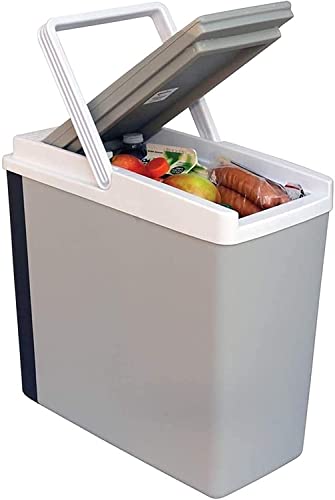
Not every car cooler needs to be a refrigerator. For the daily pattern of lunches, drinks and day food — loaded in the morning, eaten by evening, in a car that runs its air conditioning — the Koolatron’s thermoelectric simplicity is honestly sufficient, and its hard-sided 18-quart body suits car life: it protects contents from cargo crush, stacks in a trunk, and wipes clean after spills.
Koolatron is one of the original names in 12-volt thermoelectric cooling, and the 18-quart iceless cooler-warmer is its classic format: a hard-sided box for the car, truck, camper or boat that keeps lunch and drinks cold without ice and can warm food on the return leg. Hard sides matter more than they appear to — they protect the contents from cargo crush, stack better, and clean up faster than fabric coolers. The listing’s audience list (camping, picnic, travel, lunch, office) describes its real life accurately. As with every thermoelectric here, cooling is relative to ambient air, so it is a drinks-and-lunch appliance rather than a refrigerator. Within that honest brief, a specialist brand’s mature design is a sensible place to spend.
Strengths
- Hard-sided body protects contents better than soft thermoelectric bags
- 18 quarts is the solo-and-pair size for lunches, drinks and day provisions
- Koolatron has made 12V thermoelectric coolers for decades — a specialist, not a dabbler
Trade-offs
- Ambient-relative cooling, like all thermoelectrics — no freezing, no heat-wave food safety
- Modest capacity for group trips
- Warmer and cooler modes are simple; no precise temperature control
| Key specs (from the manufacturer’s listing) | |
|---|---|
| Capacity | 18 quart |
| Function | Cooler and warmer, iceless |
| Build | Hard sided |
| Use | Car, truck, camper, boat, office (per listing title) |
Koolatron has specialized in exactly this product for decades, and the cooler-warmer format covers the car’s calendar: cold drinks in summer, warm food on winter pickups. The limits are the technology’s limits — cooling relative to cabin air, so a car parked in brutal sun defeats it, and no freezing — but for the in-motion, air-conditioned hours when most car cooling actually happens, it performs its brief well. Drivers who want a set-and-forget box for the daily routine, at a thermoelectric tier, will find this the most mature design in its class.
Best for: Commuters and daily drivers whose cooler works in an air-conditioned car for lunches and drinks, not in a parked car in a heat wave. / Not suited for: Anyone leaving perishables in a parked car in summer; that job needs a compressor and a power plan.
Check the Koolatron 18 Quart on Amazon — check price on Amazon for the current figure, and confirm the included cords and dimensions on the listing before you order.
6. Wagan EL6214 Personal Thermoelectric Cooler/Warmer (14 Liter)
Badge: Best Personal Cooler
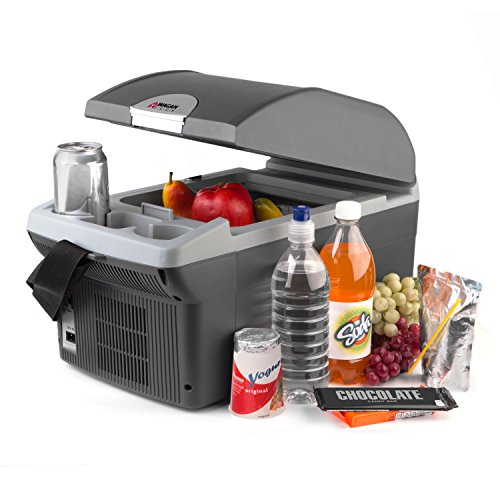
The Wagan EL6214 is built for the smallest unit of car life: one person. Fourteen liters holds a driver’s full day — lunch, drinks, snacks — in a box that fits a passenger footwell or behind a seat, from a brand that has made 12V accessories for decades, with UL Listed certification stated in its listing.
The EL6214 is Wagan’s larger personal box: 14 liters of thermoelectric cooling and warming with UL Listed certification, aimed at cars, RVs and camping. Fourteen liters is a considered size — a full day’s food and drink for a driver, a couple’s picnic without the big cooler, or a medication-and-snacks box that rides in the cab rather than the cargo area. Wagan has sold 12-volt accessories for decades, and the certification in the listing reflects that maturity. The thermoelectric caveats apply in full: it cools relative to the surrounding air and cannot freeze or guarantee refrigerator temperatures in a hot vehicle. Judged as what it is — a plug-in personal cooler-warmer that ends the ice-pack routine — it is one of the most sensible small boxes in this guide.
Strengths
- 14 liters is the personal-plus size: lunch, drinks and snacks for one or two
- UL Listed certification from an established 12V accessories brand
- Compact enough for a cab, a passenger footwell or beside a desk on an adapter
Trade-offs
- Thermoelectric limits: relative cooling only, no freezing
- Listing states DC power — home running needs a separate adapter
- Too small for family provisioning; it is a personal box by design
| Key specs (from the manufacturer’s listing) | |
|---|---|
| Capacity | 14 liter |
| Function | Cooler and warmer |
| Power | 12/24V DC |
| Certification | UL Listed (per listing title) |
Its car virtues are routine ones, repeated daily: no ice pack to remember, a warmer mode for winter lunches, and a size that never has to be unloaded to make room for passengers. The thermoelectric caveat applies — it cools relative to cabin air and cannot protect food in a hot parked car — but a personal box mostly works while you drive, in air conditioning, which is its home conditions. For gig drivers, sales reps, tradespeople and long commuters, this is the pick that turns the car into a slightly better workplace.
Best for: Solo drivers — commuters, reps, gig and delivery drivers — who want a personal lunch-and-drinks box with a warmer for winter. / Not suited for: Couples and families; 14 liters is a personal ration, not a shared one.
Check the Wagan EL6214 on Amazon — check price on Amazon for the current figure, and confirm the included cords and dimensions on the listing before you order.
Comparison Table
| Pick | Badge | Key spec | Best for |
|---|---|---|---|
| Alpicool C15 | Best Overall | 16 qt (15 L) compressor fridge-freezer, -4°F to 68°F, 12/24V DC + 100-240V AC | Drivers who want guaranteed cold in the space a car actually… |
| BougeRV 23 Quart | Best Compressor for Cars | 23 qt compressor fridge/freezer, -8°F to 50°F, cools to 32°F in 15 min (per listing), 12/24V DC + 110V AC | Drivers who want one compressor box that handles groceries, weekends and… |
| Alpicool 10 Quart | Best for Small Spaces | 10 qt (9 L) compressor fridge-freezer, -4°F to 68°F, AC/DC | Drivers with small, critical loads: medication, baby food, a daily lunch,… |
| Alpicool 28 Quart | Best for Family Cars | 28 qt compressor fridge-freezer, 12/24V DC + 110-240V AC | Families whose vehicle does groceries, sports days and road trips, and… |
| Koolatron 18 Quart | Best Thermoelectric for Cars | 18 qt thermoelectric iceless cooler-warmer, hard sided | Commuters and daily drivers whose cooler works in an air-conditioned car… |
| Wagan EL6214 | Best Personal Cooler | 14 L personal thermoelectric cooler-warmer, 12/24V DC, UL Listed | Solo drivers — commuters, reps, gig and delivery drivers — who… |
How to Choose a 12 Volt Cooler for Your Car
Measure before you shop. The best cooler for your car is the biggest one that fits the space you are actually willing to give it — and that space is usually smaller than you imagine once seats, passengers and cargo take theirs. Footwell and behind-seat spaces suit compact boxes up to roughly 16 quarts; rear seats and trunks open the range to the mid-20s; SUV and minivan cargo areas take the family sizes. Check the listing dimensions against your space with a tape measure, including room for the lid to open and the vents to breathe.
Then match technology to your parking reality. If the cooler will mostly work while you drive, in air conditioning, a thermoelectric box can be enough for drinks and lunches. If it must protect groceries, medication or food in a parked car — especially in summer — only a compressor model holds a guaranteed temperature, and you should think about how long it runs parked and what that means for your battery. Compressor picks with battery protection, or a habit of unplugging when parked for hours, keep the convenience without the jump-start risk.
Finally, consider the second life of the box. Models that also run on household AC pre-chill at home, work in hotel rooms, and serve as a spare fridge during outages or holidays. In a one-car household, that versatility is often worth more than a quart or two of capacity.
Where Should a 12 Volt Cooler Sit in a Car?
Placement decides both convenience and performance. The rear footwell and the space behind the front seats keep a compact cooler reachable from the driver’s seat — ideal for drinks, snacks and medication — and usually shaded from direct sun. The trunk or cargo area suits bigger boxes and keeps the cabin clear, at the cost of a stop to access anything. Wherever it sits, two rules apply: the vents must stay unobstructed, because a cooler that cannot shed heat works harder and cools worse; and the box should be secured or wedged, because a loaded cooler is heavy cargo in a sudden stop.
Sun is the enemy you can park away from. A cooler in a sun-baked cabin fights a much hotter environment than the same cooler in shade, and thermoelectric models may not reach useful temperatures at all. A windshield shade, a shaded parking spot, or simply placing the box on the shaded side of the car makes a measurable difference to how hard any of these machines work — and to how much of your battery they spend doing it.
Will a 12 Volt Cooler Drain a Car Battery?
It can, if you let it — and it need not, if you plan. While driving, the alternator carries the load and there is nothing to worry about. Parked, a compressor fridge cycles on and off and draws a modest average load; over an afternoon that is usually fine for a healthy battery, and over a weekend it is not. Thermoelectric boxes draw continuously while running and should generally be unplugged when parked for long stretches.
The safeguards are simple. Compressor models with battery-protection systems cut the fridge off before the battery falls to a level that risks starting — use the conservative setting on a single-battery car. Make a habit of unplugging any cooler for overnight parking unless it runs from a separate power source. And know your battery: an old, weak battery plus a hot day plus a running cooler is the combination that produces the parking-lot jump start. Managed with ordinary care, a 12V cooler is a convenience; managed carelessly, it is a countdown.
A Week With a Car Cooler: What Daily Use Actually Looks Like
Monday: the box pre-chills on the kitchen counter while coffee brews, then rides in the footwell with the week’s first lunch and a drink. It runs while the engine runs, rests unplugged in the office car park — a cold, closed compressor box coasts through a workday in mild weather — and carries the evening’s groceries home at a set temperature instead of a hopeful one. Tuesday through Thursday repeat the pattern until it stops feeling like a system and starts feeling like the car simply has a fridge.
Friday is where the second life starts. The same box that carried lunches all week takes the weekend’s provisions: loaded cold at home, plugged into the car for the drive, carried into the rental or the relatives’ spare room and put on household power for the stay. Sunday evening it comes home with the leftovers still properly cold, gets wiped out, and sits with its lid ajar until Monday. One appliance, no ice bought, no meltwater, no food roulette at any point in the week.
The drivers who abandon car coolers almost never abandon them over cooling performance. They abandon them over friction: a box too big to move easily, a cable that lives in the wrong place, a routine that required remembering instead of habit. That is why this guide weights fit, placement and dual power so heavily — the best car cooler is the one whose routine you can sustain in February as easily as in the first enthusiastic week.
How to Stop a Car Cooler From Draining Your Battery: The Complete Routine
The complete routine fits in five habits. One: plug in after the engine starts, not before — the cooler should never be part of the cranking load. Two: for any park longer than a couple of hours, unplug a thermoelectric box entirely and let a compressor box run only with its battery protection enabled, set conservatively on a car you depend on. Three: know your battery’s age; a five-year-old battery and a cooler are a poor team, and the cooler will be blamed for the battery’s retirement.
Four: give the alternator a chance — a cooler that runs mostly on driving days and rests on parked weekends can live happily on a starter battery for years, while one that runs three parked days a week needs a separate power answer. Five: watch for the early warnings. A fridge that begins cutting out overnight, or a car that cranks a fraction slower in the morning, is information delivered early and cheaply. Act on it — charge the battery, check its health, adjust the protection level — and the jump-start morning never arrives.
None of this requires equipment beyond the cooler itself and ordinary attention. The battery horror stories in this category are remarkably consistent: a cooler left running, unprotected, for days, on an old battery, in extreme weather. Remove any two of those factors and the story ends differently.
What About the Trunk? Placement Realities for Sedan Owners
Sedan owners face the placement question in its purest form, because a sedan trunk is a separate, unconditioned box that heat-soaks worse than the cabin and cannot be reached without stopping. A compressor cooler survives trunk duty well — it holds its set temperature regardless — but it works harder there, and everything in it is a stop away. A thermoelectric cooler in a hot sedan trunk is the weakest combination in this entire guide: relative cooling against trunk temperatures that can exceed the cabin’s by a wide margin.
The sedan answers are placement creativity and habit. The rear footwell and behind-seat spaces — the compact picks’ home — keep the box in conditioned air and within reach. If the trunk must be used, use it knowingly: compressor only, pre-chilled hard, and with the understanding that its contents are for the destination, not the drive. Sedan owners who accept those terms get the same cold as everyone else; the trunk is a constraint, not an exclusion.
How to Use a 12 Volt Cooler in Your Car, Day to Day
A car cooler becomes part of the routine in about a week. These habits keep it cold, quiet and harmless to your battery.
- Pre-chill before the drive. If your model runs on household AC, cool it indoors and load cold contents. A box that starts cold sips power on the road; a warm box works hard in a hot cabin.
- Load in reach order. Put what you will want while driving — drinks, snacks, medication — at the top or in the smallest box near the seats, so stops and lid openings stay short.
- Plug in with the engine running. Make the cooler part of your start-up routine: engine on, cooler on. Unplug it (or confirm battery protection is active) when you park for more than a short stop.
- Give the vents air. Leave a few inches around the cooler’s vents, and never bury it under coats and bags on a long drive. A cooler that can breathe cools faster on less power.
- Park smart in summer. Shade, a windshield shade, or the shaded side of the car lowers the cabin heat every cooler has to fight — and protects the contents of thermoelectric boxes, whose cooling is relative to cabin air.
- Empty and air it weekly. A quick wipe and an hour with the lid open at home keeps odors away and the seals healthy, so the box is always ready to grab.
That is the whole system: start cold, breathe freely, unplug when parked. The drivers who love these boxes are simply the ones who built those three habits.
Common Buying Mistakes
Buying by capacity alone. A 50-quart box in a compact sedan is not a bargain; it is furniture you did not want. Measure the space first and buy the largest cooler that truly fits it.
Trusting a thermoelectric box with parked-car perishables. On a hot day a parked car’s cabin can defeat thermoelectric cooling entirely. Medication and raw food in a parked car need a compressor cooler and a power plan.
Leaving any cooler plugged in all weekend. Even an efficient compressor fridge will eventually flatten a starter battery. Use battery protection, unplug for long parking, or power the box separately.
Burying the cooler under cargo. Blocked vents mean longer run times, warmer contents and more battery spent. The cooler needs airflow like any refrigerator does.
Skipping the pre-chill on road trips. Loading a warm box with warm drinks at departure wastes the first hours of the drive — and the most battery — just getting to temperature. Start cold at home.
Final Recommendation
For most cars and most drivers, the Alpicool C15 is the recommendation: true compressor refrigeration in the size cars actually have room for, with home pre-chilling on AC. Step up to the BougeRV 23 Quart for more capacity and the fastest cool-down, choose the Alpicool 10 Quart when the load is small and critical, and give family vehicles the Alpicool 28 Quart. Daily drivers on a budget are honestly served by the Koolatron 18 Quart for in-motion duty, and solo drivers by the personal Wagan EL6214.
Keep researching the cluster with Best 12 Volt Cooler, Best 12 Volt Coolers For Cars, Best 12 Volt Cooler For Camping, Best 12 Volt Cooler For Travel and Best 110 12 Volt Cooler. Measure your space, check price on Amazon for the pick that fits it, and enjoy drinks that are cold because you planned it.
If you want the shortest path: start with the Alpicool C15, BougeRV 23 Quart, Alpicool 10 Quart — check price on Amazon for each, compare them against your space and your power plan, and you will land on the right box for your pattern of use.
Frequently Asked Questions
What size 12V cooler fits in a car?
Compact compressor boxes around 10–16 quarts fit footwells and behind-seat spaces. Mid-size models in the low-to-high 20s suit rear seats and trunks, and family sizes need an SUV or minivan cargo area. Measure your intended space, including lid clearance and vent room, against the listing dimensions before ordering.
Can I leave a 12V cooler running in a parked car?
For short stops, a compressor cooler with battery protection enabled is generally fine on a healthy battery. For hours or overnight, unplug it, switch to a separate power source, or accept the risk deliberately — thermoelectric boxes, which draw continuously, should not be left running in a parked car at all.
Is a thermoelectric cooler enough for a car?
For drinks and lunches while driving in air conditioning, yes — that is its home duty. For groceries, medication or food in a parked car in summer, no: its cooling is relative to cabin air temperature, and a hot cabin defeats it. That job needs a compressor model.
Can a 12V car cooler freeze ice cream or make ice?
Only compressor models with a stated sub-freezing range can, and the picks above list their ranges from their manufacturers’ listings. Thermoelectric coolers cannot freeze anything. Note that freezing in a car also uses considerably more power than chilling.
Do 12V coolers work in electric vehicles and hybrids?
They run from the same 12V accessory system, but the caution doubles: in many EVs and hybrids the 12V battery is small and is charged from the main pack only under certain conditions. Use battery protection, run the cooler while the vehicle is on, and avoid long parked running unless your vehicle manual blesses it.
How do I stop a car cooler from smelling?
Empty it after trips, wipe the interior, and store it with the lid ajar. A small box of baking soda inside during storage helps. Most odor problems come from storing a closed, damp box — the weekly airing habit in our how-to section prevents them.


