Disclosure: airfryerkitchensupply.com is reader-supported. When you buy through links on our site, we may earn an affiliate commission at no extra cost to you.
Where to buy
Buying the best 12 volt car air compressor: Every compressor below was verified against current catalog data before this guide was published, and all are sold through Amazon. Use the links to check the current price on Amazon and confirm the power connection — cigarette plug or battery clamps — and included hoses and adapters before you order.
- VIAIR 88P 12V Portable Air Compressor Kit (Best Overall) — Check the current price on Amazon
- VIAIR 300P 12V Portable Tire Inflator (150 PSI) (Best for Trucks and Off-Road) — Check the current price on Amazon
- VIAIR 450P-RV Automatic 12V Air Compressor (150 PSI) (Best for RVs and Trailers) — Check the current price on Amazon
- VIAIR 85P Portable Tire Inflator (Cigarette Plug) (Best Socket-Powered Convenience) — Check the current price on Amazon
- EPAuto 12V DC Portable Air Compressor Pump (Digital) (Best Budget Digital) — Check the current price on Amazon
- AstroAI AIRUN H Tire Inflator (12V DC) (Best Compact Digital) — Check the current price on Amazon
The best 12 volt car air compressor is the tool you buy hoping never to need, and thank yourself for the first time you do — on a shoulder at night, in a trailhead car park, or in your own driveway the morning of a trip. The category splits by how the compressor connects to power, and that split is the whole buying decision in miniature: cigarette-socket models are convenient and limited by the socket’s fuse, while battery-clamp models draw real current and inflate big tires seriously fast. The six verified picks here are led by VIAIR, the brand that defines portable 12 volt air, with two digital convenience picks for everyday drivers.
Specifications in this category reward a skeptical eye. The headline number — maximum PSI — is the least useful figure on the box, because car tires need 30–40 PSI and even truck tires rarely exceed 80; what matters is flow: how much air the compressor moves at working pressure, which decides whether a tire takes two minutes or ten, and whether the unit overheats and rests mid-job. Duty cycle — how long it can run before it must cool — is the second honest number. The reviews and buying guide here translate the marketing into those terms, pick by pick.
This guide covers the full ladder from glovebox convenience to RV-grade air. The how-to section walks through a complete roadside inflation, including the safety habits that matter when you are working beside traffic, and the mistakes section covers the errors — socket overloads, hot compressors screwed onto valves, pressures never checked with a real gauge — that turn a simple tool into a frustrating one.
A note on brands before the picks, because this category has a clear hierarchy and pretending otherwise helps no one: VIAIR has defined portable 12 volt air for decades, its units are the ones in professional road kits and off-road club recommendations, and four of the six picks here carry its name for that reason. The two digital picks earn their places on a different axis — household convenience — where preset pressures and auto shut-off matter more than flow. Read the badges as two leagues, each with its own champion, and choose your league first.
In this guide
Quick Picks
VIAIR 88P 12V Portable Air Compressor Kit — Best Overall. The benchmark portable: battery-clamp power, up to 120 PSI, and honest capability for tires up to 33 inches — the one most drivers should own. — Check price on Amazon
VIAIR 300P 12V Portable Tire Inflator (150 PSI) — Best for Trucks and Off-Road. The flow leader for big tires: a stated 2.30 CFM at up to 150 PSI — the air-down, air-up ritual done at professional speed. — Check price on Amazon
VIAIR 450P-RV Automatic 12V Air Compressor (150 PSI) — Best for RVs and Trailers. The long-reach, long-duty specialist: automatic operation, 150 PSI, and capability for tires up to 42 inches — built for RV and trailer duty. — Check price on Amazon
VIAIR 85P Portable Tire Inflator (Cigarette Plug) — Best Socket-Powered Convenience. VIAIR quality on a cigarette plug: plugs straight into the 12V outlet for convenient top-ups on cars and SUVs — no hood opening required. — Check price on Amazon
EPAuto 12V DC Portable Air Compressor Pump (Digital) — Best Budget Digital. The value digital: a 12V DC compressor pump with a digital inflator interface — preset the pressure, let it stop itself, at the friendly end of the tier. — Check price on Amazon
AstroAI AIRUN H Tire Inflator (12V DC) — Best Compact Digital. A compact digital with auto shut-off, a digital gauge, an LED light for night use and a 9.8-foot cord — the glovebox-friendly all-rounder. — Check price on Amazon
How These Picks Were Chosen
Every compressor was verified against live catalog data through this site’s product-verification system, confirming the model, its maximum pressure class, its power connection and its intended tire sizes as currently listed. Only genuine 12 volt vehicle compressors were included — workshop mains compressors and novelty mini pumps were excluded. Flow and pressure figures quoted come from the verified listings themselves.
The shortlist was built around the power-connection divide: clamp-powered VIAIR units for trucks, SUVs and RVs, socket-powered units for cars, and digital auto-shutoff models for drivers who value set-and-forget convenience over raw speed.
- Confirmed 12 volt operation with the connection type stated — clamps or socket
- Pressure and flow figures taken from the verified listing, interpreted honestly
- Tire-size suitability as listed, matched to real vehicles
- Duty and cooling expectations set by the unit’s class
- Gauge and shutoff features that affect real-world accuracy
- Trade-offs stated, especially socket current limits and heat
The 6 Best 12 Volt Car Air Compressors

VIAIR 88P 12V Portable Air Compressor Kit — Best Overall
The 88P is the portable compressor against which the category is measured, and its specification shows the VIAIR philosophy: connect directly to the battery with clamps — no socket fuse limiting the current — and you get a machine that delivers up to 120 PSI and handles tires up to 33 inches, which covers the overwhelming majority of cars, trucks, SUVs and Jeeps on the road. It inflates at a pace socket units cannot match and does so without overheating theatrics on ordinary tires.
It is a kit in the working sense: everything needed to reach a valve, read the pressure and get moving again, in a form that lives in a trunk or under a seat for years. Drivers who air down for sand or trails and air back up at the pavement will feel the difference most — the 88P turns a twenty-minute chore into a few minutes per tire — but even the once-a-year slow-leak rescue justifies it. If you buy one compressor from this guide, buy this one.
Strengths
- Clamp power unlocks real inflation speed
- Capacity to 33-inch tires covers most vehicles
- Proven category benchmark with broad support
Trade-offs
- Clamps mean opening the hood — less casual than a socket plug
- No digital auto-shutoff; you watch the gauge
- Overkill for a small city car that never leaves town
| Spec | Detail |
|---|---|
| Output | Up to 120 PSI |
| Tires | Up to 33 inches |
| Power | 12V battery-clamp class kit |
| Use | Cars, trucks, SUVs, Jeeps, RVs |
The 88P’s real virtue is that it removes doubt. Underrated compressors make you wonder whether the tire, the unit or your patience will give out first; the 88P simply does the job at a professional pace and goes back in its bag. For households with a truck or SUV in the driveway, it is not the premium choice — it is the proportionate one.
The 88P’s bag earns a permanent home in the vehicle: add a standalone gauge, a valve-core tool and a plug kit if your travels are remote, and you own a complete tire-rescue station. Check the clamps’ teeth and cable each season — they are the whole connection, and the connection is the whole performance.
Best for: most drivers, especially truck, SUV and Jeep owners / Not suited for: drivers wanting set-and-forget digital convenience
Check on Amazon — check price on Amazon before you order, and confirm the listing matches the model described here.

VIAIR 300P 12V Portable Tire Inflator (150 PSI) — Best for Trucks and Off-Road
Off-road drivers live by a rhythm: air down for traction and comfort on the trail, air up for the highway home. The 300P exists for the second half of that rhythm. Its stated 2.30 CFM flow is the figure that matters — air volume at working pressure — and it is what separates a compressor that reseats four big tires in minutes from one that needs cooling rests between them. The 150 PSI ceiling is headroom; the flow is the product.
Sized for tires up to 33 inches on trucks, SUVs and Jeeps, it is the enthusiast’s step up from the 88P: same clamp-powered honesty, more air. If your weekends involve aired-down tires, if you tow and adjust pressures for load, or if your truck’s tires are simply large and numerous in your life, the 300P pays for its tier every single trip. Commuters with a single compact car will never use its talents — and this guide’s digital picks serve them better.
Strengths
- Highest stated flow in this guide — fast on big tires
- Built for repeated air-down / air-up cycles
- 150 PSI headroom for load and towing pressures
Trade-offs
- Premium tier for capability many drivers never need
- Clamp connection and manual gauge watching
- Larger and heavier to store than car-class units
| Spec | Detail |
|---|---|
| Output | 150 PSI |
| Flow | 2.30 CFM (as listed) |
| Tires | Up to 33 inches |
| Use | Trucks, SUVs, Jeeps, off-road |
Judge this compressor by the trailhead test: four tires, twenty-plus PSI each, everyone waiting. The 300P finishes while lesser units are resting hot. That is the entire case, and for the drivers it describes, it is conclusive. Everyone else should save the money and the trunk space.
High-flow ownership means respecting heat as a consumable: the 300P will do four big tires eagerly, but give it the pauses its duty asks for on the hottest days and it will still be eager in year five. Store it out of direct sun in the vehicle; a cool compressor starts every job with thermal headroom.
Best for: off-roaders, towers and truck owners with big tires / Not suited for: compact-car commuters
Check on Amazon — check price on Amazon before you order, and confirm the listing matches the model described here.

VIAIR 450P-RV Automatic 12V Air Compressor (150 PSI) — Best for RVs and Trailers
RVs and trailers change the inflation problem in two ways: the tires are bigger — this unit is rated for tires up to 42 inches — and there are more of them, often including duals that punish a compressor’s duty cycle and a hose’s reach. The 450P-RV is VIAIR’s answer: an automatic 150 PSI machine built for sustained work across many large tires, the class of tool that lives in a motorhome’s bay and services the whole rig plus the towed car.
Automatic operation matters at this scale because the job is long; a compressor that manages itself while you move wheel to wheel turns a half-hour chore into a routine check. For truck and SUV owners it is more machine than necessary — the 88P and 300P cover that ground — but for RV owners, trailer towers and anyone maintaining a small fleet of large tires, this is the pick that matches the workload. Tire pressure is a safety system on a heavy rig, and this is the safety-grade tool.
Strengths
- Handles the largest tires in this guide — to 42 inches
- Automatic operation suits long multi-tire sessions
- Built for RV and trailer duty cycles
Trade-offs
- Most expensive class of portable here
- Size and weight suit bay storage, not a car trunk
- Capability wasted on ordinary car tires
| Spec | Detail |
|---|---|
| Output | 150 PSI, automatic |
| Tires | Up to 42 inches |
| Use | RVs, trucks, SUVs, Jeeps, trailers |
| Power | 12V automatic compressor |
RV tire pressures run high, the consequences of underinflation at highway weight are severe, and hand pumps and socket inflators simply do not service the rig. If your travels involve a motorhome or a serious trailer, the 450P-RV is not an accessory — it is part of the rig’s safety equipment, and should be budgeted and stored like it.
The 450P-RV should live on the rig’s maintenance schedule, not in a forgotten bay: pressures checked at every fuel stop on travel days is the rhythm its owners swear by. Keep its long hose coiled loosely — tight coils and kinks are how good hoses die young.
Best for: RV owners, trailer towers and large-tire fleets / Not suited for: ordinary car and light-truck use
Check on Amazon — check price on Amazon before you order, and confirm the listing matches the model described here.

VIAIR 85P Portable Tire Inflator (Cigarette Plug) — Best Socket-Powered Convenience
The 85P trades the clamp models’ muscle for pure convenience, and for millions of drivers that is the right trade. It plugs directly into the cigarette lighter outlet, lives in the trunk, and handles the everyday reality of tire care — the slow leak found on a Tuesday, the monthly pressure top-up, the spare that has gone soft unnoticed — without opening the hood or touching the battery. It carries VIAIR’s build quality into the socket-powered class, which is not a class famous for it.
The limits are the socket’s limits, and they are honest ones: the outlet’s fuse caps the current, so inflation of a large, very flat tire is slower and may need pauses, and big truck tires are the clamp models’ territory. For cars and SUVs at normal pressures, none of that matters in practice. This is the compressor for the driver who will actually use it monthly — and a used-monthly compressor beats a stronger one that lives in a garage across town.
Strengths
- True plug-in convenience encourages regular use
- VIAIR build in the socket class
- Ideal size for trunk storage in cars and SUVs
Trade-offs
- Socket fuse limits speed on big or very flat tires
- Not the tool for truck tires or airing up from trails
- Shares the outlet with anything else plugged in
| Spec | Detail |
|---|---|
| Power | 12V cigarette lighter plug |
| Type | Portable tire inflator |
| Use | Cars and SUVs |
| Brand | VIAIR 85P |
Tire care is a habit, and convenience is what makes habits stick. The 85P is the pick for the family car, the new driver, the second vehicle — the places where a compressor’s job is ninety percent top-ups and ten percent rescues. Buy it for that life and it will quietly prevent the one bad morning that pays for it.
Socket units like the 85P ask for one kindness: do not run them through a tired, loose outlet that arcs and heats. A firm socket or a quick outlet replacement keeps the little VIAIR delivering its best for years, and keeps the vehicle’s wiring as happy as the tires.
Best for: car and SUV owners wanting easy monthly top-ups / Not suited for: big tires, towing or trail use
Check on Amazon — check price on Amazon before you order, and confirm the listing matches the model described here.
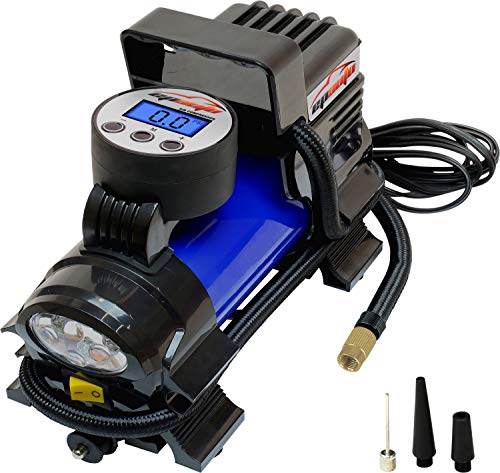
EPAuto 12V DC Portable Air Compressor Pump (Digital) — Best Budget Digital
EPAuto’s digital inflator is the compressor that introduced a generation of drivers to set-and-forget tire care: connect it, dial in the target pressure on the digital display, and let the machine stop itself at the number. That single behavior fixes the most common home-inflation error — guessing — and makes monthly top-ups a two-minute, no-gauge-needed routine anyone in the household will actually do.
It is a value-tier socket-class machine, and its limits follow: it is built for car tires at car pressures, worked at a socket unit’s pace, and asked to rest like one if you push it across many tires. Within that brief it is excellent and honestly priced in its tier. Drivers graduating to trucks or trails should graduate to the clamp-powered VIAIRs; drivers keeping a family fleet of ordinary cars at correct pressure could not spend the money better.
Strengths
- Digital preset with auto-stop removes the guesswork
- Value pricing for a genuinely useful tool
- Simple enough for every driver in the household
Trade-offs
- Socket-class pace and duty limits
- Car tires are its world — not a truck tool
- Digital features add a failure mode plain pumps lack
| Spec | Detail |
|---|---|
| Power | 12V DC |
| Type | Digital tire inflator |
| Use | Portable car air compressor pump |
The EPAuto is the right first compressor for most households: cheap enough to buy without deliberation, capable enough to matter, and convenient enough to be used. Correct tire pressure is safety, fuel and tire life in one habit — this little machine’s real product is the habit itself.
The EPAuto’s digital brain wants dry storage: a trunk is fine, a wet footwell is not. Keep its cable untangled and its display readable, and verify its readings against a standalone gauge seasonally — a digital you trust because you check it is the best of both worlds.
Best for: households wanting easy, accurate car-tire top-ups / Not suited for: trucks, towing or off-road air-ups
Check on Amazon — check price on Amazon before you order, and confirm the listing matches the model described here.

AstroAI AIRUN H Tire Inflator (12V DC) — Best Compact Digital
The AIRUN H is designed around the moment compressors are actually used: at night, in the rain, in a car park, by someone who did not plan to. The LED light is therefore not a gimmick — it is the feature that lights the valve stem at 11 p.m. — and the digital gauge with auto shut-off means the job is done by number, not by squinting at a dial in the dark. A 9.8-foot cord reaches around a car from the socket without drama.
AstroAI positions it across cars, motorcycles and bikes, and that breadth suits its compact, glovebox-adjacent format. Like all socket-class digitals it works at a modest pace and wants rest across many tires; like the EPAuto it trades the VIAIRs’ muscle for household convenience. Between the two digital picks, choose the EPAuto for value simplicity and the AstroAI for the light, the cord and the compact polish.
Strengths
- LED light solves the night-time valve hunt
- Digital gauge and auto shut-off for accurate fills
- 9.8 ft cord reaches all four corners easily
Trade-offs
- Socket-class speed and duty cycle
- Compact format is car-and-bike territory only
- Bright color shows every mark of trunk life
| Spec | Detail |
|---|---|
| Power | 12V DC |
| Features | Auto shut-off, digital pressure gauge, LED light |
| Cord | 9.8 ft |
| Use | Car, motorcycle and bike tires |
Keep this one in the car your family actually drives at night — the commuter, the college car, the road-trip sedan. Its design assumes the real world of dark car parks and low tires discovered late, and it is equipped for exactly that world. That kind of fit between design and use is rarer than raw power, and more valuable most days.
The AIRUN H’s light makes it the household’s night-shift compressor; keep it charged with purpose by using it for the monthly checks too, not only rescues. A tool used monthly is a tool known-good — the deepest principle in this whole guide, and this little unit embodies it.
Best for: night drivers, commuters and compact storage / Not suited for: truck tires or repeated trail air-ups
Check on Amazon — check price on Amazon before you order, and confirm the listing matches the model described here.
Comparison Table
| Pick | Badge | Key spec | Best for |
|---|---|---|---|
| VIAIR 88P 12V Portable Air Compressor Kit | Best Overall | 120 PSI, tires to 33in, clamp powered | most drivers, especially truck, SUV and Jeep owners |
| VIAIR 300P 12V Portable Tire Inflator (150 PSI) | Best for Trucks and Off-Road | 150 PSI, 2.30 CFM flow | off-roaders, towers and truck owners with big tires |
| VIAIR 450P-RV Automatic 12V Air Compressor (150 PSI) | Best for RVs and Trailers | 150 PSI automatic, tires to 42in | RV owners, trailer towers and large-tire fleets |
| VIAIR 85P Portable Tire Inflator (Cigarette Plug) | Best Socket-Powered Convenience | Socket plug convenience, VIAIR build | car and SUV owners wanting easy monthly top-ups |
| EPAuto 12V DC Portable Air Compressor Pump (Digital) | Best Budget Digital | Digital preset inflator, value tier | households wanting easy, accurate car-tire top-ups |
| AstroAI AIRUN H Tire Inflator (12V DC) | Best Compact Digital | Digital gauge + LED light, 9.8 ft cord | night drivers, commuters and compact storage |
How to Choose the Best 12 Volt Car Air Compressor: Connection, Flow, Duty
Start with the connection, because it caps everything else. A cigarette socket is fused — typically limiting the compressor to a gentle pace suitable for car tires and top-ups. Battery clamps remove that ceiling, letting a compressor draw the current that real flow requires. If your vehicle wears tires over about 31 inches, if you tow, or if you ever air down for terrain, buy clamps. If your life is car tires and convenience, a socket digital will serve you happily for years.
Next, read flow, not pressure. Every unit here exceeds any car tire’s needs in maximum PSI; what separates them is CFM at working pressure — the 300P’s stated 2.30 CFM is why it airs up big tires several times faster than a socket unit. Finally, respect duty cycle: compressors heat as they work and need rest in proportion to their size. A unit that inflates one car tire continuously may need a cool-down before the fourth truck tire. Buy enough compressor that your worst realistic job — four tires, from low, in summer — fits inside its comfortable duty, not at its limit.
- Cars, top-ups, convenience: EPAuto, AstroAI, VIAIR 85P
- Trucks, SUVs, all-round: VIAIR 88P
- Trails, towing, big tires: VIAIR 300P
- RVs and trailers: VIAIR 450P-RV
Pressure Accuracy: The Gauge Is the Product
A compressor’s real job is not air — it is correct pressure. Underinflation overheats tire sidewalls and is a leading mechanical contributor to blowouts; overinflation shrinks the contact patch and wears the center tread. The digital picks here earn their place by measuring and stopping at a set number, removing the two classic errors: the wildly optimistic dial gauge on a vibrating pump, and the driver who stops ‘when it feels firm.’
Whatever compressor you buy, verify it quarterly against a quality standalone gauge — even digital inflators drift — and always measure tires cold, before driving, against the pressure on the vehicle’s door-jamb placard, not the number molded on the tire sidewall, which is a maximum, not a target. Check the spare with the same discipline; a flat spare discovered during a change is a special kind of betrayal, and it is entirely preventable with sixty seconds twice a year.
Beyond Tires: What Else a 12 Volt Compressor Does
A vehicle compressor quietly becomes a household tool. With the adapter sets these kits include, it inflates bicycle tires properly (many bike tires want pressures car units reach easily), sports balls, air mattresses for guests and campsites, inflatable boats and pool toys, and it blows dust from filters and keyboards with a nozzle. Campers pair it with the rest of the 12 volt kit in this cluster — it airs the mattress, tops the tow vehicle’s tires, and reseats the trailer tires before the drive home.
Know its edges, too: it will not run air tools, fill a workshop tank, or substitute for a dive or paintball fill — different machines entirely. And inflatables with huge volume and tiny pressure, like large towable tubes, fill faster with a dedicated low-pressure blower. Within its true brief — vehicle tires and everyday inflation — a good 12 volt compressor is among the highest-value tools a household can own.
Setting Up a Home Inflation Routine That Actually Happens
The best compressor is the one used monthly, and monthly use is a design problem, not a willpower problem. Store the compressor with the vehicle it serves — never in a garage across town — with its hose coiled, its adapters in their pouch, and a standalone gauge riding in the same bag. Pick a trigger that already exists: the first fuel fill of the month, the car-wash visit, the Sunday you check the oil. Attach the pressure check to that trigger and it stops being a resolution and becomes a rhythm.
Work cold and in order: pressures before driving, same sequence around the car every time — front left, front right, rear right, rear left, spare — so no tire is ever the forgotten one. Write the placard pressures on a card in the compressor bag; memory is how a 32 PSI car ends up at the 35 someone half-remembers. Top up in small bursts on manual units and re-seat the chuck fully between readings, because a half-seated chuck is the leading cause of ‘the gauge lies’ complaints that are really technique.
Twice a year, do the deep version: pressures, spare, a visual pass over tread and sidewalls, valve caps present, and the compressor itself run and inspected. That twenty-minute ritual, plus the monthly two-minute one, is the entire maintenance program behind tires that last their full life and never star in a roadside story. The compressor is the tool; the routine is the product.
Compressor Care: Making a Portable Last a Decade
A portable compressor asks for almost nothing, which is why the little it asks for is so often skipped until failure teaches it. Keep the unit dry and its intake filter — where fitted — clean; a compressor breathing dusty air wears its heart out early. Coil the hose loosely rather than winding it tight around the body, because tight coils kink air lines and stress the chuck fitting that every inflation depends on. Inspect the power cable and clamps seasonally: chafed insulation and corroded clamp teeth are the two failure points that actually occur in the field.
Exercise is the second discipline. A compressor that runs monthly for tire checks is a known-good tool; one that sleeps for two years may have seized, perished a seal, or simply been forgotten by its owner at the moment of need. The monthly pressure routine in this guide is therefore also the compressor’s maintenance schedule — the tool services the tires, and the ritual services the tool. Store it where the vehicle’s regular driver can reach it in the dark, with its adapters together in their pouch.
Finally, retire gracefully. A compressor that labors, smells hot at modest work, or cannot hold its rated pace has told you its news; replacing a tired portable is cheap insurance compared with discovering its condition beside a flat tire at midnight. The picks in this guide are built to make that day distant — a decade of monthly service is a reasonable expectation for the VIAIR class — but the expectation is earned by the small cares above, not granted by the badge alone.
How to Inflate a Tire With a 12 Volt Compressor (Roadside Routine)
This routine covers a roadside or driveway top-up or rescue inflation. Work on the safest side of the vehicle, with hazard lights on and, on a road, a warning triangle out and passengers behind a barrier where one exists.
- Park on flat, firm ground away from traffic, engine running if your compressor maker recommends it (clamp models draw hard — a running engine protects the battery)
- Find the correct pressure on the driver’s door-jamb placard — not the tire sidewall — and note it before you start
- Remove the valve cap and keep it in a pocket; check the tire for obvious damage, and if the sidewall is cut or the rim is bent, fit the spare or call assistance instead of inflating
- Connect the compressor: clamps to the battery (positive first) or plug into the socket, then screw the air chuck firmly onto the valve stem until the hissing stops
- Set the target on a digital unit, or start a manual unit and watch its gauge; inflate in a relaxed stance, never kneeling in a traffic lane
- Stop at the target pressure, disconnect the chuck quickly to minimize air loss, and replace the valve cap — it keeps dirt and moisture out of the valve core
- Repeat for any other low tires, check the spare while the compressor is out, and let a hard-worked unit cool before packing it away
- Recheck the rescued tire the next morning when cold; a tire that loses pressure overnight has a leak that needs a repair shop, not more air
Back home, write the date and pressures on a note in the glovebox — the habit of monthly cold checks, compressor in hand, is what actually prevents roadside moments. Store the compressor where it will be found in the dark, with its adapters together, and run it briefly once a season so the day you need it is not the day you learn it has failed. A compressor is emergency equipment that moonlights as a convenience; maintain it like the former and it will delight you as the latter.
One more roadside refinement: after inflating a rescued tire, drive gently for the first minutes and re-check the pressure at the next safe stop. A tire that was run seriously low can be damaged internally in ways air cannot fix, and the recheck is how you learn whether you have a slow leak to monitor or a tire to replace. Note the date and the tire’s position in your glovebox log — patterns in that log are how small leaks get caught while they are still small.
Common Buying Mistakes
Reading pressure from the tire sidewall. The sidewall number is a maximum, not your target. The correct pressure is on the door-jamb placard (or in the manual) for your vehicle and load.
Overloading the cigarette socket. Big compressors on socket adapters blow fuses and still inflate slowly. If the unit ships with clamps, use the clamps — the connection is the capability.
Never checking the spare. Spares lose pressure silently for years. Check it whenever the compressor is out, or your rescue plan has a hole in it.
Trusting a pump gauge forever. Gauges drift, especially on vibrating pumps. Verify against a good standalone gauge a few times a year and inflate to the verified number.
Running the compressor until it cooks. Compressors need duty rest. Four big tires in summer is work — pause between tires, let the unit cool, and it will live for years instead of one season.
Inflating a damaged tire. A cut sidewall or bent rim will not be saved by air, and a failure under pressure is dangerous. Inspect first; spare or assistance is the right call for real damage.
Final Recommendation
Most drivers should buy the VIAIR 88P: clamp-powered, honest, and capable across cars and trucks alike. Off-roaders and towers should step up to the 300P’s flow, RV owners to the 450P-RV’s reach and duty, and drivers who prize convenience — the majority of top-ups — to the socket picks: the VIAIR 85P for build quality, the EPAuto for digital value, the AstroAI for its light and compact polish.
Whichever you choose, learn your placard pressures, check monthly and cold, and do not forget the spare. A 12 volt compressor is inexpensive insurance that also happens to be useful every month of the year — the rare tool that is both. Keep one in the car, know how it connects, and the low tire becomes a five-minute story instead of a ruined day.
Close with the economics, because they are unusually clear in this category. A single roadside assistance call-out for a flat tire costs more than the socket-class picks here; a single tire destroyed by underinflation costs more than the 88P; a single accident is beyond pricing entirely. Against those numbers, a compressor’s purchase price is not really the question — the question is only which tier matches your vehicles and your roads. Buy that tier, keep it in the vehicle, use it monthly so it is a known friend rather than a sealed mystery, and teach everyone who drives the vehicle where it lives and how it connects. Preparedness of this kind is quiet and unglamorous right up until the night it is the only thing that matters — and on that night, the best 12 volt car air compressor is simply the one that is there, working, in your trunk.
- VIAIR 88P 12V Portable Air Compressor Kit (Best Overall) — Check on Amazon
- VIAIR 300P 12V Portable Tire Inflator (150 PSI) (Best for Trucks and Off-Road) — Check on Amazon
- VIAIR 450P-RV Automatic 12V Air Compressor (150 PSI) (Best for RVs and Trailers) — Check on Amazon
- VIAIR 85P Portable Tire Inflator (Cigarette Plug) (Best Socket-Powered Convenience) — Check on Amazon
- EPAuto 12V DC Portable Air Compressor Pump (Digital) (Best Budget Digital) — Check on Amazon
- AstroAI AIRUN H Tire Inflator (12V DC) (Best Compact Digital) — Check on Amazon
Keep exploring the cluster: Best 12 Volt Buffer Best 12 Volt Cab Heater Best 12 Volt Camping Cooler Best 12 Volt Camping Fridge
Frequently Asked Questions
Is a cigarette-socket compressor powerful enough?
For car tires and routine top-ups, yes — socket units like the 85P, EPAuto and AstroAI handle that work well. For large truck tires, towing pressures, or airing up after trails, the socket’s fuse limits them; battery-clamp models like the VIAIR 88P and 300P are the correct tools.
What PSI should I inflate my tires to?
The pressure on the driver’s door-jamb placard, measured cold — not the maximum molded on the tire sidewall. Loads and towing sometimes call for the placard’s higher figure; the placard and manual are the authority for your vehicle.
Why does my compressor get hot and slow down?
Compressing air generates heat, and small units shed it slowly. That is the duty cycle: work, then rest. Pause between tires on big jobs, keep the unit out of direct sun while it works, and choose a larger model if your regular job overheats a small one.
How long does it take to inflate a tire?
A typical car tire needing a top-up takes a few minutes on any pick here; a large truck tire from low pressure separates the classes — minutes on a high-flow clamp unit like the 300P, much longer with rests on a socket unit. Flow (CFM), not maximum PSI, predicts the time.
Can a 12 volt compressor fill a flat tire from zero?
Usually, yes, if the bead is still seated and the tire is undamaged — it will just take time and duty rests on smaller units. If the tire is off the bead, the sidewall is damaged, or it goes flat again overnight, the answer is the spare and a repair shop.
Should I run the engine while using the compressor?
For clamp-powered units, yes — they draw substantial current, and a running engine keeps the battery healthy during a long job. For brief socket top-ups it matters less, but running the engine is never wrong when a compressor is working hard.
Can I use a 12 volt compressor for bicycle tires?
Yes — most picks here include or accept the adapters, and bike tires’ high pressures sit comfortably within these units’ ranges. Inflate in short bursts and watch the gauge closely: a bike tire’s tiny volume fills in seconds, and overshooting is easier than with a car tire.
How often should I check tire pressure?
Monthly, and before any long trip, always cold. Tires naturally lose a little air over time and pressure swings with temperature, so the monthly rhythm catches slow leaks while they are still top-ups instead of roadside events. The compressor in your trunk makes the check a two-minute habit.


