Disclosure: airfryerkitchensupply.com is reader-supported. When you buy through links on our site, we may earn an affiliate commission at no extra cost to you.
Where to buy
Buying the best 12 volt camping fridge: Every fridge below was verified against current catalog data before this guide was published, and all are sold through Amazon. Compressor fridges span a wide price spread and listings change with the seasons, so use the links to check the current price on Amazon and confirm the capacity, zones and included power cords before you order.
- Alpicool C20 Portable Compressor Fridge Freezer (21 Quart) (Best Overall) — Check the current price on Amazon
- BougeRV 12V Refrigerator (23 Quart) (Best Fast Cooling) — Check the current price on Amazon
- Alpicool C50 Portable Car Freezer (47 Quart) (Best Large Capacity) — Check the current price on Amazon
- Alpicool Car Refrigerator (10 Quart) (Best Compact) — Check the current price on Amazon
- BougeRV CRD2 V2 52QT Refrigerator with 240Wh Battery (Dual Zone) (Best Off-Grid / Dual Zone) — Check the current price on Amazon
- Alpicool 43 QT Dual Zone Refrigerator (APP Control) (Best Dual Zone Value) — Check the current price on Amazon
The best 12 volt camping fridge is a different machine from a 12 volt cooler, and the difference is a compressor. Where a thermoelectric cooler chills to a margin below the weather, a compressor fridge holds a set temperature — fridge cold for produce and dairy, or deep-freezer cold for ice cream and frozen meat — in a 60-degree dawn or a 105-degree desert afternoon alike. That certainty is what you are paying for, and for campers who tour for weeks, hunt, fish, or simply refuse to plan menus around melting ice, it changes camping entirely: no ice runs, no waterlogged food, no cooler’s slow surrender by day three.
The modern 12 volt fridge market is mature and competitive, which is good news for buyers: efficient compressors, battery-protection systems that guard your vehicle’s starting battery, app control, dual zones, and even detachable batteries that let a fridge run untethered at the site. The six verified picks here span the useful range — a 10 quart personal box, the 21–23 quart sweet spot for couples, and 43–52 quart family machines — from two of the category’s defining brands, Alpicool and BougeRV.
This guide explains how to choose among them without a spreadsheet headache: size by trip length and party, zones by menu, and power by how you actually camp. The how-to section covers setting up a fridge in a vehicle properly — ventilation, tie-downs, battery protection levels — and the mistakes section lists the errors that make expensive fridges underperform, almost all of which are free to avoid.
One market note before the picks, because it explains the brand landscape you are shopping in: the affordable compressor-fridge category was built largely by Alpicool and BougeRV, and the six picks here come from those two lines deliberately. Their compressors, control boards and battery-protection systems are proven across enormous numbers of vehicles, parts and cords are interchangeable and findable, and the ownership knowledge base — forums, videos, hard-won settings advice — is deep. Exotic no-name fridges sometimes undercut them briefly; they rarely out-serve them across five summers. In a product you will trust with a week of food, proven is a feature.
In this guide
Quick Picks
Alpicool C20 Portable Compressor Fridge Freezer (21 Quart) — Best Overall. The classic sweet-spot fridge: 21 quarts of true compressor fridge-freezer capacity on 12/24V DC or 110V AC — the size most campers should buy. — Check price on Amazon
BougeRV 12V Refrigerator (23 Quart) — Best Fast Cooling. A 23 quart fridge-freezer spanning -8 to 50 degrees, with a stated 15-minute cool to 32 degrees — the quick-chill specialist for road-trip life. — Check price on Amazon
Alpicool C50 Portable Car Freezer (47 Quart) — Best Large Capacity. The big-box Alpicool: 47 quarts of fast-cooling fridge-freezer space for families, groups and long tours, on DC or wide-range AC power. — Check price on Amazon
Alpicool Car Refrigerator (10 Quart) — Best Compact. A true compressor fridge in a 10 quart footprint with a -4 to 68 degree range — real fridge certainty for one person’s food, anywhere. — Check price on Amazon
BougeRV CRD2 V2 52QT Refrigerator with 240Wh Battery (Dual Zone) — Best Off-Grid / Dual Zone. The flagship formula: 52 quarts, dual zones with independent control, an included 240Wh LiFePO4 battery, wheels and a telescopic handle. — Check price on Amazon
Alpicool 43 QT Dual Zone Refrigerator (APP Control) — Best Dual Zone Value. Dual-zone fridge-and-freezer flexibility at 43 quarts with app control and fast cooling — the two-temperature answer without the flagship battery. — Check price on Amazon
How These Picks Were Chosen
Every fridge was verified against live catalog data through this site’s product-verification system, confirming the model, capacity, temperature range and power options as currently listed. Only true compressor fridges were admitted — thermoelectric coolers were excluded and are covered in their own guide — and every specification quoted here, from temperature ranges to battery capacity, comes from the verified listing itself.
The shortlist balances the three real buying decisions: compact versus family capacity, single versus dual zone, and vehicle-powered versus battery-equipped independence, across the two brands that define the value end of this market.
- Confirmed compressor fridge with a stated settable temperature range reaching freezing
- Capacity matched to a realistic party size and trip length
- 12/24V DC and AC power arrangements as listed
- Battery protection or an included battery for vehicle-off use, where featured
- Zone configuration stated plainly — single or dual
- Trade-offs stated honestly, including weight and footprint when loaded
The 6 Best 12 Volt Camping Fridges

Alpicool C20 Portable Compressor Fridge Freezer (21 Quart) — Best Overall
The C20 is the fridge that defined the affordable end of this category, and its formula remains the benchmark: a 21 quart compressor fridge freezer that runs on 12/24V DC in the vehicle and 110V AC at home or on a powered site. Twenty-one quarts is the size experience recommends for a couple or a solo tourer — several days of real food, drinks kept separate in the door routine of your packing, and a footprint that fits behind a seat or in a modest trunk without rearranging the trip around it.
As a fridge freezer it holds a true set temperature rather than chasing the weather, so it can be the fridge on one trip and the freezer on another — ice for drinks and frozen supplies on a fishing week, then fresh-food duty on a road tour. Alpicool’s ubiquity also means cords, baskets and know-how are easy to find, the quiet advantage of buying the category’s most common machine.
Strengths
- The proven couple-size capacity in the category
- True fridge-or-freezer flexibility
- Runs on vehicle DC and home AC power
Trade-offs
- Single zone — one temperature at a time
- No included battery for untethered running
- Basic feature set beside app-controlled rivals
| Spec | Detail |
|---|---|
| Capacity | 21 quart (20 liter) |
| Type | Compressor fridge freezer |
| Power | 12/24V DC and 110V AC |
| Use | Car and home |
If this is your first compressor fridge, buy this size before you buy bigger. Most campers who oversize their first fridge trade it down within two seasons; most who buy the 21 quart class keep it for years and add a second, different tool later if touring grows. The C20 is the proportionate, proven answer for the majority of camping lives.
Across years of ownership the C20’s virtues compound: cords are everywhere, settings knowledge is universal, and its size never forces a packing argument. It is the fridge most likely to be lent to friends — and the one whose absence from your own vehicle you will feel immediately.
Best for: couples and solo tourers wanting their first true camping fridge / Not suited for: large families or simultaneous fridge-and-freezer needs

Check on Amazon — check price on Amazon before you order, and confirm the listing matches the model described here.
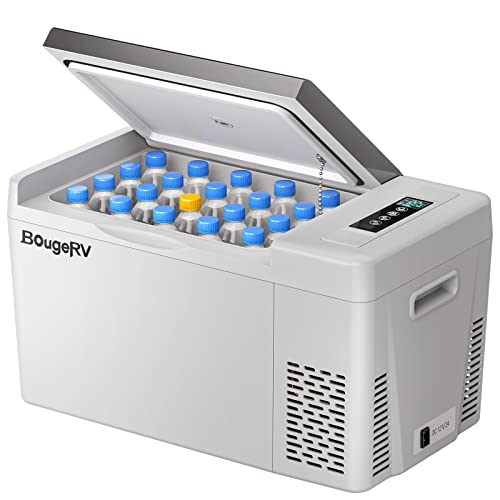
BougeRV 12V Refrigerator (23 Quart) — Best Fast Cooling
BougeRV’s 23 quart fridge competes on responsiveness. The listing states a range from -8 to 50 degrees — full freezer to gentle chill — and a fast cool that reaches 32 degrees in 15 minutes, which in real life means the fridge you forgot to pre-chill still rescues the shopping on the drive home from the store, and drinks loaded warm at a midday stop are properly cold by the afternoon trailhead. For road-trip-heavy campers, that pull-down speed is used constantly.
The size sits a step above the C20 class with the same fridge-or-freezer flexibility, on the same dual power arrangement. BougeRV has built a strong name in vehicle camping gear, and this model is its core offer: nothing exotic, everything responsive. Campers who tour in hot climates will particularly value a compressor and control system tuned for fast recovery after every lid opening at a fuel stop.
Strengths
- Widest stated temperature span in this group
- Fast pull-down rescues warm loads quickly
- Slightly larger than the classic 21 quart size
Trade-offs
- Single zone like its direct rivals
- Fast cooling works the compressor — and battery — harder
- No untethered battery option in this model
| Spec | Detail |
|---|---|
| Capacity | 23 quart |
| Range | -8℉ to 50℉ |
| Cooling | Fast 15-min cool to 32°F (as listed) |
| Power | 12/24V DC, 110V AC |
Choose the BougeRV when your camping is stitched into driving days: national-park loops, festival runs, long weekends with supermarket stops. Its talent is recovery — every time life warms the box up, it gets cold again fast. Static base-camp campers will not use that talent enough to matter; mobile campers will use it daily.
Fast pull-down has a second benefit owners discover in winter: the same responsive system defrosts and recovers quickly after cleaning, so the fridge spends its life at temperature rather than travelling toward it. Keep its vents clean and the responsiveness you bought is the responsiveness you keep.
Best for: road-trippers and hot-climate tourers who reload often / Not suited for: static base camps that rarely open the lid
Check on Amazon — check price on Amazon before you order, and confirm the listing matches the model described here.

Alpicool C50 Portable Car Freezer (47 Quart) — Best Large Capacity
When the party grows or the tour stretches past a week, capacity stops being a luxury. The C50’s 47 quarts hold a family’s fresh food for a long weekend or a couple’s provisions for a serious tour, with fast cooling to recover after the big load-in. It runs on 12/24V DC and wide-range 100–240V AC, a detail international travelers and RV owners appreciate more than most.
Size discipline still applies: 47 quarts loaded is a two-hand, plan-the-lift object, and it claims a large, permanent footprint in the vehicle. In return you stop playing cooler Tetris, shop less often on tour, and carry frozen and fresh in one machine across a trip (at one temperature — it is a single-zone box). For group camps where one person provisions everyone, this is the pick that ends the ice conversation.
Strengths
- Family and group capacity without a second unit
- Fast cooling handles big warm load-ins
- Wide-range AC input suits RV and travel use
Trade-offs
- Large, heavy footprint in the vehicle
- Single zone despite the family size
- Draws more from the battery system than compact models
| Spec | Detail |
|---|---|
| Capacity | 47 quart |
| Type | Portable car freezer / refrigerator |
| Power | 12/24V DC and 100-240V AC |
| Use | RV, truck, camping, outdoor |
The C50 buyer is provisioning people, not just camping. Scout troops, fishing camps, multi-family sites, the friend who cooks for the group — this is their fridge. If your trips are two people and three days, it is more box than you need and the C20 will serve you better; if you have ever bought ice twice in one weekend, the C50 is your size.
A big single-zone box rewards one packing discipline above all: freeze flat. Sauces, meats and meals frozen in flat packs stack like books, chill the box evenly, and thaw predictably. Master flat-freezing and the C50’s capacity feels half again larger than its litres suggest.
Best for: families, groups and long tours needing one big box / Not suited for: solo and couple campers in small vehicles
Check on Amazon — check price on Amazon before you order, and confirm the listing matches the model described here.

Alpicool Car Refrigerator (10 Quart) — Best Compact
Small fridges are usually thermoelectric toys; this one is not. The Alpicool 10 quart is a genuine compressor fridge freezer with a stated range from -4 to 68 degrees, in a box small enough for a footwell, a boat console, or beside a single camp chair. That combination — real temperature certainty, tiny footprint — serves needs the big boxes cannot: medication and specialty food that must stay truly cold, one person’s fresh supplies on a solo tour, or a freezer for ice in a vehicle already carrying a cooler.
Its limits are arithmetic, not quality: ten quarts is a few days of one person’s fresh food, or drinks for two for a day. It sips power compared with its larger siblings and is the easiest fridge here to run from a modest power station overnight. For van-lifers with a main fridge, it also makes an ideal dedicated freezer — the classic two-box system in miniature.
Strengths
- True compressor performance in the smallest footprint
- Wide stated range covers freezer duty
- Light power draw suits small power stations
Trade-offs
- 10 quarts is strictly personal-scale
- Single temperature zone
- Per-quart cost is higher than big models
| Spec | Detail |
|---|---|
| Capacity | 10 quart (9 L) |
| Range | -4~68°F |
| Power | AC / DC |
| Use | Truck, van, RV, camper, SUV, boat |
Buy this fridge for certainty in miniature: the insulin, the baby food, the good cheese, the ice for evening drinks. It is also the lowest-commitment way to learn compressor-fridge life before buying a family box. Small, exact, and honest about its scale — a specialist that knows its job.
The little Alpicool’s best trick is specialization: dedicate it to the items that must never warm — medication, baby food, the good butter, tonight’s ice — and let a cheaper cooler handle drinks. Two small, purposeful boxes often serve a solo tourer better than one large compromise.
Best for: solo campers, medication storage and dedicated mini-freezer duty / Not suited for: family provisioning
Check on Amazon — check price on Amazon before you order, and confirm the listing matches the model described here.

BougeRV CRD2 V2 52QT Refrigerator with 240Wh Battery (Dual Zone) — Best Off-Grid / Dual Zone
The CRD2 V2 is what the category looks like with every modern box ticked. Two zones with independent temperature control mean a true freezer beside a true fridge — ice cream and frozen meat on the left, produce and drinks on the right. The included 240Wh lithium iron phosphate battery changes campsite life most of all: the fridge keeps running untethered while the vehicle is away on a day trip, or through the night with no draw on the starting battery at all.
Wheels and a telescopic handle acknowledge the obvious: 52 quarts of food is heavy, and a fridge this capable will live at base camps, RV sites and group kitchens where rolling beats carrying. It is the premium pick in this guide on merit — the feature set is the fullest expression of what a 12 volt camping fridge can be — and for off-grid campers who measure trips in weeks, it is the one-box answer.
Strengths
- Dual zones with independent control — fridge and freezer together
- Included LiFePO4 battery for untethered running
- Wheels and handle tame the loaded weight
Trade-offs
- Premium tier — the most expensive formula here
- Large footprint demands a suitable vehicle
- Battery adds weight even when you do not need it
| Spec | Detail |
|---|---|
| Capacity | 52 quart, dual zone |
| Range | -4~68℉, independent zone control |
| Battery | 240Wh LiFePO4 included |
| Mobility | Wheels and telescopic handle |
Choose the CRD2 V2 when the trip is long, the group is hungry, and the vehicle leaves camp without you. Hunters, fishing camps, overland tourers and RV boondockers are its people. If your camping is two nights and a powered site, its talents are wasted; if your camping is ten nights and a shoreline, nothing else in this guide does the whole job.
The CRD2 V2’s battery deserves one ownership note: lithium iron phosphate packs prefer partial cycling and cool storage, so the fridge’s own battery will age best in exactly the touring life it was bought for. Wheels and handles should be rinsed after beach camps — sand is their only real enemy.
Best for: off-grid, long-trip and group campers wanting fridge + freezer + battery / Not suited for: weekend campers on powered sites
Check on Amazon — check price on Amazon before you order, and confirm the listing matches the model described here.

Alpicool 43 QT Dual Zone Refrigerator (APP Control) — Best Dual Zone Value
For many families the real upgrade is not size but zones. This 43 quart Alpicool splits into dual zones, so frozen food stays frozen while the fridge side holds produce at a gentle chill — the two-temperature life that single-zone owners compromise around with ice packs and packing order. App control sounds like garnish until the fridge is buried behind luggage: checking and changing temperatures from the driver’s seat, without unloading the cargo area, is a feature owners use every trip.
Fast cooling and the standard wide power input (12/24V DC, 100–240V AC) complete a specification aimed at vehicle-based family touring: truck, RV, camper. What it does not include is a battery, so untethered running means a power station or the vehicle’s system with battery protection — plan the power side, and this fridge covers the food side completely at a friendlier tier than the flagship.
Strengths
- Dual zones solve the fridge-versus-freezer compromise
- App control is genuinely useful in a packed vehicle
- Family capacity with fast cooling recovery
Trade-offs
- No included battery for untethered use
- Dual-zone dividers reduce single-space flexibility
- App setup is one more account-and-pairing chore
| Spec | Detail |
|---|---|
| Capacity | 43 QT, dual zone |
| Control | APP control |
| Power | 12/24V DC & 100-240V AC |
| Cooling | Fast cooling |
This is the dual-zone pick for campers who tour from the vehicle and sleep near it — the power question is already answered by the alternator and the occasional powered site. Families upgrading from a single-zone box will feel the difference at the first ice-cream stop. If your vehicle leaves camp all day, look at the BougeRV flagship instead; if it stays, this is your fridge.
App control ages better than sceptics expect, because its real use is boring and constant: verifying temperature from the cab after a fuel stop, confirming the freezer after a rough track. Keep the app’s firmware updated at home, on good Wi-Fi, never mid-tour on a trailhead connection.
Best for: families wanting fridge + freezer in one vehicle-powered box / Not suited for: campers needing untethered battery running
Check on Amazon — check price on Amazon before you order, and confirm the listing matches the model described here.
Comparison Table
| Pick | Badge | Key spec | Best for |
|---|---|---|---|
| Alpicool C20 Portable Compressor Fridge Freezer (21 Quart) | Best Overall | 21 qt compressor fridge/freezer, DC + AC | couples and solo tourers wanting their first true camping fridge |
| BougeRV 12V Refrigerator (23 Quart) | Best Fast Cooling | 23 qt, -8~50F, 15-min cool to 32F | road-trippers and hot-climate tourers who reload often |
| Alpicool C50 Portable Car Freezer (47 Quart) | Best Large Capacity | 47 qt family size, DC + 100-240V AC | families, groups and long tours needing one big box |
| Alpicool Car Refrigerator (10 Quart) | Best Compact | 10 qt compressor, -4~68F range | solo campers, medication storage and dedicated mini-freezer duty |
| BougeRV CRD2 V2 52QT Refrigerator with 240Wh Battery (Dual Zone) | Best Off-Grid / Dual Zone | 52 qt dual zone + 240Wh battery, wheels | off-grid, long-trip and group campers wanting fridge + freezer + battery |
| Alpicool 43 QT Dual Zone Refrigerator (APP Control) | Best Dual Zone Value | 43 qt dual zone, app control, DC + AC | families wanting fridge + freezer in one vehicle-powered box |
How to Choose the Best 12 Volt Camping Fridge: Size, Zones, Power
Size by appetite and itinerary, not by the biggest number. Ten quarts serves one person’s essentials; the 21–23 quart class covers a couple for a long weekend; 43–52 quarts feeds families and week-plus tours. Remember that a fridge replaces ice volume too — the usable food space in a 40 quart fridge rivals a much larger ice chest, because none of it is ice. Campers upgrading from coolers consistently overbuy their first fridge; the class below the one you are eyeing is usually right.
Zones decide menus. A single-zone fridge is one temperature: perfect if a trip is all-fridge or all-freezer, limiting if you tour with both fresh produce and frozen meat for a week. Dual zones cost more and complicate packing slightly, and for long or family trips they are worth it the first time ice cream and salad share a box successfully. Power is the third leg: vehicle-powered fridges need battery-protection settings respected, while battery-equipped models like the BougeRV flagship trade money for independence from the vehicle entirely.
- Solo / essentials: Alpicool 10 Quart
- Couples: Alpicool C20 or BougeRV 23 Quart
- Families, one temperature: Alpicool C50
- Families, two temperatures: Alpicool 43 QT Dual Zone
- Off-grid independence: BougeRV CRD2 V2 with battery
Battery Protection and Power Planning
Every vehicle fridge in this class offers battery protection — a cutoff that stops the fridge before it can flatten your starting battery — and the most common owner error is leaving it on the wrong setting. Set it to the highest protection level when running from a starting battery; the fridge cycling off at dawn is an inconvenience, while a no-start at a remote site is an emergency. With a dedicated leisure battery or power station, lower protection extracts more of that battery’s capacity safely.
Understand the draw rhythm: a compressor fridge cycles, sipping hard for a few minutes, then resting, averaging a modest hourly consumption that a day’s driving replaces easily. The danger window is the parked multi-day stay. Plan it like water: know your battery’s usable capacity, the fridge’s appetite, and your recharge source — alternator, solar, or site power — and the fridge becomes the most reliable appliance you own. Solar pairs naturally here: a panel that covers the fridge’s daytime draw stretches any battery system by days.
Packing a Compressor Fridge for Real Performance
Cold air falls out of a top-opening fridge far less than a front door, which is one reason this chest format dominates camping. Pack by day and by meal so each opening retrieves several things at once, keep drinks — the most-raided item — in one corner or a separate small cooler, and fill empty space with tomorrow’s supplies rather than air. Liquids in sealed, flat containers stack and chill better than round bottles, and raw meat goes lowest, in a sealed box, where any leak harms nothing.
Set temperatures with intent: fridge zones around the high 30s Fahrenheit for general food, freezer zones at or below zero for anything stored beyond a couple of days or for ice cream that should scoop like it. Give a loaded fridge an hour to settle before judging it, and let hot leftovers cool before they go in — a compressor can handle them, but your battery pays for the heat you could have left on the picnic table for twenty minutes.
Fridge Slides, Covers and the Accessories That Are Actually Worth It
The accessory market around these fridges is large, and two items earn their money for almost every regular tourer. The first is the insulated cover: in a sun-heated vehicle it can cut the compressor’s workload noticeably, because the fridge’s hardest job is fighting the cabin air around it. The second is the fridge slide, which converts a buried box into a drawer — on a two-week tour, the difference between lifting luggage to reach dinner and simply sliding the fridge out is the difference between a system you love and one you tolerate.
Beyond those two, buy accessories to solve named problems, not to complete a catalogue. A basket set helps if your packing is chaotic; a remote temperature monitor helps if the fridge rides in a separate trailer or canopy; a dedicated DC wiring kit with quality cable helps if your vehicle’s socket run is long and thin, because voltage drop on a weak circuit is the hidden cause of many ‘faulty fridge’ stories that are actually faulty wiring. Test voltage at the fridge under load before blaming the appliance.
And keep one analogue tool in the kit: a simple fridge thermometer. App readouts and lid displays are convenient, but an independent thermometer, checked on the first morning of a trip, is the ground truth that your food is safe. It costs almost nothing, never needs pairing, and has ended more campsite arguments than any other object in the touring kitchen.
Single Zone vs Dual Zone: Living With Each, Honestly
The zone decision deserves a lived account rather than a spec comparison. Single-zone life is simple and, for most trips, sufficient: set the box to fridge temperature, and manage frozen items by eating them first, packing them deepest, or accepting that ice cream is a day-one treat. Generations of tourers have eaten extremely well this way, and the money saved against dual zone buys a lot of excellent food. The compromise is real but small, and it shrinks further on trips under a week.
Dual-zone life removes a category of planning: the freezer side simply holds its line for the whole tour, so menus can be planned by appetite instead of by thaw order. Families notice it most at the ends of long trips — day nine’s frozen berries and ice cream taste like a superpower — and hunters and anglers notice it when the catch must be frozen properly for the journey home. The costs are money, a little packing rigidity from the divider, and the discipline of managing two temperatures.
Choose by trip length and menu ambition, not by feature envy. Under a week, mostly fresh: single zone, happily. Over a week, or frozen goods at the heart of the plan: dual zone, without regret. And remember that a single-zone box can always run as a dedicated freezer beside a cheap cooler for fresh goods — the two-box system that many experienced tourers quietly prefer to any single appliance.
How to Set Up a 12 Volt Fridge in Your Vehicle
A fridge installed carelessly underperforms no matter how good it is. This setup covers placement, ventilation, power and tie-down for a typical vehicle install — the same principles apply in an RV, boat or truck bed with a canopy.
- Pre-chill the fridge at home on AC power and load it with already-cold food before it goes near the vehicle
- Choose a flat, shaded position with several inches of clearance around the compressor vents — never bury the vents in luggage
- Secure the fridge with straps or a slide so it cannot tip or slide under braking; a loaded fridge is heavy and becomes a hazard loose
- Run the DC cable by the shortest tidy route to the socket or battery, avoiding pinch points and hot surfaces, and keep the plug connection accessible
- Set the battery protection to its highest level if the fridge runs from the starting battery; lower it only for a dedicated leisure battery or power station
- Set your temperatures — fridge in the high 30s F, freezer at or below 0 F — and give the loaded box an hour to settle before adjusting
- On the first trip, check the fridge and the vehicle’s starting after the first long stop; confirm protection settings behave as expected
After a few trips, two upgrades transform fridge life for regular tourers: a fridge slide, which turns a buried box into a drawer you can actually pack from, and an insulated cover, which cuts power draw in hot vehicles noticeably. Neither is necessary on day one. What is necessary is the habit of checking the vents and the battery setting each season — the two five-second checks that prevent nearly every ‘my fridge stopped working’ story.
A final installation refinement: if your fridge will live in the vehicle semi-permanently, hard-wire a dedicated, fused DC circuit with quality cable rather than relying on a distant socket. Voltage drop across a long, thin factory socket run is the single most common cause of fridges that cycle oddly, error at dawn, or underperform their specification. One proper circuit, installed once, makes the fridge behave like the appliance it is — and makes every future 12 volt accessory in that space work better too.
Common Buying Mistakes
Buying capacity you cannot house. A 52 quart fridge in a hatchback eats the trip it was bought to feed. Measure the vehicle space, with the lid opening considered, before falling for capacity.
Leaving battery protection on the lowest setting. On a starting battery, low protection trades a cold drink for a no-start. Highest protection for starting batteries; lower settings belong to leisure batteries and power stations.
Blocking the compressor vents. A fridge suffocated by luggage works constantly, draws heavily, and cools poorly. Vent clearance is a performance feature, not a suggestion.
Loading warm food and judging the fridge an hour later. A full warm load takes hours to pull down. Pre-chill the box and the food, then judge performance the next morning.
Opening constantly for drinks. Drinks cause most openings. A small separate drinks cooler — even a thermoelectric one — protects the fridge’s temperature and your battery across a whole trip.
Running the fridge unsecured. A loaded fridge sliding under braking endangers passengers and the fridge. Strap it down every trip, not just on rough roads.
Final Recommendation
Most campers should buy the Alpicool C20: the proven size, true fridge-freezer range, and dual power at the category’s friendliest tier. Mobile road-trippers who reload often will prefer the BougeRV 23 Quart’s fast recovery, families needing volume the C50, and families needing two temperatures the Alpicool 43 QT Dual Zone. Solo campers and specialist users get certainty in miniature from the 10 Quart, and serious off-grid tourers should save for the BougeRV CRD2 V2 — dual zones and its own battery make it the complete one-box answer.
Whichever you choose, set the battery protection correctly, keep the vents clear, and pre-chill before you load. A compressor fridge treated that way is the single biggest quality-of-life upgrade in modern camping — the end of ice, and the start of eating at camp exactly as well as you eat at home.
One last habit separates fridge owners who rave from fridge owners who troubleshoot: the first-morning check. On the first morning of every trip, before breakfast, look at three things — the fridge’s internal temperature against your thermometer, the battery system’s state after the night, and the vents’ clearance after a day of cargo shifting. Ninety seconds, three glances. That tiny ritual catches every common fridge problem while it is still a curiosity instead of a crisis: the setting bumped in transit, the vent buried by a moved bag, the battery working harder than the plan allowed. Touring is a chain of small systems, and the fridge is the one your food, your battery and your morale all depend on at once. Check it first, check it briefly, and then go and enjoy the wilderness secure in the knowledge that dinner is exactly as cold as you left it.
New owners sometimes ask when a fridge stops feeling like equipment and starts feeling like infrastructure. The answer, consistently, is the second long trip — the one where the shopping is done by appetite rather than by ice arithmetic, where the last day’s food is as good as the first day’s, and where the drive home no longer includes a cooler of casualties to throw away. Every pick in this guide is capable of delivering that trip. Choose the size and the zones your life actually needs, install it with care, and let the second trip make the argument this guide has been making all along.
That is the quiet promise at the heart of this category: food you can trust, anywhere the road or the track can take a 12 volt wire, in any weather your camping life can find.
- Alpicool C20 Portable Compressor Fridge Freezer (21 Quart) (Best Overall) — Check on Amazon
- BougeRV 12V Refrigerator (23 Quart) (Best Fast Cooling) — Check on Amazon
- Alpicool C50 Portable Car Freezer (47 Quart) (Best Large Capacity) — Check on Amazon
- Alpicool Car Refrigerator (10 Quart) (Best Compact) — Check on Amazon
- BougeRV CRD2 V2 52QT Refrigerator with 240Wh Battery (Dual Zone) (Best Off-Grid / Dual Zone) — Check on Amazon
- Alpicool 43 QT Dual Zone Refrigerator (APP Control) (Best Dual Zone Value) — Check on Amazon
Keep exploring the cluster: Best 12 Volt Camping Cooler Best 12 Volt Camping Heater Best 12 Volt Camping Shower Best 12 Volt Cab Heater
Frequently Asked Questions
What temperature should I set a camping fridge to?
For general fresh food, the high 30s Fahrenheit keeps everything safely cold without freezing produce at the cold spots. For a freezer zone storing food beyond a few days — or ice cream — set at or below zero. Dual-zone owners can run both at once, which is the point of the format.
How long will a 12 volt fridge run on my car battery?
With battery protection set high, it will cycle safely for many hours and stop before endangering a start — but multi-day parked running belongs on a leisure battery, power station, solar setup, or a battery-equipped fridge like the BougeRV CRD2 V2. A day of driving replenishes far more than a night of fridge use consumes.
Is a dual-zone fridge worth it?
For trips longer than a weekend, or any trip mixing frozen meat and fresh produce, yes — it removes the daily compromise of a single temperature. For weekend fridge-only camping, a single zone is simpler, lighter and cheaper, and loses nothing.
Can a 12 volt fridge replace my home freezer overflow?
Several picks here run on AC power and work happily as a garage or spare-room overflow freezer — the wide-range AC input on the larger Alpicools suits this well. It is a common second life for a touring fridge in the off-season.
Why does my fridge draw more power on hot days?
The compressor works against the temperature difference between the box and its surroundings, and it sheds heat through vents into the vehicle’s air. Hot, still air around the vents makes every cycle longer. Shade, vent clearance and an insulated cover all pay for themselves in battery life.
Fridge or cooler — how do I decide?
If your trips are short, your weather mild and your menu flexible, a thermoelectric cooler is lighter and cheaper. If you tour long, camp hot, carry raw meat for days, or want frozen food at camp, the compressor fridge is not a luxury — it is the tool the job actually requires.
How loud is a 12 volt camping fridge at night?
Modern units in this class are designed for sleeping-vehicle life: the compressor’s hum is comparable to a quiet household fridge and cycles off entirely once at temperature. Light sleepers position the fridge as far from the bed as the vehicle allows and use the insulated cover, which muffles as well as insulates.
Can I run a camping fridge from solar?
Yes — it is one of the classic solar loads. A modest panel covering the fridge’s daytime draw, paired with a battery for the night, runs a fridge indefinitely in sunny conditions. Battery-equipped models like the BougeRV CRD2 V2 simplify the system further by carrying their own storage.


