Disclosure: airfryerkitchensupply.com is reader-supported. When you buy through links on our site, we may earn an affiliate commission at no extra cost to you.
Where to buy
Buying the best 12 volt buffer: Every linked pick below was verified against Amazon’s catalog data for this site before this guide was published, and each one is sold through Amazon. Prices move constantly on detailing tools, so this page never prints a fixed figure: use the links to check the current price on Amazon, confirm the kit contents match what is described here, and check which batteries and pads are actually in the box before you order.
- SPTA Cordless Car Buffer Polisher (2-Battery Brushless Kit) (Best Overall) — Check the current price on Amazon
- DCA 12V Cordless Buffer Polisher (3 Inch Brushless) (Best for Tight Panels and Spot Work) — Check the current price on Amazon
- KITLUCK 12V Cordless Buffer Polisher Kit (40-Piece Pad Set) (Best Complete Starter Kit) — Check the current price on Amazon
- SPTA Cordless Mini Polisher RO/DA (12V Multi Polisher) (Best for Scratch Correction) — Check the current price on Amazon
- WORKPRO 12V Cordless Mini Buffer Polisher Kit (Best Budget) — Check the current price on Amazon
- SPTA Cordless Mini Car Polisher (12V Micro) (Best for Motorcycles and Detailing Pros) — Check the current price on Amazon
Finding the best 12 volt buffer starts with an honest definition, because the phrase means something specific in today’s market. There is no mainstream orbital buffer that runs off a cigarette-lighter socket the way a 12 volt fan or cooler does. What actually exists — and what detailers actually buy — is a family of compact polishers powered by 12 volt lithium battery packs: small dual-action and rotary mini machines built for spot correction, wax spreading, motorcycle and trim work, and panel-by-panel polishing where a full-size corded machine is clumsy. Every pick in this guide is one of those verified 12 volt machines.
That framing matters because it sets realistic expectations. A 12 volt buffer will not correct a whole neglected SUV in an afternoon the way a 15 mm long-throw corded polisher can, and it is not meant to. Its strengths are control, low weight, and precision: removing a door-handle scratch cluster, polishing a headlight lens, working a motorcycle tank, or laying down wax without dragging a cord across fresh paint. Judged on that job — precision work, tight panels, and grab-and-go detailing — the six machines below are the ones worth your money.
This guide is organized the way a careful buyer actually shops. The Quick Picks give you the shortlist with a clear badge for each machine. The detailed reviews explain who each buffer suits and where it gives up ground. The buying-guide sections then cover pad sizes, throw, battery math, and technique, and the how-to section walks through a complete first polishing session step by step. If you only read one section, read the mistakes section before you buy — most disappointment with 12 volt buffers comes from expecting full-size correction power from a precision tool.
One more framing note before the picks: the 12 volt label describes the battery platform these machines share with a huge family of compact tools, and platform loyalty is a real buying factor. If your garage already runs a 12 volt system from one of the brands here, a compatible body can share batteries and chargers across tools. If you are starting fresh, judge each kit as a self-contained system — batteries, charger, plates and pads — because that is what you will actually live with. The reviews below score the kits exactly that way.
In this guide
Quick Picks
SPTA Cordless Car Buffer Polisher (2-Battery Brushless Kit) — Best Overall. The most complete expression of what a 12 volt buffer should be: a brushless machine, two 12V lithium batteries in the box, variable speed, and a pad kit that covers real waxing and light polishing from day one. — Check price on Amazon
DCA 12V Cordless Buffer Polisher (3 Inch Brushless) — Best for Tight Panels and Spot Work. A brushless 3 inch mini polisher that doubles as a 2 inch sander, with two 2.0Ah batteries and a wide 2800–8300 RPM range for precise spot correction. — Check price on Amazon
KITLUCK 12V Cordless Buffer Polisher Kit (40-Piece Pad Set) — Best Complete Starter Kit. The kit for buyers starting from zero: 1, 2 and 3 inch capability, a 40-piece pad set, and two larger 2.5Ah batteries with charger included. — Check price on Amazon
SPTA Cordless Mini Polisher RO/DA (12V Multi Polisher) — Best for Scratch Correction. A rotary/dual-action switchable micro polisher with wool pads in the set, aimed squarely at scratch and defect work in small areas. — Check price on Amazon
WORKPRO 12V Cordless Mini Buffer Polisher Kit — Best Budget. Five variable speeds and a compact body from a mainstream tool brand, positioned as the affordable way into 12 volt polishing for cars and household projects alike. — Check price on Amazon
SPTA Cordless Mini Car Polisher (12V Micro) — Best for Motorcycles and Detailing Pros. The micro-format SPTA for the smallest painted surfaces — motorcycle tanks, chrome-adjacent trim, and concours-level spot work where control is everything. — Check price on Amazon
How These Picks Were Chosen
Each candidate machine was checked against live catalog data through this site’s product-verification system before it earned a place here. That check confirms the exact model, its battery platform, and its kit contents as currently listed, so the machine described in a review is the machine the link actually sells. Machines whose listings could not be matched with confidence were left out rather than guessed at, and no specifications appear in this guide unless they come from the verified listing itself.
The shortlist was then balanced deliberately across the ways people use a 12 volt buffer: one all-rounder, one kit for buyers who own nothing yet, one rotary-leaning correction tool, one budget starter, and two micro machines for the tightest work. Six near-identical generic kits would have been easier to list and far less useful.
- Verified 12 volt battery platform with the batteries and charger situation stated plainly
- Pad and backing-plate sizes that match real detailing work, from 1 inch spot pads to 3 inch panel pads
- Speed control with enough range for both compounding and gentle wax spreading
- Kit contents counted honestly — pads, batteries and cases change the real value
- Weight and grip shape suited to one-handed precision work
- A clear limitation stated for every pick, not just strengths
The 6 Best 12 Volt Buffers

SPTA Cordless Car Buffer Polisher (2-Battery Brushless Kit) — Best Overall
If you want one 12 volt buffer that handles the widest range of home detailing, this SPTA kit is the sensible center of the market. The brushless motor is the headline: brushless designs run cooler and keep torque steadier under pad pressure than brushed equivalents, which is exactly where small polishers usually fade. Two 12V lithium batteries in the box means one can charge while the other works, so a full waxing session never stalls waiting on a charger.
The included polishing pad kit makes it a genuine starter system rather than a bare tool. You can spread wax across a whole car, then drop to a finer pad for light swirl work on a single panel, without a second purchase. Variable speed control lets you slow the pad right down for delicate trim and fresh paint, then bring it up for more cut on oxidized clear coat.
Strengths
- Brushless motor holds speed better under pressure than brushed rivals
- Two batteries included, so polishing and charging can overlap
- Pad kit included — usable for waxing and light correction immediately
Trade-offs
- Still a compact machine; whole-car heavy correction is slow work
- Pad selection is starter-grade rather than professional-grade
- Small batteries drain quickly at sustained high speed
| Spec | Detail |
|---|---|
| Power | 12V lithium battery (2 included) |
| Motor | Brushless |
| Speed | Variable speed |
In practice this is the buffer we would hand to someone correcting their first car. The balance is neutral, the trigger discipline is easy to learn, and the machine forgives the classic beginner error of lingering in one spot better than a rotary does, because a dual-action style pad path spreads heat. Pair it with a mild polish for swirls and a finishing pad for wax, and it covers ninety percent of what home detailers actually do. Reserve it for that work, and it will feel capable rather than compromised.
Ownership is straightforward: the brushless motor asks for nothing, the pads wash clean, and the two-pack rotation means a pack is always ready. Keep a medium and a finishing pad dedicated to this machine and it becomes the default paint-care tool in the garage — the one that gets used because it is always ready to be used.
Best for: home detailers who want one 12 volt buffer for waxing, light swirl removal and general paint care / Not suited for: professionals correcting hard, heavily oxidized paint all day
Check on Amazon — check price on Amazon before you order, and confirm the listing matches the model described here.

DCA 12V Cordless Buffer Polisher (3 Inch Brushless) — Best for Tight Panels and Spot Work
The DCA is the precision instrument of this group. Its 3 inch polishing head and 2 inch sanding configuration put it exactly where full-size machines cannot go: A-pillars, mirror caps, door-handle cups, motorcycle bodywork, and the narrow painted strips between badges and panel edges. The brushless motor and the unusually wide speed range — 2800 to 8300 RPM across two variable settings — give it both the gentle low end for wax and the top end for spot compounding.
Two 2.0Ah batteries are included, which matters more on a mini polisher than buyers expect, because spot work involves constant stopping, inspecting, and restarting. The sanding function is a real second trade, useful for nib removal, small paint-prep jobs, and headlight restoration work where controlled abrasion is the whole point.
Strengths
- Brushless motor with a genuinely wide, usable speed range
- Switches between 3 inch polishing and 2 inch sanding roles
- Two 2.0Ah batteries included for stop-start spot work
Trade-offs
- 3 inch pad is slow across large flat panels
- Sanding discs and finer pads are extra purchases
- High top speed demands care on thin or repainted panels
| Spec | Detail |
|---|---|
| Power | 12V, 2 x 2.0Ah batteries |
| Pad sizes | 3 inch polisher / 2 inch sander |
| Speed | 2 variable speeds, 2800–8300 RPM |
| Motor | Brushless |
Choose the DCA when your detailing problems are specific rather than general: the scratch by the fuel flap, the scuffed piano-black trim, the hazed headlight. It is the machine most likely to live in a detailing apron pocket rather than a cabinet. What it is not is a volume tool — polishing an entire bonnet 3 inches at a time teaches patience the hard way — so pair it with realistic expectations and it excels.
The DCA’s second life as a sander deserves emphasis: headlight restoration alone can justify it, since the controlled 2 inch sanding stage is exactly what lens kits try to imitate with drill attachments. Add its polishing precision and it is really two specialist tools sharing one battery platform.
Best for: spot correction, headlights, motorcycles and narrow panels / Not suited for: buyers who mainly polish large flat panels
Check on Amazon — check price on Amazon before you order, and confirm the listing matches the model described here.

KITLUCK 12V Cordless Buffer Polisher Kit (40-Piece Pad Set) — Best Complete Starter Kit
Most mini polishers quietly assume you already own pads, backing plates, and batteries. The KITLUCK kit assumes the opposite, and that is its entire appeal. Three pad sizes — 1, 2 and 3 inch — cover everything from badge surrounds to door panels, the 40-piece pad set spans cutting through finishing grades, and the two included batteries are the larger 2.5Ah size, with a charger in the box. Unbox it and you can detail the same afternoon.
The two-speed variable control is simpler than some rivals, and the machine itself is a straightforward mini waxer-polisher rather than a high-torque correction tool. That honesty is fine: the value here is completeness. For a first buffer, having the right pad for the job matters more than the last increment of motor sophistication.
Strengths
- Most complete box in this guide — pads, plates, batteries, charger
- Larger 2.5Ah batteries run longer between swaps
- Three pad sizes cover spot work through small panels
Trade-offs
- Simpler speed control than the brushless picks
- Pad quality is consumable-grade; expect to replace favorites
- Not the choice for aggressive defect removal
| Spec | Detail |
|---|---|
| Power | 12V, 2 x 2.5Ah batteries + charger |
| Pad sizes | 1 / 2 / 3 inch |
| Kit | 40-piece polishing pad set |
| Speed | 2 variable speeds |
Think of the KITLUCK as a detailing course in a box. The variety of pads teaches the single most important polishing lesson — pad and product choice changes results more than machine choice — because you can experiment across grades on one panel. Once you know which pads you actually use, upgrading the machine later is an informed decision instead of a guess.
Because everything is in the box, the KITLUCK is also the most giftable and lendable pick here — nothing needs explaining or supplementing. Its pad wardrobe doubles as a learning library: work through the grades on one test panel and you will understand more about polishing than a month of videos teaches.
Best for: first-time buyers who own no pads or batteries yet / Not suited for: experienced detailers who already own a pad system
Check on Amazon — check price on Amazon before you order, and confirm the listing matches the model described here.
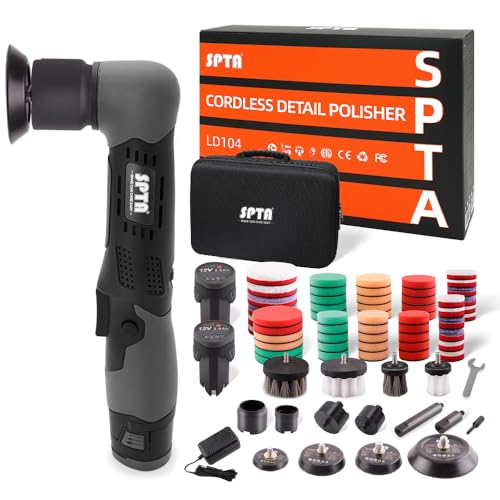
SPTA Cordless Mini Polisher RO/DA (12V Multi Polisher) — Best for Scratch Correction
SPTA built its name on mini polishers, and this multi polisher shows why. The ability to work in rotary mode for concentrated defect removal and dual-action mode for safer finishing is rare at this size, and the included wool pads signal the intent: this machine is for the scratch, the scuff, and the keyed panel section, not for spreading wax over a whole car — though it will do that too, gently, in DA mode.
Rotary mode demands respect. It concentrates cut in a small circle and can burn through clear coat in careless hands, which is why this pick is badged for correction rather than for beginners. Used with a light touch, frequent inspection, and a finishing pass in DA mode, it removes defects that pure dual-action minis simply polish around.
Strengths
- Rotary and dual-action modes in one micro machine
- Wool pads included for genuine cutting work
- SPTA’s mini-polisher ergonomics are well sorted
Trade-offs
- Rotary mode can damage paint in inexperienced hands
- Premium positioning within the 12 volt class
- Small pads make large-area work impractical
| Spec | Detail |
|---|---|
| Power | 12V cordless |
| Action | RO / DA switchable |
| Kit | Polishing pads and wool pads included |
The honest way to use this machine is as a surgical tool. Work a defect in short rotary passes, wipe, inspect under good light, and stop the moment the defect is gone — every extra pass is clear coat you cannot put back. Finish in DA mode with a fine pad to remove the rotary haze. Detailers who already understand that discipline will get professional-grade spot results from a pocket-size tool.
The correction ability cuts both ways in ownership terms: wool pads load with residue quickly and need spur-cleaning during a session, and rotary work demands fresh masking tape on edges every time. Build those habits and the machine’s ceiling is the highest here for defect work.
Best for: experienced users removing scratches and isolated defects / Not suited for: complete beginners polishing their first car
Check on Amazon — check price on Amazon before you order, and confirm the listing matches the model described here.

WORKPRO 12V Cordless Mini Buffer Polisher Kit — Best Budget
WORKPRO’s mini buffer is the pragmatist’s pick. Five variable speeds cover the working range for waxing, light polishing, and the household jobs the listing itself names — furniture polishing among them — and the compact body is unintimidating for someone who has never held a polisher. As a first machine for keeping one or two family cars tidy, it asks very little and does the job.
The compromises are the expected ones at the budget end of the 12 volt tier. It is a mini machine with mini-machine torque, so heavy oxidation will defeat it, and the kit is a starter set rather than a full pad wardrobe. Judge it as an inexpensive wax spreader and light polisher and it is honestly specified; judge it as a correction tool and you are shopping in the wrong tier.
Strengths
- Five speeds give useful control for the price tier
- Compact and approachable for first-time users
- Doubles for furniture and household polishing
Trade-offs
- Light torque; heavy defects are beyond it
- Starter-grade pad selection
- Battery ecosystem is WORKPRO-specific
| Spec | Detail |
|---|---|
| Power | 12V cordless |
| Speed | 5 variable speeds |
| Design | Compact mini buffer polisher kit |
There is a real detailing philosophy behind buying this tier first: learn technique on a gentle machine, on an older panel, before spending more. Speed control, pad pressure, and product amount are skills, and the WORKPRO lets you build them while keeping a daily driver waxed and presentable. If detailing becomes a hobby, it retires gracefully to trim and interior-adjacent work.
WORKPRO ownership is deliberately unremarkable, which suits its buyers: charge the pack, wash the pads, wax the car. Its household second jobs — a scratched tabletop, a dull headboard — mean it earns storage space in homes where a dedicated detailing tool might not.
Best for: budget-conscious owners waxing and lightly polishing family cars / Not suited for: correcting neglected or heavily swirled paint
Check on Amazon — check price on Amazon before you order, and confirm the listing matches the model described here.
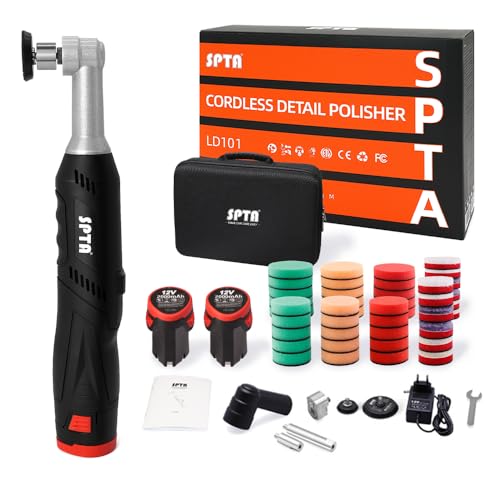
SPTA Cordless Mini Car Polisher (12V Micro) — Best for Motorcycles and Detailing Pros
Some painted surfaces are simply too small, curved, or valuable for anything but a micro polisher: a motorcycle fuel tank, the painted frame rails of a classic, piano-black interior trim, the edges around a grille badge. This micro SPTA exists for that work. Its tiny footprint follows curves a 3 inch machine bridges over, and the RO/DA action choice lets you correct and then finish without changing tools.
Like its larger SPTA sibling, it rewards an experienced hand. The small pad concentrates both cut and heat, so short passes and constant inspection are the working method. In return you get access and control that no full-size machine can match, which is why machines like this live in professional detailing kits despite their size.
Strengths
- Micro format reaches surfaces no larger polisher can follow
- RO/DA flexibility for correction and finishing
- Ideal for motorcycles, trim and classic-car details
Trade-offs
- Slowest possible choice for large panels
- Concentrated cut requires experience and care
- Accessories are model-specific
| Spec | Detail |
|---|---|
| Power | 12V cordless |
| Action | RO / DA micro polisher |
| Use | Polishing, sanding and cleaning |
If your garage holds a motorcycle, this is arguably the first pick rather than the last: tanks, fenders and side panels are all micro-polisher territory, and one machine keeps the whole bike corrected and waxed. Car detailers should see it as the specialist that complements a larger machine, not replaces it. Bought with that understanding, it is the most precise tool in this guide.
Micro polishers consume pads faster relative to their size, simply because the small pad does all its work in a concentrated area. Keep spares of your favorite grade; running out mid-motorcycle is the classic micro-polisher frustration, and it is entirely a spares problem, not a machine problem.
Best for: motorcycles, trim, classics and precision spot work / Not suited for: anyone wanting a single buffer for whole cars
Check on Amazon — check price on Amazon before you order, and confirm the listing matches the model described here.
Comparison Table
| Pick | Badge | Key spec | Best for |
|---|---|---|---|
| SPTA Cordless Car Buffer Polisher (2-Battery Brushless Kit) | Best Overall | Brushless motor, 2 x 12V batteries included | home detailers who want one 12 volt buffer for waxing, light swirl removal and general paint care |
| DCA 12V Cordless Buffer Polisher (3 Inch Brushless) | Best for Tight Panels and Spot Work | 3in/2in brushless, 2800–8300 RPM, 2 x 2.0Ah | spot correction, headlights, motorcycles and narrow panels |
| KITLUCK 12V Cordless Buffer Polisher Kit (40-Piece Pad Set) | Best Complete Starter Kit | 1/2/3 inch pads, 40pc pad kit, 2 x 2.5Ah | first-time buyers who own no pads or batteries yet |
| SPTA Cordless Mini Polisher RO/DA (12V Multi Polisher) | Best for Scratch Correction | RO/DA switchable, wool pads included | experienced users removing scratches and isolated defects |
| WORKPRO 12V Cordless Mini Buffer Polisher Kit | Best Budget | 5 variable speeds, compact kit | budget-conscious owners waxing and lightly polishing family cars |
| SPTA Cordless Mini Car Polisher (12V Micro) | Best for Motorcycles and Detailing Pros | Micro RO/DA format for smallest panels | motorcycles, trim, classics and precision spot work |
How to Choose the Best 12 Volt Buffer for Your Work
Start by naming the job honestly, because the 12 volt class splits cleanly by task. Wax spreading and light gloss enhancement need only a gentle dual-action mini with a soft pad. Swirl removal on one or two panels needs more torque, ideally a brushless motor, and a medium-cut pad. Isolated scratches need rotary capability or a wool pad, plus the experience to use them. Buyers who skip this step and simply buy the strongest machine often end up with a tool that is harder to control than the work requires.
Pad size is the second decision, and it is really a decision about your car’s shapes. Three inch pads are the generalists: big enough for doors and bonnets in sections, small enough for bumpers. One and two inch pads are specialists for pillars, mirrors, and motorcycles. Kits that include several sizes, like the KITLUCK set, postpone this decision usefully by covering all three. A single-size machine is a commitment — make sure it matches the panels you actually polish.
- Match the machine to the defect: wax and gloss — any pick here; swirls — brushless DA picks; scratches — RO/DA picks with wool
- Count the batteries in the box before comparing prices; a second battery bought later erases a cheap headline price
- Check which backing plates the kit includes, not just how many pads
- Decide whether sanding ability matters to you — headlight work and paint prep use it constantly
Battery Math: What 12 Volts Really Delivers
A 12 volt platform is a deliberate trade: lower voltage keeps the tool small, light, and cheap, at the cost of the sustained torque a larger platform delivers. In practice that means a 12 volt buffer is happiest in short, controlled passes with light pressure — let the pad and product do the work. Leaning on the machine slows the pad, builds heat, and drains the battery, all three at once. Two-battery kits exist precisely because a single small pack will not cover a long session at high speed.
Battery capacity, shown in amp-hours, is runtime rather than power. The 2.5Ah packs in the KITLUCK kit simply run longer between swaps than 2.0Ah packs. For most home users, two modest batteries beat one large one, because the rotation never stops. Store packs partly charged, keep them out of a hot trunk, and expect any 12 volt machine to feel strongest in its first minutes on a fresh pack — plan your correction passes accordingly.
Pads, Products and the System Around the Machine
New detailers consistently over-invest in the machine and under-invest in pads, then blame the buffer. The pad is the cutting interface: wool and firm foam cut, medium foam polishes, soft foam finishes and spreads wax. A mini polisher with three pad grades will out-correct a stronger machine with one worn pad every time. Keep pads clean — a clogged pad stops cutting and starts smearing — and replace them when the foam tears or the hook-and-loop backing weakens.
Product choice follows the same logic. A compound removes defects, a polish refines, a wax or sealant only protects and adds gloss; no wax will remove a swirl, whatever the label implies. With a 12 volt machine, work one grade milder than you think you need, inspect, and step up only if the defect survives. That discipline is what makes a small machine safe on modern thin clear coats.
Long-Term Ownership: Pads, Batteries and Care That Keep a Mini Buffer Working
A mini polisher’s working life is decided by consumables and habits more than by the motor. Pads are the first consumable: wash them after every session, because dried polish turns a finishing pad into a cutting pad and a cutting pad into a scratching pad. Spin them dry, store them face-protected in a closed box, and retire any pad whose foam is torn or whose backing is letting go — a pad that detaches at speed can gouge the panel it was polishing. Budget for pads as an ongoing cost, the way you budget for polish itself, and the machine will always feel as capable as the day it arrived.
Batteries are the second system to manage. Lithium packs dislike two things above all: being stored fully flat for months, and being baked in a hot vehicle. Store them partly charged in the house, rotate both packs evenly so one does not age alone, and never leave a pack on the charger for weeks at a time. A 12 volt platform’s packs are inexpensive compared with larger tool batteries, which is part of the format’s charm — a tired pack is a small replacement, not a crisis — but the storage habits above will double the interval before you need one.
Finally, keep the machine itself clean in the places that matter: polish dust works into vents and switches, and a soft brush and a blast of air after each session keep both clear. Check the backing plate’s hook-and-loop grip monthly, because a plate that no longer holds pads firmly is a safety issue, not a nuisance. None of this takes more than minutes. It is the difference between a buffer that feels tired in year two and one that is still the first tool you reach for in year five.
What a 12 Volt Buffer Cannot Do — And What to Use Instead
Honesty about limits is what makes a buying guide trustworthy, so here is the 12 volt class’s full list of cannots. It cannot correct a whole car quickly: a full correction is hours of work even for a large machine, and a mini polisher multiplies the sections. It cannot remove deep scratches, stone-chip damage, or paint defects that have broken the clear coat — no polisher can, at any size. It cannot match a rotary’s speed on heavy oxidation, and it cannot run all day on a single small battery. Buyers who need those things need a corded dual-action polisher in the 5–6 inch class, which is a different purchase for a different day.
What the 12 volt machine does instead is own the ninety percent: the maintenance polish twice a year, the wax before winter, the scratch that appeared this week, the headlights every few seasons, the motorcycle every month. In real garages, that ninety percent is the work that actually happens, while the heroic full correction happens once — often professionally — and is then maintained. Seen that way, the mini buffer is not the compromise tool; for most households it is the main tool, and the big machine is the specialist.
If you are deciding between spending more within this class or stepping up a class, decide by counting your panels and your patience. One car, normal paint, a few defects: stay here and buy the best kit. Multiple vehicles, hard German clear coats, a restoration project: step up for the correction work and keep a mini from this guide for everything else. The two-machine garage is the detailer’s actual endgame, and it usually starts with the small one.
How to Use a 12 Volt Buffer: A Complete First Session
This walkthrough assumes a dual-action mini polisher, a medium polishing pad, a fine finishing pad, a bottle of polish, and a wax or sealant. Work in shade, on paint that is cool to the touch, and give yourself an unhurried hour for one panel rather than rushing a whole car.
- Wash and dry the car thoroughly; polishing over grit grinds the grit into the paint
- Clay or chemically decontaminate the panel if it feels rough — a buffer cannot fix bonded contamination
- Mask rubber trim, badges and sharp panel edges with painter’s tape
- Fit the medium pad, apply four pea-sized drops of polish, and dab the pad across a two-foot-square section to distribute it
- Start the machine on the paint at low speed, spread the polish, then raise speed and work slow overlapping passes with light pressure for about a minute
- Stop, wipe the residue with a clean microfiber, and inspect under the strongest light you have; repeat only if the defect remains
- Swap to the finishing pad, apply wax or sealant thinly at low speed, let it haze per the product directions, and buff off by hand
- Remove tape, clean pads in warm water with a little detergent, and charge the battery you used while the second pack rests
Two habits separate good results from expensive ones. First, always do a test spot: one small section, start to finish, before committing to a whole panel, because paint hardness varies enormously between cars and even between original and repainted panels. Second, stop early. A defect that is ninety percent gone is invisible in normal light, while the clear coat removed chasing the last ten percent is gone forever. A 12 volt buffer rewards that restraint — it is a precision instrument, and precision is mostly knowing when to stop.
A word about lighting, because you cannot fix what you cannot see. Polishing inspection needs a strong, point-source light — a detailing light, a bright torch, or low sun — raked across the panel. Overhead garage tubes hide swirls that a single bright source reveals instantly. Check your test spot under the harshest light you have; paint that looks finished there will look flawless everywhere else. This one habit explains most of the gap between amateur results and professional ones, and it costs nothing but a torch.
Common Buying Mistakes
Expecting whole-car correction. A 12 volt buffer is a precision tool. Using one to chase heavy oxidation across an entire vehicle leads to dead batteries, sore arms, and half-finished panels. Match the tool class to the job, or hire the big correction out and maintain it with the mini.
Leaning on the machine. Pressure feels productive and accomplishes the opposite: it slows the pad, stalls the orbit, and builds heat. Use the machine’s weight plus a light guiding hand, and let pad and product do the cutting.
Using one pad for everything. A cutting pad leaves its own haze; a finishing pad cannot remove a scratch. Skipping grades means the final result always carries the marks of the coarsest step you took.
Polishing dirty paint. Skipping the wash, or polishing a panel that still feels gritty after washing, turns contamination into an abrasive. The buffer will happily engrave it across the panel.
Ignoring the battery rotation. Starting a long session with one pack and no charged spare guarantees a half-polished car. Charge both packs the night before and rotate them.
Working in direct sun. Hot panels flash-dry polish, making it dusty, grabby, and hard to wipe. Shade and cool paint are not preferences; they are part of the process.
Final Recommendation
If you buy one machine from this guide, buy the SPTA brushless two-battery kit: it is the most capable all-rounder, with the motor and battery setup to handle waxing, light correction, and general paint care without frustration. First-time buyers who own nothing should look hard at the KITLUCK kit instead — its completeness teaches the craft faster than a better bare tool would. Experienced users chasing scratches should choose between the two SPTA RO/DA minis by panel size, and budget shoppers will be well served by the WORKPRO for honest light duties.
Whichever you choose, remember what the 12 volt class is: not a weaker version of a real buffer, but a different tool — the precision end of polishing. Used on the work it was designed for, every machine here earns its place in the garage.
A last practical note on technique with small machines: work in the shade, in sections no larger than the pad can govern, and overlap your passes by half so no stripe of paint is polished twice as much as its neighbor. Count your passes rather than watching the clock — four slow passes is a repeatable unit of work you can compare across a panel — and wipe and inspect after every unit rather than every panel. Small machines reward methodical operators out of all proportion to their size, because their gentleness lets you approach a defect gradually, in measured steps, instead of gambling on one aggressive pass. That measured quality is, in the end, the deepest reason the 12 volt class has earned its place in serious detailing kits: it turns paint correction from an act of faith into a process of small, verified steps, and paint — which cannot be un-polished — deserves exactly that respect.
- SPTA Cordless Car Buffer Polisher (2-Battery Brushless Kit) (Best Overall) — Check on Amazon
- DCA 12V Cordless Buffer Polisher (3 Inch Brushless) (Best for Tight Panels and Spot Work) — Check on Amazon
- KITLUCK 12V Cordless Buffer Polisher Kit (40-Piece Pad Set) (Best Complete Starter Kit) — Check on Amazon
- SPTA Cordless Mini Polisher RO/DA (12V Multi Polisher) (Best for Scratch Correction) — Check on Amazon
- WORKPRO 12V Cordless Mini Buffer Polisher Kit (Best Budget) — Check on Amazon
- SPTA Cordless Mini Car Polisher (12V Micro) (Best for Motorcycles and Detailing Pros) — Check on Amazon
Keep exploring the cluster: Best 12 Volt Car Air Compressor Best 12 Volt Cab Heater Best 12 Volt Camping Cooler Best 12 Volt Camping Fridge
Frequently Asked Questions
Is a 12 volt buffer powerful enough to remove scratches?
It depends on the scratch and the machine. Light scratches and swirls that catch no fingernail respond well to the brushless and RO/DA picks here, especially with a wool or firm foam pad. Deep scratches that catch a nail have usually cut through the clear coat, and no buffer of any size can restore missing paint — polishing can only soften their edges.
What is the difference between a buffer and a polisher?
In modern detailing the words are used interchangeably for the same machines. Strictly, polishing describes the corrective, abrasive step and buffing the final wipe or gloss step, but any machine in this guide does both jobs depending on the pad and product fitted. Buy by pad size, action and speed control, not by which word the listing uses.
Can I run a 12 volt buffer from my car’s cigarette lighter?
The machines in this guide run from their own 12V battery packs, not from the car’s socket — that is what the 12 volt label refers to. Socket-powered orbital buffers are essentially absent from the current market because a lighter socket cannot safely deliver the sustained current a polishing motor wants. Charge the packs from household power before you start.
Which pad size should a beginner choose?
Three inch is the most forgiving starting point: large enough to work a door in sections, small enough for bumpers and pillars. Kits that add 1 and 2 inch plates, like the KITLUCK set, extend your reach later without buying a second machine. Avoid starting on the smallest pads — they concentrate cut and punish mistakes.
How long does a 12V polisher battery last?
Runtime varies with speed and pressure, but expect a small pack to cover a few panels of active polishing rather than a whole car. That is why two-battery kits are strongly recommended: one pack works while the other charges, and rotating them removes runtime from the list of things to think about.
Will a mini buffer damage my paint?
A dual-action mini used with a mild pad, light pressure and short passes is one of the safest ways to polish, which is why this class suits beginners. Rotary mode is the exception — it can burn edges and thin clear coat quickly — so treat the RO/DA picks’ rotary setting as an advanced tool and practice on an old panel first.
Do I need different polish for a mini buffer?
No — standard compounds, polishes and waxes all work with mini machines. What changes is quantity and pace: use less product than you think (small pads need only a few drops), work smaller sections, and let the product’s abrasives break down fully at moderate speed. The chemistry is identical; only the scale of the work differs.
Can a 12 volt buffer polish a boat or RV?
For spot work, waterline stains and small fiberglass repairs, yes — gelcoat responds well to these machines, and the micro picks are excellent around fittings. For whole-hull polishing, the area defeats any mini machine; that is full-size polisher territory, and hiring it out or renting the bigger tool is the honest answer for a full boat.


