Disclosure: airfryerkitchensupply.com is reader-supported. When you buy through links on our site, we may earn an affiliate commission at no extra cost to you.
Where to buy
Every pick in this guide to the best 110 volt electric driveway gate opener options was verified live before inclusion. Every kit in this guide was verified on Amazon through the Creators API before it earned a place here. Prices on gate hardware move constantly, so no prices are printed in this article — use the links below to check the current price on Amazon for each kit, and confirm the kit contents on the listing before ordering, because remotes, batteries and mounting hardware are packaged differently across sellers.
- TOPENS A5131 Single Swing Gate Opener — Best Overall
- TOPENS A8131 Single Swing Gate Opener — Best Heavy Duty
- TOPENS XD851 Smart Single Swing Gate Opener — Best Smart Features
- TOPENS AT6131 Single Swing Gate Opener — Best Mid-Heavy Value
- JUJIANG C01 Automatic Gate Opener — Best Budget
- CO-Z Automatic Swing Gate Opener Kit — Best Complete Kit Alternative
Shopping for the best 110 volt electric driveway gate opener starts with a fact the marketing rarely volunteers: the arm that moves your gate almost certainly runs on low-voltage DC power, and the 110 volt part of the system is how it is fed — a control box or transformer plugged into a standard 110–120 volt household outlet, usually charging a battery that actually drives the motor. That arrangement is a feature, not a fudge. It means no 240 volt trenching to the gate post, no electrician for the power run in most cases, and a gate that keeps working through short power cuts on its battery.
The second fact is capacity, and it is where buyers get caught. Openers are rated by gate weight OR gate length, and the “or” matters: a long, solid gate catches wind like a sail, and wind load acts as extra weight on every cycle. A kit rated for 550 pounds or 16 feet is not rated for a 16-foot solid privacy gate at 550 pounds in a crosswind — derate honestly for solid panels, slopes and exposed sites, and the motor you buy will live a long life instead of a heroic short one. Every rating in this guide is printed exactly as the manufacturer publishes it, and the buying guide shows you how to adjust it for your gate.
This guide covers driveway gates generally — the six verified kits below are single-swing openers, the format most residential driveways use, from the established TOPENS range in four duty classes, a smart WiFi model, the budget JUJIANG kit and CO-Z’s complete entry-level kit. All are AC-powered systems with remotes included and solar compatibility for buyers who later want a panel to help the battery. If your driveway has a double gate with two leaves, you need a dual kit — several of these brands sell one — but for the single-leaf majority, start here.
In this guide
Quick Picks
Best Overall — TOPENS A5131 Single Swing Gate Opener: The medium-duty default for most driveways: AC powered, rated to 550 lb or 16 ft, remote included, solar compatible if you add a panel later.
Best Heavy Duty — TOPENS A8131 Single Swing Gate Opener: The heavy-duty step-up: 880 lb or 18 ft of AC-powered capacity for long ranch gates and heavy framed panels the medium kits should not be asked to move.
Best Smart Features — TOPENS XD851 Smart Single Swing Gate Opener: Heavy-duty capacity plus a phone in your pocket: WiFi app control on the 880 lb / 18 ft AC-powered platform, with a physical remote still in the box.
Best Mid-Heavy Value — TOPENS AT6131 Single Swing Gate Opener: The in-between step: 660 lb and a full 18 ft of reach in a medium-duty AC kit — for long but light gates that outgrow the A5131 on length alone.
Best Budget — JUJIANG C01 Automatic Gate Opener: The budget complete kit: a 40W AC-powered opener for gates up to 440 lb and 16 ft, with remote and full kit contents at an entry-level tier.
Best Complete Kit Alternative — CO-Z Automatic Swing Gate Opener Kit: A complete-kit alternative at 660 lb / 18 ft: remotes and release keys in the box, aimed at driveway, home and garden swing gates.
How These Picks Were Chosen
Picks were chosen by working backwards from real driveway constraints. First, power: the kit had to run from standard North American household current — an AC-powered control box on a 110–120 volt circuit — because that is the literal promise of the keyword. Pure solar kits with no AC charging path were excluded, even from brands represented here, because a buyer searching 110 volt wants the outlet to be the system’s backbone.
Second, verified identity. Each opener was searched by brand and model through the Creators API on this site’s own Amazon connection, and an ASIN was attached only where the returned title matched the model, duty class and gate rating intended. Specs in the mini boxes — weight and length ratings, power type, control features — come only from those verified titles.
Third, a genuine ladder of duty and price tier: a budget kit for light gates, a medium-duty default, a heavier medium, a heavy-duty flagship, and a smart version of that flagship for app control. A list of six identical arms at six prices helps nobody; a list that maps to real gates — light farm gate, suburban swing gate, long ranch gate — helps everyone.
The 6 Best 110 Volt Electric Driveway Gate Opener Kits

TOPENS A5131 Single Swing Gate Opener — Best Overall
For the typical residential driveway — a tubular steel, aluminium or modest timber single gate on sound posts, with an outlet within reach — the A5131 is the kit sized to the job without paying for capacity that will never be used.
Strengths
- AC power keeps the battery charged regardless of season or shade
- 550 lb / 16 ft rating covers most residential single gates with headroom
- Remote included and solar compatible for later expansion
Trade-offs
- Medium duty: solid wind-catching gates must be derated honestly
- TOPENS sells several similar models — confirm A5131 at checkout
- Backup battery arrangement is modest; check the listing for your needs
| Gate capacity | Up to 550 lb or 16 ft (manufacturer rating) |
| Power | AC powered, solar compatible |
| Kit | Remote control included |
| Duty class | Medium duty |
Balance is this kit’s whole case. Its rating sits where residential gates actually cluster, its AC charging removes the winter anxiety of solar-only systems in shaded or northern driveways, and its control board accepts the accessories — keypads, extra remotes, safety sensors — that households add over the years. Installation follows the universal linear-arm pattern, and its success is decided before the first hole is drilled: post bracket position sets the geometry, and a gate that swings freely by hand, level and true, is the prerequisite no opener can substitute for. If your gate binds or sags now, fix the gate first and the A5131 will feel overpowered; skip that step and no kit on this page will save you. For gates honestly within its envelope — and the derating guide below tells you how to judge — this is the opener to buy first and think about least.
Ownership settles into a rhythm with the A5131: a remote by the door, a second in the car, and a gate that has simply never been a topic of conversation since installation. That invisibility is the product. Owners upgrading later usually add the keypad first — for cleaners, deliveries and family — and the control board accepts it without drama, which is the quiet advantage of buying into the range’s mainstream model rather than an orphan kit.
Best for: Most single residential driveway gates up to about 16 ft / Not suited for: Heavy solid privacy gates or steep, wind-exposed driveways
Check the current price on Amazon

TOPENS A8131 Single Swing Gate Opener — Best Heavy Duty
Long gates punish undersized openers through leverage: every extra foot multiplies hinge strain and wind area. The A8131 exists so an 18-foot ranch gate or a genuinely heavy framed panel sits comfortably inside its opener’s envelope instead of at the edge of it.
Strengths
- 880 lb / 18 ft rating gives real headroom for long or heavy leaves
- Same AC-powered, solar-compatible architecture as the rest of the range
- Heavy-duty hardware built for the leverage a long gate applies
Trade-offs
- Oversized for light gates — capacity you pay for and never use
- Demands genuinely solid posts; it will find a weak one
- Heavier kit to handle during a solo installation
| Gate capacity | Up to 880 lb or 18 ft (manufacturer rating) |
| Power | AC powered, solar compatible |
| Kit | Remote control included |
| Duty class | Heavy duty |
Headroom is a longevity strategy. An opener cruising at half its rating runs cooler, quieter and longer than one straining at ninety percent, and long gates strain in ways the bathroom scale never shows — flex, sag and wind all bill the motor. The A8131’s rating lets those gates live mid-envelope. Its honest precondition is structure: a heavy-duty arm will tear fixings out of a rotten post or twist a light one, so an hour spent checking post plumb, footing and hinge condition is part of this purchase whether you budget for it or not. Power follows the family pattern — AC charging as the backbone, solar as an optional supplement — which suits rural driveways where the gate may sit far from daily attention but never far from a barn outlet. If your gate measures anywhere near the medium kits’ limits, this is not the upsell; it is the correct size.
The A8131 also changes how a big gate feels to own: long gates under manual power get left open, then get left closed, then stop being used as gates at all. Under a heavy-duty opener the same gate becomes a door again — used daily, closed nightly, and no longer a small dread on a windy evening. If your property has a gate you currently avoid, that restoration of use is the return on the heavy-duty tier, and it arrives in the first week.
Best for: Long ranch gates and heavy framed single gates up to 18 ft / Not suited for: Lightweight gates or unsound posts
Check the current price on Amazon
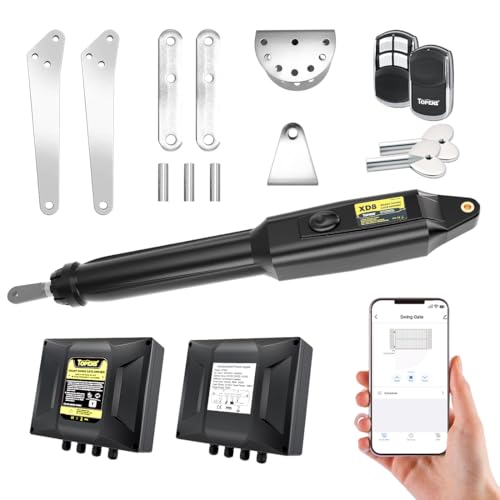
TOPENS XD851 Smart Single Swing Gate Opener — Best Smart Features
The XD851 answers the two modern driveway anxieties — did the gate close, and can I let this delivery in — with app control and status, on the strongest single-gate platform in this guide. Its one precondition is WiFi that actually reaches the gate.
Strengths
- App control opens for deliveries and confirms closure from anywhere
- Heavy-duty 880 lb / 18 ft rating matches the flagship class
- Physical remote still included for guests and simplicity
Trade-offs
- Smart features depend on your WiFi genuinely reaching the gate post
- App setup adds a step beyond a plain remote kit
- Heavy-duty capacity is wasted on a light gate
| Gate capacity | Up to 18 ft or 880 lb (manufacturer rating) |
| Power | AC powered, solar compatible |
| Control | WiFi app control plus remote included |
| Duty class | Heavy duty |
Smart control earns its place when it removes a recurring friction, and at a driveway gate the frictions are daily: the courier at the gate while you are out, the teenager who may or may not have closed it, the guest arriving before you do. The XD851 folds those into a phone while keeping the physical remote for everyone who should never need an app. Its mechanical side is the heavy-duty platform, so the same derating and post-structure advice applies in full. The gating question is connectivity, and it should be answered before ordering, with your phone, standing at the gate post: if your home WiFi is a whisper out there, plan a range solution or choose the A8131 and accept remote-only life. Buyers with strong gate-side signal get the most complete kit in this guide — flagship muscle with modern manners.
The XD851’s app data becomes quietly useful over time: a household learns its own gate habits — the school run, the delivery windows, the evening the gate stood open — and adjusts auto-close and alerts to match. That learning loop is what separates a smart opener from a remote with a longer range. Keep the firmware and app updated as you would any connected device, and treat the physical remote as the permanent backup it was designed to be.
Best for: Heavy gates whose owners want app control and closure confirmation / Not suited for: Driveways where WiFi does not reach the gate
Check the current price on Amazon

TOPENS AT6131 Single Swing Gate Opener — Best Mid-Heavy Value
Some gates are long without being heavy — an 18-foot tubular farm gate weighs little but swings a big arc. The AT6131 is specced for exactly that shape of problem: medium-duty muscle with full-length reach.
Strengths
- 18 ft reach in a medium-duty kit suits long, light gates
- 660 lb rating adds margin over the A5131
- AC powered with solar compatibility and remote included
Trade-offs
- Medium-duty arm on an 18 ft solid gate would still be a mistake — derate for wind
- Overlaps the A5131 for shorter gates; choose on your measurements
- Same solid-post requirement as every arm kit
| Gate capacity | Up to 660 lb or 18 ft (manufacturer rating) |
| Power | AC powered, solar compatible |
| Kit | Remote control included |
| Duty class | Medium duty |
Gate sizing has two axes and buyers usually shop one. Weight is the obvious axis; length is the sneaky one, because a long light gate still presents leverage, flex and wind area that a short heavy gate does not. The AT6131 is the range’s answer to the length axis: it keeps medium-duty cost and complexity while extending the geometry to 18 feet. In practice it suits the classic ranch and large-lot driveway — tubular or rail gates that a person can swing with one hand but that defeat a shorter-rated kit on span alone. The discipline remains derating: an 18-foot solid privacy panel is a sail, and no medium-duty badge survives a sail in a storm. Measure your gate’s length and weight separately, honestly, and if length is your binding constraint while weight is modest, this is the most economical correct answer in the TOPENS line.
The AT6131 is also the range’s natural answer for agricultural entrances — the long, light tubular gate at a field or yard entrance that opens twenty times a day and weighs almost nothing. Its duty cycle suits that rhythm, and its AC charging means the gate at the far barn, used hardest in the darkest months, never meets a flat battery in February. Length, lightness and frequency: where those three meet, this is the kit.
Best for: Long but lightweight gates up to 18 ft / Not suited for: Solid 18 ft panels or heavy gates near its weight limit in windy sites
Check the current price on Amazon

JUJIANG C01 Automatic Gate Opener — Best Budget
Not every driveway gate is a ranch gate. For a light residential gate — tubular steel, aluminium, a modest timber leaf — the JUJIANG C01 offers a complete AC-powered kit at the budget end, with a stated 40W motor and everything needed in the box.
Strengths
- Complete kit with remote at an entry-level tier
- AC powered — no dependence on sun or panel placement
- 440 lb / 16 ft rating covers genuinely light residential gates
Trade-offs
- The lightest capacity here: no headroom for heavy or solid gates
- Budget tier means modest accessory ecosystem compared with TOPENS
- Installation care matters even more — geometry must be right, not forced
| Gate capacity | Up to 440 lb / 16 ft (manufacturer rating) |
| Motor | 40W, AC powered |
| Kit | Complete kit with remote |
| Duty class | Medium duty (light end) |
Budget kits live or die on honesty about the gate. Within its rating — a light gate, swinging freely, on a level driveway — the C01 does the complete job: motor, control, remote, mounting hardware, AC power so the system is not hostage to a shaded panel. The 40W motor figure tells the same story as the 440-pound rating: this is equipment for gates that move easily, and it will reward a gate that already swings true with years of unremarkable service. Ask it to drag a sagging, solid, wind-loaded gate and it will fail the way all undersized openers fail — slowly, then suddenly, usually in bad weather. The buyer this kit suits knows their gate is light, has checked the posts are sound, and would rather spend the saving on the keypad or the second remote. That buyer gets full driveway automation at the lowest tier in this guide, with no feature that matters missing.
Budget kits reward one extra investment: time on the gate itself. An hour spent re-hanging, greasing and levelling a light gate before the C01 goes on will do more for the system’s lifespan than any feature on any box in this guide, because a budget motor asked to move a willing gate is a reliable motor, and asked to fight one, it is a countdown. Buyers who understand that bargain get remarkable service from this tier.
Best for: Light residential gates on level driveways, bought on a budget / Not suited for: Heavy, solid or sloped gates of any size
Check the current price on Amazon

CO-Z Automatic Swing Gate Opener Kit — Best Complete Kit Alternative
CO-Z’s kit competes on completeness: a 660 lb / 18 ft rating, remotes in the plural and manual release keys in the box, packaged for the driveway, home and garden buyer who wants one box to end the project.
Strengths
- Complete kit includes remotes and manual release keys
- 660 lb / 18 ft rating matches the mid-heavy class
- Release keys matter: manual opening during a long outage is built in
Trade-offs
- Confirm the power arrangement on the listing — kit packaging varies
- Brand ecosystem is thinner than TOPENS for later accessories
- Same derating rules apply to solid and sloped gates
| Gate capacity | Up to 660 lb / 18 ft (manufacturer rating) |
| Kit | Complete kit with remote controls and release keys |
| Use | Driveway, home and garden swing gates |
| Type | Single swing gate opener kit |
The release keys are the detail that reveals whether a kit designer has lived with a gate. Every opener eventually meets the day the power is out, the battery is flat or the board is being replaced — and on that day the gate is either a door you open with a key or a wall you climb. CO-Z includes the keys, and this guide counts that as a genuine feature rather than a bullet point. The headline rating places the kit squarely in the mid-heavy class alongside the AT6131, suitable for substantial tubular and framed gates with the usual derating for solid panels and slopes. Because kit contents and power arrangements vary across listings and sellers, the standing advice applies with extra force here: read the listing’s kit list and power description before ordering, and confirm the manual release works the day you install it, not the day you need it. Do that, and this is a complete, sensibly rated alternative to the TOPENS ladder.
CO-Z’s kit suits one more buyer worth naming: the gift-and-project purchaser — the adult child automating a parent’s driveway gate, the new homeowner finishing a property’s last manual chore. A complete box with remotes and release keys, at a mid-heavy rating that covers most real gates, minimises the return trips and missing-parts delays that kill project weekends. Completeness, in that context, is not a feature list; it is the schedule.
Best for: Buyers wanting a complete mid-heavy kit with manual release included / Not suited for: Buyers planning a large accessory ecosystem around the opener
Check the current price on Amazon
Comparison Table
| Pick | Badge | Key spec | Best for |
|---|---|---|---|
| TOPENS A5131 Single Swing Gate Opener | Best Overall | Up to 550 lb OR 16 ft, AC powered | Most single residential driveway gates up to about 16 ft |
| TOPENS A8131 Single Swing Gate Opener | Best Heavy Duty | Up to 880 lb OR 18 ft, AC powered | Long ranch gates and heavy framed single gates up to 18 ft |
| TOPENS XD851 Smart Single Swing Gate Opener | Best Smart Features | Up to 880 lb OR 18 ft, WiFi app control | Heavy gates whose owners want app control and closure confirmation |
| TOPENS AT6131 Single Swing Gate Opener | Best Mid-Heavy Value | Up to 660 lb OR 18 ft, AC powered | Long but lightweight gates up to 18 ft |
| JUJIANG C01 Automatic Gate Opener | Best Budget | Up to 440 lb / 16 ft, 40W AC powered | Light residential gates on level driveways, bought on a budget |
| CO-Z Automatic Swing Gate Opener Kit | Best Complete Kit Alternative | Up to 660 lb / 18 ft, remotes and release keys | Buyers wanting a complete mid-heavy kit with manual release included |
How to Choose the Best 110 Volt Electric Driveway Gate Opener
Measure your gate before you read another spec: its length with a tape, its weight estimated honestly or weighed at a hinge, and its construction — open tubular gates pass wind, solid gates catch it. Then apply the derating discipline: for solid panels, slopes or exposed windy sites, treat the manufacturer’s rating as roughly half spoken for before you start, and choose the class that still contains your gate comfortably. Headroom is not waste; it is motor life.
Decide the control layer next. A remote in the box serves most households for years. Keypads suit gates with regular visitors, codes for cleaners and deliveries; app control suits owners who need to admit people from afar or confirm closure — provided WiFi reaches the gate. Finally, plan power honestly: an outlet within a sensible cable run of the control box, a battery sized for your outage pattern, and solar as a supplement where the sun actually shines on the gate.
- Weigh and measure the gate; derate for solid panels, slopes and wind
- The gate must swing freely by hand before any opener is fitted
- AC charging as the backbone; solar as a supplement, not a hope
- Manual release is a requirement, not a feature — test it on install day
- Buy the class above your number if you are within a fifth of a kit’s limit
Single vs Dual, Swing vs Slide: Matching the Opener to the Driveway
This guide covers single swing gates because they dominate residential driveways, but the format decision deserves a minute. A swing gate needs a clear arc — level ground through its swing, no parked cars or rising drive inside it. A driveway that climbs steeply from the gate, or one where the arc would sweep across a footpath, may belong to a sliding gate instead, which runs sideways on a track and asks a different class of opener entirely.
Dual gates — two leaves meeting in the middle — need a dual kit with synchronised arms; a single kit cannot be stretched across both, and the second leaf is not an accessory you improvise. Several brands in this guide sell dual versions of these same platforms, so the duty-class advice transfers: size each leaf, derate for its construction, and buy the class that contains the heavier leaf with room to spare.
Installation Geometry: The Hour That Decides Everything
Every linear-arm opener is a geometry problem with a motor attached. The distance from the hinge to the post bracket sets the arm’s leverage and the gate’s opening angle; get it wrong by an inch and the gate either will not open fully, will not close flush, or will strain at one end of every cycle. The manuals give measurements for a reason: lay them out in pencil on the post, clamp the arm in place, and swing the gate by hand through its full arc before drilling anything permanent.
The other installation truth is that openers amplify gate faults. A hinge that groans by hand will groan louder under power; a gate that drops an inch at the latch will fight the arm daily. Spend the first hour on the gate itself — hinges greased or replaced, posts plumb, latch line true — and the opener installation that follows becomes the easy part it is advertised as.
Safety Sensors, Auto-Close and Living With an Automatic Gate
An automatic gate is a moving machine at the edge of your property, and its safety layer deserves the same seriousness as its motor. Photo-eye or sensor protection stops and reverses a gate that meets an obstruction; obstacle sensitivity should be set so the gate respects a genuine obstruction without false-tripping on wind. If your gate opens onto a footpath or a shared drive, that layer is not optional equipment — it is the difference between automation and liability.
Auto-close is the feature households either love or disable within a month, and the honest setting depends on your traffic: a short delay suits a gate used as a true door, while rural gates that stand open for yard work all day are better closed deliberately. Set the behaviour to your life, test the safety reversal with a soft obstruction after installation and seasonally thereafter, and keep the manual release key somewhere every adult in the house can find it in the dark.
Gate Openers and Winter: The Season That Tests Everything
Every weakness in a gate system declares itself in winter. Batteries hold less charge in the cold, gates grow heavier with ice and wet timber, hinges stiffen, and the driveway’s drainage sends meltwater to freeze exactly where the gate must swing. The AC-charged systems in this guide are built for that season — the mains keeps the battery at full readiness regardless of daylight — but the gate itself still needs its winter preparation: hinges greased before the frost, the swing arc kept clear of the gravel and ice that accumulate at the gate line, and drainage that does not pond at the posts.
The mid-winter check is ten minutes well spent: watch one full cycle, listen for new strains or slowing, confirm the safety reversal still works against a soft obstruction, and clear the control box of the insects and moisture that colonise any warm enclosure. A gate system maintained on that rhythm does not have bad days in February — which is fortunate, because February is when a manual gate is at its most miserable and an automatic one earns its entire price.
Remotes, Keypads and Access: Planning Who Gets In
Access control is the part of gate ownership that grows. The remote in the box covers the household’s cars; then come the realities — family visiting, a cleaner on Tuesdays, deliveries, a neighbour feeding animals during a holiday. Keypads solve the recurring-visitor problem with codes that can be changed rather than keys that cannot be un-copied, and app systems solve it with temporary, revocable access. Planning that ladder at purchase time — confirming the control board accepts the accessories you will want — is cheaper than discovering its limits at the first holiday.
The discipline that keeps access safe is equally simple: change codes when people change, keep a household list of who holds remotes, and treat a lost remote as a small security event rather than a shopping errand. A gate is a boundary, and its access list is the boundary’s real substance; the motor merely moves it.
Gate Openers and Property Value: The Quiet Upgrade
An automatic gate is one of the few property upgrades whose value is felt daily and noticed by everyone else exactly once — the first visit. For the household, the return is the accumulation of small dignities: arriving home in rain without the gate ritual, guests admitted without a walk, deliveries received, the property closed behind you every night without a decision. Real-estate language calls this kerb appeal and security; the people who live behind the gate call it the end of an errand that had lasted years.
The security value deserves its measured sentence. A closed, automatic gate does not make a property a fortress, and this guide will not pretend otherwise — but a boundary that is actually closed, every night, because closing it costs nothing, is a materially different boundary from a gate that stands open because opening and closing it by hand was a chore. Automation’s real security product is consistency, and consistency is what the kits in this guide sell.
For sellers, the same logic applies in miniature: a working automatic gate signals a maintained property before a visitor reaches the door. It is not the largest upgrade a driveway can receive, but it may be the most legible one — and for the household still living there, it pays its dividend every single day until the day it is sold.
Living With the Gate: The First Month and After
The first month with an automatic gate has a shape most owners recognise: a week of deliberate enjoyment, pressing the remote early just to watch it work; a fortnight of adjustment, as auto-close timings, remote habits and visitor routines settle; and then the disappearance, as the gate joins the list of things a household simply expects. The kits in this guide were chosen to reach that third stage without detours — no recurring faults to manage, no seasonal failures to forgive, no features that demand attention after their novelty fades.
Keep the disappearance permanent with the lightest of rhythms: a seasonal glance at hinges and hardware, a safety test with the change of the clocks, a remote battery before it becomes a driveway surprise. That is the whole maintenance contract of a well-chosen, well-installed opener — a few minutes a year in exchange for a boundary that opens and closes itself thousands of times. Few machines in a home’s life repay their purchase so quietly, or so often.
How to Install a 110 Volt Electric Driveway Gate Opener
A single swing opener is a well-trodden DIY project for a competent homeowner — a day of careful measuring and mounting rather than difficult work. These steps follow the universal pattern; your kit’s manual governs its specific measurements and wiring.
- Prepare the gate first: it must swing freely by hand through its full arc, level, with sound hinges and posts. Fix every fault now — the opener will not fix any of them.
- Mark the bracket geometry from the manual in pencil on the post and gate, clamp the arm in position, and swing the gate by hand to verify full opening and flush closing before drilling.
- Mount the post bracket and gate bracket permanently, fit the arm, and confirm the manual release works — open and close the gate by hand with the release engaged.
- Mount the control box under cover near the gate, connect the arm and any battery per the manual, and route cables protected from weather, strimmers and tyres.
- Run the AC supply to the control box as the manual directs — a standard outlet circuit — keeping all mains connections inside their enclosures.
- Fit safety sensors if your installation uses them, set obstacle sensitivity, and test reversal with a soft obstruction before trusting the gate.
- Programme the remotes, set open and close limits, and run ten full cycles watching for strain, binding or uneven travel; adjust geometry, not force, to cure problems.
- Set auto-close behaviour to your household’s real pattern, show every driver in the house the manual release, and store the key where it can be found in the dark.
Measure twice, swing by hand, test the release, test the safety reversal — an opener installed with that discipline disappears into daily life, which is the highest compliment driveway hardware can earn.
Common Buying Mistakes
Trusting the headline rating. Weight OR length, in ideal conditions. Derate for solid panels, slopes and wind, or buy a motor with a short, heroic life.
Motoring a faulty gate. An opener amplifies sag, binding and bad hinges. Fix the gate by hand first; then add power.
Skipping the manual release test. The day the power fails is the wrong day to learn how the release works. Test it on installation day.
Assuming WiFi reaches the gate. Smart features die quietly at the end of a long driveway. Test your signal standing at the gate post before buying the smart kit.
Neglecting safety sensing. A gate that cannot detect an obstruction is a liability at the property line. Fit it, set it, test it seasonally.
Burying the geometry step. Bracket position is the installation. Pencil, clamps and a hand-swing test before drilling will save the whole project.
Final Recommendation
For most driveways, the TOPENS A5131 is the recommendation: medium-duty capacity honestly matched to typical gates, AC charging that ignores the weather, and a remote in the box. Long light gates point to the AT6131, heavy or long gates to the A8131, and the XD851 adds app control to that flagship platform where WiFi reaches. The JUJIANG C01 automates a light gate on a budget, and the CO-Z kit is the complete-box alternative with release keys included.
Whichever kit you choose, the gate decides the outcome: measured honestly, derated for wind and slope, swinging freely by hand before a motor ever touches it. Get those things right and any pick here will open your driveway for years without asking to be thought about.
Start with TOPENS A5131 Single Swing Gate Opener, or TOPENS A8131 Single Swing Gate Opener if your needs are narrower, and keep TOPENS XD851 Smart Single Swing Gate Opener on the shortlist as the alternative.
Related guides in this series: Best 110 Volt Electei Fence Charger, Best 110 Volt Electric Garage Heaters, Best 110 Volt Electric Heater, Best 110 Volt Winches, Best 110 Volt Air Compressor, Best 110 Volt Dryer.
Frequently Asked Questions
Do I need an electrician to install a 110 volt gate opener?
Most homeowners install these kits themselves: the opener system is fed from a standard outlet circuit, with the control box mounted under cover and connections made inside its enclosure. The demanding part is mechanical, not electrical — bracket geometry and a gate that swings true. If your supply run involves new outdoor wiring rather than an existing outlet, local codes may require an electrician for that part, and that is money well spent.
What does the weight OR length rating really mean?
It means the kit is rated up to that weight, or up to that length — for a gate that is typical in the other dimension. A long solid gate breaks the assumption twice: its area catches wind, and wind load behaves like extra weight on every cycle. For solid panels, slopes and exposed sites, derate substantially and buy the class above your arithmetic. Headroom is motor life.
Will the gate work during a power cut?
These systems drive the arm from a battery that the AC supply keeps charged, so short outages are normally invisible — the gate keeps opening until the battery runs down. Every kit should also have a manual release, and you should test yours on installation day, in daylight, rather than learning it during a storm at midnight.
Can I add a panel later if I buy an AC kit?
The TOPENS kits in this guide are solar compatible, meaning a panel can supplement the battery charging later without replacing the opener. Treat solar as a supplement where sun reaches the gate, not as a reason to skip the AC connection that makes the system season-proof — the hybrid is the most reliable arrangement of all.
My gate is a double gate. Can I use one of these kits?
No — these are single-leaf kits with one arm. Double gates need a dual kit with two synchronised arms; most brands here sell dual versions of the same platforms, and the sizing advice transfers: measure each leaf, derate for construction and wind, and size for the heavier leaf with headroom.
How do I know if the smart opener will work at my gate?
Stand at the gate post with your phone and check your home WiFi. App control needs a genuinely usable signal at the control box, and long driveways are where home networks go to whisper. If the signal is weak, either plan a range solution as part of the project or choose the non-smart heavy-duty kit and live happily with remotes.


