Disclosure: airfryerkitchensupply.com is reader-supported. When you buy through links on our site, we may earn an affiliate commission at no extra cost to you.
Where to buy
Every pick in this guide to the best 110 volt dryer options was verified live before inclusion. Every dryer in this guide was verified on Amazon through the Creators API before it earned a place here. Portable dryer prices shift with seasons and stock, so no prices are printed in this article — use the links below to check the current price on Amazon for each model, and confirm the venting arrangement and electrical requirements on the listing before ordering, because every model here is a vented dryer that needs somewhere for moist air to go.
- Panda 3.5 Cu. Ft. Portable Clothes Dryer (1500W, 120V) — Best Overall
- BLACK+DECKER 3.5 Cu. Ft. Portable Dryer BCED37 (1500W, 120V) — Best Brand-Name Alternative
- BLACK+DECKER 2.65 Cu. Ft. Portable Dryer BCED26 (1400W, 120V) — Best Mid-Size
- ROVSUN 110V Portable Clothes Dryer (850W) — Best Simple Controls
- COSTWAY 1.5 Cu. Ft. Portable Clothes Dryer (850W, 110V) — Best Compact Value
- Euhomy Portable Clothes Dryer 1.5 Cu. Ft. (850W, 120V) — Best Compact Alternative
Shopping for the best 110 volt dryer means shopping in the one corner of the laundry market where a standard wall outlet is enough. A full-size household dryer needs a 240 volt circuit and a dedicated laundry room; a 110–120 volt portable dryer plugs into the same outlet as a lamp, vents through a window kit or an indoor vent box, and fits in an apartment, dorm, RV or small house where a full-size machine simply cannot go. That convenience defines the whole category — and so do its limits, which this guide states plainly.
The honest limit is capacity and speed. These machines hold between roughly one and three-and-a-half cubic feet — a few outfits at a time, not a family’s weekly wash — and a 110 volt heating element dries more gently and slowly than a 240 volt one. Loads that take forty minutes in a full-size dryer can take noticeably longer here, especially heavy cotton and towels. Buyers who accept that trade get something genuinely valuable: in-unit laundry, on a normal outlet, with no installation beyond a vent hose. Buyers who expect full-size performance from a portable box will be disappointed by any model on this page.
The six picks below were all verified live on Amazon with matching titles. They split into two honest groups: the 3.5 cubic foot, 1500W class — Panda and BLACK+DECKER — for buyers who want the most capacity a standard outlet can feed, and the compact 850W class — ROVSUN, COSTWAY and Euhomy — for the smallest spaces and the lightest electrical demand. All are vented front-load tumble dryers with stainless drums; the differences that matter are capacity, wattage, controls and footprint, and the buying guide below explains how to match them to your space and your circuit.
In this guide
Quick Picks
Best Overall — Panda 3.5 Cu. Ft. Portable Clothes Dryer (1500W, 120V): The biggest capacity a standard outlet can feed: 3.5 cubic feet, 13.2 lb loads and a full 1500W element on 120V, with a stainless tub in a compact vented front-loader.
Best Brand-Name Alternative — BLACK+DECKER 3.5 Cu. Ft. Portable Dryer BCED37 (1500W, 120V): The same 3.5 cu ft / 1500W formula from a household name: BCED37 vented front-loader with a stainless drum, built for standard wall outlets.
Best Mid-Size — BLACK+DECKER 2.65 Cu. Ft. Portable Dryer BCED26 (1400W, 120V): The middle path: 2.65 cubic feet and 8.8 lb loads at 1400W — noticeably smaller than the 3.5 cu ft class, noticeably more capable than the compacts.
Best Simple Controls — ROVSUN 110V Portable Clothes Dryer (850W): A straightforward 110V tumble dryer with a stainless tub and a simple control knob — 850W of gentle drying for apartments and dorms that value simplicity.
Best Compact Value — COSTWAY 1.5 Cu. Ft. Portable Clothes Dryer (850W, 110V): The compact benchmark: 1.5 cubic feet, 850W, four drying modes and a stainless tub on 110V — the small-space dryer formula in its most established form.
Best Compact Alternative — Euhomy Portable Clothes Dryer 1.5 Cu. Ft. (850W, 120V): Another honest compact: 1.5 cubic feet, 850W, stainless drum on 120V — Euhomy’s take on the small apartment dryer, for buyers comparing listings in the compact class.
How These Picks Were Chosen
Picks were chosen against the constraints that actually decide satisfaction with a portable dryer. First, power: the machine had to run on standard North American household current — 110–120V — because that is the literal promise of the keyword. Full-size 240 volt dryers were excluded no matter how good they are, and so were spin dryers, which extract water without heated tumble drying and are a different product wearing a similar name.
Second, verified identity. Each dryer was searched by brand and model through the Creators API on this site’s own Amazon connection, and an ASIN was only attached where the returned title matched the model, capacity and wattage we intended to write about. Every spec in the mini boxes — cubic feet, pounds capacity, watts, drum material — comes from those verified listing titles and nothing else.
Third, spread across real use cases: the largest-capacity option for small families, a mid-size option, and genuinely compact options for dorms, RVs and single-person households. Finally, venting practicality was part of the judgement — every pick is a vented dryer, and the guide is explicit about the window kit or indoor vent box you will need, because a dryer that fills your apartment with warm damp air helps no one.
The 6 Best 110 Volt Dryer Models for Apartments and Small Spaces

Panda 3.5 Cu. Ft. Portable Clothes Dryer (1500W, 120V) — Best Overall
The Panda is the pick for buyers who want the portable format without giving up more capacity than physics requires. At 3.5 cubic feet and 13.2 pounds per load it handles a couple’s laundry in sensible batches, and its 1500W element is the maximum a standard circuit comfortably delivers — which translates directly into the shortest drying times this category offers.
Strengths
- Largest drum in this guide at 3.5 cu ft and 13.2 lb per load
- Full 1500W element on a standard 120V outlet for the fastest portable drying
- Stainless steel tub resists rust and is easy to wipe clean
Trade-offs
- 1500W is a heavy draw — it wants a circuit that is not already loaded
- Still a vented dryer: you need a window kit or indoor vent box
- Too big for the tightest dorm corners despite the portable label
| Capacity | 3.5 cu ft / 13.2 lb |
| Power | 1500W, 120V |
| Drum | Stainless steel tub |
| Type | Vented front load |
Capacity is the whole argument for this machine, and it is a strong one. The jump from 1.5 to 3.5 cubic feet is the difference between drying a load and drying the load — shirts, trousers and a towel together rather than in relays — and for a household doing laundry twice a week that difference compounds into hours saved across a year. The 1500W element deserves respect as well as praise: on a shared apartment circuit, running the dryer alongside a microwave or a space heater can trip a breaker, so the practical routine is to give it the circuit while it runs, which the buying guide below covers in detail. Panda has sold portable laundry machines for years and the stainless tub and front-load layout here follow the proven pattern rather than experimenting. If your space fits it and your wiring is modern, this is the portable dryer to buy first; the smaller machines below win only where space or circuit capacity genuinely rules this one out.
A practical note on pairing: this dryer is most often bought beside a portable washer, and the pairing works best when the washer’s spin is strong — every extra cup of water the spin removes is minutes the Panda does not spend evaporating it. Owners who add a window vent kit at purchase, rather than improvising one later, report the smoothest first month. The machine’s size also rewards a permanent home: plumbed into its corner with the hose routed once, it stops being an appliance you set up and becomes laundry infrastructure.
Best for: Couples and small households wanting maximum portable capacity on a standard outlet / Not suited for: Tiny dorm rooms or old wiring that cannot spare a 1500W draw
Check the current price on Amazon
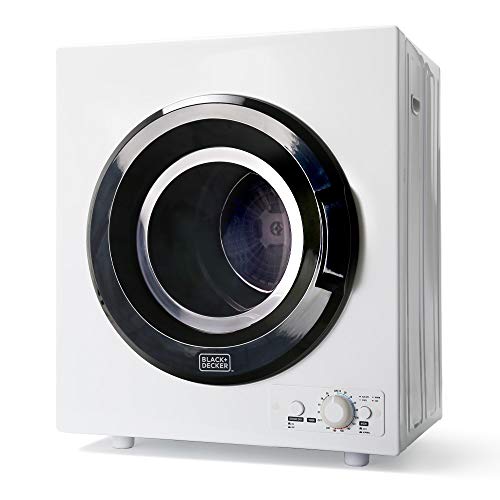
BLACK+DECKER 3.5 Cu. Ft. Portable Dryer BCED37 (1500W, 120V) — Best Brand-Name Alternative
Buyers who prefer a familiar badge on a major appliance get the same headline formula here as the Panda — 3.5 cubic feet, 13.2 pounds, 1500W on 120V — in BLACK+DECKER’s BCED37. It suits households that value a big-brand support network and a standard-outlet installation.
Strengths
- Matches the largest capacity and wattage in this category
- Backed by a widely recognised appliance brand and support network
- Stainless steel drum and vented front-load layout follow the proven design
Trade-offs
- Same 1500W circuit consideration as any full-power portable
- Venting kit planning is still on you
- Two 3.5 cu ft options in this guide means choosing on brand and listing details
| Capacity | 3.5 cu ft / 13.2 lb |
| Power | 1500W, 120V |
| Drum | Stainless steel |
| Type | Vented, model BCED37 |
When two machines share a spec sheet, the decision moves to everything around the specs: brand support, listing clarity, control layout and which seller is actually stocking the unit when you need it. The BCED37’s case is straightforward — BLACK+DECKER’s portable laundry line is established, replacement lint filters and vent accessories are easy to find, and the machine follows the same stainless-drum, vented front-load pattern as the best in this class. In daily use it will behave like the Panda: generous batches for a portable, drying times that reward smaller, well-spun loads, and a real need for a sensible vent route. Households upgrading from a spin dryer or from laundromat trips will feel the step up immediately. Choose between this and the Panda on the listing in front of you — stock, delivery and the exact kit contents — because the machines themselves are honest equivalents, and either will serve an apartment household well.
The BCED37’s ownership story is the quiet one: a big-brand portable that does its loads, asks for its lint filter to be cleaned, and otherwise stays out of the household’s thoughts. Its size makes it the portable most likely to be given a permanent laundry-corner installation rather than a stored-and-deployed life, and it suits that role — vented once, levelled once, and then simply used. For households replacing laundromat trips permanently rather than occasionally, that set-and-forget character is the real specification.
Best for: Buyers who want full portable capacity from a major brand / Not suited for: Spaces where a 3.5 cu ft footprint simply does not fit
Check the current price on Amazon
BLACK+DECKER 2.65 Cu. Ft. Portable Dryer BCED26 (1400W, 120V) — Best Mid-Size
The BCED26 exists for the large group of buyers the two extremes miss: one or two people whose laundry is real but modest, in a space where a 3.5 cubic foot box crowds the room. Its 8.8 pound loads cover a week of one person’s clothes in two batches, and 1400W keeps drying times reasonable.
Strengths
- Mid-size drum fits spaces the 3.5 cu ft class cannot
- 1400W element keeps cycle times close to the full-power models
- Stainless drum and vented design match the bigger machines
Trade-offs
- 8.8 lb loads mean more batches for couples
- Still needs a vent route like every dryer here
- Heavy bedding and big towels will test its capacity
| Capacity | 2.65 cu ft / 8.8 lb |
| Power | 1400W, 120V |
| Drum | Stainless steel |
| Type | Vented, model BCED26 |
Mid-size appliances live or die on whether the compromise lands in the right place, and this one mostly does. The capacity cut from 13.2 to 8.8 pounds sounds large, but in practice a single person’s laundry is a series of small loads anyway, and the footprint saving is real floor space in a studio or a narrow laundry closet. The 1400W element is the quiet success here: only slightly below the category maximum, so drying performance per pound of laundry stays close to the bigger machines — the loads are smaller, not slower. Where you will feel the limit is bulky items: a thick duvet cover or a week of bath towels becomes a planning exercise rather than a single load. If that is your weekly reality, step up to a 3.5 cubic foot model and find the space. If your laundry is clothes, sheets and the occasional towel batch, the BCED26 is arguably the best-balanced portable dryer in this guide.
The mid-size format has one more advantage worth naming: it is the largest portable many standard doorways, closets and RV doors accept without a struggle, and the easiest of the full-featured machines to move house with — a real consideration for renters, who are this category’s core buyers. A dryer you can take with you, install in an afternoon and run on any outlet is worth more to a renting household than a theoretically better machine that belongs to one address.
Best for: Singles and couples in compact spaces with moderate laundry volume / Not suited for: Households drying bulky bedding every week

ROVSUN 110V Portable Clothes Dryer (850W) — Best Simple Controls
The ROVSUN strips the portable dryer back to essentials: a stainless tub, a front-loading door and a single control knob you turn and forget. At 850W it draws half the power of the big models, which makes it the friendliest option here for older wiring and shared circuits.
Strengths
- 850W draw is gentle on older or shared circuits
- Simple knob control — nothing to programme, nothing to learn
- Stainless tub in a compact apartment-and-dorm format
Trade-offs
- Lower wattage means longer drying times, especially for heavy cotton
- Smaller loads than the 3.5 cu ft class
- Vented operation still requires a vent plan
| Power | 850W, 110V |
| Drum | Stainless steel tub |
| Controls | Simple control knob |
| Type | Front load tumble dryer |
There is a real engineering trade inside the 850W figure, and it cuts both ways. Halving the element power roughly halves the electrical stress — this dryer can share a building’s older wiring with a fridge and lights without drama — but heat is what dries clothes, so cycles stretch, particularly for jeans, hoodies and towels. The owners who love these compact 850W machines share a pattern: small, frequent, well-spun loads. A portable washer’s spin cycle does half the drying work before the dryer starts, and a 850W dryer finishing a well-spun load is a perfectly reasonable appliance. The owners who hate them overload them with dripping full-size loads and conclude the category is useless. The ROVSUN’s simple knob deserves a mention too: in a category filling up with touch panels, a mechanical-feeling control that a guest, a parent or a dorm-mate can operate without instructions has genuine value. Buy it for light, frequent laundry in a small space and it will not disappoint.
The ROVSUN’s knob deserves a final word, because it predicts the ownership experience: there is nothing to update, pair, or learn, and a guest doing a load in your apartment needs no instructions. In dorms and shared houses that simplicity prevents the misuse that kills appliances early. Pair it with the discipline the whole 850W class demands — small loads, hard spins, filter cleaned every time — and it delivers the essential service, dry clothes at home, with the least possible apparatus around it.
Best for: Dorms, RVs and small apartments with light, frequent loads and older wiring / Not suited for: Heavy weekly laundry or anyone in a hurry with thick cotton loads
Check the current price on Amazon

COSTWAY 1.5 Cu. Ft. Portable Clothes Dryer (850W, 110V) — Best Compact Value
COSTWAY’s 1.5 cubic foot dryer is the compact format in its most familiar form, sold for years into exactly the spaces this keyword serves: apartment corners, dorm rooms, RVs and laundry closets where a full-size machine is not an option. Four drying modes give it a little more finesse than a bare timer knob.
Strengths
- Compact 1.5 cu ft footprint fits the smallest laundry corners
- Four drying modes cover delicates through heavier cottons
- 850W on 110V suits older buildings and shared circuits
Trade-offs
- Small drum means small loads — plan on batches
- 850W drying is patient drying, especially for towels
- Vented design needs a window or indoor vent solution
| Capacity | 1.5 cu ft |
| Power | 850W, 110V |
| Modes | 4 drying modes |
| Drum | Stainless steel tub |
Judged as a compact, this machine’s virtues are proportion and maturity. The 1.5 cubic foot drum matches the output of the portable washers it is usually paired with, so washer load and dryer load stay in sync — a detail that matters more in daily life than any single spec, because a dryer smaller than your washer creates a permanent backlog of wet clothes. The four modes are genuinely useful at this scale: delicates and synthetics dry fast and cool, while cottons need the full heat and time, and having the machine manage that beats guessing with a single timer. COSTWAY’s long presence in this niche also means the ownership basics — lint filter access, vent hose fitting, stacking or counter placement — are well-trodden ground. Accept the batch rhythm and the longer cycles, spin your loads well, and this is the compact dryer most small-space households end up happy with.
COSTWAY’s compact has one structural advantage in shared and rental living: it is small enough to live on a sturdy counter or stand in a bathroom-adjacent corner, which puts laundry where the water already is and shortens the vent run to the window. Shorter vent runs dry faster — a small, free performance gain that rewards buyers who place the machine thoughtfully rather than wherever the delivery driver left it.
Best for: Small apartments and dorms pairing it with a portable washer / Not suited for: Anyone expecting to dry full family loads in one go
Check the current price on Amazon

Euhomy Portable Clothes Dryer 1.5 Cu. Ft. (850W, 120V) — Best Compact Alternative
Euhomy’s compact dryer covers the same brief as the COSTWAY — 1.5 cubic feet, 850W, stainless drum, standard outlet — giving compact buyers a second established listing to compare on stock, delivery and kit contents when they shop.
Strengths
- Compact format sized for apartments and small laundry spaces
- 850W draw is easy on standard circuits
- Stainless steel drum matches the class standard
Trade-offs
- Same compact limits: small loads, patient cycles
- Venting arrangement must be planned by the buyer
- Directly comparable to the COSTWAY — choose on the listing details
| Capacity | 1.5 cu ft |
| Power | 850W, 120V |
| Drum | Stainless steel drum |
| Type | Compact portable dryer |
Two near-identical compacts in one guide is deliberate, because in this class the practical buying decision often comes down to which listing is in stock, ships sensibly to your address, and includes the vent accessories you need. The Euhomy covers the compact brief completely: a drum sized to a portable washer’s output, an 850W element that will not fight your building’s wiring, and a stainless drum that will not rust in a humid laundry corner. Used the way compacts demand — small loads, well spun, lint filter cleaned every cycle — it delivers the core miracle of this category, which is laundry finished at home instead of at a laundromat. Used like a full-size dryer, it will feel slow, as will every 850W machine ever made. Compare it head-to-head with the COSTWAY on the day you buy; the better listing is the better purchase, and either machine will serve a small household honestly.
Choosing between this Euhomy and its COSTWAY rival on the day of purchase, the deciding details are mundane and real: which listing includes the vent hose arrangement you need, which ships sooner, and which seller’s listing answers the sizing questions clearly. The machines will behave near-identically in your home. That is not a criticism of either — it is what a mature product category looks like, and it means the compact buyer can shop the listing with confidence rather than agonising over the badge.
Best for: Compact-space buyers comparing the established 1.5 cu ft listings / Not suited for: Larger households or bulky-item drying
Check the current price on Amazon
Comparison Table
| Pick | Badge | Key spec | Best for |
|---|---|---|---|
| Panda 3.5 Cu. Ft. Portable Clothes Dryer (1500W, 120V) | Best Overall | 3.5 cu ft, 13.2 lb, 1500W, 120V | Couples and small households wanting maximum portable capacity on a standard outlet |
| BLACK+DECKER 3.5 Cu. Ft. Portable Dryer BCED37 (1500W, 120V) | Best Brand-Name Alternative | 3.5 cu ft, 13.2 lb, 1500W, 120V, BCED37 | Buyers who want full portable capacity from a major brand |
| BLACK+DECKER 2.65 Cu. Ft. Portable Dryer BCED26 (1400W, 120V) | Best Mid-Size | 2.65 cu ft, 8.8 lb, 1400W, 120V, BCED26 | Singles and couples in compact spaces with moderate laundry volume |
| ROVSUN 110V Portable Clothes Dryer (850W) | Best Simple Controls | 110V, 850W, stainless tub, knob control | Dorms, RVs and small apartments with light, frequent loads and older wiring |
| COSTWAY 1.5 Cu. Ft. Portable Clothes Dryer (850W, 110V) | Best Compact Value | 1.5 cu ft, 850W, 110V, 4 drying modes | Small apartments and dorms pairing it with a portable washer |
| Euhomy Portable Clothes Dryer 1.5 Cu. Ft. (850W, 120V) | Best Compact Alternative | 1.5 cu ft, 850W, 120V, stainless drum | Compact-space buyers comparing the established 1.5 cu ft listings |
How to Choose the Best 110 Volt Dryer for Your Space and Circuit
Choose capacity first, because it decides your weekly rhythm. A 3.5 cubic foot machine dries a couple’s laundry in a few generous batches; a 1.5 cubic foot machine turns the same laundry into a steady routine of small loads. Neither is wrong — but they suit different households, and the smaller machine in a busy household creates a permanent wet-laundry queue that owners come to resent. Match the dryer to your washer: portable washers output small loads, full-size washers output loads a compact dryer must split in two.
Choose wattage second, with your building in mind. The 1500W models dry fastest and draw the most; on modern wiring with a lightly loaded circuit they are the obvious pick. In older buildings, dorms and RVs, an 850W model trades speed for electrical peace of mind, and that trade is often correct. Either way, a dryer deserves a circuit that is not simultaneously running a microwave, a space heater or a hair dryer.
- Measure the space including door swing and vent hose routing, not just the footprint
- Match drum size to your washer’s load size to avoid a wet-clothes backlog
- 1500W for speed on healthy circuits; 850W for older wiring and RVs
- Plan the vent before the dryer arrives — window kit or indoor vent box
- Spin loads thoroughly: the washer’s spin is half your drying performance
Venting a Portable Dryer Without a Laundry Room
Every dryer in this guide is a vented machine: it removes moisture from clothes by blowing warm, damp air out of a hose, and that air has to go somewhere. The clean solution is a window vent kit — a flat panel that seals into a partially opened window with the hose attached — which suits most apartments and can be removed when you move. In windowless spaces, an indoor vent box traps lint in a water reservoir while releasing warm air into the room; it works, but it warms and humidifies the room, so it suits occasional use in larger spaces better than daily use in a studio.
Whichever route you choose, keep the hose run short and straight, clean the lint filter after every load, and check the hose connection monthly — a slipped hose quietly pumping moist air behind the machine is the most common portable-dryer problem and the easiest to prevent. Never run a vented dryer into a sealed small room for hours; moisture always wins that argument, and mould is a far worse problem than laundry.
What 110 Volt Drying Times Really Look Like
Set expectations with physics. A 240 volt dryer element delivers roughly twice the heat of the strongest 120 volt element, and the 850W compacts deliver a little over half of that again. In practice: a well-spun load of mixed clothes dries in a 1500W portable in a time that feels merely slower than a full-size machine, while the same load in an 850W compact is an exercise in patience, and heavy towels or denim in any portable should be split into smaller loads or given extra time without complaint.
The single biggest variable is how wet the load is when it goes in. Clothes from a good spin cycle carry a fraction of the water of hand-wrung or gently spun clothes, and every portable dryer owner quickly learns that an extra spin is the cheapest drying upgrade available. Sort by weight, too: a load of shirts dried separately from a load of towels finishes faster in total than a mixed load run twice because the shirts were still damp.
Portable Dryer Care: Lint, Hoses and Drum
Portable dryers ask for three habits. First, the lint filter, every load, without exception — airflow is everything in a low-power machine, and a matted filter stretches cycle times and stresses the element. Second, a monthly check of the vent hose and its connections, plus a periodic clean of the hose itself, because lint accumulates where the hose bends. Third, leave the door ajar between laundry days so the drum airs; a sealed, damp drum in a warm room develops the stale smell owners then blame on the machine.
Follow those habits and a portable dryer is a simple, long-lived appliance — a motor, an element, a drum and a fan, with very little to go wrong. Neglect the filter and the vent, and even the best model here will dry slowly and age quickly.
Pairing a Portable Washer and Dryer: The Apartment Laundry System
The portable dryer reaches its full value as half of a system. A portable washer — twin-tub or compact automatic — washes loads sized to the dryer’s drum, and its spin cycle does the invisible work: the drier the load enters the dryer, the shorter and cheaper every cycle becomes. Households that buy the pair together, sized to each other, report the laundromat simply disappearing from their week, which is the outcome this whole category exists to deliver.
The system has a rhythm worth learning. Wash in the evening, spin hard, dry while the next load washes; two machines working in relay finish a household’s laundry in the background of an ordinary night. Keep both lint paths clean — the washer’s filter and the dryer’s — and the pair will run for years on nothing but standard outlets and tap water. It is the closest thing apartment living has to a laundry room, and it fits in a closet.
Drying Different Fabrics in a Low-Power Dryer
Fabric strategy matters more in a 110 volt dryer than in a full-size machine, because heat is the scarce resource. Synthetics and blends dry fast and forgive; cotton is thirsty; denim and towels are the heavyweight class that should travel in small, dedicated loads. Sorting by weight rather than by colour is the portable owner’s first skill — a mixed load finishes when its heaviest item does, and everything else has been tumbling, waiting, and wearing in the meantime.
Delicates deserve the gentle end of whatever modes your machine offers, and a mesh bag for the items that tangle. Heavy items deserve the opposite discipline: fewer pieces, full heat, and a mid-cycle pause to shake and redistribute them, which can cut the tail of a towel load noticeably. None of this is fussiness — it is how a low-power appliance is made to perform like a thoughtful one, load after load.
The True Cost of the Laundromat Trip
It is worth pricing the alternative honestly, because the portable dryer’s value only appears against it. A laundromat habit costs three currencies: the coins or card charges per load, which accumulate to a serious annual sum for a household washing weekly; the time, which is never less than an hour door to door and usually two; and the scheduling tyranny of an errand that cannot be done at midnight, in pyjamas, or during a storm. Against that ledger, a portable dryer’s slower cycles are not a cost at all — they run in the background of an evening at home, which is time you were already spending.
The break-even arithmetic usually surprises people: a household doing several loads a week recovers a compact dryer’s tier remarkably quickly, and even the largest portable here pays for itself in avoided trips within a timeframe owners describe in months, not years. After that point the machine is printing convenience — laundry finished during a film, a uniform dried overnight, a rainy week rendered irrelevant. That is the purchase the buyers in this category are actually making, and why satisfaction with these modest machines runs so much higher than their specifications suggest.
There is a hygiene footnote to the same argument. Your own machine washes and dries only your household’s clothes, at your temperatures, with your detergent — a consideration that shared facilities can never offer and that households with babies, allergies or medical laundry needs weigh heavily. The portable dryer is not merely the cheaper laundromat; for those households it is the only acceptable one, and its 110 volt plug is what makes it possible in the homes that need it most.
How to Set Up a 110 Volt Dryer in an Apartment
A portable dryer needs no plumber and no electrician, but a careful first setup decides whether it becomes a quiet convenience or a warm, damp nuisance. Work through these steps in order on the day it arrives.
- Position the dryer on a flat, stable surface near the outlet and the vent route, with clearance around it for airflow and for the door to open fully.
- Plug it directly into a wall outlet — never an extension cord or power strip — and note what else shares that circuit so you can avoid running heavy appliances simultaneously.
- Attach the vent hose firmly to the dryer’s exhaust, then route it to your window kit or indoor vent box with the fewest, gentlest bends possible.
- Seal the window kit carefully; gaps leak warm moist air back into the room and waste the energy you just paid for.
- Run a first small test load of towels or old clothes and check every connection for leaks, slipping hoses or unusual vibration.
- Clean the lint filter, then run a normal mixed load and time it honestly — that timing, not the manual’s optimism, is your planning number from now on.
- Adopt the routine: filter cleaned every load, loads spun hard before drying, door left ajar between laundry days.
Set up once, properly, and a 110 volt dryer becomes the appliance that quietly ends laundromat trips. Most complaints about this category trace back to a skipped vent plan or an overloaded drum — both solved on day one.
Common Buying Mistakes
Expecting full-size performance. A 110 volt dryer is a convenience appliance with real limits on load size and speed. Judged as an apartment solution it excels; judged as a 240 volt replacement it always disappoints.
Buying a spin dryer by mistake. Spin dryers extract water with centrifugal force and have no heating element. They are useful, but they do not dry clothes — check that the listing says heated tumble dryer.
Ignoring the vent. Ordering the dryer without a window kit or vent box plan means a room full of warm, damp air on the first load. Venting is part of the purchase.
Overloading the drum. A stuffed compact drum dries unevenly and slowly. Two half loads finish faster than one packed load in every machine in this guide.
Running heavy appliances on the same circuit. A 1500W dryer plus a microwave is a tripped breaker. Give the dryer its circuit while it runs.
Skipping the lint filter. On low-power machines, airflow is drying power. A clogged filter is the difference between a normal cycle and a marathon.
Final Recommendation
For most buyers, the Panda 3.5 Cu. Ft. is the recommendation: the most capacity and the full 1500W a standard outlet can deliver, in a stainless front-loader that ends laundromat trips for a small household. The BLACK+DECKER BCED37 matches it spec for spec if you prefer the brand, and the BCED26 is the balanced mid-size for tighter spaces. Where wiring or room is genuinely limited, the 850W compacts — ROVSUN for simplicity, COSTWAY and Euhomy in the proven 1.5 cubic foot format — trade speed for an easy electrical life, and used in small, well-spun batches they are honestly good machines.
Whichever you choose, plan the vent before it arrives, spin loads hard, and keep the lint filter clean. A 110 volt dryer rewards those three habits with years of laundry done at home, on an ordinary outlet, in spaces a full-size dryer could never enter.
Start with Panda 3.5 Cu. Ft. Portable Clothes Dryer (1500W, 120V), or BLACK+DECKER 3.5 Cu. Ft. Portable Dryer BCED37 (1500W, 120V) if your needs are narrower, and keep BLACK+DECKER 2.65 Cu. Ft. Portable Dryer BCED26 (1400W, 120V) on the shortlist as the alternative.
Related guides in this series: Best 110 Volt Stackable Washer Dryer, Best 110 Volt Electric Heater, Best 110 Volt Digital Kitchen Timer Alarm, Best 110 Volt Winches, Best 110 Volt Air Compressor, Best 110 Volt Spa.
Frequently Asked Questions
Can a 110 volt dryer really dry clothes properly?
Yes — with adjusted expectations. A 110–120 volt portable dryer dries clothes completely; it simply does it in smaller loads and usually more slowly than a 240 volt full-size machine, because its heating element is limited by what a standard circuit delivers. Well-spun, sensibly sized loads come out properly dry. Overloaded drums of heavy cotton are where the category gets its unfair reputation.
Do I need to vent a portable dryer outside?
These are vented dryers, so the moist air must go somewhere planned: a window vent kit is the cleanest solution, and an indoor vent box is the fallback for windowless spaces, at the cost of warming and humidifying the room. What you cannot do is run the hose into a small sealed room indefinitely — the moisture will win, and mould is a worse problem than laundry.
Will a 1500W portable dryer trip my breaker?
It can, if the circuit is shared with other heavy appliances. A 1500W dryer is a large continuous load; running a microwave, space heater or hair dryer on the same circuit at the same time is the classic trip recipe. Give the dryer its circuit while it runs, plug it directly into a wall outlet — never an extension cord — and older buildings may be happier with an 850W model.
What is the difference between a portable dryer and a spin dryer?
A portable tumble dryer heats and tumbles clothes until they are dry. A spin dryer only centrifuges water out — clothes come out much less wet, but still damp and needing air drying. Spin dryers are useful partners to hand washing, but they are not dryers, and confusing the two when ordering is the most common disappointment in this category.
How much can I put in a 1.5 cubic foot dryer?
Think in outfits, not laundry baskets: a few garments at a time, loosely loaded so air can move. The practical rule for every portable is that two half loads dry faster and better than one packed load. Match the dryer to your washer — a portable washer’s load is roughly a compact dryer’s load, which is why the two are so often bought together.
Can I stack or counter-mount a portable dryer?
Many compact models are placed on sturdy counters or purpose-made stands, and some households wall-mount or stack them over a portable washer. Whatever the arrangement, it must be flat, stable and vibration-tolerant, with the vent hose routed without sharp bends and the lint filter still easy to reach — you will be cleaning it after every load, so accessibility is part of the installation.


