Smoking a brisket or a pork shoulder can take most of a day, so a thermometer that watches the meat and the smoker chamber at the same time is worth having. The best models for smokers carry several probes, hold up under long cooks and alert you if the fire drifts.
The six picks below suit low-and-slow cooking, from tough multi-probe stations to a probe that records its own readings. We have not used these thermometers ourselves, and we avoid figures we cannot confirm. Check the current listing for probe count, range and app support before you order.
As an Amazon Associate we earn from qualifying purchases. Links below are affiliate links, and they do not change the product information we give.
What to Look For
| Feature | Why it matters |
|---|---|
| Probe count | Separate probes for meat and for the smoker chamber give a full picture |
| Range | Long cooks often happen far from the house, so signal strength matters |
| Alarms | Alerts for low and high temperatures protect the cook while you rest |
| Durability | Cables and probes face hours of smoke and heat |
In this guide
Specs at a Glance
| Thermometer | Connection | Probes | Best for |
|---|---|---|---|
| ThermoWorks Smoke X4 | Radio and optional app link | Four-probe design | Long, hands-off cooks |
| FireBoard 2 Drive | Wi-Fi and Bluetooth | Multi-channel | Cooks who want data logs |
| Combustion Predictive Thermometer | Bluetooth | Single multi-sensor probe | Precise internal tracking |
| Inkbird IBT-4XS | Bluetooth | Four wired probes | Straightforward app use |
| ThermoPro TP829 | Radio receiver | Four wired probes | Long-range checks without a phone |
| MEATER Block | Wi-Fi and Bluetooth | Four wire-free probes | Multiple cuts at once |
The 6 Best Wireless Meat Thermometers for Smokers
Top pickBest for serious pitmasters
1. ThermoWorks Smoke X4
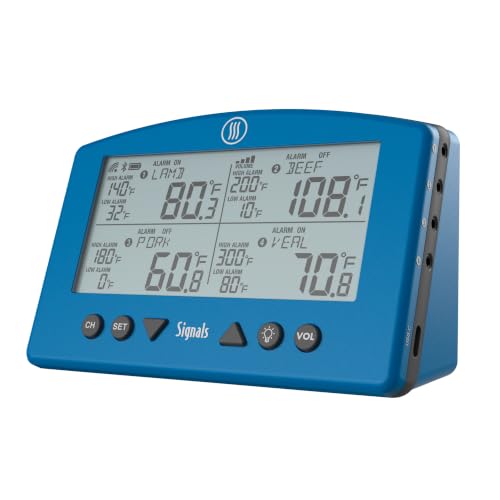
A four-probe remote thermometer from a respected thermometer maker, built for long smoker cooks. A base unit stays with the smoker while a handheld receiver travels with you. Check the listing for the exact kit contents.
Suits: serious pitmasters. Strengths: a brand known for accurate thermometers. Weaknesses: the setup is more involved than a simple receiver. Skip it if you only smoke occasionally.
View ThermoWorks Smoke X4 on Amazon
Best for cooks who like detailed logs
2. FireBoard 2 Drive
A multi-channel Wi-Fi and Bluetooth thermometer popular with smoker owners. Optional Drive hardware lets it control a blower on some cookers. Confirm compatibility with your smoker before buying the accessory.
Suits: cooks who like detailed logs. Strengths: data tracking and strong app support. Weaknesses: it takes time to learn. Skip it if you want a simple dial-and-go tool.
View FireBoard 2 Drive on Amazon
Best for cooks who want precision in large cuts
3. Combustion Predictive Thermometer
A wire-free probe with several sensors along its length that tracks core and surface readings. It also estimates how close the cook is to finished. Check the listing for what the starter set includes.
Suits: cooks who want precision in large cuts. Strengths: internal tracking along the probe. Weaknesses: only one probe in a basic set. Skip it if you need several probes for multiple cuts.
View Combustion Predictive Thermometer on Amazon
Best for home smokers who like phone alerts
4. Inkbird IBT-4XS
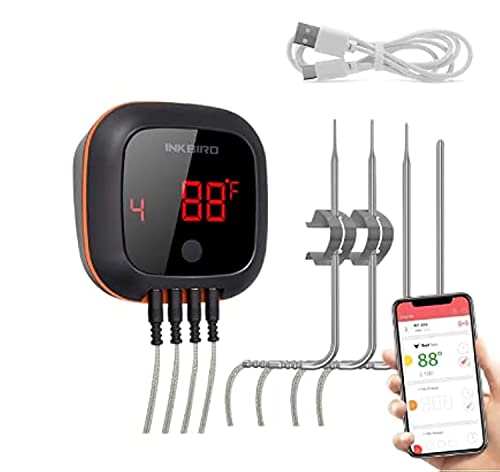
A Bluetooth thermometer with four wired probes and an app. It is a straightforward way to watch several cuts or the smoker air on your phone. Look at owner feedback on app reliability.
Suits: home smokers who like phone alerts. Strengths: multiple probes in a compact unit. Weaknesses: Bluetooth range is limited indoors. Skip it if you cook far from the house.

Best for long cooks away from the kitchen
5. ThermoPro TP829
A long-range thermometer with a handheld receiver and multiple wired probes. It runs without an app, which is handy when the phone is busy. The probes are wired, so mind the cable routing.
Suits: long cooks away from the kitchen. Strengths: long-range radio and a clear receiver. Weaknesses: the receiver is another gadget to carry. Skip it if you want phone logs.
View ThermoPro TP829 on Amazon
Best for smoking several cuts at once
6. MEATER Block
A Wi-Fi and Bluetooth block that holds up to four wire-free probes. It tracks each cut separately and sends alerts to your phone. Check the listing for probe count and the block range.
Suits: smoking several cuts at once. Strengths: no wires to snag in a crowded smoker. Weaknesses: it depends on the app. Skip it if you prefer a simple hardware receiver.
Care and Setup
- Keep probe connectors dry and wipe them clean.
- Clip cables away from direct flame and hot grates.
- Replace batteries before a long overnight cook.
- Test the probes in ice water now and then.
Mistakes to Avoid
- Poking a probe into fat or bone.
- Leaving the transmitter in the smoker with the lid closed.
- Relying on one probe for a whole packer brisket.
- Setting alarms so tight they go off constantly.
Monitoring Pit Temperature With an Ambient Probe
Smoking is mostly about holding a steady cooking temperature for hours, so measuring the smoker’s air temperature is as important as measuring the meat. A thermometer’s ambient probe sits near the cooking surface and reports what the meat is actually experiencing, which can differ from the dome or lid thermometer built into the smoker. Lid thermometers are often located high in the dome and can read differently from the grate level.
When looking at a multi-probe smoker thermometer, check whether it includes an ambient probe or whether you must add one. Confirm the maximum temperature the probe and clip can handle, and check how the clip attaches to the grate. Place the ambient probe at grate height near the meat but not touching it or the metal walls of the smoker.
Use the readings to learn your smoker. Many cookers have hot and cool spots, so moving the probe around during an empty preheat can teach you where the temperature differs. Keep notes on how your vents, fuel and weather affect the pit. Alerts for high and low temperature are especially useful on long cooks, since they let you correct a drifting fire before it ruins the cook.
Handling the Stall and Long Cooks
Large cuts such as pork shoulder and beef brisket often pause in temperature rise for a long time during a smoke. Cooks call this the stall. It can be alarming if you do not expect it, and a good thermometer helps you stay calm by showing that the temperature is still moving, just slowly.
A wireless thermometer lets you track the trend without lifting the lid. Many apps or displays show a temperature graph, which is helpful for spotting a stall, a pit drop or a rapid rise. Look for features that make long monitoring easy, such as a clear display, reliable alerts and a long-lasting power source. Check the listing for how the device is powered and what the manual says about battery care.
Plan your timing with flexibility. Because every cook varies, treat time estimates as rough guidance and rely on temperature and feel instead. Follow recognized food-safety guidance from official sources for the meat you are smoking. If you need to hold the meat after cooking, think about how you will keep it warm and safe, and check it with a separate thermometer before serving.
Probe Cables, Clips and Heat Protection
Smokers run for hours, so probe cables and connectors face a lot of heat and moisture. Check how the manufacturer describes the cable material and its maximum temperature rating. Many cables are braided or coated, but they can still be damaged by contact with flame, hot metal or sharp edges. Route cables so they do not rest against hot surfaces, and avoid pinching them in the smoker door.
Door and lid gaskets can be affected by cables. Some cooks route probes through a gap or a port, so check the design of your smoker and consider whether a cable could leave a gap that lets heat escape or air leak in. Keep transmitters and base units outside the hot zone, away from direct heat and smoke.
Helpful practices include:
- Use grate clips for ambient probes as the manual describes
- Keep probe tips clean so smoke residue does not affect readings
- Do not submerge connectors in water
- Let probes cool before cleaning
- Inspect cables for fraying, kinks or heat damage before each cook
If a cable shows damage, replace it according to the manufacturer’s guidance rather than continuing to use it.
Range, Signal and Smoker Materials
Smokers are often large steel or ceramic cookers, and these materials can weaken wireless signals. A transmitter placed inside a closed metal cabinet may have less range than the listing suggests, since stated ranges are typically measured in open space. Placement matters: keep the base unit outside the cooking chamber when the manual allows, and avoid burying it behind metal.
Think about where you want to be during a long cook. If you plan to stay in the yard, a handheld receiver or Bluetooth connection may suit you. If you want to monitor from indoors or while running errands, check whether the product supports longer-range connection through a hub or network, and read the manual for requirements and limits. Walls, distance and interference can all reduce reliability.
Prepare for dropouts. Before a long smoke, test the connection with the lid closed and walk to the farthest spot you plan to use. Know how the device behaves if the signal is lost: some units reconnect and fill in the data, others show a gap. Keep a backup thermometer or a manual check plan, especially when cooking for guests. A stable signal and clear alerts matter more on a twelve-hour cook than any single advanced feature.
Choosing by Cook Style and Budget Tier
Match features to how you cook. Weekend smokers who do a single large cut at a time may be fine with a simpler model with a couple of probes. Cooks who smoke several items at once, such as a brisket, ribs and sausage, may want more channels. Competitors or very frequent smokers might value durability, extra probe options and detailed logging.
Budget tiers can be described qualitatively. Entry-level units generally cover the basics: a few probes, a handheld display and simple alerts. Midrange units tend to add app connectivity, more channels or better build quality. Premium units may emphasize durability, extended connectivity, data logging or modular systems. Features differ by product, so check each listing instead of assuming.
Before buying, ask yourself:
- How many items do I usually cook at once?
- Do I need an app, or is a handheld display enough?
- Is the unit easy to read in bright sun or at night?
- How is it powered, and how easy is charging or battery replacement?
- Are replacement probes and cables available?
- What does the warranty cover?
Avoid paying for features you will not use, but do not skimp on probe quality and reliable alerts, since these decide whether the thermometer helps or frustrates you on a long cook.
A Quick Checklist Before You Pick a Thermometer
A wireless thermometer is only useful if it fits your smoker, your routine and your comfort with gadgets. Before you compare the models above, spend a few minutes writing down how you cook, and use the list below as a guide. The answers tend to narrow the field quickly, and they keep you from paying for features that will sit unused.
- How many cuts of meat do you usually smoke at once: one brisket, two pork shoulders, or a rack of ribs plus a chicken?
- Do you want to watch temperatures on a small base unit, on your phone, or both?
- Will you cook near your home network, or in a yard where the signal could be weak?
- Do you need an extra probe to track the temperature of the cooking chamber itself?
- Are you comfortable replacing batteries and charging a base, or would you rather plug in?
Once you know your pattern, the choice between a simple model and a multi-probe system becomes much easier to make.
How to Read a Thermometer Listing
Product pages for thermometers pack in numbers, and a few of them deserve more attention than the rest. The probe count tells you how many items you can monitor at the same time, and the maximum temperature tells you how much heat the probe cable and tip can handle. Check the wording carefully, because some listings quote the limit for the probe tip only, while the cable or the connector may have a lower limit.
Wireless range is another figure that deserves skepticism. Advertised distances usually assume open air with nothing in between, and a metal smoker, a brick wall or a closed door can reduce the real range a lot. If you plan to monitor from inside the house, look for models that connect through a home network or a cloud service, and read what the maker says about how the connection works.
Finally, look for accuracy information and for the response time of the probe, which tells you how quickly it reacts when the temperature changes. A fast response is handy when you check on the meat, while stability matters more for a probe left inside for hours.
Comparing Connection Styles
| Style | What it offers | Keep in mind |
|---|---|---|
| Radio base unit | Works without a phone or home network | Range depends on walls and metal |
| Bluetooth to phone | Alerts and graphs on a screen | Shorter range, needs the phone nearby |
| Wi-Fi or cloud | Monitor from anywhere with a signal | Needs a stable home network and an account |
| Hybrid base and app | Several ways to check in | More settings to learn |
If you smoke in a spot far from your router, a model with its own radio link may be the safest bet. If you like graphs and notes about each cook, an app-based system is appealing.
Probe Placement and Food Safety
Where the probe sits matters as much as which probe you own. For large cuts, insert the tip into the thickest part of the meat and keep it away from bone, which can read hotter than the surrounding meat. For poultry, follow official guidance on where to measure. Place the ambient probe at grate level near the food, not touching the grate or the meat, so it reports the temperature your food actually experiences.
Rely on official food safety sources for safe internal temperatures and for how long food may remain in the range where bacteria multiply. A thermometer is a tool for following that guidance, not a replacement for it. Check readings in more than one spot on large pieces, and never serve meat that has not reached the temperature recommended for it.
Care, Cables and Common Mistakes
Treat probes gently. Wipe them clean after each cook, keep the cables away from direct flame and avoid sharp bends, which can damage the wiring. Do not immerse the connector or the base unit in water unless the maker says it is allowed. Store the probes in a dry case so they are ready for the next cook.
Common mistakes include letting cables touch hot metal, inserting a probe so shallowly that it measures the outer layer only, and ignoring low battery warnings. Test your thermometer in ice water and in boiling water, as the maker’s instructions suggest, to see whether it reads sensibly. If the readings seem far off, contact the maker or replace the probe.
Glossary for Smoker Thermometer Listings
- Probe: the metal spike you insert in the meat or place in the cooking chamber.
- Ambient probe: a probe that reads the air temperature of the smoker, not the food.
- Base unit or booster: the part that receives probe data and sends it to your phone or display.
- Alarm: an alert that sounds when a set temperature is reached.
- Range: the distance at which the signal works under good conditions.
- Calibration: checking that readings match a reference such as ice water.
Probe Placement Rules of Thumb
| Cut | Where to place the probe |
|---|---|
| Thick roasts | Into the center, avoiding bone and large pockets of fat |
| Poultry | Into the thickest part of the thigh or breast, as food safety guidance describes |
| Ribs | Between bones, using the probe’s depth guide |
| Smoker air | At grate level, near the food but not touching it |
Cook Day Habits
- Check probes in ice water before the cook, and follow the maker’s calibration advice.
- Insert probes before the food goes into the smoker, if the design allows it.
- Route cables so they do not touch hot metal or get pinched by the lid.
- Set alarms slightly below your target, to leave time for resting.
- Keep the display or phone within the stated signal range.
Rely on official food safety guidance for safe internal temperatures. The thermometer is a tool, and the cook still needs to use judgment.
Wipe probes clean after each cook, following the maker’s directions, and never submerge a base unit or the plugs. Coil the cables loosely and store the set in its case so the thin wires are not crushed or kinked in a drawer.
Choosing a Wireless meat thermometer for smokers With a Clearer Eye: The Criteria That Deserve a Second Look
The opening sections of this guide cover the headline points to check when you compare wireless meat thermometers for smokers. This section slows down and looks at the same decision from the owner’s side: not what a wireless meat thermometer for smokers promises on the day it arrives, but how the choice plays out across months of following meat and pit temperatures through long smoker cooks without lifting the lid. Reading it before you settle on a pick will help you use the product sections above more sharply, because you will know which details in each description actually matter for your household and which are simply nice to have.
Fit and space, measured honestly
Start with the number of probes and channels your typical cooks need, and a connection style that suits a metal smoker and your distance from it. Measure twice, in the unhurried way that feels excessive, and write the numbers down rather than trusting memory. Allow for the unglamorous details too: how the wireless meat thermometer for smokers is reached, what sits around it in the smoker and wherever you spend the hours between checks, and whether the space you have measured is the space that will still be there once everything else is back in place. Most disappointing purchases in this category are not bad products; they are good products matched to the wrong space, and nearly all of them could have been avoided with a tape measure and ten quiet minutes before ordering.
Performance where it counts
Next, think about readings that stay accurate and connected through hours of smoke, heat and a heavy metal cooking chamber. Headline claims are easy to compare and often the least useful guide, because daily satisfaction comes from consistency: the tenth use behaving like the first, and the result staying predictable when conditions are less than perfect. As you read the pick-by-pick sections above, keep returning to this question — does this option perform in the specific way my routine actually demands, or is it strong in ways I will rarely call on? A wireless meat thermometer for smokers that is merely good at everything but exactly right for your main job usually beats a more impressive all-rounder.
Everyday ease, not first-day impressions
Consider alarms and apps or receivers that stay helpful at hour six of a cook, not just during an enthusiastic setup. Ease of use rarely appears in a feature list, yet it decides whether a wireless meat thermometer for smokers becomes part of your routine or an obstacle you work around. Picture the busiest, messiest moment of normal use — not a calm demonstration — and ask whether the design still helps you then. Small frictions repeat: a control that needs two attempts, a part that is awkward to lift, a routine that takes a minute longer than it should. Multiplied across a year of regular use, those small frictions are the difference between a purchase you recommend to friends and one you quietly stop using.
Cleaning and upkeep you will actually do
Be honest about probes coated in smoke and rendered fat, cables that need gentle handling and storage that keeps tips protected. Every wireless meat thermometer for smokers in this guide asks for some upkeep, and the realistic question is not whether the cleaning is easy in theory but whether it fits the time and patience you genuinely have. Short, regular attention almost always beats occasional heroic deep cleans, both for results and for how long the product lasts. As you compare the picks, favour the design whose upkeep matches your habits — a slightly simpler model you keep clean will outperform a sophisticated one you neglect, every single time.
Safety and the people around you
Finally, think about judging doneness properly rather than by time alone, handling hot probes and keeping transmitters within their heat limits. Safety in this category is mostly a matter of habits and placement rather than dramatic risks: where the wireless meat thermometer for smokers sits, who can reach it, and whether your routine includes the small checks that keep everything sound. Read the safety notes in each product section above with your own household in mind — the presence of children, pets, elderly relatives or simply a busy, distracted cook changes which precautions matter most. A few minutes spent setting things up safely at the start is repaid every time you use the wireless meat thermometer for smokers without thinking about it.
Putting It to Work: How a Wireless meat thermometer for smokers Fits Real Routines
Specifications describe a wireless meat thermometer for smokers; routines reveal one. The scenarios below describe the situations readers most often have in mind when they shop for wireless meat thermometers for smokers, and what each situation rewards. Find the scenario closest to your life and weight it heavily: a pick that shines in your scenario is a better buy than a pick that wins on a comparison table but belongs to somebody else’s routine. Many households recognise themselves in two scenarios at once, in which case the overlap between them is usually where the right choice sits.
Brisket and other overnight cooks
This is about watching the stall and the pit temperature while you get some sleep. In this situation, the wireless meat thermometer for smokers is not an occasional tool but part of a repeating pattern, so reliability and ease matter more than novelty. Look again at the picks above and ask which of them is described in terms that match this pattern: steady performance across a long session, straightforward handling when you are busy, and upkeep that can keep pace with frequent use. It is also worth thinking about what happens on the busiest version of this day, not the average one, because a wireless meat thermometer for smokers chosen for the average day is the one that lets you down precisely when the stakes are highest — guests waiting, a deadline looming or a car packed and ready to leave.
Several meats in one smoker
This is about a shoulder, ribs and chicken all finishing at different times on different shelves. In this situation, the wireless meat thermometer for smokers is not an occasional tool but part of a repeating pattern, so reliability and ease matter more than novelty. Look again at the picks above and ask which of them is described in terms that match this pattern: steady performance across a long session, straightforward handling when you are busy, and upkeep that can keep pace with frequent use. It is also worth thinking about what happens on the busiest version of this day, not the average one, because a wireless meat thermometer for smokers chosen for the average day is the one that lets you down precisely when the stakes are highest — guests waiting, a deadline looming or a car packed and ready to leave.
Learning a new smoker
This is about building a picture of how your pit behaves — its hot spots, recovery and drift. In this situation, the wireless meat thermometer for smokers is not an occasional tool but part of a repeating pattern, so reliability and ease matter more than novelty. Look again at the picks above and ask which of them is described in terms that match this pattern: steady performance across a long session, straightforward handling when you are busy, and upkeep that can keep pace with frequent use. It is also worth thinking about what happens on the busiest version of this day, not the average one, because a wireless meat thermometer for smokers chosen for the average day is the one that lets you down precisely when the stakes are highest — guests waiting, a deadline looming or a car packed and ready to leave.
Competition-style precision at home
This is about logging cooks so a great result can be repeated, not just remembered fondly. In this situation, the wireless meat thermometer for smokers is not an occasional tool but part of a repeating pattern, so reliability and ease matter more than novelty. Look again at the picks above and ask which of them is described in terms that match this pattern: steady performance across a long session, straightforward handling when you are busy, and upkeep that can keep pace with frequent use. It is also worth thinking about what happens on the busiest version of this day, not the average one, because a wireless meat thermometer for smokers chosen for the average day is the one that lets you down precisely when the stakes are highest — guests waiting, a deadline looming or a car packed and ready to leave.
Day-to-Day Use, Cleaning and Care in More Detail
The care sections earlier in this guide give the essentials. What follows is the longer view: how to build the small habits that keep a wireless meat thermometer for smokers performing well, how to clean it without turning the job into a chore you avoid, and how to store and look after it between uses. None of this requires specialist products or skills — it requires doing simple things regularly, which is unglamorous and entirely effective.
The first uses set the pattern
When your wireless meat thermometer for smokers is new, take the first use slowly. Read the maker’s instructions properly — not as a formality, but because the details that matter, from first setup to what not to do, are specific to your model and are not repeated anywhere else. Run through the basic routine once without time pressure, notice what feels awkward, and adjust your setup while the stakes are low. Owners who give a new wireless meat thermometer for smokers one unhurried first session almost always have a smoother first month than owners who debut it in front of an audience or a deadline.
A cleaning rhythm that sticks
For cleaning, little and often is the whole secret. Deal with probes coated in smoke and rendered fat, cables that need gentle handling and storage that keeps tips protected while traces are fresh and the job takes minutes; leave them and the same job becomes the kind of task that gets postponed indefinitely. Keep the basic supplies you need within reach of where the wireless meat thermometer for smokers lives, use only cleaning methods and products the maker allows for the surfaces involved, and let everything dry fully before the next use or before storage. If several people share the wireless meat thermometer for smokers, agree on the rhythm out loud — most neglected equipment belongs to everyone in theory and nobody in practice.
Storage and the time between uses
What happens between uses shapes a wireless meat thermometer for smokers’s life as much as the uses themselves. Store it and its accessories together, dry and protected from knocks, dust and damp, in a place that does not require a struggle to reach — equipment stored awkwardly gets used reluctantly. Before a longer break, a proper clean and a quick check of the parts that wear, loosen or perish means the wireless meat thermometer for smokers comes back to service ready rather than needing rescue. When you return to it, a brief inspection before the first use catches the small problems — a frayed edge, a loose fitting, a part left dirty — while they are still small.
Knowing what is normal and what is not
Every wireless meat thermometer for smokers develops a familiar pattern of sounds, smells, timings and behaviour, and learning that pattern is a genuine skill. Once you know what normal looks like, changes announce themselves early: a new noise, a slower result, a part that no longer sits as it did. Most changes have simple causes covered in the troubleshooting spirit of this guide — something needs cleaning, adjusting or replacing as a consumable. The ones that do not respond to the simple checks are the ones to hand to a professional, and catching them early is usually what keeps a repair minor.
How the Picks in This Guide Compare With Each Other
Readers often ask for a simple ranking of the wireless meat thermometers for smokers above, but the honest comparison is about fit. Each pick in this guide earned its place for a slightly different reader, and the sections describing them already contain everything needed to separate them: who each one suits, the strengths highlighted, and the honest limitation mentioned alongside. The notes below show how to run that comparison for yourself, pick by pick, so the final choice rests on your priorities rather than on a generic verdict.
Consider the ThermoWorks Smoke X4. Return to its section above and note three things in order: the reader it is described as suiting, the strength the guide emphasises most, and the limitation it openly flags. Then hold those three points against the criteria and scenarios earlier on this page. If the reader it suits sounds like you, and its flagged limitation touches something you rarely do, it belongs on your shortlist even if another pick looks stronger on paper. If the limitation sits squarely in your main routine, that is the comparison doing its job — cross it off without regret and move to the next pick, because a wireless meat thermometer for smokers whose weakness meets your most common use will disappoint you weekly, however good its strengths are.
Consider the FireBoard 2 Drive. Return to its section above and note three things in order: the reader it is described as suiting, the strength the guide emphasises most, and the limitation it openly flags. Then hold those three points against the criteria and scenarios earlier on this page. If the reader it suits sounds like you, and its flagged limitation touches something you rarely do, it belongs on your shortlist even if another pick looks stronger on paper. If the limitation sits squarely in your main routine, that is the comparison doing its job — cross it off without regret and move to the next pick, because a wireless meat thermometer for smokers whose weakness meets your most common use will disappoint you weekly, however good its strengths are.
Consider the Combustion Predictive Thermometer. Return to its section above and note three things in order: the reader it is described as suiting, the strength the guide emphasises most, and the limitation it openly flags. Then hold those three points against the criteria and scenarios earlier on this page. If the reader it suits sounds like you, and its flagged limitation touches something you rarely do, it belongs on your shortlist even if another pick looks stronger on paper. If the limitation sits squarely in your main routine, that is the comparison doing its job — cross it off without regret and move to the next pick, because a wireless meat thermometer for smokers whose weakness meets your most common use will disappoint you weekly, however good its strengths are.
Consider the Inkbird IBT-4XS. Return to its section above and note three things in order: the reader it is described as suiting, the strength the guide emphasises most, and the limitation it openly flags. Then hold those three points against the criteria and scenarios earlier on this page. If the reader it suits sounds like you, and its flagged limitation touches something you rarely do, it belongs on your shortlist even if another pick looks stronger on paper. If the limitation sits squarely in your main routine, that is the comparison doing its job — cross it off without regret and move to the next pick, because a wireless meat thermometer for smokers whose weakness meets your most common use will disappoint you weekly, however good its strengths are.
Consider the ThermoPro TP829. Return to its section above and note three things in order: the reader it is described as suiting, the strength the guide emphasises most, and the limitation it openly flags. Then hold those three points against the criteria and scenarios earlier on this page. If the reader it suits sounds like you, and its flagged limitation touches something you rarely do, it belongs on your shortlist even if another pick looks stronger on paper. If the limitation sits squarely in your main routine, that is the comparison doing its job — cross it off without regret and move to the next pick, because a wireless meat thermometer for smokers whose weakness meets your most common use will disappoint you weekly, however good its strengths are.
Consider the MEATER Block. Return to its section above and note three things in order: the reader it is described as suiting, the strength the guide emphasises most, and the limitation it openly flags. Then hold those three points against the criteria and scenarios earlier on this page. If the reader it suits sounds like you, and its flagged limitation touches something you rarely do, it belongs on your shortlist even if another pick looks stronger on paper. If the limitation sits squarely in your main routine, that is the comparison doing its job — cross it off without regret and move to the next pick, because a wireless meat thermometer for smokers whose weakness meets your most common use will disappoint you weekly, however good its strengths are.
Two further checks sharpen any shortlist. First, compare upkeep: the picks differ in how much routine attention they ask for, and the one whose care routine matches your habits will still be performing well long after a needier rival has been neglected. Second, compare the whole purchase, not just the unit — the accessories, consumables, replacement parts and storage the wireless meat thermometer for smokers needs over its life.
The Longer View: Owning One Well
A wireless meat thermometer for smokers is one of those purchases whose value compounds quietly. The first month is about learning it; the first year is about the routine settling around it; after that, it simply becomes how things are done in your home. Owners who get the most from wireless meat thermometers for smokers share a few traits that have nothing to do with which model they bought. They keep the basic accessories and consumables in stock so a missing item never cancels a plan. They do the small cleaning and checking jobs on rhythm rather than on memory. And they revisit their setup occasionally — as households, tastes and routines change, the way a wireless meat thermometer for smokers is used can change with them, and a small rearrangement sometimes unlocks value that was there all along.
It is also worth keeping a light record, even if only mentally, of what works for you: the settings, timings, arrangements or combinations that produced your best results. The guides and product sections can start you off, but your own notes — adjusted for your space, your ingredients, your car, your collection, your people — are what turn a good wireless meat thermometer for smokers into the right one. When the time eventually comes to replace it, that record tells you exactly which of the criteria in this guide mattered in practice, and the next purchase becomes the easiest one you have made in this category.
Smoker Thermometer FAQ
How many probes do I need for a smoker?
At least two, one for the meat and one for the chamber. More lets you track several cuts or different zones.
Do I need Wi-Fi?
No. Radio-based models work without a network, while Wi-Fi and Bluetooth models add phone alerts and logs.
Can wireless probes stay in during a long smoke?
Many are designed for long cooks, but check the maker guidance for the heat limits of cables and transmitters.
Why do I need an ambient probe on a smoker?
It measures the air temperature near the meat, which can differ from the lid thermometer on many smokers. That gives a more useful picture of the cooking environment. Check whether the model includes one.
What is the stall?
It is a period where the meat's temperature rises very slowly or pauses during a long cook. A wireless thermometer with a graph helps you see that the temperature is still progressing.
Can probe cables get damaged by the smoker?
Yes, heat, flame, sharp edges and pinching in a door can damage cables. Check the heat rating in the manual, route cables carefully and replace damaged ones.
Will my smoker's metal body block the signal?
It can reduce range. Keep the base unit outside the cooking chamber when the manual allows, and test the connection with the lid closed before a long cook.
Is an app necessary?
Not always. A handheld display can be enough if you stay near the smoker. An app helps if you want graphs, alerts on your phone or monitoring from farther away. Check compatibility on the listing.
How do I check that my thermometer is reading correctly?
Compare it with a second thermometer, and follow any calibration steps in the manual. If readings are consistently off, contact the seller or manufacturer.
How many channels do I need for different cooks?
A single large cut can work with one meat probe and an ambient probe, while multiple items need more channels. Count how many probes you use in a typical cook and add a margin.
Should I replace probes over time?
Probes and cables wear out with heat and handling. Replace them if you see damage, corrosion or erratic readings, and check whether the manufacturer offers replacements.
Where exactly should the probe tip sit in a large cut?
In the thickest part, centred as well as you can judge, and clear of bone and large pockets of fat, which read differently from the meat itself. On a brisket that usually means the thick end of the flat; when in doubt, a second check with an instant-read thermometer at serving time settles arguments.
Why do two probes in the same meat sometimes disagree?
A large cut is not one uniform temperature — thickness, fat seams and position in the smoker all vary. Small differences are information, not error: they tell you how the cook is progressing across the cut. Judge doneness by the lowest, most central reading and by feel.
Can I rely on preset temperatures in the app?
Presets are a starting point, not a promise, because cuts vary and personal preference varies more. Use them to set alarms, then make the final call with tenderness and a confirming check. The cooks you remember best will come from your own notes, not the factory defaults.
What should I do if a probe reading suddenly jumps or freezes?
Check the connection at both ends, look for a cable pinched in the door or resting on hot metal, and confirm the probe has not slipped out of the meat. Swap in a spare channel if you have one. A frozen reading during a long cook is a reason to check promptly, not at the planned time.
How do I protect probe cables from the smoker door?
Route them through a port if your smoker has one, or over a gasket line where the seal is forgiving, and avoid sharp bends. Cables fail from repeated crushing and heat at one spot, so a consistent, gentle route extends their life considerably.
Is it worth keeping a cook log?
A simple log — meat, weight, pit temperature, wrapping time, finishing feel — turns one good cook into a repeatable method. It also makes a thermometer’s history features genuinely useful, because you can compare today’s cook against your best one rather than guessing.
The Short Version
For a pitmaster pick, the ThermoWorks Smoke X4. For data logs, the FireBoard 2 Drive. For precision, the Combustion probe. For app basics, the Inkbird IBT-4XS. For long range without a phone, the ThermoPro TP829. For several wire-free probes, the MEATER Block.