Disclosure: airfryerkitchensupply.com is reader-supported. When you buy through links on our site, we may earn an affiliate commission at no extra cost to you.
Where to buy
Every model shortlisted as one of the best robot vacuum for fringe rugs in this guide is listed below with its badge. Every vacuum below is sold on Amazon and was verified against its listing before earning a link. This guide opens with the honesty this search requires: no robot vacuum title in the verified set claims fringe handling, so the picks are chosen for the technologies that matter around fringe — obstacle avoidance, anti-tangle design, mapping with no-go zones, and tangle-free suction — and the guide teaches the setup that keeps fringe safe.
- roborock Qrevo Master Robot Vacuum and Mop Combo (Best Overall) — check price on Amazon
- Shark AV2501AE AI Robot Vacuum with XL Self-Empty Base (Best for Pet Hair & Fringe Homes) — check price on Amazon
- ILIFE V2 Robot Vacuum Cleaner, Tangle-Free Suction (Best Fringe-First Design) — check price on Amazon
- roborock Q5+ Robot Vacuum with Self-Empty Dock (Best Self-Empty Value) — check price on Amazon
- iRobot Roomba Vac Robot Vacuum (Q0120) (Best Simple) — check price on Amazon
- eufy C10 Robot Vacuum Self Emptying (Best Low Clearance) — check price on Amazon
The best robot vacuum for fringe rugs is a search built on a worry, so this guide starts with the honest answer: fringe is the natural enemy of robot vacuums, and no manufacturer in the verified set claims otherwise in its listing title. Loose fringe strands invite exactly what spinning brushes do — catch, wrap, and drag — and a robot that meets a long, loose fringe unprepared will eat it, stall, or tow the rug across the room. What separates the good outcomes from the bad is not a fringe mode, because there isn’t one; it is a combination of obstacle avoidance, brush design, mapping with no-go zones, and ten minutes of owner setup, all of which this guide covers in the open.
The six picks were chosen for fringe-relevant engineering stated in their verified titles. Obstacle avoidance leads, because a robot that sees and steers around obstacles treats rug edges more gently. Anti-tangle and tangle-free designs follow, because what wraps less, traps less. LiDAR mapping matters because it enables no-go zones — the nuclear option that simply keeps the robot off a precious rug’s fringe entirely. And raw suction numbers, which several titles state proudly, are treated here as secondary: suction cleans the rug, but it is brush behavior and navigation that decide whether the fringe survives the cleaning.
The buying-guide and how-to sections carry the other half of the answer: how to assess your own rug’s fringe — length, looseness, and whether it can be tucked or weighted — and how to run a supervised first cleaning that tells you the truth about your specific robot-and-rug pairing before you ever schedule an unattended run. Fringe safety is a system, and this guide sells you the system, not a fantasy.
In this guide
Quick Picks
Best Overall: roborock Qrevo Master Robot Vacuum and Mop Combo — 10,000Pa suction with FlexiArm edge design, obstacle avoidance, self-emptying and refilling, and auto mop washing — the most fringe-aware navigation in the set. — Check on Amazon
Best for Pet Hair & Fringe Homes: Shark AV2501AE AI Robot Vacuum with XL Self-Empty Base — LiDAR navigation, AI object handling, and a 60-day bagless self-empty base with HEPA stated in the title — built for busy, pet-haired floors. — Check on Amazon
Best Fringe-First Design: ILIFE V2 Robot Vacuum Cleaner, Tangle-Free Suction — a tangle-free suction robot with no main brushroll to wrap fringe — 120 minutes runtime, remote, schedule, slim and self-charging. — Check on Amazon
Best Self-Empty Value: roborock Q5+ Robot Vacuum with Self-Empty Dock — 2700Pa suction, 180-minute runtime, and a self-empty dock good for up to 7 weeks — the mapping family’s accessible entry. — Check on Amazon
Best Simple: iRobot Roomba Vac Robot Vacuum (Q0120) — an easy-to-use Roomba with power-lifting suction, smart navigation in neat rows, multi-surface cleaning, and self-charging. — Check on Amazon
Best Low Clearance: eufy C10 Robot Vacuum Self Emptying — a 2.85-inch slim LiDAR robot with self-emptying for 8 weeks, smart mapping, and carpet detection — slides under the furniture fringe rugs live beneath. — Check on Amazon
Key Takeaways
- No verified robot vacuum title claims fringe handling — be skeptical of any source that promises a fringe-proof robot.
- The fringe-relevant technologies are obstacle avoidance, anti-tangle or tangle-free brush design, and LiDAR mapping with no-go zones.
- A tangle-free suction design with no main brushroll is the gentlest architecture around loose fibers.
- The supervised first run is non-negotiable: watch your robot meet your fringe before scheduling anything unattended.
- For precious rugs, the correct answer may be a no-go zone and a handheld pass over the fringe — this guide says so plainly.
How These Picks Were Chosen
Candidates were verified by brand and model through the site’s own product data feed. Because no title claims fringe capability, selection ran on the fringe-relevant properties titles do state: obstacle avoidance, anti-tangle systems, tangle-free suction, LiDAR navigation and mapping (the enabler of no-go zones), self-emptying for homes that run the robot often, and slim profiles for rug-edge transitions. Accessory listings that infest vacuum searches — virtual walls and replacement parts sold alone — were excluded; every pick is a complete robot vacuum.
The six map to strategies rather than a single ranking. The roborock Qrevo Master leads on avoidance and edge design. The Shark AI model brings LiDAR and a self-empty base with a HEPA claim stated in its title. The ILIFE V2 is the tangle-free suction specialist — the only architecture here with no brushroll to wrap fringe in the first place. The roborock Q5+ is the self-empty value in the mapping family, the Roomba Vac is the simple rows-and-done option, and the eufy C10 is the slim LiDAR pick for low furniture. Specs repeat only verified title content.
No prices are printed; robot vacuum pricing is promotion-driven and dock configurations multiply it. Each linked pick says check price on Amazon, and the budget section argues in tiers — avoidance flagships, mapping mid-tiers, and simple or tangle-free specialists.
Best Robot Vacuum for Fringe Rugs: The 6 Picks

roborock Qrevo Master Robot Vacuum and Mop Combo — Best Overall
The Qrevo Master leads because obstacle avoidance is the fringe owner’s first defense, and its verified title states it outright alongside serious cleaning hardware: 10,000Pa suction, a FlexiArm design side brush and mop for edges, auto mop washing and drying, self-emptying and refilling, and dock self-cleaning, in black. A robot that perceives obstacles and plans around them approaches a rug’s edge as a boundary to respect rather than a surprise to collide with — the behavioral difference that fringe outcomes turn on.
Strengths
- Obstacle avoidance stated in the title — the single most fringe-relevant navigation trait
- FlexiArm edge design reaches along baseboards and rug edges deliberately rather than by collision
- Full dock automation — self-empty, refill, mop wash and dry — suits the frequent runs fringe homes should prefer over rare deep assaults
Trade-offs
- Flagship tier and a flagship dock footprint; the dock needs its own floor space and water routine
- Mop functions must be managed around rugs — use the mapping to keep wet mops off delicate rug fibers
- No title claims fringe handling, because none exists: the supervised first run still applies
| Suction (verified title) | 10,000Pa |
| Navigation | Obstacle avoidance |
| Edge design | FlexiArm side brush & mop |
| Dock | Self-emptying & refilling, mop wash/dry |
| Fringe claim | None stated — see intro |
Frequent gentle runs beat occasional deep ones in fringe homes, and this dock is built for frequency: the robot empties itself, refills itself, and washes its own mops, so a daily maintenance pass costs the owner nothing but the schedule. Daily passes keep grit from migrating into the rug’s pile — grit being what actually wears fringe fibers out — while each individual pass stays light. It is a maintenance philosophy disguised as a dock, and it suits delicate rugs better than any suction figure.
The FlexiArm deserves a fringe-specific note: an extending side brush sweeps edges proactively, which along a rug’s edge means debris is gathered from the border zone deliberately. Watch it on the first run near your fringe — the side brush is exactly the component to observe — and if your fringe is long and loose, the no-go guidance in this guide’s how-to applies to even this robot.
Dock placement is this flagship’s one domestic demand: it needs floor space, a nearby outlet, and — for its water functions — a spot where refilling and emptying tanks is a sink-side habit rather than a chore. Put the dock where the routine is easy and the automation the title promises actually happens; a flagship dock exiled to a far corner quietly turns its owner back into the robot’s servant.
One more ownership rhythm for flagship owners: schedule the fringe rooms as their own zone runs at first, separate from the whole-home clean, so you can spot-check results room by room while trust builds. Once a room has passed a month of incident-free zone runs, fold it into the general schedule. Trust, in fringe ownership, is earned per rug — and this robot’s mapping makes that granularity possible.
Best for: fringe-rug homes wanting the most aware navigation and hands-free upkeep / Not suited for: buyers wanting a simple, dock-free setup
Check on Amazon — check the current price on Amazon before you decide.

Shark AV2501AE AI Robot Vacuum with XL Self-Empty Base — Best for Pet Hair & Fringe Homes
The Shark AV2501AE pairs the two systems fringe-and-pet homes need most: LiDAR navigation — the mapping technology that enables precise no-go zones — and a bagless XL self-empty base with a 60-day capacity and a HEPA claim stated in the verified title, framed for pet hair across carpet and hard floor, with Alexa and Wi-Fi. Where the roborock wins on avoidance finesse, the Shark wins on mapped control plus hair handling, the combination most fringe-rug households with pets actually live with.
Strengths
- LiDAR navigation enables room mapping and no-go zones — the definitive fringe-protection tool
- 60-day bagless self-empty base with HEPA stated in the title suits pet-hair volumes
- AI-framed navigation and pet-hair design target the debris fringe homes actually fight
Trade-offs
- The self-empty base is a large dock commitment in the room it lives in
- HEPA here is the listing’s stated term for its base filtration — this guide repeats it as stated, no further
- As with every pick: no fringe claim exists, and the first run near fringe should be supervised
| Navigation | LIDAR |
| Self-empty | XL base, bagless, 60-day capacity |
| Filtration (per title) | HEPA |
| Stated strength | Pet hair, carpet & hard floor |
| Fringe claim | None stated — see intro |
The no-go zone is the honest endgame of fringe protection, and LiDAR is what makes it precise. With a mapped home, you draw the line where protection matters — around a precious antique rug entirely, or across the fringe ends of an everyday rug while its body still gets cleaned — and the robot obeys the map forever, not just when it happens to sense well. For fringe owners, that feature alone justifies choosing a mapping robot over a random-navigation one, and the Shark’s title puts LiDAR in writing.
Pet hair is the fringe home’s second front: hair mats into fringe, and fringe traps hair against the floor where weaker robots skate over it. A robot framed and equipped for pet hair, emptying itself into a high-capacity bagless base, sustains the frequent-run rhythm that keeps both the rug body and its borders honest between your own occasional hand passes.
Draw your no-go zones generously on the first map — a margin beyond the fringe ends, not a line shaved along them — because a robot’s real-world path wobbles a little around its planned one. You can tighten a generous zone later, after observed runs earn your trust; you cannot un-catch a strand. In fringe mapping, as in tailoring, it is easier to take in than to let out.
The bagless base deserves a fringe-home footnote: pet hair and rug fiber are exactly the debris that makes bagless emptying dusty, so empty the base outdoors or over a bin with the lid close at hand. Sixty days of capacity means sixty days of accumulated allergens leaving at once — a small ritual of care that keeps the system’s convenience from taxing the air it cleaned.
Best for: pet homes with fringe rugs that need mapped no-go control / Not suited for: dock-averse minimalists
Check on Amazon — check the current price on Amazon before you decide.
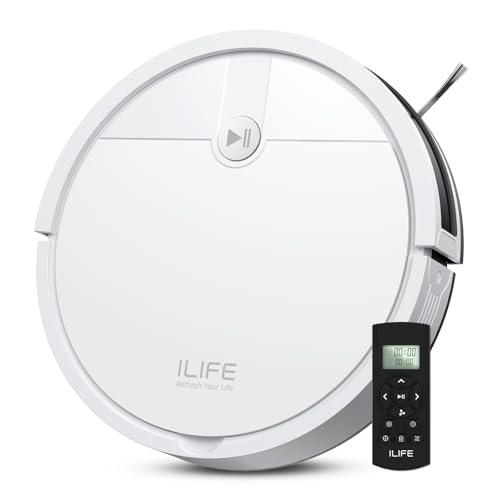
ILIFE V2 Robot Vacuum Cleaner, Tangle-Free Suction — Best Fringe-First Design
The ILIFE V2 is the architectural answer to the fringe problem: its verified title states tangle-free suction, and a suction-port design without a main rotating brushroll removes the very mechanism that wraps fringe, hair, and threads. Around loose fibers, that is not a minor spec — it is the difference between a robot that can only harm fringe by bumping it and one that can ingest it. Add 120 minutes of runtime, remote and schedule control, a slim self-charging body, and a stated fit for pet hair and hard floors, and the V2 is the fringe-first specialist of this guide.
Strengths
- Tangle-free suction with no main brushroll — the gentlest architecture around loose fringe, full stop
- Slim body slips under furniture where fringe rugs often live, and self-charges when done
- Remote and schedule control without app dependency suits simpler households
Trade-offs
- Suction-only cleaning is less aggressive on deep carpet pile than brushroll agitation — hard floors and low pile are its home
- No LiDAR mapping in the title, so no-go zones are physical, not digital: doors and barriers do that job
- 120 minutes is the stated ceiling; large homes may need recharge-and-resume expectations set accordingly
| Cleaning system | Tangle-free suction |
| Runtime (per title) | 120 mins |
| Navigation | Not stated (no LiDAR claimed) |
| Control | Remote control, schedule |
| Fringe relevance | No brushroll to wrap fringe |
Every other pick in this guide manages the brushroll problem — with avoidance, anti-tangle combs, or mapping. The V2 declines to have the problem. That is why, for a home whose defining feature is a beloved fringed rug on hard floors, this unassuming robot can be the safest daily driver in the list: it patrols, it suctions, and its underside holds no spinning trap for a loose strand to find. The trade is real — deep-pile carpet wants agitation this design does not provide — but fringe rugs overwhelmingly live on hard floors and low pile, which is precisely the V2’s stated territory.
Use it as the daily maintenance layer and reserve deeper carpet work for an upright. That division of labor — robot for frequency, upright for depth, hand for the fringe itself — is the system this guide recommends, and the V2 is its most natural robot.
Without app mapping, the V2’s zoning is physical, and physical zoning has its own craft: a closed door is a perfect no-go zone, a low threshold strip guards a rug room, and furniture placement can funnel the robot’s rounds away from a fringe end you are protecting. Owners of simple robots have used these tools for years; combined with this design’s brushroll-free underside, they make a complete and honest system.
Suction-only designs also age gracefully around rugs in one specific way: there is no brushroll to develop the nicks and burrs that an aging brush acquires — burrs that snag fibers a new brush would have spared. A robot whose fringe manners do not degrade with its hardware is worth real consideration for a rug you intend to keep for decades, cleaned by a robot you intend to keep for years.
Best for: hard floors and low-pile fringed rugs, and owners who fear brushroll wrap above all / Not suited for: deep-pile carpet homes needing brush agitation
Check on Amazon — check the current price on Amazon before you decide.
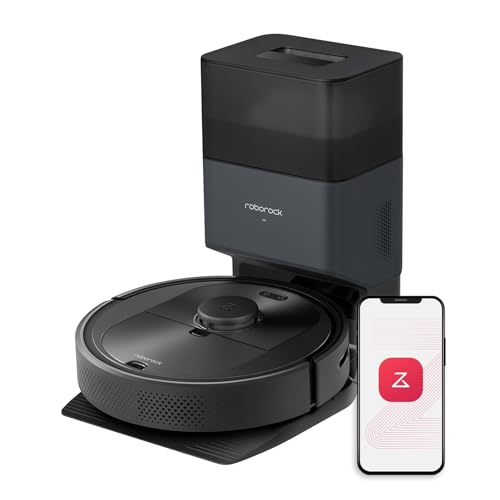
roborock Q5+ Robot Vacuum with Self-Empty Dock — Best Self-Empty Value
The Q5+ is the pragmatic mapping pick: its verified title states a self-empty dock with hands-free cleaning for up to 7 weeks, 2700Pa max suction, and a 180-minute max runtime, framed for hard floors, carpets, and pet hair, with Alexa compatibility. The suction figure is modest beside the flagship’s 10,000Pa — and for fringe homes that is no bad thing, because the Q5+’s case rests on runtime, autonomy, and the roborock mapping ecosystem rather than on force.
Strengths
- 180-minute runtime is the longest stated here — big fringe-rug homes get covered in one outing
- Self-empty dock sustains up to 7 weeks of hands-free running, enabling the frequent-gentle rhythm
- roborock’s mapping family gives access to room maps and zone control through the app
Trade-offs
- 2700Pa is the gentlest suction here — fine for maintenance, not a deep-clean headline
- Anti-tangle and avoidance specifics are not stated in this title; judge it as a mapping-and-runtime pick
- Dock bags or dock upkeep are part of self-empty ownership — check the listing for its consumables
| Suction (verified title) | 2700Pa max |
| Runtime | 180 mins max |
| Self-empty | Dock, up to 7 weeks |
| Stated floors | Hard floors, carpets, pet hair |
| Fringe claim | None stated — see intro |
Runtime is the sleeper spec of fringe homes. A robot that dies mid-map restarts confused, re-covers ground, and meets the same rug edge four times in an outing — four chances for an incident. A 180-minute robot finishes the home in one coherent pass, meets each edge once, and goes home. For large homes with several rugs, that coherence is a safety feature in everything but name.
Position the Q5+ as the set-and-forget layer: map once, mark the precious zones, schedule frequent runs, and let the dock absorb the evidence for weeks at a time. Its gentler suction is honestly matched to that maintenance role — it is keeping a clean home clean, which is the workload that protects rugs and fringe in the long run.
The Q5+’s 7-week dock rhythm has a fringe-specific dividend: because the robot is never full, it is never skipped, and because it is never skipped, the rug borders never accumulate the grit load that makes owners demand a deep, aggressive — and fringe-risky — recovery clean. Autonomy is what keeps every individual run boring, and boring is the highest praise a fringe-rug cleaning run can earn.
If your home has one precious rug among several ordinary ones, the Q5+ supports the mixed strategy gracefully: map everything, zone the precious rug out, and let the robot’s long runtime service the rest of the house in a single outing while you hand-tend the one rug that matters. Not every robot in a fringe home must be a fringe robot — some must simply be excellent everywhere else.
Best for: large homes wanting long-runtime, self-emptying maintenance runs / Not suited for: buyers wanting maximum suction or stated obstacle avoidance
Check on Amazon — check the current price on Amazon before you decide.

iRobot Roomba Vac Robot Vacuum (Q0120) — Best Simple
The Roomba Vac is the simplicity pick: its verified title promises easy use, power-lifting suction, multi-surface cleaning, and smart navigation that cleans in neat rows, with self-charging and Alexa. Neat rows are the fringe-relevant detail — a robot that cleans in predictable straight lines meets a rug’s edge at a shallow, consistent angle and crosses borders the same way every time, which is behavior an owner can actually learn and trust, unlike random-bounce navigation.
Strengths
- Neat-rows navigation is predictable — the robot meets every rug edge the same way, run after run
- Roomba’s ease-of-use framing suits owners who want cleaning without app archaeology
- Multi-surface cleaning with power-lifting suction handles the hard-floor-to-rug transitions fringe homes are made of
Trade-offs
- No self-empty dock and no LiDAR in the stated title — control is simpler and coarser than the mapping picks
- Obstacle avoidance is not claimed in the title; fringe supervision on first runs is essential
- Suction is described in words, not a Pa figure, in this title — compare it as a design, not a number
| Navigation | Smart navigation, neat rows |
| Suction | Power-lifting (per title) |
| Self-empty | Not stated |
| Self-charging | Yes |
| Fringe claim | None stated — see intro |
Predictability is an underrated safety property. With a rows-cleaning robot, you can stand in the room for one full session, watch exactly how it approaches and crosses your rug’s fringe from its working direction, and know that tomorrow’s run will repeat the geometry. That learnability is what turns supervision from a permanent chore into a one-time verification — the practical path by which fringe owners actually achieve unattended cleaning.
The Roomba also suits the mixed household: one fringed rug among otherwise ordinary floors, an owner who wants the robot to simply handle the ordinary and be watched, briefly, at the extraordinary. Not every home needs a mapping flagship; some need a dependable row-cleaner and an owner who has done the first-run homework this guide insists on.
Learn this robot’s row direction in your rug room and arrange the supervised test around it: rows that approach the fringe end-on, strands lying in their natural direction, are the gentlest geometry; if your room’s rows meet the fringe side-on and lift it, a quarter-turn of the rug — where the room allows — can change the meeting angle permanently. Sometimes the fix is not in the robot at all, but in the rug’s rotation.
Rows navigation has a second, subtler fringe benefit: it misses less. Random-pattern robots re-cross the same border repeatedly in one session while leaving other ground untouched; a rows robot crosses each border a small, countable number of times and covers everything once. Fewer crossings, fewer chances — the mathematics of fringe safety quietly favor the methodical.
Best for: simpler homes and owners who value predictable, learnable behavior / Not suited for: buyers wanting app-drawn no-go zones
Check on Amazon — check the current price on Amazon before you decide.

eufy C10 Robot Vacuum Self Emptying — Best Low Clearance
The eufy C10 closes the guide with the slim argument: its verified title states a 2.85-inch profile, advanced smart mapping with LiDAR navigation, self-emptying for 8 weeks of hands-free cleaning, an edge expansion brush for pet hair, and carpet detection. Fringe rugs live under coffee tables, sofas, and beds — the low-clearance world — and a robot too tall to enter it leaves the rug’s most-trafficked borders uncleaned. The C10 is built to go where the rug actually is.
Strengths
- 2.85-inch slim body reaches under the low furniture that shelters rug edges
- LiDAR smart mapping enables the no-go zones this guide treats as definitive fringe protection
- Carpet detection stated in the title — the robot knows when it has climbed onto pile
Trade-offs
- Slim bodies carry smaller onboard bins; the self-empty dock compensates, but dock space is required
- Edge expansion brush is a spinning component — observe it at your fringe on the supervised first run
- Suction is described as powerful without a Pa figure in this title
| Height (verified title) | 2.85-inch slim |
| Navigation | LiDAR, smart mapping |
| Self-empty | 8 weeks hands free |
| Detection | Carpet detection |
| Fringe claim | None stated — see intro |
Carpet detection is a quietly fringe-relevant feature: a robot that registers the transition onto carpet adjusts its behavior for the surface it is on, rather than charging from hard floor onto a rug at full hard-floor settings. Combined with LiDAR mapping — and the no-go precision it enables — the C10 offers the control set of the big mapping robots in a body that fits the actual geography of rug-and-furniture rooms.
Eight weeks of self-emptying completes the frequent-gentle strategy this guide keeps recommending: the robot can run daily, empty itself, and keep the borders of your rugs swept before grit works into the fringe roots. In fringe care, that boring consistency outperforms any heroic monthly deep clean.
The edge expansion brush is the component to watch in your supervised run: it extends to sweep edges, which along a fringed border means it works exactly where strands lie. On most everyday fringe it will sweep debris off the border cleanly; on long loose fringe it is the part most likely to stir strands — which is what the first-run protocol exists to reveal, on your rug, before trust is granted.
Slim robots change which rooms are fringe-safe to automate: the bedroom with the fringed rug half under the bed, the study with the rug under the desk — spaces tall robots patrol only at the edges, leaving grit to accumulate exactly where feet and fringe meet. A 2.85-inch robot that cleans the whole rug, borders included, serves the rug’s health as well as the floor’s appearance.
Best for: low-furniture rooms and owners wanting LiDAR control in a slim body / Not suited for: homes with high thresholds the slim body still cannot cross
Check on Amazon — check the current price on Amazon before you decide.
Comparison Table
| Pick | Badge | Key spec | Best for |
|---|---|---|---|
| roborock Qrevo Master Robot Vacuum and Mop Combo | Best Overall | 10,000Pa, obstacle avoidance, FlexiArm | fringe-rug homes wanting the most aware navigation and hands-free upkeep |
| Shark AV2501AE AI Robot Vacuum with XL Self-Empty Base | Best for Pet Hair & Fringe Homes | LiDAR, 60-day self-empty, HEPA per title | pet homes with fringe rugs that need mapped no-go control |
| ILIFE V2 Robot Vacuum Cleaner, Tangle-Free Suction | Best Fringe-First Design | Tangle-free suction, no brushroll, 120 min | hard floors and low-pile fringed rugs, and owners who fear brushroll wrap above all |
| roborock Q5+ Robot Vacuum with Self-Empty Dock | Best Self-Empty Value | 2700Pa, 180 min, 7-week self-empty | large homes wanting long-runtime, self-emptying maintenance runs |
| iRobot Roomba Vac Robot Vacuum (Q0120) | Best Simple | Neat rows, power-lifting suction | simpler homes and owners who value predictable, learnable behavior |
| eufy C10 Robot Vacuum Self Emptying | Best Low Clearance | 2.85in slim, LiDAR, carpet detection | low-furniture rooms and owners wanting LiDAR control in a slim body |
How to Choose a Robot Vacuum When You Own Fringe Rugs
Start by grading your fringe, because it decides which strategy you are buying. Short, tight, woven-in fringe on a low-pile rug is the easy case: most mapping robots, supervised once, will handle it. Long, loose, or hand-knotted fringe — especially on a rug you would grieve — is the hard case, and the honest options narrow to a tangle-free suction robot, a LiDAR robot with a no-go zone drawn around the fringe, or keeping the robot off that rug entirely. No purchase decision should be made before that grading, and no marketing should be allowed to make it for you.
Then buy the control layer before the power layer. Suction figures — 10,000Pa at the top of this guide, 2700Pa at the pragmatic end — describe cleaning force on open floor. Fringe outcomes are decided by navigation and brush architecture: obstacle avoidance, anti-tangle or tangle-free design, mapping with zones, carpet detection. A mid-powered robot with LiDAR and a tangle-free port will protect fringe better than a flagship on random navigation, every single run.
Finally, count the dock honestly. Self-emptying looks like a luxury until you adopt the frequent-gentle rhythm fringe care wants — daily light runs instead of weekly deep ones — at which point a dock that empties for 60 days or 8 weeks is what makes the rhythm effortless. In fringe homes, autonomy is a rug-care feature.
Fringe Mechanics: What Actually Goes Wrong, and What Prevents It
A brushroll spins at speed with its bristles angled to flick debris upward. A loose fringe strand lying in its path gets flicked, caught, and wound — and within a second the robot is either stalled with an error, dragging the rug by its fringe, or, in the worst case, pulling strands out of the rug’s end. Side brushes do a smaller version of the same thing at edges. Every prevention in this guide maps to that mechanism: tangle-free ports remove the brushroll, anti-tangle designs comb hair and fiber off the roll before it winds tight, obstacle avoidance slows and steers the approach, and no-go zones remove the meeting entirely.
Fringe length is the multiplier. Strands under roughly an inch, lying flat, usually pass under a robot’s attention; long strands lift, flutter in the suction, and present themselves to every spinning part. Tucking fringe under the rug’s ends for robot runs, or weighting the ends with furniture feet where the layout allows, changes the physics in your favor more cheaply than any robot upgrade — an unglamorous truth this guide is happy to print.
The Alternatives, Honestly: When the Robot Should Not Clean the Rug
Some rugs should not meet a robot at all: antique and hand-knotted pieces, rugs with already-damaged or separating fringe, and any rug whose loss you could not shrug off. For those, the correct system is a LiDAR robot with the rug zoned out, plus your own occasional gentle care — a suction-only handheld or an upright on its gentlest setting, worked from the rug’s center outward, never dragging across the fringe against its lay.
Saying so costs this guide nothing and may save a reader a rug. A buying guide that cannot name the cases where you should not buy is a catalog, not a guide — and fringe, of all topics, deserves the distinction kept bright.
Budget Tiers for Robot Vacuums in Fringe Homes
No prices are printed here; dock configurations and promotions move robot pricing constantly. The tiers follow the control layers. Flagship: avoidance, FlexiArm edges, full dock automation — the Qrevo Master’s shelf. Mid: LiDAR mapping and self-emptying in slimmer or simpler bodies — the Shark, Q5+, and eufy C10 cover it from three directions. Value and specialist: the Roomba Vac’s predictable rows, and the ILIFE V2’s tangle-free suction, which at its tier may be the single most fringe-appropriate architecture in this entire guide.
Spend on the property your fringe grade demands. Easy fringe needs only supervision and any pick here. Hard fringe needs LiDAR zones or a brushroll-free design — and in that light, the cheapest pick in this guide is sometimes the correct flagship for the job.
Maintaining the Robot Itself in a Fringe Household
A robot that works around fringe needs its own inspection rhythm, because the evidence of fringe contact collects on the robot: strands wound on a side brush, fibers packed at a brushroll end, hair felted into a wheel. A thirty-second underside check after runs in fringe rooms — weekly once trust is established — catches the slow accumulations before they become a stall or a dragged rug. The check is also your early-warning system for fringe that has loosened with age and begun presenting more of itself to the robot than it used to.
Keep the sensors and the brush hardware clean for a navigation reason as much as a cleaning one: a robot whose cliff and obstacle sensors are dusty behaves more boldly and less precisely at edges, and edge precision is the entire fringe game. Wipe the sensor windows when you empty the bin, replace worn side brushes before their bristles splay, and your robot’s manners at the rug’s border will stay the manners you verified on the first run.
How to Run a Robot Vacuum Safely Around Fringe: The First-Run Protocol
This protocol converts any robot in this guide from a fringe risk into a verified fringe-safe cleaner — for your specific rugs, in your specific rooms.
- Prepare the rug: vacuum or shake the fringe straight so every strand lies flat and in its natural direction, and tuck or weight any long, loose ends you can.
- Map first, clean second: if your robot has LiDAR mapping, complete a mapping run and draw no-go or caution zones around precious rugs before any cleaning pass.
- Run the first cleaning with you in the room, doing nothing else, watching only the fringe meetings: how the side brush, main brush or suction port, and wheels each meet the strands.
- Grade what you saw. Clean passes with strands undisturbed: proceed to scheduled runs. Occasional strand lifting: add tucking or weighting and re-test. Any wrapping, dragging, or stalling: zone that rug out permanently and clean it by hand.
- Set the frequent-gentle schedule — shorter, regular runs — rather than rare maximal ones, and keep the fringe itself on your own occasional hand-care list regardless.
- Re-run the supervised test whenever anything changes: a new rug, a robot firmware-driven behavior change you notice, or fringe that has loosened with age.
Keep a small ritual after runs in fringe rooms for the first month: a glance at the brushroll and side brush. What you find there — nothing, ideally — is the data that tells you the system is working.
Common Buying Mistakes
Believing any robot is fringe-proof. No verified title in this category claims fringe handling. A source that promises it is inventing a feature; the real protections are architecture, mapping, and setup — the things this guide actually specifies.
Scheduling unattended runs on day one. The first meeting between your robot and your fringe is an experiment, and experiments are observed. One supervised run buys the knowledge that makes every later run safe.
Buying suction when you needed control. A 10,000Pa robot on random navigation is a greater fringe risk than a gentle tangle-free model. For this search, navigation and brush design outrank power — buy accordingly.
Ignoring fringe maintenance. Loose, tangled, upright fringe invites trouble; fringe combed flat and tucked where possible behaves. Five minutes of rug care changes the physics more than a tier jump in robots.
Forcing the robot onto a precious rug. Antique and damaged fringe belongs behind a no-go line, cleaned gently by hand. The bravest sentence in fringe ownership is: this one, the robot skips.
Final Recommendation
For most fringe-rug homes, the roborock Qrevo Master is the most capable answer — avoidance-led navigation, edge design, and a dock that sustains gentle daily runs. Pet-heavy homes should weigh the Shark’s LiDAR and self-empty base; the genuinely fringe-anxious should look hard at the ILIFE V2, whose tangle-free suction removes the wrapping mechanism altogether. The Q5+ covers big homes on long runtimes, the Roomba Vac keeps it simple and predictable, and the eufy C10 takes LiDAR control under low furniture.
Whichever you choose, run the first-run protocol before you schedule anything. In fringe care, the owner’s ten supervised minutes are worth more than any single specification — including the ones in this guide.
Related guides on this site: Best Robot Vacuums For Pet Hair And Berber Carpet; Best Robot Vacuum For Hardwood Floors And Area Rugs; Best Robot Vacuums That Transition From Hardwood To Carpet; Best Shark Robot Vacuums; Best Robot Vacuums For Bare Floors; Best Economy Robot Vacuums.
Related guides
Frequently Asked Questions
Can a robot vacuum really handle rug fringe?
With the right architecture and setup, most everyday fringe, yes — but no manufacturer claims fringe handling, and this guide promises none. Obstacle avoidance, anti-tangle or tangle-free designs, and LiDAR no-go zones manage the risk; the supervised first run verifies it for your rug.
Which robot design is safest for fringe?
A tangle-free suction design like the ILIFE V2, which has no main brushroll to wrap strands in the first place. Mapping robots with no-go zones are the other definitive answer — they simply never meet the fringe you zone out.
What is a no-go zone and why does it matter here?
A boundary you draw on a LiDAR robot’s home map that the robot will not cross. For fringe, it is the one absolute protection: zone the fringe ends — or a precious rug entirely — and the question of brush behavior becomes moot.
Should I tuck my rug’s fringe under before runs?
For long or loose fringe, yes — tucking or weighting the ends changes the physics in your favor more cheaply than any robot upgrade. Comb strands flat and in their natural direction as part of the same preparation.
My robot already ate my fringe once. What now?
Untangle it gently without pulling strands free, inspect the rug’s end for loosened knots, then change the system before the next run: add a no-go zone, switch that room to a tangle-free approach, or reserve the rug for hand cleaning. Repeating the same setup invites the same result.
How often should a robot run in a fringe-rug home?
Frequent, gentle runs beat rare deep ones: grit tracked into the pile is what wears fringe fibers, and daily maintenance passes keep it out. Self-emptying docks — several picks here empty for weeks — exist to make that rhythm effortless.


