Disclosure: airfryerkitchensupply.com is reader-supported. When you buy through links on our site, we may earn an affiliate commission at no extra cost to you.
Where to buy
Every chair in this guide is sold through Amazon, and each product name below links straight to its listing so you can check the current price on Amazon, confirm the color and configuration in stock, and read the seller’s own assembly and warranty notes before you commit:
- SIHOO M18 Ergonomic Office Chair — Best Overall
- Furmax Office Chair, Mesh Mid-Back — Best Budget
- BestOffice Ergonomic Office Chair — Best Simple Starter Chair
- Sweetcrispy Ergonomic Computer Desk Chair — Best for Small Spaces
- DUMOS Home Office Chair — Best with Rocking Mode
- Steelcase Leap Office Chair — Best Premium
A note on measuring before any of them arrive: chair dimensions in listings describe the chair, but your room is the other half of the fit. Measure the width between your desk legs, the height of the knee opening, and the distance from the desk to the wall or bed behind it. A chair that fits its sitter but not its room will spend its life being wrestled instead of rolled, and every pick below deserves better than that.
Shopping for the best rolling chairs home use actually demands is a different exercise from shopping for a corporate office. At home, one chair has to cover laptop work at the kitchen table in the morning, homework supervision in the afternoon, and maybe a gaming session or a craft project at night — and it has to do all of that on whatever floor you happen to have, rolled across rooms, parked under a desk that was never designed for an office, and assembled by you alone on a Saturday. The six chairs below were chosen for exactly that reality. They all roll on casters, they all swivel, and they span the honest range of the home market: simple mesh task chairs at the budget end, a genuinely adjustable ergonomic chair in the middle, and one premium chair for people who sit eight-plus hours a day and are done compromising. Where a listing confirms a detail — a weight capacity, an armrest style, a tilt lock — we say so. Where it does not, we say that too, because a chair you cannot verify is a chair you should buy with your eyes open.
Key Takeaways
- For most homes, a mid-back mesh chair with adjustable lumbar support and a stated weight capacity is the sweet spot — the SIHOO M18 is the pick that checks every one of those boxes.
- Flip-up arms (Sweetcrispy) matter more than almost any other feature in small rooms, because the chair can tuck fully under the desk when the workday ends.
- Caster type should match your floor: every chair here rolls, but hard floors reward softer casters or a chair mat, and thick carpet slows any wheel down.
- The Steelcase Leap costs several times more than the budget picks because of its LiveBack backrest and Natural Glide System — worth it for full-time sitters, overkill for occasional use.
- Assembly is part of the purchase at home. Every pick here is a self-assembly chair; budget 30–60 minutes and keep the hardware carefully sorted as you unpack each individual part.
In this guide
Quick Picks
Best Overall — SIHOO M18 Ergonomic Office Chair. Mesh back with a headrest, adjustable lumbar support, 2D armrests, a wide cushion, tilt lock, and a stated 330 lb capacity. It is the most completely specified chair in this guide. Check the current price on Amazon.
Best Budget — Furmax Office Chair. A mid-back mesh chair with lumbar support, adjustable height, a breathable backrest and armrests, sold as an easy-assembly home and office chair. The classic first rolling chair. Check the current price on Amazon.
Best Simple Starter Chair — BestOffice Ergonomic Office Chair. Mid-back swivel design with a sponge seat, lumbar support, adjustable height and rolling wheels. Fewer adjustments, fewer things to get wrong. Check the current price on Amazon.
Best for Small Spaces — Sweetcrispy Ergonomic Computer Desk Chair. Mid-back mesh with flip-up arms, so it slides completely under a desk in a bedroom, study corner or apartment. Check the current price on Amazon.
Best with Rocking Mode — DUMOS Home Office Chair. Mid-back mesh, height adjustment, fixed armrests and a rocking mode on a 360° swivel base — the relaxed sitter’s pick. Check the current price on Amazon.
Best Premium — Steelcase Leap Office Chair. A long-running professional ergonomic chair with LiveBack technology, a Natural Glide System and wheels specified for carpet. Buy once, sit for years. Check the current price on Amazon.
How These Picks Were Chosen
We started from what “rolling chair for the home” really means in search behavior: a wheeled, swiveling desk chair that a household buys once and uses everywhere. From there we applied five filters. First, every pick had to be a complete chair on casters — no stools, no kneeling chairs, no chair mats or cushions masquerading as chairs. Second, every ASIN in this article was cross-checked against Amazon’s own catalog data, and the product details we print — capacities, armrest types, back styles — come from the verified listing titles, not from marketing copy. Third, we required a spread of ownership styles: a budget starter, a small-space specialist, a rocking chair for relaxed sitters, a fully adjustable mid-range chair, and one premium long-term chair. Fourth, we favored chairs whose listings state their key numbers openly; a stated 330 lb capacity (SIHOO) is more useful to a buyer than a vague promise of sturdiness. Fifth, we dropped chairs that only make sense in a commercial office — drafting-height chairs, reception seating, and multi-packs — because this guide is for homes. What survived is a short list where each chair earns its badge for a different reason, and where the trade-offs are stated plainly enough that you can disagree with our ranking and still buy well.
The 6 Best Rolling Chairs Home Users Actually Need

SIHOO M18 Ergonomic Office Chair — Best Overall
The SIHOO M18 is the chair we would hand to a home worker who asked for one recommendation and no homework. Its listing is unusually complete: a mesh back desk chair with a headrest, adjustable lumbar support, 2D armrests, a wide cushion, a tilt lock, and a stated capacity of 330 lbs. That combination — headrest plus real lumbar adjustment plus arms that move in two directions — is what separates an ergonomic chair from a chair that merely looks ergonomic, and it is rare to see all of it spelled out in one mid-priced listing. It suits the person who works from home most days, shares the chair with a partner of a different build (the adjustments make sharing practical), and wants a chair that still feels supportive in year three. It is less suited to very small rooms, where the headrest and full-size base can feel like a lot of chair, and to buyers who want a soft, lounge-like sit — mesh support is firm and posture-led, not plush.
Strengths
- Adjustable lumbar support and a headrest — the two adjustments that matter most over long days
- Stated 330 lb capacity and a wide cushion, so the sizing promise is verifiable before you buy
- 2D armrests and a tilt lock let you set the chair up for typing, reading and reclining
Trade-offs
- Mesh seating is supportive rather than cushioned; if you love a soft sink-in seat, try the cushion-first picks instead
- Full-size footprint — measure tight desk nooks before ordering
- More adjustment points means a longer setup session to dial it in properly
| Mini spec box — from the verified listing | |
|---|---|
| Back style | Mesh back with headrest |
| Lumbar | Adjustable lumbar support |
| Armrests | 2D armrests |
| Capacity | 330 lbs (as stated in the listing) |
| Extras | Wide cushion, tilt lock |
What makes the M18 work at home is that its adjustments map onto real household situations. The headrest earns its keep during video calls and reading. The tilt lock lets a teenager doing homework sit upright and a parent reviewing documents lean back, in the same chair, ten seconds apart. The wide cushion and stated capacity mean larger sitters are not guessing whether the chair was built for them. Assembly is a standard bolt-together job; the important part is the week after, when you should revisit the lumbar height and armrest position once your body has an opinion. Set the lumbar pad so it meets the small of your back when you sit fully back, set the arms so your shoulders stay relaxed while typing, and the chair disappears under you — which is the whole point.
Best for: full-time home workers and shared household chairs. / Not suited for: very small rooms or buyers who want a plush lounge feel.
Check the current price on Amazon
Furmax Office Chair — Best Budget
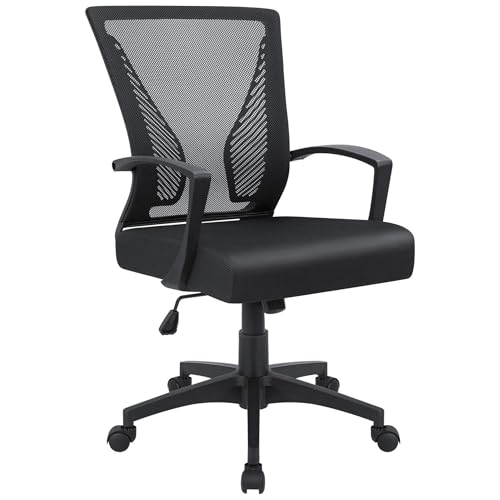
The Furmax is the chair that proved a rolling home chair does not need to be complicated or expensive to be useful. It is a mid-back mesh chair with lumbar support, adjustable height, a breathable backrest, a 360° swivel and armrests, and its listing leads with easy assembly — a detail home buyers should take seriously, because a chair that takes twenty minutes to build is a chair that actually gets built. It suits students, first-apartment desks, spare-room workstations and anyone upgrading from a dining chair. It is not the chair for a 250 lb user working ten-hour days — the listing does not state a capacity, and the honest move at that size and schedule is to step up to the SIHOO with its stated 330 lbs. Within its lane, though, the Furmax is the benchmark budget rolling chair for a reason: mesh keeps it cool, the mid-back keeps it compact, and the swivel-and-caster base makes a small desk feel bigger because you glide instead of scooting.
Strengths
- Breathable mesh back — the right call for warm rooms and long study sessions
- Easy assembly is a headline feature, and it shows in the straightforward build
- Mid-back profile and armrests make it a complete desk chair at an entry budget tier
Trade-offs
- No weight capacity stated in the listing — larger users should choose a chair that states one
- Fixed-style armrests do not adjust, so very tall or very petite sitters may find them approximate
- Budget-tier materials are built for ordinary home use, not for a decade of daily eight-hour shifts
| Mini spec box — from the verified listing | |
|---|---|
| Back style | Mid-back mesh, breathable backrest |
| Lumbar | Lumbar support (fixed design) |
| Base | 360° swivel with armrests |
| Capacity | Not stated in the listing |
| Assembly | Easy assembly (as listed) |
Used well, the Furmax is a three-to-five-year chair for light-to-moderate sitting, and there is no shame in that math: at a budget tier, replacing a chair once is still cheaper than over-buying features you never adjust. Pair it with decent habits — feet flat, screen raised, a short walk every hour — and it will feel better than chairs costing twice as much that are set up badly. On hard floors, add a chair mat or check that the casters roll smoothly on your surface; on carpet, expect a slower glide and give the base an occasional clean, because caster wheels collect hair and grit in homes with pets.
Best for: students, first desks, spare rooms and budget-first buyers. / Not suited for: heavy daily use by larger sitters who need a stated capacity.
Check the current price on Amazon
BestOffice Ergonomic Office Chair — Best Simple Starter Chair
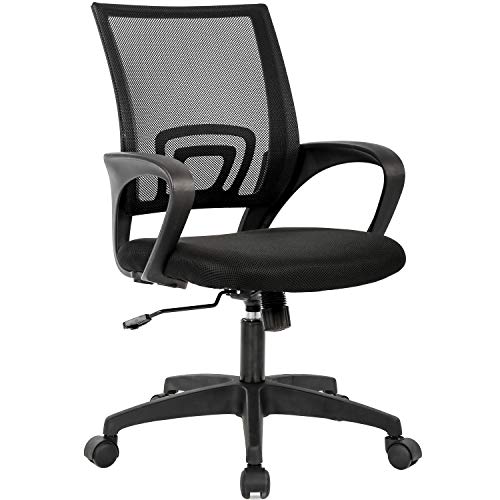
BestOffice takes the opposite approach to the SIHOO: instead of offering every adjustment, it offers the essentials done plainly. The verified listing describes a mid-back swivel desk chair with lumbar support, adjustable height, a breathable backrest, a sponge seat and rolling wheels, for home and office. That sponge seat is the personality of the chair — where mesh chairs feel taut and technical, a padded seat feels familiar, closer to the cushioned chairs most people grew up sitting on. It suits buyers who find mesh seats chilly or slippery, guest rooms and homework desks that see an hour or two at a time, and anyone who wants a rolling chair without a setup project. It is not the pick for hot rooms (padding breathes less than mesh) or for sitters who know they need fine lumbar tuning. Think of it as the reliable sedan of this guide: not the most adjustable, not the cheapest, just sensibly specified and easy to live with.
Strengths
- Sponge seat cushion feels familiar and forgiving for shorter sitting sessions
- Complete basic spec — lumbar support, height adjustment, swivel and rolling wheels
- Mid-back size fits under and around home desks without dominating the room
Trade-offs
- Padded seat traps more warmth than the mesh picks in summer
- No capacity or armrest adjustability stated in the listing
- Fewer ergonomic adjustments than the SIHOO for all-day work
| Mini spec box — from the verified listing | |
|---|---|
| Back style | Mid-back, breathable backrest |
| Seat | Sponge seat |
| Lumbar | Lumbar support |
| Base | Swivel with rolling wheels |
| Capacity | Not stated in the listing |
The BestOffice earns its place in households that run on practicality. It is the chair you buy two of — one for the desk, one for the teen who keeps stealing yours. Because the design is simple, maintenance is simple too: vacuum the seat, wipe the back, tighten the bolts once a season. If you sit for long stretches, alternate it with standing tasks and consider it a starter chair you may later upgrade, handing this one down to a lighter-duty spot. That hand-me-down path is exactly how home furniture budgets should work.
Best for: cushioned-seat fans, homework desks, guest rooms and simple setups. / Not suited for: hot rooms or all-day ergonomic fine-tuning.
Check the current price on Amazon

Sweetcrispy Ergonomic Computer Desk Chair — Best for Small Spaces
The Sweetcrispy solves the problem nobody mentions in chair reviews: where the chair goes when you are not sitting in it. Its flip-up arms fold away so the chair rolls completely under the desk, returning the floor to the room — a decisive feature in bedrooms, studio apartments, dorm-style setups and study corners carved out of living rooms. The rest of the spec is right for the job: a mid-back mesh design with lumbar support, a rolling swivel base, and a gray finish that blends into a bedroom better than office black. It suits students, apartment dwellers and anyone whose “office” folds away at night. The trade-off of flip-up arms is that they are there when you want them and gone when you do not, but they do not offer the fine positioning of the SIHOO’s 2D arms; if your shoulders need exact arm height all day, that is the upgrade path. For the space-constrained, though, this is the most thoughtful chair in the guide.
Strengths
- Flip-up arms let the chair tuck fully under the desk — real floor space returned, every day
- Mesh mid-back with lumbar support keeps the ergonomic basics intact
- Gray finish suits bedrooms and living spaces better than corporate black
Trade-offs
- Flip-up arms do not height-adjust like 2D armrests
- No capacity stated in the listing
- Mid-back support ends at the shoulder blades — tall sitters wanting head support should look at the SIHOO
| Mini spec box — from the verified listing | |
|---|---|
| Back style | Mid-back mesh |
| Armrests | Flip-up arms |
| Base | Rolling swivel |
| Color (this listing) | Gray |
| Capacity | Not stated in the listing |
A small-space chair lives or dies by its parked footprint, so measure before you buy: check the desk’s knee opening height against the chair’s back height with the arms flipped up, and confirm the chair’s width clears the desk legs. Do that one measurement and the Sweetcrispy becomes the chair that makes a one-room work-and-sleep setup genuinely workable. It also doubles politely — rolled out, it is an extra seat for a study partner; rolled away, the room is a bedroom again.
Best for: apartments, bedrooms, dorms and fold-away work corners. / Not suited for: sitters who need adjustable arm height or headrest support.
Check the current price on Amazon

DUMOS Home Office Chair — Best with Rocking Mode
Some people think better when they can move, and the DUMOS is built for them. Alongside the expected mid-back mesh, lumbar support, height adjustment and 360° swivel, its listing calls out a rocking mode — the ability to lean and rock rather than sit locked in one posture. At home, where a chair serves work, reading, phone calls and daydreaming in roughly equal measure, that relaxed range of motion matters more than it would under office fluorescent lights. The fixed armrests keep the design simple and sturdy, and the black finish is deliberately neutral. It suits relaxed sitters, readers, and households where the desk chair doubles as the room’s thinking chair. It is not the chair for someone who wants to lock a precise recline angle for hours (that is the SIHOO’s tilt lock) or for minimalists counting every centimeter (a rocking base wants a little room behind the desk). Treat the rocking as a feature to use with intention: gentle movement through the day beats one frozen posture, however correct that posture looks in a diagram.
Strengths
- Rocking mode encourages micro-movement instead of one fixed posture
- Mid-back mesh with lumbar support covers the ergonomic essentials
- Fixed armrests and a simple mechanism mean fewer parts to adjust or loosen
Trade-offs
- Rocking is free movement, not a lockable recline at set angles
- Needs clearance behind the desk to rock comfortably
- No capacity stated in the listing
| Mini spec box — from the verified listing | |
|---|---|
| Back style | Ergonomic mid-back mesh |
| Motion | Rocking mode, 360° swivel |
| Armrests | Fixed armrest |
| Height | Height adjustable |
| Capacity | Not stated in the listing |
The DUMOS is also a sensible family chair: the mechanism is intuitive, there is nothing delicate to misadjust, and the rocking makes it the seat kids gravitate to — which cuts both ways, so set a household rule if the chair shares space with homework. Keep the rocking tension comfortable rather than loose, plant your feet when you need stability for precise mouse work, and let the chair do what it was designed to do the rest of the time.
Best for: relaxed sitters, readers and thinkers who like to move. / Not suited for: buyers who need a lockable recline or have minimal clearance behind the desk.
Check the current price on Amazon

Steelcase Leap Office Chair — Best Premium
The Steelcase Leap is the chair on this list that comes from the professional ergonomic world rather than the home-furnishings world, and its listing reflects that: ergonomic back support, wheels specified for carpet, a Natural Glide System, and LiveBack technology — Steelcase’s name for a backrest designed to change shape as your spine moves. In plain terms, the Leap is built for the person who sits eight to ten hours a day, has learned that a cheap chair is expensive in discomfort, and intends to buy once. It suits full-time remote professionals, people with demanding backs who have been advised to invest in their chair, and anyone furnishing a dedicated home office meant to last a decade. It is honestly not suited to casual use — buying a Leap for a homework desk is like buying a chef’s knife to open letters — and its Onyx, office-first styling will not warm up a cozy room the way the gray Sweetcrispy does. But if sitting is your job, this is the chair your job deserves.
Strengths
- LiveBack backrest is engineered to flex and support as you shift posture
- Natural Glide System keeps you oriented to your work as you recline
- Wheels specified for carpet — a detail home offices with carpeted floors will appreciate
Trade-offs
- Premium tier pricing — several times the budget picks in this guide
- Professional styling reads “office” more than “home”
- Over-specified for light or occasional sitting
| Mini spec box — from the verified listing | |
|---|---|
| Back technology | LiveBack technology |
| Recline system | Natural Glide System |
| Casters | Wheels for carpet (as listed) |
| Color (this listing) | Onyx |
| Capacity | Not stated in the listing title |
A premium chair repays a careful first week: adjust it daily in small increments instead of forcing a “perfect” setup on day one, because your body adapts and reports back. The Leap’s value case is arithmetic, not luxury — spread over years of daily use, the per-day cost of a chair that still supports you in year eight beats cycling through budget chairs. If your budget cannot stretch here today, the SIHOO M18 is the honest halfway point, with the key adjustments present at a mid-range tier.
Best for: full-time professionals furnishing a long-term home office. / Not suited for: casual sitters or tight budgets.
Check the current price on Amazon
Comparison Table
| Pick | Badge | Key spec (from listing) | Best for |
|---|---|---|---|
| SIHOO M18 | Best Overall | Headrest, adjustable lumbar, 2D arms, 330 lb capacity | Full-time home work |
| Furmax Mesh Chair | Best Budget | Mid-back mesh, lumbar support, easy assembly | Students and first desks |
| BestOffice Chair | Best Simple Starter | Sponge seat, mid-back, rolling wheels | Cushion fans, homework desks |
| Sweetcrispy Chair | Best for Small Spaces | Flip-up arms, mid-back mesh, gray | Apartments and bedrooms |
| DUMOS Chair | Best with Rocking Mode | Rocking mode, fixed arms, mid-back mesh | Relaxed sitters |
| Steelcase Leap | Best Premium | LiveBack, Natural Glide, carpet wheels | Decade-long daily sitting |
How to Choose a Rolling Chair for Your Home
Start with hours, not features. Count how long the chair will actually be sat in on a normal day. Under two hours, any pick in this guide will serve you, and budget should lead. Two to six hours, prioritize lumbar support and a seat style you like — mesh for coolness, sponge or cushion for softness. Over six hours, adjustments stop being luxuries: look for adjustable lumbar, armrests that move, and a stated capacity with headroom above your weight. Next, measure the space. Note the desk height, the knee opening, and the floor area where the chair will park. Flip-up arms (Sweetcrispy) or a mid-back profile keep small rooms workable; a headrest chair (SIHOO, Leap) needs the full footprint. Then match the chair to the floor, which brings us to casters.
What to Know About Casters and Home Floors
Every chair in this guide rolls, but floors differ. On hardwood, laminate and tile, standard casters roll fast and can mark softer finishes over time; a chair mat or softer aftermarket casters protect the floor and quiet the roll. On low-pile carpet, most casters do fine. On thick or plush carpet, any chair will feel sluggish — the Steelcase Leap’s carpet-specified wheels are the exception that proves the rule, and a rigid chair mat is the practical fix for everyone else. Whatever the floor, vacuum caster wheels monthly: household hair and grit are the number-one cause of a chair that stops gliding, and a two-minute clean restores most of the roll. If a chair will travel between rooms — a common home pattern — check your door thresholds; a lip that a person steps over without noticing can stop a loaded chair dead.
How to Set Up Your Rolling Chair Once It Is Built
Assembly first: lay out every bolt and washer before you start, tighten in a star pattern where the instructions allow, and leave final tightening until the chair stands assembled — parts align better under their own weight. Then set the chair up in this order. One: seat height, so your feet rest flat and your thighs are roughly level. Two: sit fully back and set lumbar support (where adjustable) into the curve of your lower back. Three: armrests, so your elbows rest with shoulders relaxed, not shrugged. Four: recline or rocking tension, firm enough to support you, loose enough to move. Five: your screen and keyboard — the chair serves the desk, not the other way around; the top of the screen should sit near eye level. Revisit every setting after three days of real use. Comfort problems that feel like “a bad chair” are very often a good chair set up once and never revisited.
Common Buying Mistakes
The first mistake is buying by photograph: a chair that looks plush may have no lumbar support at all, while a plain mesh chair may be the most supportive seat in the house. Read the listing’s stated specs, not the styling. The second is ignoring capacity — if a listing does not state one and you are a larger sitter, treat that silence as information and choose a chair like the SIHOO that states 330 lbs. The third is forgetting the parked footprint; measure the knee opening before ordering a full-size chair for a small desk. The fourth is mismatching casters to floors and then blaming the chair for scratches or sluggish rolling that a mat would have prevented. The fifth is over-buying: a premium chair for a twice-a-week desk wastes money that a mid-range chair plus a good monitor arm would spend better. The sixth is skipping assembly care — loose bolts in week one become wobbles and squeaks in month six, so re-tighten after the first fortnight. A seventh, quieter mistake is buying a chair for a floor you plan to change: if a rug is coming out or carpet is going in, the caster behavior you tested will change with it, so either wait for the floor to settle or budget for a chair mat from the start. And an eighth: assuming every sitter in the house wants the same chair. Two different mid-range chairs, each matched to its main user, usually make a household happier than one premium chair that everyone compromises on — the exception being the dedicated full-time desk, where one person and one excellent chair is exactly the right formula.
Matching a Rolling Chair to Each Job in the House
A home chair rarely has one job, but it usually has a main one, and naming it honestly sharpens the choice. For the full-time remote worker, the chair is income infrastructure: adjustments and stated capacity come first, which is why the SIHOO M18 and Steelcase Leap anchor that role. For the student, the priorities invert — price, compact size and a chair that survives being sat on sideways; the Furmax and Sweetcrispy fit, and the flip-up arms of the Sweetcrispy are a genuine study feature, because a chair that tucks away makes a small bedroom feel less like an office at midnight. For the shared family desk, choose forgiveness: a chair that several bodies can use without a ten-minute re-adjustment ritual each time. The BestOffice and DUMOS, with their simpler mechanisms, get borrowed without complaint, while a finely tuned ergonomic chair will be re-tuned by every user and loved by none. For the crafter, gamer or hobbyist, rolling range matters most — you glide between table, shelves and machine — so test the caster roll on your actual floor and prefer a base that feels stable at the edge of the seat, where hobbyists perch. For the reader and thinker, the DUMOS rocking mode turns the chair into furniture rather than equipment. None of these roles is more legitimate than another; the mistake is buying for the role you admire instead of the one you live.
Understanding the Budget Tiers Without Seeing a Single Price Tag
Because prices move constantly, think in tiers rather than numbers. At the budget tier — where the Furmax and BestOffice sit — you are buying the essential geometry of a rolling chair: casters, swivel, height adjustment, a back with some lumbar shaping. Materials are lighter and warranties shorter, and that is a fair trade for light-to-moderate use. At the mid tier — SIHOO, Sweetcrispy, DUMOS territory — money buys adjustments and specificity: stated capacities, armrests that flip or move in two directions, headrests, tilt locks, rocking mechanisms. This is the tier where most home buyers should land, because the upgrades map directly onto daily comfort. At the premium tier, the Steelcase Leap stands nearly alone in this guide: you are paying for engineered back technology, glide systems and a build intended for a decade of professional use. The per-year cost of the premium tier can undercut the budget tier if you truly sit all day, every day — and can be pure waste if you do not. A useful household rule: buy the tier that matches your weekly sitting hours, not your aspirations, and spend any leftover budget on the desk setup around the chair — a mat for the floor, a riser for the screen — where small money still buys real comfort.
How to Keep a Rolling Chair Rolling: Care That Takes Minutes
Home chairs fail slowly and then all at once, and almost every slow failure is preventable. Once a month, flip the chair or crouch down and clear the casters: pull out the wound hair, wipe the grit from the wheel treads, and check that each wheel spins freely. A chair with one seized caster drags, twists and scratches floors. Once a season, re-tighten the assembly bolts — the armrest and back bolts loosen first, and thirty seconds with the hex key prevents the wobble that makes a chair feel cheap. Vacuum mesh backs and sponge seats; dust ground into mesh weakens its feel, and crumbs in a cushion are a household reality worth staying ahead of. Keep the chair out of punishing sun where you can, since ultraviolet light ages plastics and fabrics, and if the chair lives on carpet, lift and reposition it occasionally so the casters do not carve permanent dents. Finally, sit like you mean it: feet planted when you roll, no standing on the seat, no using the armrests as a step. Rolling chairs are wonderfully forgiving machines, but they keep score.
Home Ergonomics: The Four Adjustments That Actually Matter
Ergonomics marketing lists dozens of features; bodies care about four. The first is seat height, because it decides whether your feet rest flat and your knees sit at a comfortable angle — every chair in this guide adjusts height, and it should be the first thing you set. The second is lumbar contact: your lower back should feel met, not pushed and not abandoned. Fixed lumbar shaping (Furmax, BestOffice, DUMOS, Sweetcrispy) works when its curve happens to match yours; adjustable lumbar (SIHOO) works for more bodies and for shared chairs, which is a real argument for it in family homes. The third is armrest position. Arms that are too high shrug your shoulders all day; too low and they are decoration. Flip-up arms trade precision for space, 2D arms trade space for precision, fixed arms trade both for simplicity — know which trade you are making. The fourth is movement: a tilt lock, a rocking mode, a glide system. Spines dislike statues. A chair that lets you shift, lean and return keeps the same posture from becoming a strain, which is why we rate the DUMOS’s rocking and the Leap’s Natural Glide as health features, not toys. Beyond the chair, remember the desk: screen near eye level, keyboard close, feet supported. A rolling chair is the center of a home workstation, not the whole of it, and the best chair in this guide cannot rescue a laptop hunched on a coffee table.
Final Recommendation
For most households, buy the SIHOO M18: it is the only mid-priced chair here that states its capacity and gives you a headrest, adjustable lumbar and 2D arms in one package. On a budget, the Furmax remains the sensible starter, and the BestOffice is its cushioned-seat alternative. Short on space, choose the Sweetcrispy and take your floor back every evening. If you think in motion, the DUMOS rocking chair will suit you. And if sitting is your profession, the Steelcase Leap is the long-term investment. Keep exploring the chair cluster: Best Easy Rolling Office Chairs, Best Ergonomic Office Chairs Home, Best Home Office Chairs For Comfort, Best Chair Mat For Carpets Rolling Chairs, Best Inexpensive Ergonomic Office Chairs, and Best Desk Chairs Mesh.
Frequently Asked Questions
What is the difference between a rolling chair and an office chair?
In practice, very little. “Rolling chair” describes the caster base and swivel that let you move without standing; most desk and office chairs are rolling chairs. The term is useful at home because it captures what households actually want — a chair that glides between desk, table and printer instead of being dragged. When you shop, treat the two terms as one category and judge each model on its back support, seat, armrests, stated capacity and how its casters behave on your floor, rather than on which label the listing happens to use.
Are mesh or cushioned seats better for home use?
Mesh breathes, stays cool and holds its shape; cushions feel softer at first sit and suit shorter sessions. For warm rooms and long days, choose mesh (Furmax, SIHOO, Sweetcrispy, DUMOS). For an hour of homework or bills, a sponge seat like the BestOffice is perfectly comfortable.
How much weight capacity do I need?
Choose a stated capacity comfortably above the sitter’s weight — the margin covers leaning, rocking and the occasional child climbing aboard. Where a listing states a figure, such as the SIHOO M18’s 330 lbs, you can buy with confidence; where it does not, larger sitters should pick a chair that publishes one.
Will rolling chairs damage hardwood floors?
They can mark soft finishes over time, especially with grit trapped in the wheels. A chair mat is the simple insurance policy, and monthly caster cleaning helps. On carpet, the risk flips: the floor is safe, but rolling resistance rises, so carpet-specified wheels or a rigid mat keep the glide easy.
How long should a home rolling chair last?
Budget chairs in daily use typically serve three to five years; mid-range chairs longer with bolt checks and caster cleaning; a professional chair like the Steelcase Leap is built for a decade of daily sitting. Longevity follows use honestly — a chair sat in ten hours a day ages faster than one used for homework.
Can one rolling chair really serve the whole household?
Yes, with the right expectations. A shared chair gets re-adjusted constantly, so favor models whose key settings are quick to change — gas-lift height, an obvious tilt control — and accept that no shared chair fits every body perfectly. Adjustable lumbar, as on the SIHOO M18, widens the range of people a single chair can serve well. What does not work is sharing a chair between a small child and a tall adult for long sessions; for homework-age kids, a simple mid-back chair of their own, like the Furmax, is kinder than a hand-me-down set up for someone twice their size.
What should I check in the first week with a new chair?
Three things. First, the bolts: re-tighten them after several days of sitting, because new assemblies settle. Second, the casters: roll the chair across your actual floor and listen — grinding means grit, dragging means a wheel is not spinning, and both are easier to fix now than later. Third, your own setup: if your shoulders ache, it is usually armrest height; if your lower back tires, it is usually lumbar position or sitting perched on the seat edge instead of fully back. Adjust one variable at a time, live with it for a day, and let your body file its report before changing anything else.
Is a headrest worth it in a home chair?
If you lean back to read, take calls or think, yes — a headrest supports the neck in recline, which is when you notice its absence. If you sit upright and task-focused, a mid-back chair is enough and parks more compactly. In this guide the SIHOO M18 and Steelcase Leap are the head-supporting designs; the rest are mid-back chairs.


