Disclosure: airfryerkitchensupply.com is reader-supported. When you buy through links on our site, we may earn an affiliate commission at no extra cost to you.
Where to buy
Chair mats are sold on Amazon, through office suppliers and in office stores. Buy by three stated facts — the carpet pile the mat is rated for, its thickness, and its exact footprint including any lip — rather than by photographs, which make every clear mat look identical. The verified picks below state their carpet ratings in their own listings, including a tempered glass mat for the deepest piles.
BesWin Office Chair Mat for Carpet, 30 x 48, Clear — check price on Amazon
Heavy Duty Chair Mat for Carpet, Low Pile 1/4 Inch, with Lip — check price on Amazon
Staples Clear Vinyl Chair Mat with Lip, 36 x 48 — check price on Amazon
Kuyal Desk Chair Mat for Carpet, 30 x 48 — check price on Amazon
Azadx Clear Office Chair Mat for Low and No Pile Carpet, 36 x 48 — check price on Amazon
Koonmi Tempered Glass Chair Mat for Carpet, 46 x 60 — check price on Amazon
The best chair mat for carpets rolling chairs must do two jobs that fight each other: stay rigid enough that casters roll instead of ploughing, and grip a soft carpet surface that wants to let the whole mat wander. Cheap thin mats fail at both within months — they dimple under the wheels, crack at the edges and creep across the room. This guide’s verified picks are all carpet-rated mats with stated pile limits, and the reviews are blunt about the one specification that decides success: the thickness of your carpet, including its underlay.
Measure your pile before you shop, because it eliminates most of the market instantly. Low-pile commercial carpet takes almost any rated mat; medium residential pile needs a genuinely heavy-duty mat; deep plush carpet with thick underlay defeats most plastic mats entirely and points you to the glass class discussed in the final slot. A mat bought for the wrong pile is not a bargain at any price — it is a return.
Shape matters second. A lip extends under the desk to protect the carpet where your feet rest and where the chair rolls forward; a plain rectangle maximises rolling area for desks you approach from the side. The picks below mix both, in the standard 30 by 48, 36 by 48 and lip formats that fit most home offices.
In this guide
Quick Picks
BesWin Office Chair Mat for Carpet, 30 x 48, Clear — Best Overall. A heavy-duty clear mat rated for low carpeted floors, promising easy glide and a lie-flat fit without curling edges. Check on Amazon
Heavy Duty Chair Mat for Carpet, Low Pile 1/4 Inch, with Lip — Best Heavy Duty. A quarter-inch-thick heavy-duty carpet protector with a lip, aimed at low-pile floors and gaming as well as office chairs. Check on Amazon
Staples Clear Vinyl Chair Mat with Lip, 36 x 48 — Best Trusted-Brand Pick. The office-supply staple: a 36 x 48 clear vinyl lip mat rated for flat-pile carpet, from the retailer that has sold chair mats for decades. Check on Amazon
Kuyal Desk Chair Mat for Carpet, 30 x 48 — Best Value Rectangle. A transparent rectangular mat for low and no-pile carpeted floors, in the compact 30 x 48 size, at the value end of the verified set. Check on Amazon
Azadx Clear Office Chair Mat for Low and No Pile Carpet, 36 x 48 — Best Larger Rectangle. The Kuyal’s concept at a larger size: a 36 x 48 clear rectangle for low and no-pile carpet, built for easy rolling. Check on Amazon
Koonmi Tempered Glass Chair Mat for Carpet, 46 x 60 — Best for Deep Pile. A verified tempered glass mat for carpet with polished round edges and the widest footprint in this roundup. Check on Amazon
How These Picks Were Chosen
Every linked mat was cross-checked through Amazon data, matching the brand and model in the returned listing title to the mat described — including, critically, its stated carpet rating. Mats whose listings did not state a carpet application were excluded from the linked picks, because a hardwood-floor mat sold into a carpet search is this category’s commonest trap.
Selection then weighed thickness and rigidity for caster performance, the grip system underneath — cleats or studs sized for carpet rather than smooth-back grippers — edge design that lets a chair mount the mat without a jolt, and size honesty in the listing. Novelty rug-style mats for hard floors were excluded from the carpet picks.
Glass chair mats — the premium answer for deep pile — are represented by a verified pick, the Koonmi tempered glass mat, after a fresh API check during this batch confirmed it. No prices are printed; use the check-price links for current figures.
The 6 Best Chair Mats for Carpets and Rolling Chairs
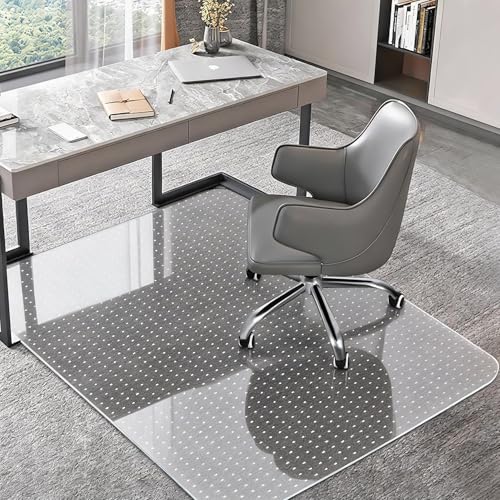
BesWin Office Chair Mat for Carpet, 30 x 48, Clear — Best Overall
The BesWin leads this roundup because it states its brief honestly — heavy duty, for low carpeted floors — and adds the two properties cheap mats lack: it is built to lie flat without curling, and its surface is finished for easy caster glide. In the standard 30 by 48 home-office footprint, it is the balanced default for the commonest carpet type.
Strengths
- Rated specifically for low-pile carpet rather than floors generally
- Lie-flat design avoids the curled-edge trip and catch problem
- Clear finish protects carpet without visually shrinking the room
Trade-offs
- Low-pile rating is a real limit — medium and plush piles need a heavier mat
- 30 x 48 suits standard desks; wide rolling ranges may need larger
- Clear mats show carpet colour through, including any carpet flaws
Key details
- Size: 30 x 48 inches
- Rating: low-pile carpet
- Format: clear, heavy duty, lie-flat
Curl is the silent killer of budget chair mats: edges lift, casters catch, the mat cracks at the fold line, and within a season it is rubbish. A mat engineered to arrive and stay flat removes that failure mode entirely, and on low-pile carpet — office carpet tiles, Berber, most rental-grade carpet — the BesWin’s rigidity is well matched to the surface.
Roll it out and give it a day to settle before judging, and place the grippers down as directed. On the right pile, expect the chair to move with a push of the feet rather than a shuffle — the small daily luxury this whole category exists to provide.
Best for: home offices on low-pile carpet wanting a dependable standard-size mat / Not suited for: medium or plush pile carpets

Heavy Duty Chair Mat for Carpet, Low Pile 1/4 Inch, with Lip — Best Heavy Duty
Thickness is the specification that separates carpet mats that work from those that dimple, and this mat leads with it: a quarter-inch build, heavy-duty positioning for carpeted floors, and a lip format that extends protection under the desk. For gaming chairs — heavier, with more aggressive rolling — that build is the point.
Strengths
- Quarter-inch thickness resists caster dimpling better than thin mats
- Lip format protects the under-desk foot zone as well as the rolling zone
- Heavy-duty build suits gaming chairs and heavier users
Trade-offs
- Still a low-pile rating — thickness does not convert it into a plush-pile mat
- Lip shape must match your desk orientation to be useful
- Semi-transparent finish shows more than fully clear mats in some lights
Key details
- Thickness: 1/4 inch
- Rating: low-pile carpet
- Format: with lip, semi-transparent
Dimpling is what rolling on a too-thin mat feels like by month two: each caster sits in its own little crater, and moving the chair means climbing out of five holes at once. A quarter-inch mat spreads the load so the surface stays a surface. Heavier users and gaming chairs, which combine weight with constant movement, feel this difference most.
Check the lip against your desk before ordering: the lip should slide under the desk’s kneehole so the protected zone is continuous from footrest area to rolling area. A lip pointing the wrong way is just a smaller rectangle with a notch missing.
Best for: gaming chairs, heavier users and low-pile rooms wanting maximum rigidity / Not suited for: plush piles or desks where a lip cannot fit the kneehole

Staples Clear Vinyl Chair Mat with Lip, 36 x 48 — Best Trusted-Brand Pick
There is comfort in the conventional choice. Staples’ clear vinyl mat is the standard-issue corporate chair mat — 36 by 48 with a lip, rated for flat-pile carpet — and its virtues are predictability: known sizing, known vinyl behaviour, and a retailer whose specification language (‘flat pile’) is precise about where it belongs.
Strengths
- Generous 36 x 48 footprint with lip for full rolling range
- Rated honestly for flat-pile carpet
- Mainstream vinyl is a known quantity for care and durability
Trade-offs
- Flat-pile rating excludes most plush residential carpets
- Vinyl can arrive with a smell that needs a day of airing
- No premium features — it is the standard, done properly
Key details
- Size: 36 x 48 inches with lip
- Rating: flat-pile carpet
- Material: clear vinyl
The larger footprint is this pick’s practical edge. A 36-inch width gives a genuine rolling range for L-shaped work — turning from desk to side table, rolling back to a printer — where 30-inch mats strand a caster off the edge. On flat-pile and commercial carpet, that range plus a lip is the complete standard setup.
Vinyl care is simple: wipe clean, keep solvents away, and unroll it flat with patience on day one, weighting the corners if your room is cold. It will not wow anyone, and after a year of invisible service that is exactly the review most office equipment should earn.
Best for: standard home offices on flat-pile carpet wanting a larger, proven mat / Not suited for: plush carpet or buyers wanting a design-led mat

Kuyal Desk Chair Mat for Carpet, 30 x 48 — Best Value Rectangle
The Kuyal is the straightforward rectangle option: no lip, a compact footprint, and a rating for low and no-pile carpet. For a desk against a wall where the chair rolls straight back and forth — and for tighter rooms where a lip serves nothing — the plain rectangle is the right shape and this is its value-tier verified example.
Strengths
- Rectangle format suits straight-line rolling and side-approach desks
- Rated for low and no-pile carpet
- Compact size fits smaller home-office footprints
Trade-offs
- No lip means no under-desk foot-zone protection
- Value tier — expect competent rather than premium rigidity
- Low-pile limit applies as with the other plastic picks
Key details
- Size: 30 x 48 inches, rectangle
- Rating: low and no-pile carpet
- Finish: transparent
Shape choice is underrated in this category. A lip only earns its plastic if your feet and chair actually travel under the desk; in a shallow desk setup, the lip wastes area you needed for rolling width. The Kuyal spends its whole footprint on the rolling zone, which in a small room is the smarter allocation.
As the value pick, judge it on the fundamentals after a month: still flat, no cracks at the caster lines, no creep across the carpet. Those are the tests that separate an honest budget mat from a disposable one, and they are the tests to apply on arrival while a return is still easy.
Best for: small offices and straight-line rollers on low-pile carpet / Not suited for: desks needing under-desk lip protection

Azadx Clear Office Chair Mat for Low and No Pile Carpet, 36 x 48 — Best Larger Rectangle
The Azadx scales the plain rectangle up to 36 by 48, for users whose rolling range outgrew the compact mats — dual-monitor desks, L-shaped setups and anyone whose chair travels. Its rating stays honest: low and no-pile carpeted floors, with easy rolling as the stated design goal.
Strengths
- Larger rectangle covers a wide rolling range without a lip
- Clear finish keeps the room visually open
- Rated specifically for carpeted floors, not adapted from a hard-floor mat
Trade-offs
- Larger mats are more awkward to unroll and position solo
- Low-pile limit still applies — size does not change the rating
- Rectangle leaves the under-desk zone unprotected
Key details
- Size: 36 x 48 inches, rectangle
- Rating: low and no-pile carpet
- Finish: clear
Edge-stranding is the annoyance this size solves. On a too-small mat, the day’s tenth roll to the filing cabinet drops a caster onto carpet, the chair lurches, and the mat’s edge takes the damage that eventually cracks it. A 36-inch width keeps the whole working arc on the mat, which is both a comfort and a durability upgrade.
Position it with the desk edge in mind: the mat should start just under the desk front so the transition from carpet to mat happens behind your usual sitting position, not under your feet where you will feel the edge every time you stand.
Best for: wide desks and mobile workers on low-pile carpet / Not suited for: plush piles or lip-format desks
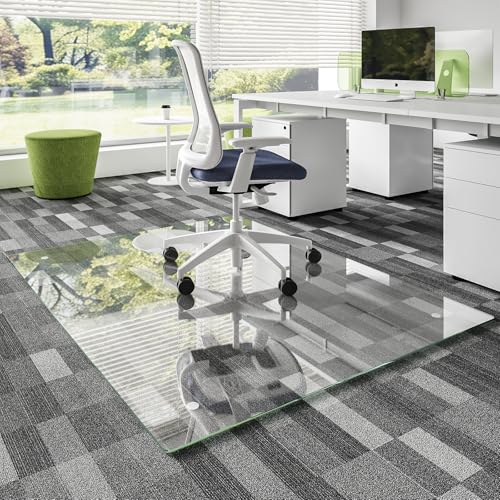
Koonmi Tempered Glass Chair Mat for Carpet, 46 x 60 — Best for Deep Pile
This pick replaces what was, in the first pass of this guide, an unlinked description of the glass class — because a verified glass mat for carpet has now been confirmed. The Koonmi is a tempered glass chair mat sized 46 by 60 inches, with round polished edges, built specifically for carpet: a rigid panel that gives casters a hard-floor glide on top of any pile.
Strengths
- True hard-floor glide on carpet of any pile depth
- Tempered glass with polished round edges — no dimpling, no cracking under caster lines
- Generous 46 x 60 footprint covers the widest rolling arcs in this roundup
Trade-offs
- Premium cost tier — several times a plastic mat
- Heavy panel; positioning is a two-person job and the floor must be level
- Glass is unforgiving of dropped heavy objects at its edges
Key details
- Class: tempered glass chair mat
- Size: 46 x 60 inches
- Edges: round, polished
Judge it against the plastic picks on the only axis that matters for deep pile: it does not deform. Where the quarter-inch plastic mat resists dimpling on low pile and the vinyl serves flat pile honestly, the Koonmi simply removes deformation from the equation, which is why glass remains the permanent-home-office answer. Its size is also its comfort: a 46 by 60 panel keeps an L-shaped desk’s whole working arc on glass.
Handle the buying checks from the original class guidance, now applied to a real product: confirm the tempering specification on the listing, verify your floor is level before it arrives, and plan the two-person placement. Bought that way, this is the last chair mat most rooms will ever need.
Best for: medium and plush pile carpets and permanent home offices / Not suited for: renters wanting a cheap, portable mat
Comparison Table
| Pick | Badge | Key spec | Best for |
|---|---|---|---|
| BesWin Office Chair Mat for Carpet, 30 x 48, Clear | Best Overall | 30 x 48 in, low-pile rated, lie-flat | home offices on low-pile carpet wanting a dependable standard-size mat |
| Heavy Duty Chair Mat for Carpet, Low Pile 1/4 Inch, with Lip | Best Heavy Duty | 1/4 in thick, lip, low-pile rated | gaming chairs, heavier users and low-pile rooms wanting maximum rigidity |
| Staples Clear Vinyl Chair Mat with Lip, 36 x 48 | Best Trusted-Brand Pick | 36 x 48 in, lip, flat-pile vinyl | standard home offices on flat-pile carpet wanting a larger, proven mat |
| Kuyal Desk Chair Mat for Carpet, 30 x 48 | Best Value Rectangle | 30 x 48 in rectangle, low-pile rated | small offices and straight-line rollers on low-pile carpet |
| Azadx Clear Office Chair Mat for Low and No Pile Carpet, 36 x 48 | Best Larger Rectangle | 36 x 48 in rectangle, low-pile rated | wide desks and mobile workers on low-pile carpet |
| Koonmi Tempered Glass Chair Mat for Carpet, 46 x 60 | Best for Deep Pile | Tempered glass, 46 x 60 in | medium and plush pile carpets and permanent home offices |
Measure Your Carpet Pile Before Anything Else
Pile height decides this purchase, and guessing is how mats get returned. Press a ruler into the carpet beside the desk until it meets the backing, then read the fibre height; add the underlay’s give by standing on the carpet and noting how far your heel sinks. Low pile — commercial carpet, carpet tiles, tight Berber — takes any mat in this guide. Medium pile needs the heavy-duty end of plastic or glass. Deep plush with thick underlay is glass territory, full stop.
Manufacturers’ pile language varies, so translate: ‘flat pile’ and ‘no pile’ mean the thinnest carpets; ‘low pile’ typically covers up to about a quarter inch of fibre; anything vaguer than that in a listing is a warning, not a specification. The verified picks above state their ratings in their own titles, which is the standard to hold every mat to.
While measuring, map your rolling arc. Sit in the chair, do a normal day’s movements, and note the extremes. Your mat must cover that arc plus margin on every side — a mat sized to the desk alone strands casters at the exact moments you move most.
Plastic, Vinyl and Glass: Chair Mat Materials Compared
Polycarbonate is the premium plastic: rigid, clear and crack-resistant, holding its flat shape for years on low-to-medium pile. Standard PVC and vinyl mats cost less and serve flat-to-low pile honestly — the Staples pick is the type specimen — but they dimple sooner under heavy users and can carry an initial odour that needs airing. Generic thin plastics are the false economy: they curl, crack at caster lines and creep.
Grip underneath matters as much as the top surface. Carpet mats use cleats or studs that bite into the pile; hard-floor mats use smooth gripper backs that skate dangerously on carpet. Never press a hard-floor mat into carpet service, however similar it looks — the underside is the difference, and it is invisible in photographs.
Glass sits above the plastics in rigidity, longevity and price, and is the only class that makes deep carpet behave like a hard floor. Rug-style fabric mats, popular for hard floors, have no place in this search: on carpet they bunch under casters and protect nothing. Match material to pile first, then to budget.
Lip or Rectangle, and Getting the Size Right
A lip extends the mat under the desk’s kneehole, protecting the carpet where your feet rest and covering the forward roll as you pull into the desk. Choose a lip if your desk has a kneehole you sit into and your chair’s forward travel goes under it. Choose a rectangle if you approach from the side, use a standing desk with a wide stance, or your rolling is mostly lateral — the full footprint then serves movement instead of a zone your chair never enters.
Standard sizes cluster at 30 by 48 and 36 by 48 inches for a reason: they fit standard desks and door widths. Go larger when your rolling arc demands it, not by default — oversized mats are harder to position, cost more and can foul door swings and nearby furniture. In a small room, tape the mat’s outline on the carpet and live with it for a day before ordering; the tape test has saved more returns than any review.
Finally, check the edge profile. A ramped or bevelled edge lets casters mount the mat smoothly from carpet; a square-cut thick edge is a tiny kerb you will hit a hundred times a day. On the heavy-duty picks the edge treatment is part of what you are paying for.
How to Install a Chair Mat on Carpet So It Stays Flat and Put
Most chair-mat disappointment is installation error, not product failure. This sequence gives a plastic or vinyl mat its best start; glass mats need two people and a level floor check instead.
- Unroll the mat in a warm room and let it relax — cold vinyl is stubborn; a few hours flat, weighted at the corners if needed, beats forcing it.
- Vacuum the carpet area thoroughly; grit trapped under a mat grinds into the carpet backing and helps the mat wander.
- Position the mat by its outline — lip under the kneehole if fitted — then stand on it and shuffle gently to seat the underside cleats into the pile.
- Test the rolling arc in the chair, checking every extreme of your normal movement for a caster leaving the mat; adjust position now, not after a week of edge damage.
- Check door swings and nearby furniture against the mat’s edges, and confirm no edge sits where feet will catch it when standing up.
- Re-check after the first week: creep of an inch or two as the mat settles is normal — reposition once, firmly, and it should then stay.
- Clean by wiping the surface and lifting the mat monthly to vacuum beneath; a mat that is never lifted hides a carpet of trapped grit under it.
If a mat keeps creeping in one direction, the cause is usually asymmetric rolling — a dominant push-off foot. Rotating the mat 180 degrees or adding a rug-grip layer beneath the push-off corner usually cures it without replacing the mat.
Common Buying Mistakes
Buying for the wrong pile. A low-pile mat on plush carpet dimples within weeks. Measure the pile, respect the rating in the listing, and step up to heavy-duty or glass when the pile demands it.
Using a hard-floor mat on carpet. Smooth gripper backs skate on carpet and the mat travels dangerously. Carpet mats have cleated undersides; the difference is invisible in photos, so read the rating.
Sizing to the desk instead of the rolling arc. Casters leaving the mat crack its edges and lurch the chair. Map your real movement and buy coverage for the arc, plus margin.
Forcing a cold, curled mat flat. Cracked fold lines start exactly this way. Let the mat relax warm and flat, weight the corners, and give it a day before judging its flatness.
Ignoring the lip’s direction. A lip that cannot enter the kneehole wastes a third of the mat. Confirm the desk geometry before choosing lip or rectangle.
Never lifting the mat. Trapped grit under an unmoved mat abrades carpet backing for years. Lift and vacuum beneath monthly — the mat protects carpet only if the interface stays clean.
Chair Mats for Gamers, Heavier Users and Standing-Desk Hybrids
Gaming chairs stress a carpet mat differently from office chairs: they are heavier, their casters are often larger and harder, and play sessions involve constant small movements plus occasional violent ones. The quarter-inch heavy-duty pick in this guide is the plastic answer — thickness spreads the load and resists the dimpling that gaming casters carve into thin mats within weeks. Gamers on medium pile should skip the plastic experiment entirely and go to the glass class: the cost difference is smaller than one replacement cycle of failed plastic, and the glide quality under a gaming chair is the closest thing to a hard floor the category offers.
Heavier users should read every specification in this category through one lens: load spreading. A mat’s job is to distribute a concentrated caster load across carpet that compresses; the heavier the user-plus-chair, the more rigidity decides success. That means the thick end of plastic on low pile, glass on anything deeper, and no patience for mats whose listings avoid stating a pile rating or thickness at all. It also means checking caster type — hard twin-wheel casters concentrate load most; softer rollerblade-style wheels, where a chair accepts them, are kinder to both mat and carpet.
Standing-desk hybrids — sit-stand desks where the chair parks to the side for hours — create a different wear pattern: a parked chair’s casters sit in one spot all afternoon, which is precisely how dimples form. The defence is the same rigidity, plus a habit: park the chair off the mat or in a varied spot when standing. Anti-fatigue mats for the standing position should sit beside, not under, the chair mat’s rolling zone, or the chair must cross a soft edge every time it returns — a small daily annoyance that adds up.
Across all three profiles, the measurement discipline from the main guide is unchanged: pile first, rolling arc second, material third. Special users do not need special mysteries — they need the standard criteria applied with their load and movement honestly included.
Protecting the Carpet Itself: What a Mat Does and Does Not Do
A chair mat protects carpet from caster abrasion, compression and spills in the rolling zone — and from nothing else. It will not restore pile already crushed by furniture, prevent fading from sunlight, or stop a determined spill from reaching the carpet at its edges. Setting that boundary honestly matters, because owners who expect total protection neglect the complementary habits: lifting the mat monthly to vacuum beneath, blotting spills at the mat’s edge promptly, and occasionally shifting the desk layout so traffic patterns change.
Compression deserves its own note. Even under a good mat, carpet pile in the rolling zone compresses over years; the mat prevents the far worse outcome — casters grinding fibres and backing apart — but pile recovery tricks like ice cubes on dents belong to furniture feet, not to a whole rolling zone. Rotating the mat 180 degrees occasionally, where its shape allows, evens the wear across its surface and the carpet’s, and is a two-minute habit worth adopting at the monthly lift-and-vacuum.
When a mat finally retires — cracked, permanently dimpled or skating despite a clean interface — replace it promptly rather than tolerating decline. A failing mat concentrates exactly the damage a mat exists to prevent, and the carpet underneath is worth more than the weeks of extra service squeezed from a dead mat. That replacement moment is also the chance to re-measure the pile and the arc with fresh eyes: rooms, chairs and carpets all change, and the second mat should be bought for the room as it is, not as it was.
Chair Casters: The Other Half of the Rolling Equation
A chair mat is only half of the rolling system; the casters are the other half, and mismatched casters sabotage good mats. Standard twin-wheel casters, supplied with most office and gaming chairs, concentrate the load on two narrow contact lines — ideal for carving dimples into a marginal mat. If your mat dimples despite a correct pile rating, the casters are the first suspect, and the fix may be cheaper than a new mat: softer, wider or rollerblade-style wheels spread load and roll quieter, and many chairs accept them as a simple stem swap.
Hard casters belong on carpet systems; soft casters are made for hard floors, where they protect the surface. The confusing part is that each type is described by the floor it protects, not the floor it suits — a soft hard-floor caster on a carpet mat rolls like it is wading, while a hard carpet caster on the mat in this guide is the intended pairing. Check what your chair shipped with before blaming any mat for heavy rolling: the mismatch is common, because chairs are sold for generic floors and mats are bought for specific ones.
Caster maintenance closes the loop. Hair and carpet fibre wind around caster axles exactly as they do around vacuum brushrolls, and a chair that rolls badly is often a chair whose five wheels are felted solid. A monthly pick-and-wipe of the casters, done when you lift the mat to vacuum beneath it, keeps the whole system — mat, chair and carpet — performing as the day it was assembled.
Judge rolling quality as a system, then, and spend accordingly: the right mat on the right pile, the right casters on the mat, and ten minutes of maintenance a month. No single component in that trio can rescue the other two, and no component needs to be exotic for the trio to work beautifully for years.
Renting, Moving and Other Reasons Your Mat Choice Might Change
Renters face a version of this purchase with two extra constraints: the carpet is someone else’s asset, and the mat must leave with you. Protection matters more, not less — caster damage to a landlord’s carpet is a deposit argument waiting to happen — but portability argues for the plastic picks over glass, and for keeping the purchase receipt and a photograph of the carpet’s condition under the mat at move-in. A mid-weight, correctly rated mat like the BesWin or Staples picks is the renter’s sweet spot: real protection now, one-person carrying later.
Home-movers should treat the mat as room-specific equipment rather than furniture. Pile height differs between houses and between rooms in the same house, so the mat that served a low-pile study may be wrong for the new home’s plush spare room. Re-measure at the new address before assuming the old system transfers, and let a mat that no longer matches be sold or passed on rather than pressed into dimpled service. The glass class, for owners who have settled, inverts the logic: buy it for the room you will keep, and let it be the last mat that room needs.
Finally, anyone converting a carpeted room to hard flooring should know the system changes entirely: carpet mats’ cleated undersides can mark hard floors, and hard-floor mats are a separate purchase with smooth gripper backs. The keyword discipline of this guide — read the rating, match the surface — survives the conversion intact, even though every product changes.
The Pre-Purchase Checklist for a Carpet Chair Mat
Six confirmations, in the order this guide has argued throughout. One: pile height and underlay give, measured with a ruler and a heel, place your carpet in the flat, low, medium or plush band. Two: the mat’s stated rating — in its own listing, not a review’s paraphrase — covers that band. Three: your rolling arc, mapped from the chair through a real day’s movements, fits the mat’s footprint with margin, lip included only where the chair truly travels. Four: the underside is cleated for carpet; a smooth gripper back disqualifies the mat regardless of its top surface. Five: your casters are the hard, carpet-appropriate type, or are being changed in the same order. Six: the installation plan — a warm room, a clean carpet, a day for the mat to relax — is scheduled rather than improvised.
That sequence takes fifteen minutes and prevents essentially every failure this guide has catalogued: the dimpled mat, the skating mat, the cracked edge, the lurching caster. Chair mats are the purest example in home equipment of a category where the buying decision is the product — get the six confirmations right and the mat itself almost cannot disappoint you.
A closing observation from the category’s long history: the chair mat is one of the few office products whose ideal state is invisibility. Nobody should notice a chair mat — not its edge under a caster, not its curl under a foot, not its outline in the room. Every section of this guide, from pile measurement to caster pairing, exists to purchase that invisibility, and every failure mode it warns against is a way a mat becomes noticeable. Judge your own setup a month after installation by that standard alone. If you have forgotten the mat is there while it quietly preserves the carpet beneath your working day, the purchase — whichever pick it was — has done everything this category promises.
Environmental notes close the practical file. Plastic chair mats are recyclable in principle and awkward in practice — bulky, mixed-material and rarely accepted kerbside — which is one more argument for buying the right mat once: the greenest mat is the one not replaced. Glass mats invert the profile, with a long life and an established recycling stream at its end. When a plastic mat does retire, check whether the retailer or an office-supply scheme takes it back before defaulting to landfill; schemes exist in many areas and cost only the asking. Longevity, as this guide has argued on comfort and cost grounds alike, turns out to be the environmental strategy too.
Document the setup when it is new: the mat’s model and rating, the carpet’s pile measurement, and a photograph of the installed position. If the mat is ever replaced under warranty, moved to a new room or matched for a second desk, that small record converts a fresh research project into a reorder. Home-office equipment accumulates across years and addresses; the households that keep a one-page note per workstation are the ones whose second and third setups are right the first time.
That note is also the kindest thing you can leave a future self who is reordering under time pressure: the right mat, identified in one line, instead of the whole category reopened on a deadline.
One line, kept where the next order will be placed, closes the loop this guide opened with a measurement.
Measurement in, invisibility out — that is the whole bargain.
That is the complete shortlist, from flat-pile vinyl to tempered glass.
Six picks, five materials, one measurement that decides between them.
Final Recommendation
On low-pile carpet, the BesWin is the balanced default, the quarter-inch heavy-duty mat serves gaming chairs and heavier users, and the Staples vinyl remains the proven larger-footprint standard. The Kuyal and Azadx rectangles cover the value and wide-rolling cases between them.
On medium or plush pile, do not let any plastic mat talk you out of the measurement: step up to the glass class described in the final slot and buy it once. Whatever class you choose, measure the pile, map the rolling arc, and install with patience on day one — those three habits are the difference between a mat that disappears into your working day and one that annoys you for years.
Best Office Chairs
Best Office Chair Mats
Best Standing Desks
Best Desk Lamps
Related guides
Frequently Asked Questions
What thickness of chair mat do I need for carpet?
For low-pile carpet, a heavy-duty mat around a quarter inch thick resists caster dimpling well. As pile and underlay deepen, thickness alone stops solving the problem — medium and plush piles are better served by the glass class, which does not dimple at all.
Why does my chair mat keep moving on carpet?
Usually a smooth-backed hard-floor mat used on carpet, or cleats too short for the pile. Use a carpet-rated mat with a cleated underside, seat it firmly when installing, and reposition once after the first week’s settling.
Chair mat with a lip or without?
With a lip if your chair rolls forward into a desk kneehole; without if your movement is lateral or side-approach. The lip protects the under-desk zone, but only if your chair actually travels there.
Can I use a chair mat on plush carpet?
Plastic mats struggle on plush pile with thick underlay — they dimple and flex. Tempered glass mats are the reliable answer for deep carpet, which is why this guide covers the class even though no glass product could be verified for linking.
How do I flatten a new chair mat that arrived rolled?
Unroll it in a warm room, reverse-roll it gently if needed, and weight the corners flat for several hours. Never force cold vinyl flat — that is how fold-line cracks start.
How long should a carpet chair mat last?
A quality polycarbonate or heavy-duty mat on the correct pile should serve for years; thin vinyl on the wrong pile can fail in a season. Glass mats last longest of all. Lifespan is mostly a pile-matching question, which is why this guide starts with measuring.


