Disclosure: airfryerkitchensupply.com is reader-supported. When you buy through links on our site, we may earn an affiliate commission at no extra cost to you.
Where to Buy
For the best home office chairs for comfort, adjustability was the entry ticket. Office chairs are among the most promotion-driven products on Amazon, so no static prices are printed here: use the Amazon links to check the current price on Amazon, and confirm the color and configuration on the product page, because several of these chairs sell in variants that change the arms, base, and price.
- SIHOO M18 Ergonomic Office Chair — check price on Amazon
- GABRYLLY Ergonomic Office Chair (High Back Mesh) — check price on Amazon
- Marsail Ergonomic Office Chair (High Back Mesh) — check price on Amazon
- HON Ignition 2.0 Ergonomic Office Chair — check price on Amazon
- Steelcase Leap Office Chair — check price on Amazon
- Herman Miller Embody Ergonomic Office Chair — check price on Amazon
Comfort in a home office chair is not a vibe; it is a list of physical events that either happen or do not over an eight-hour day. Your feet rest flat, your thighs are supported without pressure behind the knees, your lower back is held in its curve instead of being left to slump, your shoulders stay down because the armrests meet your elbows where they naturally rest, and heat does not build up in the seat by hour three. The best home office chairs for comfort are simply the ones engineered to make all five events happen for your body, at your desk, for your hours. This guide evaluates six verified chairs against exactly that standard, across the full price arc from budget mesh to the two most famous ergonomic chairs ever made.
The spread is deliberate. Two picks are the industry’s reference points — the Herman Miller Embody and the Steelcase Leap — included because any honest comfort guide has to say what the top of the category feels like and costs. One is a mainstream corporate-grade chair, the HON Ignition 2.0. Three are the high-value mesh chairs that most home workers actually buy, from SIHOO, Marsail, and GABRYLLY, each with adjustable lumbar support, headrests, and the flip-up or multi-axis arms home offices need. Every listing was verified, and features are reported as the listings state them — capacities, tilt ranges, arm adjustability — without inflation.
One boundary, stated once and applied throughout: a chair can support a comfortable working posture, and that is a real and purchasable thing. This guide makes no medical claims for any chair — nothing here is presented as treating or preventing back pain or any condition, whatever a listing’s marketing implies. Buy for fit, adjustability, and build; that is what a chair can actually deliver.
In this guide
Quick Picks
Short version: the SIHOO M18 is the value benchmark with a headrest and a stated 330 lb capacity, the GABRYLLY is the big-and-tall home pick with flip-up arms, the Marsail brings 3D armrests and a headrest, the HON Ignition 2.0 is the corporate-grade all-rounder, the Steelcase Leap is the buy-it-for-a-decade chair, and the Herman Miller Embody is the category’s ceiling. Reviews below, in value-to-premium order of discussion.
- Best Value: SIHOO M18 Ergonomic Office Chair — a mesh-back chair with a headrest, adjustable lumbar support, 2D armrests, a wide cushion, tilt lock, and a stated 330 lb capacity. — Check on Amazon
- Best for Big and Tall Home Workers: GABRYLLY Ergonomic Office Chair (High Back Mesh) — a high-back mesh chair with a headrest, flip-up arms, a 90–120° tilt lock, and a wide cushion, listed for big and tall users. — Check on Amazon
- Best Armrests in the Value Tier: Marsail Ergonomic Office Chair (High Back Mesh) — a high-back mesh chair with adjustable lumbar support, 3D armrests, and a headrest — the value pick for elbow-and-shoulder precision. — Check on Amazon
- Best Corporate-Grade All-Rounder: HON Ignition 2.0 Ergonomic Office Chair — a mainstream contract-grade chair with lumbar support and adjustable arms — the office-quality middle of this guide. — Check on Amazon
- Best Buy-It-for-a-Decade Chair: Steelcase Leap Office Chair — the Leap, with its LiveBack technology and Natural Glide System per the listing — the ergonomic benchmark for long-term ownership. — Check on Amazon
- Best Premium Chair: Herman Miller Embody Ergonomic Office Chair — the Embody in Charcoal Rhythm, with fully adjustable arms and carpet casters per the listing — the category’s flagship. — Check on Amazon
How These Picks Were Chosen
A chair received a link only when the listed a title clearly matching the model we describe, including its headline configuration. Where a brand sells one chair under several near-identical listings — a common pattern with value mesh chairs — we chose one canonical listing per model and deduplicated the rest, so the six picks are six distinct chairs, not six storefronts.
The comfort criteria were applied in a fixed order. Adjustability first: a comfort chair must adapt to a body, so seat height, lumbar support that adjusts or dynamically responds, armrests that move, and a tilt with lock positions were the gate. Support second: the backrest had to be shaped or tensioned to hold a lumbar curve through a workday, in mesh or in engineered foam. Capacity and fit third, taken from the listings themselves — two picks state capacities of 330 lb, and the GABRYLLY is listed as a big and tall design with a wide cushion, because comfort for larger bodies is a specification, not an afterthought. Build and brand accountability fourth: the premium picks justify themselves with mechanisms and longevity that the value picks honestly do not claim.
Standing rules were applied without exception: no static prices anywhere in the article, and no star ratings or review counts, because both change too often to print honestly. Health language appears nowhere as a claim — the listings’ ergonomic vocabulary is reported as design description (lumbar support, headrest, tilt), and the guide’s comfort standard is the five physical events from the introduction, which any reader can test in the first week of ownership.
The 6 Best Home Office Chairs for Comfort
The reviews run from the value mesh chairs most home workers will buy, through the corporate-grade middle, to the two reference chairs. Features and capacities are quoted exactly as the listings state them.

SIHOO M18 Ergonomic Office Chair — Best Value
The SIHOO M18 is the chair that defined the modern value-ergonomic category, and its listing shows why: a breathable mesh back with an adjustable headrest, adjustable lumbar support, 2D armrests, a wide cushioned seat, tilt lock, and a stated capacity of 330 pounds. That is the full comfort checklist — every adjustment a home worker actually uses — in one mainstream listing. The mesh back is the headline for comfort over long days: it breathes in a way no foam-and-fabric back can, so the hour-six heat build-up that drives people out of budget chairs simply does not happen.
Strengths
- Complete adjustment set: lumbar, headrest, 2D arms, tilt lock — nothing essential missing
- Mesh back eliminates the heat build-up of foam backs over long days
- Stated 330 lb capacity and a wide cushion fit larger bodies honestly
Trade-offs
- The seat cushion is foam, and foam seats are the first thing to age on value chairs
- 2D armrests lack the width adjustment of 3D/4D arms for exact elbow placement
- Assembly and adjustment quality vary more than the premium brands — take setup seriously
| Back | Mesh back with headrest (per listing) |
| Lumbar | Adjustable lumbar support (per listing) |
| Armrests | 2D adjustable (per listing) |
| Capacity | 330 lbs (per listing) |
| Seat | Wide cushion (per listing) |
The M18’s comfort logic is adjustability density: it spends its budget on the number of things you can tune rather than on any single exotic mechanism. For a home office, that is usually the right trade. Most workers’ discomfort traces to one or two misfits — lumbar support hitting at the wrong height, armrests forcing shoulders up, a seat edge pressing behind the knees — and a chair that lets you correct all of them beats a chair with one brilliant mechanism and three fixed misfits. Set the lumbar to your belt line, the arms to resting elbow height, the tilt tension to your weight, and the M18 disappears under you, which is the actual definition of a comfortable chair.
Ownership notes: the mesh keeps its tension well, the cushion will soften over the first month and then stabilize, and the chair rewards a careful first assembly — cross-threaded bolts are the main source of the wobble complaints that follow value chairs around. Tighten in sequence, re-check after a week, and it will sit as solid as it was designed to.
Best for: home workers who want the full ergonomic checklist at a value position, including larger bodies up to the stated capacity / Not suited for: buyers who want a decade-grade mechanism or 4D arm precision
Check the current price on Amazon

GABRYLLY Ergonomic Office Chair (High Back Mesh) — Best for Big and Tall Home Workers
The GABRYLLY’s listing says the quiet part out loud: it is a big and tall mesh chair, with a high back, a headrest, a wide cushion, flip-up arms, and a tilt that locks between 90 and 120 degrees. The high back matters for tall users in a way mid-back chairs cannot fix — support and headrest contact that actually reach a tall spine — and the wide cushion gives larger frames a seat that supports the thighs instead of perching them. The flip-up arms are the home-office feature par excellence: arms for typing, arms gone for sliding close to the desk, playing an instrument, or fitting the chair under a desk in a small room.
Strengths
- High back and headrest sized for tall spines, wide cushion for larger frames
- Flip-up arms solve the small-home-office storage and desk-clearance problem
- Mesh back for all-day breathability, with a locking tilt for posture changes
Trade-offs
- Flip-up arms adjust less than 2D/3D arms — they are up or down, not tuned
- The 90–120° tilt range is work-focused, not a recliner
- Like all value mesh chairs, assembly care decides long-term solidity
| Back | High back mesh with headrest (per listing) |
| Armrests | Flip-up (per listing) |
| Tilt | 90–120° tilt lock (per listing) |
| Seat | Wide cushion (per listing) |
| Fit | Big and tall design (per listing) |
Tall and large workers are the most poorly served buyers in the chair market — standard chairs are dimensioned around a median body, and the misfit compounds hourly: a backrest that ends mid-shoulder-blade, a headrest that lands on the neck, a seat pan too short for long thighs. The GABRYLLY addresses the dimensions directly rather than with adjectives: height in the back, width in the cushion, and a headrest positioned for a tall sitter. If you are over six feet or broadly built and have never had a chair that felt ‘your size,’ this is the value pick aimed at you, and the stated design intent in the listing is the reason it is in this guide.
The flip-up arms deserve their second mention as a daily-life feature: in a home office that is also a bedroom corner or a dining room, the chair has to park under the desk and get out of the room’s way. Arms that fold make the difference between a chair that lives in the room and a chair that fits the room. Between this and the SIHOO, the decision is fit style: GABRYLLY for tall/large dimensions and flip-up convenience, SIHOO for finer arm adjustment at standard dimensions.
Best for: tall and larger home workers who need a high back, a wide seat, and arms that get out of the way / Not suited for: petite users, who will find the dimensions oversized, or anyone wanting 3D/4D arm tuning
Check the current price on Amazon

Marsail Ergonomic Office Chair (High Back Mesh) — Best Armrests in the Value Tier
Marsail’s entry in this guide competes on the detail that most affects shoulder and neck comfort by mid-afternoon: the armrests. Its listing specifies 3D armrests — height, depth, and angle — alongside a high-back mesh design, adjustable lumbar support, and a headrest. Armrests sound minor until you understand the mechanism of end-of-day shoulder ache: if the rests sit too high, your shoulders shrug all day; too low or too wide, your elbows hang and your neck carries your arms’ weight. Three axes of adjustment is how a chair in this tier solves that properly, and it is why the Marsail earns its own badge instead of being a third generic mesh chair.
Strengths
- 3D armrests — the most elbow-placement precision in the value tier
- Adjustable lumbar and headrest complete the fit picture
- High-back mesh keeps long days breathable
Trade-offs
- The listing does not headline a capacity figure the way the SIHOO does — check the product page if capacity is decisive
- A newer brand name than HON or Steelcase for long-term parts confidence
- 3D arms have more moving joints — set them deliberately, then leave them
| Back | High back mesh (per listing) |
| Lumbar | Adjustable lumbar support (per listing) |
| Armrests | 3D adjustable (per listing) |
| Headrest | Adjustable headrest (per listing) |
Set the Marsail up in the order the body cares about: seat height first (feet flat, thighs level), lumbar second (support in the small of the back at belt height), headrest third (contact at the back of the head when you lean back, not pushing it forward when you sit straight), and arms last, with your shoulders relaxed and elbows bent naturally — then adjust the rests up to meet your elbows, never the reverse. That sequence, which the how-to section generalizes, is worth more comfort than any single feature on any chair in this guide, and the Marsail’s adjustment range is wide enough to execute it fully.
As a brand, Marsail sits in the same value-mesh generation as SIHOO and GABRYLLY, and the honest differentiators are configuration details like these arms and the specific lumbar mechanism. If your discomfort history is shoulder- and neck-led, this is your value pick; if it is heat-led, all three mesh picks tie; if it is size-led, the GABRYLLY’s dimensions lead. That is a genuinely useful way to choose, and it is how this guide intends its badges to be read.
Best for: workers whose end-of-day ache lives in the shoulders and neck and who will actually dial in 3D arms / Not suited for: buyers who want the simplest possible chair with nothing to adjust
Check the current price on Amazon

HON Ignition 2.0 Ergonomic Office Chair — Best Corporate-Grade All-Rounder
HON is one of the names that furnishes actual offices, and the Ignition 2.0 is its mainstream ergonomic chair: the listing specifies lumbar support and adjustable arms in a black desk-chair format. What ‘corporate-grade’ buys a home worker is not a headline mechanism — it is the unglamorous virtues: mechanisms rated for full-time daily use by a rotating cast of bodies, parts and support infrastructure behind the product, and a design tuned for eight-hour days rather than showroom sits. For the home worker who wants to buy the chair their employer’s facilities department would buy, and then not think about chairs again for years, this is the pick.
Strengths
- Contract-grade durability intent — built for daily full-time use
- A major office-furniture brand’s support and parts ecosystem
- Balanced, uncontroversial ergonomics that suit a wide range of bodies
Trade-offs
- Less feature-flashy than the value mesh picks — no headrest headline here
- Corporate styling is deliberately plain
- Sits above the value tier on price positioning without the premium chairs’ signature mechanisms
| Brand line | Ignition 2.0 (per listing) |
| Lumbar | Lumbar support (per listing) |
| Armrests | Adjustable arms (per listing) |
| Class | Ergonomic office desk chair (per listing) |
The Ignition’s comfort case is consistency. Value chairs can be excellent, but their mechanisms and cushions are built to a price; contract chairs are built to a duty cycle. The tilt stays smooth, the cylinder stays honest, the arms stay where they are set, year after year of full-time sitting. For a home worker whose chair is a professional tool used 2,000 hours a year, that consistency is a comfort feature in itself — discomfort often arrives as a chair’s slow degradation rather than its initial fit. Buy the Ignition if your decision style is ‘the sensible professional choice, once,’ and your alternative was furnishing a small office.
It is also the natural upgrade path recommendation for readers who tried a value mesh chair, liked the concept, and wore it out: the Ignition keeps the same ergonomic vocabulary — lumbar support, adjustable arms, breathable formats in the line — and adds the build standard. Check the exact configuration on the product page, as the Ignition line sells in several arm, back, and base combinations under similar listings.
Best for: full-time home professionals who want office-grade durability and brand support without the flagship price tier / Not suited for: buyers who want a headrest and maximum advertised features per dollar
Check the current price on Amazon

Steelcase Leap Office Chair — Best Buy-It-for-a-Decade Chair
The Steelcase Leap is one of the two chairs that the entire ergonomic category is measured against, and its listing names the two mechanisms that built that reputation. LiveBack: the backrest flexes and changes shape as you move, so lumbar support follows your spine through posture changes instead of being correct only in one frozen position. Natural Glide: as you recline, the seat glides forward so your body opens up without sliding you away from your desk and your work. Together they describe a chair designed around a truth the value tier approximates — that comfort over ten hours is about movement, not about finding one perfect posture and holding it.
Strengths
- LiveBack dynamic support that adapts as you shift — the mechanism the category benchmarks against
- Natural Glide recline keeps you oriented to your desk as you lean back
- A decade-scale ownership proposition with a major manufacturer behind it
Trade-offs
- Premium pricing — several times the value picks
- The listing specifies wheels for carpet; hard-floor users should confirm caster type
- A fabric/foam chair in a warm room will never breathe like the mesh picks
| Technology | LiveBack technology (per listing) |
| Mechanism | Natural Glide System (per listing) |
| Use | Work chair with wheels for carpet (per listing) |
| Color | Onyx (per listing) |
Who should spend Leap money? The full-time professional whose chair is their primary work tool, who has already learned from a cheaper chair exactly how they sit, and who intends to keep the next chair for ten years. Amortized over that life, the Leap’s cost per working day is modest, and its support consistency in year eight is the actual product. Who should not: anyone still discovering their fit preferences, anyone whose budget would be strained — a well-adjusted SIHOO beats a resented Leap — and anyone in a hot, un-air-conditioned room, where mesh’s breathability outweighs mechanism sophistication.
The Leap also anchors this guide’s honesty: it is the chair we point to when readers ask what the value picks are approximating. If you buy a value chair and love everything except that the back support feels static when you shift around, you have identified the exact problem LiveBack exists to solve, and you will know precisely what the premium buys when you are ready for it. That is a better upgrade path than buying premium first and never knowing what you paid for.
Best for: full-time professionals buying a ten-year chair whose support must adapt to a moving body / Not suited for: budget-constrained buyers, hot rooms, or anyone still learning their seating preferences
Check the current price on Amazon
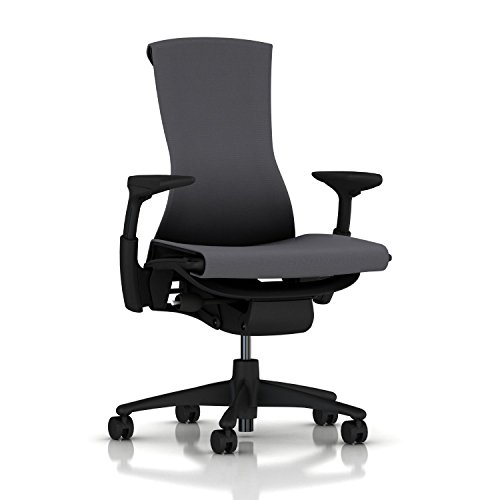
Herman Miller Embody Ergonomic Office Chair — Best Premium Chair
The Embody is Herman Miller’s flagship task chair and the most ambitious comfort object in this guide. Its design premise — a back and seat built from flexible structures that distribute pressure and move with the sitter rather than presenting a fixed sculpted surface — is the premium expression of the same insight as the Leap’s LiveBack: bodies move, and chairs should move with them. The verified listing is the Charcoal Rhythm configuration with fully adjustable arms and carpet casters. Everything about the Embody, from its pixelated support surface to its price, says the same thing: this is the chair for the person who has decided that the object they spend a third of their life in should be the best one they can get.
Strengths
- The category’s flagship support design — pressure distribution and movement as the core idea
- Fully adjustable arms to complete the fit
- An ownership horizon measured in decades, from the category’s most established maker
Trade-offs
- The highest price in this guide by a wide margin
- Its distinctive feel is polarizing — some sitters never bond with it, so the trial period matters
- Carpet casters per the listing; hard floors may need a mat or a caster check
| Configuration | Charcoal Rhythm fabric (per listing) |
| Armrests | Fully adjustable arms (per listing) |
| Casters | Carpet casters (per listing) |
| Class | Ergonomic office chair (per listing) |
An honest premium paragraph: the Embody does not make a bad desk setup good, and it does not repeal the need for breaks, a correctly positioned monitor, and movement through the day. What it does is remove the chair from the list of things working against you, at the highest level of engineering the category offers, and keep it removed for a very long time. Buyers should use any available trial or return window seriously, because flagship chairs have distinctive feels and the Embody’s is the most distinctive of all — the people who love it describe forgetting it exists during work, which is the highest praise a chair can earn.
Within this guide, the Embody’s role is partly as a compass: it defines the ceiling so the other five picks can be judged as value engineering against a known top. If your budget reaches it and your work is chair-bound, it is a rational purchase. If it does not, the HON offers the professional middle and the three mesh chairs offer genuinely good comfort at a fraction of the cost — and no reader should feel that this guide’s premium pick invalidates its value picks. They answer different budgets with the same standard of fit.
Best for: chair-bound professionals buying the best-supported seat available, for the long term / Not suited for: anyone whose budget strains at it, or who has not yet learned their fit preferences on a lesser chair
Check the current price on Amazon
Comparison Table
| Pick | Badge | Key Spec | Best For | Amazon |
|---|---|---|---|---|
| SIHOO M18 Ergonomic Office Chair | Best Value | Mesh + headrest, adjustable lumbar, 330 lb capacity | home workers who want the full ergonomic checklist at a value position, including larger bodies up to the stated capacity | Check price |
| GABRYLLY Ergonomic Office Chair (High Back Mesh) | Best for Big and Tall Home Workers | High-back mesh, flip-up arms, wide cushion, big & tall | tall and larger home workers who need a high back, a wide seat, and arms that get out of the way | Check price |
| Marsail Ergonomic Office Chair (High Back Mesh) | Best Armrests in the Value Tier | High-back mesh, 3D arms, adjustable lumbar + headrest | workers whose end-of-day ache lives in the shoulders and neck and who will actually dial in 3D arms | Check price |
| HON Ignition 2.0 Ergonomic Office Chair | Best Corporate-Grade All-Rounder | Contract-grade build, lumbar support, adjustable arms | full-time home professionals who want office-grade durability and brand support without the flagship price tier | Check price |
| Steelcase Leap Office Chair | Best Buy-It-for-a-Decade Chair | LiveBack dynamic back support, Natural Glide recline | full-time professionals buying a ten-year chair whose support must adapt to a moving body | Check price |
| Herman Miller Embody Ergonomic Office Chair | Best Premium Chair | Flagship ergonomic chair, fully adjustable arms | chair-bound professionals buying the best-supported seat available, for the long term | Check price |
Read the table as a ladder of what money buys in this category. The value mesh chairs (SIHOO, GABRYLLY, Marsail) buy adjustability breadth — lumbar, headrest, arms, tilt — plus breathability, and differ by fit emphasis: standard dimensions with 2D arms, big-and-tall dimensions with flip-up arms, and 3D-arm precision. The HON buys duty cycle and brand infrastructure. The Leap and Embody buy dynamic mechanisms that adapt to movement, and ownership horizons measured in decades. Comfort exists at every rung; what changes is how the chair achieves it and how long it keeps achieving it. Choose by your hours, your body, and your horizon — in that order.
How to Choose a Home Office Chair for Comfort
Comfort is fit over time, so shop in the order the body experiences a chair: dimensions first, adjustability second, materials third, brand last. A chair that fits your dimensions with modest adjustments will out-comfort a flagship that is the wrong size for you. The five events from the introduction are your test protocol for the first week with any chair: feet flat, thighs supported without knee pressure, lumbar curve held, shoulders resting on correctly placed armrests, and no heat build-up by mid-afternoon. A chair that passes all five, for your body, is a comfortable chair — whatever it cost.
The adjustments that actually matter
Seat height is non-negotiable and universal. Lumbar support must either adjust in height or respond dynamically, because a fixed lumbar bump lands on the wrong vertebra for most bodies — that is why every pick here either adjusts (the value mesh chairs) or adapts (LiveBack on the Leap). Armrests should meet your elbows at resting height without lifting your shoulders; the axes beyond height — depth on 2D arms, angle on the Marsail’s 3D arms, full adjustment on the Embody — refine that meeting. Tilt with tension control and at least one lock lets you change posture through the day, and posture change, not posture perfection, is what long days actually require. A headrest is a bonus for reclined reading and calls, valuable on the value picks, and not a substitute for any of the above.
Mesh, foam, and fabric over eight hours
Mesh backs breathe, and in warm rooms or for warm sitters that is the difference between comfort and a damp shirt by 3 p.m. — the reason three of six picks are mesh-backed. Foam-and-fabric chairs (HON’s class, the Leap, the Embody’s structures) offer more sculpted, cushioned support and better cold-room comfort, at the cost of heat retention. Seat cushions follow the same trade: foam seats feel plush and age by softening; structured seats feel firmer on day one and more consistent in year three. Match the material to your room’s climate and your own thermostat before you match it to your décor.
Capacity and dimensions, stated plainly
Buy to the numbers your body actually presents. Where listings state capacities — 330 lb on the SIHOO — respect them as engineering limits, not suggestions. Tall users need back height and headrest reach (the GABRYLLY’s stated big-and-tall design), petite users need seat depths that do not press behind the knees, and everyone needs the seat width their hips require. A chair that fits is a comfort feature; a chair that almost fits is an eight-hour problem. Measure your desk height too: the chair’s armrests and your desk underside must agree, which is one more reason flip-up and adjustable arms earn their place in home offices.
Setting Up Your Chair and Desk as a System
The chair is half the system. Set the monitor so its top is at or slightly below eye level, at arm’s length; place the keyboard so your elbows rest at roughly a right angle with shoulders down; and if your feet do not rest flat after the chair is set for the desk, a footrest is the correct fix — not a lower chair that wrecks your arm angle. Then move: no chair in this guide, at any price, makes ten motionless hours healthy or comfortable. Stand, walk, and change posture on a rhythm; the chairs with good tilt mechanisms make those micro-changes pleasant, which is precisely what their mechanisms are for.
How to Adjust Your Office Chair, Step by Step
Most office chairs are never adjusted beyond height, which is like buying a suit and wearing it unbuttoned. This ten-minute sequence, done once and revisited after a week, extracts the comfort you already paid for — it applies to every pick in this guide, with the premium mechanisms simply rewarding it more.
- Sit in the chair with your back against the backrest and set the seat height so your feet rest flat on the floor and your thighs are roughly level, with a fist’s width of space between the seat edge and the back of your knees. Use a footrest if the desk forces the chair higher.
- Adjust the lumbar support to sit in the curve of your lower back, around belt height. On adjustable models, move it until your lower back feels held rather than pushed; on dynamic backs like the Leap’s, set the baseline support and let the mechanism follow you.
- Set the armrests: relax your shoulders completely, bend your elbows as if to type, and raise or move the rests to just touch your elbows. If your shoulders rise to meet the rests, the rests are too high — that shrug, held for eight hours, is the classic end-of-day neck ache.
- Position the headrest, if your chair has one, so it contacts the back of your head when you lean back to read or take a call — it should not push your head forward while you work upright.
- Set tilt tension to your weight so you can lean back with gentle resistance, and choose a lock position for focused work and a free tilt for reading. Change between them through the day on purpose.
- Now set the desk side: monitor top at or just below eye level, screen at arm’s length, keyboard and mouse at the elbow height your armrests just established.
- Revisit everything after one week. Cushions settle, your body adapts, and the settings that felt right on day one usually want one refinement — the chairs in this guide all allow it, which is the point of buying adjustability.
If discomfort persists after a genuine week of correct setup, the diagnosis is usually dimensional — seat depth, back height, or width wrong for your body — rather than adjustment. That is the moment the size-focused picks in this guide (the big-and-tall GABRYLLY, the value-standard SIHOO) become relevant, and it is why this guide treats dimensions as a first-class comfort specification.
Common Buying Mistakes
Buying by looks or by a gaming silhouette
Racing-style chairs photograph well and are dimensioned for a different activity — deep buckets, fixed wings, and posture assumptions from a couch-and-controller context. A home office chair is a work tool evaluated over eight hours. Every pick in this guide is a task chair with adjustable support; that category discipline matters more than any single feature.
Never adjusting anything but the height
An unadjusted ergonomic chair is just a chair. The lumbar is at a stranger’s height, the armrests are at shipping position, and the tilt tension suits a different body weight. Ten minutes with the setup sequence in this guide is the highest-value comfort purchase you will ever make, because it is free.
Chasing a headrest while ignoring the lumbar
Headrests are visible and marketable; lumbar fit is invisible and decisive. A chair with a headrest and a fixed, wrongly placed lumbar bump will ache by lunch, while a headrest-free chair with correct lumbar support — the HON’s profile — will not. Buy support from the bottom up: seat, lumbar, arms, then headrest as the finishing feature.
Assuming a premium price repeals ergonomics homework
The Leap and Embody are engineered to adapt, but they still need correct height, a correct desk setup, and an owner who moves during the day. Premium money buys adaptation and longevity, not immunity. Conversely, a value chair set up with real care will out-comfort a flagship left at factory settings — setup is the great equalizer, which is why this guide spends a full section on it.
Ignoring capacity and dimension limits
Capacities in listings are engineering statements, and bodies above them compress cushions, strain cylinders, and void the comfort the chair was designed to give. The same applies in miniature to height and seat depth. The picks here state their fits — 330 lb on the SIHOO, big-and-tall on the GABRYLLY — so that the match between body and chair is a decision, not a discovery.
Final Recommendation
For most home workers, the decision lands in the value mesh tier, and the tie-breaker is your body: the SIHOO M18 for the complete standard checklist including a stated 330 lb capacity, the GABRYLLY if you are tall or large and need the dimensions and flip-up arms, the Marsail if your shoulders and neck demand 3D arm precision. If the chair is a full-time professional tool and you buy for duty cycle, the HON Ignition 2.0 is the sensible once-and-done purchase. And if the budget and the hours justify the top of the category, the Steelcase Leap is the decade chair and the Herman Miller Embody is the flagship — both verified, both honestly described, both worth it for the right working life.
Whichever rung you choose, spend the ten minutes on setup and the first week on honest testing. Comfort is not the chair’s price or its feature list; it is the five physical events from the introduction, happening quietly, every day, until you stop noticing the chair at all.
- Best Value: SIHOO M18 Ergonomic Office Chair — Check on Amazon
- Best for Big and Tall Home Workers: GABRYLLY Ergonomic Office Chair (High Back Mesh) — Check on Amazon
- Best Armrests in the Value Tier: Marsail Ergonomic Office Chair (High Back Mesh) — Check on Amazon
- Best Corporate-Grade All-Rounder: HON Ignition 2.0 Ergonomic Office Chair — Check on Amazon
- Best Buy-It-for-a-Decade Chair: Steelcase Leap Office Chair — Check on Amazon
- Best Premium Chair: Herman Miller Embody Ergonomic Office Chair — Check on Amazon
Keep reading in this series: Best Home Office Chairs For Comfort, Best Ergonomic Office Chairs Home, Best Inexpensive Comfortable Office Chairs, Best Ergo Office Chairs Available, Best Customizable Office Chairs.
Frequently Asked Questions
What makes an office chair comfortable for a full workday?
Fit and adjustability sustained over hours: a seat height that leaves feet flat, lumbar support at the right height for your spine, armrests that meet relaxed elbows, a tilt that lets you change posture, and materials that do not build up heat. This guide tests its picks against those five events rather than against showroom softness, which is a poor predictor of hour-eight comfort.
Is mesh or foam better for long days?
Mesh breathes, so it wins in warm rooms and for warm sitters — three picks here are mesh-backed for that reason. Foam and structured seats feel more cushioned and consistent, and suit cooler rooms and people who dislike mesh’s hammock feel. Neither is universally better; match the material to your room’s climate and your own thermostat.
Do I need a headrest on an office chair?
Need, no — it is a reclining and reading feature, not a working-posture feature. It earns its place if you lean back for calls, reading, or thinking, and all three value picks here include one. But buy lumbar fit and arm adjustability first; a headrest on a chair whose lumbar support misses your back is decoration on a problem.
How much should I spend on a home office chair?
Match the spend to your hours and horizon. Part-time desk use is well served by the value mesh tier. Full-time professional use justifies the corporate-grade middle (HON) on duty cycle alone. The flagship tier (Leap, Embody) amortizes over a decade of full-time work — rational for chair-bound professionals, extravagant for occasional use. This guide deliberately verifies options at each level rather than prescribing one.
What if I am big or tall — which pick fits me?
Start with the picks that state their dimensions: the GABRYLLY is listed as a big and tall design with a high back, headrest, and wide cushion, and the SIHOO M18 states a 330 lb capacity with a wide cushion. Check any chair’s stated capacity and seat dimensions against your own measurements before buying — fit is a specification, and the honest listings publish it.
Can a chair fix my back pain?
This guide makes no medical claims, and you should be skeptical of any chair marketing that does. A well-fitted chair supports a comfortable working posture, and that is the legitimate purchase. Pain that persists, radiates, or includes numbness is a matter for a clinician, not a product page — buy the chair for fit, adjustability, and build quality, and let professionals handle diagnoses.


