Disclosure: airfryerkitchensupply.com is reader-supported. When you buy through links on our site, we may earn an affiliate commission at no extra cost to you.
Where to buy
Every chair in this guide to the best ergo office chairs available right now is sold through Amazon, and that is where we recommend buying: office chair listings change configuration, upholstery, and caster type often, and Amazon makes it easy to confirm exactly which version you are getting before you pay. Start with our top pick, the Steelcase Leap, or jump to the chair that matches your budget and body: the Herman Miller Embody if money is no object, the HON Ignition 2.0 for dependable all-day task work, the SIHOO M18 for a headrest and a stated 330 lb capacity at a mid-range tier, the Furmax Mesh Office Chair if you want the lowest spend that still gets you lumbar support, and the BestOffice Mid-Back Chair for a compact spare-room setup. Check the current price on Amazon for whichever chair you shortlist, because office chair pricing moves constantly and we do not print static prices that would be stale within weeks.
Introduction: what “available” actually means for ergo chairs
If you are shopping for the best ergo office chairs available today, the honest first thing to know is that “available” is doing real work in that sentence. Ergonomic chairs are one of the most volatile categories in office furniture: flagship models sell through production runs, budget mesh chairs appear and vanish under new brand names every quarter, and the same chair is often listed in three configurations that look identical in a thumbnail. A guide that recommends a chair you cannot actually buy, in the configuration described, is useless. So this guide only includes chairs we could verify as live, purchasable listings at the time of writing, and every product below was cross-checked against Amazon’s own catalog data before it earned a slot.
The second thing to know is that “ergonomic” is an unregulated marketing word. Any chair with a curved backrest can be labeled ergonomic, including chairs with a fixed lumbar bump molded into foam that fits almost nobody. What separates a genuinely ergonomic chair from a chair-shaped object is adjustability: a lumbar support that moves to where your lumbar curve actually is, a seat height range that lets your feet rest flat, armrests that adjust so your shoulders can relax, and a backrest that reclines with tension you control rather than a single locked upright position. Our six picks span the full market, from a budget mesh chair that covers the basics to two of the most respected ergonomic chairs ever made. None of them is perfect, and we say plainly where each one falls short.
Who is this guide for? Anyone setting up a home office, replacing a kitchen chair that is destroying their back over eight-hour days, or furnishing a small team office and wanting chairs that will still be comfortable in year three. If you sit for long stretches, the differences between these chairs are not cosmetic. They are the difference between finishing the day with energy and finishing it with a stiff neck.
In this guide
Quick Picks
| Pick | Badge | Why it is here |
|---|---|---|
| Steelcase Leap | Best Overall | LiveBack backrest and Natural Glide recline that track your spine instead of forcing a shape on it |
| Herman Miller Embody | Best Premium | Pixelated seat and back support with fully adjustable arms; the flagship end of the market |
| HON Ignition 2.0 | Best for All-Day Task Work | Contract-grade build, adjustable lumbar and arms, made for full work weeks |
| SIHOO M18 | Best Mid-Range with Headrest | Mesh back, headrest, 2D armrests and a stated 330 lb capacity |
| Furmax Mesh Office Chair | Best Budget | Breathable mid-back mesh, lumbar support and easy assembly at the lowest tier here |
| BestOffice Mid-Back Chair | Best Compact Budget | Sponge seat, mid-back profile and small footprint for spare rooms and student desks |
Short on time? Buy the Steelcase Leap if your budget reaches it; it is the chair we would hand to almost anyone. Buy the SIHOO M18 if it does not. Everything below explains why, and where each chair’s limits are.
How These Picks Were Chosen
We started with a simple filter: the chair had to be a complete, ready-to-assemble office chair sold as a finished product. That sounds obvious, but chair shopping online is full of traps — replacement chair mats, seat cushions, and parts listings rank for the same searches as actual chairs. Every pick here is a whole chair. We then verified each model against Amazon’s catalog data, confirming the exact product, its stated features, and that the listing was live. Only chairs confirmed that way received purchase links in this guide.
From there, we judged chairs on the adjustments that matter physiologically. First, lumbar support: is it adjustable in height or depth, or at least shaped and positioned to meet the lower back rather than the shoulder blades? Second, seat height range and seat comfort over long sessions. Third, armrest adjustability, because fixed arms at the wrong height quietly wreck shoulders and wrists. Fourth, recline behavior: a chair you cannot lean back in forces one static posture all day, and static posture — even “good” posture — is the real enemy. Fifth, build honesty: stated weight capacity where the maker publishes one, and materials that match the tier. Where a listing does not state a capacity or a spec, we say so rather than guessing. A chair with no stated capacity is not necessarily weak, but you should know the maker chose not to publish one.
Finally, we spread the six slots across real budgets. Ergonomic chairs exist at almost every price, but the honest truth is that adjustability costs money: below a certain tier you get lumbar support and height adjustment and little else. We would rather show you one good chair per tier and explain what each step up buys than pretend a budget chair does everything a flagship does.
The 6 Best Ergo Office Chairs Available Now

1. Steelcase Leap — Best Overall
The Steelcase Leap has been the reference point for ergonomic task chairs for years, and it earns the top slot here because its backrest solves the problem most chairs ignore: your spine does not move as one rigid curve. The Leap’s LiveBack technology lets the backrest change shape as you shift, flexing more in the lower back when you sit upright and supporting differently when you recline. The Natural Glide System moves the seat forward as you lean back, so the backrest stays in contact with your back instead of sliding away from it — the flaw that makes most reclining chairs feel like they are abandoning you mid-lean.
Strengths
- LiveBack backrest flexes with your spine’s changing shape through the day
- Natural Glide recline keeps back support in contact as you lean
- Deep adjustment range makes it fit a wide span of body sizes
Trade-offs
- Premium tier pricing — this is an investment chair, not a budget buy
- The listing we verified is the carpet-caster version; hard-floor users should confirm caster type before ordering
- Traditional padded aesthetic looks dated next to mesh flagships
Spec snapshot (from the verified listing): ergonomic work chair with wheels for carpet; Onyx finish; LiveBack Technology and Natural Glide System named in the listing. The listing does not state a weight capacity, and we do not invent one — check the current listing if capacity is a deciding factor for you.
Who should buy it: anyone who sits six or more hours a day and plans to keep one chair for many years. The Leap’s genius is that it does not force a posture; it supports several. You can sit bolt upright for focused work, recline for calls, and perch forward for reading, and the chair follows. In our judgment it is the safest single recommendation in this guide — the chair least likely to be wrong for a given body.
Best for: long daily hours and buyers who want one chair that fits almost anyone / Not suited for: tight budgets or buyers who want a headrest included
Check the current price on Amazon
2. Herman Miller Embody — Best Premium
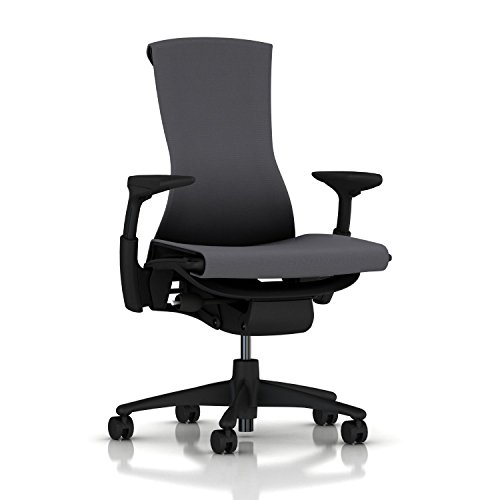
The Herman Miller Embody is the flagship end of ergonomic seating, built around a support system of small independent elements — often described as pixels — that distribute pressure across the seat and back instead of spreading your weight over a flat foam slab. The result is a chair that feels alive under you: shift your weight and support redistributes. The verified listing is the Charcoal Rhythm upholstery version with fully adjustable arms and carpet casters.
Strengths
- Pixelated support system distributes pressure point by point
- Fully adjustable arms — height, width, depth and angle territory that budget chairs never reach
- Backrest narrows at the top, letting your arms move back freely while typing and reaching
Trade-offs
- The most expensive chair in this guide by a wide margin
- No headrest, and the narrow upper back feels unusual for the first week
- Carpet casters on this listing; hard-floor homes need to check the configuration
Spec snapshot (from the verified listing): fully adjustable arms; carpet casters; Charcoal Rhythm fabric. The listing title does not state a weight capacity.
Who should buy it: the person who has already burned money on two cheaper chairs and is done experimenting. The Embody is a buy-once answer for people whose work is entirely seated and whose back problems are real but general — diffuse stiffness and fatigue rather than a specific medical condition, which no chair can treat. It is also the strongest choice here for people who fidget: the chair rewards movement instead of punishing it.
Best for: all-day sitters who want the flagship support system and full arm adjustment / Not suited for: anyone shopping on a budget, or buyers who insist on a headrest
Check the current price on Amazon

3. HON Ignition 2.0 — Best for All-Day Task Work
The HON Ignition 2.0 comes from the contract furniture world — the chairs bought by the hundreds for offices — and that origin shows in the right ways. It is not flashy. It is a black ergonomic desk chair with adjustable lumbar support and adjustable arms, built to survive full work weeks for years. HON’s listing states lumbar support and adjustable arms plainly, without the inflated language budget brands use, which we take as a good sign.
Strengths
- Adjustable lumbar support and adjustable arms — the two adjustments that matter most
- Contract-grade construction aimed at daily commercial use
- Understated design that fits any office without shouting “gaming room”
Trade-offs
- No headrest on this configuration
- Styling is plain; buyers wanting a statement chair should look elsewhere
- The listing does not state a weight capacity
Spec snapshot (from the verified listing): ergonomic office desk chair in black; lumbar support; adjustable arms. Capacity not stated in the listing title.
Who should buy it: home-office workers who want a chair from a maker with a commercial track record, and anyone furnishing more than one desk. The Ignition 2.0 is also the pick we would give a facilities manager: consistent, adjustable enough for a range of employees, and unglamorous in the way durable things often are.
Best for: full-time task work and small offices buying several chairs / Not suited for: buyers who want a headrest or a recliner-like lounge feel
Check the current price on Amazon

4. SIHOO M18 — Best Mid-Range with Headrest
The SIHOO M18 is where the mid-range gets genuinely interesting. For a mid-tier spend you get a mesh back with a headrest, adjustable lumbar support, 2D armrests, a wide cushion, and tilt lock — a feature list that flagship chairs were charging heavily for not long ago. SIHOO also does something we wish every brand did: it states a capacity, 330 lbs, right in the listing. Stated numbers can be checked; vague “heavy duty” claims cannot.
Strengths
- Headrest included — rare at this tier and valuable for reclined calls and reading
- Stated 330 lb capacity, published openly in the listing
- Adjustable lumbar support, 2D armrests and tilt lock cover the core ergonomic adjustments
Trade-offs
- Mesh back keeps you cool but offers less cushion-like comfort than padded chairs
- 2D armrests adjust less than the 3D/4D arms on pricier chairs
- Assembly and adjustment quality vary more at this tier than with contract brands
Spec snapshot (from the verified listing): mesh back desk chair with headrest; adjustable lumbar support; holds 330 lbs; 2D armrests; wide cushion; tilt lock; black.
Who should buy it: the value-focused home worker who wants a headrest and a published capacity without flagship money. If you run warm, the mesh back is a genuine quality-of-life upgrade over foam in summer. If you are a larger sitter, the stated 330 lb figure gives you a concrete number to weigh — literally — instead of a guess.
Best for: warm rooms, headrest fans, and larger sitters who want a stated capacity / Not suited for: buyers who prefer deep padded seats
Check the current price on Amazon
5. Furmax Mesh Office Chair — Best Budget
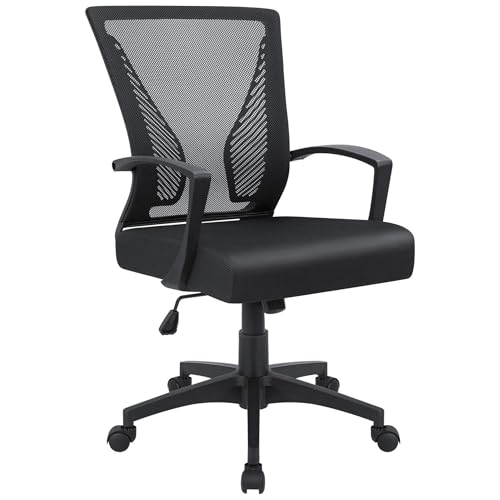
The Furmax Mesh Office Chair is the honest floor of this category: a mid-back mesh chair with lumbar support, adjustable height, a breathable backrest, and 360-degree swivel, sold at the lowest tier in this guide. Furmax also claims easy assembly, which matters at this price because budget chairs live or die on whether the bolt holes line up. Set expectations correctly and this chair is a rational buy: it covers posture basics for light-to-moderate daily use.
Strengths
- Lowest spend in this guide while still including lumbar support
- Breathable mesh back suits warm rooms and non-air-conditioned spaces
- Simple assembly and a mid-back profile that fits under most desks
Trade-offs
- Armrests are fixed — the biggest ergonomic compromise at this tier
- No stated weight capacity in the listing
- Seat cushioning is thinner than mid-range chairs; heavy daily use will show it
Spec snapshot (from the verified listing): ergonomic computer desk mesh chair; lumbar support; adjustable height; breathable backrest; mid-back; 360 swivel with armrests; black. Capacity not stated.
Who should buy it: students, spare-room setups, part-time home workers, and anyone upgrading from a dining chair on a strict budget. If your seated day is three to four hours, the Furmax covers the fundamentals. If your day is eight hours, save toward the SIHOO or HON instead — the difference is real and your back will invoice you for the savings.
Best for: light daily use, students, and first home-office setups on a budget / Not suited for: eight-hour daily sitters or anyone needing adjustable arms
Check the current price on Amazon
6. BestOffice Mid-Back Chair — Best Compact Budget
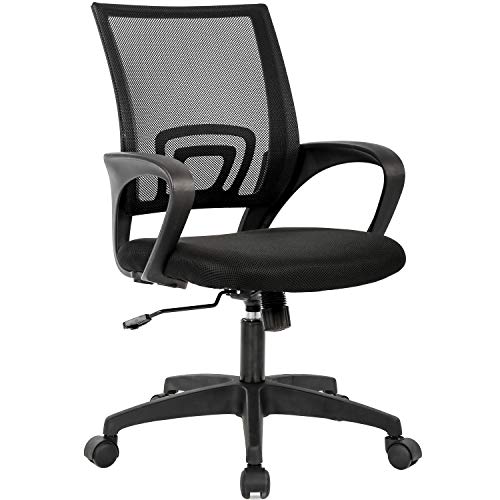
The BestOffice Ergonomic Office Chair takes the other budget slot because it makes a different trade than the Furmax: a padded sponge seat instead of mesh-first design, in a compact mid-back frame that suits small rooms. It includes lumbar support and adjustable height with a breathable backrest and rolling wheels, per the verified listing. Think of it as the dorm-and-first-apartment chair: small footprint, padded seat, nothing fancy, everything present.
Strengths
- Padded sponge seat — softer sit than mesh-first budget chairs
- Compact mid-back footprint for small rooms and under-desk storage
- Lumbar support and height adjustment cover the posture basics
Trade-offs
- Fixed armrests, as with most chairs at this tier
- No stated weight capacity in the listing
- Mid-back design gives no shoulder or head support for leaning back
Spec snapshot (from the verified listing): mid-back swivel desk chair in black; lumbar support; adjustable height; breathable backrest; sponge seat; rolling wheels; sold as a pack of 1. Capacity not stated.
Who should buy it: buyers furnishing a small space who prefer a cushioned seat, and anyone who needs a second chair for a partner or teenager that will not dominate the room. Between this and the Furmax, choose mesh if you run warm and choose the sponge seat if you dislike the hammock feel of budget mesh.
Best for: small spaces and buyers who prefer a padded seat at the lowest tier / Not suited for: tall sitters who need a high back, or full-time eight-hour use
Check the current price on Amazon
Why “Available” Changes — and How to Shop Around It
A word about the search itself: people search for ergo chairs “available” because they have been burned by the alternative — a glowing review of a chair that turns out to be discontinued, out of stock, or sold only in a configuration that does not match the review. Office chairs churn faster than almost any furniture category. Finishes rotate, caster options change, and budget brands relist near-identical chairs under new names each season. Every chair in this guide was verified as a live listing when we wrote it, but the honest advice is to treat any guide — including this one — as a shortlist to confirm, not a guarantee carved in stone.
When you land on a listing, spend sixty seconds on configuration discipline. Confirm the caster type matches your floor, the upholstery color is the one you think it is, and the size or capacity variant in the title is the variant in your cart — several chairs here are sold in multiple versions from one page. If the exact configuration you wanted is gone, the closest sibling within the same model line is usually a safer substitute than a different brand’s lookalike, because the adjustment system — the part your back actually cares about — stays the same.
Finally, do not let a stock-out push you into a panic buy at the wrong tier. A chair is a five-to-ten-year object. Waiting a week for the right one, or stepping deliberately to the adjacent pick in this guide, beats a year of evenings in the wrong seat. Patience is part of the purchase, and so is the willingness to adjust the chair twice — once on day one, and once after your body has filed its report at the end of the first week.
Comparison Table
| Pick | Badge | Key spec | Best for |
|---|---|---|---|
| Steelcase Leap | Best Overall | LiveBack flexing backrest, Natural Glide recline | Long hours, most bodies |
| Herman Miller Embody | Best Premium | Pixelated support, fully adjustable arms | Buy-once flagship seekers |
| HON Ignition 2.0 | Best for All-Day Task Work | Adjustable lumbar and arms, contract build | Full work weeks, small offices |
| SIHOO M18 | Best Mid-Range with Headrest | Mesh, headrest, stated 330 lb capacity | Warm rooms, larger sitters |
| Furmax Mesh Chair | Best Budget | Mesh mid-back, lumbar support, swivel | Light use, strict budgets |
| BestOffice Mid-Back | Best Compact Budget | Sponge seat, compact mid-back | Small rooms, padded-seat fans |
How to Choose an Ergonomic Office Chair
Start with the lumbar support, because it is the adjustment people feel most. Your lower back curves inward, and a chair should meet that curve — not push a generic bump into your spine at a fixed height. Adjustable lumbar, like the systems on the HON Ignition 2.0 and SIHOO M18, lets you place support where your curve actually sits, which differs by several inches between a 5’2″ sitter and a 6’1″ sitter. Dynamic systems like the Leap’s LiveBack go further and adapt as you move. A fixed molded bump is the weakest form: fine if it happens to land on your curve, a pressure point if it does not.
Next, seat height and depth. Your feet should rest flat on the floor with your knees at roughly 90 degrees, and there should be two to three fingers of space between the seat edge and the back of your knees. Most chairs in this guide adjust height with a standard pneumatic lift; seat depth adjustment is rarer and lives at higher tiers. Shorter sitters should pay special attention: a seat that is too deep forces you to perch on the edge, abandoning the backrest entirely, which quietly deletes every ergonomic feature you paid for.
Armrests deserve more respect than they get. The point of an armrest is to let your shoulders hang relaxed while your forearms rest lightly — elbows around 90 degrees, shoulders neither shrugged up nor dragged down. Fixed arms, found on both budget picks here, are a lottery: right for some bodies, wrong for others, and unchangeable either way. If you type all day and your shoulders ache by evening, armrest adjustability is likely your highest-value upgrade, which is why the Embody’s fully adjustable arms and the HON’s adjustable arms matter.
Recline is the fourth pillar. Sitting locked upright at 90 degrees all day is not a goal; it is a strain. A good chair lets you recline to 100–110 degrees for reading and calls, with tension control so the backrest supports rather than dumps you backward. Tilt lock, as on the M18, lets you hold a chosen angle. The Leap’s Natural Glide is the premium expression of the same idea. Whatever the mechanism, use it: posture variety through the day beats one “perfect” posture held rigidly.
Finally, match the chair to your floor and your honesty about budget. Two of our verified listings ship with carpet casters; on hard floors you will want to confirm a hard-floor caster option or budget for a chair mat. And be honest about hours: the single best predictor of chair satisfaction is whether the chair’s tier matches your seated hours. Four hours a day, a budget chair serves well. Eight-plus, the mid-range and flagship tiers stop being luxury and start being arithmetic — cost per comfortable year strongly favors buying once.
Assembly Day: What to Expect and What to Check
Every chair in this guide arrives flat-packed and needs assembly, typically with an included hex key and a dozen or so bolts. Budget chairs like the Furmax advertise easy assembly and generally deliver it — thirty minutes is a fair expectation. Mid-range and flagship chairs take longer and reward patience: the Leap and Embody arrive in larger, heavier boxes, and some flagship configurations come substantially pre-assembled, which you will appreciate at the door. Whatever the tier, assemble on a soft surface to protect upholstery, keep every bolt finger-tight until all are started, then tighten in sequence — the single habit that prevents the misaligned-backrest wobble people blame on manufacturing.
Before your first full workday, run a five-point check. One: the lift raises and holds your weight without sinking over ten minutes. Two: the recline tension knob changes resistance noticeably across its range. Three: every adjustment lever actually locks — a lumbar or arm setting that drifts under load is a defect, not a quirk, and it is far easier to exchange in week one than month six. Four: casters roll straight; a caster that tracks sideways usually just needs reseating. Five: sit and listen — creaks from bolted joints often mean a bolt wants another quarter turn, while creaks from the recline mechanism on day one are worth a support call.
Keep the box and packaging until you have worked in the chair for several full days. Ergonomic fit is a slow verdict: a lumbar curve that feels “supportive” for an hour can become a pressure point by day three, and a seat that feels firm at first may be exactly right once your old chair’s collapsed foam stops being your reference. Reputable sellers expect this evaluation period; use it honestly rather than forcing yourself to love a chair your back is voting against.
How to Set Up Your Ergonomic Chair Correctly
A great chair adjusted badly is a mediocre chair. Spend ten minutes on setup when yours arrives. First, set seat height so your feet are flat and your thighs are roughly parallel to the floor. Second, sit all the way back — no perching — and set the lumbar support to meet the small of your back; you should feel gentle contact, not a shove. Third, set armrests so your forearms rest with shoulders relaxed; if the arms force a shrug, lower them or, on fixed-arm chairs, accept the compromise consciously and take more standing breaks. Fourth, set recline tension so you can lean back with light pressure and be held, not launched. Fifth, position your monitor so the top of the screen is at or slightly below eye level, about an arm’s length away — the chair cannot fix a laptop hunched on a low desk, so raise the screen and use an external keyboard if you work on a laptop full-time. Revisit the setup after a week; first impressions of “supportive” often turn out to be “too much lumbar,” and small corrections compound.
Ergonomic Chair Price Tiers, Explained Honestly
Because we do not print static prices — they change too fast to stay truthful — buyers often ask what the tiers in this guide actually buy. Here is the honest map. At the budget tier, represented by the Furmax and BestOffice chairs, you get the skeleton of ergonomics: height adjustment, a lumbar bump or modest support, a swivel base, and either mesh or basic foam. What you give up is refinement: arms do not adjust, cushions are thinner, recline is basic, and the chair is built for lighter duty cycles. For a student or a part-time desk, that trade is fair.
The mid-range, where the SIHOO M18 and HON Ignition 2.0 sit, is where ergonomics becomes real for full-time work. You gain genuinely adjustable lumbar support, adjustable arms, better recline control with tilt lock, a headrest in the M18’s case, and construction aimed at daily eight-hour use. This tier is the value peak for most home workers: every adjustment that changes how your body feels at 5 p.m. is present, and what you are not paying for is brand heritage and exotic materials.
The flagship tier — the Steelcase Leap and Herman Miller Embody — buys adaptability and longevity. These chairs do not just offer more adjustments; their support systems respond dynamically, the LiveBack flexing with your spine and the Embody’s support elements redistributing pressure as you shift. They are also built to be serviced and to last through many years of daily use, which is why offices that calculate cost per year keep buying them. Whether that premium is worth it depends on your hours and your history: if chairs are consumables in your life, flagships end the cycle; if you sit three hours a day, they are more chair than you need.
One more tier note: gaming chairs are not a tier of ergonomic chair, whatever their marketing says. A few are decent; many are car-seat cosplay with fixed lumbar pillows. If a chair’s ergonomic claim rests on a loose pillow strapped to the backrest, treat it as decoration, not support.
Mesh, Padded, and Hybrid Seats: Which Suits You?
Material choice shapes daily comfort as much as adjustments do, and the right answer depends on your room and your body. Mesh backs, like those on the SIHOO M18 and Furmax, breathe. Air moves through them, so your back does not heat-soak over a long session — a genuine advantage in warm climates, sun-facing rooms, and homes without air conditioning. The trade-off is feel: mesh suspends you in a hammock-like tension that some sitters love and others find unsupportive at the edges, and mesh seats in particular can feel firm under the thighs.
Padded chairs, like the Leap and the BestOffice’s sponge seat, give a familiar cushioned sit and distribute pressure through foam. Good foam over a shaped base is comfortable for years; cheap thin foam bottoms out within months, which is why budget padded chairs age faster than budget mesh. Padded upholstery also suits cooler rooms and sitters who dislike the suspended feel of mesh.
Hybrid designs — padded seat, mesh back — are the quiet majority of good mid-range chairs, and for most people they are the right default: cushion where your weight concentrates, airflow where your back heats up. The HON Ignition 2.0 follows this sensible pattern. When in doubt, choose hybrid, set it up carefully, and spend your remaining budget on the adjustments rather than the surface.
A final material warning: bonded leather and glossy PU finishes photograph beautifully and age badly in daily use, cracking and peeling at contact points. None of our six picks leans on that look, deliberately. Fabric and mesh forgive; shiny faux leather keeps receipts.
Common Buying Mistakes
Buying the word “ergonomic” instead of adjustments. The word means nothing by itself. Count the adjustments: lumbar, seat height, arms, recline tension. Fewer than three and you are buying a hope.
Ignoring caster type. Carpet casters on hardwood roll too freely and can mark floors; hard casters on carpet fight you all day. Two flagship listings in this guide specify carpet casters — check before you click.
Assuming a capacity that was never stated. Several good chairs here publish no capacity in their listings. If you are a larger sitter, choose a chair with a stated figure like the M18’s 330 lbs, or verify the number on the current listing first.
Choosing by looks alone. Racing-style buckets and sculptural mesh both photograph well. Neither guarantees support. Buy the adjustment list, not the silhouette.
Sitting in it for five minutes and deciding. Chairs reveal themselves over days. Buy from a seller with a workable return path, assemble carefully, keep the box for the first week, and judge at day five, not minute five.
Skipping setup. An unadjusted flagship loses to an adjusted mid-range chair every time. Ten minutes with the levers is part of the purchase.
Matching a Chair to Your Work Style
Two people can sit in the same chair for the same eight hours and need different things, because work is not one activity. If your day is deep-focus typing and writing, your chair’s job is quiet stability: lumbar support that holds position, arms that keep shoulders down, and a seat that does not demand attention. The HON Ignition 2.0 and the Leap serve this worker best — support you forget exists.
If your day is calls and meetings, you move: upright to present, reclined to listen, swiveling to a second screen or a notebook. For you, recline quality and a headrest rise in value, and the SIHOO M18’s tilt lock and headrest, or the Leap’s gliding recline, match the rhythm. Presenters who gesture should also value armrests that adjust out of the way or flip up, a feature worth checking on any configuration before buying.
If you split the desk with creative work — drawing tablets, dual monitors, reference books — seat depth and arm width adjustability matter more, because your forearms land in different places for different tools. The Embody’s fully adjustable arms are built for exactly this variety. And if your “office” is a corner of a bedroom, footprint and looks enter honestly into the decision: the BestOffice’s compact mid-back disappears into a small room in a way a flagship never will, and a chair you resent seeing is a chair you will replace early.
Shared chairs — couples alternating, hot-desking households — need adjustment range above all, because the chair must fit two spines. Favor chairs whose lumbar and arms move widely and easily, and agree on a thirty-second reset ritual: height, lumbar, arms, every handover. The Leap’s broad fit range makes it the natural shared chair in this guide.
When to Replace Your Current Chair
Chairs rarely fail dramatically; they fade. The foam compresses until you feel the seat pan through it. The gas lift sighs and sinks an inch an hour. The recline lock slips. Armrest pads crack. By the time a chair is visibly dying, it has usually been under-supporting you for a year. A practical test: sit in your chair at your normal settings and check the fundamentals from our buying guide. Feet flat with the lift at a sane height? Lumbar meeting your curve, or has the foam slumped away from it? Can you recline and be held? If two or more answers are no, the chair is done, whatever it looks like.
Replacement timing also follows your life, not just the chair’s decay. A promotion to full-time remote work, a new chronic stiffness, a move to a smaller space — each is a legitimate trigger. And when you replace, replace upward by hours, not by looks: the best money in this whole category is the step from a faded budget chair to a mid-range chair with real adjustments, the step where evenings stop hurting.
Final Recommendation
For most people, the answer is the Steelcase Leap: it adapts to the widest range of bodies and working postures, and it is the chair we would keep if we could only keep one. If your budget tops out in the mid-range, the SIHOO M18 delivers a headrest, mesh cooling, and a stated 330 lb capacity for a fraction of flagship money, while the HON Ignition 2.0 is the sober contract-grade alternative. Money-no-object buyers should go straight to the Herman Miller Embody. On a strict budget, pick mesh with the Furmax or padding with the BestOffice, and plan the upgrade when your hours grow. Exploring more of the category? See our guides to Best Ergonomic Chairs For Posture, Best Desk Chairs Mesh, Best Customizable Office Chairs, and Best Desk Chairs For Extended Use.
Frequently Asked Questions
What makes a chair truly ergonomic?
Adjustability that matches your body: lumbar support positioned at your lower-back curve, seat height that lets your feet rest flat, armrests that let your shoulders relax, and a recline you can vary through the day. A chair with those four, adjusted properly, is ergonomic in practice — whatever the box says.
Is a mesh or padded chair better for long hours?
Mesh breathes and suits warm rooms and people who run hot; padded seats feel plusher initially and suit cooler rooms. For long hours, support geometry matters more than surface: a well-shaped mesh chair like the SIHOO M18 beats a poorly shaped padded one, and a well-padded chair like the Leap beats cheap mesh. Match the material to your climate and the adjustments to your body.
How much should I spend on an ergonomic office chair?
Spend in proportion to your seated hours. Under four hours a day, the budget tier in this guide is rational. Six to eight hours, the mid-range is the value sweet spot. Full-time seated work over many years justifies flagship chairs, whose cost per year of comfortable use is often lower than cycling through cheap chairs.
Do I need a headrest on an office chair?
Only if you recline to read, take calls leaning back, or watch content at your desk. Upright typing does not use a headrest at all. If you do lean back often, a headrest like the M18’s is a real comfort feature; if you never recline, skip it and put the money toward armrest or lumbar adjustability.
What if a chair listing does not state a weight capacity?
Treat the capacity as unknown, not as unlimited. Several respected chairs in this guide do not publish a figure in the listing title. If capacity is a deciding factor, check the full current listing or the maker’s specification sheet before buying, or choose a chair like the SIHOO M18 that states its 330 lb capacity openly.
Can an ergonomic chair fix my back pain?
A chair can remove aggravating factors — unsupported lumbar, seats that force bad angles, arms that shrug your shoulders — and for many desk workers that is the difference between a stiff evening and a comfortable one. But a chair is furniture, not treatment. Persistent, sharp, radiating, or worsening pain deserves a medical professional, not a shopping cart. Buy the chair to support healthy working posture, move and stand regularly through the day, and let clinicians handle anything beyond everyday stiffness.
How long should an ergonomic chair last?
Contract-grade and flagship chairs are built for many years of daily use; budget mesh chairs typically serve a shorter life before cushions flatten and lifts tire. Longevity is the quiet argument for the upper tiers: a chair that stays supportive for a decade costs less per year than three budget chairs that each fade in a few years.


