Disclosure: airfryerkitchensupply.com is reader-supported. When you buy through links on our site, we may earn an affiliate commission at no extra cost to you.
Where to buy
The best kids chairs homeschool setups can offer share one trait that ordinary kids’ chairs do not: they are built for hours. A homeschool chair is not a place a child perches for twenty minutes of homework — it is where a student sits through lessons, reading, writing practice, art and screen school, day after day, in a room that also has to be a kitchen table or a living room by evening. That duty cycle points to one category, and this guide follows it honestly: adjustable desk chairs, sized for children, with the height adjustment, swivel and back support that long sitting demands.
All six picks are verified children’s desk chairs, and their listings state the features that matter for schoolwork: height adjustability on every one, mesh task-chair backs on most, and — across the six — armrests, footrests, lumbar support and sit-brake casters where the makers offer them. What none of them is: a toddler armchair, a bean bag or a novelty seat. Those have their place in a reading corner, and the guide says where, but a homeschool student’s primary seat needs to meet the desk at the right height with feet supported, and only an adjustable desk chair does that for a growing child.
Every pick was verified connection, with names and stated features taken from the listed listing titles. Where a listing states an age range, this guide prints it; where it does not, the review says so instead of inventing one. We never print fixed prices — check the current price on Amazon, and measure your desk height before ordering any chair, because the best chair at the wrong height is the wrong chair.
- VIVO Children’s Height Adjustable Desk Chair (Gray, DESK-V201G-CH) (Best Overall): available on Amazon — check the current price on Amazon before you order.
- HONEY JOY Kids Desk Chair (Adjustable Height, Armrest and Footrest) (Best Full-Featured): available on Amazon — check the current price on Amazon before you order.
- Costzon Kids Desk Chair (Sit-Brake Casters) (Best for Wiggly Students): available on Amazon — check the current price on Amazon before you order.
- Primy Kids Desk Chair (Pink, Ages 4–12 as Listed) (Best for Younger Students): available on Amazon — check the current price on Amazon before you order.
- Giantex Kids Desk Chair (Armless, Lumbar Support) (Best Armless Design): available on Amazon — check the current price on Amazon before you order.
- Ergonomic Kids Desk Chair (Footrest and Flip-Up Armrests, Ages 4–12 as Listed) (Best Flexible Configuration): available on Amazon — check the current price on Amazon before you order.
In this guide
Quick Picks
Six verified adjustable kids’ desk chairs, ranked for the homeschool day: adjustment range, foot support, casters and back design.
- Best Overall: VIVO Children’s Height Adjustable Desk Chair (Gray, DESK-V201G-CH) — a height-adjustable kids’ desk chair from an established desk-gear maker, in a calm gray that suits a shared family room. Check the current price on Amazon.
- Best Full-Featured: HONEY JOY Kids Desk Chair (Adjustable Height, Armrest and Footrest) — the fullest feature list in this guide — adjustable height, armrests and a footrest, with a swivel mesh task back. Check the current price on Amazon.
- Best for Wiggly Students: Costzon Kids Desk Chair (Sit-Brake Casters) — height-adjustable mesh task chair with armrests and sit-brake casters that lock the rolling when the student sits down. Check the current price on Amazon.
- Best for Younger Students: Primy Kids Desk Chair (Pink, Ages 4–12 as Listed) — a height-adjustable swivel mesh chair whose listing states ages 4–12 — the clearest sizing promise in this guide. Check the current price on Amazon.
- Best Armless Design: Giantex Kids Desk Chair (Armless, Lumbar Support) — an armless, height-adjustable mesh task chair with stated lumbar support — the chair that tucks fully under the desk. Check the current price on Amazon.
- Best Flexible Configuration: Ergonomic Kids Desk Chair (Footrest and Flip-Up Armrests, Ages 4–12 as Listed) — height adjustment, a footrest and flip-up armrests on 360° wheels, with a stated 4–12 range — the configuration that changes its mind as your child does. Check the current price on Amazon.
How These Picks Were Chosen
The catalog was searched for children’s desk and study chairs — chairs whose listings state adjustability and school or study use. Toddler furniture, lounge chairs and gaming chairs aimed at adults were excluded. Six listings survived as distinct products from distinct makers, each stating height adjustability, and between them covering the variations a homeschool buyer actually chooses among: with or without armrests, with or without a footrest, standard casters or sit-brake casters, bright colors or quiet ones.
The ranking weighs the ergonomics of a school day, in the order a child’s body experiences them. Feet support comes first — a child whose feet dangle will fidget, slouch and perch, so footrests and low minimum seat heights score heavily. Height adjustment range comes second, because a homeschool chair should serve for years of growth, not one school year. Back support and breathability follow, then the practicalities: casters that suit your floor, armrests that fit under your desk, and colors that suit a room that is also your home.
One methodological honesty: children’s desk chair listings rarely state weight limits or exact seat-height ranges in their titles, and this guide does not invent them. The spec boxes print what each listing states — features, configurations, and age ranges where given — and the buying guide tells you which measurements to confirm on the listing page before ordering. That confirmation step is built into the how-to section, because with children’s furniture the fit check is not fine print; it is the purchase.
The 6 Best Kids Chairs Homeschool Setups Can Offer

VIVO Children’s Height Adjustable Desk Chair (Gray, DESK-V201G-CH) — Best Overall
VIVO makes desk equipment for a living, and its children’s chair is the grown-up approach to this category: a height-adjustable desk chair, in a restrained gray, described by its listing as a multifunctional workstation chair for school writing, study or play. For a homeschool room that is also a family room, that restraint is a feature — this is the chair that looks like furniture rather than a toy, adjusts as the child grows, and comes from a maker whose entire business is things that hold desks and people at the right height.
Strengths
- Height adjustability from a desk-specialist brand — the core homeschool requirement, done by experts
- Neutral gray suits shared rooms where a neon chair would fight the furniture
- Positioned for real schoolwork: writing, study and screen lessons, not novelty seating
Trade-offs
- The listing title does not state a footrest or armrests — confirm the configuration on the listing if those matter to you
- No age range is stated in the verified title; check the listing’s sizing guidance against your child’s height
- A task-chair look will not excite a young child the way the colorful picks below do
| Adjustment (as listed) | Height adjustable |
| Model (as listed) | DESK-V201G-CH |
| Color (as listed) | Gray |
| Stated use | School writing, study or play — interactive workstation chair |
The VIVO is the pick for families building a homeschool setup meant to last several school years. Height adjustment is the mechanism of that longevity: set correctly — feet flat or supported, elbows near desk height, screen at eye level — the same chair serves a small seven-year-old and a gangly eleven-year-old, with the family only re-checking the fit each term. Buying that adjustability from a desk-gear maker rather than a toy maker is a deliberate bet on the mechanism’s durability, because the lift cylinder and base are the parts that live or die by engineering.
Its plainness deserves a second look rather than an apology. Homeschool happens in real homes, often in sight of the front door, and a gray task chair disappears into a room in a way a pink or purple chair never will. If your student is old enough to care about their workspace looking serious — and many homeschoolers, working beside a parent doing the same, care earlier than expected — this is the chair that respects that.
Best for: families building a long-term homeschool desk setup in a shared room, with a growing student / Not suited for: very young children who need a footrest today, or buyers wanting a bright, playful chair
Check on Amazon — check the current price on Amazon, and confirm the exact configuration on the listing before ordering.
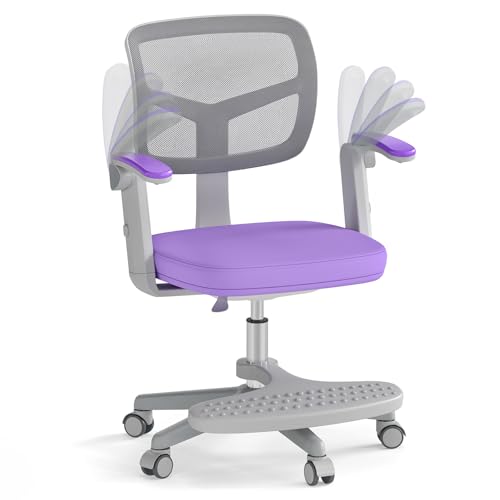
HONEY JOY Kids Desk Chair (Adjustable Height, Armrest and Footrest) — Best Full-Featured
The HONEY JOY is the maximalist answer: its listing states adjustable height, adjustable armrests and an adjustable footrest around a swivel, rolling mesh task chair. That footrest is the headline for homeschool use. Younger students in desk chairs face a geometry problem — the seat height that puts their elbows at the desk leaves their feet swinging — and a footrest solves it directly, giving the legs support that stops the fidget cycle at its source. If your student is on the younger, smaller end of desk-chair sizing, this is the configuration designed for them.
Strengths
- Footrest included and adjustable — the single most valuable homeschool feature for younger students
- Armrests adjust too, so the chair fits both the child and the desk’s clearance
- Mesh back breathes through long morning lesson blocks
Trade-offs
- More adjustment points mean more setup and more periodic re-checking as the child grows
- Purple is the listed color — confirm other options on the listing if your room disagrees
- Rolling swivel freedom is a distraction risk for some young students; see the caster discussion in the buying guide
| Adjustment (as listed) | Adjustable height, armrest and footrest |
| Back (as listed) | Mesh task chair |
| Movement (as listed) | Swivel, rolling |
| Color (as listed) | Purple |
Read this chair as a fitting system rather than a product. Height for the desk, footrest for the legs, armrests for the shoulders: three adjustments that together let one chair produce the posture teachers ask for — feet supported, back against the backrest, forearms level. No fixed kids’ chair can do that for a growing body, and no single-adjustment chair does it for the youngest students, whose proportions are the furthest from the desk’s. The HONEY JOY’s feature list is long because the problem it solves is genuinely three-dimensional.
The parental workload is real, though: an adjustable chair only works adjusted. Build the termly ritual — first week of each school term, re-fit the chair: seat height, footrest height, armrest height, in that order, with the child sitting in school posture at the actual desk. Five minutes, three times a year, and the chair keeps the promise its listing makes.
Best for: younger and smaller homeschool students whose feet do not yet reach the floor at desk height / Not suited for: families who want set-and-forget furniture, or students distracted by swivel and roll
Check on Amazon — check the current price on Amazon, and confirm the exact configuration on the listing before ordering.

Costzon Kids Desk Chair (Sit-Brake Casters) — Best for Wiggly Students
Every homeschool parent knows the rolling-chair problem: the chair becomes a vehicle, the lesson becomes a commute. Costzon’s answer is the cleverest mechanical one in this guide — sit-brake casters, which brake when the child’s weight is on the chair and release when it is not. The student gets a real adjustable mesh task chair with armrests for schoolwork, the chair stays where it was put during lessons, and it still rolls freely when an adult moves it for cleaning. For the wiggly student, this is the pick that removes the fight instead of having it daily.
Strengths
- Sit-brake casters end the rolling-across-the-room problem without removing the chair’s adjustability
- Mesh back and armrests cover the long-sitting comfort basics
- Aimed by its listing at home, office and school — a true study chair, not a toy
Trade-offs
- Braking casters can feel odd to a child used to free rolling — expect a short adjustment period
- The listing title does not state a footrest; smaller students may need a separate foot support
- Caster style suits hard floors best; on thick carpet any caster chair rolls poorly
| Adjustment (as listed) | Height adjustable |
| Casters (as listed) | Sit-brake casters |
| Armrests (as listed) | Included |
| Back (as listed) | Mesh task chair, swivel |
The sit-brake deserves explanation because it is easy to misunderstand: the casters are not locked, they are weight-sensitive. Sit down and the chair plants; stand up and it moves. That behavior maps exactly onto the homeschool day — stationary during lessons, movable between them — and it teaches nothing punitive. The chair is not a punishment device; it is a chair whose physics agree with the house rules, which is the most durable kind of rule there is.
Pair it with the mesh back for the full picture: this is the chair for the energetic student in a warm room doing long morning blocks. Breathable back, supported arms, planted base. If your homeschool struggles are motion and fidget rather than fit and size, the Costzon addresses the actual problem, which is more than most products in any category manage.
Best for: energetic, wiggly students who turn rolling chairs into vehicles during lessons / Not suited for: very small students who need a footrest first, or thick-carpet schoolrooms
Check on Amazon — check the current price on Amazon, and confirm the exact configuration on the listing before ordering.

Primy Kids Desk Chair (Pink, Ages 4–12 as Listed) — Best for Younger Students
The Primy earns its slot with one line of honesty the other listings mostly skip: it states its audience, ages 4 to 12, right in the title. That range covers the full elementary homeschool span, and the chair behind it is the category standard — height-adjustable, swivel, mesh task back — in a pink finish aimed at girls who want their school corner to be theirs. For a parent buying for a five- or six-year-old starting homeschool, a stated age range removes the worst of the guesswork from the purchase.
Strengths
- Stated 4–12 age range — the clearest fit guidance of any pick here
- Height adjustment lets the chair track the whole stated range as the child grows
- Mesh back keeps young students cooler through long sitting
Trade-offs
- Pink is the listed color; confirm alternatives on the listing for a different room or recipient
- No footrest is stated — the youngest students may still dangle at correct desk height
- A stated age range is a guide, not a guarantee: a tall four-year-old and a small twelve-year-old are different fits
| Stated ages (as listed) | 4–12 |
| Adjustment (as listed) | Height adjustable |
| Back (as listed) | Mesh task chair, swivel |
| Color (as listed) | Pink |
Age ranges on kids’ chairs are approximations wearing a uniform, and this guide prints Primy’s because a stated approximation beats silence — but fit the child, not the number. What the range really tells you is the design intent: seat dimensions, adjustment span and proportions were chosen for elementary bodies. Within that intent, the height adjustment does the fine work term by term, which is the correct division of labor between maker and parent.
The pink finish deserves a practical word rather than a dismissive one: a homeschool corner that a young student claims as her own gets used more willingly than a borrowed adult setup, and color is the cheapest ownership signal there is. If the chair’s job includes making a six-year-old proud of her school space, this pick does that job on purpose.
Best for: elementary-age homeschoolers, especially younger starters, in a dedicated school corner / Not suited for: students past the stated range, or families needing a footrest included
Check on Amazon — check the current price on Amazon, and confirm the exact configuration on the listing before ordering.

Giantex Kids Desk Chair (Armless, Lumbar Support) — Best Armless Design
The Giantex makes the case for leaving the armrests off. Its listing states an armless, height-adjustable mesh task chair with lumbar support — and armless is a genuine homeschool configuration, not a missing feature. Armrests collide with desks, prevent chairs tucking away in small rooms, and encourage the sideways lean that school posture tries to avoid. A chair that slides fully under the desk at day’s end returns the room to the family; a chair with stated lumbar support looks after the back while it is out.
Strengths
- Armless design tucks completely under the desk — the small-room and tidy-room winner
- Stated lumbar support, the back feature that matters most over long lessons
- Mesh back and height adjustment cover the category essentials
Trade-offs
- No armrests means no forearm support during reading and screen work — some students miss it
- No footrest stated; smaller students need the floor or a separate support
- Armless task styling is the plainest look in this guide
| Armrests (as listed) | Armless design |
| Adjustment (as listed) | Adjustable height |
| Support (as listed) | Lumbar support |
| Back (as listed) | Mesh task chair, swivel |
The armrest question splits homeschool families, and both sides are right about different children. Students who read and type for long stretches benefit from forearm support; students who write, draw and lean into desk work often find armrests are simply in the way, and every armrest is a future collision with a desk edge or a sibling’s chair. Giantex’s bet — support the back, free the sides — suits the writing-and-drawing-heavy elementary day particularly well, and the tuck-away storage is a daily dividend in a dining-room school.
The stated lumbar support is the detail to weigh heaviest here. Kids’ chairs often treat the backrest as a shaped board; a listing that names lumbar support is claiming the curve lands where a child’s lower back actually is. Combined with correct seat height — set so the back meets the backrest rather than the child perching forward of it — that is the posture foundation the whole homeschool day stands on.
Best for: writing-and-drawing-heavy students, small rooms, and families who tuck chairs away daily / Not suited for: students who read or type for long stretches and want arm support
Check on Amazon — check the current price on Amazon, and confirm the exact configuration on the listing before ordering.

Ergonomic Kids Desk Chair (Footrest and Flip-Up Armrests, Ages 4–12 as Listed) — Best Flexible Configuration
This unbranded ergonomic chair is the configurability pick: its listing states a footrest, flip-up armrests, height adjustment and 360-degree wheels in a mesh student chair for ages 4 to 12. The flip-up armrest is the detail that resolves this guide’s running argument — arms down for reading and screen work, arms up for writing, drawing and tucking the chair away. Combined with the footrest that younger students need, it is the one chair here that adapts to the lesson instead of asking the lesson to adapt to it.
Strengths
- Footrest plus flip-up armrests: both sides of the armrest debate in one chair
- Stated 4–12 range matches the elementary homeschool span
- Mesh task back and full swivel cover the standard study-chair brief
Trade-offs
- Unbranded listing — the maker has no desk-gear track record to lean on, unlike the VIVO
- Free-rolling 360° wheels give the wiggly student the vehicle the Costzon exists to prevent
- More moving parts mean more to re-check and re-tighten over the school years
| Stated ages (as listed) | 4–12 |
| Features (as listed) | Footrest and flip-up armrests |
| Movement (as listed) | 360° wheels |
| Back (as listed) | Mesh student task chair |
Judge this chair as a bundle of correct answers to known problems. Feet dangle: footrest. Armrests collide: flip them up. Child grows: adjust the height. Room is shared: mesh task styling that reads as a student chair rather than a toy. Each feature answers a complaint that appears in every homeschool forum, and the bundle arrives in one listing at what is typically a friendlier tier than the branded equivalents — check the current price on Amazon to see the gap for yourself.
The counterweight is provenance. A branded chair carries a parts pipeline and a reputation; an unbranded listing carries a specification sheet. The practical mitigation is inspection on arrival: work every adjustment, sit the child, check the casters and the lift, and use the return window while it exists if anything feels loose or uneven. Bought with that discipline, the configuration is genuinely hard to beat for a 4-to-12 student.
Best for: families wanting footrest and optional armrests in one chair for the full elementary span / Not suited for: buyers who prioritize brand support and parts availability over configuration
Check on Amazon — check the current price on Amazon, and confirm the exact configuration on the listing before ordering.
Comparison Table
| Pick | Badge | Key spec | Best for |
|---|---|---|---|
| VIVO Children’s Height Adjustable Desk Chair (Gray, DESK-V201G-CH) | Best Overall | Height adjustable; desk-chair specialist brand; gray | families building a long-term homeschool desk setup in a shared room, with a growing student |
| HONEY JOY Kids Desk Chair (Adjustable Height, Armrest and Footrest) | Best Full-Featured | Height + armrest + footrest adjustable; mesh swivel task chair | younger and smaller homeschool students whose feet do not yet reach the floor at desk height |
| Costzon Kids Desk Chair (Sit-Brake Casters) | Best for Wiggly Students | Height adjustable; sit-brake casters; mesh swivel task chair | energetic, wiggly students who turn rolling chairs into vehicles during lessons |
| Primy Kids Desk Chair (Pink, Ages 4–12 as Listed) | Best for Younger Students | Height adjustable; mesh swivel; stated for ages 4–12 | elementary-age homeschoolers, especially younger starters, in a dedicated school corner |
| Giantex Kids Desk Chair (Armless, Lumbar Support) | Best Armless Design | Armless; height adjustable; lumbar support (as listed); mesh | writing-and-drawing-heavy students, small rooms, and families who tuck chairs away daily |
| Ergonomic Kids Desk Chair (Footrest and Flip-Up Armrests, Ages 4–12 as Listed) | Best Flexible Configuration | Footrest + flip-up armrests; height adjustable; stated 4–12 | families wanting footrest and optional armrests in one chair for the full elementary span |
How to Choose a Homeschool Chair
Start from the desk, not the chair. Measure the desk’s underside height and its top height, because the chair must satisfy two masters: the student’s elbows at the desktop, and the chair’s armrests — if any — clearing the underside. Then measure the student: seated, their feet should rest flat on the floor or a footrest with knees near a right angle, and the seat depth should support the thigh without pressing behind the knee. A chair that cannot produce that geometry at your desk is the wrong chair regardless of its reviews.
Then choose by your student’s actual problem. Feet dangling: a footrest model (HONEY JOY, or the ergonomic pick). Rolling away mid-lesson: sit-brake casters (Costzon). Long reading and screen blocks: armrests and a mesh back. A room that must reset every evening: armless (Giantex) or flip-up arms. A setup meant to serve for five years: the widest height range from a desk-gear brand (VIVO). The category is mature enough that the right question is never ‘which chair is best’ but ‘which problem is mine’.
The foot question, settled
Feet support is the most under-bought feature in children’s seating. A student whose feet dangle shifts, hooks ankles around chair legs, sits on one foot, and perches on the seat edge — every one of those is a posture the parent then corrects all morning. If your student’s feet do not reach the floor at correct desk height, the solutions in order are: a chair with a footrest, a chair set lower paired with a desk that suits it, or a stable separate footrest under the desk. Do not solve it by lowering the chair until the desk is at chest height; that trades leg discomfort for shoulder and neck strain.
Casters, brakes and floors
Rolling chairs on hard floors roll very freely — wonderful for an adult, distracting for a seven-year-old and hard on floor finishes if the casters are the wrong type. Sit-brake casters, as on the Costzon pick, are the engineered answer. On carpet, casters bog down and the question mostly answers itself. If you buy free-rolling casters for a hard floor, a chair mat both protects the floor and calms the rolling, and it gives the school corner a visual boundary that helps younger students understand where school happens.
Mesh versus padded backs for the school day
Most picks here use mesh backs, and for homeschool that is the right default: lessons run for hours, rooms warm up, and mesh breathes where vinyl and foam do not. Padded backs feel plusher in a showroom minute and warmer in a school morning. The exception is the youngest students in cool rooms, for whom padding’s comfort is real — but for the standard homeschool day, breathability wins, and every mesh pick in this guide also tends to be lighter to move at day’s end.
Setting Up the Homeschool Seat: Desk, Screen and Light
The chair is one third of the workstation. The desk should let the student sit with forearms roughly level for writing, and any screen should sit high enough that the student looks level or slightly down at it — a stack of books under a laptop is a legitimate, free monitor stand, and it prevents the slow slump that parents blame on the chair. Light should come from the side opposite the writing hand where possible, so the student’s own hand does not shadow the work.
Finally, defend the setup’s territory. A homeschool chair that migrates around the house loses its adjustments and its purpose; keep the chair at the desk, re-fit it at the start of each term, and let the student personalize the corner rather than the chair’s settings — a cushion they chose, a color they like (the Primy’s pink exists for exactly this), their work on the wall. Ownership of the space, correctness of the fit: that combination is what makes a child sit down and start.
One Chair or Two? Seating the Whole Homeschool
Families schooling more than one child eventually face the fleet question, and the answer is rarely ‘the same chair twice’. Children differ in size, wiggliness and subject mix, and the six picks in this guide were chosen partly because they let a family mix configurations without mixing quality: one fitting system, several behaviors.
Siblings at one table
Two students at a shared table need chairs that do not fight: matching footprints, casters that behave, and armrests that do not collide when chairs sit side by side. Armless or flip-up-arm models earn their keep here, and identical models in different colors — where the listing offers them — give each child ownership without giving the room a mismatched look. Fit each chair to its child individually; siblings are not a size category.
The second seat: reading corners and art tables
Not every homeschool hour is desk work, and the second seat in the room should be deliberately different from the first: the soft chair, the floor cushion, the art-table stool. This guide excluded those from the picks because the search asks for the school chair, but the honest setup pairs one real desk chair per student with relaxed seating for reading aloud and projects. Movement between the two across the day is a feature — bodies, especially young ones, learn in more than one posture.
Growing out, handing down
An adjustable chair’s second career is the younger sibling. When the older student graduates to a teen or adult desk chair, the kids’ chair refits downward in five minutes and serves again — which is the economic argument for buying the adjustment mechanism from a maker who builds it to last. Plan the fleet with hand-downs in mind: buy the durable chair once for the eldest, and let time distribute it through the family.
How to Fit a Kids Desk Chair, Term by Term
An adjustable chair only earns its price if someone adjusts it. This five-minute routine, run at the start of each school term and after any growth spurt, keeps every pick in this guide honest.
- Seat height first: raise or lower until the student’s feet rest flat on the floor or fully on the footrest, knees near a right angle.
- Footrest second (where fitted): set it so the whole foot rests on it without the knees lifting — it should support, not perch.
- Armrests third (where fitted): set them so forearms rest level with shoulders relaxed, and confirm the chair still slides under the desk; flip or lower them if it cannot.
- Back check: the student sits back fully — if they perch on the front half of the seat, the seat is too deep or too high; correct the height before blaming posture.
- Desk check: elbows should meet the desktop near a right angle for writing; if the desk is the wrong height for the fitted chair, adjust the desk side — a different table or a footrest-plus-lower-seat combination — rather than breaking the chair fit.
- Tighten and test: work every adjustment once, sit-test as the student, and note the settings; photograph them if your chair’s scales allow, so a reset takes seconds.
Five minutes a term is the entire maintenance contract of an adjustable chair, and it buys the thing homeschool actually needs from furniture: a student who can sit comfortably enough to forget the chair entirely and remember the lesson.
Common Buying Mistakes
Buying a cute chair for a school day. Toddler armchairs and novelty seats are reading-corner furniture. A student who sits for hours needs height adjustment and back support — every pick here is a real desk chair for that reason.
Ignoring dangling feet. It is the most common homeschool seating error and the easiest to fix: footrest chair, lower setup, or a stable foot support. Dangling feet become fidgeting, slouching and complaints within the hour.
Skipping the desk measurements. Armrests that cannot clear the desk underside and seats that cannot reach desk height are discovered after delivery. Measure the desk first; the chair’s listing dimensions second; order third.
Never re-fitting the chair. Children grow in bursts, and a chair fitted in September can be wrong by spring. Termly five-minute refits are the price of the adjustability you paid for.
Free-rolling casters for a wiggly student on hard floors. You will spend the year policing the chair instead of teaching. Sit-brake casters or a chair mat solve the physics so you do not have to solve the behavior.
Trusting age ranges as guarantees. A stated range like 4–12 describes design intent, not your child. Fit the actual student — seated height, leg length, the real desk — before the return window closes.
Final Recommendation
For most homeschool families, the VIVO is the anchor recommendation: height adjustability from a desk-gear specialist, in a finish that respects a shared room. The HONEY JOY is the fullest fitting system for younger students, built around its adjustable footrest; the ergonomic pick matches that footrest and adds flip-up armrests for families who want every option. The Costzon solves the rolling-chair war with sit-brake casters, the Primy states its 4–12 range and serves the youngest starters in a color they will claim, and the Giantex is the armless, lumbar-support choice for writing-heavy days and rooms that must reset each evening.
Whichever you choose, do the unglamorous parts: measure the desk, fit the chair to the child, and refit it every term. Homeschool furniture succeeds invisibly — the student sits, the lessons happen, and nobody thinks about the chair at all. That invisibility is what these six were chosen to deliver.
One last habit separates the families who love their setup from the ones who replace it yearly: put the termly refit on the same calendar as the term’s first lesson plan. The chair gets five minutes, the student gets a seat that fits, and the school year starts with the furniture already solved.
- VIVO Children’s Height Adjustable Desk Chair (Gray, DESK-V201G-CH) — best overall.
- HONEY JOY Kids Desk Chair (Adjustable Height, Armrest and Footrest) — best full-featured.
- Costzon Kids Desk Chair (Sit-Brake Casters) — best for wiggly students.
- Primy Kids Desk Chair (Pink, Ages 4–12 as Listed) — best for younger students.
- Giantex Kids Desk Chair (Armless, Lumbar Support) — best armless design.
- Ergonomic Kids Desk Chair (Footrest and Flip-Up Armrests, Ages 4–12 as Listed) — best flexible configuration.
Best Desk Chairs For Kids Best Chairs For Sitting At Desk Best Ergonomic Chairs For Studying Best Chairs For College Students Best Carpet For Under Desk Chairs Best Chair Mat For Carpets Rolling Chairs
Frequently Asked Questions
What kind of chair is best for homeschool?
An adjustable desk chair sized for children — the category all six picks here belong to. Homeschool involves hours of daily sitting, so the chair needs height adjustment to meet the desk as the child grows, a supportive back, and feet that rest flat on the floor or a footrest. Lounge chairs, bean bags and toddler furniture suit a reading corner, not a school day.
Does my child really need a footrest on their school chair?
If their feet do not reach the floor when the seat is at correct desk height, yes — dangling feet are the leading cause of the fidget-and-slouch cycle parents fight all morning. Two picks in this guide include footrests (the HONEY JOY and the ergonomic chair). Otherwise, a stable separate footrest under the desk achieves the same support.
How do I stop my child rolling around in their desk chair?
Choose physics over policing: the Costzon pick uses sit-brake casters that brake under the student’s weight and release when they stand. A chair mat on hard floors also calms rolling and protects the floor. Free-rolling casters are fine for older, settled students; for wiggly ones, brake the casters and keep the lesson.
What age do kids desk chairs fit?
It varies by model, which is why stated ranges matter: two picks here state ages 4–12 in their listings, covering the elementary span. Treat any range as design intent and fit the actual child — seated, feet supported, elbows at desk height — within the return window. Height adjustment is what lets one chair honestly serve across several of those years.
Armrests or no armrests for a homeschool chair?
Both are defensible, for different students. Armrests support reading and screen work; armless chairs tuck under desks, suit writing and drawing, and prevent sideways leaning. The ergonomic pick in this guide splits the difference with flip-up armrests. Decide by your student’s dominant activity and your desk’s clearance, measured before ordering.
Can a homeschool chair double as a gaming or homework chair later?
Yes — that is the point of buying a real adjustable desk chair instead of themed children’s furniture. The same fit that serves lessons serves homework, reading and screen time, and the neutral picks like the VIVO keep serving as the student grows into a teen desk setup. Refit it as they grow and the chair’s working life is measured in school careers, not school years.
How long should a homeschool chair last?
A height-adjustable chair bought for a five- or six-year-old should serve until they outgrow the children’s size class entirely — typically into the early teens — because adjustment absorbs the growth. What ends a chair’s life is usually the lift mechanism or a caster, which is why this guide favors desk-gear makers and simple, serviceable designs. Refit each term, keep casters clear of hair and thread, and the chair’s life is measured in school careers.
Should the homeschool chair match the kitchen or dining chairs?
It should not try to. Dining chairs are sized for adults and for thirty-minute sittings; a student in one spends the school day with dangling feet and a table at chest height. A dedicated kids’ desk chair in a finish that suits the room — the VIVO’s gray exists for exactly this compromise — respects both the child’s body and the home’s appearance, and it returns to the corner when school is done.


