Disclosure: airfryerkitchensupply.com is reader-supported. When you buy through links on our site, we may earn an affiliate commission at no extra cost to you.
Where to buy
Every chair in this guide was verified against Amazon’s own catalog data before it earned a link, so the names, models and features below match real, current listings. Prices move constantly on kids’ furniture, so this page never prints a fixed price: use the links below to check the current price on Amazon for the exact color and configuration you want. If a chair could not be verified, it would appear here as a pick with no link at all — we would rather show you five linked chairs and one honest gap than invent a product to fill a slot.
- HONEY JOY Kids Desk Chair (Purple) (Best Overall) — check price on Amazon
- Costzon Kids Desk Chair (Blue) (Best for Ages 4–12) — check price on Amazon
- Primy Kids Desk Chair (Pink) (Best for Younger Kids) — check price on Amazon
- GIANTEX Kids Desk Chair (Purple) (Best Armless Design) — check price on Amazon
- VIVO Children’s Desk Chair (DESK-V201G-CH) (Best Simple, No-Frills Pick) — check price on Amazon
- OYOWINGO Ergonomic Kids Desk Chair (Best with Flip-Up Arms) — check price on Amazon
Finding the best desk chairs for kids sounds simple until you shop for one: most chairs sold for children are either scaled-down office chairs with adult proportions in miniature, or novelty seats that look fun in photos and wobble within a month. A good kids’ desk chair has to do a harder job than an adult chair. It must fit a body that changes size every year, survive homework, art projects, spinning contests and the occasional standing-on-it incident, and still hold a posture that lets a child read and write without hunching over the desk.
The six chairs below were chosen around one central idea: adjustability is everything at this age. A fixed-height chair that fits a seven-year-old perfectly will be wrong by nine. Every pick here adjusts in height, and the better ones add adjustable armrests, footrests or lumbar shaping, because a child’s feet dangling off the floor is the single most common cause of the slouch parents keep correcting. Mesh backs dominate the list, and that is deliberate — mesh breathes during long homework sessions, wipes clean after marker accidents, and does not peel the way cheap bonded upholstery does.
One honest note on colors: several manufacturers sell the same chair in four or five colors as separate listings. We treated those as one product, not five, and picked a single representative listing per design. Where a brand sells genuinely different configurations, we say so. Read the per-chair notes before ordering, check the seat-height range against your child’s desk, and measure the desk’s knee opening — the most common return reason for kids’ chairs is an armrest that will not slide under the desktop.
In this guide
Quick Picks
Six verified chairs, six different jobs, and one shared requirement: every one of them adjusts. The table below is the short version; the detailed reviews after it explain who each chair suits, where each one compromises, and which specs are actually confirmed by the manufacturer’s own listing data.
| Pick | Badge | Key spec | Best for | Price |
|---|---|---|---|---|
| HONEY JOY Kids Desk Chair (Purple) | Best Overall | Adjustable height, armrests and footrest; swivel mesh task chair | growing kids who need one chair to last several school years | Check on Amazon |
| Costzon Kids Desk Chair (Blue) | Best for Ages 4–12 | Height adjustable with arms and wheels; sized for ages 4–12 per listing | elementary-age kids who need arm support at a standard homework desk | Check on Amazon |
| Primy Kids Desk Chair (Pink) | Best for Younger Kids | Height adjustable swivel mesh task chair; sized for ages 4–12 per listing | younger elementary kids setting up a first real homework desk | Check on Amazon |
| GIANTEX Kids Desk Chair (Purple) | Best Armless Design | Armless swivel mesh chair with adjustable height and lumbar support | small desks and tight homework corners where armrests get in the way | Check on Amazon |
| VIVO Children’s Desk Chair (DESK-V201G-CH) | Best Simple, No-Frills Pick | Height adjustable children’s desk chair; chair only, model DESK-V201G-CH | parents who want a plain, sturdy height-adjustable chair without extras | Check on Amazon |
| OYOWINGO Ergonomic Kids Desk Chair | Best with Flip-Up Arms | Ages 4–12 per listing; footrest, flip-up armrests, 360° wheels, mesh back | kids who alternate between desk work and open floor space | Check on Amazon |
How These Picks Were Chosen
How these picks were chosen starts with verification. Each chair was searched by brand and model connected to this site, and the listing title returned by Amazon’s own data had to match the chair we intended to recommend. Only then did the chair earn a purchase link. Chairs we could not confirm were excluded or left without a link — in this batch, all six finalists verified cleanly, so every pick below carries a link.
The selection criteria were, in order: height adjustability with a range that suits elementary through early-teen bodies; a stable five-point or equivalent rolling base; a backrest shape that supports the lower back rather than decorating it; materials that tolerate daily child use, with mesh preferred for breathability and cleaning; and a footprint that fits a typical kids’ desk without the armrests colliding with the desktop. Chairs marketed purely as gaming thrones with racing styling and no real adjustment were passed over, as were desk-and-chair sets, because this guide is about the chair alone — a set forces you to accept a desk you may not need.
We also weighted the small things parents actually live with: whether the casters roll on carpet as well as hard floors, whether the seat cushion is thick enough for a full homework session, and whether assembly is a one-adult job with the tool included. No chair here is perfect — each review lists three genuine trade-offs alongside its strengths, because a chair that is wrong for your child’s desk or habits is a bad buy no matter how good it looks in a roundup.
A word on gaming-style chairs, because children ask for them by name. Racing-bucket styling, high backs and bold colors dominate that shelf, and a few of our picks borrow light gaming language in their listings. What separated the chairs that made this list from the ones that did not is substance under the styling: real height adjustment, a back shaped for sitting at a desk rather than reclining with a controller, and a seat sized for a child’s body rather than a small adult’s. If your child wants the gaming look, the mesh task chairs here with footrests are the sensible compromise — they read as exciting to a nine-year-old while still doing the homework job properly. A chair bought for a desk should be judged at the desk, in the second hour of homework, not in the first photo.
The 6 Best Desk Chairs for Kids
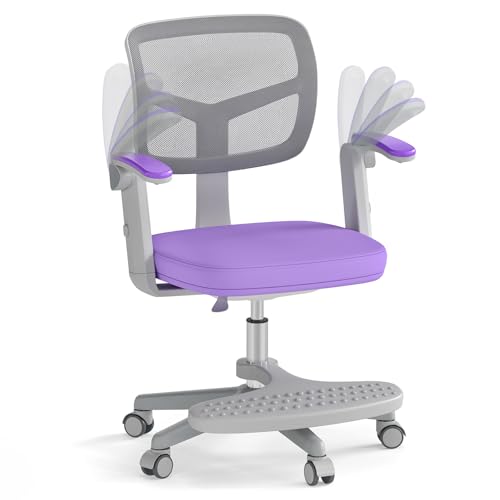
HONEY JOY Kids Desk Chair (Purple) — Best Overall
The HONEY JOY earns the top spot because it adjusts in the three places that matter most as a child grows: seat height, armrest position and a footrest. That footrest is the feature parents underestimate. When a smaller child’s feet cannot reach the floor, they hook their ankles around the chair legs, perch on the seat edge, or sit on one foot — all of which wreck posture within twenty minutes of homework. A footrest gives those feet somewhere honest to land, and because it adjusts, it can follow the child upward as the seat rises year by year.
The mesh back keeps air moving during long study sessions and shrugs off the ink, juice and glue incidents that are a matter of when, not if. The swivel and rolling base make it easy for a child to turn between desk, bookshelf and parent without dragging the chair across the floor. The trade-off for all this adjustability is assembly and upkeep: more moving parts means more bolts to check every few months, and the rolling base is a genuine distraction for some younger children, who will treat any chair on wheels as a vehicle. If your child is under five or cannot yet be trusted with casters, look at the simpler picks below instead.
Strengths
- Height, armrest and footrest all adjust, so the chair adapts across several growth stages
- Mesh back breathes well and wipes clean after spills and marker accidents
- Swivel rolling base lets kids reposition without dragging the chair
Trade-offs
- Rolling casters can distract younger children and tempt standing or riding
- More adjustment points mean more hardware to re-tighten periodically
- This listing is the purple version; other colors are separate listings to check
| Type | Kids swivel task / study chair |
|---|---|
| Adjustments | Height, armrest and footrest (per listing title) |
| Back | Mesh |
| Base | Rolling casters |
| Color of this listing | Purple |
Best for: growing kids who need one chair to last several school years / Not suited for: families who want a non-rolling, fixed chair for very young children
Check on Amazon — check the current price on Amazon before you buy, and confirm the exact configuration on the listing page.
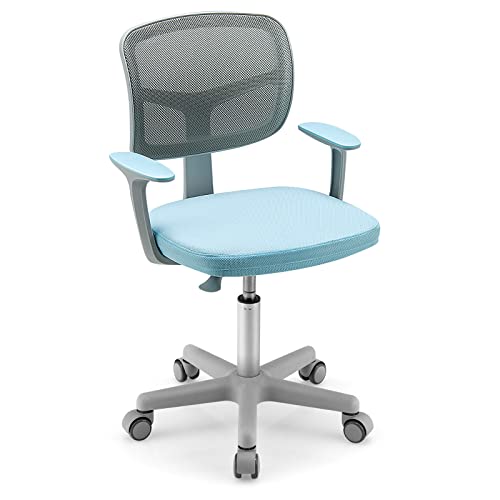
Costzon Kids Desk Chair (Blue) — Best for Ages 4–12
Costzon states the sizing plainly — ages four to twelve — and that honesty makes this chair easy to recommend for the elementary years. It is a height-adjustable study chair with armrests and wheels, shaped like a proper task chair rather than a toy. The arms matter at this age: younger children writing by hand rest their forearms more than adults do, and a chair without arms leaves shoulders shrugged up around ears by the second page of homework.
The design is deliberately conventional, which is a compliment. It looks like a real desk chair, and kids who are starting to care about having a grown-up workspace respond to that. The compromises are the fixed arms — they do not flip up or adjust, so measure your desk’s knee opening before ordering, because an arm that hits the desktop edge will push the whole chair back and put your child too far from their work. And the stated 4–12 range is a real ceiling: a tall eleven-year-old may already be near the top of the seat-height range, so check the listing’s dimensions against your child’s inseam rather than trusting the age label alone.
Strengths
- Manufacturer states a clear 4–12 age range, simplifying the fit decision
- Armrests support younger writers during handwriting homework
- Conventional task-chair styling suits kids who want a grown-up desk setup
Trade-offs
- Fixed armrests cannot flip away if they collide with the desktop
- Taller children may outgrow the height range before age twelve
- Arms and wheels add assembly steps compared with armless designs
| Type | Kids study / computer chair |
|---|---|
| Stated age range | 4–12 (per listing title) |
| Arms | Fixed arms |
| Base | Wheels / casters |
| Color of this listing | Blue |
Best for: elementary-age kids who need arm support at a standard homework desk / Not suited for: taller teens who have outgrown the 4–12 sizing
Check on Amazon — check the current price on Amazon before you buy, and confirm the exact configuration on the listing page.

Primy Kids Desk Chair (Pink) — Best for Younger Kids
The Primy is aimed squarely at the younger end of the range — a first proper desk chair for a child moving from the kitchen table to their own homework corner. It is a height-adjustable swivel mesh task chair sized, per the listing, for ages four to twelve, and its proportions suit smaller bodies better than the teen-leaning designs. The mesh back keeps the chair light enough for a child to move themselves, which sounds trivial until you have repositioned an adult-weight chair four times a day.
What you give up versus the HONEY JOY is the extra adjustment: there is no footrest on this design, so for the youngest users you may end up adding a simple foot box or a low step under the desk to give feet a resting place — a cheap and effective workaround worth planning for. The pink finish of this listing will not suit every room or every child, and Primy sells other colors as separate listings, so confirm you are on the right one before ordering. As a straightforward, breathable, correctly sized starter chair, though, it does the essential job well.
Strengths
- Proportions suit younger, smaller elementary-age children
- Lightweight mesh design is easy for a child to move and reposition
- Height adjustment covers the stated 4–12 span
Trade-offs
- No footrest, so the youngest users may need a separate foot support
- This listing is pink; other colors live on separate listings
- Fewer adjustment points than the top pick as the child grows
| Type | Kids study / task chair |
|---|---|
| Stated age range | 4–12 (per listing title) |
| Back | Mesh |
| Base | Swivel with casters |
| Color of this listing | Pink |
Best for: younger elementary kids setting up a first real homework desk / Not suited for: buyers who need armrests that adjust or a footrest
Check on Amazon — check the current price on Amazon before you buy, and confirm the exact configuration on the listing page.

GIANTEX Kids Desk Chair (Purple) — Best Armless Design
Going armless is a deliberate choice, and for the right desk it is the correct one. The GIANTEX slides fully under almost any desktop, which means your child can sit at the right distance from their work instead of perching at arm’s length because the armrests hit the desk edge. In small bedrooms and shared homework corners, that saved space is the difference between a desk setup that works and one that gets abandoned for the floor. The backrest carries lumbar shaping, so support does not disappear just because the arms did.
A transparency note: GIANTEX sells this same armless design in several colors as separate listings, and we counted it once. The purple listing linked here is the representative; the grey, pink and rose versions are the same chair in different fabric, not different products. The real trade-off of armless design shows up during long reading sessions, when there is nowhere to rest elbows, and some children compensate by leaning on the desk itself. If your child’s homework is mostly reading rather than writing at a surface, one of the armed chairs above will serve them better.
Strengths
- Armless profile slides fully under desks, fixing the too-far-from-work problem
- Lumbar-shaped mesh back keeps support without armrests
- Compact footprint suits small bedrooms and shared study corners
Trade-offs
- No armrests to lean on during long reading sessions
- Same design is sold in multiple colors as separate listings — easy to land on the wrong one
- Casters still require a child who can be trusted with a rolling chair
| Type | Kids study / task chair |
|---|---|
| Arms | Armless |
| Back support | Lumbar support shaping (per listing title) |
| Back | Mesh |
| Color of this listing | Purple |
Best for: small desks and tight homework corners where armrests get in the way / Not suited for: kids who lean on armrests while writing or reading
Check on Amazon — check the current price on Amazon before you buy, and confirm the exact configuration on the listing page.

VIVO Children’s Desk Chair (DESK-V201G-CH) — Best Simple, No-Frills Pick
VIVO is better known for desk hardware than for children’s furniture, and this chair reflects that background: it is a plain, height-adjustable kids’ desk chair with no novelty styling, no gaming pretensions and no features you did not ask for. The listing is explicit that this is the chair only — VIVO also sells desk-and-chair combinations, and the model number DESK-V201G-CH in the title is your confirmation that you are looking at the standalone chair. For a family that already owns a good desk, that clarity is worth having.
The simplicity cuts both ways. There is no footrest for dangling feet and the design is the most utilitarian here, so a child who is excited about a colorful new workspace may find it underwhelming. But for a second chair, a shared family desk, or a parent who values straightforward function over styling, the VIVO is the honest workhorse of this list. Check the listing for the seat-height range and confirm it brackets your desk height before ordering, as with every chair here.
Strengths
- Straightforward height-adjustable design from a desk-hardware brand
- Model number in the listing title makes it easy to confirm the exact product
- Neutral gray suits shared desks and hand-me-downs between siblings
Trade-offs
- No footrest for younger children whose feet dangle
- Utilitarian styling will not excite kids who want a colorful chair
- Fewer comfort extras than the mesh task chairs above
| Type | Children’s height adjustable desk chair |
|---|---|
| Model | DESK-V201G-CH (per listing title) |
| Sold as | Chair only — desk not included |
| Color of this listing | Gray |
Best for: parents who want a plain, sturdy height-adjustable chair without extras / Not suited for: kids who need a footrest, armrests or a mesh back
Check on Amazon — check the current price on Amazon before you buy, and confirm the exact configuration on the listing page.

OYOWINGO Ergonomic Kids Desk Chair — Best with Flip-Up Arms
The OYOWINGO combines the two features that solve the most common kids’-chair complaints: a footrest for dangling feet and flip-up armrests for desks the chair must slide under. Arms down for writing support, arms up to tuck the chair away or sit cross-legged — that flexibility suits children who use the same chair for homework, drawing and tablet time in open floor space. The listing sizes it for ages four to twelve and gives it a mesh back and full 360-degree swivel on wheels.
The honest caveat is brand depth: OYOWINGO is a marketplace brand rather than a long-established furniture maker, so long-term spare-part support is less certain than with the bigger names here, and we could not verify a stated weight capacity from the listing title data — check the full listing page for capacity and dimensions before buying, especially for a child near the top of the age range. On features per chair, though, it matches the top pick point for point, and for many families it will come down to which listing’s current price and color selection fit better.
Strengths
- Footrest plus flip-up armrests solve the two most common fit complaints
- Mesh back and full swivel suit mixed homework, art and reading use
- Sized for the full 4–12 span per the listing
Trade-offs
- Marketplace brand with less certain long-term parts support
- Weight capacity not stated in the listing title — verify on the product page
- Flip-up arm mechanisms add hardware to keep tightened
| Type | Kids study / task chair |
|---|---|
| Stated age range | 4–12 (per listing title) |
| Arms | Flip-up armrests |
| Extras | Footrest (per listing title) |
| Back | Mesh |
Best for: kids who alternate between desk work and open floor space / Not suited for: buyers who prefer an established furniture brand name
Check on Amazon — check the current price on Amazon before you buy, and confirm the exact configuration on the listing page.
Comparison Table
Read this table across, not down: the right question is not which chair is best in the abstract, but which chair fits your child’s body, desk and habits. Key specs below are drawn only from what each listing itself confirms.
| Pick | Badge | Key spec | Best for | Check |
|---|---|---|---|---|
| HONEY JOY Kids Desk Chair (Purple) | Best Overall | Adjustable height, armrests and footrest; swivel mesh task chair | growing kids who need one chair to last several school years | Check on Amazon |
| Costzon Kids Desk Chair (Blue) | Best for Ages 4–12 | Height adjustable with arms and wheels; sized for ages 4–12 per listing | elementary-age kids who need arm support at a standard homework desk | Check on Amazon |
| Primy Kids Desk Chair (Pink) | Best for Younger Kids | Height adjustable swivel mesh task chair; sized for ages 4–12 per listing | younger elementary kids setting up a first real homework desk | Check on Amazon |
| GIANTEX Kids Desk Chair (Purple) | Best Armless Design | Armless swivel mesh chair with adjustable height and lumbar support | small desks and tight homework corners where armrests get in the way | Check on Amazon |
| VIVO Children’s Desk Chair (DESK-V201G-CH) | Best Simple, No-Frills Pick | Height adjustable children’s desk chair; chair only, model DESK-V201G-CH | parents who want a plain, sturdy height-adjustable chair without extras | Check on Amazon |
| OYOWINGO Ergonomic Kids Desk Chair | Best with Flip-Up Arms | Ages 4–12 per listing; footrest, flip-up armrests, 360° wheels, mesh back | kids who alternate between desk work and open floor space | Check on Amazon |
How to Choose the Best Desk Chairs for Kids
Start with the desk, not the chair. Measure the height of the desktop and the height of the knee opening beneath it, then compare both against the chair’s seat-height range and armrest height. A chair is correctly set when your child sits with feet supported, knees at roughly a right angle, and forearms resting near desktop level without shrugging. If the seat-height range of a chair does not bracket the position your desk requires, no amount of padding will make it comfortable — this single check prevents most returns.
Feet are the second check, and the one most often skipped. On a chair sized for a growing child, the seat will spend much of its life a little too high for the child’s legs, which is exactly why footrests appear on two of our six picks. Dangling feet pull a child forward on the seat, round the lower back and start the fidget cycle that ends homework early. If the chair you like has no footrest, budget for a simple foot support under the desk for the years when the seat must sit high.
Finally, decide honestly about wheels and arms. Casters make a chair fun and mobile, and some children simply cannot leave them alone; a child who spins instead of studying may do better with the chair pushed to a carpeted corner where rolling is damped. Arms help handwriting posture but fight with shallow desks. There is no universal right answer — there is only the right answer for your child’s desk, room and temperament.
- Measure desktop height and knee opening before comparing any chairs
- Confirm the seat-height range brackets the position your desk needs
- Plan foot support for any year when the seat sits above foot reach
- Choose flip-up or no arms if the chair must slide fully under the desk
- Check the stated age or size range against your child’s actual height
Mesh, Padding and Cleaning: What Daily Life Demands
Kids’ chairs live harder lives than office chairs. They absorb spilled drinks, marker bleed-through, snack crumbs and the occasional muddy shoeprint on the seat edge. Mesh backs, which dominate this list, are popular with parents for practical reasons: they do not trap heat during long sessions, they do not peel or crack the way inexpensive coated fabrics can, and most spills pass through or wipe off rather than soaking in. A padded seat cushion still matters — mesh backs do not excuse a thin seat — so look for a seat that feels supportive at the end of a homework session, not just in the first five minutes.
Whatever you choose, plan the cleaning routine at purchase time. A chair that needs specialist cleaner will simply not get cleaned. Mesh and smooth surfaces that tolerate a damp cloth and mild soap will still look presentable in year three; textured fabrics that trap crumbs and stains will not. If your child eats snacks at the desk — most do — treat easy cleaning as a core feature, not a bonus.
Posture, Explained Simply: Why Fit Beats Features
Parents often ask whether a kids’ chair needs lumbar support, headrests or ergonomic certification. The honest answer is that for children, fit does ninety percent of the work and features do the rest. A child’s spine is not a small adult spine; what it needs most is a seat at the right height, feet that rest somewhere solid, and a backrest that meets the lower back when the child sits back. When those three things are right, homework posture mostly takes care of itself, because the comfortable position and the correct position become the same position.
When they are wrong, no feature compensates. A chair that is too high produces dangling feet and a rounded back within minutes, whatever its backrest shape. A chair that is too low pushes knees above hips and makes the desk surface feel like a shelf. This is why this guide ranks height-adjustable chairs with foot support at the top, and why we keep returning to the tape measure: two minutes of measuring buys more posture than any marketing term on a listing. It is also why the chair should be re-fitted each school term — growth is the variable that never stops changing.
None of this is medical advice, and a child with persistent back or neck discomfort should be seen by a professional rather than re-seated by a shopping guide. What a well-fitted chair does is remove the everyday, avoidable strain of a badly matched desk setup, and give ordinary homework a fair chance to happen in a sensible position.
Durability and Hand-Me-Downs: Buying for the Second Child Too
Kids’ desk chairs are frequently bought twice — once for an older child, then again when a sibling reaches school age — because the first chair did not survive or did not adjust far enough. Buying with the second child in mind changes the math: a chair with a wide height range, a neutral color and replaceable-feeling simplicity, like the gray VIVO, may out-serve a highly styled chair that a younger sibling refuses as ‘the pink one’. Mesh backs age gracefully in this respect; they do not carry the cracks and peeling that make a three-year-old upholstered chair look finished even when its frame is sound.
Hardware is the other longevity factor. Chairs with more adjustment — the HONEY JOY and OYOWINGO — have more bolts, and bolts on kids’ furniture loosen with use. A two-minute tightening pass each term, at the same moment you re-check the height, keeps a good chair feeling solid for years. Keep the assembly tool and instructions in a labeled bag taped under the desk; the family that can find the Allen key owns the chair that stays tight.
Finally, think about where the chair goes when it is outgrown. A standard task-chair footprint fits a teen’s first desk, a craft table or a spare-room setup. Chairs bought purely as scaled-down novelties tend to fit nothing else in the house. The picks in this guide were chosen as real furniture at child scale, and that is what gives them a second and third life after the elementary years.
Casters, Floors and the Room Around the Chair
Every chair in this guide rolls, and rolling interacts with your floor more than with the chair itself. On hardwood or laminate, hard casters can mark softer finishes over a school year of daily use, and the chair will also move more freely than most parents expect — a push with one foot sends it across the room. A low-pile rug or a dedicated chair mat under the desk solves both problems at once: it protects the floor, steadies the chair, and defines the homework zone in a way children genuinely respond to. On carpet, the same casters roll more reluctantly, which many parents of energetic younger children count as a feature rather than a flaw.
Leave maneuvering room in the layout. A kids’ desk chair needs roughly a body’s width of clear floor behind it for the daily in-and-out, plus turning space if the child moves between desk and bookshelf. Squeezing a swivel chair into a gap it barely fits produces scuffed walls and a child who climbs in from the side — which defeats the posture the chair was bought to create. If the room truly cannot give a rolling chair its space, that is useful information before you buy, not after: it argues for the most compact armless pick and a desk position that lets the chair slide straight in and out.
Lighting and desk position matter to how the chair gets used, too. A chair at a desk facing a wall in a dim corner will be abandoned for the sofa regardless of its ergonomics. Put the homework station where the light is decent and a parent passes by naturally, and the good chair you fitted so carefully will actually be sat in — which is, in the end, the only metric that counts.
How to Set Up a Kids’ Desk Chair Correctly
A good chair set up badly still produces bad posture. Spend ten minutes on this sequence when the chair arrives, and repeat the height check every few months — children grow in spurts, and a chair that was perfect in September can be quietly wrong by spring.
- Assemble the chair fully and tighten every bolt; then sit your child in it at the desk with shoes off and feet flat toward the floor.
- Adjust seat height until the knees sit at roughly a right angle and the thighs are near level. If the feet no longer reach the floor at that height, lower the footrest — or place a foot support — until the feet rest flat and still.
- Check the desk relationship: forearms should rest near the desktop with shoulders relaxed, not lifted. If armrests block the chair from reaching that position, flip them up, or accept a slightly greater reach only as a temporary compromise.
- Set the backrest contact: your child should feel the back support meet the lower back when sitting back, not only when slouching. Encourage sitting back rather than perching on the front edge.
- Test the roll: casters should move without grabbing. On hard floors, a low-pile rug or chair mat under the desk steadies the chair and protects the floor.
- Write the date on a sticky note under the seat. Every school term, re-check height, footrest position and bolt tightness against that note.
Expect a short novelty period with any swivel chair on wheels. A clear family rule — wheels are for getting in and out, not for racing — set on day one prevents most chair-as-vehicle incidents. If spinning remains a genuine problem after the novelty fades, moving the desk to a carpeted area damps the rolling enough to calm things down without replacing the chair.
One last setup habit separates chairs that stay comfortable from chairs that slowly stop fitting: involve the child in the term-time check. A child who helps measure, adjust and tighten their own chair understands what ‘sitting properly’ is supposed to feel like, and will often correct the setup themselves when a sibling or a growth spurt changes it. The goal was never a perfect chair on day one; it is a chair that keeps being adjusted, briefly and regularly, for as long as the child keeps growing — which is to say, for the chair’s entire working life in your house.
Common Buying Mistakes
Buying for the age label instead of the tape measure. Age ranges are rough guides based on average children. Your child’s inseam and your desk’s height are facts. Measure both, and let the seat-height range — not the birthday — make the decision.
Forgetting the armrest-versus-desktop collision. Fixed armrests that cannot pass under the desktop push the chair, and the child, too far from the work surface. It is the most common fit failure in this category and the easiest to check in advance.
Ignoring dangling feet. A chair can match the desk perfectly and still fail the child if their feet swing free. Footrests and simple foot supports exist precisely because this problem is so common and so fixable.
Counting color variants as different chairs. Many listings that look like competing products are the same chair in another color. Compare designs and features, not listing count, or you will pay a ‘different product’ price for a dye change.
Skipping the term-time re-check. Children grow several centimeters a year. A chair bought ‘with room to grow’ still needs its height and footrest actually moved as the child grows into it.
Final Recommendation
For most families, the HONEY JOY is the safest single recommendation: it adjusts at the seat, arms and footrest, breathes through a mesh back, and adapts across the widest span of growth. If your desk is small or its knee opening is shallow, the armless GIANTEX or the flip-up-arm OYOWINGO will fit where it cannot. For a plain, durable chair at a shared family desk, the VIVO is the honest choice, and younger children starting their first homework corner are well served by the Primy or the clearly-sized Costzon.
Whichever you choose, do the two-minute measurement first — desktop height, knee opening, child’s inseam — and check the current price on Amazon on the exact listing and color you intend to order. Fit is the whole game in this category; a correctly fitted mid-range chair beats an expensive chair at the wrong height every single school day.
- HONEY JOY Kids Desk Chair (Purple) — check price on Amazon
- Costzon Kids Desk Chair (Blue) — check price on Amazon
- Primy Kids Desk Chair (Pink) — check price on Amazon
- GIANTEX Kids Desk Chair (Purple) — check price on Amazon
- VIVO Children’s Desk Chair (DESK-V201G-CH) — check price on Amazon
- OYOWINGO Ergonomic Kids Desk Chair — check price on Amazon
Best Desk Chairs Around 300 Best Carpet For Under Desk Chairs Best Desk Chairs For Extended Use Best Desk Chairs For Petite Women
Frequently Asked Questions
What height should a kids’ desk chair be?
There is no single correct number, because the chair must match both the child and the desk. Set the seat so the knees bend at roughly a right angle with feet supported, and the forearms rest near desktop level with relaxed shoulders. That is why every pick in this guide adjusts in height — the adjustment range matters more than any one position.
Do kids really need a footrest on a desk chair?
If their feet cannot reach the floor at the seat height the desk requires, yes. Dangling feet pull children forward, round the lower back and trigger fidgeting. Two picks here include footrests, and for the others a simple foot box or low step under the desk solves the same problem cheaply.
Are rolling chairs safe for young children?
They are appropriate for most school-age children with a clear rule that the chair is not a vehicle. For very young or particularly energetic children, placing the desk on carpet damps rolling, and choosing a chair day-one with that behavior in mind matters more than any single product feature.
Mesh or padded back — which is better for kids?
Mesh breathes better, wipes clean easily and does not peel, which is why most of our picks use it. A padded back can feel cozier for reading-heavy use. Either way, the seat cushion’s support over a full homework session matters more than the back material, and a chair that still feels supportive in the last ten minutes of homework will beat a plusher chair that bottoms out by the second page every time.
How long will one of these chairs last my child?
A height-adjustable chair sized for the 4–12 span can realistically serve through most of elementary school, provided you re-adjust it each term and re-tighten hardware periodically. Children at the tall end of the range will outgrow these chairs sooner — check dimensions, not just the age label.
Should I buy a desk-and-chair set instead?
Only if you also need the desk. Sets force a compromise on one piece or the other, and the chair is the piece that affects posture daily. This guide covers chairs alone; the VIVO listing, for example, is explicitly the chair only, which suits families who already own a good desk.


