Disclosure: airfryerkitchensupply.com is reader-supported. When you buy through links on our site, we may earn an affiliate commission at no extra cost to you.
Where to buy
All six chairs below were confirmed as live Amazon listings on 2026-11-22. Each name links to its listing so you can check the current price on Amazon and — just as important for a petite buyer — open the listing’s own specification table to confirm seat height and seat depth before you order:
- CHEJODAX Executive Desk Chair for Short & Petite Adults — Check on Amazon
- MUSSO E80 Air Petite Ergonomic Office Chair — Check on Amazon
- Nexthro Leather Office Chair for Short People — Check on Amazon
- HUANUO Criss Cross Office Chair, petite design — Check on Amazon
- LEAGOO Office Chair with Foot Rest for Short Women — Check on Amazon
- ergoCentric Little Person Chair — Check on Amazon
A note that applies to every chair in this guide: petite fit lives in numbers — the lowest seat height, the seat depth, the distance from the seat to the lumbar curve — and several listings state their petite intent clearly while leaving some of those numbers to their specification tables rather than their titles. Where a number is not in the title, this guide says so and tells you exactly which number to verify on the listing before buying. That is not a weakness of these picks; it is the honest state of this product category, and a petite buyer who checks two numbers will be happier than one who reads twenty adjectives.
Introduction: why petite women need a different desk chair
The search for the best desk chairs for petite women usually starts after a familiar failure: a standard office chair, bought on looks or on a colleague’s recommendation, in which your feet do not quite rest flat, the seat edge presses into the back of your thighs, the lumbar support lands somewhere around your shoulder blades, and the armrests hold your elbows at a height that keeps your shoulders shrugged all day. None of that is a posture problem on your part. It is a geometry problem. Mainstream desk chairs are dimensioned around a taller average body, and a petite frame — broadly, women around five foot four and under, though proportions matter more than any single height — meets every one of those dimensions at the wrong point.
The three measurements that decide petite fit are seat height, seat depth, and lumbar placement. Seat height must go low enough for your feet to rest flat on the floor with knees at roughly ninety degrees; for many petite women that means a chair whose range starts lower than the mainstream standard. Seat depth — the distance from the backrest to the front edge — must be short enough that you can sit fully back, using the backrest, with a small gap behind your knees; a deep seat forces a choice between perching on the edge with no back support or sitting back with the edge cutting into your calves. And the lumbar curve must be positioned, or adjustable, low enough to meet a shorter back. Every pick in this guide was chosen because its listing speaks to petite or short users directly — stated height ranges, petite designs, small-frame ergonomics — rather than because it is a standard chair that happens to come in pink.
There is also a desk side to this equation, and it is worth stating in the introduction because no chair can fix it alone: a standard-height desk paired with a low-seated petite user can leave the work surface at chest height. The solutions are a chair that still reaches a comfortable typing height with feet supported — which is why footrests appear in this guide as a feature, not a gimmick — or a height-adjustable desk. The chairs below were assessed with that whole workstation in mind, and the buying guide explains how to measure your own desk-and-body combination before you spend anything.
In this guide
Quick Picks
| Pick | Badge | Key detail from the listing | Check price |
|---|---|---|---|
| CHEJODAX Executive Desk Chair for Short & Petite Adults, Black | Best Overall | Stated fit range 5’2″–5’7″; 4.1″ thick cushion; 90° flip-up armrests; 300 lb stated capacity | Check on Amazon |
| MUSSO E80 Air Petite Ergonomic Office Chair, Pink | Best Premium Ergonomic | Built for women and small frames; 3D lumbar support; 4D headrest; retractable footrest; breathable mesh | Check on Amazon |
| Nexthro Leather Office Chair for Short People, Brown | Best Executive Style | Leather-look executive chair sized for short people; swivel; padded arms; lumbar support | Check on Amazon |
| HUANUO Criss Cross Office Chair, Deep Green | Best for Cross-Legged Sitting | Petite design for small spaces; wide cross-legged seat style; adjustable armrests; corduroy fabric | Check on Amazon |
| LEAGOO Office Chair with Foot Rest, White | Best with Built-In Footrest | Mid-back ergonomic chair for short women; foot rest; teddy fleece; adjustable height | Check on Amazon |
| ergoCentric Little Person Chair | Best Specialist Chair | Purpose-built little-person chair with armrests from an ergonomic seating specialist | Check on Amazon |
How These Picks Were Chosen
Every chair here was verified on 2026-11-22: searches were run on petite-specific terms, the returned listing titles and brand fields were matched to the chairs described, and each ASIN comes from the listing response. Only listing-confirmed listings carry buying links. Facts stated in a listing title — a height range, a cushion thickness, a capacity — are used as stated. Facts a title does not state, most often the exact lowest seat height in inches, are flagged as “check the listing’s specification table” rather than invented, because for this category an invented number would be worse than no number.
Selection required the listing itself to address petite or short users. That filter removed most of the office-chair market: standard ergonomic chairs with excellent reviews were excluded when nothing in their listing spoke to a smaller frame, because a great chair in the wrong size is the wrong chair. Colour variants of the same chair were deduped — the CHEJODAX and the MUSSO E80 each appear once although both are sold in more than one colour. Within the petite-addressed set, the six picks were spread across the real ways petite women buy: an all-round executive chair, a premium ergonomic mesh chair, a leather-look option, a cross-legged small-space chair, a footrest chair, and a specialist little-person chair for buyers at the shortest end of the range or with the least tolerance for compromise.
One more honesty note: “petite” in a listing title is a claim about intent, not a measurement. The reviews below separate what each listing actually states from what you should verify, chair by chair, so the final check is always yours and always possible before the box arrives.
The 6 Best Desk Chairs for Petite Women

1. CHEJODAX Executive Desk Chair for Short & Petite Adults — Best Overall
The CHEJODAX leads this list for one rare reason: it states its fit range in the title. This is an executive desk chair designed for short and petite adults of 5’2″ to 5’7″, in black faux leather, with a 4.1-inch thick cushion, 90-degree flip-up armrests, a 120-degree rocking function and a stated 300 lb capacity. A stated height range does two kinds of work for a petite buyer: it tells you the chair’s geometry was actually planned around a shorter body rather than relabelled for one, and it tells you honestly if you fall outside the plan — a buyer under 5’2″ should read that range as a signal to look hardest at the specialist pick at the end of this list, not as a challenge to make this chair fit anyway.
Strengths
- Stated 5’2″–5’7″ fit range — the clearest petite sizing claim in this category
- 4.1″ thick cushion gives real seat padding for long workdays
- Flip-up armrests get out of the way in small rooms and let the chair tuck under the desk
Trade-offs
- Faux leather warms up in summer and breathes less than mesh
- Buyers under the stated range should treat the range as a genuine boundary
- The exact lowest seat height is a specification-table number — verify it on the listing against your measurements
Key specs (from the listing)
- Stated fit: short and petite adults, 5’2″–5’7″
- Seat cushion: 4.1″ thick
- Armrests: 90° flip-up
- Motion: 120° rocking; stated capacity 300 lbs
- Upholstery: faux leather, Black
As an all-round proposition this is the chair that asks the fewest compromises of a petite buyer in its range: executive styling that looks right on a video call, padding that survives a full workday, arms that disappear when the room is small, and a rocking function for the thinking pauses between tasks. Its honest limits are the limits of its class — faux leather is a look and a feel, not a cooling technology, and a stated range is a promise with edges. Inside those edges, it is the most straightforward recommendation in this guide.
Best for: petite women between 5’2″ and 5’7″ who want one chair that does everything reasonably well. / Not suited for: buyers under 5’2″, or anyone in a hot room who knows they prefer mesh.

2. MUSSO E80 Air Petite Ergonomic Office Chair — Best Premium Ergonomic
The MUSSO E80 Air Petite is the spend-up ergonomic option, designed for women and small frames, and its listing reads like a checklist of the adjustments petite users usually have to live without: 3D Bio-Wing lumbar support, a 4D headrest, 90-degree flip-up arms, a retractable footrest, a 135-degree recline and breathable mesh throughout. The footrest deserves emphasis. For a petite user at a standard-height desk, the choice is often between feet dangling at typing height or feet flat at a height where the desk is too high; a retractable footrest breaks that trade by supporting the feet at the height the desk demands, then disappearing when it is not wanted.
Strengths
- Purpose-designed for women and small frames, in breathable mesh
- Retractable footrest solves the standard-desk height trap
- Deep adjustment set — 3D lumbar, 4D headrest, 135° recline — rarely offered in petite chairs
Trade-offs
- Premium positioning — check the current price on Amazon and judge it against how many hours a day you sit
- Mesh feel is firmer than a thick padded seat; cushion lovers should note the difference
- The verified listing is the Pink colourway; a Beige variant exists and is the same chair, not a different pick
Key specs (from the listing)
- Design target: women and small frames
- Lumbar: 3D Bio-Wing support; headrest: 4D adjustable
- Arms: 90° flip-up; footrest: retractable
- Recline: 135°; upholstery: breathable mesh
Who justifies the premium? Someone who sits for a living. Spread across thousands of working hours, the difference between a chair that approximately fits and a chair whose lumbar, headrest, arms and foot support all land where a small frame needs them is the difference between ending the day tired and ending it sore. The E80’s adjustment depth is also its learning curve — expect to spend the first week tuning it, using the setup method in this guide, rather than judging it from the first afternoon. Adjusted properly, it is the most complete ergonomic answer currently listed for petite buyers.
Best for: full-time desk workers with small frames who will use the adjustments, and anyone fighting the standard-desk height trap. / Not suited for: buyers who want a soft padded seat, or occasional-use home offices where the premium cannot pay for itself in hours.
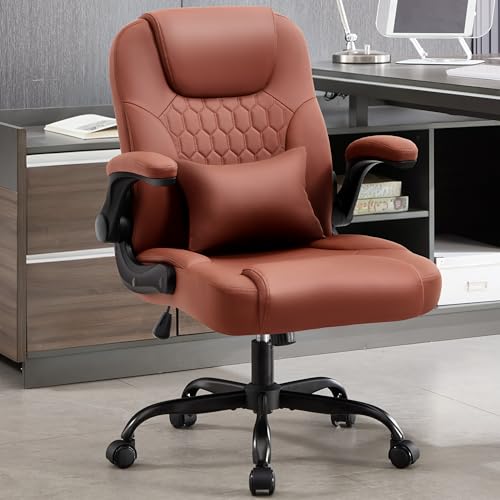
3. Nexthro Leather Office Chair for Short People — Best Executive Style
Some workspaces need the leather-look executive chair — the client-facing home office, the traditional study, the video-call backdrop that should read “established” rather than “ergonomic equipment.” The Nexthro is that chair, sized for short people: a brown leather-look (PU leather) executive office chair with swivel, rolling wheels, padded arms and lumbar support. It earns its place by proving the petite buyer does not have to choose between the executive silhouette and a chair that acknowledges her height, which for years was exactly the choice the market offered.
Strengths
- Classic executive styling in brown leather-look PU, sized for short people
- Padded armrests and lumbar support cover the everyday comfort bases
- 360° swivel and rolling base suit a multi-surface home office
Trade-offs
- PU leather is a look, not the durability or breathability of mesh or genuine hide
- Adjustment depth is executive-chair standard, not ergonomic-chair deep — no multi-axis lumbar or headrest system is stated
- Exact seat height range is a specification-table check on the listing
Key specs (from the listing)
- Design target: short people
- Style: executive, PU leather, Brown
- Features stated: lumbar support, padded arms, 360° swivel, wheels
Buy this chair for the room it will sit in and the impression it needs to make, with your eyes open about the trade: you are exchanging the MUSSO’s adjustment laboratory for a chair that looks like it belongs behind a partner’s desk. For many petite professionals that is the right exchange — the chair fits the short-person brief, supports the back and arms adequately for a working day, and never makes the office look like a gaming setup. Just confirm the seat-height numbers on the listing first, because executive chairs as a class run tall, and this one’s short-person design intent deserves verification in inches before it earns your money.
Best for: petite professionals who need traditional executive styling that respects their height. / Not suited for: buyers who need deep ergonomic adjustment, or hot rooms where PU upholstery will feel sticky by afternoon.

4. HUANUO Criss Cross Office Chair — Best for Cross-Legged Sitting
A large share of petite women do not sit in chairs the way chair designers imagine: they sit cross-legged, one foot tucked up, sideways with knees over one arm — partly comfort, partly because a too-deep standard seat makes conventional sitting the least comfortable option. The HUANUO Criss Cross is designed for exactly that reality: a petite-design desk chair for small spaces, in deep green corduroy, with adjustable armrests and a swivel base, in the wide-seat cross-legged style. Instead of fighting the habit, it gives the habit a chair — a wide, soft seat you can fold yourself into, sized so a petite user is not lost in it.
Strengths
- Designed around cross-legged and tucked-up sitting, in a petite-scaled frame
- Soft corduroy upholstery suits home offices and vanity-desk double duty
- Adjustable armrests and a compact footprint fit genuinely small rooms
Trade-offs
- Cross-legged comfort is not ergonomic support — long, disciplined typing sessions are better served by the MUSSO or CHEJODAX
- No lumbar system is stated in the listing; back support is cushion-level
- Corduroy is a fabric that shows wear patterns and holds pet hair
Key specs (from the listing)
- Design: petite design, small-space footprint, cross-legged seat style
- Upholstery: corduroy, Deep Green
- Armrests: adjustable; base: swivel
- Stated uses: home office and vanity chair
The honest way to frame this chair is as a lifestyle fit rather than an ergonomic intervention. If your work is a blend of laptop sessions, reading, journaling, calls and creative tasks — and your body keeps voting for cross-legged no matter what chair it is given — a chair built for how you actually sit will be used happily every day, which beats a technically superior chair you perch on resentfully. If your work is eight hours of continuous keyboard time, treat the HUANUO as the second chair, the reading-and-calls chair, and let an ergonomic pick carry the typing load.
Best for: petite women who sit cross-legged by instinct, in small rooms and mixed-use home offices. / Not suited for: long continuous typing days, or anyone specifically shopping for lumbar support.

5. LEAGOO Office Chair with Foot Rest — Best with Built-In Footrest
The LEAGOO attacks the petite problem from the comfort end: a mid-back ergonomic executive chair with a foot rest, adjustable height and a teddy fleece finish, listed directly for short women. The foot rest is the functional heart of it — as with the MUSSO, it lets a shorter user set the seat at desk height and still rest her feet fully, which is the combination standard chairs make impossible. Around that function, the LEAGOO wraps a softer proposition than the mesh ergonomic chairs: plush teddy fleece, a reclining executive shape, and a white colourway that suits a bedroom-office or dressing-room desk.
Strengths
- Built-in foot rest solves feet-flat versus desk-height for short users
- Listed for short women, with adjustable height to tune the fit
- Teddy fleece finish is the cosiest upholstery in this guide
Trade-offs
- Teddy fleece is warm — a feature in winter, a drawback in a hot room
- White upholstery shows everything; this is a chair for careful owners
- Also marketed as a gaming-style chair; the ergonomics are comfort-grade rather than clinical
Key specs (from the listing)
- Design target: short women
- Features stated: foot rest, adjustable height, mid-back ergonomic shape, reclining
- Upholstery: teddy fleece, White
Choose the LEAGOO when the footrest is the point and the room is a personal one — a bedroom desk, a study corner, a hybrid work-and-vanity setup where the chair should feel like furniture rather than equipment. Its comfort-first build will suit the many petite users whose real complaint is not a diagnosable ergonomic failure but the daily accumulation of dangling feet, a too-high desk edge and a chair that feels like it was borrowed from a taller person’s office. Between the footrest and the adjustable height, that accumulation is exactly what this chair is built to end.
Best for: short women at standard-height desks who want foot support and a soft, furniture-like chair. / Not suited for: hot rooms, messy work (white fleece forgives nothing), or buyers wanting mesh ergonomics.

6. ergoCentric Little Person Chair — Best Specialist Chair
Every other chair in this guide adapts a mainstream category to petite users. The ergoCentric Little Person Chair starts from the other end: it is a chair purpose-built for little people, from a maker whose business is ergonomic seating, sold with armrests. Its listing title is the sparsest in this guide — it states the chair, its intended user, and the armrests, and leaves dimensions and adjustment details to the listing page — so this review is correspondingly careful: what can be said with confidence is that this is the specialist option, the chair to examine first if you are at the shortest end of the petite range, if stated-range chairs like the CHEJODAX begin above your height, or if years of almost-fitting chairs have taught you that adaptation is not the same as design.
Strengths
- Purpose-built for little people rather than adapted from a standard chair
- From an ergonomic seating specialist — fit is the product, not a feature
- Armrests included, proportioned to the chair’s intended user
Trade-offs
- Specialist positioning means a specialist price — check the current price on Amazon and weigh it as equipment, not furniture
- The listing title states few specifications, so the listing’s own detail page must be read carefully before ordering
- Availability and options may be narrower than mainstream chairs
Key specs (from the listing)
- Design target: little people (purpose-built)
- Configuration verified: with armrests
- Dimensions and adjustment ranges: not stated in the title — verify on the listing
The case for the specialist chair is cumulative. A petite buyer who has replaced three almost-right chairs has already spent the specialist’s price on compromises; the fourth purchase should be the one designed for her body from the first sketch. If that is where you are — or if you are simply below the stated range of every mainstream petite chair — start your shopping here, read the listing’s specifications with the measurement guide below in hand, and treat every number as checkable rather than assumed. That discipline, applied to a purpose-built chair, is the most reliable route in this entire category to a desk chair that finally disappears under you.
Best for: the shortest petite buyers, and anyone done with adapting mainstream chairs. / Not suited for: buyers who want specifications summarised in a title, or budget-first shoppers.
Comparison Table
| Pick | Badge | Key spec | Best for |
|---|---|---|---|
| CHEJODAX Executive Desk Chair | Best Overall | Stated fit 5’2″–5’7″; 4.1″ cushion; flip-up arms | All-round petite office use |
| MUSSO E80 Air Petite | Best Premium Ergonomic | 3D lumbar; 4D headrest; retractable footrest; mesh | Full-time desk work, small frames |
| Nexthro Leather Office Chair | Best Executive Style | PU leather executive chair for short people | Traditional, client-facing offices |
| HUANUO Criss Cross Chair | Best for Cross-Legged Sitting | Petite design; corduroy; adjustable arms | Cross-legged sitters, small rooms |
| LEAGOO Chair with Foot Rest | Best with Built-In Footrest | Foot rest; teddy fleece; for short women | Standard desks, bedroom offices |
| ergoCentric Little Person Chair | Best Specialist Chair | Purpose-built for little people; armrests | Shortest buyers, no-compromise fit |
How to Choose a Desk Chair When You Are Petite: Measure First
Measure your body before you measure any chair. Sit on a hard chair or bench with your feet flat on the floor and measure from the floor to the crease behind your knee — that is your popliteal height, and your desk chair’s seat, at its lowest, should sit at or slightly below it so your feet rest flat without the seat edge pressing into your thighs. Then measure from that same seated position: the distance from the back of your buttocks to the back of your knee is the maximum seat depth you can use while still sitting fully back; your chair’s seat depth should be a little less than that number, leaving a gap of roughly two or three fingers behind the knee. Write both numbers down. They are worth more than any marketing word in this category, including the word “petite.”
Now measure the desk. With your feet flat and your measuring-chair at the height from step one, measure the height at which your forearms rest comfortably horizontal — that is your ideal work-surface height. Compare it with your actual desk. If the desk is higher, you have three honest options: raise the chair and support your feet (the footrest chairs in this guide exist for exactly this), lower or replace the desk, or use a keyboard tray to bring the work down to you. What does not work is the compromise most petite women live with for years — chair high, feet dangling, shoulders raised to a too-high desk — because every element of it loads a different part of the body a little more each hour.
Then read listings like an engineer. Prioritise, in order: a stated fit range or petite design intent; a lowest seat height at or below your popliteal number; a seat depth at or below your seated depth number; lumbar support that is adjustable in height or shaped low; armrests that adjust down or flip away, because fixed arms set for a taller torso will hold your elbows too high and shrug your shoulders for you. Where a listing title does not state a number — and in this category that happens often — the specification table on the listing is the source of truth, and a chair whose seller cannot tell you its lowest seat height is a chair to skip, however pretty it is.
Finally, budget by hours. A chair used nine hours a day is equipment; a chair used for an hour of evening email is furniture. The premium ergonomic and specialist picks in this guide justify themselves across full working weeks and years of service; the comfort picks justify themselves by being sat in happily every day. Both are legitimate purchases. The mistake is buying furniture for an equipment job, or equipment for a furniture job, and this category punishes the first error in your lower back.
How to Set Up a Petite Desk Chair: A First-Week Routine
Assembly first: build the chair on a soft surface, tighten every bolt fully, then re-tighten them all after the first week of use — new chairs settle, and a wobble that appears on day eight is usually a bolt asking for its second turn, not a defect. Set the casters appropriate to your floor if options are offered, and position the chair at the desk before you adjust anything, because fit only exists in the chair-desk-body system, not in the chair alone.
Adjustment order matters. One: set seat height so your feet rest fully flat — on the floor, or on the footrest if your desk demands a higher seat. Two: sit fully back and check the seat-depth gap behind your knees; if the edge presses, no other adjustment will rescue the chair, and that is a return-window fact worth knowing early. Three: set the lumbar support to meet the curve of your lower back — on adjustable chairs, move it until you feel support in the small of the back rather than pressure in the middle of it. Four: set armrests so your elbows rest with shoulders relaxed and forearms roughly horizontal to the desk; if the arms cannot come down to you, flip them up or leave them unused rather than letting them lift your shoulders. Five: set recline tension so you can lean back with gentle pressure and return upright without effort. Then work a full day before changing anything. Small misalignments announce themselves by the hour — a pressure point at hour three, an ache at hour six — and adjusting one variable at a time, a day apart, is how you converge on a setup that disappears. Keep the box and paperwork until the setup survives a full working week; petite fit is proven in days, not in the first sit.
Common Buying Mistakes
The first mistake is buying a standard chair in a smaller colour. A standard chair in pink is a standard chair; petite fit is dimensions, not palette. The second is trusting the word “petite” without checking the two numbers — lowest seat height and seat depth — that decide whether the chair fits your legs at all. The third is ignoring the desk: pairing a correctly low chair with a fixed high desk and concluding the chair failed, when the system failed. The fourth is choosing fixed armrests; on a petite frame, non-adjustable arms are set for someone else’s shoulders. The fifth is treating a cross-legged comfort chair as an ergonomic chair, or demanding ergonomic performance from a comfort chair — they are different tools, and this guide badges them differently on purpose. The sixth is discarding the box on day one: petite buyers, more than any other chair buyers, need the return window, because the difference between a chair that fits and a chair that almost fits only reveals itself across full working days.
Final Recommendation
Start with the CHEJODAX executive chair if you fall inside its stated 5’2″–5’7″ range — it is the most straightforward petite purchase in this guide. Step up to the MUSSO E80 Air Petite if you sit full-time and will use its lumbar, headrest and footrest adjustments. Choose the Nexthro when the room needs executive leather-look styling, the HUANUO Criss Cross when you know you sit cross-legged and your work is varied rather than continuous typing, and the LEAGOO when a built-in footrest and a soft, personal-room feel are the point. If you are below the mainstream petite ranges, or done compromising, go straight to the ergoCentric Little Person Chair and verify its listing specifications against your measurements. Whichever you choose, check the current price on Amazon, confirm the seat numbers on the listing, and keep the box for a week.
Related guides in this series: Best Carpet For Under Desk Chairs · Best Desk Chairs Mesh · Best Desk Chairs With Comfortable Seats · Best Customizable Office Chairs
Why Height Alone Misleads: Petite Proportions Explained
Two women can both be five foot two and need different chairs, because height is a sum and chairs respond to the parts. Leg length decides the seat height and depth you need; torso length decides where the lumbar curve and headrest must land; arm length and shoulder width decide whether the armrests meet you or miss you. This is why the stated range on a chair like the CHEJODAX is a starting filter rather than a fitting: a long-legged, short-torso buyer at the top of the range and a short-legged, long-torso buyer at the bottom of it will adjust the same chair very differently, and both can be right. It is also why “petite” departments in clothing and petite chairs share a philosophy — the proportions are scaled, not just shortened. When you shop, think in three separate fits: the leg fit (feet flat, depth gap behind the knees), the back fit (lumbar meeting the small of your back while you sit fully back), and the arm fit (elbows resting with shoulders down). A chair that passes all three is your chair, whatever its label says; a chair that fails one will remind you of the failure daily, in the order leg, back, arms. The picks in this guide were chosen because their listings address at least the first two fits by design, and the setup routine in this guide exists to tune the third.
Petite Chairs in Small Rooms: Casters, Footprints and Desk Clearance
Petite buyers disproportionately work in small rooms — the bedroom desk, the apartment corner, the converted closet office — and chair size interacts with room size in ways listings rarely discuss. A chair with a wide five-star base and fixed arms claims a circle of floor that a small room may not have; flip-up arms, as on the CHEJODAX and MUSSO picks here, let the chair park fully under the desk and return that floor to the room every evening. Caster choice matters at petite weights too: a lighter user generates less force to start a chair rolling, so on hard floors a chair that glides too freely can feel skittish, while on carpet a chair that rolls too stiffly turns every reach for the printer into a small workout. If a listing offers floor-specific casters, choose for your actual floor; if it does not, a chair mat — the subject of one of the related guides linked above — is the standard fix, and it protects the floor as a bonus. Finally, check the recline footprint: chairs that recline deeply, like the 135-degree MUSSO, need clear space behind them, and in a room where the desk backs onto a bed or a wall, a rocking executive chair or a mid-back design may simply fit the life of the room better. Measure the room’s chair circle — desk edge to the nearest obstacle — before you fall in love with a recline angle.
Petite Desk Chairs for Shared and Mixed-Height Households
Many petite women do not have the desk to themselves, and a chair bought for one body will be borrowed by others — a taller partner on weekends, a growing teenager whose proportions change every school year, guests who sit down without asking. Plan for the household you have. If the chair is shared daily, prioritise adjustment range over perfect single-user fit: height adjustment that travels far enough for both users, lumbar that can be repositioned in seconds, and a simple household rule that each user resets the chair on arrival rather than inheriting the previous person’s settings — most “uncomfortable chair” complaints in shared homes are really un-reset chairs. If the chair is shared rarely, buy for the primary user without apology and let guests perch; a chair fitted to its daily user and borrowed twice a month is a better household asset than a chair fitted to nobody and used by everyone. Growing teenagers deserve a specific note: a petite chair with room in its height range can serve a young teen now and an adult later, but seat depth does not grow with the child, so a chair bought for a twelve-year-old should be re-fitted, honestly, every year — and the two measurements in this guide take five minutes to redo. Finally, in a genuinely mixed-height home office with two desks, resist the matching-pair temptation: two different chairs, each fitted to its user, will always outperform two identical chairs fitted to neither, and the room will look like a place where two people work, which is exactly what it is.
Accessories That Complete a Petite Setup
Once the chair fits, three inexpensive accessories decide whether the whole workstation does. The first is a separate footrest for chairs without one: if your desk height forces the seat up, a stable, angled footrest restores the feet-flat position the chair was adjusted for, and it should be wide enough for both feet to shift across the day rather than a narrow perch. The second is a monitor position that matches your seated eye line — petite users at standard desks often find screens sitting low relative to a raised chair, and a simple stand or a stack of the desk’s own reference books, honestly assessed, beats a year of looking down. The third is a chair mat chosen for your floor and casters, which appears in this guide’s related links for a reason: on carpet, the right mat lets a lighter user roll without the shove-and-strain that quietly wrecks a careful chair setup, and on hard floors it protects the surface the casters would otherwise groove. None of these accessories can rescue a chair with the wrong seat depth or a lumbar curve in the wrong place — accessories tune a fit, they do not create one — but on top of a correctly fitted petite chair they are the difference between a workstation that works on paper and one that works at hour seven.
Frequently Asked Questions
What seat height do petite women usually need?
It depends on your leg length, not your overall height alone. Measure from the floor to the crease behind your knee while seated with feet flat: your chair’s lowest seat height should be at or slightly below that number. Many petite women find mainstream chairs cannot go low enough, which is why stated petite ranges and low-starting chairs matter more than any other feature in this category.
Is a footrest a real solution or a workaround?
A real solution, when the problem is a fixed-height desk. If your desk is higher than your ideal work height, raising the chair and supporting your feet on a footrest keeps both your arms and your legs in neutral positions. Two picks in this guide build the footrest in. The workaround to avoid is the opposite one: feet dangling from a raised chair with no support at all.
Can a petite woman use a standard ergonomic chair with a cushion?
A cushion can fix seat padding and can raise you, but it cannot shorten a too-deep seat or lower a lumbar curve placed for a taller back, and raising yourself on a cushion makes the foot problem worse. If a standard chair’s depth and lumbar placement are wrong for your body, accessories will only decorate the mismatch. Buy the dimensions first; accessorise second.
What does “stated fit range” actually guarantee?
It tells you the heights the chair was designed around — for example, the CHEJODAX states 5’2″–5’7″. It is a design claim, not a personal fitting: your leg and torso proportions still decide your individual fit, which is why this guide pairs every stated range with the two measurements to check yourself. Treat a range as a strong shortlist filter, then verify with your numbers.
Are cross-legged chairs bad for your back?
They are comfort chairs, not ergonomic chairs, and should be bought as such. For varied, shorter work sessions many petite women find them genuinely more comfortable than perching on a standard chair. For long continuous typing, a chair with real, correctly placed lumbar support is the better tool. The honest answer is that the best chair is the one matched to the work — which is why this guide includes both kinds and labels them clearly.
How long should I trial a new chair before deciding?
A full working week of normal days. Adjust one setting at a time, live with each change for a day, and judge by how you feel at the end of the longest day, not the first sit. Keep packaging and paperwork until the week is done — petite fit is the hardest fit to predict from a product page, and the return window is part of the purchase.


