Disclosure: airfryerkitchensupply.com is reader-supported. When you buy through links on our site, we may earn an affiliate commission at no extra cost to you.
Where to buy
All six picks below were verified against live Amazon listings on 2026-11-22 (three in fresh searches, three reused from this site’s verified API cache dated 2026-11-22). Use these links to check the current price on Amazon and confirm seat dimensions and capacity figures before ordering — in this category, the seat is the product, and its stated width and cushion type are the numbers that matter.
- GABRYLLY Ergonomic Office Chair with Wide Cushion — Check the current price on Amazon
- SIHOO M18 Ergonomic Office Chair with Wide Cushion — Check the current price on Amazon
- SIHOO B100 SE Ergonomic Office Chair with Memory Foam Seat — Check the current price on Amazon
- ELABEST X100 Ergonomic Mesh Office Chair with Footrest — Check the current price on Amazon
- BOLISS Mid Back Mesh Drafting Chair with Extra Wide Seat — Check the current price on Amazon
- Herman Miller Classic Aeron Chair, Size B — Check the current price on Amazon
Introduction: the seat is where a desk chair succeeds or fails
Most desk-chair shopping obsesses over backs — mesh, lumbar, headrests — while the best desk chairs with comfortable seats are decided by the part you actually load for eight hours: the seat pan. A seat fails in three ways. Its cushion is too thin or too soft, so you bottom out onto the hard pan beneath by mid-afternoon. Its front edge presses into the backs of your thighs. Or it is simply the wrong width and depth for your body, so you perch or slump instead of sitting. This guide compares six verified desk chairs chosen specifically for their seats — wide cushions, a memory-foam seat, an extra-wide drafting seat, a footrest-equipped big-and-tall design, and one famous mesh exception — and explains honestly what each seat construction does across a working day.
Two honesty notes shape the whole guide. First, seat comfort claims in listings are adjectives; the verifiable facts are construction and dimensions — cushion type where stated, seat width where stated, capacity where stated — and those are what we compare. Where a listing does not state a cushion’s thickness or a seat’s depth, we mark it not stated rather than guessing. Second, one pick — the Herman Miller Aeron — has no cushion at all: its seat is a suspended mesh membrane. It is included deliberately and labelled clearly, because for some long-sitters a pressure-distributing mesh outperforms every foam in this guide, and a “comfortable seats” roundup that hid the most famous seat in office history would be lying by omission. If you want foam, five picks are foam; the Aeron is the alternative philosophy, flagged as such.
A related exclusion, made on principle: seat cushions and pads appeared throughout our searches — memory-foam pads you strap onto an existing chair. They are accessories, not desk chairs, and per this site’s rules they cannot occupy a pick slot in a chair guide. If your current chair’s frame and back are good and only its seat has died, a pad is a legitimate rescue — but it is a different product, and you will not find it recommended here disguised as a chair.
In this guide
Quick Picks
| Pick | Badge | Why it is here | Link |
|---|---|---|---|
| GABRYLLY Ergonomic Office Chair | Best Overall | Wide cushion seat, high-back mesh, flip-up arms, 90-120° tilt lock | Check price on Amazon |
| SIHOO M18 Ergonomic Office Chair | Best Value Wide Seat | Wide cushion, adjustable lumbar, 330 lb capacity per listing | Check price on Amazon |
| SIHOO B100 SE | Best Memory-Foam Seat | Soft memory-foam seat per listing, 135° recline, flip-up arms | Check price on Amazon |
| ELABEST X100 | Best Big & Tall with Footrest | Big-and-tall frame, footrest, 5D flip-up arms, 3D lumbar | Check price on Amazon |
| BOLISS Drafting Chair | Best Extra-Wide Seat / Standing Desk | Extra wide seat, 400 lb capacity per listing, foot ring | Check price on Amazon |
| Herman Miller Classic Aeron Size B | Best Mesh Alternative | Suspended mesh seat — no cushion; the premium long-sit benchmark | Check price on Amazon |
How These Picks Were Chosen
The search’s filter is the seat, so candidates were screened on seat evidence in their verified listings: a stated wide cushion (GABRYLLY, SIHOO M18), a stated memory-foam seat (SIHOO B100 SE), a stated extra-wide seat with a stated 400 lb capacity (BOLISS), a big-and-tall frame with a footrest for seat-offloading (ELABEST X100), and the mesh benchmark (Aeron). Generic office chairs whose listings said nothing specific about their seats were passed over, however popular — a “comfortable seat” guide must be built from seat evidence, not from overall chair fame. The one deliberate exception proves the rule: the Aeron’s seat is its fame.
Verification ran. The GABRYLLY, the B100 SE, and the Aeron were confirmed in fresh searches on 2026-11-22; the SIHOO M18, ELABEST X100, and BOLISS were reused from this site’s verified API cache of the same date, with their full cached titles supplying the specifications quoted. Prices the listed were internal sanity checks only and are never printed. Capacities are quoted exactly as listings state them (330 lbs for the M18, 400 lbs for the BOLISS) and are not independently tested by us — treat them as manufacturer figures.
Ergonomic language is handled carefully throughout. These are comfort products for healthy working posture; nothing here is a medical device, and no chair in this guide is claimed to treat back conditions or pain. Where a listing uses words like “ergonomic,” we report the adjustable features behind the word — lumbar adjustment, tilt range, arm movement — because features are checkable and adjectives are not.
The 6 Best Desk Chairs With Comfortable Seats

GABRYLLY Ergonomic Office Chair — Best Overall
The GABRYLLY earns the lead on the exact terms of the keyword: its listing leads with a wide cushion seat in a high-back mesh chair with a headrest, flip-up arms, and a 90-120° tilt lock, positioned for big and tall users. The wide cushion is the point — a broader, padded seat pan spreads load across more of the thigh and hip than the narrow, thinly padded seats that dominate budget chairs, and it is the single feature long-sitters feel most by hour six. The mesh back handles the other half of comfort, heat, while the cushion handles pressure: a sensible division of labour that many more expensive chairs get wrong by meshing everything or padding everything.
Strengths
- Wide cushion seat — the brief of this guide, stated in the listing itself
- Mesh high back with headrest balances the padded seat with a breathable back
- Flip-up arms and 90-120° tilt lock suit both desk work and lean-back calls
Trade-offs
- Cushion thickness and foam density are not stated in the Amazon title — judge firmness expectations accordingly
- Big-and-tall proportions may overwhelm petite users; seat depth is not stated in the title
- Mesh back means back support depends on the chair’s built-in curve, not a stated adjustable lumbar in the title
Spec snapshot (from the verified listing)
- Seat: wide cushion
- Back: high-back mesh, with headrest
- Arms: flip-up
- Tilt: 90-120°, with tilt lock
- Positioning: big and tall (per listing)
The working day this chair produces is unremarkable in the best way: you sit, the seat is simply there, broad and padded, and your attention stays on the work. That sounds like faint praise until you have spent a month on a chair whose seat you notice every twenty minutes. The flip-up arms are a quietly practical feature for musicians, for desks with low clearance, and for anyone who pulls in close to a keyboard tray. If your current chair’s failure is specifically its seat — thin, narrow, dead by 3 p.m. — the GABRYLLY is the most direct replacement in this guide.
Best for: long-sitters whose current chair seat is the problem. / Not suited for: petite users or buyers who need every dimension stated before ordering.

SIHOO M18 Ergonomic Office Chair — Best Value Wide Seat
The M18 is SIHOO’s volume ergonomic chair, and its verified listing states the seat case plainly: a wide cushion, in a mesh-back chair with a headrest, adjustable lumbar support, 2D armrests, tilt lock, and a stated 330 lb capacity. That combination — wide seat plus genuinely adjustable lumbar plus a published capacity — at the M18’s tier is why it anchors the value end of this guide. The wide cushion does the seat brief; the adjustable lumbar does the back brief properly, with a mechanism rather than a pillow; and the capacity figure tells bigger users the chair was designed with them in the specification, not as an afterthought.
Strengths
- Wide cushion seat with adjustable lumbar — both halves of sitting comfort addressed with real mechanisms
- Stated 330 lb capacity gives larger users a verifiable figure
- 2D armrests and tilt lock cover the standard adjustment set at a value tier
Trade-offs
- Seat cushion material and thickness are not stated in the Amazon title
- Mesh back with a headrest suits most, but users who prefer a padded back should look elsewhere
- Value-tier components reward gentle use; treat the adjustments with reasonable care
Spec snapshot (from the verified listing, cached 2026-11-22)
- Seat: wide cushion
- Back: mesh, with headrest; lumbar: adjustable
- Capacity: 330 lbs (per listing)
- Arms: 2D; tilt lock fitted
SIHOO sells a great many chairs into home offices, and the M18 is the model that built that volume: it is the chair bought by people who researched for an evening and wanted the checklist — wide seat, adjustable lumbar, headrest, arms that move, a capacity in writing — without entering premium money. In this guide’s seat-first terms it stands second only to its badge-mate because the GABRYLLY’s cushion positioning is slightly more emphatic; in whole-chair value terms, many buyers will rank it first. Either way, if your budget has a ceiling and your working day has no mercy, this is the sensible seat.
Best for: home-office buyers who want the full adjustment checklist at a value tier. / Not suited for: buyers who want a stated premium foam or a padded back.

SIHOO B100 SE — Best Memory-Foam Seat
The B100 SE is the foam purist’s pick in the SIHOO line: its listing states a soft memory-foam seat — the only pick here whose cushion material is named outright — with lumbar support, flip-up armrests, and a 3-gear recline reaching 135°. Memory foam in a seat does a specific thing: it moulds to your shape under load and redistributes pressure away from the sitting bones, which is why it feels luxurious in hour one. The honest caveat, covered in the trade-offs, is that memory foam’s moulding is also its ageing path. For buyers who know they love memory foam from their mattress and pillows, this is the chair that speaks their language.
Strengths
- Memory-foam seat stated in the listing — the named-material seat of the roundup
- 135° recline with 3-gear locking for lean-back breaks
- Flip-up arms keep it compatible with tight desks and keyboard trays
Trade-offs
- Memory foam sleeps warm — in hot rooms it is the least breathable seat here
- Foam softens and compresses with years of use; its best feel is its early feel
- Seat width is not stated in the Amazon title — larger users should check the M18 or BOLISS first
Spec snapshot (from the verified listing)
- Seat: memory foam (“soft,” per listing)
- Lumbar: support fitted (type per listing)
- Recline: 3-gear, up to 135°
- Arms: flip-up
The B100 SE’s buyer is choosing a sensation, and should own that choice with eyes open. In a cool room, for a sitter of average build who works in focused ninety-minute blocks and leans back between them, the moulded memory-foam seat plus the deep recline is the most indulgent combination in this guide under premium money. In a hot room, or for a sitter who runs warm, the same foam becomes the complaint — which is why the mesh-backed, standard-cushion picks flank it in this list. Know your room, know your build, and the B100 SE is either exactly right or clearly not, with very little middle ground.
Best for: memory-foam lovers in cool rooms who recline between work blocks. / Not suited for: hot rooms, warm sitters, or the largest users.

ELABEST X100 — Best Big & Tall with Footrest
The X100 attacks seat comfort from a different angle: if a seat must carry a big-and-tall user all day, one relief strategy is to give the legs somewhere else to go. Its listing states a footrest, 5D flip-up arms, adjustable 3D lumbar support, and a big-and-tall mesh build across gaming and executive positioning. The footrest matters to this guide because it periodically offloads the seat entirely — feet up on a call, weight redistributed, the cushion gets a rest and so do your thighs. The 5D arms are the most adjustable in this roundup, which matters for larger frames whose elbows land where standard arms never reach.
Strengths
- Footrest lets you periodically offload the seat — a genuine comfort mechanism, not a gimmick
- Big-and-tall frame with 3D lumbar and 5D arms: the most adjustment in this guide
- Mesh construction keeps a large chair breathable across long sessions
Trade-offs
- Seat cushion construction is not stated in the Amazon title — the seat itself is the least documented here
- Gaming/executive styling is a taste decision, and the footrest adds footprint
- Capacity is not stated in the Amazon title despite the big-and-tall positioning — verify on the listing
Spec snapshot (from the verified listing, cached 2026-11-22)
- Format: big and tall mesh office chair, with footrest
- Arms: 5D flip-up
- Lumbar: adjustable 3D support
- Seat construction and capacity: not stated in the Amazon title
Buy the X100 for its system rather than its seat specification — and note that we say so openly, because its listing does. For a tall, heavy user, the lived experience of a chair is arms that reach, a back that fits, and the ability to change posture radically without standing; the X100 is built around exactly that experience, and its seat benefits indirectly every time the footrest takes the load. If you are an average-build user who never puts their feet up, its advantages evaporate and the GABRYLLY or M18 serve you better for less. Fit the chair to the body and the habits, not to the feature count.
Best for: big-and-tall users who work long sessions and use a footrest. / Not suited for: average builds or buyers who need the seat’s own construction documented.

BOLISS Mid Back Mesh Drafting Chair — Best Extra-Wide Seat / Standing Desk
The BOLISS is the specialist: a drafting-height chair whose listing states an extra wide seat and a 400 lb capacity, with a lower-back support design, an adjustable foot ring, height-adjustable armrests, and two locking positions. Drafting chairs serve standing desks and high counters, where the sitter perches higher and the seat carries weight differently — more load toward the front edge, more sliding pressure. An extra-wide, high-capacity seat is precisely the right answer to that posture, and the foot ring gives the feet a perch that keeps thighs from dangling against the seat edge, which is the classic drafting-chair discomfort.
Strengths
- Extra wide seat with a stated 400 lb capacity — the most seat, in writing, in this guide
- Foot ring solves the dangling-leg pressure that ruins high-chair comfort
- Built for standing-desk heights that standard chairs cannot reach
Trade-offs
- Drafting height is wrong for a standard desk — this is a specialist tool, not a general chair
- Mid-back design gives up the headrest and upper-back support of the high-back picks
- Seat cushion material is not stated in the Amazon title
Spec snapshot (from the verified listing, cached 2026-11-22)
- Seat: extra wide
- Capacity: 400 lbs (per listing)
- Format: drafting chair, mid back mesh, foot ring
- Tilt: 2 locking positions
Standing-desk owners discover a predictable arc: they stand, they tire, they perch on a stool, the stool punishes them, and they go looking for a real chair at drafting height. The BOLISS is that chair, and its seat is why it is in a comfortable-seats guide at all — width and capacity stated in the listing, in a format where the seat carries more of you, more of the time. If your desk is standard height, admire it and move on; the M18 gives you the wide-seat idea at the right height. If your desk rises, this is the pick that ends the stool era.
Best for: standing-desk and counter-height users, and larger users who need stated capacity. / Not suited for: standard-height desks or anyone wanting a high back with headrest.
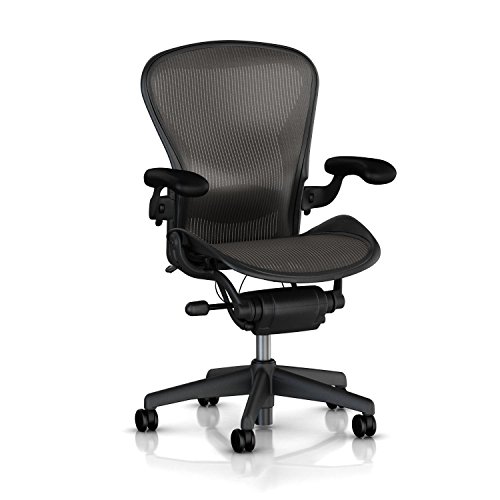
Herman Miller Classic Aeron Chair, Size B — Best Mesh Alternative
The Aeron is the deliberate exception that tests the whole guide: a chair with no seat cushion at all, whose seat is a suspended elastomer mesh that distributes pressure across its surface and conforms without foam. The verified listing is the Classic Aeron in aluminium, Size B — the middle of the Aeron’s three sizes. For a certain long-sitter, this is the most comfortable seat ever put in an office: no foam to bottom out, no heat build-up, no cushion to age, and a waterfall front that never presses the thighs. For another sitter, it is a firm, frame-edged perch they never forgive. Both reactions are honest, and which one you will have is the most predictable taste question in seating.
Strengths
- Suspended mesh seat: zero bottoming-out, zero cushion ageing, maximum breathability
- Size system (this is Size B) fits the seat to the body more precisely than one-size chairs
- The long-term benchmark for eight-hour sitting, with durability to match
Trade-offs
- No cushion — buyers who want to sink into foam will not convert; try before committing if possible
- Premium tier by a wide margin — check the current price on Amazon; this listing is the Classic in aluminium
- The mesh’s frame edge is felt by some sitters, particularly when perching forward
- Detailed adjustment specification is not stated in the Amazon title for this listing — confirm the configuration on the listing
Spec snapshot (from the verified listing)
- Seat: suspended mesh (Pellicle-style), no cushion
- Size: B (medium of the Aeron size range)
- Finish of verified listing: Aluminium frame
- Adjustment details: not stated in the Amazon title
Place the Aeron in this guide correctly: it is not the winner of the cushion contest, it is the evidence that the contest has two philosophies. Foam seats comfort by moulding and padding; the Aeron comforts by suspending and distributing. Foam wins the first hour for most people; mesh partisans argue it wins the eighth hour and the eighth year. If you have sat in an Aeron at an office and loved it, nothing else in this guide will substitute, and the premium is simply the price of the seat you already know fits you. If you have never sat in one, the foam picks are the safer blind purchase, and the Aeron is the chair to test in a showroom before it is the chair to order.
Best for: mesh devotees, hot rooms, and decade-scale ownership. / Not suited for: foam lovers, blind premium purchases, or tight budgets.
Comparison Table
| Pick | Badge | Key spec (verified) | Best for | Link |
|---|---|---|---|---|
| GABRYLLY | Best Overall | Wide cushion, mesh high back, flip-up arms | All-round long sitting | Check price |
| SIHOO M18 | Best Value Wide Seat | Wide cushion, adj. lumbar, 330 lbs | Home office value | Check price |
| SIHOO B100 SE | Best Memory-Foam Seat | Memory-foam seat, 135° recline | Foam lovers, cool rooms | Check price |
| ELABEST X100 | Best Big & Tall + Footrest | Footrest, 5D arms, 3D lumbar | Large users, long sessions | Check price |
| BOLISS Drafting | Best Extra-Wide Seat | Extra wide seat, 400 lbs, foot ring | Standing desks | Check price |
| Herman Miller Aeron B | Best Mesh Alternative | Suspended mesh seat, Size B | Mesh philosophy, longevity | Check price |
How to Choose a Desk Chair for Its Seat
Start with your own dimensions, because seats fail by fit before they fail by material. You want a seat width that lets you sit centred with a little room either side — not a squeeze, not a swimming pool. You want a depth that supports most of the thigh while leaving a fist’s width between the seat edge and the back of your knee; a seat that is too deep forces slumping, and one that is too shallow concentrates all your weight on the sitting bones. Where listings state width or capacity, use them (the BOLISS’s extra-wide seat and 400 lb figure, the M18’s 330 lbs). Where they do not — several picks here — treat that absence as information and check the listing’s dimension diagram before ordering.
Then choose your seat philosophy. Cushioned foam comes in two tempers: standard wide cushions (GABRYLLY, M18) that feel supportive immediately and age gracefully, and memory foam (B100 SE) that moulds luxuriously and ages faster while sleeping warmer. Suspended mesh (Aeron) refuses the whole foam bargain — nothing to compress, nothing to heat up — at the price of a firmer, edged feel that divides humanity. There is no universal winner; there is your body’s verdict, and the most reliable predictor is what you have already sat on happily for years. Buy the philosophy you know, or the mid-priced foam if you genuinely do not know yet.
Height range is the seat’s silent partner. A comfortable seat at the wrong height is an uncomfortable seat: feet should rest flat (or on a foot ring, at drafting height), knees near a right angle, thighs unweighted at the front edge. Check that the chair’s seat-height range covers your desk height and your leg length — and if you work at a standing desk at perch height, stop shopping standard chairs entirely and buy the drafting format, as the BOLISS section explains. Arms matter to seats more than people think: arms at the wrong height shrug your shoulders, which slumps your pelvis, which changes how the seat loads. Adjustable arms (2D on the M18, 5D on the X100, flip-up on the GABRYLLY and B100 SE) are seat features in disguise.
Finally, plan the seat’s life, not its first week. Foam compresses; the question is whether the chair still serves when it has. Wide cushions with more material (GABRYLLY, M18) degrade more gracefully than thin ones. Memory foam’s decline is steeper. Mesh does not decline at all, which is the core of the Aeron’s decade economics. Match the purchase to your horizon: a two-year home-office stint argues value foam; a ten-year career chair argues either the best foam you can justify or the mesh benchmark.
How to Set Up Your Chair So the Seat Can Do Its Job
A comfortable seat is half product, half adjustment, and the adjustment half is free. Set the height first: sit, feet flat on the floor, and raise or lower until your thighs are level or slope very slightly down toward the knees, with no pressure under the front of the thigh. Set the depth relationship second — if the chair has a sliding seat, position it so two or three fingers fit between the edge and the back of your knee; if it does not, a small cushion behind your back is the honest workaround for a too-deep seat. Set the arms third, to where your elbows rest with shoulders fully relaxed; if the arms cannot get there, flip them up or accept their absence rather than shrugging all day.
Then set the back to serve the seat: lumbar support should meet the small of your back without pushing you forward off the seat’s depth, and the tilt tension should let you lean back with effort you can sustain, locked for focused typing and free for calls. At a drafting chair, set the foot ring so your feet rest with the same thigh geometry as a standard chair — the ring is a floor, not a decoration. Revisit every adjustment after a week: foam settles, bodies adapt, and the settings that felt right on day one are a draft, not a verdict. The most comfortable seat in this guide, misadjusted, will lose to the plainest seat in it, adjusted well.
Budget allocation within a chair deserves one honest paragraph. In a mid-tier chair, the money you can see — leather-look upholstery, chrome bases, gaming wings — is rarely the money that determines comfort. The invisible spend is foam quality, mechanism quality, and the gas lift’s grade. This is why this guide’s value pick is a mesh-and-cushion chair with a published capacity rather than a plusher-looking chair with none: SIHOO put the money in the specification. When two chairs cost the same and one publishes its seat width, capacity, and adjustment ranges while the other publishes its racing stripes, the first chair is telling you where its budget went.
Common Buying Mistakes
The first mistake is buying a chair for its back and discovering its seat by suffering — this entire guide exists because seat evidence should lead. The second is adding a strap-on cushion pad to a chair whose seat pan is the wrong size: a pad changes softness, never geometry, and per this site’s rules it is an accessory, not a chair. The third is ignoring capacity and width figures where they are stated, or failing to check dimensions where they are not. The fourth is choosing memory foam for a hot room, or mesh for a body that has always hated mesh, on the strength of reviews written by other bodies. The fifth is buying drafting height for a standard desk, or standard height for a standing desk. And the sixth is expecting any chair, however comfortable its seat, to substitute for movement: the healthiest seat in this guide still wants you standing up every half hour or so, and no listing in this category claims otherwise.
Assembly and first-week realism, briefly: every chair here arrives in a box and asks for twenty to forty minutes of bolts and patience, and every foam seat here feels firmer in week one than it will in week four. Do not judge a cushion in its first evening, and do not throw the box away in it either. Judge at the end of the first full working week, by the only metric this guide recognises — how often you noticed the seat. The right chair is the one that disappears.
Measure before you order — your inseam, your desk’s underside height, and the doorway the box must pass through. Five minutes with a tape measure has saved more chair purchases than any review ever written, this one included.
One final test belongs in every chair trial, and it takes ten seconds: sit down the way you actually sit down at 4 p.m. on a tired Thursday — not the posture-demo sit, the real one, slightly slumped, one leg ready to tuck. The right seat forgives that sit. It catches you without a hard edge, a narrow squeeze, or a pan that has gone dead under you, and it lets you straighten up again without a negotiation. Run that test in the first week on whichever chair you choose from this guide; the chairs that pass it are the chairs still being praised in year three, and every pick here was chosen because its seat — cushion, foam, or mesh — is built to pass it.
Final Recommendation
Most buyers should take the GABRYLLY (check price on Amazon) for its wide cushion and complete package, or the SIHOO M18 (check price on Amazon) if the budget is firm and the checklist matters. Memory-foam devotees get their named material in the B100 SE (check price on Amazon). Big-and-tall users who sit long should consider the footrest-equipped X100 (check price on Amazon), standing-desk users the extra-wide BOLISS (check price on Amazon), and mesh believers the Aeron Size B (check price on Amazon) — the one seat here with nothing to wear out.
Related guides on this site: Best Desk Chairs With Headrest · Best Desk Chairs With Soft Seats · Best Ergonomic Desk Chairs With Purple Option
Flooring and casters are the seat’s overlooked neighbours. A chair that rolls too freely on hard floors makes you brace with your legs all day — a subtle thigh workout that masquerades as seat discomfort — while a chair that will not roll on carpet makes you twist to reach anything. If your seat feels mysteriously tiring, check what is under the wheels before blaming what is under the cushion: the right casters for your floor (and most of these chairs assume typical office flooring) restore the seat’s geometry to what its designer intended.
A Working Day on Each Seat: What Hour Six Feels Like
Specifications flatten differences that a working day exposes, so here is the honest hour-six report for each philosophy in this guide. On the wide standard cushions — GABRYLLY and M18 — hour six feels like hour two, only warmer: the cushion has taken your shape without surrendering to it, and the main sensation is that you have stopped thinking about the chair, which is the whole goal. These are the seats for people whose work is a long, unbroken sit: writers, coders, analysts. Their failure mode arrives in year two or three, not hour six, as the foam slowly loses its spring — a decline you can plan around.
On memory foam, hour one is the best hour any seat here offers, and hour six is the argument. The foam has moulded completely, which in a cool room still feels like support and in a warm room feels like sitting in a warm mould of yourself. B100 SE owners who love the chair tend to be climate-controlled owners; the recline also changes the equation, because a memory-foam sitter who leans back at 135° between blocks redistributes load so often that the foam never becomes a trap. On the mesh Aeron, hour six is identical to hour one — the membrane does not know what time it is — and the sitters who thrive are the fidgeters and the warm-blooded, who never wanted to sink in the first place.
The specialists earn their paragraphs too. The X100’s hour six often happens with feet on the footrest and the seat half-unloaded — a posture no other pick here offers, and for a big user in a long meeting it is less a feature than a rescue. The BOLISS at hour six is a perch that still works, because its extra-wide seat spreads a load that a narrow drafting stool would have made unbearable by hour two. Match the hour-six story to your actual day — its length, its temperature, its posture changes — and the right pick usually selects itself.
Shared and hot-desk seating flips the logic of this guide in an instructive way. When several bodies use one chair, the winning seat is not the one moulded to a single person — memory foam’s whole appeal — but the one that resets between users: a standard wide cushion or, ideally, mesh, with fast, obvious adjustments. Households with a shared study and offices with rotating desks should read the GABRYLLY, M18, and Aeron as their shortlist and treat the B100 SE’s personal moulding as a reason to give it a dedicated owner. Comfort is personal; shared comfort is adjustability plus a seat that forgives everyone.
The Seat-Edge Problem Nobody Mentions
Ask a room of office workers where their chair hurts and a surprising number will point not at their backs but at the backs of their thighs, just above the knee. That is the seat-edge problem: a seat pan whose front edge is too high, too hard, or too deep presses into the thigh’s soft tissue, and the sitter responds unconsciously — sliding forward, perching, crossing legs — trading the edge pain for a slumped back. It is the hidden mechanism behind a great deal of “my chair gives me backache,” and it is a seat problem wearing a back problem’s clothes.
The defences are all in this guide. A waterfall or well-padded front edge (the wide cushions), a seat depth that leaves clearance behind the knee (fit, again), a height that lets thighs slope gently rather than press down onto the edge, and — at drafting height — a foot ring that carries the legs’ weight so the edge does not. The Aeron’s suspended front is the extreme solution: there is effectively no hard edge to press. When you test any chair from this list in its first week, test the edge specifically: sit for twenty minutes of real work and notice your thighs, not your back. If the edge is wrong, no lumbar adjustment will save the chair, and the return window is the right tool.
Frequently Asked Questions
What makes a desk chair seat comfortable over a full workday?
Three things: enough width and padding that you never bottom out on the seat pan, a front edge that does not press the backs of your thighs, and dimensions that fit your body so you sit centred and supported. Material philosophy — standard foam, memory foam, or suspended mesh — comes after those three, and the right answer differs by body and by room temperature.
Is memory foam or a regular cushion better for a desk chair?
Memory foam (the B100 SE) moulds to you and feels luxurious early, but sleeps warm and compresses faster with age. A good standard wide cushion (GABRYLLY, SIHOO M18) feels supportive immediately, breathes better, and ages more gracefully. Choose memory foam if you already love it in bedding and your room is cool.
Why is a mesh chair in a guide about comfortable seats?
Because the Aeron’s suspended mesh seat is one of the most respected long-sitting seats ever made — it cannot bottom out or wear out its cushion, because it has none. It is labelled as the alternative philosophy throughout this guide: if you want foam, the other five picks are foam. If you have sat happily in an Aeron for years, it may be your most comfortable option of all.
Can I just add a cushion pad to my current chair?
You can, and if your chair’s size and back suit you and only its padding has died, a pad is a reasonable rescue. But a pad is an accessory, not a chair — it cannot fix a seat that is too narrow, too deep, or at the wrong height, which is why this guide recommends complete chairs and does not place pads in pick slots.
What capacity and width should I look for as a larger user?
Start from stated figures: the BOLISS lists an extra-wide seat and 400 lb capacity, the SIHOO M18 lists 330 lbs, and the ELABEST X100 is built as a big-and-tall chair (verify its capacity on the listing, as the title does not state it). Treat capacities as manufacturer figures, and leave yourself margin rather than sitting exactly at a limit.
How long should a good seat cushion last?
Expect a quality wide cushion in daily eight-hour use to feel its best for roughly two to four years before compression becomes noticeable, with memory foam typically at the shorter end of that range. Suspended mesh — the Aeron — does not compress at all, which is the core of its long-horizon value. Rotating your sitting posture and using tilt and footrest features spreads wear and extends any foam’s useful life.
Does chair height range really affect seat comfort?
Decisively. A seat at the wrong height loads the front of your thighs or leaves your feet dangling, and no cushion fixes geometry. Match the chair’s height range to your desk and legs — and if you perch at a standing desk, buy a drafting chair with a foot ring rather than stretching a standard chair beyond its design.


