Disclosure: airfryerkitchensupply.com is reader-supported. When you buy through links on our site, we may earn an affiliate commission at no extra cost to you.
Where to Buy
One practical note before the picks: because bagged models are now the minority, some are sold through specialist vacuum retailers as well as Amazon, and bag multi-packs are often cheapest when ordered with the machine rather than after it. Nothing in this guide depends on where you buy — but everything depends on buying the exact model number written here, since this category’s bagged and bagless twins are separated by as little as two digits.
Bagged vacuums are a minority of the market now, so the reliable route is Amazon, where each model below was confirmed against the manufacturer’s own listing data before earning a link. The shortlist: Miele Guard L1 Allergy Bagged Canister Vacuum, Kenmore Intuition Bagged Upright Vacuum, Simplicity S20EZM Allergy Bagged Upright Vacuum, Oreck HEPA Upright Bagged Vacuum, Eureka 3670H Bagged Canister Vacuum, and Bissell Zing Bagged Canister Vacuum 2154A. Replacement bags are sold alongside each machine on the same listings — worth adding a pack to the first order. Prices shift often, so check the current price on Amazon rather than trusting any figure printed in a guide.
Introduction
Shoppers hunting for the best vacuums not bagless are usually fleeing a specific frustration: the dust cloud that blooms when a bagless bin gets emptied, the filter that needs washing and never quite smells right again, or suction that fades as a small dirt cup fills. A bagged vacuum solves all three in an unfashionable, mechanical way — dirt goes into a sealed, disposable bag with far more capacity than a bin, the bag itself does much of the filtering, and emptying means lifting out a closed bag and dropping it in the trash without touching what is inside. The trade is real: bags are a recurring consumable you must remember to buy. But for allergy-conscious households, pet owners tired of bin dust, and anyone who wants a machine that behaves the same in year five as in week one, the bag is a feature, not a bug. The six machines below span the honest range of the format — a premium German canister, two full-size uprights with serious filtration, a famously light upright, and two inexpensive canisters — and every one was verified as a genuinely bagged model in its listing data, which matters, because several near-identical model numbers in this category are bagless.
Key Takeaways
- “Not bagless” means the dirt path ends in a sealed disposable bag — bigger capacity, cleaner emptying, and filtration that does not depend on you washing a foam filter.
- Filtration wording differs by listing and it matters: this guide preserves each model’s exact tier — HEPA filter, HEPA Media, or Certified HEPA — rather than flattening them into one claim.
- Canisters excel on hard floors, stairs, and above-floor cleaning; uprights excel at deep carpet cleaning with less technique.
- Budget for bags as a consumable, and confirm the bag type your model uses before the first bag fills — a thirty-second check at purchase prevents the only ownership surprise this format has.
In this guide
Quick Picks
- Best Overall: Miele Guard L1 Allergy Bagged Canister Vacuum with HEPA Filter — the sealed-bag canister format done to a premium standard. Check the current price on Amazon
- Best Upright: Kenmore Intuition Bagged Upright Vacuum with HEPA Filter and lift-up design — full-size carpet power with a detachable pod for stairs. Check the current price on Amazon
- Best Filtration Focus: Simplicity S20EZM Allergy Bagged Upright — listed with Certified HEPA filtration and multi-surface reach. Check the current price on Amazon
- Best Lightweight: Oreck HEPA Upright Bagged Vacuum — HEPA Media filtration and two-speed control in an easy-to-carry upright. Check the current price on Amazon
- Best Budget: Eureka 3670H Bagged Canister Vacuum — a lightweight canister that ships with 2 bags and doubles as a blower. Check the current price on Amazon
- Best Compact: Bissell Zing Bagged Canister Vacuum, 2154A — a small, simple bagged canister for apartments and quick cleanups. Check the current price on Amazon
How These Picks Were Chosen
The first filter was literal: the machine had to be bagged, confirmed in its own listing data — not “bagged-style,” not a cyclonic machine with an optional bag, and not a sibling model number. This category is a minefield of near-duplicates; the Bissell Zing line alone sells in both bagged (2154A, included here) and bagless (2156A, excluded) versions, and only the listing text separates them. Second, we required complete machines — no replacement-bag packs, no bare powerheads. Third, we balanced formats: canister and upright, premium and budget, full-size and compact, because “not bagless” describes a dirt-disposal preference, not a single cleaning style. Fourth, filtration claims were recorded exactly as each listing states them and never upgraded in the writing: a model listed with HEPA Media is described as HEPA Media, and the one model listed with Certified HEPA keeps that distinct label. Where a listing does not state a specification — cord length, weight, bag capacity — the spec boxes below say so rather than estimating.
The 6 Best Vacuums Not Bagless

Miele Guard L1 Allergy Bagged Canister Vacuum — Best Overall
Miele built its reputation on exactly this machine shape: a sealed bagged canister, engineered tightly, with filtration treated as a system rather than an accessory. The Guard L1 Allergy pairs the bagged canister format with a HEPA filter, per its listing, and the canister layout is the right starting point for most mixed-floor homes — the floor head glides over hard floors without scattering debris, the body trails behind on its casters, and the wand reaches under furniture and up stairs without you carrying the motor’s weight in your hand. For the “not bagless” shopper specifically, this is the format’s best argument: a large sealed bag that fills over weeks rather than days, empties without a dust event, and keeps the exhaust path filtered the whole time. It is the premium pick, and it behaves like one — quiet composure, dense build, and controls that feel considered rather than assembled.
Strengths
- Bagged canister format with HEPA filter, as listed — the sealed-system approach to dirt and exhaust
- Canister layout excels on hard floors, stairs, and under-furniture reach
- Premium build quality aimed at long service life
Trade-offs
- Premium tier pricing within this guide’s range of formats
- Canister technique — guiding a trailing body around corners and through doorways — takes a session or two to learn before it feels natural
- Ongoing bag purchases are part of ownership
Spec box: Format: bagged canister | Filtration: HEPA filter (as listed) | Model line: Guard L1 Allergy
The deeper case for the Miele is ownership rhythm. Bagged canisters ask little of you between bag changes: no bin to scrub, no foam filter rotation, no cyclonic shroud to pick clean with a chopstick. Suction stays consistent as the bag fills because the bag’s surface area dwarfs a bin’s filter, and when the bag is finally full, the swap is a ten-second, no-contact job. Homes with allergy concerns, homes with a mix of hard floor and area rugs, and buyers who keep appliances for a decade rather than a product cycle will get the most from this machine. If your home is wall-to-wall deep carpet, an upright below may serve you better; for everything else, this is the benchmark the rest of the list is measured against.
Best for: mixed-floor homes, allergy-conscious households, and long-term owners. / Not suited for: buyers who want the lowest possible purchase price or who deep-clean thick carpet daily.
Check the current price on Amazon

Kenmore Intuition Bagged Upright Vacuum — Best Upright
The Intuition is the bagged format translated into the American upright idiom: a full-size, two-motor upright with a HEPA filter, a lift-up pod that detaches for stairs and above-floor work, and pet-focused tooling including a HandiMate for upholstery and pet hair, per its listing (model BU4022). Two motors matter in an upright because the brush roll and the suction path each get dedicated power, which is how an upright sustains deep carpet cleaning without feeling breathless at the edges. The lift-up design answers the classic upright objection — that stairs and shelves require a second machine — by letting the pod come with you while the base stays parked. For households whose floors are mostly carpet and whose dirt is mostly pet-related, this is the most direct machine on the list: push it like the upright you already know, empty it like the bagged machine you came here for.
Strengths
- Two-motor bagged upright with HEPA filter, as listed
- Lift-up detachable pod for stairs and above-floor cleaning
- Pet-focused tooling including HandiMate and a 3-in-1 combination tool
Trade-offs
- Full-size upright heft — the heaviest style of machine in this guide
- Upright format is less nimble on hard floors and under low furniture than a canister
- Bag changes plus brush-roll upkeep are both part of ownership
Spec box: Format: bagged upright, lift-up pod | Filtration: HEPA filter (as listed) | Model: BU4022 | Motors: 2 (as listed)
What makes the Intuition interesting beyond its spec lines is that it refuses the usual bagged-upright compromise. Older bagged uprights were simple and durable but clumsy above the floor; bagless lift-away designs fixed the clumsiness and reintroduced the bin. This machine keeps the sealed bag and adds the detachable pod, so the buying question becomes purely about floor type and storage space. In a carpeted two-story home with a shedding dog, it is arguably the most complete answer in this guide. In a hard-floor apartment, its strengths are wasted and its weight is not — the canisters below exist for that home.
Best for: carpet-heavy homes, pet owners, and two-story houses needing stair reach. / Not suited for: small hard-floor apartments or anyone who struggles to lift a full-size upright.
Check the current price on Amazon

Simplicity S20EZM Allergy Bagged Upright Vacuum — Best Filtration Focus
Simplicity is a dealer-brand name that built its following on metal where others use plastic and on filtration claims stated precisely. The S20EZM’s listing describes an allergy-focused bagged upright with Certified HEPA filtration — wording we preserve exactly, because certification language is the top tier of how these claims are made, and it is not interchangeable with a plain “HEPA filter” or “HEPA Media” label. The machine is listed for multiple surfaces — carpet, rugs, and hardwood — and as a pet vacuum, which makes it the upright for households where the filtration system is the purchase reason and the cleaning is expected to cover the whole home. If you came to the bagged category specifically because someone in the house reacts to dust, this is the pick that takes that motivation most seriously on paper.
Strengths
- Certified HEPA filtration, as listed — the most precisely stated filtration claim in this guide
- Multi-surface brief covering carpet, rugs, and hardwood
- Allergy-focused bagged design with a sealed dirt path
Trade-offs
- Dealer-brand distribution means bags and service run through specialist channels
- Upright format shares the usual weight and hard-floor nimbleness limits
- The listing states fewer convenience details than the big-box brands
Spec box: Format: bagged upright | Filtration: Certified HEPA (as listed) | Model: S20EZM
The honest context: filtration claims across this whole category reward careful reading. A bagged machine already gains a real advantage — the bag is a large, fine filter that is replaced before it clogs — and each model then adds its own exhaust filtration tier. The S20EZM’s certified wording puts it at the top of that stack as listed, and pairing it with disciplined bag changes (swap on the indicator, not on a guess, and never shake a used bag out for “one more week”) is how the paper advantage becomes a lived one. For dust-sensitive homes that prefer an upright’s carpet performance, this is the deliberate choice.
Best for: dust-sensitive households that want an upright and read filtration labels carefully. / Not suited for: buyers who prioritize big-box convenience and accessory ecosystems.
Check the current price on Amazon

Oreck HEPA Upright Bagged Vacuum — Best Lightweight
Oreck’s entire identity is the light upright: a bagged machine you can carry up stairs with one hand and hang in a closet without a wrestling match. This model pairs that featherweight format with HEPA Media filtration — the listing’s exact wording, describing filtration media that traps debris and locks in dirt — and two-speed control, so the same machine can drop a gear for hard floors and area rugs. The bagged design suits the Oreck philosophy perfectly: big bags, infrequent changes, and a dirt path with no bins to wash. For older owners, for multi-level homes where the vacuum travels floors daily, and for anyone whose current machine’s weight is the reason the floors get done less often than they should, this is the pick that removes the excuse.
Strengths
- Lightweight upright format — the easiest machine here to carry between floors
- HEPA Media filtration, as listed, with a sealed bagged dirt path
- Two-speed control adapts the machine to carpet and hard floors
Trade-offs
- Light uprights trade away the deep-agitation heft of full-size machines on thick carpet
- Filtration is listed as HEPA Media — a different tier of wording than Certified HEPA
- Onboard tooling is minimal in this format; above-floor work is not its strength
Spec box: Format: bagged upright, lightweight | Filtration: HEPA Media (as listed) | Speeds: 2 (as listed)
Judge this machine by frequency of use, not by single-session heroics. A slightly less aggressive vacuum that comes out four times a week keeps a home cleaner than a powerhouse that comes out once a month because nobody wants to haul it. That is the Oreck bargain, and decades of hotel and home use say it is a real one. Pair it with the canister of your choice later if you develop above-floor ambitions; as the daily driver for floors, it earns its slot on weight and simplicity alone.
Best for: multi-level homes, older owners, and anyone who vacuums more when the machine weighs less. / Not suited for: deep-pile carpet specialists or heavy above-floor cleaning routines.
Check the current price on Amazon

Eureka 3670H Bagged Canister Vacuum — Best Budget
The 3670H is a descendant of the Mighty Mite, one of the longest-running budget canister designs ever sold, and its listing keeps the formula intact: a lightweight bagged canister with power suction, a blower function for clearing porches and garages, and two bags included in the box. It is listed for hardwood, carpet, pet hair, and even car interiors — the classic second-vacuum brief, and honestly also a credible only-vacuum brief for small homes. The bagged format at this tier is almost a cheat code: where cheap bagless machines lose suction to clogged foam within months, a cheap bagged canister just asks for a fresh bag and returns to full strength. Nothing about it is luxurious — the plastics, the switchgear, and the accessory set are all built to a price — but the cleaning architecture is sound, which is the part you cannot upgrade later.
Strengths
- Bagged canister value: full suction restored with every inexpensive bag change
- Ships with 2 bags, per the listing, plus a blower function for outdoor clearing
- Lightweight canister suits cars, stairs, and small homes alike
Trade-offs
- Budget construction throughout — this is a tool, not an heirloom
- Low-pile and hard floors are its home turf; thick carpet overwhelms it
- The listing does not claim HEPA-tier filtration
Spec box: Format: bagged canister | Model: 3670H | Included: 2 bags (as listed) | Extras: blower function (as listed)
The 3670H is the pick we would hand a first-time renter, a dorm-bound student with a real floor to keep, or a homeowner who wants a garage-and-car vacuum that does not borrow the good machine. Its limits are honest and its strengths — weight, simplicity, bagged hygiene, blower utility — are exactly the ones its owners praise year after year. If it becomes your only vacuum and your home grows, it retires gracefully to second-vacuum duty, which is more than most budget appliances manage.
Best for: small homes, first apartments, car and garage duty, and budget-first buyers. / Not suited for: large carpeted homes or buyers wanting premium filtration claims.
Check the current price on Amazon
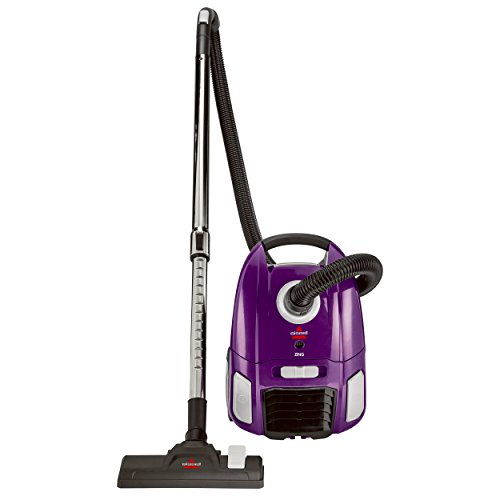
Bissell Zing Bagged Canister Vacuum, 2154A — Best Compact
The Zing bagged canister (model 2154A — check those digits, because the 2156A twin is bagless) is Bissell’s small-home answer: a compact, lightweight canister that stores in a closet corner, carries by its handle from room to room, and keeps the sealed-bag dirt path that defines this guide. It is built for the quick, frequent clean — crumbs under the high chair, litter tracked from the box, the entryway grit that appears daily — in homes where a full-size machine would simply not come out for jobs that small. The canister format gives it hard-floor manners and stair reach that a stick vacuum at this tier rarely matches, and the bag means the quick clean does not end with the not-quick ritual of bin washing.
Strengths
- Compact bagged canister that stores almost anywhere, even a small closet
- Lightweight carry for apartments, stairs, hallways, and quick spot-cleaning rounds
- Model 2154A is the verified bagged version of the Zing line
Trade-offs
- Small machine, small bags — active homes will change bags more often
- Not built for whole-house deep carpet cleaning sessions
- The near-identical bagless 2156A makes careful model checking essential when reordering
Spec box: Format: bagged canister, compact | Model: 2154A (bagged version, as listed)
Think of the Zing as the vacuum equivalent of the countertop appliance you use daily versus the stand mixer you use monthly. It will not deep-clean a carpeted family room the way the Kenmore or Simplicity uprights will, and it does not pretend to. What it does is collapse the distance between “I should vacuum that” and done — and in a small home, that frequency is worth more than peak power. Pair it with disciplined bag stocking, since small bags fill faster, and it becomes the hardest-working modest appliance in the closet.
Best for: apartments, small homes, and as a lightweight second vacuum. / Not suited for: large homes or deep-carpet primary cleaning.
Check the current price on Amazon
Read the table below with one caution in mind: the filtration column reproduces each listing’s own wording deliberately. “HEPA filter,” “HEPA Media,” and “Certified HEPA” appear side by side because the manufacturers wrote them that way, and flattening them into a single checkmark would hide exactly the difference a careful buyer is paying to understand. Use the table to shortlist by format and filtration tier, then read the full review of your finalist before deciding — the strengths and trade-offs sections carry the ownership details a table cannot.
Comparison Table
| Pick | Badge | Key spec | Best for |
|---|---|---|---|
| Miele Guard L1 Allergy | Best Overall | Bagged canister, HEPA filter (as listed) | Mixed floors, long-term ownership |
| Kenmore Intuition BU4022 | Best Upright | Bagged upright, 2 motors, lift-up pod, HEPA filter | Carpet and pet homes |
| Simplicity S20EZM | Best Filtration Focus | Bagged upright, Certified HEPA (as listed) | Dust-sensitive households |
| Oreck HEPA Upright | Best Lightweight | Bagged upright, HEPA Media, 2 speeds | Multi-level homes, easy carrying |
| Eureka 3670H | Best Budget | Bagged canister, 2 bags included, blower function | Small homes, cars, garages |
| Bissell Zing 2154A | Best Compact | Bagged canister, compact format | Apartments and quick cleanups |
How to Choose the Best Vacuums Not Bagless
Decide format first. Uprights put the weight and the brush roll in one pushed unit, which makes them the natural deep-carpet tool and the simpler storage proposition. Canisters split the machine into a trailing body and a light wand, which makes them better on hard floors, stairs, furniture, and anywhere you clean with reach rather than with passes. Most mixed-floor homes are happier with a canister; most carpet-dominant homes are happier with an upright. Neither is a compromise pick — they are different tools that happen to share a bag.
Second, read the filtration wording like a contract. Listings in this category use distinct tiers — a HEPA filter, HEPA Media, Certified HEPA — and those phrases are not synonyms, even though marketing would love you to treat them as such. This guide preserves each model’s exact wording so you can compare like with like. Whatever tier you choose, the bag itself is doing the first and largest share of the filtering work, which is why the whole category appeals to dust-sensitive households in the first place.
Third, price the consumable honestly. Bags are a per-year cost that varies by machine and by how much dirt your home generates — pet homes fill bags faster, small canisters fill small bags faster. Check that your model’s bags are commonly stocked and buy a multi-pack with the machine; a bagged vacuum with no spare bag in the closet is a bagless vacuum with extra steps, waiting to happen at the worst moment.
Fourth, match the machine to your dirt. Pet hair wants brush-roll access and above-floor tools. Hardwood wants a floor head that will not scatter or scratch. Stairs want either a lift-up pod, a canister’s reach, or a machine light enough to carry. Allergies want the sealed path and the strongest filtration wording you can verify. Write your home’s actual dirt profile in one sentence before shopping, and let it veto machines that do not fit — the best vacuum here is the one whose strengths point at your floors.
Bagged vs Bagless: The Honest Trade-Off
Bagless machines won the market on a visible promise — no bags to buy — and a visible pleasure, watching the bin fill. Their costs are quieter: emptying stirs the finest dust back into the air at the exact moment you are closest to it; foam and pleated filters need washing, drying, and eventual replacement; and suction depends on seals, shrouds, and bins that owners maintain imperfectly. Bagged machines invert the ledger. The consumable is real money, spent forever. In exchange, capacity is measured in weeks, emptying is a closed-bag lift-and-drop, the filter you rely on most is factory-fresh with every bag change, and performance on day three hundred looks like performance on day three. Neither architecture is morally superior. But the shoppers this guide serves have usually already lived the bagless side of the ledger and priced it honestly — which is why they typed “not bagless” into the search bar.
How to Get the Most From a Bagged Vacuum
- Step 1: Learn your bag type on day one — write it on a note inside the closet door, and order a multi-pack before the included bags run out.
- Step 2: Change the bag when the indicator says so or when suction first softens, not when the bag is packed solid; an overfilled bag strangles airflow and strains the motor.
- Step 3: Seat each new bag fully on its collar or dock. A half-seated bag leaks dust into the motor compartment — the one mess a bagged machine can make.
- Step 4: Check the brush roll monthly on uprights: cut away wound hair, and confirm the belt (where fitted) is intact.
- Step 5: Inspect post-motor and exhaust filters on the schedule your manual sets; the bag does most of the work, not all of it.
- Step 6: Store the machine with the cord loosely coiled and bags stocked beside it — the whole ownership advantage of this format is that upkeep takes minutes per month.
Common Buying Mistakes
- Buying the bagless twin. Several lines sell near-identical bagged and bagless models under adjacent numbers — the Zing 2154A versus 2156A in this very guide. Verify the exact model before ordering.
- Treating all HEPA wording as equal. HEPA filter, HEPA Media, and Certified HEPA are different statements. Read the listing’s exact tier and compare like with like.
- Ignoring bag economics. A bargain machine whose bags are scarce or costly can outspend a better machine within two years. Check bag availability and multi-pack pricing first.
- Overfilling bags to “save money.” A packed bag costs suction, strains the motor, and can leak at the collar — the false economy of this category.
- Choosing format by habit. Buying another upright for a hard-floor home, or a canister for wall-to-wall carpet, repeats the mismatch that made vacuuming feel like a chore.
- Forgetting above-floor cleaning. Baseboards, stairs, upholstery, and vents are half the job. Confirm the machine’s reach and tools match your home before the floors seduce you.
Final Recommendation
For most mixed-floor homes, the Miele Guard L1 Allergy is the bagged format at its best and the safest long-term buy. Carpet-and-pet households should take the Kenmore Intuition and its lift-up pod; dust-sensitive readers who want an upright should take the Simplicity S20EZM and its Certified HEPA listing. If weight rules your decision, the Oreck is the easy carry; if budget rules it, the Eureka 3670H is the sound cheap machine; and apartment dwellers should look hard at the Bissell Zing 2154A. Whichever you choose, order a multi-pack of the correct bags in the same basket, and check the current price on Amazon before you check out.
A last word on expectations: switching to a bagged machine will not make vacuuming fun, and no honest guide should promise that. What it changes is the texture of the chore — no dust bloom at the trash can, no filter drying on the counter, no slow fade in performance that you blame on the floors. The six machines above were chosen to deliver that change at every format and tier this category honestly offers, from a budget canister that costs less than a family dinner out to a premium machine built for a decade of Saturdays. Pick by your floors, stock the bags, and let the format’s quiet competence make its own case over the first month.
Related guides in this vacuum series: Best Bagged Vacuums For Allergies, Best Bagged Vacuums For Carpet And Hardwood, Best And Lightest Miele Vacuums, Best Bissell Canister Vacuums, and Best Economical Canister Vacuums.
Matching a Bagged Vacuum to Your Home
The right pick sharpens when you describe your home before your preferences. The hard-floor apartment with two area rugs wants a compact canister — the Zing or the Eureka — because the cleaning is mostly smooth surfaces, the storage is a closet corner, and the sessions are short and frequent. The carpeted family home with a dog wants the Kenmore Intuition: brush-roll aggression for the carpet, a lift-up pod for the stairs the dog also owns, and a bag big enough that pet hair does not turn bag changes into a weekly event. The dust-sensitive home wants the filtration wording first and the format second — the Simplicity’s Certified HEPA listing in upright form, or the Miele’s sealed canister system — and should treat bag discipline as part of the appliance, changing on the indicator without exception. The multi-level home whose owner is done carrying heavy machines wants the Oreck, accepting gentler deep-carpet performance in exchange for a vacuum that actually makes the trip upstairs. The large mixed-floor home that keeps appliances for a decade wants the Miele, because build quality compounds over years of weekly use in a way that features cannot. Notice that none of these answers is “the most powerful” or “the most expensive” — each is a fit between a dirt profile, a floor plan, and a human who has to push the thing. That fit, not spec-sheet supremacy, is what makes one of these six machines the right one for a given reader.
Two-home and second-vacuum scenarios deserve a word, because bagged canisters dominate them. A compact bagged canister at a holiday home, a rental you maintain, or an elderly parent’s house offers a specific mercy: it can sit unused for weeks and work perfectly the moment it is switched on, with no bin of old dust fermenting inside and no filter left damp from a hurried wash. Landlords and cleaners who supply machines to others reach for the same format for the same reason — the maintenance state of a bagged vacuum is visible at a glance (bag full or not), while a bagless machine’s true state hides in its filters. If you are equipping a space you do not personally clean every week, weight that reliability heavily.
The Real Cost of Bags, Priced Honestly
Since the bag is this format’s one recurring cost, it deserves arithmetic instead of vibes. A typical household changes bags somewhere between monthly and quarterly depending on machine size and dirt load; pet homes and small canisters sit at the frequent end, large canisters in adult-only homes at the relaxed end. Multi-packs bring the per-bag cost down substantially versus single bags bought in a panic, which is why this guide keeps repeating the stocking advice — it is the difference between bags as a trivial line item and bags as an irritating errand. Set against that cost are the bagless expenses people forget to count: replacement filters on their stated cycles, the occasional bin or seal replaced after a drop, and the owner’s time spent washing, drying, and picking clean the parts a bagged machine simply does not have. Neither ledger is zero. The bagged ledger is just predictable — a known consumable, bought in bulk, changed in seconds — and for many households predictability is the entire point. Buy the machine whose bags are easy to source, stock them like you stock detergent, and the format’s only real disadvantage shrinks to a rounding error in the household budget.
Your First Month With a Bagged Vacuum
The first month teaches you the format’s rhythm, and a little attention then pays off for years. In week one, vacuum your highest-traffic room and note how the machine feels with a factory-fresh bag — that is your suction baseline, the reference point that will later tell you a bag is filling long before any indicator does. Check the bag compartment after the first few sessions just to learn how fast your home’s dirt accumulates; pet homes are routinely surprised, in both directions. In week two, practice the above-floor routine — stairs, a sofa, one set of baseboards — while the manual is still nearby, because tools you have never fitted are tools you will never use. In week three, do the brush-roll check on uprights and the filter glance on canisters, not because they need it yet but because the habit forms now or never. By week four, order your first multi-pack of bags if you have not already; the correct moment to learn your bag type is while the machine still works, not on the day it stops picking up. Owners who run this small onboarding end up in the format’s happy majority — people who describe their vacuum, accurately, as the appliance they never think about. That invisibility is the product you actually bought.
A note on storage and households with helpers: if anyone else will use the machine — a partner, a teenager, a cleaner — show them the bag indicator and where the spares live. Bagged vacuums fail socially more often than mechanically: someone runs the machine for a month on a packed bag because nobody mentioned it, then reports that the expensive vacuum “doesn’t pick up anymore.” A thirty-second orientation prevents the only common complaint this format generates.
Reading a Bagged Vacuum Listing Without Getting Fooled
This category rewards skeptical reading, because the difference between the machine you want and its opposite can hide in two characters of a model number. First, confirm the word “bagged” — or an explicit statement that the machine uses disposable bags — in the listing itself, not in a review, a Q&A answer, or a comparison chart, all of which routinely mix sibling models. Second, separate the filtration tiers with your eyes open: a listing that says “HEPA Media” is making a different claim from one that says “Certified HEPA,” and a listing that says neither is telling you something too. Third, find the bag type — usually a letter or a short code — and search for it before you buy the machine; a vacuum whose bags return pages of in-stock multi-packs is a safe ownership bet, while a vacuum whose bags return scarcity is a future headache at any purchase price. Fourth, distinguish included bags from the machine’s capacity claims; “ships with two bags” is a starter supply, not a specification. Fifth, be wary of marketplace listings that photograph one model and ship another — the Zing twins in this guide are the standing example, and the defense is simply to match the model number on the box to the model number on your order the day it arrives. None of this requires expertise; it requires the same five minutes of literal reading this guide applied when it excluded every bagless sibling from the picks above.
Frequently Asked Questions
Are bagged vacuums really better for allergies?
The mechanism is straightforward: dirt leaves the home inside a sealed bag rather than being shaken out of a bin, and the bag’s large surface filters the air path without depending on a washed foam filter. Models in this guide add their own listed filtration tiers on top — read the exact wording per model, since the tiers genuinely differ.
How often will I change the bag?
It depends on bag size, home size, and dirt load — pet homes fill bags fastest. The practical rhythm is to change on the machine’s indicator or at the first softening of suction, and to keep a multi-pack stocked so a full bag never tempts you into overfilling it.
Do bagged vacuums lose suction as the bag fills?
Far less than folklore suggests, because a bag presents a huge filtering surface compared with a bin filter. This is also why two homes can report completely different bag-change intervals for the same machine: fine dust loads a bag’s pores faster than coarse debris does, so a home with construction dust, fireplace ash, or heavy pet dander will move through bags more quickly than a home whose dirt is mostly crumbs and tracked-in grit. Suction stays consistent through most of the bag’s life and only falls as the bag approaches genuinely full — which is your cue to change it, not a design flaw.
Can a bagged vacuum handle pet hair?
Yes — two picks in this guide are explicitly pet-focused in their listings, the Kenmore Intuition with its HandiMate tool and the Simplicity S20EZM. The bag format is arguably kinder to pet homes, since hair and dander leave in a sealed bag instead of a dust cloud at the trash can.
What is the difference between the Zing 2154A and 2156A?
Exactly the subject of this guide: the 2154A is the bagged canister and the 2156A is the bagless one. Same family, adjacent numbers, opposite dirt systems — verify the model digits on the listing before ordering, every time.
Should I keep my bagless vacuum as a backup?
Many households do, and the division of labor usually settles itself: the bagless stick handles a thirty-second crumb emergency, and the bagged machine handles the real weekly clean, the stairs, and the deep carpet work. What owners consistently report is that the bagged machine’s share grows over time, because it is the one whose emptying nobody dreads. If storage forces a single choice, keep the machine that matches your floors and your dust sensitivity — for the readers of this guide, that is the bagged one.
Are bags for these machines easy to find?
For mainstream brands, yes — bags are stocked alongside the machines on Amazon and through vacuum retailers. Dealer brands like Simplicity run through specialist channels. Either way, confirm your exact bag type at purchase and stock a multi-pack; availability is a buying criterion, not an afterthought.
