Disclosure: airfryerkitchensupply.com is reader-supported. When you buy through links on our site, we may earn an affiliate commission at no extra cost to you.
Where to buy
Every linked pick in this guide to the best robot vacuums for dog hair was confirmed before it earned a link. Dog hair is a consumables game as much as a suction game, so check price on Amazon from the picks below and factor in bags, brushes and filters when you compare — no static prices are printed here.
- roborock Q5+ Robot Vacuum with Self-Empty Dock — Check the current price on Amazon
- Shark AV2501S AI Ultra Robot Vacuum with Self-Empty Base — Check the current price on Amazon
- Shark Matrix Plus Robot Vacuum & Mop Combo (AV2610WA) — Check the current price on Amazon
- iRobot Roomba 105 Vac with AutoEmpty Dock — Check the current price on Amazon
- Roborock Q7 L5 Robot Vacuum and Mop Combo — Check the current price on Amazon
- eufy C10 Robot Vacuum, Self-Emptying — Check the current price on Amazon
The best robot vacuums for dog hair are not simply the robots with the biggest suction numbers. Dog hair defeats robot vacuums in specific, predictable ways: it wraps around brushrolls until they stall, it fills small dustbins by Tuesday, it mats into carpet edges where weak navigation never goes, and it hides under sofas in tumbleweed form. A robot that survives a shedding dog needs an anti-tangle or self-cleaning brush story, a bin strategy — ideally a self-empty dock — and navigation that covers the room methodically instead of bouncing around the easy middle.
That is why every pick in this guide has a self-empty dock except the one deliberate exception, and why the verified listing titles here keep repeating the same phrases: pet hair, anti-tangle, self-empty, LiDAR mapping. Those are not marketing decorations on this category; they are the difference between a robot that genuinely takes over floor duty in a dog household and a robot that becomes a hair-wrapped ornament you have to rescue and clean more often than your old vacuum.
One expectation to set honestly at the start: a robot vacuum maintains floors, it does not deep-clean them. Run daily, the picks below keep visible dog hair at near zero and stop it migrating into corners, bedding and clothes. The full-size vacuum still comes out occasionally for stairs, upholstery and a seasonal deep clean. Owners who understand that division of labour love these machines; owners who expect a robot to replace every other cleaning tool are the ones who return them.
There is also a dog in this equation, not just hair. Most dogs habituate to a robot within days when runs are scheduled predictably and the machine never chases them; a minority remain anxious, and for them the answer is scheduling runs during walks rather than returning an otherwise perfect cleaner. Puppies should be supervised around any new robot for the first weeks, partly for the puppy’s confidence and partly because puppies produce exactly the floor incidents a robot must never meet alone. None of the picks here is marketed as a pet, a toy or a companion for your dog — it is an appliance that happens to make living with a dog measurably cleaner, and that is quite enough.
In this guide
Quick Picks
Six verified robots chosen for hair warfare: two Roborock anti-tangle specialists, two Shark self-empty systems built around pet hair, a Roomba with a 75-day dock, and a slim eufy that slides under furniture where dog hair retires to.
- Best Overall: roborock Q5+ Robot Vacuum with Self-Empty Dock — the balanced benchmark for dog homes: self-emptying for up to seven weeks per its title, 180 minutes of runtime, and explicit pet-hair positioning for hard floors and carpets. — Check on Amazon
- Best Bagless Self-Empty: Shark AV2501S AI Ultra Robot Vacuum with Self-Empty Base — a bagless 30-day self-empty base with HEPA filtration, Matrix Clean passes and home mapping, positioned in its title as perfect for pet hair. — Check on Amazon
- Best Vacuum-Mop Combo: Shark Matrix Plus Robot Vacuum & Mop Combo (AV2610WA) — the full Shark stack: 60-day self-emptying, anti-hair-wrap brushroll, LiDAR mapping and sonic mopping for the paw-print layer vacuuming leaves behind. — Check on Amazon
- Best for Roomba Loyalists: iRobot Roomba 105 Vac with AutoEmpty Dock — the current entry Roomba with a dock that self-empties for up to 75 days per its title, LiDAR navigation and a stated 7,000Pa suction figure. — Check on Amazon
- Best Anti-Tangle Specialist: Roborock Q7 L5 Robot Vacuum and Mop Combo — a dual anti-tangle system and a stated 8,000Pa suction figure, with LiDAR and multi-level mapping — the pick when hair wrapping is your personal enemy. — Check on Amazon
- Best for Under-Furniture Hair: eufy C10 Robot Vacuum, Self-Emptying — a 2.85-inch slim self-emptying robot — eight weeks hands-free per its title — that reaches the under-sofa hair reserves taller robots cannot. — Check on Amazon
How These Picks Were Chosen
Candidates were searched by brand and model account. To qualify, a robot’s returned listing title had to speak to the dog-hair brief directly — pet-hair positioning, anti-tangle or self-cleaning brush design, self-empty capacity, or some combination — because generic robots with none of those features clog and fill exactly as fast as you would predict. Combo vacuum-and-mop models were included only where their vacuum side carries the pet-hair features; the mop is a bonus, never the reason for inclusion.
Suction figures quoted below (in pascals, Pa) come from the verified listing titles and are manufacturer figures measured under their own conditions; they are useful for ranking within a brand’s line and rough comparison across brands, not as laboratory truth. Self-empty day counts are likewise manufacturer estimates based on typical household debris — a double-coated dog in spring shedding season will fill any dock faster than the box suggests, and this guide says so wherever a day count appears. Prices and ratings from the listing were internal sanity checks only and are never printed.
The judging criteria, in order, were: hair handling (brush design and bin or dock capacity), navigation quality (LiDAR mapping beats random bouncing in hairy homes because edges and under-furniture zones are where hair lives), runtime and recharge behaviour, and the consumables picture — bags, filters and brush replacements you will actually buy over the robot’s life.
The 6 Best Robot Vacuums for Dog Hair
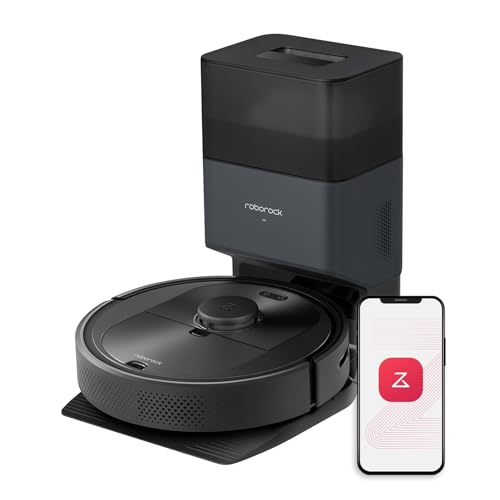
roborock Q5+ Robot Vacuum with Self-Empty Dock — Best Overall
The Q5+ is the robot that defined this category’s sensible middle: a competent vacuum, a bagged self-empty dock rated in the title at up to seven weeks hands-free, and a runtime figure of 180 minutes that covers large, hairy floor plans without a recharge break. Its title says “perfect for hard floors, carpets, and pet hair” outright, and the product’s long production run backs the claim with an ecosystem of bags, filters and brushes that remain easy to source.
Its 2,700Pa maximum suction figure looks modest next to newer flagships shouting five-figure pascal counts, and this is where dog-hair reality corrects spec-sheet thinking. Hair pickup is mostly about brush contact, airflow path and coverage discipline, not raw suction theatre: a methodical robot with a well-sealed bin collects more hair in a week of daily runs than a stronger robot you only run when the tumbleweeds become embarrassing.
Strengths
- Self-empty dock rated up to 7 weeks in the title — the core dog-hair convenience
- 180-minute maximum runtime stated in the title covers big floor plans in one run
- Mature platform: bags, filters and brushes are widely stocked
Trade-offs
- Vacuum only — no mopping function on this model
- Suction figure is modest beside newer flagships, even if real-world hair pickup is strong
- Dock bags are an ongoing consumable cost to budget for
| Detail | What the listing confirms |
|---|---|
| Self-empty | Dock, hands-free up to 7 weeks — stated in the Amazon title (manufacturer estimate) |
| Suction | 2,700Pa max — stated in the Amazon title (manufacturer figure) |
| Runtime | 180 minutes max — stated in the Amazon title |
| Positioning | Hard floors, carpets and pet hair; Alexa compatible — per the Amazon title |
Buy the Q5+ if you want the category’s proven answer without paying flagship money for mopping theatre you may not use. Its honest limitation is that it is a previous-generation platform: mapping and obstacle handling are good rather than state of the art, so pick up cables, socks and dog toys before a run, as you should with any robot. In exchange you get the exact feature stack that matters for dog hair, from a line with years of filter and bag availability ahead of it. For most single-dog and two-dog homes, this is the recommendation to beat.
Best for: most dog households wanting proven self-empty convenience and long runtime / Not suited for: buyers who want vacuum-and-mop in one machine, or the newest obstacle-avoidance cameras

Shark AV2501S AI Ultra Robot Vacuum with Self-Empty Base — Best Bagless Self-Empty
Shark’s difference is the bagless base. Where bagged docks charge you a small toll every month or two forever, the AV2501S base holds a stated 30 days of debris with HEPA filtration and empties like a regular vacuum canister. In a heavy-shedding household that fills docks faster than manufacturer estimates assume, skipping the bag subscription is a genuine economic argument, not a gimmick.
On the floor, Matrix Clean makes multiple passes in a grid pattern rather than trusting a single sweep, which suits hair: the first pass lifts the surface layer, later passes catch what the brush flicked aside. Add home mapping and a self-cleaning brushroll philosophy that Shark builds its pet marketing around, and the package is coherent — every headline feature points at the same enemy.
Strengths
- Bagless self-empty base: no dock bags to buy, HEPA filtration in the base per the title
- 30-day capacity stated in the title
- Matrix Clean multi-pass pattern suits hair pickup; home mapping included
Trade-offs
- 30 days is a manufacturer estimate — a shedding-season double coat will shorten it
- Emptying a bagless base is a dustier job than swapping a sealed bag
- Vacuum only; the mopping sibling is the Matrix Plus below
| Detail | What the listing confirms |
|---|---|
| Self-empty | Bagless base, 30-day capacity, HEPA — stated in the Amazon title (manufacturer estimate) |
| Navigation | Matrix Clean, home mapping — stated in the Amazon title |
| Positioning | “Perfect for Pet Hair” — per the Amazon title |
| Connectivity | WiFi — stated in the Amazon title |
Choose the AV2501S if the bagged-dock business model irritates you or your dog sheds enough to make bag costs a real line item. Its honest limitation is the emptying moment itself: tip a month of hair and dander into the bin and some of it becomes airborne again, which allergy-sensitive households may reasonably prefer to keep sealed inside a bag. Everyone else gets the lowest running-cost self-empty system in this guide, from the brand that has specialised in pet-hair floor care longer than most.
Best for: heavy shedders and bag-fee sceptics wanting low running costs / Not suited for: buyers who want debris sealed in a bag for cleaner disposal, or vacuum-mop combos

Shark Matrix Plus Robot Vacuum & Mop Combo (AV2610WA) — Best Vacuum-Mop Combo
Dog ownership produces two kinds of floor dirt: hair, which vacuums eat, and paw-borne grime, which they do not. The Matrix Plus is built for households tired of handling the second kind by hand. Its title stacks the relevant credentials: 60-day self-emptying, Matrix Clean navigation for carpet, hard floors and pet hair, HEPA filtration, sonic mopping, an anti-hair-wrap brushroll and LiDAR mapping.
Anti-hair wrap deserves its sentence, because hair wrapping is the maintenance task robot owners actually quit over. A brushroll that actively resists wrapping converts the weekly scissor-and-swearing ritual into an occasional check, and in a dog home that difference decides whether the robot is still in service in year two. The 60-day dock figure, as always here, is a manufacturer estimate that shedding season will tax.
Strengths
- Anti-hair wrap brushroll — the maintenance feature dog owners feel most
- 60-day self-empty capacity stated in the title (manufacturer estimate)
- Sonic mopping handles paw prints and dried dribbles between real mops
Trade-offs
- Combo complexity: mop pads need washing and the water routine adds chores back
- Largest running-cost picture here once pads, filters and parts are counted
- Mopping is maintenance-grade, not a substitute for a real mop after a muddy-paw incident
| Detail | What the listing confirms |
|---|---|
| Self-empty | 60-day self-emptying — stated in the Amazon title (manufacturer estimate) |
| Brush | Anti-hair wrap — stated in the Amazon title |
| Navigation | Matrix Clean, LiDAR mapping — stated in the Amazon title |
| Mopping | Sonic mopping — stated in the Amazon title |
Buy the Matrix Plus if your floors are mostly hard surfaces and your dog brings the outdoors in on its feet daily. Its honest limitation is chore displacement rather than chore deletion: pads, tanks and dock still need human attention on a rhythm, just a lighter one than manual cleaning. Households with mostly carpet should save the premium and take the Q5+ or the AV2501S; households with muddy paw traffic on tile and laminate will feel this machine earn its place within the first week.
Best for: hard-floor homes with muddy-paw traffic wanting vacuum and mop in one robot / Not suited for: mostly carpeted homes, or buyers wanting the simplest possible maintenance routine

iRobot Roomba 105 Vac with AutoEmpty Dock — Best for Roomba Loyalists
The Roomba 105 Vac with AutoEmpty Dock is iRobot’s answer to the self-empty era, and its title leads with the dock: self-emptying for up to 75 days, the longest hands-free figure among these picks — a manufacturer estimate, as with every day count in this guide, and one a shedding dog will shorten. Behind it sits LiDAR navigation, multi-surface cleaning and a stated 7,000Pa power-lifting suction figure.
Roomba’s enduring advantage is ecosystem gravity: parts, bags and support knowledge for iRobot machines exist everywhere, and the brand’s carpet behaviour — the way its extractors work hair out of pile — has been refined over more generations than any rival can claim. The 105 brings that heritage into the LiDAR-and-dock format the market now expects.
Strengths
- Self-empties for up to 75 days per the title — the longest dock interval here (manufacturer estimate)
- LiDAR navigation and multi-surface cleaning stated in the title
- iRobot’s parts and support ecosystem is the deepest in the category
Trade-offs
- Title does not headline anti-tangle brush tech; check the brush design on the listing if your dog’s hair is long
- Dock uses bags — an ongoing consumable, as with the Roborock
- Newer platform than the Q5+, so its long-term track record is still being written
| Detail | What the listing confirms |
|---|---|
| Self-empty | AutoEmpty Dock, up to 75 days — stated in the Amazon title (manufacturer estimate) |
| Suction | 7,000Pa power-lifting suction — stated in the Amazon title (manufacturer figure) |
| Navigation | LiDAR navigation, multi-surface cleaning — stated in the Amazon title |
Choose the 105 if you trust iRobot’s carpet heritage and want the longest dock interval on this page. Its honest limitation, for this specific keyword, is that its listing title sells suction and dock days rather than brush-level hair engineering; owners of long-haired breeds should inspect the extractor design on the listing and plan on the standard brush-check rhythm. For short-to-medium coats and mixed floors, the combination of LiDAR discipline and a 75-day dock is a strong, low-effort package.
Best for: Roomba loyalists and mixed-floor homes wanting the longest self-empty interval / Not suited for: long-haired-breed owners who want anti-tangle technology headlined and confirmed

Roborock Q7 L5 Robot Vacuum and Mop Combo — Best Anti-Tangle Specialist
The Q7 L5’s title names the feature this search cares about most after the dock: a dual anti-tangle system, attacking hair wrap at both the main brush and the side brush. Side-brush tangles are the quiet failure mode of cheaper robots — hair winds there first, the brush stops sweeping edges, and corners quietly become hair storage. Designing against both wrap points is the correct engineering priority for dog homes.
Around that system sits a modern Roborock platform: a stated 8,000Pa suction figure (manufacturer number, as always), LiDAR navigation, multi-level mapping for multi-storey homes, and a mop function riding along as a bonus. Note what the title does not claim: there is no self-empty dock in this listing. The bin is yours to empty, which is the deliberate trade this pick makes.
Strengths
- Dual anti-tangle system covering main and side brushes — stated in the title
- 8,000Pa stated suction figure, the highest among the non-flagship picks here
- LiDAR navigation with multi-level mapping for multi-storey homes
Trade-offs
- No self-empty dock in this listing — you empty the bin yourself, often, in shedding season
- Mop function is maintenance-grade, as with all combos here
- Anti-tangle reduces wrapping; it does not repeal brush checks entirely
| Detail | What the listing confirms |
|---|---|
| Brush system | Dual anti-tangle system — stated in the Amazon title |
| Suction | 8,000Pa — stated in the Amazon title (manufacturer figure) |
| Navigation | LiDAR, multi-level mapping — stated in the Amazon title |
| Dock | Self-charging only; no self-empty dock stated in the Amazon title |
Buy the Q7 L5 if brush maintenance has killed your previous robots and you would rather empty a bin than perform brush surgery — a rational trade many long-haired-breed owners will recognise. Its honest limitation is exactly that bin: in peak shedding, expect to empty it every run or two, which is why dock-equipped rivals rank above it for hands-off ownership. As a cleaning machine per dollar of suction and anti-tangle engineering, though, it is the sharpest tool in this guide, and multi-storey homes get mapping that follows them upstairs.
Best for: long-haired breeds and multi-storey homes prioritising anti-tangle design / Not suited for: buyers whose first requirement is weeks of hands-free emptying

eufy C10 Robot Vacuum, Self-Emptying — Best for Under-Furniture Hair
Every dog owner knows where the hair really lives: under the sofa, under the bed, under the low cabinet — precisely the places a tall robot with a LiDAR turret cannot enter. The C10’s answer is a 2.85-inch slim body stated in its title, trading turret height for access, while still offering LiDAR-based smart mapping, a self-empty station rated at eight weeks hands-free, and an edge expansion brush aimed at pet hair along skirting boards.
That edge brush matters more than it sounds. Hair migrates to edges and corners by air current and foot traffic, and a robot that cannot work its edges leaves a visible hair tide-line around every room. An expanding side brush that reaches into the corner line is a direct answer to the most visible failure of robot cleaning in pet homes.
Strengths
- 2.85-inch slim body reaches under low furniture where hair accumulates
- Self-emptying, 8 weeks hands-free stated in the title (manufacturer estimate)
- Edge expansion brush for pet hair, plus carpet detection — stated in the title
Trade-offs
- Slim bodies carry smaller onboard bins between dock visits
- Eight weeks assumes typical debris; shedding season compresses it
- Suction is described as “powerful” without a figure in the title — no number is claimed here
| Detail | What the listing confirms |
|---|---|
| Height | 2.85 inches — stated in the Amazon title |
| Self-empty | 8 weeks hands free — stated in the Amazon title (manufacturer estimate) |
| Navigation | LiDAR smart mapping, carpet detection — stated in the Amazon title |
| Brush | Edge expansion brush for pet hair — stated in the Amazon title |
Choose the C10 if your home’s hair problem is visibly an under-furniture and edges problem — low sofas, platform beds, long skirting runs. Its honest limitation is capacity physics: slim and small-bin go together, so the dock does the heavy lifting and bag or bin costs should be checked on the listing before you commit. For apartments and smaller homes especially, the access advantage is not a niche benefit; it is the difference between a robot that cleans where the hair is and one that cleans where the hair is not.
Best for: homes with low furniture and long skirting runs where hair hides at the edges / Not suited for: very large homes wanting maximum onboard capacity between dock visits
Comparison Table
| Pick | Badge | Key spec | Best for |
|---|---|---|---|
| roborock Q5+ Robot Vacuum with Self-Empty Dock Check on Amazon | Best Overall | Self-empty up to 7 weeks, 180-min runtime, pet-hair positioning | most dog households wanting proven self-empty convenience and long runtime |
| Shark AV2501S AI Ultra Robot Vacuum with Self-Empty Base Check on Amazon | Best Bagless Self-Empty | Bagless 30-day HEPA base, Matrix Clean, pet-hair positioning | heavy shedders and bag-fee sceptics wanting low running costs |
| Shark Matrix Plus Robot Vacuum & Mop Combo (AV2610WA) Check on Amazon | Best Vacuum-Mop Combo | 60-day self-empty, anti-hair wrap, sonic mopping, LiDAR | hard-floor homes with muddy-paw traffic wanting vacuum and mop in one robot |
| iRobot Roomba 105 Vac with AutoEmpty Dock Check on Amazon | Best for Roomba Loyalists | 75-day AutoEmpty dock, 7,000Pa stated, LiDAR navigation | Roomba loyalists and mixed-floor homes wanting the longest self-empty interval |
| Roborock Q7 L5 Robot Vacuum and Mop Combo Check on Amazon | Best Anti-Tangle Specialist | Dual anti-tangle, 8,000Pa stated, LiDAR multi-level mapping, no dock | long-haired breeds and multi-storey homes prioritising anti-tangle design |
| eufy C10 Robot Vacuum, Self-Emptying Check on Amazon | Best for Under-Furniture Hair | 2.85-in slim, 8-week self-empty claim, edge brush for pet hair | homes with low furniture and long skirting runs where hair hides at the edges |
How to Choose the Best Robot Vacuums for Dog Hair
Start with the hair, not the robot. Short, stiff hair (Labrador, Beagle, most short coats) behaves like grit: it works into carpet pile and needs brush agitation plus disciplined coverage. Long, fine hair (Collies, Retrievers, spaniels, double coats in blow-out season) behaves like thread: it wraps brushes and fills bins. Short-hair homes should prioritise mapping quality and dock capacity; long-hair homes should prioritise anti-tangle design first and accept more frequent bin or brush attention. Every pick here states which side of that line it was built for.
The dock decision is the budget decision. Self-empty docks convert daily bin-emptying into a monthly bag or canister task, at the price of consumables (bags) or dustier manual emptying (bagless). The day counts in titles — 30, 60, 75 days, seven or eight weeks — are manufacturer estimates for typical homes; a shedding dog in spring will beat every one of them, so treat the ranking as relative, not literal. If you skip the dock entirely, as with the Q7 L5 pick, do it consciously in exchange for better brush engineering, and set a phone reminder rather than relying on noticing a full bin.
Navigation is a hair feature. Random-bounce robots eventually cover a room but under-serve edges, corners and under-furniture zones — which is where hair accumulates. LiDAR mapping robots clean in ordered rows, return to docks reliably, support no-go zones around food bowls and water dishes, and let you send the robot to the specific room the dog has just shaken itself in. In a dog home, mapping is not a luxury tier; it is the difference between a system and a toy.
Finally, price the year, not the day. Bags, filters, side brushes, main brushes and mop pads form a predictable annual spend that differs meaningfully between these picks — bagless Shark at the low end, full combo systems at the high end. None of it is hidden; it is all on the listings. The cheapest robot to buy is regularly the most expensive robot to own, and dog hair accelerates every consumable on the list.
Living With a Robot in a Shedding House: The Routine That Works
Run the robot daily, on a schedule, whether the floors look dirty or not. Dog hair management is a flow problem: a daily pass removes hair before it mats, migrates and weaves itself into carpet edges, and five quiet daily runs beat one heroic weekend run on every measure including total hair collected. Schedule runs for when the dog is settled or out — most dogs habituate to a predictable robot quickly, and a predictable schedule is kinder to a nervous dog than surprise runs.
Prepare the floor like you mean it. Cables, socks, small toys and — above all — any accidents must be off the floor before a run. Every robot in this guide will spread a mess it drives through, and no obstacle system at any price is a guarantee against the one incident that will define your opinion of the product forever. A two-minute pre-run sweep of each room is the tax that makes the automation honest.
Empty and check on a rhythm, not on a failure. Dock bags or canisters monthly in shedding season, onboard bins every couple of runs on dockless models, and a brush glance fortnightly even on anti-tangle designs. Filters follow the manufacturer’s rhythm. Owners who keep this light rhythm report robots that work for years; owners who wait for error messages report robots that mysteriously “got worse,” when in fact they simply filled up.
Dog Hair by Floor Type: Carpet, Hardwood, Tile and Rugs
Hardwood and laminate are the robot’s home turf. Hair sits on the surface, airflow collects it cleanly, and the main risks are cosmetic: grit dragged under a wheel or a brush can mark delicate finishes over years, which is one more reason to keep brushes clean and runs frequent, so grit never accumulates into a grinding layer. On hard floors, edge performance decides the visible result — hair collects along skirting boards in a grey tide-line, and the picks with deliberate edge strategies (Shark’s multi-pass Matrix pattern, eufy’s expanding edge brush) earn their keep exactly there.
Low and medium pile carpet is where brush design proves itself. Hair weaves into pile and needs agitation to release; robots that detect carpet and boost effort there — carpet detection is stated in the eufy C10’s title, and multi-surface cleaning in the Roomba’s — handle the transition from rug to floor without your intervention. Deep pile and shag remain the honest limit of the category: brushes bog, suction seals poorly, and even the best robot merely skims. If your home is wall-to-wall deep pile, budget for the upright to remain a weekly tool rather than a seasonal one.
Tile and grout lines collect hair in the channels, where it mats with moisture into ropes that resist casual passes. Daily running prevents the matting stage entirely — hair collected dry, daily, never becomes the damp rope problem. This is also where the mopping combos justify themselves: the Matrix Plus’s sonic mopping lifts the paw-print film and the fine grey dust that vacuuming alone redistributes, turning a two-tool weekly routine into a robot’s daily one.
Loose rugs deserve a sentence of their own. Fringes tangle in brushes and side brushes, lightweight rugs get pushed into heaps, and dark rug patterns can confuse cliff sensors on some designs into treating the rug as a drop. The app-based fixes — no-go lines at fringes, or simply folding fringe under before a run — take a minute and save the run. None of this is a reason to avoid a robot in a dog home; it is the ordinary texture of owning one, and every pick here has the mapping tools to manage it once you tell the app where the trouble lives.
How to Set Up a Robot Vacuum for a Dog Household
Setup takes twenty minutes and decides whether the robot becomes infrastructure or clutter. Do it in this order, once, properly.
- Place the dock like a piece of furniture. Give the dock a permanent home on hard floor against a wall, with clear space in front and to the sides as the manual specifies. The robot must find it, dock and self-empty thousands of times; a dock wedged behind a door will generate a year of small failures.
- Map the home before you customise anything. Tidy floors, open doors, and let the robot complete a full mapping run. Then, in the app, name rooms and set no-go zones around water bowls, food stations, litter areas and the dog’s own bed if your dog objects to it being cleaned around.
- Schedule daily runs at dog-friendly hours. Pick times when the dog is typically calm, walked or out. Start by running it while you are home so the dog learns the robot is boring furniture that moves — the lesson nearly every dog learns within a week.
- Do the first week of bin checks daily. Whatever the dock’s day-count claims, check the bin or dock after each of the first several runs. You will learn your own dog’s real fill rate in shedding terms, and every maintenance interval you set afterwards will be based on evidence instead of box copy.
- Introduce brush and filter dates into your calendar. Create recurring reminders for brush checks, filter changes and bag or canister emptying at the intervals your first week suggested. The robot’s app will track some of this; your calendar is the backup that survives an app redesign.
- Keep the upright vacuum for its real jobs. Stairs, upholstery, car interiors and the dog’s bedding still belong to other tools. Letting the robot own the floors — only the floors — is what makes the arrangement feel like magic instead of compromise.
Follow that sequence and the robot disappears into the household routine within a fortnight, which is the highest praise any appliance in a dog home can earn.
Keep the dock’s surroundings boring thereafter: no shoes stored in its approach path, no dog toys migrating into its docking lane, and no furniture rearrangements without a fresh map. Robots are creatures of the map you gave them, and most “it suddenly stopped working” stories are, on inspection, “we moved the sofa” stories.
Common Buying Mistakes
Buying suction numbers instead of hair systems. A huge pascal figure on a robot with a wrapping brush and a thimble bin loses to a balanced system every shedding season. Hair is a handling problem before it is a power problem.
Believing dock day-counts literally. Thirty, sixty, seventy-five days are manufacturer estimates for average debris. Your dog did not read the estimate. Check early, learn your real interval, and plan bags accordingly.
Running the robot only when the floor looks bad. By the time hair is visible everywhere, it has already matted into edges and textiles. Daily scheduled runs are the entire strategy; a robot used reactively is an expensive ornament.
Skipping the pre-run floor check. One accident, one charging cable, one sock — each can end a run or spread a problem across three rooms. Two minutes of tidying is part of the product’s real operating cost; accept it and the system works.
Neglecting brushes because the marketing said anti-tangle. Anti-tangle means dramatically less wrapping, not zero maintenance. A fortnightly glance keeps the promise true; a year of neglect defeats any brush design ever shipped.
Expecting the robot to replace every vacuum you own. It replaces floor maintenance. Stairs, sofas, cars and deep cleans still need other tools, and buyers who demand everything from one robot end up disappointed with an excellent floor machine.
Final Recommendation
For most dog households, the roborock Q5+ remains the balanced answer: proven platform, seven-week dock, long runtime, honest pet-hair positioning. Bag-fee sceptics should take the Shark AV2501S and its bagless HEPA base; hard-floor homes with muddy paws should take the Matrix Plus and let sonic mopping handle the paw-print layer. Roomba loyalists get their ecosystem and the longest dock interval in the 105 Vac, long-haired-breed owners get the sharpest anti-tangle engineering in the Q7 L5, and low-furniture homes get under-sofa justice from the slim eufy C10.
Whichever you choose, commit to the daily schedule. In a shedding house, the best robot vacuum is not the strongest one — it is the one that runs every day, empties itself, and never asks you to cut hair off a brushroll at midnight.
A last, practical way to decide between the finalists: picture your dog’s worst shedding week, not its best. Which failure would annoy you most in that week — a full bin, a wrapped brush, a tide-line of hair along the skirting, or paw prints dried onto the kitchen tile? Each of those answers names a different pick in this guide, and choosing by your real worst week, rather than by the longest feature list, is how dog owners end up keeping and liking the robot they bought.
Shortlist again, with links: roborock Q5+ Robot Vacuum with Self-Empty Dock (Check on Amazon); Shark AV2501S AI Ultra Robot Vacuum with Self-Empty Base (Check on Amazon); Shark Matrix Plus Robot Vacuum & Mop Combo (AV2610WA) (Check on Amazon); iRobot Roomba 105 Vac with AutoEmpty Dock (Check on Amazon); Roborock Q7 L5 Robot Vacuum and Mop Combo (Check on Amazon); eufy C10 Robot Vacuum, Self-Emptying (Check on Amazon).
Related guides on this site: Best Robot Vacuums For Pet Hair And Berber Carpet; Best Robot Vacuum For Hardwood Floors And Area Rugs; Best Robot Vacuums For Bare Floors; Best Robot Vacuums For Tile Floors; Best Robot Vacuums For Dust; Best Air Purifiers For Dog Owners.
Frequently Asked Questions
How often should a robot vacuum run in a house with a shedding dog?
Daily is the honest answer. Hair is produced continuously and migrates constantly; a daily scheduled run keeps it at the surface where the robot collects it easily. In heavy shedding season, many owners run the main living areas twice a day. Less frequent running still helps, but it converts the robot from a maintenance system into a cleanup tool, and cleanup is the harder job.
Do self-empty docks really last as long as their day counts claim?
Treat every day count — 30, 60, 75 days, seven or eight weeks — as a manufacturer estimate for a typical home. A large dog in spring coat-blow can halve them. The counts are still useful for comparing models against each other, and any dock, even one you empty twice as often as promised, is dramatically less work than emptying a small onboard bin after every run.
Will a robot vacuum pick up dog hair from carpet, or only hard floors?
Both, with realistic expectations. Robots excel at surface hair on low and medium pile, especially with daily passes and good brush agitation — several picks here are positioned in their titles for carpets and pet hair explicitly. Deep-set hair in thick pile still needs an upright vacuum periodically. Hard floors are where robots look flawless; carpet is where they look very good, which for daily maintenance is enough.
What happens if the robot runs over a dog accident?
Nothing good, and no obstacle system in this guide is sold as a guarantee against it. Prevention is the routine: check floors before scheduled runs, use no-go zones around areas where accidents are likely, and run the robot when someone has recently been home. This is the most common real-world complaint about robot vacuums in pet homes, and it is a management issue, not a model choice.
Are anti-tangle brushes worth prioritising for long-haired dogs?
Yes — for long, fine coats they are the difference between a fortnightly glance and a weekly cutting session. The Roborock Q7 L5’s dual anti-tangle system and Shark’s anti-hair-wrap design exist precisely for this coat type. Short-haired breeds wrap brushes far less, so their owners can weight dock capacity and navigation more heavily instead.
Can a robot vacuum replace my regular vacuum entirely?
For floors, mostly — that is the point of the daily system. For stairs, upholstery, vehicles, mattresses and the occasional deep clean, no. Most satisfied dog owners keep an upright or a cordless stick for those jobs and report that total vacuuming effort still drops dramatically, because the largest, most frequent job — the floors — has been fully delegated.


