Disclosure: airfryerkitchensupply.com is reader-supported. When you buy through links on our site, we may earn an affiliate commission at no extra cost to you.
Where to buy
Vertical offset smokers are heavy steel freight items, and the verified selection on Amazon is smaller than in any other smoker category — a fact this guide states plainly rather than padding around. The links below reach the current listings of the models we could verify through Amazon’s catalog data; check price on Amazon, including freight terms, before deciding.
- Oklahoma Joe’s Bandera Smoker and Grill — check price on Amazon
- Dyna-Glo Wide Body Vertical Offset Charcoal Smoker — check price on Amazon
- Dyna-Glo Vertical Offset Charcoal Smoker — check price on Amazon
- Sophia & William Vertical Offset Charcoal Smoker — check price on Amazon
The best vertical offset smokers answer a very specific desire: the flavor of a traditional offset — meat cooked by the heat and smoke of a real wood or charcoal fire burning beside the food, never under it — in a chamber that stacks upward instead of sprawling sideways. A conventional offset smoker is a horizontal barrel with a firebox welded to one end, and it eats patio the way it eats firewood: generously. The vertical offset keeps the firebox-and-chamber separation but stands the cooking chamber on end, so heat and smoke rise from the firebox at the base, past rack after rack of meat, and out the top. You get offset character on a cabinet footprint.
Honesty about this category matters more than in most. The vertical offset is a niche design, and Amazon’s verifiable selection is thin: four current models earned links in this guide, and the final two slots are covered as unlinked entries describing the custom and specialist end of the market, because inventing listings to fill a table would serve nobody. What the category lacks in breadth it repays in character — these are fire-managed smokers for cooks who consider tending a fire part of the pleasure, and every pick below was verified against Amazon’s catalog.
In this guide
Quick Picks
- Best Overall — Oklahoma Joe’s Bandera: the original vertical offset, a design with decades of production behind it — a firebox below, a tall smoking chamber above, and the ability to grill in the firebox as well. Check the current price on Amazon
- Best Capacity — Dyna-Glo Wide Body Vertical Offset: a wide-body vertical offset chamber on a side firebox, built for cooks who fill every rack with ribs, butts and birds. Check the current price on Amazon
- Best Value — Dyna-Glo Vertical Offset: the standard-body version of Dyna-Glo’s vertical offset design, bringing genuine offset cooking to the category’s most accessible tier. Check the current price on Amazon
- Best Extra-Large — Sophia & William Vertical Offset: a heavy-duty vertical offset with about 961 square inches of cooking area, for the biggest cooks in this guide. Check the current price on Amazon
- Best Heavy-Gauge Custom — regional fabricator vertical offsets: thick-steel, often reverse-flow vertical offsets built by specialist welders; not sold as a standard Amazon listing, and covered here in prose for completeness.
- Best for Traditionalists on a Quest — secondhand and restored classic offsets: the used market for older heavy vertical offsets is real and rewarding for patient buyers; again, unlinked, because no verifiable listing exists to link.
How These Picks Were Chosen
Vertical offsets were judged as fire instruments. Steel thickness and build quality came first, because an offset’s temperature stability is substantially its mass: heavy steel absorbs the fire’s swings and returns steadiness, while thin steel transmits every gust and every fresh split straight to the meat. Second, the firebox — its size relative to the chamber, its air intake control and whether it can also grill, which on the Bandera is a genuine second talent. Third, the chamber’s sealing and rack layout: an offset that leaks smoke at every seam is burning flavor into the yard, and vertical chambers live or die on whether their racks are usable at every level. Fourth, the honesty test specific to this category: we verified every candidate, and models that could not be confirmed as current Amazon listings were not given links, however famous their names. Two slots are therefore deliberately unlinked, describing real segments of this market — custom fabricators and the secondhand trade — that a buyer should know exist even though no link can be honestly attached.
The 6 Best Vertical Offset Smokers
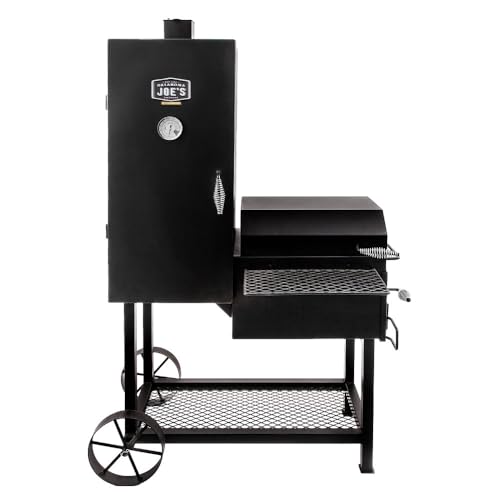
Oklahoma Joe’s Bandera — Best Overall
The Bandera is where the vertical offset story starts: Oklahoma Joe’s stood the offset upright decades ago, and the design’s longevity is itself a review. A firebox sits low with a charcoal grate that doubles as a direct grill, the tall chamber above it carries multiple racks, and the whole cooker runs on charcoal and wood chunks or splits with the attentive management offset cooking implies. It suits traditionalists who want authentic offset flavor without a horizontal pit’s footprint. It does not suit anyone seeking convenience — this is a fire you cook with, not an appliance you set.
Strengths
- The proven original: decades of production, a deep owner community and available parts and knowledge
- Firebox doubles as a grill, so the cooker sears as well as it smokes — two tools in one footprint
- Tall chamber with multiple racks handles briskets, ribs and birds in genuine offset style
Trade-offs
- Fire management is the cook’s job for the entire session — splits, vents and weather included
- Factory sealing on this class of cooker benefits from owner gasket work for best performance
- Steel is working-grade rather than the heavy plate of custom pits; temperature swings need managing
The Bandera’s enduring appeal is that it teaches and rewards the complete offset craft in a manageable size. You learn to build a coal bed, to feed it wood for smoke rather than flame, to read the chamber’s response to a vent change twenty minutes later — and the food that emerges carries the deep, clean smoke signature that no chip tray or pellet tube fully imitates. Owners modify them, compete on them and keep them for decades, which tells you the design’s bones are right. If the vertical offset idea attracts you at all, this is its reference implementation. Check the current price on Amazon
Best for: traditionalists who want authentic offset cooking on a small footprint / Not suited for: convenience seekers or unattended cooks

Dyna-Glo Wide Body Vertical Offset Charcoal Smoker — Best Capacity
Dyna-Glo’s Wide Body takes the vertical offset layout and stretches the chamber sideways, answering the standard design’s one real frustration: rack width. Ribs lie flatter, briskets fit with less negotiation, and the total capacity suits genuine gatherings. It suits batch cooks and rib specialists who want offset flavor at production scale. It does not suit small households, and like every offset here it demands a cook who tends fire.
Strengths
- Wide chamber fits full racks and big cuts more gracefully than standard vertical offsets
- Side firebox keeps the true offset cooking arrangement — no direct heat under the meat
- Capacity for event-scale cooks without moving to a horizontal pit
Trade-offs
- A bigger chamber means a bigger fire to manage and more fuel per cook
- Temperature can vary across a wide chamber; rack rotation is part of the craft
- Assembly and sealing attention at setup pay off for the cooker’s whole life
Capacity in an offset is not just about feeding more people; it is about cooking the same cuts better. A brisket that fits without touching walls cooks more evenly, and ribs that lie flat render more honestly than ribs bent into submission. The Wide Body buys that breathing room while keeping the firebox honest. For the cook whose offset ambitions are measured in full racks and whole packers, it is the natural step up from the standard body — with the understanding that a larger fire is a larger responsibility, every single cook. Check the current price on Amazon
Best for: rib and brisket cooks who need width as much as height / Not suited for: small households or hands-off cooks

Dyna-Glo Vertical Offset Charcoal Smoker — Best Value
The standard-body Dyna-Glo vertical offset is the category’s accessible door: a side firebox, a vertical chamber and genuine offset cooking at the friendliest tier we could verify. It suits beginners who are certain they want the offset craft — not smoking generally, this craft specifically — and cooks adding a flavor-focused second smoker. It does not suit anyone unsure about fire tending; a cheap offset owned by a reluctant fire-keeper is a garden ornament with a chimney.
Strengths
- True offset arrangement at the most accessible verified price point in this guide
- Vertical footprint keeps the patio cost of offset flavor low
- A long-sold design with the usual owner knowledge base around it
Trade-offs
- Thinner steel than premium cookers means closer fire attention in wind and cold
- Sealing and small modifications are part of the ownership bargain at this tier
- Chamber width is the standard body’s limit — big briskets negotiate
Value in an offset is a subtle thing, because the fire does most of the cooking and a modest cooker in skilled hands will out-smoke a premium pit in careless ones. This Dyna-Glo’s offer is the craft itself at a fair entry price: real offset airflow, real wood smoke, real learning curve. Expect to add gaskets, expect to watch it closely in bad weather, and expect the food — once you and the fire understand each other — to justify every bit of the attention. Check the current price on Amazon
Best for: committed beginners and value buyers entering offset cooking / Not suited for: the fire-tending-reluctant

Sophia & William Vertical Offset Charcoal Smoker — Best Extra-Large
The Sophia & William entry competes on scale: roughly 961 square inches of cooking area in a heavy-duty vertical offset format, aimed at cooks whose gatherings outgrew the standard body. It suits event cooks, large families and anyone smoking in quantity with real fire. It does not suit minimalists — a cooker this size consumes fuel and attention in proportion to its chamber.
Strengths
- About 961 square inches — the largest verified capacity in this guide
- Heavy-duty positioning for cooks who run big loads regularly
- True offset layout preserves the flavor character the category exists for
Trade-offs
- A newer name in the category, with a thinner long-term track record than Oklahoma Joe’s or Dyna-Glo
- Large chambers amplify the need for fire discipline and rack rotation
- Overkill, in fuel and footprint, for ordinary family cooks
Big offsets live or die on whether their owners actually cook big, and this one is honest about its audience. Run at capacity — racks loaded for a reunion, a freezer-filling weekend, a church cook — its size becomes efficiency, because one fire cooks what two smaller smokers would need two fires to produce. Run it for a single chicken and it is a monument. Buy it if your calendar genuinely contains the cooks it is built for. Check the current price on Amazon
Best for: event-scale cooks who fill racks every time / Not suited for: small households or occasional smokers
Heavy-Gauge Custom Vertical Offsets — Best for the Committed
Beyond the factory market sits the world this category’s enthusiasts eventually discover: regional fabricators and specialist builders who weld vertical offsets from heavy plate steel, often with reverse-flow baffling that routes smoke under and across the meat for exceptional evenness. We cover this tier without a link, deliberately — these cookers are built to order or sold through the builders’ own channels, and no standard Amazon listing exists that we could verify. Attaching an unverified link would be a disservice dressed as thoroughness.
Strengths
- Heavy steel transforms temperature stability — the fire’s swings are absorbed by mass
- Reverse-flow designs deliver the most even chamber temperatures in the offset world
- Built to order means dimensions, racks and features match the cook’s actual life
Trade-offs
- Premium-tier cost and waiting lists measured in months are normal
- Weight makes delivery, placement and any future move a logistics project
- Buying well requires research into individual builders rather than a brand comparison
Who is this tier for? The cook who has run a factory offset for years, knows exactly which of its compromises they resent — the thin steel in January, the hot spot by the firebox, the rack that almost fits — and wants them engineered away. Custom steel is the end of the upgrade path rather than its beginning, and it rewards buyers who arrive with experience. If that description fits, shop builders the way you would shop for a contractor: work seen in person, owners questioned, steel thickness and weld quality inspected. This is a premium-tier purchase by any measure, and patience is part of its price.
Best for: experienced offset cooks commissioning a lifetime cooker / Not suited for: beginners or the impatient
Secondhand and Restored Classic Vertical Offsets — Best for Patient Hunters
The final slot in this guide belongs to a market rather than a model: used vertical offsets. Heavy cookers outlive their owners’ interest, and classic Banderas and older heavy-gauge pits circulate through local marketplaces at prices that make patient buyers smile. Again, unlinked by necessity — a secondhand market cannot be linked, only explained.
Strengths
- Heavy older steel at prices factory-new budgets cannot touch
- Restoration — wire brush, high-heat paint, new gaskets and grates — is satisfying, bounded work
- A proven design bought used carries zero design risk; its reputation precedes it
Trade-offs
- Condition varies wildly; rust-through at the firebox is the disqualifier to inspect for
- No warranty, no returns and transport is the buyer’s problem
- Finding the right cooker takes time — this is a hunt, not a purchase
Judge a used offset the way you would judge a used cast-iron pan with a fire inside it: surface rust is cosmetic, but thin, flaking metal at the firebox floor or around the chamber door is structural, and no bargain survives a firebox that burns through in its second season. Bring a flashlight, check the grates and hinges, and ask what the owner cooked and how often — a cooker used monthly for a decade is a better bet than one abandoned after two summers. For the right buyer, this route delivers the heaviest steel in the guide at the lightest cost, and the restoration weekend becomes part of the cooker’s story in your yard.
Best for: patient, handy buyers who enjoy the hunt and the restore / Not suited for: buyers who need it this weekend with a warranty
Comparison Table
| Pick | Badge | Key spec | Best for |
|---|---|---|---|
| Oklahoma Joe’s Bandera | Best Overall | Classic vertical offset; firebox also grills | Authentic offset flavor, small footprint |
| Dyna-Glo Wide Body Vertical Offset | Best Capacity | Wide-body chamber, side firebox | Full racks and gathering cooks |
| Dyna-Glo Vertical Offset | Best Value | Standard-body vertical offset | Entering offset cooking affordably |
| Sophia & William Vertical Offset | Best Extra-Large | ~961 sq in cooking area, heavy-duty build | Event-scale offset cooking |
| Custom fabricator vertical offsets | Best Heavy-Gauge | Heavy plate, often reverse-flow, built to order | Lifetime cookers for experienced hands |
| Secondhand classic vertical offsets | Best for Hunters | Used heavy steel via local marketplaces | Patient buyers who restore |
How to Choose the Best Vertical Offset Smoker
Begin by interrogating your own commitment, because an offset is a relationship rather than an appliance. Every cook on every model in this guide involves building a fire, feeding it and reading its moods for hours. Cooks who love that describe offset days as the best days of their summer; cooks who tolerate it describe the same days as chores and quietly stop smoking by August. If there is any doubt, the cabinet and pellet guides in this series will make you happier. If there is no doubt — if fire is the point — proceed, because nothing else tastes like this.
Steel is the second decision, and it is really a climate decision. Heavy steel buys stability everywhere, but its value compounds in cold and wind, where thin-walled cookers demand constant attention to hold temperature. A fair-weather cook in a sheltered yard can run a factory-weight offset happily for years. A winter smoker in an exposed northern yard should weight the steel question heavily — or accept that their season is shorter. Read your own weather as honestly as your own temperament.
Size comes third, and the vertical offset has a specific trap: chamber height is cheap, but firebox capacity is the real limit. A tall, wide chamber needs a fire that can heat it, and undersized fireboxes make big cookers frustrating. Match the chamber to the firebox as a system, and match the system to your biggest regular cook — the wide-body and extra-large models exist for gatherings, and they burn gathering-sized fires even for small loads.
Finally, budget for the craft around the cooker: wood in the species and split size your firebox likes, a chimney starter, heat-resistant gloves, gaskets and high-heat sealant for the seams every factory cooker in this class benefits from, and a cover. The offset itself is the largest purchase and the smallest part of the education.
Fire Management in a Vertical Offset: The Whole Craft
An offset fire is a coal bed with ambitions. The foundation is charcoal or a burned-down bed of wood coals; the smoke comes from wood splits or chunks added to that bed at intervals, burning cleanly rather than smoldering. The distinction matters: a split that catches and flames briefly before settling into the coal bed produces the thin, pale smoke that flavors meat sweetly, while a split starved of air produces the thick white smoke that coats meat in bitterness. New offset cooks almost always over-smoke their first briskets by keeping the fire too cool and the wood too green. The correction is a smaller, hotter fire with better airflow — the counterintuitive heart of the craft.
Temperature control is anticipation. A vertical offset’s chamber responds to a vent change or a fresh split over tens of minutes, so the cook works ahead of the thermometer: feed the fire before the temperature falls, adjust the intake before the spike arrives. Splits go on in a rhythm learned per cooker — the Bandera’s appetite differs from the Dyna-Glo’s — and the firebox door and intake are the only real controls. Weather leans on everything: wind feeds the fire and steals the chamber’s heat simultaneously, rain cools the steel, and a cold morning extends every timeline. None of this is hidden knowledge; it is a season of cooks, logged honestly. Keep notes. The offset cooks who plateau are the ones who guess; the ones who improve are the ones who wrote down what the fire did.
How to Run Your First Brisket on a Vertical Offset Smoker
Prepare the cooker before the meat demands attention. Seal obvious seam leaks with gasket or high-heat sealant after the first test burn, fill the water pan if your design uses one, and run one empty seasoning cook to learn the firebox’s rhythm and burn off factory residue. For the brisket itself, start the fire early — a vertical offset wants a mature coal bed, not a young fire — and stabilize the chamber at your target with the meat still in the refrigerator. Cold meat takes smoke best, and a stable cooker receiving cold meat dips briefly and recovers; an unstable cooker receiving cold meat becomes a morning of corrections.
Through the cook, your instruments are a grate-level probe, a meat probe and your notes. Feed splits on the rhythm your seasoning cook taught you, keep the smoke thin and pale, and resist the door: every inspection costs the chamber heat that the fire must repay. When the brisket’s bark is set and dark — hours in, not minutes — wrapping becomes a choice about texture rather than a rescue. The finish is tenderness: the probe sliding in with little resistance, the brisket jiggling when nudged. Rest it properly, slice against the grain, and write down everything the fire taught you while the memory is fresh. Your second brisket is where offsets start paying their famous dividends, and it is better because the first one was documented.
Sealing, Tuning and Modifying a Factory Vertical Offset
Nearly every factory offset in this guide improves with the same short list of owner modifications, and planning them is part of buying wisely. Gaskets on the chamber door and firebox door are first: a cooker that holds its smoke cooks with less fuel and steadier temperature, and the smoke stains around a new cooker’s seams are a map showing exactly where the gasket belongs. A grate-level thermometer is second, because the factory gauge measures the lid’s opinion rather than the meat’s environment. Third is firebox management — a charcoal basket or a simple grate arrangement that keeps the coal bed compact and its airflow clean, which extends burn times and steadies everything downstream.
Resist the longer modification lists until you have cooked a season. Baffle plates, tuning plates and chimney extensions all have their devotees, and some genuinely help specific cookers — but a modification installed before you know your cooker’s personality is a solution shopping for a problem. Cook first, note the actual flaws (a hot side, a lazy draw, a leaking corner), and modify against evidence. That order of operations is the difference between a tuned cooker and a decorated one, and it is the same discipline the custom builders in this guide apply at ten times the price.
Vertical Offset vs Horizontal Offset: An Honest Comparison
Buyers cross-shopping the two offset shapes deserve the trade stated cleanly. The horizontal offset — the classic Texas-style pit — offers a long, single-level chamber where every cut sits at roughly the same height, a firebox sized for full splits, and the deepest tradition in barbecue. Its costs are footprint and price per capacity: a serious horizontal pit is a piece of yard furniture with a mortgage’s confidence. The vertical offset compresses that same idea: capacity stacks, the footprint shrinks to cabinet scale, and the firebox shrinks with it, which means smaller fuel and more frequent feeding. The vertical’s chamber also stratifies more — top and bottom racks live in measurably different heat — where the horizontal’s gradient runs end to end and is managed with placement and tuning plates.
Flavor is closer than partisans admit. Both cook indirectly with real wood smoke; both reward the same fire craft. The horizontal’s larger firebox and splits give it an edge in smoke depth and in long, steady burns, and competition cooks vote with their trailers accordingly. The vertical’s edge is access and density: more food per square foot of patio, a door that opens onto every rack, and — in the Bandera’s case — a firebox that grills lunch. Choose the horizontal if the yard, budget and ambition are all large. Choose the vertical if any one of the three is not, and know that you are trading a margin of fire capacity for a large amount of practicality — a trade most households should make gladly.
Wood Selection and Split Sizing for a Vertical Firebox
A vertical offset’s firebox is smaller than a horizontal pit’s, and that single fact reorganizes the woodpile. Splits must be cut shorter and split thinner than pit wood — pieces that fit the box with room for air around them, because a split crammed wall-to-wall smolders no matter how seasoned it is. Many vertical owners keep a dedicated saw and a splitting habit: buy or cut wood long, then process it to firebox size in batches, and stack it to keep drying. The reward is control; a firebox fed with right-sized splits responds quickly and burns cleanly, while one fed with whatever fits becomes a negotiation.
Species strategy simplifies at this scale. Keep one assertive wood and one mild wood and you can cook the entire canon: oak or hickory for brisket and butt, apple or cherry for ribs, poultry and fish, with blends for everything between. What matters more than species is seasoning — wood dried until it is stable and light for its size, bark loosening, ends checking. Green wood is the vertical firebox’s worst enemy because the small box cannot generate the spare heat to dry a wet split while cooking; it just smolders and complains. Buy wood a season ahead, store it off the ground under cover with air moving through the stack, and the firebox will repay the planning on every single cook.
Common Buying Mistakes
Buying an offset for convenience. The category’s founding mistake. An offset is the least convenient serious smoker design ever sold, and its owners love it for exactly the involvement others flee. Be one of those owners or buy a different guide’s recommendation.
Judging steel by the shipping weight of the box. Packaging, grates and hardware inflate numbers. What matters is the cooker’s own heft and how its doors and seams feel — thin, flexing steel announces itself the moment you lift a lid in person or read owners closely.
Burning green or oversized wood. Wet wood and huge splits smolder, and smoldering makes bitter meat. Seasoned wood, sized to the firebox, in a small hot fire — the unglamorous formula behind every great offset result.
Chasing thick smoke. Beginners equate visible smoke with flavor. Thin, pale, barely-there smoke is the goal; the white billows are the fire asking for air. If you can barely see it, you are probably doing it right. The chimney is your instrument here: judge smoke by what leaves the stack, not by what you see when the door opens, because door smoke is always thicker and tells you almost nothing about the cook.
Skipping the gaskets to save an hour. A leaking factory offset burns more fuel, swings more and smokes the yard instead of the meat. The gasket job is the highest-return hour in offset ownership. Do it during the seasoning phase, before habits form around the leak — cooks who seal a new cooker in week one never learn the compensations a leaky cooker teaches, and their fire management is cleaner for the rest of the cooker’s life.
Expecting the first cook to be the verdict. Offset cooking is a learned craft with a real curve. The third brisket tells the truth about a cooker; the first one tells the truth about the learning curve, which is a different and more hopeful story.
Storing the cooker wet and ashy. Ash plus moisture becomes a corrosive paste, and a vertical offset’s firebox lives closest to it. Empty the ash when it cools, keep the cooker covered and dry, and oil the firebox grate occasionally. The heaviest steel in this guide will still lose to a wet winter of neglect, while modest steel kept dry outlives its price by decades.
Buying the biggest chamber for the first cook. A large vertical offset demands a large fire from its very first seasoning run, which is the hardest possible classroom. New offset cooks learn faster and enjoy more on the standard bodies — the Bandera and the standard Dyna-Glo exist at their sizes for a reason — and graduate to width and volume with skills already in hand.
The Economics of an Offset Habit
Offset cooking’s running costs surprise new owners, and planning them honestly separates a hobby from a resentment. Fuel is the first line: a long brisket cook on a vertical offset consumes a meaningful stack of seasoned splits plus its charcoal base, and quality wood bought in small bags at retail is the most expensive way to feed the habit. Owners who stay in the craft buy wood the way they buy meat — in quantity, ahead of need, from local sources — and treat the woodpile as infrastructure. The second line is time, which costs nothing and everything: an offset brisket is a day, and households that schedule around that day thrive while households that resent it sell the cooker. The third line is maintenance: gaskets, high-heat paint for the firebox’s hard life, grate replacements and the occasional hinge or handle. None of it is ruinous; all of it is real.
Against those costs, set the offset’s peculiar economics of satisfaction. It is the only cooker in this series whose use is itself the entertainment — the fire, the craft, the gradual mastery — so its owners are not buying smoked meat at a markup over the restaurant’s; they are buying a practice that also produces dinner. Judged as a meat appliance, the vertical offset is indefensible next to a pellet cabinet. Judged as a craft that feeds people, it has no competition in this guide at all. Buy it under the second description and the economics will always add up.
Final Recommendation
For most buyers entering this category, the Oklahoma Joe’s Bandera is the recommendation: the original design, a living owner community and a firebox that grills as a bonus. Cooks who need width should take the Dyna-Glo Wide Body, value hunters the standard Dyna-Glo vertical offset, and event cooks the Sophia & William. The custom and secondhand routes are real graduations for experienced hands, covered above in prose because honesty about links matters more than a complete-looking table. Before you commit to fire management, honestly consider the alternatives in this series — Best Vertical Cabinet Smokers for set-and-forget capacity, Best Vertical Meat Smokers for the all-fuel view, Best Vertical Gas Smokers for propane’s middle path, and Best Vertical Pellets Smokers for wood flavor with digital discipline. Traditionalists comparing shapes may also want Best Traditional Smokers.
Learning the Craft Faster: A Season Plan for New Offset Owners
The offset learning curve flattens dramatically when the first season is sequenced instead of improvised. Cook one: a pork butt, chosen because it forgives every fire mistake you are about to make, with the single goal of holding temperature in a reasonable band for hours. Cook two: the same butt again, with notes from the first in hand — repetition against your own baseline is how fire behavior becomes legible. Cooks three and four: ribs, which cook faster and teach smoke quality, because ribs show bitterness and over-smoking more honestly than a butt does. Only then, with the firebox’s rhythm in your hands, attempt the brisket, and treat the first one as tuition regardless of outcome.
Two habits multiply the learning. The first is the log: date, weather, wood, fire events and results, written in five lines after every cook. Patterns invisible across a summer of memory become obvious across ten pages of notes — your cooker runs hot in west wind, your splits from one supplier burn faster, your chamber settles twenty minutes after a feed. The second habit is restraint in variables: change one thing per cook. New owners who change the wood, the rub, the temperature and the wrapping method simultaneously learn nothing from a great result and less from a poor one. Sequence the season, log it, vary one thing at a time, and by autumn the vertical offset will have stopped being a challenge you manage and become an instrument you play.
Frequently Asked Questions
What makes a vertical offset different from a regular offset?
The cooking chamber stands vertically instead of lying horizontally, with the firebox low and the racks stacked above it. Heat and smoke rise through the chamber, so the footprint shrinks dramatically while the offset principle — indirect cooking from a separate fire — stays intact.
Is a vertical offset harder to run than a cabinet smoker?
Yes, substantially. Cabinet electrics and pellets hold temperature automatically; a vertical offset’s temperature is the cook’s continuous work — fire building, split timing, vent judgment and weather management. That involvement is precisely what its owners are buying. Put numerically, a pellet cabinet asks for your attention a few times per cook; an offset asks for it a few times per hour, and repays it in flavor and in the peculiar satisfaction of having personally conducted twelve hours of fire into a brisket that no appliance could have made for you, in your own yard, with your own hands, on an ordinary Saturday that the fire quietly turned into an occasion worth remembering for years to come, long after the last slice was served and the fire had finally cooled to ash.
What wood should I burn in a vertical offset?
Seasoned hardwood splits sized to your firebox, over a charcoal or coal-bed base. Oak is the forgiving all-rounder, hickory the assertive classic for beef and pork, fruitwoods the milder choice for poultry. Avoid green wood and softwoods; both punish the meat. Store the pile like you mean it — off the ground, covered on top, open at the sides for air — and buy ahead of the season, because the time to discover your supplier’s wood is damp is not the morning of a brisket. A moisture meter, a cheap and cheerful tool, ends all arguments about whether a split is ready: seasoned wood reads dry inside a fresh-split face, and your firebox can tell the difference even when your eyes cannot.
Why does my offset produce bitter meat?
Almost always the smoke: thick, white, smoldering smoke from a starved or oversized fire coats meat with harsh compounds. Run a smaller, hotter, better-ventilated fire, add splits to a mature coal bed, and aim for thin pale smoke. Bitter brisket is a fire problem, not a meat problem. One more suspect deserves naming: bark and rub choices can read as bitterness when smoke is blamed — a rub heavy in sugar, burned by a temperature spike, chars bitter all by itself. Rule the fire in or out first with a plain-salted test cook before redesigning your seasoning around a combustion problem.
Do vertical offsets work in cold weather?
They work, and they work their owners harder. Thin steel loses heat to cold and wind, so fuel consumption rises and fire attention doubles. Sheltered placement helps; heavy custom steel helps more. Fair-weather cooks will not notice; winter cooks should buy steel accordingly. Practical winter craft exists too: preheat longer, keep splits warming on the firebox so they ignite instantly instead of smoldering, face the firebox away from the prevailing wind, and accept a slightly higher target temperature to give the chamber margin against gusts. Winter offset cooking is genuinely satisfying — the fire matters more when the air is cold — but it is a deliberate choice, not an accident of the calendar.
Can the Bandera’s firebox really grill?
Yes — the firebox has a cooking grate over the charcoal, so the same fire that smokes the chamber can sear directly. Owners use it for steaks and burgers while a long cook runs above, which is one of the design’s most-loved practical jokes: the smoker feeds you lunch while it makes dinner.
How often do I need to add wood during a cook?
On a rhythm set by your firebox size and target temperature — for the factory verticals in this guide, expect to check the fire every half hour or so and feed it as the coal bed asks, which on long cooks becomes a comfortable routine rather than an alarm. The skill is feeding ahead of the temperature drop: add the split while the chamber is still at target, and the fire’s dip and recovery stay small.
Should I use water in a vertical offset?
Many vertical designs include or accommodate a water pan, and it earns its place the same way it does in a bullet smoker: buffering the fire’s swings and adding humidity. In an offset it also softens the direct radiant character of the lower chamber. Try cooks both ways once you know your fire; the difference is real, and your own palate should arbitrate.


